Al Jazeera English is one: Getting better at imitating its rival BBC World!

al-jazeera.jpg

Al Jazeera English (AJE), the world’s newest global news and current affairs channel, completed one year on the air on 15 November 2007.

This in itself is a commendable accomplishment, and we extend heart-felt first birthday greetings to the channel that entered the highly competitive arena of global newscasting offering to ‘balance the information flow from South to North, providing accurate, impartial and objective news for a global audience from a grass roots level, giving voice to different perspectives from under-reported regions around the world.

AJE wanted to revolutionise English language TV in the same way Al Jazeera turned Arabic TV world upside down, ending the monopoly of the airwaves by state broadcasters.

First, the good news. AJE has done well on some fronts, adding to the diversity in international news and current affairs television, and enriching the often endangered media pluralism in a world that is, ironically, having more broadcast channels than ever before in history. It has brought to us stories ignored by other news outlets, while offering us somewhat different takes on widely covered stories.

In a self-congratulatory note and video clip posted this week on YouTube, the channel says: “A year ago Al Jazeera English was launched, marking the start of a new era in international journalism. In the last 12 months we have brought a fresh perspective to world events and shed light on many of the world’s little reported stories.”

Here are some of the highlights compiled by AJE.

In another post on its own website, AJE offers a selection of exclusive video stories from its correspondents to show how it ‘continues to set the news agenda’.

We also salute AJE for withstanding the unofficial yet widespread ‘block out’ of its distribution by North American cable operators, depriving most viewers in the US and Canada the opportunity of watching it on their TV screens. In a nifty move, the channel started placing some of its more consequential content on YouTube, making it available to anyone, anywhere with a sufficiently high speed Internet connection.

Image courtesy Al Jazeera

And now, on to the not-so-good news…

If AJE in its first year somewhat stood apart from the other two global newscasters – BBC World and CNN International – that was occasional and superficial, and not quite consistent or substantial. In fact, the only thing that AJE has consistently done is to under-deliver on its own lofty promise of doing things differently.

As I wrote in a blog post in August 2007: “I’m looking long and hard for the difference that they (AJE) so emphatically promised. Instead, I find them a paler version of BBC World, at times trying oh-so-hard to be just like the BBC!”

Of course, AJE – or any other broadcaster, for that matter – is fully entitled to set a trend or follow a model already set by another channel, even that of a rival. But to so blatantly imitate the BBC while all the time claiming to be different is simply not credible.

And credibility is the most important virtue for a news and current affairs media operation. Earn and sustain it and the world will be on their side. Lose it, and they will be the laughing stock on the air.

I’m not suggesting that has happened yet. But as I cautioned in an op ed written days after AJE started broadcasting in November 2006, “unless it’s very careful and thoughtful, AJE runs the risk of falling into the same cultural and commercial traps that its two rivals are completely mired in.”

Here’s a simple test. If viewers were to watch AJE, BBC World and CNN International without logos and any other tell-tale branding, how many would be able to tell the channels apart?

To me, CNN is in a league of its own for a variety of positive and negative reasons. Their offering is technically and professionally superior, even if I have objections to some of their editorial choices and analysis.

However, it’s harder to discern differences between the often befuddled BBC World and its enthusiastic imitator, Al Jazeera English. Perhaps it’s no coincidence that the latter has a significant number of former BBC reporters and presenters, many of who have been poached. While that again is a choice for AJE’s management, they must realise that we the viewers in the global South do not want a global channel rooted in our part of the world to dress up in the BBC’s increasingly discredited clothes.

And then there is the whole question of ethical sourcing of content — an important consideration which most global, regional and national TV channels continue to ignore. Many roaming news journalists’ key operating guideline seems to be: get the story ahead of rivals, no matter what — or who gets hurt in that process.

That business as usual must end. As I have argued in this blog and elsewhere: “If products of child labour and blood diamonds are no longer internationally acceptable, neither should the world tolerate moving images whose origins are ethically suspect.”

Aug 2007 blog post: Wanted: Ethical sourcing of international TV news

Nov 2005 op ed on SciDev.Net: Communication rights and communication wrongs, by Nalaka Gunawardene

In August 2007, I critiqued some Sri Lanka related stories appearing on AJE’s People & Power strand, pointing out some ethically questionable practices in how their reporter got the story, possibly placing some of her sources and interviewees at personal risk. To her credit, the reporter Juliana Ruhfus engaged me in this blog, explaining her side. Read the full exchange here.

But there are other key areas where AJE needs to very carefully guard its image and credibility. In the past year, the world’s assorted development and humanitarian agencies have realised that it’s ‘cool’ to be seen on Al Jazeera than on BBC and CNN. Some of their propagandists (sorry, public information officers) had beaten a path to AJE offices in London, Doha and Kuala Lumpur, seeking to cut various deals to get coverage.

Yes, the development and humanitarian communities certainly have worthwhile messages and issues to communicate, many of which need urgent, wide dissemination. Tragically, what most agencies seek is self-promotion and ego-massaging, not issue based discussion. It is precisely this alarming trend of paying media outlets to carry agency propaganda that I have labelled ‘cheque-book development’.

Aug 2007: ‘Cheque-book Development’ – paying public media to deliver development agency logos

It’s no secret that BBC World has shamelessly allowed its airwaves to be sold for cash by assorted ‘touts’ claiming to have privileged access to the once-respected broadcaster. In the past year, some of these touts have extended their tentacles to AJE. We don’t yet know if these are entirely pro bono acts of goodwill by AJE, or if money has exchanged hands somewhere along the line.

If the latter has happened, we ardently hope that someone within AJE would blow the whistle in their own collective self interest. Or perhaps AJE wants to be too much like BBC World in every respect — including the corruption part?

Meanwhile, the real challenge to Al Jazeera remains exactly what I said one year ago: to usher in real change, it needs to transform not just how television news is presented and analysed, but also how it is gathered.

Despite having a code of ethics for its conduct, the well-meaning, south-cheering channel has yet to rise to that part of the challenge. Let’s hope that in its second year, Al Jazeera English would spend less time imitating its rivals, and more time in living up to its own promise.

Personal note: Some readers have asked why I continue to hold AJE to higher standards in a world where media ethics are being observed in the breach all the time. It’s simply because I still see AJE as the best hope for the majority world to tell its own stories in its own myriad voices and accents. I desperately want AJE to succeed on all fronts, not just in audience ratings, signal coverage and market penetration. For that, it must fast find its identity and stop defining itself by its rivals.

Journalists and scientists seeking Green Accord

Can journalists save the planet?

This was the question I raised in a blog post written in April 2007. Arguing that environmental journalists alone cannot adequately address the multitude of complex environmental challenges faced today, I wrote: “We urgently need more good journalism that covers sustainable development as an integral part of mainstream human affairs.”

For the past five years, an Italian non-profit cultural association named Greenaccord has been attempting just this. In the (northern hemisphere) Fall of each year, they invite and host 50 – 60 journalists and scientists from all over the world to discuss how the media can be an integral part of society’s response to today’s environmental crises. In fact, they believe the media must play a path-finder role in our search for solutions.

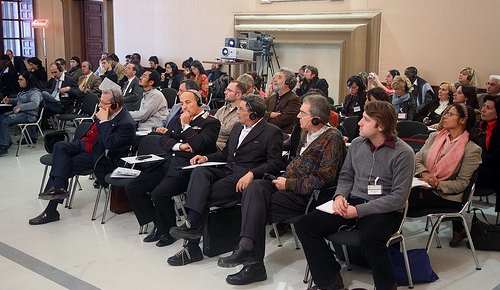
During this week, I have been attending the V Greenaccord International Media Forum on the Protection of Nature, held from 7 to 11 Novmeber 2007 at the historic Villa Mondragone in Frascati, some 20km south east of Rome.

It has been a time to meet old friends again and to make new ones. I have been part four of the five Greenaccord media forums since the first one was held in Rapolane Terme, in the Tuscany valley in northern Italy in 2002.

Greenaccord is the only regular (annual) meeting that I know of where practising journalists and media gatekeepers come together from all regions of the world to discuss the state of the planet and state of their profession.

Each year, we have some ‘regulars’ returning while new participants join the growing network. As some old hands noted this week, it is evolving into an extended family.

That family consists mainly of print and broadcast media journalists from Africa, Asia, Europe, Latin America and the Caribbean. Many are engaged in ‘deadline journalism’ of news and current affairs, while a few of us, like myself, have moved on to more reflective and analytical kind of journalism. We also have a few researchers, activists and public information officers among us, enriching our discussions with a diversity of perspectives.

To engage this group of participants over three and a half days, Greenaccord invites a dozen or so scientific or industry experts from different regions of the world and different disciplines. This year’s theme, ‘Capitalising on the Environment’, was explored by business leaders, fair trade activists, economists and a number of technical experts specialising in fields such as clean energy, clean technology and organic farming.

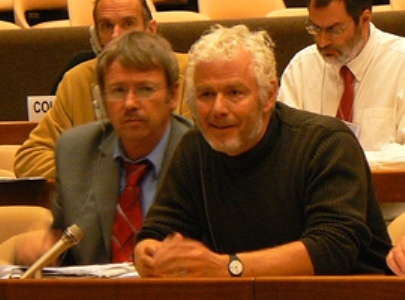
greenaccord-v-forum-in-progress-nov-2007.jpg

As with all meetings, some speakers were far more interesting than others. And some sessions were blessed with competent chairpersons who kept overenthusiastic speakers in check and allowed meaningful discussion and debate to happen.

Sitting through such meetings is a bit like gem mining. One has to sift through a lot of gravel to find a rare precious gem. When that happens, it’s well worth the hassle.

Well, I’ve had my share of gravel moments (zzzzzzzzzzzzzzzzz!) and precious moments (Eureka!) this week. I’ll write separate blog posts on some of the latter. They are indeed worth sharing.

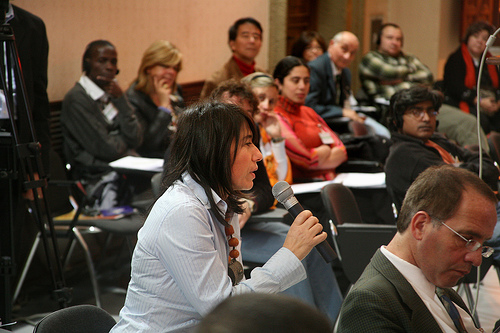
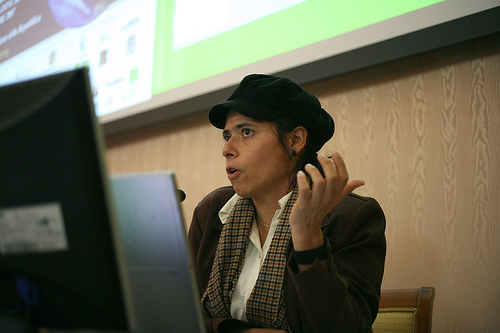
The real stars (or gems if you like) in this whole exercise are the participants themselves. We come from such diverse backgrounds – the sessions are supported by simultaneous interpretation in English, Spanish and Italian, with an occasional remark in French – that we enrich each other by simply being there.

emanuela-gasbarroni-from-tve-med-intervenes.jpg

Some of us can barely contain our passion for what we do, and keep making comments or asking questions at every available opportunity. Others are more quiet during sessions but expressive during the many hours of networking and socialising over fine Italian wine, coffee and gastronomical treats. All these are part of Greenaccord’s cultural diversity that we contribute to, and then celebrate.

Even if we don’t take ourselves too seriously, we do discuss sobering issues. On the one hand, the planet is in peril, largely thanks to human bungling over generations. On the other, mass media itself is in crisis in many countries — under siege from oppressive governments, grappling with limitations of money and skills, and facing competition from new media platforms grabbing audiences and revenue.

For example, a colleague from Cameroon found the government closing down his privately owned FM radio station just a couple of days before he left for Rome. Others had worrying tales to share about official censorship, physical violence unleashed on media organisations and journalists, and the tension between media owners’ interests and the public interest.

We expressed solidarity and support for all Greenaccord colleagues currently experiencing difficulties of various kinds. The spirit of camaraderie in this network is strong – and keeps growing.

So is all this networking and meeting hopping a distraction from real work, which each one of us have to perform at our desks, or in our studios, on an individual basis? I don’t think so. Far from being a drag on my time, I find gatherings like Greenaccord inspiring and energising. They also remind me that I’m not alone in the daily struggle and drudgery of deadlines, government bureaucracies, funding crises and a never-ending race to keep up with new media technologies.

A planet in peril and a media in crisis need more platforms like this to connect and support many more of our kind who weren’t in Rome this week. Greenaccord isn’t perfect (we’re working on it), but it has lit more than a few candles against the looming darkness.

– Nalaka Gunawardene, Frascati, Rome: 10 November 2007

zilia-castrillon-speaking-at-greenaccord-v-nov-2007.jpg


Meeting photos courtesy Adrian Gilardoni’s Flickr account

New media anarchy is good for you!

neha-viswanathan.jpg

“You people are too well mannered! I’ve never been to a conference where people are so properly dressed and so polite to each other!”

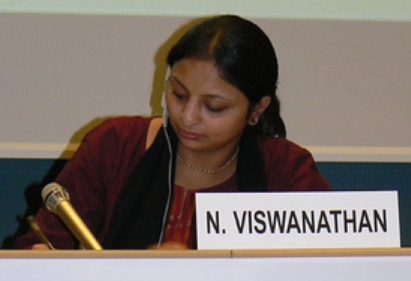
With these words, Neha Viswanathan made sure she had everyone’s attention. But it was not just a gimmick — she was contrasting the relatively more orderly, organised world of mainstream media (MSM) with the decidedly more anarchic world of new media — including blogs, wikis, YouTube and Second Life.

Neha, South Asia Editor of Global Voices, was speaking on a panel on ‘new media’ during the Global Symposium+5 on ‘Information for Humanitarian Action’ in Geneva this week (22 – 26 Oct 2007).

The panel topic itself showed the rapid change taking place in the humanitarian sector. As the panel premise said: “Within minutes of a disaster or conflict, the first images are seen on YouTube rather than CNN, and probably to a larger audience. YouTube, Flickr and blogging are bringing wars, disasters and their humanitarian consequences to the attention of the public, government and aid agencies more efficiently than ever. It’s now possible to keep watch on a Darfur village through satellite imagery, or take a virtual tour of a refugee camp.”

The panel was to discuss whether citizen journalism and new collaborative/ networking technologies are improving humanitarian response, and review how the humanitarian community is faring in this new environment.

My own views on this are found in another blog post: New media tsunami hits humanitarian sector – rescue operations now on!

Neha’s take was slightly different. She started reminding everyone that the new media activists were unruly and not always polite. The blogosphere is very much a contested and contentious space where arguments rage on. Not everything is moderate, balanced or ‘evidence-based’ (to use a new favourite phrase of the humanitarian community).

But in times of crisis or emergency – whether disasters or war – new media activists are increasingly the first responders. The anarchic nature actually provides them with an advantage: they are distributed, self-organising and motivated. There is no central newsroom or coordination point telling them what to do. In typical Nike style, they just do it.

As an example, she described World Wide Help, whose introduction reads: “Using the web to point help in the direction where it’s most needed”.

This blog was started by several founders and members of the SEA EAT (South East Asian Earthquake And Tsunami) blog, wiki and database, all of which gained worldwide attention at the time of the Indian Ocean earthquake and tsunami on 26 December 2004. The group, now calling themselves The World Wide Help Group, has since remobilised to aid in other relief efforts.

Read the whole story of the SEA EAT Blog: A Candle in My Window by Peter Griffin, one of its co-founders

As Sir Arthur C Clarke has also noted, the 2004 tsunami marked a turning point in how citizen journalists and other new media activists respond to emergencies. Since then, the power of new media has been unleashed on many public interest issues and humanitarian causes. As an example, Neha cited the online campaign against street sexual harassment in India.

In Neha’s view, new media can collate authentic testimonials of those directly affected by disasters or other crises, and keep the public attention (and thereby, political interest) on emergencies beyond the first few days.

Her advice to humanitarian aid agencies: keep looking at the new media, especially blogs, to find out what people at ground zero are saying about relief and recovery work.

“Bloggers are not objective – they talk openly, and express themselves freely,” she told the largely prim and proper Geneva audience, where some participants had referred to the meeting as ‘this august gathering’!

Finally, in situations where MSM (the formerly big media!) are shut down, restrained or intimidated into not carrying out their watchdog role, it’s the new media that fills the voice. Neha described the pro-democracy struggles in Nepal in 2005 – 2006 as an example where the people power struggles continued to be reported and commented on after the autocratic king clamped down on all print and broadcast media.

Read my August 2007 blog post: The Road from Citizen Kane to Citizen Journalist

‘Embedded’ or aloof: Media’s choice in covering emergencies

banner.jpg

In many disaster and conflict hot spots of the world, journalists and relief aid providers work closely together. There are times when journalists play good Samaritan and aid workers dabble as reporters. In the difficult field conditions of emergencies, this is understood and accepted.

But should journalists become ’embedded’ in humanitarian operations? If so, how impartial or independent would their coverage be?

This issue kept coming up during the Global Symposium+5 on ‘Information for Humanitarian Action’ in Geneva this week (22 – 26 Oct 2007). The majority aid officials and handful of journalists present didn’t always agree.

UN agencies and other humanitarian organisations increasingly recognise the power of media, especially broadcast television, to raise public awareness on emergencies. This, in turn, influences political commitments, aid donations and relief operations themselves.

But how close can the media get to aid agencies before they lose their sense of perspective and independent analysis? If journalists becoming embedded with the military in conflicts is frowned upon, what about media’s de facto embedding with humanitarian missions?

There was no consensus on the issue, but a few of us stressed on the need for independent media — independent of governments, aid agencies and other vested interests — to take stock of crisis situations and report, reflect and analyse on what they find.

The presence of nosy reporters might be an occasional irritant to some aid agencies, especially if they have things to hush up, but at the big picture level it can serve everyone’s interest — especially those of affected groups.

Alain Modoux, a former red cross official who went on to become an assistant director general of UNESCO, reminded us how governments often stand in the way of free flow of information on emergency situations. The reasons for such suppression vary: some don’t want to admit failures on their watch, and others fear public discussion and debate, especially at international level, on what is happening in their own country.

Governments can — and often do — bring pressure upon aid agencies to fall in line (or risk being thrown out). In such situations, it’s only the independent media that can take stock of rapidly changing situations and highlight the unmet needs and any disparities in the emergency response.

Then there is the media’s traditional watchdog role. The humanitarian sector is now the world’s largest unregulated industry – billions of dollars flow through the sector every year, most of it public funds (direct donations or taxes collected by governments). Yes, the aid agencies all audit their accounts and the UN has stringent regulations on how they can spend money. But there’s nothing like a bit of media scrutiny to keep everybody clean and honest…

Follow the money! This is what journalists are taught and trained to do – and with good reason. In emergency situations following the money often brings up instances of waste, corruption and mismanagement that aid agencies would rather not talk about.

edward-giradet.jpg

Swiss journalist Edward Girardet (photo, above), who specialises in in media, humanitarian aid and conflict issues, has been making this point for a long time.

As he has written: “Humanitarianism should not ‘belong’ to any one group. What the international aid industry urgently needs is more hard-nosed and independent reporting.”

That is unlikely to happen when individual journalists are too cosy with aid workers or their bosses.

Ed was at the Geneva Symposium this week, once again making a case for a viable media watchdog capable of reporting the real causes behind humanitarian predicaments, including how the international community responds.

Read my June 2007 blog post quoting Ed Girardet: Can the media tame the alms bazaar?

In one intervention, I suggested that the media can become the ‘conscience’ of the humanitarian industry – to ensure transparency and accountability of resources, decisions and conduct.

Partnerships between media and aid workers is fine, as long as the media remain somewhat aloof and detached.

And it’s not the global media who can or will stay with the stories as recovery takes months or years. We all saw in the aftermath of the Indian Ocean Tsunami how quickly the global media’s news interest went down.

In the long term, empowering the local journalists to ask the right questions and go in search of answers.

Read this blog post reproduced in Asia Media Forum


Read this blog post adapted in MediaHelpingMedia

A million video cameras to change the world!

Something remarkable is happening with online public video sharing platforms: progressive non-profit groups worldwide are seizing their power to do good.

YouTube started off more like the people’s version of funniest home videos. But it’s no longer confined to that category. Activist and social groups are increasingly uploading their videos. As broadband Internet rolls out around the world, more people are actually able to watch these videos online.

In response, YouTube, owned by search giant Google, is creating a special section for nonprofits to air their videos and link them to its Google Checkout online payment system to receive funds directly.

“Nonprofits understand that online video isn’t just a way to broadcast public service announcements on a shrunken TV set,” Reuters quoted Steve Grove, head of news and politics at YouTube, as saying. “It’s a way to get people to do more than just absorb your message but to engage with their user generated content as well.”

Pure Digital, maker of the Flip video camera, has said it plans to give away a million video cameras to non-profit organizations around the world to capture images and moments in places traditional media outlets might not be able to reach.

“Video has power and media has power but the challenge is that the media is limited to telling stories that are controlled by a very small number of people,” Jonathan Kaplan, chief executive of Pure Digital, told Reuters. “This program along with YouTube and other sites will expand the media universe for learning what’s really going on in the world,” he said.

Visit FlipVideo website on support for non-profit groups

Reuters quotes the recent example of the impact of clips of the Myanmar army’s confrontations with local protesters which were posted on YouTube and other Web sites. Some of the clips made their way to mainstream news media, which were blocked out of entering or covering events in Burma.

See an example of a YouTube video on what’s happening in Burma:

Our friends at Witness, an activist group founded by the musician Peter Gabriel in 1992, has long specialised in raising awareness of such previously unseen events through video. Sam Gregory, programme director at Witness, says online distribution has made it easier to put videos in front of the right people such as decision makers and others with a personal connection to the cause.

“It’s not necessarily about the size of the audience it’s about placing targeted video and turning ‘watching’ into action,” said Gregory.

Read the Reuters story on 19 Oct 2007: Nonprofits turn to YouTube to raise awareness, funds

My blog post on 1 Oct 2007: Shoot on sight: Rights Alert on Burma

My blog post on 30 Sep 2007: Kenji Nagai: Filming to the last moment

TVE Asia Pacific News story March 2007: TVEAP films now on YouTube

What’s happening with online video has a parallel in how activist groups seized the potential of the hand-held video camera. The handicam was invented in 1985 by Sony. Intended originally for entertainment and domestic documentation purposes only (ranging from family vacations and weddings), it did not take long to find new uses for this revolutionary technology.

The Handicam Revolution in media began when a video camera captured police beating Rodney King on a Los Angeles highway. The shocking amateur footage was broadcast on TV around the world. The acquittal of the police officers after their first trial sparked outrage, and riots erupted in a 20 block section of Los Angeles, leaving 54 people dead and over 2,000 injured.

Ever since Rodney King, broadcasters have been using amateur video to provide images of events that their own camera people have not captured. And human rights activists have started relying on the power of video images to capture the attention of the broadcasters to expose acts of human rights abuse and violation.

Katie Couric: Faithfully her Master’s voice?

This is an interesting video, uploaded last month on to YouTube by media activists.

In September 2007, Katie Couric, anchorwoman of CBS Evening News reported live from Baghdad. But instead of using that opportunity to ask tough questions and dig for the truth, Couric asked soft questions and repeated a number of false Bush talking points.

As activists point out, the media’s failure to ask tough questions helped America get embroiled in Iraq in the first place.

It’s hard to believe that Couric currently occupies the slot that was long adorned by the likes of Walter Cronkite, anchorman for The CBS Evening News for 19 years (1962 – 1981). During the heyday of CBS News in the 1970s and 1980s, he was often cited in viewer opinion polls as “the most trusted man in America”, because of his professional experience and avuncular demeanor.

From Wikipedia

Media watchers cannot help comparing how Cronkite covered an earlier, equally controversial conflict that left America bruised and bleeding: the Vietnam War. Following Cronkite’s editorial report during the Tet Offensive that the Vietnam War was unwinnable, President Lyndon Johnson is reported to have said, “If I’ve lost Walter Cronkite, I’ve lost Middle America.”

How times have changed. Couric is the media lap-dog that every government and military would wish to have — her recent reportage from Iraq would probably be held up by some of them as ‘an example to every journalist covering a war’.

Incidentally, Cronkite provides the voiceover introduction to Couric’s CBS Evening News, which began on 5 September 2006.

And that’s the way it is.

YouTube video courtesy Moveon.org – Democracy in Action

Sputnik + 50: The beep that shook the world…

The Space Age was ushered in by the launch of a 83.6km metallic ball, named Sputnik 1, on 4 October 1957. When it happened exactly half a century ago, the course of history was changed forever.

‘Sputnik’ is Russian for travelling companion or satellite.

Here’s how a newsreel of Universal International News, screened at cinemas across the US, reported the development:

As one comment, posted by fromthesidelines said on YouTube:
This was one of the last weekly newsreels seen in movie theaters across the country (thanks to television)- this excerpt, from October of ’57, shows how much of an impact Russia’s “Sputnik” had on space and world affairs. Note that animated “simulations” were used, as Universal did NOT have access to any of the actual footage of “Sputnik” itself!

Sir Arthur C Clarke, author and inventor of the communications satellite, has just recalled personal memories of that momentous day in an interview with IEEE Spectrum:

“Although I had been writing and speaking about space travel for years, I still have vivid memories of exactly when I heard the news. I was in Barcelona for the 8th International Astronautical Congress. We had already retired to our hotel rooms after a busy day of presentations by the time the news broke. I was awakened by reporters seeking an authoritative comment on the Soviet achievement. Our theories and speculations had suddenly become reality!

“For the next few days, the Barcelona Congress became the scene of much animated discussion about what the United States could do to regain some of its scientific prestige. While manned spaceflight and Moon landings were widely speculated about, many still harboured doubts about an American lead in space. One delegate, noticing that there were 23 American and five Soviet papers at the Congress, remarked that while the Americans talked a lot about spaceflight, the Russians just went ahead and did it!”

And here is how Arthur C Clarke sums up the accomplishments of the first 50 years of space exploration:
On the whole, I think we have had remarkable accomplishments during the first 50 years of the Space Age. Some of us might have preferred things to happen in a different style or time frame, but when our dreams and aspirations are adjusted for reality, there is much we can look back on with satisfaction. (For example, in 1959 I took a bet that men would be landing on the Moon by June 1969, and lost only very narrowly.) And in the heady days of Apollo, we seemed to be on the verge of exploring the planets through manned missions. I could be forgiven for failing to anticipate all the distractions of the 1970s that wrecked our optimistic projections — though I did caution that the Solar System could be lost in the paddy fields of Vietnam. (It almost was.)”

Read the full Arthur C Clarke interview by Saswato R. Das in IEEE Spectrum

Read all of IEEE Spectrum’s coverage about Sputnik + 50

Wanted: Fair Trade in Film and Television!

This short film, Fair Trade: The Story (8 mins) has been produced by Eq.tv (Equilibrium Television).

It’s very well made, with great use of images and sound, and powerfully sums up the complex issues around fair trade in an accessible manner. The best part: we don’t feel it’s an activist film, even though fair trade is, by definition, progressive and activist.

What is your power as a consumer? The film, produced in association with TransFair USA and TinCan Productions, begins with this question.

It then tells us: “Fair Trade combines stringent environmental criteria with the highest income and labour standards of any product certification. Fair Trade ensures a fair price for farmers, fair wages for workers, safe working conditions, direct marketing access, community development, democratic decision making, sustainable farming methods, environmental protection.”

Chris White of TransFair USA quips: “Fair trade isn’t a product. Fair trade isn’t a brand. Fair trade is a story.”

Fair trade is all about creating opportunities for small scale producers in the developing countries to get organised and supply directly to consumers in different parts of the world. When they sell direct, with few or no intermediaries, they can earn three or four times more, and that money will enhance their incomes, living standards and societies.

Read more about fair trade at Oxfam website, Make Trade Fair

Fair trade is certainly a cherished ideal, but it’s mired in complex economic and political realities. The globalised march of capital, profit-maximising multinational corporations and developed country farm subsidies are three among many factors that made fair trade difficult to achieve in the real world.

Difficult, but not impossible. Determined producers and consumers have shown over the years that they can connect to each other, ensuring greater fairness and justice in transaction. That’s the power of the consumer.

Now here’s another kind of fair trade that I have been advocating for a long time: Fair Trade in Film and Television (FTinFT for short). It’s high time we started promoting this as another plank in fair trade activism.

Let me explain. In the media-rich, information societies that we are now evolving into, media and cultural products are an important part of our consumption — and therefore, more of these have to be produced. In the globalised world, more television and film content is being sourced from the majority world — or is being outsourced to some developing countries where the artistic and technical skills have reached global standards.

But in a majority of these media production deals, the developing country film and TV professionals don’t enjoy any fair terms of trade or engagement. Their creativity and toil are being exploited by those who control the global flow of entertainment, news and information products.

This is why the top talent in the global South become assistants, helpers and ‘fixers’ to producers or directors parachuting in to our countries to cover our own stories for the Global Village. Equitable payments and due credits are hardly ever given.

I personally know many award winning film-makers in developing countries across the Asia Pacific who have been engaged on such unfair, uneven terms. Lacking sufficient market opportunities and trade unions in their own countries, these professionals have little choice but accept the occasional assignment that comes their way from BBC, CNN, AJI or other global players.

Remember, film-makers have families to feed too.

Unfair trade in film and TV is also how the unsung, unknown creative geniuses contribute significantly to the development of new cartoon animation movies or TV series, as well as hip video games that enthrall the global market. Lacking the clout and skill to negotiate better terms, freelancers and small companies across the global South remain the little elves who toil through the night to produce miracles. They work for tiny margins and even tinier credit lines. Some don’t get acknowledged at all.

If you think this is inevitable in the big bad world of profit-making business, hear this. I also know some western charities that champion global justice who are equally guilty of repeatedly exploiting southern film-makers — sometimes, ironically, to produce documentaries about social justice issues!

Even as they cover stories about fair trade practices in coffee or cotton, these entities practise unfair trade in their own industry.

I can cite many examples. Last year, the London-based Panos Institute approached me for recommendations for development-sensitive film-makers in two Asian countries where they wanted to implement some training programmes. I asked if the professionals I can gladly recommend – whose skills are on par with any western counterpart – would be paid international rates. Panos backed out saying they can only pay a local rate, which they felt was good enough.

Then there are UN agencies who always haggle with local film-makers over rates and fees. The same agencies that happily commission PR media agencies from Madison Avenue for hundreds of thousands of US Dollars would ask southern film-makers to donate their time, or work at a reduced fee, for the United Nations causes!

Local rates for local talent is simply not good enough if their work contributes to an international media effort. Southern film-makers and photographers, who lack opportunities to roam the planet looking for stories and work, should be engaged on fair, international rates in any media venture whose products will be consumed globally.

I’m proud to say that TVE Asia Pacific practises what I preach here. We are small time commissioners of southern film-making talent, but we always pay international rates, and engage local talent in every country we work in. And they get due, proper credit in all our productions.

This, then, is the essence of Fair Trade in Film and Television that we must advocate and agitate for. As long as the story tellers of the global struggles for social justice are themselves excluded from the story, there can be no fair trade, or true global justice.

There is now an urgency to address FTinFT because Media Process Outsourcing (MPO) is emerging as a growth industry. May 2007 news: India’s InfoSys and TV18 set up MPO firm.

Let me return to the question frequently posed by fair trade activists: What is your power as a consumer?

Now ask that question as a consumer of media products on TV, video, DVD, web and mobile devices. Don’t take anything for granted. Don’t accept the lofty PR claims of big time (or even small time) producers and peddlers of media content on how ethically they have sourced or made this content.

For a start, look carefully at where stories have been made, and whether local film and TV professionals get proper, on-screen credit. And write to the big players – 24/7 news channels, cartoon corporations and others – demanding to know their fair trade policies and practices in content creation and sourcing.

Make the same demands on the United Nations agencies peddling media products on their social causes. See how many of them will stand a simple test: do they engage southern film-makers to tell stories of development and social justice in the South? If not, why not?

And if you are in a position to decide on commissioning a new film, TV or video product, please consider engaging local talent — but pay them international rates if your product is going to cross borders (these days it very likely will).

We have a long way to go to achieve Fair Trade in Film and Television. Let’s get moving!

Read my call for ethical sourcing of international TV news

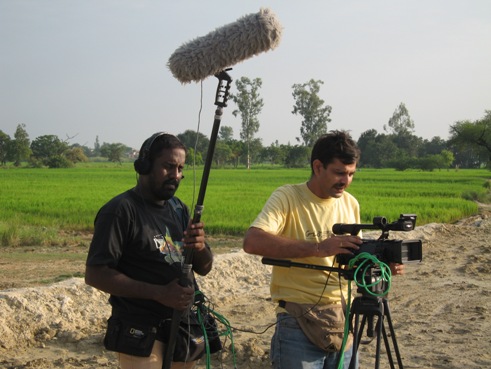
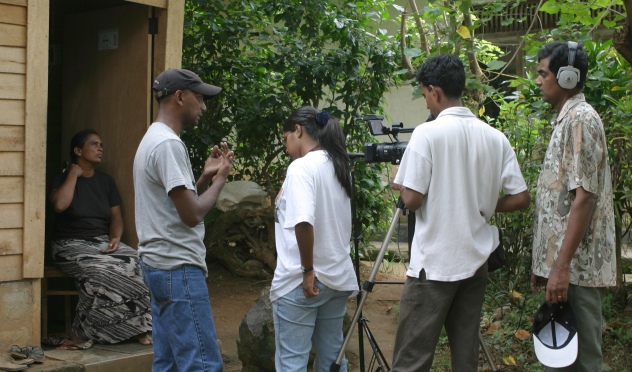
Photos from TVE Asia Pacific image archives

War Made Easy: Exposing the Spin Doctors of Death

As we mark the sixth anniversary of 9/11 terrorist attack on the World Trade Center in New York, attention is focused more and more on the role the media played in the days and months that followed.

The war in Iraq was justified as a retaliation against 9/11. The Pentagon marched on to the cheer-leading of American media, which barely asked the basic questions, let along challenge the military-political logic.

A new documentary probes how this shameless acquiescence took place in full public glare. WAR MADE EASY: How Presidents & Pundits Keep Spinning Us to Death, narrated by Sean Penn, features Normon Solomon, on whose 2005 book the film is largely based.

Here’s the trailer for the film:

And its synopsis:

War Made Easy reaches into the Orwellian memory hole to expose a 50-year pattern of government deception and media spin that has dragged the United States into one war after another from Vietnam to Iraq. Narrated by actor and activist Sean Penn, the film exhumes remarkable archival footage of official distortion and exaggeration from LBJ to George W. Bush, revealing in stunning detail how the American news media have uncritically disseminated the pro-war messages of successive presidential administrations.

War Made Easy gives special attention to parallels between the Vietnam war and the war in Iraq. Guided by media critic Norman Solomon’s meticulous research and tough-minded analysis, the film presents disturbing examples of propaganda and media complicity from the present alongside rare footage of political leaders and leading journalists from the past, including Lyndon Johnson, Richard Nixon, Defense Secretary Robert McNamara, dissident Senator Wayne Morse, and news correspondents Walter Cronkite and Morley Safer.

Norman Solomon’s work has been praised by the Los Angeles Times as “brutally persuasive” and essential “for those who would like greater context with their bitter morning coffee.” This film now offers a chance to see that context on the screen.

Approx. 72 minutes
English subtitles
Directed & Written by: Loretta Alper & Jeremy Earp
Produced by: Loretta Alper
Co-produced & Edited by: Andrew Killoy
Executive Producers: Jeremy Earp & Sut Jhally
Associate Producer: Jason Young
Sound: Peter Acker, Armadillo Media Group
Motion Graphics: Andrew Killoy & Sweet & Fizzy
Additional Music: John Van Eps & Leigh Philips
Narrated by: Sean Penn
Based on the book by Norman Solomon

Image courtesy War Made Easy website

I haven’t yet seen this film, but it’s certainly one I want to catch soon. Not the least because I live and work in a war-ravaged country – Sri Lanka – where the politicians and generals have engaged in their own (increasingly sophisticated) acts of spin doctoring. Most alarmingly, large sections of the Sri Lankan media find absolutely nothing wrong to play along, all in the name of patriotism….

Sounds familiar?

Read the full transcript of War Made Easy

“Can you help us to film a child’s leg being broken?”

“Can you help us to film a child’s leg being broken?”

This question, posed by a visiting Canadian TV crew in the 1970s, startled my good friend Darryl D’Monte, one of the most senior journalists in India and former editor of the Times of India.

Darryl was having a chat with the crew, giving them some insights on the extent of poverty in his home city of Bombay, since renamed as Mumbai. It is routine for visiting journalists to have such chats with their local counterparts to get context and advice.

It was when the conversation turned to beggars, that this western TV crew asked if they could film the intentional breaking of a poor child’s leg — a brutal practice that was believed to exist so that maimed children could be employed as beggars. A disabled child would evoke more sympathy, and consequently, more alms.

darryl-dmonte-speaking-at-ifej-2005-congress.jpg

The articulate Darryl must have expressed his exasperation in strong terms. But even he couldn’t have anticipated the response.

“It’s going to happen anyway,” was how the film crew rationalised their bizarre request.

So why not be there, capture it on film, and get a great story out of it — which can be packaged as the brutal side of India’s poverty! This must have been the crew’s line of reasoning. Maybe their editors had exerted pressure to come back with something out of the ordinary.

I quoted this incident in my essay, Ethical newsgathering challenge for Al Jazeera International, published in November 2006. It was a plea for the newest entrant to international TV newsgathering to play by a different, and more ethical, set of rules.

These and worse practices are certainly not confined to India, or to TV crews originating from any single country. And sadly, these have not been abandoned after the 1970s. In fact, the emergence of 24/7 satellite news channels since the 1980s has inspired much more competition in the TV newsgathering industry, creating an alarming race to the bottom.

Such journalists’ only operating guideline seems to be: get the story, no matter what — or who gets hurt in that process.

In filming wildlife documentaries, film-makers sometimes have to make a choice: do they interfere in the processes of Nature, such as a predator setting on a hapless prey? There is an unwritten rule that things must be allowed to happen, with humans only capturing actuality on film.

But when it comes to filming wild life of our species in our cities and villages, the ethical dilemmas are not so easily resolved. This is why all journalists and film-makers, especially those in newsgathering, need a strong ethical framework for their work.

Journalists represent the public’s right to know, which is extremely important. Media coverage and exposes can trigger much needed aid, reform or public outcry on certain issues. But that is not a justification for getting the story by any means.

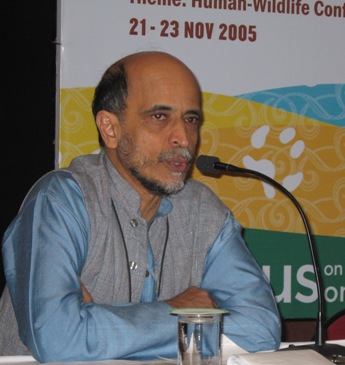
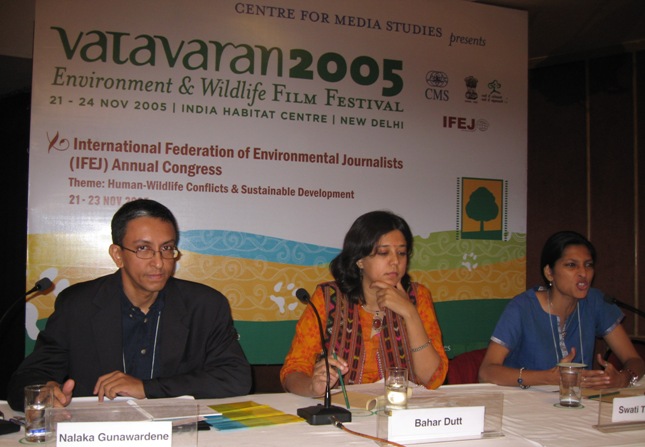
Darryl D’Monte shared the above story at panel discussion on ‘Does TV do a better job on environmental reporting?’ which I chaired during the annual congress of the International Federation of Environmental Journalists (IFEJ), held in New Delhi, India, in November 2005. That year it was part of the Vatavaran 2005, the national environmental film festival of India.

panel-discussion-at-ifej-2005-congress-new-delhi.jpg

I was reminded of this story because the 4th CMS Vatavaran film festival is round the corner: it will be in New Delhi from 12 to 16 September 2007. I won’t be there in person; my colleague Manori Wijesekera is representing TVEAP this time.

TVE Asia Pacific News: Environmental film-makers call for ethical framework

Read official report of IFEJ Congress in 2005

Related blog posts:

Al Jazeera: Looking hard for the promised difference

Wanted: Ethical sourcing of international TV news

Cheque-book Development: Paying public media to deliver development agency logos