‘Avatar’ unfolds in the Amazon: Find out the Real Price of Oil!

This is no Avatar: It's Real!
A few days ago, reviewing the blockbuster movie Avatar, I wrote: “Film critics and social commentators around the world have noticed the many layers of allegory in the film. Interestingly, depending on where you come from, the movie’s underlying ‘message’ can be different: anti-war, pro-environment, anti-Big Oil, anti-mining, pro-indigenous people, and finally, anti-colonial or anti-American. Or All of the Above…”

Indeed, an Avatar-like struggle is unfolding in the Amazon forest right now. The online campaigning group Avaaz have called it a ‘Chernobyl in the Amazon’. According to them: “Oil giant Chevron is facing defeat in a lawsuit by the people of the Ecuadorian Amazon, seeking redress for its dumping billions of gallons of poisonous waste in the rainforest.”

From 1964 to 1990, Avaaz claims, Chevron-owned Texaco deliberately dumped billions of gallons of toxic waste from their oil fields in Ecuador’s Amazon — then pulled out without properly cleaning up the pollution they caused.
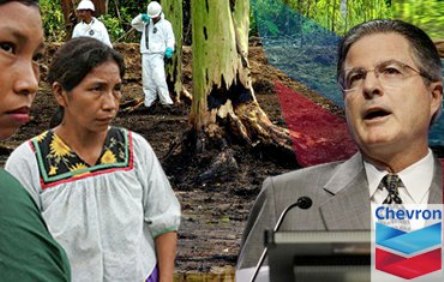
In their call to action, they go on to say: “But the oil multinational has launched a last-ditch, dirty lobbying effort to derail the people’s case for holding polluters to account. Chevron’s new chief executive John Watson knows his brand is under fire – let’s turn up the global heat.”

Avaaz have an online petition urging Chevron to clean up their toxic legacy, which is to be delivered directly to the company´s headquarters, their shareholders and the US media. I have just signed it.

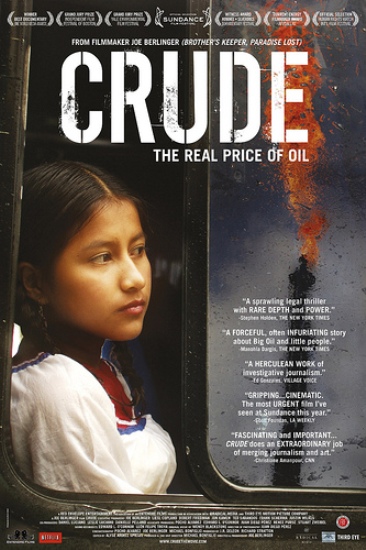
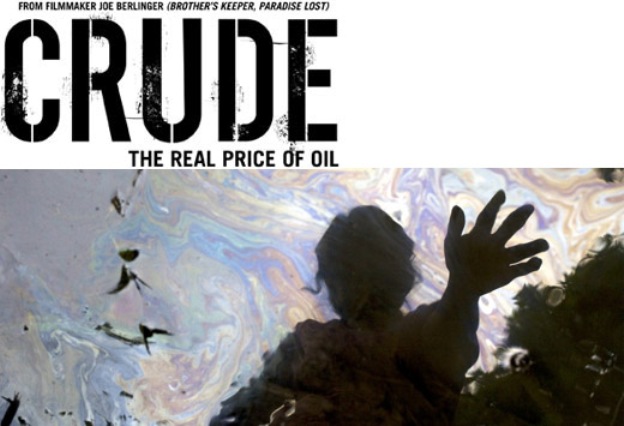
Others have been highlighting this real life struggle for many months. Chief among them is the documentary CRUDE: The Real Price of Oil, made by Joe Berlinger.

The award-winning film, which had its World Premiere at the 2009 Sundance Film Festival, chronicles the epic battle to hold oil giant Chevron (formerly Texaco) accountable for its systematic contamination of the Ecuadorian Amazon – an environmental tragedy that experts call “the Rainforest Chernobyl.”

Here’s the official blurb: Three years in the making, this cinéma-vérité feature from acclaimed filmmaker Joe Berlinger is the epic story of one of the largest and most controversial legal cases on the planet. An inside look at the infamous $27 billion Amazon Chernobyl case, CRUDE is a real-life high stakes legal drama set against a backdrop of the environmental movement, global politics, celebrity activism, human rights advocacy, the media, multinational corporate power, and rapidly-disappearing indigenous cultures. Presenting a complex situation from multiple viewpoints, the film subverts the conventions of advocacy filmmaking as it examines a complicated situation from all angles while bringing an important story of environmental peril and human suffering into focus.

Watch the official trailer of Crude: The Real Price of Oil

According to Amazon Watch website: “With key support from Amazon Watch and our Clean Up Ecuador campaign, people are coming together to promote (and see) this incredible film, and then provide ways for viewers to support the struggle highlighted so powerfully by the film.”

They go on to say: “A victory for the Ecuadorian plaintiffs in the lawsuit will send shock waves through corporate boardrooms around the world, invigorating communities fighting against injustice by oil companies. The success of our campaign can change how the oil industry operates by sending a clear signal that they will be held financially liable for their abuses.”

While Avatar‘s story unfolds in imaginary planet Pandora — conjured up by James Cameron’s imagination and created, to a large part, with astonishing special effects, the story of Crude is every bit real and right here on Earth. If one tenth of those who go to see Avatar end up also watching Crude, that should build up much awareness on the equally brutal and reckless conduct of Big Oil companies.
Civilisation's ultimate addiction?

Others have been making the same point. One of them is Erik Assadourian, a Senior Researcher at Worldwatch Institute, whom I met at the Greenaccord Forum in Viterbo, Italy, in November 2009.

He recently blogged: “The Ecuadorians aren’t 10-feet tall or blue, and cannot literally connect with the spirit of the Earth (Pachamama as Ecuadorians call this or Eywa as the Na’vi call the spirit that stems from their planet’s life) but they are as utterly dependent—both culturally and physically—on the forest ecosystem in which they live and are just as exploited by those that see the forest as only being valuable as a container for the resources stored beneath it.”

Erik continues: “Both movies were fantastic reminders of human short-sightedness, one as an epic myth in which one of the invading warriors awakens to his power, becomes champion of the exploited tribe and saves the planet from the oppressors; the other as a less exciting but highly detailed chronicle of the reality of modern battles—organizers, lawyers, and celebrities today have become the warriors, shamans, and chieftains of earlier times.”
Invictus: Clint Eastwood and Morgan Freeman serve more Mandela magic

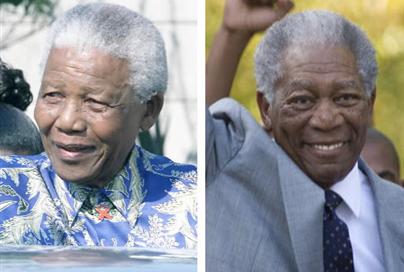
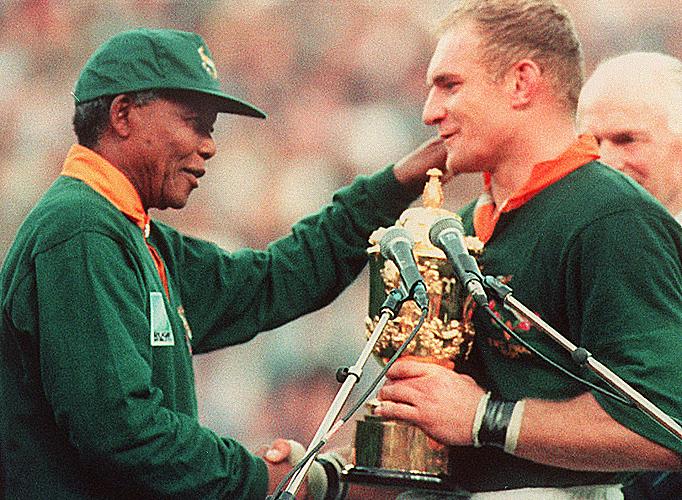
Nelson Mandela hands the World Cup to Francois Pienaar in 1995 (Photo courtesy The Sun, UK)

Updated: 6 Dec 2013 Nelson Rolihlahla Mandela (1918 – 2013): Thank You and Goodbye!

If a run-away genie granted me a wish to clone any single living human being, I’ll have no hesitation with my choice: Nelson Mandela — undoubtedly the greatest living statesman on the planet.

One might argue that Mandelas are not born; they are made. A combination of personality and historical circumstances create the rare phenomena like him.

In July 2008, when Mandela turned 90, I quoted the American film-maker, social activist and blogger Danny Schechter — who filmed Mandela’s struggle to end apartheid and restore democracy in South Africa — as saying: He (Mandela) is one of those leaders who not only helped free his own country and people but became an icon and symbol for freedom in the world. At a time when darkness seems to be descending again, with the economy on the edge amidst protracted wars and pervasive abuses of powers, he is the one person that people the world over look to as a symbol of that saying that ‘another world is possible.’ He is not perfect – who is? He has taken great risks, and made his share of mistakes, but the love and adoration he inspires speaks to how special he is – even as he sees himself as part of a collective, a movement…

The Mandela story has been told many times by many film-makers, writers and journalists. Few other leaders have engaged the popular culture and media’s attention — while both in and out of office — as Mandela has, and with good reason.

One poem + two men = Rainbow Nation

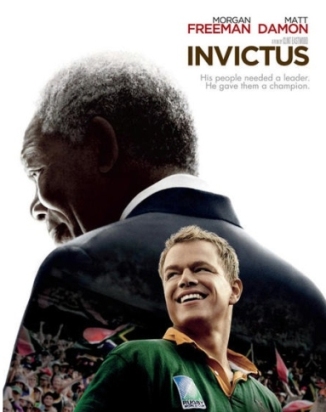
The latest film inspired by Mandela is Invictus directed by Clint Eastwood, starring Morgan Freeman and Matt Damon. Both actors have just been nominated for Oscar awards – for best actor and best supporting actor respectively. But the film’s exclusion from the 10 nominees for best picture has surprised and disappointed some.

Invictus reconstructs the events in the life of Nelson Mandela at a crucial time for himself and country: after the fall of apartheid in South Africa, during his term as the rainbow nation’s first black president. The film revolves around how he campaigned to host the 1995 Rugby World Cup event as an opportunity to unite his rainbow nation. (South Africa’s team eventually won the championship.)

Here’s the plot summary from IMDB:
The film tells the inspiring true story of how Nelson Mandela joined forces with the captain of South Africa’s rugby team to help unite their country. Newly elected President Mandela knows his nation remains racially and economically divided in the wake of apartheid. Believing he can bring his people together through the universal language of sport, Mandela rallies South Africa’s rugby team as they make their historic run to the 1995 Rugby World Cup Championship match.

Read Wikipedia’s plot summary

Watch official trailer of Invictus the movie:

The film’s title comes from the fact that Mandela had the poem Invictus, by English poet William Ernest Henley, written on a scrap of paper on his prison cell while he was incarcerated. The story is based on the John Carlin book Playing the Enemy: Nelson Mandela and the Game That Changed a Nation.

A legend plays another legend

I can’t wait to see Invictus, for it has one of my favourite actors playing one of my greatest heroes. Morgan Freeman is such a versatile and accomplished actor. Having played the US President and God in past movies, this is clearly cut out for him.

As Clint Eastwood explains: “As an actor, Morgan has the same presence when he walks in the room that Mandela has as a politician. Morgan has a certain bearing and charisma. He was built to play this role.”

The Guardian (UK) preview noted: “So convinced by Freeman’s performance was Mandela’s personal assistant that when she stepped on set, she wondered how her boss had made it to the shoot without her. Freeman plays Mandela with all the expected wisdom and fortitude, but it’s the twinkle of mischief in his eye that makes you feel you’re not just watching the man, rather than a virtuoso impression.”

The Guardian calls Invictus “a startlingly powerful film: a clear-eyed look a recent history, an awe-inspiring tale of prejudice overcome, a study of power – and a rousing sports movie.”

Note: In the movie, Mandela gives the “Invictus” poem to his national rugby team’s captain Francois Pienaar before the start of the 1995 Rugby World Cup. In reality, Mandela provided Pienaar with an extract from Theodore Roosevelt’s “The Man in the Arena” speech from 1910.

Invictus, by William Ernest Henley: Never say die!

If you and I think we have problems, we should consider the case of English poet William Ernest Henley (1849–1903).

Wikipedia says Henley became a victim of tuberculosis of the bone at age 12. A few years later, the disease progressed to his foot, and physicians announced that the only way to save his life was to amputate directly below the knee. But he persevered. In 1867, he passed the Oxford local examination as a senior student, and led an active and productive life till he died aged 53. (According to Robert Louis Stevenson’s letters, the idea for the character of Long John Silver was inspired by his real-life friend Henley.)

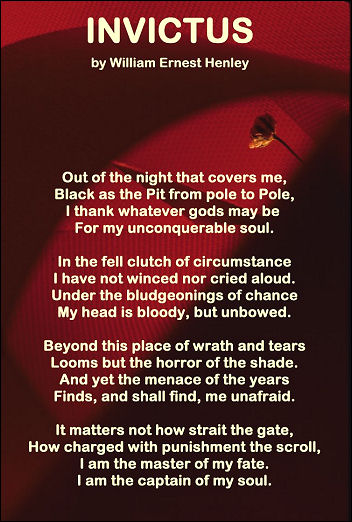
In 1875, when Henley was 26 years old, he wrote a poem from a hospital bed. It originally bore no title, and wasn’t published until 1888. It was Sir Arthur Quiller-Couch who named it “Invictus” (Latin for “unconquered”) when he included the poem in The Oxford Book Of English Verse (1900).

So here is Henley’s words of resolve and courage, speaking to us across the gulf of time:

Invictus is also the title of a remarkable 2009 film directed by Clint Eastwood, starring Morgan Freeman and Matt Damon. The film is a look at the life of Nelson Mandela after the fall of apartheid in South Africa, during his term as president, when he campaigned to host the 1995 Rugby World Cup event as an opportunity to unite his countrymen. The title comes from the fact that Mandela had the poem written on a scrap of paper on his prison cell while he was incarcerated.

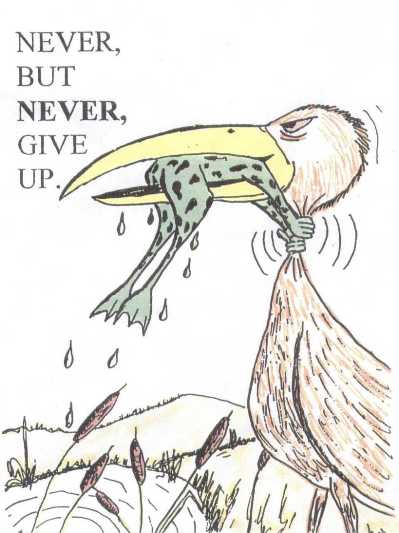
And here’s an image that echoes the same fighting spirit…

Avatar: Blockbuster film as socio-political and green allegory?


“Pictures are for entertainment, messages should be delivered by Western Union.”

Those words by American film producer and studio founder Sam Goldwyn (1879-1974) sum up Hollywood’s attitude to movie-making for the past many decades.

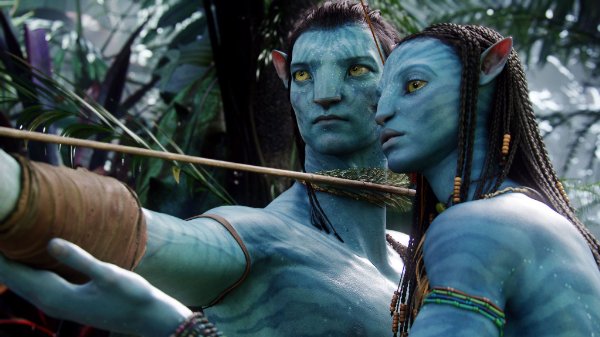
As I watched James Cameron’s latest blockbuster movie Avatar, I kept wondering how the master film maker managed to subvert this so completely. Beneath the 3D, special effects and riot of other worldly colours, the movie is one long (2 hrs 40 mins) and powerful commentary on why might is not right when it comes to exploiting resources — belonging to other countries, people, or as in this case, other worlds.

This is not just another worthy indie movie made by an idealistic movie maker defiant of Hollywood traditions and big money. James Cameron is one of the most commercially successful directors in the mainstream film industry – and perhaps one of the very few who can get away with this kind of stunt. At a budget of over US$ 300 million , Avatar is one of the most expensive films ever made, and the costliest ever for 20th Century Fox.

The big gamble is certainly paying off. On 26 January 2010 came the news that Avatar has surpassed Titanic as the highest-grossing movie worldwide. According to the studio, worldwide box office total for Avatar at that point stood at US$1.859 billion, beating the US$1.843 billion racked up by Cameron’s romantic drama in 1997-98. Avatar broke that record in a little over six weeks.

Part of the reason for such appeal is the extraordinary special effects: it’s an action-packed thriller where good and evil battle it out on another planet. The strange landscapes give it a video game like feel, but no small screen can match the theatrical experience, especially if you watch it in IMAX 3D (I didn’t). And for a change, this time the aliens inhabiting planet Pandora are benign, while it’s the humans who are ruthless invaders and brutal killers. Well, at least most of the time…

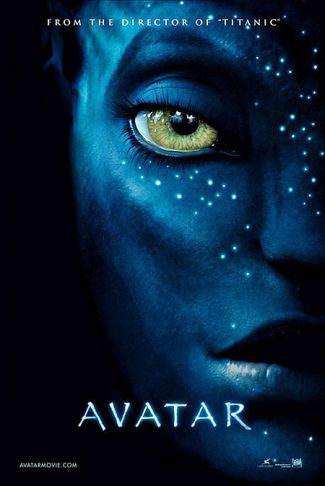
Here’s the official blurb: “Avatar takes us to a spectacular world beyond imagination, where a reluctant hero embarks on an epic adventure, ultimately fighting to save the alien world he has learned to call home. James Cameron, the Oscar-winning director of Titanic, first conceived the film 15 years ago, when the means to realize his vision did not exist yet. Now, after four years of production, AVATAR, a live action film with a new generation of special effects, delivers a fully immersive cinematic experience of a new kind, where the revolutionary technology invented to make the film disappears into the emotion of the characters and the sweep of the story.”

And here’s AVATAR – Official International Launch Trailer (HD)

Film critics and social commentators around the world have noticed the many layers of allegory in the film. Interestingly, depending on where you come from, the movie’s underlying ‘message’ can be different: anti-war, pro-environment, anti-Big Oil, anti-mining, pro-indigenous people, and finally, anti-colonial or anti-American. Or All of the Above…

It looks as if Cameron has made the ultimate DIY allegory movie: he gives us the template into which any one of us can add our favourite injustice or underdog tale — and stir well. Then sit back and enjoy while good triumphs over evil, and the military-industrial complex is beaten by ten-foot-tall, blue-skinned natives brandishing little more than bows and arrows (and with a little help from Ma Nature). If only it works that way in real life…

But the multi-purpose allegory is apparently working well. Take these two from opposite sides of the planet:

Thomas Eddlem wrote in The New American: “Avatar, is a visually stunning epic that is a perfect allegory for any of a dozen or more Indian wars in American history. From King Philip’s War in New England to Tippecanoe in Indiana to Horseshoe Bend in Alabama — and all the way across the American continent, for that matter — the story was the same. Colonists simply take land from the natives, as the Sully explains: ‘This is how it’s done. When people are sitting on something that you want, you make them your enemy so that you can drive them out.’

Mayank Shekhar wrote in The Hindustan Times newspaper: “Between a green worldview and the globe’s war over a natural resource, James Cameron’s twin analogies of present-day politics are fairly complete. They lend his science fiction ‘event picture’ a certain soul, even if not much of a story line.”

So did Cameron set out trying to send a message? Or was it all an incidental byproduct? Listen to the director himself in these two online video stories:

James Cameron’s Vision Featurette

CBS Interview with James Cameron: From Titanic to Avatar

The most compelling social commentary on Avatar I have so far read comes from Naomi Wolf, the American political activist, author and social critic. In an op ed essay written for Project Syndicate, she sees two revealing themes in Avatar: “the raw, guilty template of the American unconscious in the context of the ‘war on terror’ and late-stage corporate imperialism, and a critical portrayal of America – for the first time ever in a Hollywood blockbuster – from the point of view of the rest of the world.”

She adds: “In the Hollywood tradition, of course, the American hero fighting an indigenous enemy is innocent and moral, a reluctant warrior bringing democracy, or at least justice, to feral savages. In Avatar , the core themes highlight everything that has gone wrong with Americans’ view of themselves in relation to their country’s foreign policy.”

Does the box office triumph of Avatar make James Cameron one of the most effective campaigners for social justice on the planet (comparable, in some ways, to Michael Jackson having been one of the biggest environmental communicators of his time)?

And is Avatar the most expensive piece of info-tainment or edu-tainment ever made, just like the Lord of the Rings trilogy was one long (even if unintended) commercial for the breathtaking sights and sounds of New Zealand?

Certainly, mixing messages with entertainment is such a difficult and delicate art that most people who dabble in it fall between the two stools. The entertainment value of Cameron’s latest flick is not in question. Granted, it’s not as heart-breaking as Titanic, and the storyline is oh-so-predictable. But 3D and SFX magic alone can’t hold today’s audiences gripped for 160 long minutes. And if the underlying story starts movie-goers thinking and talking about many parallels between the fictional world of Pandora and our own Earth, he’s certainly getting somewhere.

As Naomi Wolf says: “Ironically, Avatar will probably do more to exhume Americans’ suppressed knowledge about the shallowness of their national mythology in the face of their oppressive presence in the rest of the world than any amount of editorializing, college courses, or even protest from outside America’s borders. But I am not complaining about this. Hollywood is that powerful. But, in the case of Avatar , the power of American filmmaking has for once been directed toward American self-knowledge rather than American escapism.”

Perhaps this wasn’t part of the script, but would the executives at 20th Century Fox care as they laugh all the way to their bank?

Wim Wenders: How our images can change our world

Wim WendersEvery now and then, we come across a simple yet profound statement that sums up our work or our aspirations – or both.

Here’s one such gem from Wim Wenders, the German film director, playwright, author, photographer and producer: “If we can improve the images of the world, perhaps we can improve the world.”

I must admit, now and here, that I’ve not seen any of his films (except for extracts online – does that count?). Yes, what a lot I have missed — but I’ve read a bit on him and been enormously impressed by how he plays with images, both still and moving, in a unique style of his own.

The more I searched about him, the more impressed and amazed I became about his progressive and pragmatic comments about his art and craft.

Consider these other gems I found, all talking about how movies can catalyse or support change in society:

“Any film that supports the idea that things can be changed is a great film in my eyes.”

“Any movie that has that spirit and says things can be changed is worth making.”

“Entertainment today constantly emphasises the message that things are wonderful the way they are. But there is another kind of cinema, which says that change is possible and necessary and it’s up to you.”

“On the contrary a film can promote the idea of change without any political message whatsoever but in its form and language can tell people that they can change their lives and contribute to progressive changes in the world.”

Read collected quotes of Wim Wenders on BrainyQuote

Opening of Wings of Desire (1987) by Wim Wenders

Here’s an interesting interview with the legendary film maker by a legendary broadcaster:

Frost over the World featuring Wim Wenders – Al Jazeera English on 11 Jan 2008

I’ve now run out of excuses for not seeking out Wim Wenders films. That’s one of my aspirations in 2010.

But meanwhile, this particular Wim Wenders quote is a caution for people like myself: “The more opinions you have, the less you see.”

Having a bad day? This cosmic perspective could help!

We all have a bad day every now and then. Each one has different ways of coping with it – some curse the government, others blame their karma, and still others just play sport or music to soothe the mind.

This past Season, two astronomically inclined friends showed me a new way of coping with the assorted problems of our imperfect world and unfair life.

First, Rex I de Silva – diver, naturalist and amateur astronomer who was a citizen scientist before the term was invented – sent me this clever piece of animation that originated in Australia. He wrote: “It’s so very well done that most folks don’t realize how much info is being shared! Just click on the link below….but with your computer’s speakers on. We are on quite a ride….It’s not over till it asks if you want to view again.”

Indeed, it’s the ultimate journey – take it at:
http://dingo.care2.com/cards/flash/5409/galaxy.swf (it was working as of today).

Then, Thilina Heenatigala – one of the most active astronomy and space enthusiasts in Sri Lanka – informed me that the original Galaxy Song was sung by Eric Idle from Monty Python’s Meaning of Life (1983), with graphics from NASA of flying through the universe.

So here it is, the film version from YouTube:

If the real images are not awe-inspiring enough, here’s an animated version of the same song that I discovered on my own while exploring that rapidly expanding online video galaxy – it features ‘Pinhead’ from RProduction13’s animated short series, “The Four”.

And here are the lyrics of
The Galaxy Song:

Whenever life gets you down, Mrs. Brown,
And things seem hard or tough,
And people are stupid, obnoxious or daft,
And you feel that you’ve had quite eno-o-o-o-o-ough…

Just remember that you’re standing on a planet that’s evolving
And revolving at nine hundred miles an hour,
That’s orbiting at nineteen miles a second, so it’s reckoned,
A sun that is the source of all our power.
The sun and you and me and all the stars that we can see
Are moving at a million miles a day
In an outer spiral arm, at forty thousand miles an hour,
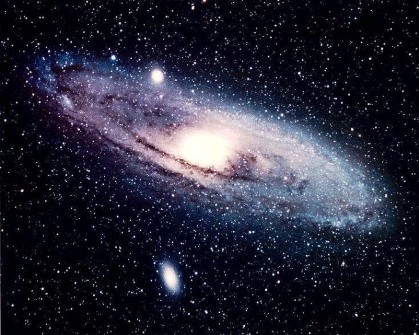
Of the galaxy we call the “Milky Way”.

Our galaxy itself contains a hundred billion stars.
It’s a hundred thousand light years side to side.
It bulges in the middle, sixteen thousand light years thick,
But out by us, it’s just three thousand light years wide.
We’re thirty thousand light years from galactic central point.
We go ’round every two hundred million years,
And our galaxy is only one of millions of billions
In this amazing and expanding universe.

(Animated calliope interlude)

The universe itself keeps on expanding and expanding
In all of the directions it can whizz
As fast as it can go, at the speed of light, you know,
Twelve million miles a minute, and that’s the fastest speed there is.
So remember, when you’re feeling very small and insecure,
How amazingly unlikely is your birth,
And pray that there’s intelligent life somewhere up in space,
‘Cause there’s bugger all down here on Earth.

Composers: Eric Idle & John Du Prez
Author: Eric Idle
Singer: Eric Idle
From the ‘Meaning of Life’ album, MCA Records MCA 6121

I have no idea who Mrs Brown is, but it sure works for me too!

Why do we still go to the movies in the 21st Century?

Going to the movies has been a shared cultural activity for at least four generations. In that time, technology has marched forward in leaps and bounds — but the core experience remains the same. And we still keep going to the movies, at the cinema, even though we now have other ways of seeing the same films. Why?

On the penultimate day of 2009, I went to the local cinema to see 2012, Roland Emmerich’s latest depiction of the mother of all disasters. For 158 gripping minutes, I willingly suspended disbelief and allowed the myth-makers of Hollywood to thoroughly scare me out of my wits. As did, it seemed, the few hundred other people watching it on wide screen with surround sound. There is no way the literally earth-shattering scenes of this movie would seem and feel remotely realistic anywhere else…

But cinemas are far from perfect – for instance, we had put up with a bunch of screaming brats whose parents had unwisely brought them for the wrong kind of movie. I’ve sat through far more noisy and boorish behaviour at cinemas: notable among them is watching Titanic at a massive, packed cinema in downtown Mumbai sometime in 1998 — and discovering how ‘interactive’ Indian movie-goers can get. (After the initial irritation wears off, I became almost oblivious to the distractions, thanks to James Cameron’s superb story telling.)

I just refuse to see such blockbusters on a small screen. (Ok, I might watch movies on long flights when I get tired of reading, but I have never been able to bring myself to watching a movie on an ipod…)

In fact, the movie industry is as much caught up in the digital wave as all other aspects of media. As Manohla Dargis of the New York Times noted in a perceptive essay this week: “How much our world of moving-image entertainment has changed in the past decade! We now live in a world of the 24-Hour Movie, one that plays anytime and anywhere you want (and sometimes whether you want it to or not). It’s a movie we can access at home by pressing a few buttons on the remote (and agreeing to pay more for it than you might at the local video store) or with a few clicks of the mouse. The 24-Hour Movie now streams instead of unspools, filling our screens with images that, more and more, have been created algorithmically rather than photographically.”

Yet, unlike in other media experiences, the changes in the movie industry have gone largely unnoticed by ordinary viewers. As Dargis writes: “Film is profoundly changing — or, if you believe some theorists and historians, is already dead — something that most moviegoers don’t know. Yet, because the visible evidence of this changeover has become literally hard to see, and because the implications are difficult to grasp, it is also understandable why the shift to digital has not attracted more intense analysis outside film and media studies.”

Dargis is probably right: by adapting and evolving with the times, the cinema has survived for over a century. As Donald Clarke noted in The Irish Times at the beginning of December 2009: “Television failed to kill movies. Video failed to kill movies. Internet piracy – not to mention all the other diversions available online – has also failed to annihilate this most stubbornly resilient of art forms. Film-makers will, it is true, tell you that it is now more difficult than ever to negotiate financing for movies that cost between $3 million and $15 million. But you couldn’t say that the current recession has crippled the movie business.”

All this makes me wonder what movie-going might be like in another decade or two. 3D and IMAX are no longer so uncommon or special, and the entertainment industry is working hard to relate to not just our seeing and hearing, but other senses as well. (Did you know that, as long ago as 1960, they tried to introduce smelling movies? Smell-O-Vision was a system that released odors during the projection of a film so that the viewer could “smell” what was happening in the movie. The technique injected 30 different smells into a movie theater’s seats when triggered by the film’s soundtrack. For some reason, it never caught on…)

Perhaps it’s not simply a matter of money or technology. There is also a whole sociology of movie going and movie watching – many of us go to the cinema (not nearly often enough in my case) not just for the personal sensory experience of a celluloid dream, but also for the shared experience of it. I like bumping into friends at cinemas. At a premiere or special screening, I also get to steal a few glimpses of the glitterati of the film world.

Have you been to a film musical and had the uncontrollable urge to burst into song? London’s Prince Charles Cinema not only allows, but encourages viewers to do just this — though only on certain days of the month. Their most famous offering is Sing-a-long-a Sound of Music: a few years ago, I joined several hundred other assorted ‘nuns’, von Trapp family members and Julie Andrews look-a-likes in such a memorable experience. I have the digitally remastered DVD of the 1965 movie, an ever-green title in my household. But watching it at home can’t compare with the sense of community that one feels when the lyrics for all the songs appear on the movie screen, giving the audience every reason to sing their hearts out…

I’m not sure how popular (or even acceptable) such community movie watching would be in different cultures. But going to the movies retains its charm and appeal in this digital age, even if we have come a long way since the glorious days of movie going as captured in this wonderful and memorable song from the musical Annie (1982) – Let’s Go To The Movies

2010: The Year We Make Contact…?

We apologise for the delayed arrival of the future?

The year 2010 has finally arrived, but as they often say in the imagination business, the future isn’t what it used to be.

Actually, any number of futures can be anticipated — but only one of them becomes real. Which one does depends on an infinite number of actions (and inactions)…

2010 holds a special significance for science fiction and movie buffs because both a well known novel and a movie have been set in that year by the grandmaster of near-future imagination, Arthur C Clarke.

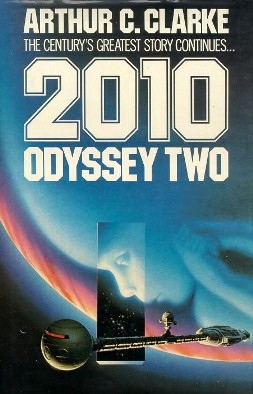
2010: Odyssey Two is a best-selling science fiction novel by Clarke, published in January 1982. It was a sequel to 2001: A Space Odyssey.

The story is about seven Russians and three Americans who embark on a joint space mission to Jupiter to figure out what happened to the previous Jupiter mission nine years earlier. They start off as acquaintances and end up as friends – the author hoped that would help improve understanding between the US and the USSR.

The book was dedicated to celebrated cosmonaut Alexei Leonov and Andrei Sakharov, physicist, Nobel laureate and humanist, whose outspoken views led to his internal exile in Gorky until 1986.

In fact, the spacecraft in 2010 is named Alexei Leonov. As Sir Arthur recalled a dozen years later: “I had just sent the manuscript of 2010 to my editors when I visited Russia for a most memorable and enjoyable visit. In between toasts at Leonov’s apartment, I revealed that most of the action in my novel was taking place on board the Cosmonaut Alexei Leonov. A delighted Leonov quipped: ‘Then it must be a good ship.'”

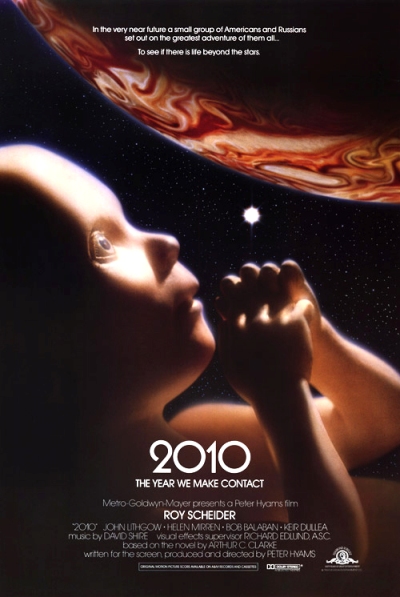
The novel was adapted as a movie by Peter Hyams and released in 1984. Its promotional title was 2010: The Year We Make Contact! (although this never appears in the film itself.) Unlike 2001: A Space Odyssey, the novel and the screenplay were not written simultaneously, and there are significant differences between the two. According to the Wikipedia, the film was only a moderate success, disappointing many critics as well as viewers.

If nothing else, the book and movie of 2010 remind us how difficult it is to write near-future stories — most of them are completely overtaken by reality.

Several elements in 2010 have become anachronistic in the years following their original release. The most striking is the end of the Cold War and the disintegration of the once mighty Soviet Union (which ceased to exist in 1991).

As Sir Arthur said in an interview in May 2005: “I’ve been more interested in the medium to long-term prospects for humanity, rather than in near-term developments. Politics and economics are so unpredictable that it’s practically impossible to make geopolitical forecasts with any degree of certainty.”

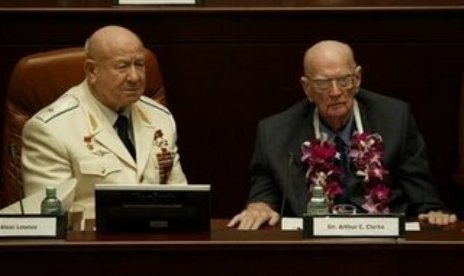
Alexei Leonov (left) and Arthur C Clarke at their last encounter in Colombo, 16 Dec 2007
Interestingly, he had peppered the novel with names of various Soviet dissidents, including physicists Andrei Sakharov and Yuri Orlov, human-rights activists Mykola Rudenko and Anatoly Marchenko, Russian Orthodox activist Gleb Yakunin, among others. That was the author’s not-so-subtle jibe at the Soviet Union, despite the fact that he was both admired and respected in the country that pioneered humanity’s entry into space.

At first, this had somehow gone unnoticed by the Soviet censors. The Russian language youth magazine Tekhnika Molodezhy began serialising 2010: Odyssey Two. Halfway through the story, the serialisation was abruptly stopped. The Central Committee then summoned Cosmonaut Leonov to ask why in the novel the crew of the spaceship Alexei Leonov consisted of Soviet dissidents. (Clearly, that was another regime that couldn’t discern between fictional and real worlds — and tried, in vain, to rule over both.)

That’s when Leonov, Hero of the Soviet Union and one of its most decorated citizens, told off the Central Committee: “You aren’t worth the nail on Arthur C. Clarke’s little finger.” This was revealed years later in Two Sides of the Moon: Our Story of the Cold War Space Race, co-authored by Alexei Leonov and American astronaut David Scott (Simon and Schuster, 2004).

As Sir Arthur – a long standing friend of Leonov – remarked in a review of their book, Leonov was “perhaps the only man in the USSR who could have got away with that kind of remark”.

Well, that 2010 is finally here — even though Sakharov and Clarke never lived to see it, Leonov is very much with us. We are not yet heading to Jupiter, but at least the Cold War is now history…

Who can predict what surprises await us as the real 2010 unfolds?

Restored GAMPERALIYA: A cultural treasure saved from the elements

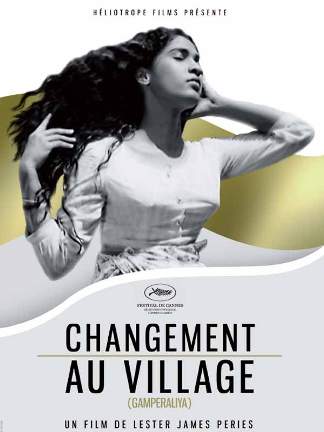
Gamperaliya-changement_au_village
Gamperaliya (1964): A Sri Lankan film classic
Last evening, at the gala opening of the European Film Festival in Colombo, I sat two rows in front of a living treasure of the Asian cinema and watched his recently restored 1964 cinematic masterpiece, a cultural treasure in its own right.

The doyen of the Lankan cinema, Lester James Peries, made Gamperaliya (Changes in the Village, 35mm, 108 minutes) based on the Sinhala novel of the same name, written by Martin Wickremasinghe, himself a leading light of Lankan literature during the 20th century.

The movie was groundbreaking in Sinhala cinema, and was shot entirely outside of a studio using one lamp and hand held lights for lighting (at a time when most films were still being made within studios). Although not an immediate commercial success, it was critically and internationally acclaimed, and won the Golden Peacock at the Grand Prix International Film Festival in India and the Golden Head of Palenque in Mexico, both in 1965. It was one of the first Lankan films to be internationally recognised.

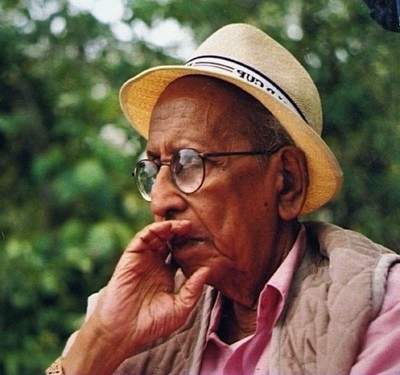
Lester James Peries
Lester: 20 feature films in a 50-year career...
Gamperaliya was the first independent film made in Sri Lanka. There was no film studio involvement, and the film maker and friends invested Lankan Rupees 170,000 to make it (roughly USD 30,000 at the time, although today the same amount of the much weaker Rupee converts to less than USD 1,500).

Critic David Chute wrote: “Gamperaliya launched a revolution, not only in the way films were made but also in content…[director] Peries sought an alternative to the Bollywood-influenced melodramas that dominated commercial cinema…With an elegant narrative style comparable to Satyajit Ray’s Apu Trilogy, [the film’s] aesthetic choices also have a moral dimension.”

Gamperaliya is two years older than myself, and although I’d watched it on television, I had never seen it in a cinema on a large screen with proper sound. It was a real treat. For nearly two hours, I was transported back to two periods of recent history: the newly independent Dominion of Ceylon (not yet renamed Sri Lanka) in the early 1960s when the film was made, and the early 20th century colonial Ceylon where the actual story takes place. To engage in such time travel in the company of the maestro film maker himself was a unique experience.

However, it was sobering to reflect how many who were involved in the creative effort to make Gamperaliya are no longer with us. Among them are screenplay writer Regi Siriwardena, actor Gamini Fonseka and co-producer Anton Wickremasinghe. It was only a few months ago that Tissa Abeysekera, who started his long and colourful association with the Lankan cinema by working as a dialogue writer and assistant director in Gamperaliya, abruptly departed.

Lester, who turned 90 in April 2009, was making a rare public appearance. We were told that this is only the second time he has ventured out since he retired from film-making two years ago. He looked a bit frail, but walked up and down the isle supported by his wife Sumitra Peries, his partner both in life and cinema.

In some ways, cine film is even more prone to the decay of elements than humans. Gamperaliya was almost totally lost. Last evening’s celebrated reunion of the master and his masterpiece was the outcome of a major restoration that involved substantial efforts and investments by concerned cinephiles on both sides of the Atlantic.

Gamperaliya was rescued from the brink of disaster. A few years ago, UNESCO launched a project to collate a World Heritage of cinema and selected another film of Lester’s, Nidhanaya (Treasure, 1972) as a work of art that should be preserved for future generations. But when Lester and UNESCO representatives went to the Sarasavi studio in Dalugama, north of Colombo, where almost all the films made in Lankan cinema are kept, they found that the master Negative (the Mother Copy from which fresh copies could be made) was burnt due to vinegar syndrome – a condition when negatives start deteriorating.

“This was not due to the failure of anybody in Dalugama studio or the National Film Corporation but due to the failure of all governments that came to power since 1956. The late journalist Ajith Samaranayake and many others fought for a film archive but we were not able to persuade any government,” the disappointed film maker was quoted as saying at the time.

Gamperaliya French poster

This news reached Pierre Rissient, a French national and a guardian of Lankan cinema who is attached to ‘Pathe’ one of the biggest film companies in the world. He urged Lester to help restore the equally important film Gamperaliya, which was also in a state of decay but could still be salvaged.

In one email, Rissient wrote to Lester: “Dear Lester you made a great masterpiece, not only of the cinematography of your country but also universally. It is your duty to make possible this restoration; it is not for your friend Pierre, but for the world.”

So Pierre Rissient pursued this and arranged for it to be carried out at the film restoration unit of the University of California in Los Angeles (UCLA). The UCLA Film and Television Archive is the largest university-based collection of film and television materials in the world,

Some 14 sound reels and 14 picture reels of Gamperaliya, weighing 60 kilos, were couriered to UCLA in May 2007. The film was restored to the visual and audio perfection by Rob Stone and Jere Guldin. The restoration with latest digital sound and visual quality will enable the film to be shown all over the world after 45 years.

In May 2008, the restored Gamperaliya was screened at the Cannes Film Festival under the section ‘Restored Classics’.

At the time, Lester wrote to Pierre Rissient: “It is a tremendous campaign that made it possible for Gamperaliya to survive and your incredible faith in our film that made this miracle possible. We do hope and pray that there is no serious deterioration that will destroy any chances of a glorious restoration. Sumithra and I thank you and are joined by the Sri Lanka film industry for your valiant effort.”

And all of us movie lovers in Sri Lanka and across the world join them in this gratitude, for saving the cultural treasure that is Gamperaliya.

Essay by D B S Jeyaraj, April 2009: Lester James Peries – Liberator of Sinhala Cinema

Calling All Climate Films: Engage the world with EngageMedia!

May a million Al Gores rise to this challenge!

Exactly this time last year, in early October 2008, I spoke to a group of Asian broadcasters and film-makers gathered in Tokyo on what it takes to stand on Al Gore’s shoulders.

Whatever we might think about the artistic and technical merits of his climate film An Inconvenient Truth, it has settled with a resounding ‘yes’ one question: can a single film make a difference in tipping public opinion about a matter of global importance?

But the climate crisis that confronts us is so formidable that we need many more Al Gores to come up with as many moving images creations as they can.

EngageMedia, a video sharing site about social justice and environmental issues in the Asia Pacific, has put out a call for video/TV films on climate crisis, climate action, climate justice and climate solutions. They plan to ‘put the best stories on a DVD and in an online package to be screened and distributed before, during and after the United Nations Framework Convention on Climate Change (UNFCCC) Summit meeting in Copenhagen in December 2009.

Their call out for all climate films says: “This December thousands of delegates, decision makers, stakeholders and activists will converge on Copenhagen. To be part of this EngageMedia is putting together a compilation of Asia-Pacific climate films to be screened and distributed at the event and around the world. Submit your film to EngageMedia and be part of the action. Global action is urgent and essential – the time for debate is over.”

TVE Asia Pacific
, already a partner on EngageMedia platform, is submitting all its recently produced climate change films.

Read the full text of Climate Crisis Video Call-Out: Time for Reel Action!