The other side of Reality TV: When Cicadas kill innocent people…

I have nothing against reality television. It’s a TV programming format that, according to Wikipedia, presents purportedly unscripted dramatic or humorous situations, documents actual events, and features ordinary people instead of professional actors.

In fact, I’ve been telling my friends who are factual film-makers that we can learn a thing or two from the recent successes of some reality TV shows.

But everything has its sane limits — and evidently these were exceeded in the recent controversy involving a British TV production company that stands accused of starting a ‘flu epidemic that left four people from a tribe of isolated Peruvian Indians dead and others seriously ill.

Matt Currington (in photo above, on the right), a London-based documentary maker, has been blamed for triggering a “mini-epidemic” in the village of 250 people which led to the deaths of three children and one adult of the Matsigenka people, who live in the isolated Amazonian Cumerjali area of south-eastern Peru.

The 38-year-old was employed by Cicada Films as researcher when he travelled to the area with a guide last year to scout for locations for the World’s Lost Tribes series, which airs on the Discovery Channel.

Here are some extracts from the story that appeared in The Guardian newspaper in the UK on 27 March 2008, written by its environment correspondent John Vidal:

The regional Indian rights organisation Fenama, government officials and a US anthropologist working in the region said in statements seen by the Guardian that a two-person crew working for London-based Cicada Films had visited groups of isolated Indian communities despite being warned not to. Fenama said the film team travelled far upriver and provoked an epidemic. It accused them of threatening the lives of Indians and called for Cicada Films to be barred from entering the area again.

It is understood the company was scouting for a location to set a TV show for Mark Anstice and Olly Steeds, in which the two British presenters would live with a remote tribe, in exchange for gifts. The company has already filmed episodes in New Guinea.

According to the Peruvian government’s protected areas department, Cicada was given a permit to visit only the community of Yomybato. It expressly prohibited visits to uncontacted or recently contacted Indians. “The Cicada team entered [remote headwaters] which are part of the strictly protected zone,” it said.


Read the full story: British reality TV crew accused as flu kills four in isolated Peruvian tribe

In case you think this is some left-wing or liberal conspiracy, read also The Times London story: TV researcher brought fatal flu to Amazon tribe.

The American anthropologist, Glenn Shepard, who met the film team on location, said he had urged them not to make the trip to the Cumerjali settlements, “where people were vulnerable to western illnesses”. “Reality tv seeks ever more dangerous, remote and exotic locales and communities,” he said.

Stephen Corey of the international tribal rights organization, Survival International, agreed. “There has been a whole rash of bizarre and extreme programmes on tribal rights. The key issue here is sensitivity which is not often a priority for television companies,” he said.

Survival International news: British TV company accused of bringing ‘epidemic’ to isolated Indians

British TV company deny allegations about Peru visit

Image from Survival International Image from Survival International

According to Survival International, Cicada Films previously caused controversy with a documentary about an expedition to visit Indians in Ecuador, which allegedly provoked an attack from uncontacted Waorani Indians.

But Cicada is certainly not alone when it comes to exploiting marginalised people in the global South in the course of film-making. And reality TV is not the only format of TV film making that often oversteps the ethical boundaries in search of a ‘good story’.

As I have been saying for sometime now, documentary film-makers and TV news gathering crews are equally guilty of many excesses, lapses and gross abuses all perpetrated in the name of media freedom.
Aug 2007 blog: Wanted – Ethical sourcing of international TV News

Nor is this sinister trend entirely new. I opened a September 2007 blog post with this bizarre request: “Can you help us to film a child’s leg being broken?” This was made by a visiting Canadian TV crew in the 1970s to my friend Darryl D’Monte, one of the most senior journalists in India and former editor of the Times of India.

This was in connection with a brutal practice that was believed to exist in India, so that forcefully maimed children could be employed as beggars. When Darryl was outraged, the film crew had shrugged off saying: “It’s going to happen anyway”.

December 2007: “Hands up who’s poor, speaks English – and looks good on TV!”

Film-makers and TV journalists roam the planet exercising their license to protect and promote the people’s right to know, and in the public interest. But this privileged position is grossly abused when they allow the end to justify their highly questionable means.

Commenting on TV’s latest crime against voiceless people, India’s Down to Earth magazine (30 April 2008 issue) says:

“These forays of reality tv perpetuate an imagery conceived by a 19th century alliance of anthropologers and photographers, that of tribals in their “innocent” state. It’s another matter these images were taken after the tribal groups were ravaged by colonialism.

“Today in the era of digital images when computer games mimic real wars, it might be hard for even the most naive eye to believe what it sees. But tv casts an enormous sway over audience perception and digitization has, in fact, aided it. We know of the images, not the circumstances in which they were taken. We believe them though they might be contrived. That’s why reality tv is dangerous.”

Read Down to Earth leader: Television has new stars

Internet Society interviews the web’s inspiation, Arthur C Clarke

In his 1964 short story, “Dial F for Frankenstein”, the late Arthur C Clarke speculated the world’s inter-connected telephone system becoming a conscious entity that then takes over the world. Years later, in 1989, this inspired the British computer scientist Tim Berners-Lee to invent the World Wide Web, a system of interlinked hypertext documents accessed via the Internet.

When Berners-Lee acknowledged his inspiration in media interviews, Sir Arthur exclaimed: “Oh dear, what have I done?”

But in later years, Sir Arthur took pride in being described as the inspiration for the web, which came on top of his much more widely acclaimed recognition of being the inventor of the communication satellite.

It was entirely appropriate, then, that most tributes to Sir Arthur would appear online. The news of his death, on 19 March 2008 in Colombo, Sri Lanka, went round the world at the speed of light thanks largely to the web. This triggered a virtual explosion of tributes, comments and eulogies from ordinary people – ranging from science fiction readers and movie buffs to computer geeks and space enthusiasts.

Among the thousands paying tribute to the grandmaster of science fiction was the Internet Society, a non-profit organisation founded in 1992 to provide leadership in Internet related standards, education, and policy. They called Sir Arthur “a visionary of science and technology, whose ideas and legacy can be seen woven through many modern communication technologies, including the Internet itself”.

As a tribute to Sir Arthur, the Internet Society has placed online, rather belatedly, an interview filmed with Sir Arthur at his Colombo home in 2002. The interview, conducted by Alan Greenberg and George Sadowsky, then Trustees of the Internet Society, is presented in four parts.

In this wide-ranging interview, a very relaxed Sir Arthur talks about the history of 20th century communications and his own role in shaping the events in the past 60 years. Here, in one place, are the reflections and extrapolations of the man who always connected the present with the future. He also touches on the future of space exploration, and the urgent need to develop clean energy sources for a world addicted to oil.

Part 1 of 4 (8 mins 51 secs):

Part 2 of 4 (9 mins 30 secs):

Part 3 of 4 (7 mins 11 secs):

Part 4 of 4 (6 mins 26 secs):

Comment: Although it’s the Internet Society, no less, they seem to be rather limited in their ability to promote these videos placed on the public video exchange platform, YouTube. These remain virtually hidden away, with a single tag (movie) which obscures them from online searches. In nearly three weeks since they were placed online (24 March 2008), these have been viewed by just a few hundred people. In contrast, other tributes and archival material of Sir Arthur are attracting thousands of views and a growing number of comments on the same YouTube.

The world according to Michael Ramirez

At the 2008 Pulitzer prizes for excellence in American journalism, announced on April 8, Michael Ramirez of Investor’s Business Daily won the prize for best editorial cartoons.

He was recognised ‘for his provocative cartoons that rely on originality, humor and detailed artistry’. This is his second Pulitzer, having earlier won the same award in 1994 for his work published in Commercial Appeal, Memphis, Tennessee, USA.

This morning, I spent a couple of enjoyable hours browsing through the archive of his political cartoons for the past one year. He doesn’t conceal his right wing political loyalties, but despite this, I could appreciate the satire and originality of his cartoons.

As I’ve said before, when it comes to the economy of words, political cartoonists are the most efficient commentators in journalism.

Here are a few of his cartoons that touched on the state of media and publishing over the past few months:


Published: 25 February 2008


Published: 3 December 2007


Published: 14 November 2007


Published: 9 October 2007


Published: 21 September 2007

Michael Ramirez is a senior editor and the editorial cartoonist for Investor’s Business Daily’s editorial page, “Issues & Insights.”

Ramirez is a Lincoln Fellow and has won several awards during his career, including the 1994 Pulitzer Prize, the UCI Medal from the University of California, Irvine and the Sigma Delta Chi Awards in 1995 and 1997. He has been the editorial cartoonist of the Los Angeles Times, the Commercial Appeal and USA Today, and is nationally syndicated in over 450 newspapers around the world.

View Michael Ramirez cartoon archive

Adrees Latif wins Pulitzer: Captured a shot heard around the world

Photo courtesy Reuters

A wounded Japanese photographer, Kenji Nagai, lay before a Burmese soldier yesterday in Yangon, Myanmar, as troops attacked protesters. Mr. Nagai later died. Published 28 September 2007 (Adrees Latif, Reuters)

This dramatic photograph, one of the harrowing and yet enduring images of 2007, has just won its photographer a Pulitzer Prize, announced in New York on 7 April 2008.

Ironically, the last defiant act of one courageous photojournalist has landed one of journalism’s most prestigious awards for another of his kind. Adrees Latif, a Pakistan-born American, had concealed his identity by blending in with the crowd in Rangoon/Yangon, and captured Nagai’s killing on film.

Read my 30 Sep 2007 post: Kenji Nagai (1957-2007): Filming to the last moment

Here’s the official citation from Pulitzer jury:

For a distinguished example of breaking news photography in black and white or color, which may consist of a photograph or photographs, a sequence or an album, in print or online or both, Ten thousand dollars ($10,000).

Awarded to Adrees Latif of Reuters for his dramatic photograph of a Japanese videographer, sprawled on the pavement, fatally wounded during a street demonstration in Myanmar.

Adrees Latif, addressing meeting in Japan March 2008

Born in Lahore, Pakistan on July 21, 1973, Adrees Latif lived in Saudi Arabia before immigrating with his family to Texas in 1980. Latif worked as a staff photographer for The Houston Post from 1993 to 1996 before joining Reuters. Latif graduated from the University of Houston in 1999 with a Bachelor of Arts in Journalism. Latif has worked for Reuters in Houston, Los Angeles before moving to Bangkok in 2003 where he covers news across Asia.

Latif’s collection of photos from his days in Burma, “Myanmar Marooned,” recently won an award given by the prestigious Japanese photographic magazine Days Japan.

Reuters blog: Latif tells the story behind the Pulitzer photo

Japan Times, 11 March 2008: Witness recalls the day of Nagai shooting

Arthur C Clarke: The Dangerous Dreamer of Colombo

Image by Reuters, courtesy Down to Earth

Arthur C Clarke: The Dangerous Dreamer of Colombo.

That’s the title I gave to an 800-word obituary/tribute on Sir Arthur C Clarke that I wrote for India’s leading science and environment fortnightly, Down to Earth.

In this essay, I took a quick look at Sir Arthur’s legendary dream power. While there are no independent dream ratings as in television broadcasting, I always felt that he had one of the most active and imaginative dream machines east of Suez (millions of his satisfied readers might agree). When I turn up at his office two mornings a week, he would often relate a fantastic dream he’d just had — a few of these eventually found their way into his stories or even non-fiction writing.

I pegged this tribute on one of my favourite quotes by another British writer, T E Lawrence: “All men dream, but not equally…the dreamers of the day are dangerous men, for they may act their dream with open eyes, to make it possible.”

The tribute has just been published, in the latest issue of Down to Earth datelined 15 April 2008. But the sub editors have chosen a less vivid title, which is of course their prerogative.

This essay was written during the weekend of March 22-23, within hours of Sir Arthur’s funeral. Pradip Saha, the magazine’s editor, contacted me soon after Sir Arthur’s demise and asked if I could do 800 words in 48 hours. He knew I’d worked closely with the late author, and years ago, I had done a Clarke interview for Down to Earth.

Talk about catching me at a busy moment. At the time, as Sir Arthur’s spokesman, I was coping with a deluge of media requests and queries from all over the world (and a few from other worlds – just kidding). But my own newsroom experience had trained me to keep a cool head and remain focused amidst turbulence. So I agreed, and wrote this on 23 March 2008 while still recovering from the sheer exhaustion of a 4-day media-marathon (mediathon?).

This is how I start off the essay:

“In his 1992 book How the World Was One, Sir Arthur C Clarke described a dream he once had: one day, CNN founder (and then owner) Ted Turner is offered the post of the President of the world, but he turns it down politely—because he didn’t want to give up power.

“The trouble with Clarke’s dreams was that many kept coming true, often faster than his own vivid imagination envisaged. Like Albert Einstein, Clarke believed that imagination was more important than knowledge—he called himself an extrapolator, one who expanded from current knowledge to what was scientifically plausible.”

Read my Down to Earth tribute to Arthur C Clarke: The Dangerous Dreamer of Colombo

TVE Asia Pacific says Thank You to Sir Arthur C Clarke

In his 1992 book How the World Was One, Sir Arthur C Clarke described a dream: one day in the near future, CNN founder (and then owner) Ted Turner is offered the post of World President, but he politely turns it down – because he didn’t want to give up power!

Just three years later, the then Secretary General of the UN suggested that CNN should be the 16th member of the Security Council. Sir Arthur was fond of quoting this, and once famously told Turner: “You owe me 10 per cent of your income”.

These references – illustrating the power of globalised satellite television – are recalled in TVE Asia Pacific‘s official tribute to Sir Arthur C Clarke, who passed away on March 19 aged 90.

“With the death of Sir Arthur C Clarke, TVE Asia Pacific has lost a long-standing friend and supporter,” the tribute says.

It adds: “Since our establishment in 1996, Television for Education Asia Pacific – to use our full name – has been engaged in pursuing Sir Arthur’s vision of using the potential of moving images to inform and educate the public. Our founders chose to focus on covering development and social issues, with emphasis on the Asia Pacific region – home to half of humanity and where Sir Arthur spent the last half century of his life.”

Although he never held a formal position at TVEAP, Sir Arthur was an informal adviser and mentor to the regional media organisation whose work across Asia Pacific is only possible thanks to the comsat that invented and the web that he inspired.

By the time TVEAP was created in the mid 1990s, the satellite TV revolution was well underway in the Asia Pacific region, and the internet revolution was just taking off. In informal discussions, Sir Arthur advised us to always keep our eyes open on what’s coming up. In the ICT sector, he cautioned, being too closely wedded to one technology or system could lead to rapid obsolescence.

The tribute mentions Sir Arthur’s specific support for the Children of Tsunami media project, and the Communicating Disasters publication.

We also talk about Sir Arthur’s concerns about using information and communication technologies (ICTs) to benefit the poor and other disadvantaged groups – a process that he aptly described as ‘geek to meek’.

We end by recalling how TVEAP recorded and uploaded to YouTube Sir Arthur’s last public video address – his 90th birthday reflections in December 2007.

Read TVEAP’s tribute to Sir Arthur C Clarke, 1917-2008

sir-arthur-clarke-reflecting-on-90-orbits.jpg

When citizens turn on journalists…

My latest op ed essay has just been published by Asia Media website of the University of California Los Angeles.

It’s titled: When citizens turn on journalists
Nalaka Gunawardene describes the disturbing trend of vigilantism against professional and citizen journalists

Once again I talk about the multiple pressures and risks faced by mainstream and citizen journalists alike when they try to cover matters of public interest in my native Sri Lanka. This is particularly so for photojournalists and videographers who simply must go out with tools of their profession.

Here are the few opening paras:

Friday, February 29, 2008

Colombo — For over two decades, Sri Lanka’s state-owned radio and television stations — located next to each other in residential Colombo — have been heavily guarded by police and army. This fortress-like arrangement is due to their being high on the list of targets for Tamil Tigers engaged in a bitter separatist war for a quarter century.

The joke is that the stations are just as likely to be attacked by outraged listeners or viewers. Considering the endless state propaganda they dish out day and night, that’s not as far-fetched as it sounds.

But shooting the messenger never solves any problem, as Sri Lanka’s deeply divided combatants — and their die hard supporters — need to be constantly reminded. Attacks on journalists and media organisations have increased several fold in the past two years, and the World Association of Newspapers ranked Sri Lanka as the third deadliest place for journalists (six killed in 2007) — behind only Iraq and Somalia.

As if this was not depressing enough, we have seen another disturbing trend emerge: authorities and citizens alike turning on reporters and photojournalists in public places, suspecting them to be agents of mayhem and terror.

Read the full essay on UCLA Asia Media

Half the sky, most of the suffering…and seeking everyone’s attention!

What’s one of the biggest reasons for suffering from violence?

Is it War? Racism? Extremism?

Or simply being born a woman?

One in 3 women is a victim of violence.

This is the powerful message in this one-minute-long public service announcement (PSA), which can be viewed here:

It was produced by the London-based advertising agency Leo Burnett for UNIFEM, the United Nations Development Fund for Women. With a striking series of images, it reveals that violence against women is one of the most common forms of violence in the world.

This PSA is part of a new global campaign on this scourge.

As UNIFEM says: “Violence against women and girls is a problem of pandemic proportions. At least one out of every three women around the world has been beaten, coerced into sex, or otherwise abused in her lifetime — with the abuser usually someone known to her. Perhaps the most pervasive human rights violation that we know today, it devastates lives, fractures communities, and stalls development.”

The campaign has elements on awareness raising as well as a call to action. The latter includes an online signature campaign that seeks to collect at least 100,000 signatures from those who oppose violence against women.

The online ‘signature book’ opened for signatures on 26 November 2007 with an appeal from actress and UNIFEM Goodwill Ambassador Nicole Kidman. She called the violence many women worldwide face “an appalling human rights violation that can be stopped”, and asked everyone to add their names to a growing number of supporters saying “NO” to violence against women at http://www.saynotoviolence.org.

She added: “The more names we collect, the stronger our case to make ending violence against women a top priority for governments everywhere.”

Watch her appeal on YouTube:

The UN Trust Fund to End Violence against Women , established in 1996, will receive US$ 100,000 from the United Nations Foundation for 100,000 signatures

I have just signed up, on this leap day 29 February 2008. Three months since the campaign was launched in New York, it has so far gathered a little over 58,500 signatures.

It’s certainly commendable – but not nearly enough, and still more than 40,000 needed to reach the modest target of 100,000.

Not that it’s just a numbers game, of course. The quality and sincerity of commitment matter a great deal. At the same time, UNIFEM and other UN agencies trying to engage the public through online interactive methods should study how successful activist groups do the same — with much better and faster results.

Avaaz.org is a leader among these. It is a new global web movement with a simple democratic mission: to close the gap between the world we have, and the world most people everywhere want. Set up in early 2007, it has quickly evolved into online community through which hundreds of thousands of concerned people are taking action together on urgent issues like climate change, poverty, human rights and the crises in the Middle East and Burma.

In October 2007, I joined Avaaz in its signature campaign to focus global attention on the political violence and gross abuse of human rights in Burma. In just four days, thousands of Avaaz members donated over $325,000 online to support the Burmese people’s efforts to peacefully promote political change and tell the world about their struggle.

The Burmese junta may not care for millions of people protesting or donating online, but the leaders of the democratic world – pondering their response to the atrocities in Burma – would find it hard to ignore this surge of public concern.

But it’s a long leap from Burma to the bed room or backyard. A major difficulty faced by those campaigning to focus on violence against women: they are countering actions that are widely distributed, pervasive and sustained over time. Much of it happens at personal and family level, necessarily beyond the public and media’s glare. Incidents flare up only occasionally to spill over to the public space to become news events or talking points.

So, as in many similar instances, out of sight often means out of mind.

The big challenge is how to raise public awareness on a wide-spread issue of violence that happens, to a large extent, in private. The facts and figures are compelling as they are alarming and depressing. The campaigners have lined up some of the biggest celebrities (like Nicole Kidman) and enlisted big guns like UN Secretary General Ban Ki-Moon.

All necessary, but not sufficient.

The campaign needs more than just star power or the UN’s clout to galvanize mass action. For a start, UN agencies need to get out of their fondness for coining and using endless acronyms. Even with my regular forays into the development community’s acronym jungle (read my post on the alphabet soup), I was recently puzzled when a film-maker colleague referred to GBV in an email without explaining it. It took me full five minutes to realise that she meant gender-based violence.

And some imaginative ways of raising the public profile would also help. Browsing on YouTube, I came across this video from Ireland. As one article described it:
“The ghosts and spirits of the millions of women who have been murdered, violated, oppressed, excluded, driven into exile, denied freedom of speech, denied participation in any decisions concerning their lives, because of war, religion, race, culture, age, disability, sexuality, poverty, bonded slavery, domestic violence or bureaucracy, glided in and out of the shoppers of Galway on 7 December 2007.”

Communicating Disasters book launched among communicators

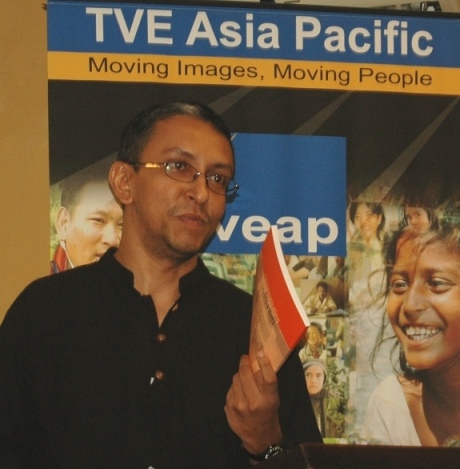
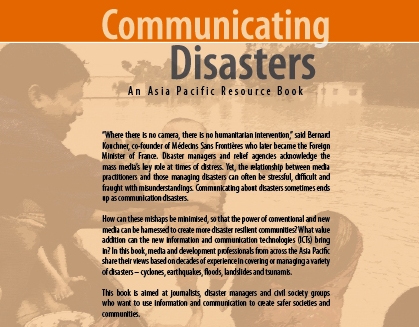
TVE Asia Pacific’s latest publication, Communicating Disasters: An Asia Pacific Resource Book, had its Sri Lankan launch on 19 February 2008.

The multi-author book focusing on how information, education and communication can help create disaster resilient communities across the Asia Pacific was released at the auditorium of Sri Lanka Press Institute (SLPI) in Colombo.

We had invited all contributing authors who are based in Sri Lanka. Six of our 21 contributors currently live in Greater Colombo, and four of them made it: Patrick Fuller, Buddhi Weerasinghe, Manori Wijesekera and myself. We missed Sanjana Hattotuwa (who is overseas) and Chanuka Wattegama.

The news story on the launch event can be read on TVEAP website.

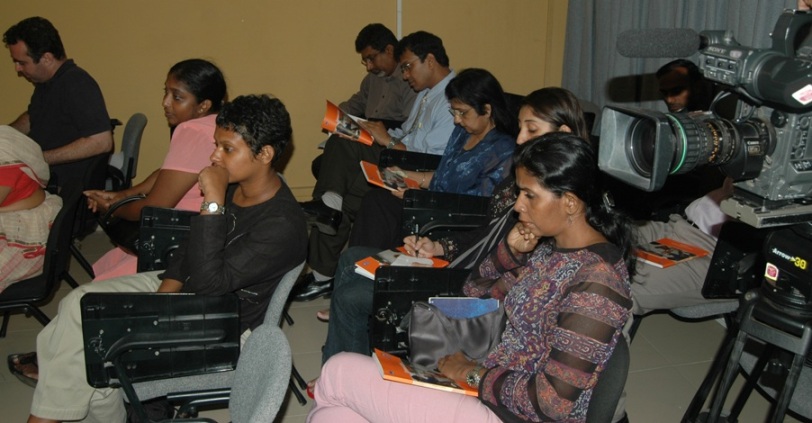
Here are some additional photographs of the event, attended by close to 50 persons working in media, communication and humanitarian sectors.

copy-of-communicating-disaster-book-launch25.jpg

Above and below: Nalaka Gunawardene introduces the what, why and how of the new book

communicating-disaster-book-launch.jpg

copy-of-communicating-disaster-book-launch48.jpg

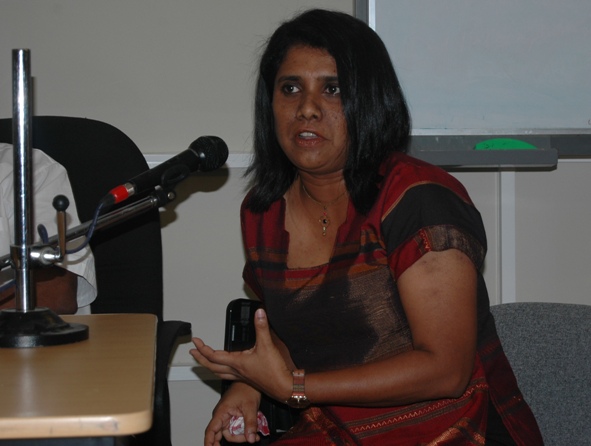
Contributing authors (L to R) Patrick Fuller, Nalaka Gunawardene, Buddhi Weerasinghe and Manori Wijesekera talk about their chapters in the book.

communicating-disaster-book-launch-buddhi-weerasinghe-speaks.jpg

Buddhi Weerasinghe responds to an audience question

manori-wijesekera.jpg

Above: Manori Wijesekera talks about Children of Tsunami

copy-of-communicating-disaster-book-launch58.jpg

Above and below: Sections of the audience

communicating-disaster-book-launch96.jpg

Photos courtesy: Indika Wanniarachchi and Wipula Dahanayake, TVE Asia Pacific

Governments, disasters and communication: Lead, follow or get out of the way!

The Association for Progressive Communications (APC) has just published a good review of the book I recently co-edited titled Communicating Disasters: An Asia Pacific Resource Book.

The review is written by two academics. Dr Malathi Subramanian is Former Principal, Daulat Ram College, University of Delhi, India, while Dr. Anupama Saxena is Head, Department of Political Science, Guru Ghasidas University, Bilaspur, Chhattisgarh, India.

As they remark: “The book has articles contributed by authors who do not engage in mere theoretical discussions. They draw on their rich and varied experiences working in either preparing disaster resilient communities or responding to humanitarian emergencies triggered by specific disasters in different parts of the globe.”

They add: “The eminently readable book provides first hand information about the real life situations of disaster, richly illustrated with case studies and use of professional images….The book is written in a manner that successfully sensitises the reader to the complexity of the issue of disaster management and its various nuances. After reading the book one is sure to echo the spirit of one of the contributors, Sanjana Hattotuwa: ‘We cannot prevent or predict all disasters. However, we can plan for, react to and learn from disasters when they do occur’.

In preparation of this review, Malathi and Anupama did an email interview with me where they posed half a dozen questions on some key issues we have addressed in the book. Here is the full interview, which brings out my personal views interspersed with those of some other contributors to our multi-author book.

Question: In developing countries the governments are considered to be the nodal agencies for disaster management. In this context do you think that there is a need to advocate the integration of the National disaster management policy with the national ICT Policy to exploit the potential of ICTs before, during and after a disaster?

Yes, that certainly is the ideal, desirable scenario. But I’m not sure how soon this can become a reality, given how many of our governments think of these sectors as separate compartments – or ‘silos’ – with little or no integration. In the real world, however, these are all mixed up: people who use ICTs are affected by various disasters and the first responders – including relief workers and journalists – use various ICT tools in their work. Increasingly, we are seeing disaster affected people themselves using ICTs, especially mobile phones, to communicate with family, friends, aid officials and others from the scenes of disaster. We have documented specific instances of all this in our book and pointed out that the typical hapless, uninformed affected person is being replaced by a digitally empowered one. So the integration of disaster management and ICTs has been happening on the ground for some time, whether or not policy-makers acknowledge it!

At policy and regulatory level, governments can play an enabling role by easing the various bottlenecks that currently hold back optimum use of ICTs in disaster preparedness, early warning or response. This is so lacking and badly needed in my own country Sri Lanka. One example: amateur radio enthusiasts played a key role in establishing emergency communication with some coastal areas badly hit by the 2004 tsunami. When everything was dead, short wave was alive. Yet, barely months later, the government blocked any new amateur radio equipment being brought into the country as someone felt it was a threat to national security!

But in my view, misguided policies are worse than no policies at all. That’s when I feel like quoting Rabindranath Tagore’s words which every southern government should heed: ‘If you can lead, lead. If you cannot, follow. If you can do neither, then get out of the way’.
tveap-image-archive.jpg

Question: Participatory Modes of communications form a very important part of a comprehensive strategy aiming at creating disaster resilient communities. What type of policies and frameworks the national governments should adopt to facilitate this?

Living with disasters – or developing resilience to disasters – is fast becoming a necessary strategy of day-to-day survival. Communication plays a role in this. In our book, we have an entire chapter on this written by Chin Saik Yoon, who has been researching and documenting participatory communication processes in development. He identifies communication as one of four necessary steps towards recovery from a disaster. Survivors need to maintain communication with family, friends, and counsellors in order to share their experiences. They need to tell their stories about the disaster, and listen to others as they tell theirs. This helps survivors to collectively release their stress.

To continue in his own words: “Participatory communication processes work best here. This is where survivors assume the role of both the ‘initiator’ as well as the ‘receiver’ of communication. No expert or government official should be there to decide what is to be discussed by the survivors. They need only facilitate the process. The participatory processes ensure that communication occurs at the pace that communities are comfortable with and address issues only when survivors are ready to deal with them.”

This makes eminent sense, but it is precisely this kind of thoughtful, sensitive approach that many governments are unable or unwilling to adopt. For too long, governments have been seen as the sole decider, provider and protector – and governments do have a responsibility in all these. But in today’s world, the role of government has to be reviewed and redefined. As Chin says, government officials may facilitate, but governments must get out of the historical habit and temptation of playing Big Mama (or worse, Big Brother!) by doing such communication themselves.

For our quest for disaster resilience to succeed, we need a transformation in governmental policies, attitudes and practices. In a world experiencing a growing number and intensity of multiple hazards, no government – however powerful or well intended – can reach out and protect every citizen. That illusion was shattered forever by hurricane Katrina. There is no need for such governmental omnipresence either! The smart option is to allow, encourage and empower individuals and communities to do part of it on their own. Governments, researchers, aid agencies and charities still have to be part of this – but first they have to break free from the ‘Let’s-Do-It-All-Ourselves’ mentality.

Question: It is evident from the many case studies in the book that participatory non-media modes of communications have been quite useful in dealing with disasters. Such efforts however, need constant involvement of a wider group of people on voluntary basis over a long period of time for creating resilience for disasters. How to develop this spirit and, more important, sustain it.

Yes, participatory communication efforts have to sustain the community engagement over weeks, months and sometimes years. As one of our contributing authors, Buddhi Weerasinghe, has written in the book: “The big challenge is to sustain disaster preparedness interventions over time. This is helped by the creation of informal leadership within the community through participatory action.”

Since no two communities are alike, it’s very hard to generalise on how to develop the necessary conditions and ‘spirit’, but some generic lessons can be drawn from documented examples. The right kind of community leadership helps, as does external help that is neither over-bearing nor fleeting. Assistance from aid agencies needs to be delivered at a pace the communities can absorb, integrate and use.

Disasters are often the latest (and highly disruptive) layer over existing multiple layers in a community. Even if a shared plight and grief temporarily unite a community, that alone cannot hold people together for too long, especially if there are deep divides in that community. So community cohesion and unity become very important factors in the success of participatory communication. There is no single formula that can work for everyone.

cartoon-noahs-doubters.gif

Question: The book describes many successful interventions based on non-media participatory mode of communications for disaster management. Which of these interventions do you think can be cited for the most optimal use of non media participatory mode of communications?

In our introduction to the book, Frederick Noronha and I wrote: “Media-based communication is vitally necessary, but not sufficient, in meeting the multiple information needs of disaster risk reduction and disaster management. Other forms of participatory, non-media communications are needed to create communities that are better prepared and more disaster resilient.”

These non-media communication methods range from basic inter-personal communication and small group discussions to participatory rural appraisal techniques. The methods are not new or unique; they are being customised to meet disaster preparedness and/or response needs.

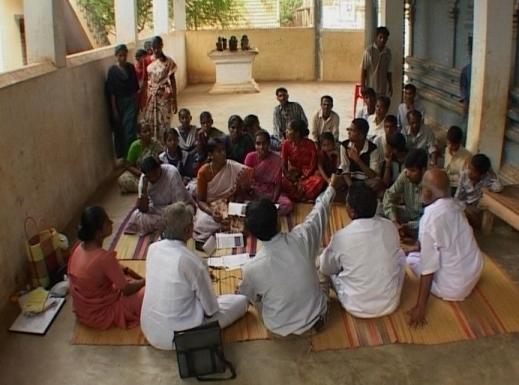
It’s more than mere talk. Some methods involve experiential learning – or learning by doing. An example is participatory hazard mapping. First, community members are divided into a few groups and asked to map their neighbourhoods – they have to capture the roads, footpaths, rivers, hillocks, houses, schools, temples and other key landmarks. Then they mark the areas that have been affected historically with different disasters such as tsunami, floods or cyclones. This helps identify relatively safer areas as well as safety routes in case a new disaster demands quick evacuation. Admittedly this is communication plus social mobilisation, but that’s what it takes in the real world – communication is only part of the solution.

As Buddhi Weerasinghe has written in his chapter, “This exercise allows informal leaderships to emerge. Encouraging this leadership and recognizing their inputs can motivate them and enable sustainability of interventions. The process of hazard mapping also imparts a sense of ownership.”

Question: To what extent is it really practicable to achieve the ‘disaster resilience’ in communities?

Disasters are all about resilience – how we pick ourselves up after a tragedy and slowly return to normalcy. And also how we take repeated battering from a multitude of disasters and still carry on with living. There is no single recipe for success in building disaster resilient communities. Everyone needs to approach this with open and flexible minds, and see what works for whom under which conditions. Disaster resilience is not a slogan like halving poverty by 2015 or writing off majority world’s debt. It’s a long-drawn, incremental process and will always remain a work in progress because both community dynamics and the nature of hazards change over time.

In many cases, the community has information and insights that help achieve resilience, but it needs to be brought out – that’s where participatory communication helps. But let’s not romanticise matters too much – some communities need external guidance, and most can benefit from external facilitation in their quest for resilience.

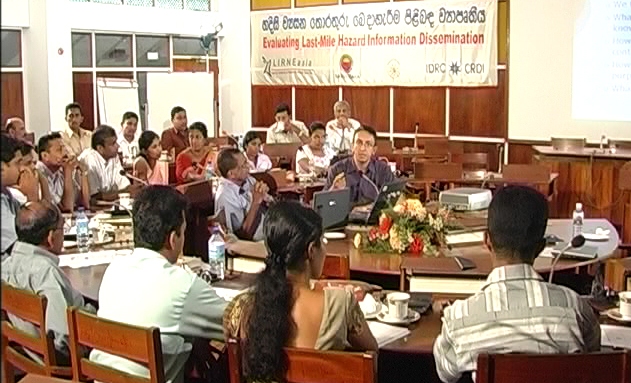
In a chapter called ‘Bridging the Long Last Mile’, I have described the experience of a community-based disaster preparedness and early warning dissemination effort undertaken by Sarvodaya, LIRNEasia and other partners in Sri Lanka. The project studied which ICTs and community mobilisation methods could work effectively in disseminating information on hazards faced by selected coastal communities all of which were battered by the Indian Ocean tsunami of December 2004.
hazinfo-project-meeting-at-sarvodaya.jpg

Sri Lanka – Last Mile Hazard Info project planning meeting: Photo courtesy Sarvodaya

I would refer you to the chapter for details, but the key lessons may be summed up as follows:
• Trusted technology: Use ICTs that are reliable in performance, accessible at the local levels and trusted by the people.
• Complementary redundancy: Always have at least two different ICTs delivering information, to minimise transmission failures.
• Credible information: Tap only the most authentic sources of information at national and international level, reducing room for misinformation and rumour.
• Right mix: Achieve the appropriate combination of technology, training and institutional arrangements at the grassroots.
• Be prepared: Raise localised awareness and provide experiential training so community know what to do when crisis occurs.
book-cover-final.jpg