The Road from Citizen Kane to Citizen Journalist

From Citizen Kane to Citizen Journalist.

That’s the original title given to an essay that I co-wrote with Sir Arthur C Clarke nearly two years ago, at the invitation of the Indian news magazine Outlook.

The editors of Outlook changed it to Arise, Citizen Journalist! — which was fine, though perhaps not as poignant.

Of course, our original title would make sense only if you know what Citizen Kane means. That’s the name of the famous 1941 movie directed by Orson Welles, based on the life and career of American newspaper publisher Charles Foster Kane. The Wikipedia describes Kane as ‘a man whose career in the publishing world was born of idealistic social service, but gradually evolved into a ruthless pursuit of power and ego at any cost.’

Many consider Citizen Kane to be one of the finest movies ever made — some rank it as the best ever.

Image courtesy Wikipedia

In the essay, written within months of the Asian Tsunami of December 2004, we looked at the rise and rise of citizen journalists — taking both a historical perspective and a futuristic scenarios.

On the road thus far, we wrote: “Historically, organised and commercialised mass media have existed only in the past five centuries, since the first newspapers — as we know them — emerged in Europe. Before the printing press was invented, all news was local and there were few gatekeepers controlling its flow. Having evolved highly centralised systems of media for half a millennium, we are now returning to a second era of mass media — in the true sense of that term. Blogs, wikis and citizen journalism are all signs of things to come.

After exploring the corporatisation of the mass media, and its implications for free flow of information and opinions, we ask the question: can the citizen journalist fill the many voids in today’s mainstream media?

The essay quotes John Naughton, a noted British chronicler of the new media, who has watched and commented on the rise of blogging and its impact on the rest of the media. We also refer to researches Shayne Bowman and Chris Willis who have defined citizen journalism as the act of citizens “playing an active role in the process of collecting, reporting, analysing and disseminating news and information”

We raise the all-important question: “Will citizen journalism survive and thrive in the harsh marketplace? The answer to that question lies in our hands—let us not underestimate the power of the discerning media consumer to set new trends (and not forget how mass indifference kills many innovations).

The essay suggests that we should not write off the mainstream media — it has survived and adapted to many changes in both technology and the marketplace.

But our conclusion is definitive: Yet one thing is clear: the age of passive media consumption is fast drawing to an end. There will be no turning back on the road from Citizen Kane to citizen journalist.”

Read the full essay in Outlook magazine’s 10th anniversary issue, 17 October 2005

Read my friend Shahidul Alam on ‘Publishing from the Streets: Citizen Journalism’

Shahidul Alam on citizen journalism on MediaHelpingMedia website

Wanted: Ethical sourcing of international TV news

In recent years, consumer pressure has built up against products made using child labour and blood diamonds. If these are no longer internationally acceptable, neither should the world tolerate moving images whose origins are ethically suspect.

This is a point I have been making for sometime. I feel very strongly about it, because to me, what goes on behind the cameras is as important as what is in front of the cameras — and is therefore seen by millions of television viewers.

Many media researchers and media-watchers don’t pay enough attention to this aspect. Volumes of content analysis are produced on what is broadcast, but do we probe how that content gets on the air in the first place?

My recent blog post, and international op ed essay, on cheque-book development corrupting the broadcast media reiterates this point.

from-mediachannelorg.jpg from-mediachannelorg.jpg

When Al Jazeeera launched its English language international news and current affairs channel in November 2006, I wrote an op ed essay called ‘Ethical Newsgathering: Al Jazeera’s Biggest Challenge’. This was published by media-watch websites on both sides of the Atlantic: MediaChannel.org managed from New York, USA, and MediaHelpingMedia managed from London, UK.

I looked at the track record of the two leading international news channels, BBC World and CNN International, and noted:

“They have increasingly come to epitomise a disturbing trend in international news and current affairs journalism: the end justifies the means.

“Take, for example, a major news story that broke in my part of the world two years ago: the Asian Tsunami of December 2004.

“In a few dreadful hours, the disaster killed, injured or otherwise shattered the lives of millions. The ‘media tsunami’ that followed added insult to injury by turning the plight of affected people into a global circus. The right to privacy and dignity of thousands of affected people was repeatedly violated. The visual media, in particular, had no qualms about showing the dead, injured and orphaned: the story was gory.

One CNN reporter later wrote a whole book recounting those few momentous days, when his team apparently managed to get stories before anyone else. Seemingly because they threw more money, equipment and diplomatic clout than others. The ‘gung-ho’ tone in that book is revolting yet revealing.

“Such journalists’ only operating guideline seems to be: get the story, no matter what — or who gets hurt in that process.”

Read the essay: Ethical Newsgathering: Al Jazeera’s Biggest Challenge, by Nalaka Gunawardene, on MediaChannel.org

Read an earlier essay, Communication Rights and Communication Wrongs, by Nalaka Gunawardene, on SciDev.Net

tv-influence-on-print-media.jpg

In the corporate media world, we the viewers are ‘consumers’ of what the multiple news channels peddle 24/7. Few of us see beyond what comes up on our screens, and even fewer bother about how those images are sourced.

If we want ethical sourcing of TV news content, that pressure must come from us, the consumers. We should react not only to the carefully packaged moving images and soundbytes dished out to us, but also demand to know if these have been acquired in an ethically acceptable manner.

Good journalism is not just a mix of accuracy, balance and credibility (the A, B and C we are taught in journalism school). There is also D (Discernment) and E (Ethical sourcing).

– Nalaka Gunawardene

‘Cheque-book Development’: Paying public media to deliver development agency logos

In their ceaseless efforts to keep their organisations in the media spotlight, spin doctors of development agencies are distorting news values and corrupting the media, turning issue-based communication products into ‘logo delivery mechanisms’.

This is the thrust of my latest op ed essay, titled ‘Cheque-book Development’ corrupting the media. It has just published by the popular media-watch website anchored in the US, MediaChannel.org

Image courtesy MediaChannel.org

In this essay, I draw on several years of first hand observations in development, humanitarian and broadcasting circles at Asian and global levels. I focus on a disturbing practice that more and more development/humanitarian agencies engage in: paying intermediaries for getting their stories on global news and current affairs TV channels.

This is nothing short of cash-for-media coverage.

Here’s an extract:

“As development organisations compete more intensely for external funding, they are increasingly adopting desperate strategies to gain higher media visibility for their names, logos and bosses.

“Communication officers in some leading development and humanitarian organisations have been reduced to publicists. When certain UN agency chiefs tour disaster or conflict zones, their spin doctors precede or follow them. Some top honchos now travel with their own ’embedded journalists’ – all at agency expense.

“In this publicity frenzy, these agencies’ communication products are less and less on the issues they stand for or reforms they passionately advocate. Instead, the printed material, online offerings and video films have become ‘logo delivery mechanisms’.

Image courtesy MediaChannel.org Cartoon courtesy Global Journalist

Some of these communication officers I write about have become friends over the years — I empathise with their pressures, but don’t approve of what their organistions do. As I write in the essay:

“This practice is wrong on two counts. One, allowing intermediaries to sell access to the airwaves is a form of corruption. Two, every time this happens, it siphons off tax-payer supported development funds intended for combating poverty and suffering in the majority world.

“It is the reverse of cheque-book journalism, where some media organisations pay celebrity or other sources for exclusive access to their stories. When development agencies are paying sections of the media to get promotional or favourable stories aired, we must call it ‘cheque-book development’.”

Make no mistake — this is a form of media corruption. It’s not just the development sector’s vanity that fuels this process. Many 24/7 news channels are struggling to fill their hours inexpensively. Some turn a blind eye to ethical sourcing as long as they can have a steady supply of subsidised content.

Read my full essay on MediaChannel.org

Note: Being a US-anchored outlet, MediaChannel.org spells ‘cheque-book’ as ‘check-book’, which is correct in American spelling of English! As I write in my essay, it appears that TV channels and networks on that side of the Atlantic seem a bit harder to corrupt. But then, what do I know?

Read my Nov 2006 essay on MediaChannel.org: Ethical News Gathering Challenge for Al Jazeera

I have been speaking about the growing threat of cheque-book development for some time. For instance, I referred to it during Communicating Disasters: An Asian Brainstorming organised by TVE Asia Pacific and UNDP in Bangkok in December 2006.

Essay republished on Asia Media Forum
asia-media-forum.gif

AV against HIV: Recalling my own ‘Richard Gere moment’

The 8th International Conference on AIDS in Asia and the Pacific, or ICAAP8, opens in my home city of Colombo in a few days’ time. As I wrote in an earlier post, some of us have been blocked out of this important event by some arrogant members of the conference Secretariat. But our interest in HIV/AIDS advocacy will not be so easily deterred.

On a positive note, I have vivid memories of my active involvement in the XV International AIDS Conference, held in Bangkok, which attracted over 17,000 delegates to the Thai capital for a week full of events and activities. One of them was the official 2004 International AIDS Film Festival, which TVE Asia Pacific organised at the invitation of the Thai Ministry of Public Health and the International AIDS Society.

2004 AIDS Film Festival in Bangkok 2004 AIDS Film Festival in Bangkok 2004 AIDS Film Festival in Bangkok 2004 AIDS Film Festival in Bangkok

Over 4 days, we screened close to 50 TV and video films at three venues, drawing a total of more than 8,000 visitors. These films came from all over the world, in response to an open call that we had issued. We received a rich mix of genres: documentaries, docu-drama, current affairs programming, short television spots as well as entertainment formats — animation, dramas and reality television.

Films at this festival captured the kaleidoscope of emotions, challenges and contradictions presented by the AIDS pandemic. They were evidence of how TV and film professionals are covering HIV as a major development concern of our times.

That formidable task — which we summed up as ‘AV against HIV’ — received a boost when movie industry heavyweights joined in. We had documentaries narrated by Angelina Jolie, Will Smith and Glenn Close.

And while we were organising the festival, actor-activist Richard Gere sent the word saying he was interested in being associated with it. Of course we seized the offer, and had him open the film festival — hugely raising its profile in the Thai and international media.

2004 AIDS Film Festival banner by TVEAP Richard Gere arrives for 2004 AIDS Film Festival, Bangkok Richard Gere being welcomed by Thai children

After three years, I can still remember the moving speech that Richard Gere made at the opening ceremony in the Scala cinema in downtown Bangkok. Talking to an audience packed with diplomats, businessmen, journalists, activists and government officials, he said his experience with persons living with HIV had changed his life even more than his study of Tibetan Buddhism.

He recalled how he had lost a very close friend to HIV. “I don’t want anyone else to die like that,” he said, adding: “It (AIDS) has gone on too long, way too long.”

Then he did something simple yet very effective. He asked everyone who knew at least one person living with HIV to put their hands up. A few dozen hands went up in an audience of around 500.

Next, he said: hands up everyone who has lost at least one person to HIV. Some hands went down while three dozen remained held up.

I did not put my hands up for either call.

That was a moment of truth for myself. Until then, I hadn’t really, closely known anyone who was living with HIV (and disclosed that fact to me). I also had not lost anyone to HIV. Not knowingly anyway.

As the event progressed, I sat there asking myself:
• What kind of little comfort zone or cocoon am I living in?
• What kind of society do I live in, where very few people – if anyone – would dare to acknowledge they are living with HIV?
• And how can I remain authentic, communicating HIV from such a detached standpoint?

Richard Gere at XVI AIDS Conference in Toronto, 2006

I’ve been writing and speaking about HIV for almost two decades. In that time, I have touched on many aspects of HIV, including:
• The science of HIV/AIDS, as a science communicator;
• Public health aspects of the global pandemic as a feature writer;
• The human rights dimensions of HIV, as a development communicator; and
• Nexus between media and HIV, as a media watcher/researcher.

But I sat there in the Scala cinema wondering if it was sufficient for me to have done all that with the objectivity of a journalist, or the clinical detachment of a researcher.

I then realised that when it comes to HIV/AIDS, we have to suspend these ordinary frameworks and ‘conditioning’ of our training.

We have to:
• Stop thinking of it as someone else’s problem;
• Get away from the ‘us’ and ‘them’ mindset;
• Understand that no one is immune or buffered from the human immunodeficiency virus, HIV; and
• More than anything else — stop living in denial.

These apply to individuals, communities, society — and also governments.

That was my Richard Gere moment.

Read TVEAP news report on 2004 AiDS Film Festival

See more photos on 2004 AIDS Film Festival on TVEAP website

Photos by Jerome Ming and Indika Wanniarachchi for TVEAP

A Silent Emergency: More television sets than toilets!

Read a later blog post: Faecal Attraction: There’s no such thing as a convenient flush…

It was September 2004. My daughter Dhara, eight years at the time (or ‘eight plus’ as she insisted on saying), had a complaint.

The toilets in her school were not clean enough. She was finding it squeamish to use them. So she was doing her best to avoid going to the loo: she’d drink less, and try to ‘hold back’ until she could rush home.

Like many sheltered middle class kids, she was still coming to terms with the wider world outside her home. And she attends a well endowed private school where, I am told, toilets are cleaned regularly by janitors engaged by the school.

Now we cut to eleven-year-old Susheela, a girl growing up in neighbouring India. I’ve never met her in person, but this sentence summed up her tragic story:
“I was always first in the class. I am very much interested in studies. I want to become a lawyer. But my mother stopped me from going to school after Class V as the middle school I was attending, 5 km from my house, had no toilet. Can someone help me?”

This was the opening of an article on water and sanitation written by Indian journalist Dr Asha Krishnakumar and published in the news magazine Frontline (part of The Hindu group) at the end of 2003. It was titled: A Silent Emergency.

dr-asha-krishnakumar.jpg Image courtesy WSSCC

It was several months later that I actually read Asha’s article. By coincidence, my daughter was having her own ‘toilet issue’ at the time — and the contrast was striking.

Asha’s article continued:
Susheela’s anguish is shared by a large number of girls in India who drop out of school for what sounds like an absurd reason: want of a toilet in school. “Sanitation is closely linked to female literacy in India,” says a United Nations Children’s Fund (UNICEF) study. According to V. Balakrishnan, convener of the Tamil Nadu Primary Schools Improvement Campaign, the lack of proper toilet facilities in schools has a definite and significant bearing on the drop-out rate of girls, particularly around the time they reach Class VIII. In 2000, barely 10 per cent of Tamil Nadu’s 40,000 government schools had usable toilets; the figure is much lower for the country as a whole.

I’d been covering development issues in the media for over 15 years, but this stark reality had not occurred to me. In some developing countries, girls face a greater struggle in enrolling in school and staying on. There are cultural, social and economic factors working against educating girls.

And as Asha’s article revealed, there are other, less known factors adding to this burden.

I shouldn’t have been surprised. Indian census data had revealed in 2001 that, some parts of the country had more television sets than toilets.

Asha’s was one of three dozen excellent media articles on water and sanitation that I read that month as a judge in an international award scheme to recognise the best media reporting on the issue. Organised by the Water Supply and Sanitation Collaborative Council (WSSCC), it was meant to to encourage broader media coverage of water supply, sanitation and hygiene (WASH) issues in the developing world.

The initiative, first launched in 2002, is open to journalists from developing countries, who write or broadcast original investigative reports on WASH issues. The Collaborative Council seeks to use the WASH Media Awards as part of the broader goals of fostering sustainable relations with journalists in developing nations, and increasing media coverage of WASH issues.

WASH has recently announced the next media awards, covering print and broadcast media coverage from 1 July 2007 to 30 April 2008. This time around, it also involves the Stockholm International Water Institute (SIWI).

Winning entries will be presented at the World Water Week in Stockholm , Sweden in August 2008. Deadline for the submission of entries is on or before May 15, 2008. Read the announcement

In 2004, the recipient of the first WASH Media Award was Nadia El-Awady from Egypt for her outstanding article “The Nile and its People”. It illustrated the impacts of industrial pollution, sewage and solid waste management on people’s health and dignity along the River Nile.

We evaluated a large number of high quality entries and decided to give special recognition and Certificates of Appreciation to several other journalists. Asha was one of them.

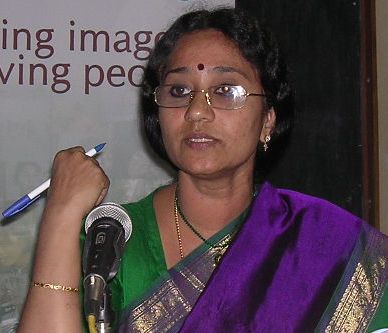
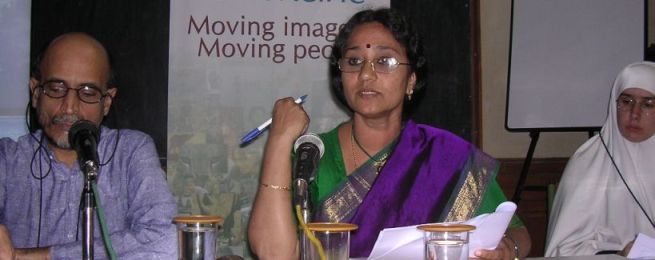
A few months later, it was my privilege to meet Asha in person at a workshop on media and sustainable development that TVE Asia Pacific organised as part of the Education for a Sustainable Future conference in Ahmedabad, India, in January 2005. The photo shows Asha addressing our workshop while Darryl D’Monte, fellow judge in WASH media awards looks on.

l-to-r-darryl-dmonte-asha-krishnakumar-and-nadia-el-awady.jpg

By another coincidence, the lady on the right is Nadia El-Awady who was overall winner of the WASH media award. At the time she was the Health and Science Page Editor of IslamOnline.net. She has since been promoted.

Either the world is smaller than we think, or our networks are larger than we imagine.

But I will always be grateful to Asha for opening my eyes on a silent emergency. One that I have since explained to my daughter. She no longer complains.

Read the WASH press release on 2004 media award winners

Read the publication on WASH Media Awards 2004

Read WASH media guide on The Biggest Scandal of the last 50 Years

Photos by Janaka Sri Jayalath, TVE Asia Pacific

Himal – 20 years of celebrating South Asian diversity

copy-2-of-southasian-map-by-himal.jpg

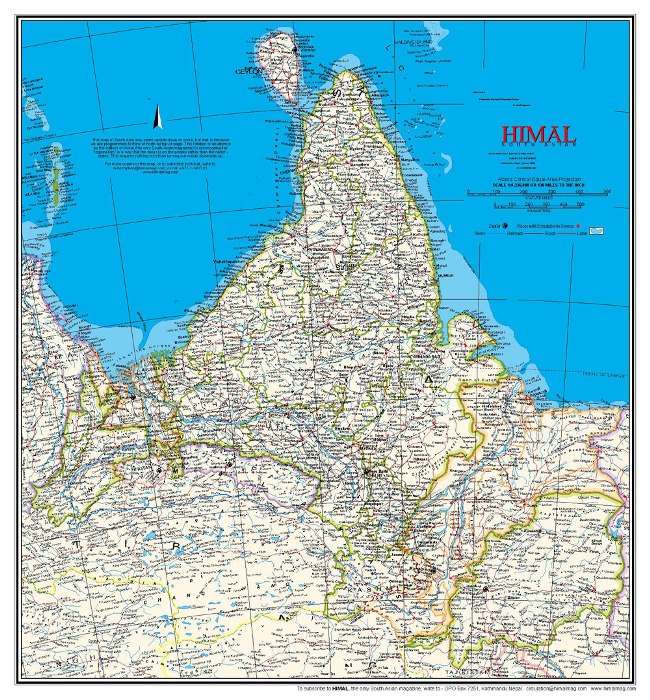
This is a map of South Asia, the sub-region where I live — along with over 1.5 billion other people, a quarter of humanity.

For sure it’s different: things look as if they have been turned upside down. But are they?

This map was published by Himal Southasian, our region’s one and only publication that really thinks and acts in genuinely South Asian terms.

Himal is celebrating 20 years of publication this month, and I join its many friends worldwide in congratulating and saluting this courageous, persistent citizen effort to evolve a regional mentality and identity for the currently divided and fragmented South Asia.

A note on their website reads:
“A friend just told us we had turned twenty. And so we counted the years and indeed it has been two decades since Himal began in 1987. That was the start of our Himalayan phase, and it has been ten years since Himal went Southasian. During the period, some of us have gone from black to grey, others grey to silver.”

That sounds characteristic of Himal’s founder, editor in chief and publisher, Kanak Mani Dixit — one of the most senior journalists in South Asia. He and his journalist brother Kunda Dixit have kept Himal going for two decades.

Kanak Mani Dixit

As with the map, Himal has offered a different, sometimes defiant, perspective on issues of public and topical interest. Staying within the basic principles of journalism, it has challenged assorted tyrants and monopolies; questioned middle class complacency and lampooned South Asian idiosyncrasies.

Except for a short period when its soul was (temporarily) possessed by crusty intellectuals (my favourite definition: people educated beyond their intelligence), Himal has remained readable, passionate and credible — virtues that are not that common in a region that has an abundance of periodicals in English and many other local languages.

Before I get carried away, let me declare that:
1. I’m privileged to count Kanak and Kunda among my friends
2. I occasionally contribute articles to Himal that they are kind enough to print. In that respect, I’m part of the ‘Himal mafia’ and my praise is anything but objective!

But hey, who wants to peddle that cold and clinically detached objectivity that journalism schools continue to advocate? Himal is living proof that one can take a stand, vehemently if needed, and still do good journalism.

As Himal comes of age, I hope it will continue to kick ass, puncture inflated egos and remain outside the ‘mainstream’ for a long time to come. Never give up, guys — too much is at stake!

PS: On the ‘right side map’ itself, Himal explained:
This map of South Asia may seem upside down to some, but that is because we are programmed to think of north as top of page. This rotation is an attempt by the editors of Himal (the only South Asian magazine) to reconceptualise ‘regionalism’ in a way that the focus is on the people rather than the nation-states. This requires nothing less than turning our minds downside-up.

Read greetings to Himal from friends and fans all over the world!

Bill Moyers and the Yes Men: The ultimate media merger?

On 20 July 2007, the Bill Moyers Journal on PBS opened with these words by the inimitable Bill Moyers:

“Here with me now are two partners of Triglyceride Investments, a private equity fund that recently announced its intention of combining the assets of all the hedge funds on Wall Street in order to bring under a single canopy of ownership every media outlet in America. Their prospectus contends that the handful of big media companies that control most of what you see, hear, and read cannot possibly produce maximum return on investment as long as each has to field its own army of lobbyists in Washington.

“If only one holding company instead of four or five controlled all the country’s radio and television stations and all of its cable, newspaper, and Internet outlets, eliminating the need for the competitive purchase of politicians, the savings on campaign contributions alone would increase the bottom line tenfold.

“Not the least of their argument is that since our present media system and Washington so closely mirror each others’ interests, it could even be possible to close down the government altogether and have the country run by Wall Street, saving huge sums of money now spent on perpetuating an impression to the contrary. Joining me are Andy Bichlbaum, the chairman of Triglyceride Investments, and his partner, Mike Bonanno, chief executive of their offshore subsidiary, Tsetse Media Inc., with headquarters in the Marianas Islands.

Bill talks with the two ‘money men’ very seriously for a couple of minutes — before letting on that it’s all a big joke. The two men are not from Wall Street – they’re the ‘Yes Men’ and “they serve up satirical humor laced with lunacy to call the media’s attention to serious issues”.

Read the full transcript of the 21-minute interview

Watch the full interview on PBS Online

The Yes Men are Andy Bichlbaum and Mike Bonanno, two impersonators who use satire to bring media attention to issues that otherwise might be overlooked.

Their premise, from their website, is:
Small-time criminals impersonate honest people in order to steal their money. Targets are ordinary folks whose ID numbers fell into the wrong hands. Honest people impersonate big-time criminals in order to publicly humiliate them. Targets are leaders and big corporations who put profits ahead of everything else.

It all started some years ago when they set up a parody of the World Trade Organization’s website. Somebody mistook it for the real thing and they got a serious invitation to speak as experts at an international conference in Austria.

“We actually see this as a form of journalism. Or perhaps more precisely, the form of collaboration of journalists,” explains Bichlbaum in his interview with Bill Moyers.

“A lot of the issues that we address journalists want to cover. But…in many situations, editorial control won’t let them unless there’s a good little hook behind it. And so, we’ve found a way to create funny spectacles that give journalists the excuse to cover issues.”

To me, their best prank was when they managed to fool BBC World TV in front of a global audience. In December 2004, on the 20th anniversary of the Bhopal gas disaster, “Dow representative” “Jude Finisterra” went on BBC World TV to announce that the company was finally going to compensate the victims with US$ 12 billion, and clean up the mess in Bhopal. The story shot around the world, much to the chagrin of Dow, who briefly disavowed any responsibility. And the BBC was left with egg all over its smug face.

Watch how the mighty news giant fell for a prank by two determined men:

After this, would you ever trust BBC World when it claims to give us the bigger picture?

And here’s the UK Channel Four’s gleeful documentation of how the BBC and other news media fell for the Yes Men:

The Yes Men have also impersonated representatives from Halliburton, Exxon and others, giving public presentations aimed at exposing what they believe to be discrepancies between how these groups want to be seen and how they really act. They call this process, “identity correction.”

While some criticize them for deception and call their hijinx unethical, they argue “these kinds of [corporate and political] wrongdoings are at such a scale – they’re so vast compared to our white lies that we think it’s ethical.”

Take the PBS Online Poll: Do you think the Yes Men’s methods are an acceptable form of social activism?

Mike and Andy released their first film in 2004 entitled, “The Yes Men,” as well as a book, The Yes Men: The True Story of the End of the World Trade Organisation. They are planning on releasing a new film shortly.

If I ever meet them, I’ll have just one question: just how do you suppress the giggles as you fool the gullible?

Who makes the best ‘Alphabet Soup’ of all?

Image courtesy Wikipedia

Take a close look. This is the original Alphabet Soup.

It’s is a kind of soup containing noodles shaped like the letters of the Latin alphabet. According to the ever-helpful Wikipedia, it comes as a prepared, canned vegetable soup with letter-shaped noodles. Read full Wikipedia entry

Metaphorically, alphabet soup means “an abundance of abbreviations or acronyms”. In this sense, the term goes back at least as far as President Franklin D. Roosevelt’s alphabet agencies of the New Deal (1933-38). In the United States, the Federal Government is described as an ‘alphabet soup’ on account of the multitude of agencies that it has spawned, including the NSA, CIA, FBI, USSS, BATF, DEA and INS.

But Uncle Sam’s expertise in making alphabet soups has been challenged by another entity – the United Nations. (Interestingly, Roosevelt was an architect of the UN, and coined the term with Winston Churchill). The UN’s propensity for enriching the alphabet soup has few parallels.

In the early 1990s, when I was earning a living as a UN consultant in Asia, I had to wade through the sea of acronyms and abbreviations as part of my daily bread. Funnily enough, some high-level peddlers of arconyms no longer even remembered what they stood for!

The UN has enriched the alphabet soup even more in the years since. MDG is a current favourite – it stands for Millennium Development Goals, a blue print for achieving basic socio-economic development by 2015.

It’s not just the UN, but the entire development community that is in love with coining abbreviations and then liberally bandying them about. Some are manageable. Others are unpronounceable tongue-twisters. PLWHA comes to mind – that stands for Persons Living with HIV/AIDS.

And then there are too many meanings or expansions for the same abbreviation, causing confusion to those who don’t know the context. ICT is a good example. We in media and development circles use it to mean Information and Communications Technologies. But the Wikipedia shows at least another two dozen meanings for the same three letter combination!

Journalism taught me to explain every technical term and abbreviation when introducing it. I still do, but on the whole I avoid abbreviations if we can help it.

But I have to watch out. A colleague reminded me recently that I’ve been happily coining inhouse acronyms myself. Examples:
GBR – The Greenbelt Reports (Asian TV series)
STP – Saving the Planet (Asian regional project and upcoming TV series)
D4C – Digits4Change (Asian TV series)

Does this make me a minor chef in expanding the Alphabet Soup?

Maybe it does! If I can’t beat ’em, I’ll join ’em….

Playing Shahrazad; Telling Stories to Save Ourselves…and the Planet

I’ve been silent on this blog for over 20 days. I like to think that was for a good cause.

Well, I was frightfully busy organising and running a small Asian regional workshop in Khao Lak, Thailand – it was part of TVE Asia Pacific’s Saving the Planet project.

Saving the Planet is telling real life stories to save our planet in peril. It was inspired by the Arabian Nights.

Remember how the clever and beautiful Shahrazad saved herself and other women in her kingdom from the murderous King Shahriyar? Once betrayed by a wife, the wicked ruler had embarked on a killing spree where he would wed a virgin bride everyday, and have her beheaded the day after the wedding. All girls and women in his kingdom were threatened.

That is, until, beautiful and clever Sharrazard volunteered to be the next bride. Facing an assured death, she starts telling the king engaging stories that holds him spell-bound. Her story, or stories, since many tales are interwoven and imbedded into the first, lasts for 1001 consecutive nights.

This story-telling captivated the king’s attention and held his patience with its fantastic and mysterious tales, its vivid descriptions and breath-taking heroism. Shahrazad’s story-telling is in itself a heroic and life-saving device, which finally forced the king to spare the wise and courageous girl’s life. Apparently he gave up his killing ways after that experience (if only some of our modern day rulers were so easily reformed!).

Image courtesy Rose TheatreImage courtesy Middleeast UK.comImage courtesy Middleeastuk.com

Read more about Arabian Nights

Story telling is more an art than a science. Shahrazad used it to save her life, and lives of all other women in her kingdom. Mythical as it may be, we can draw a few lessons from the Arabian Nights on what kind of stories to tell — with visible effects.

Good journalism is all about telling stories — real life stories about what happens to real world men, women and children. Mixing journalistic skills with development stories as we do, Saving the Planet is an attempt to tell a few good stories from the Asia Pacific — about individuals and organisations who are engaged in education for sustainable development, or ESD.

As we introduce the project on its dedicated website:
Confronted with a range of environment and development problems, the world is looking for bright ideas to sustain life on the planet. Education at all levels can shape the world of tomorrow, equipping individuals and societies with the skills, perspectives, knowledge and values to live and work in a sustainable manner. Education for Sustainable Development (ESD) is a vision of education that seeks to balance human and economic well-being with cultural traditions and respect for the earth’s natural resources.

copy-of-saving-the-planet-logo.jpg dd8.gif

Saving the Planet started with an open competition – we asked people to nominate projects or activities in developing countries of Asia that are communicating or educating their communities on any aspect of sustainable development. Not just ‘green’ issues (e.g. recycling, conservation) or scarey issues like climate change and ozone depletion, but also ‘brown’ issues (e.g. sanitation, cleaner production) and what I call ‘black and white issues’ – human rights and social justice.

We received dozens of nominations, which we turned over to a regional selection panel. Their final selection was announced in mid May 2007 – see my blog post on the winners.

Read more about the winning stories on Saving the Planet website

The idea is for us to go out and film each of these winning projects for an Asian regional TV series. But ahead of that, we brought to Khao Lak, Thailand, two representatives of each project/organisation for a week-long workshop, 2 to 6 July 2007.

That workshop sought to strengthen the communication skills and capacity of the six organisations. Not just in moving images, which we dabble in, but in new media and older media as well. In short, how to use media and other communication tools to reach out to different audiences and, hopefully, influence them in positive ways that help them — and the planet.

This is why Saving the Planet is also story telling for survival – and here we are talking about the survival of not just one individual, but of all life on the planet. And instead of one evil king, our story tellers are confronted with a multitude of threats to our survival, many of them of our own making.

The analogy with the Arabian Nights is not as far-fetched as it might seem. The success of the Arabian Nights stories over many other forgotten folk tales may be due to their blend of popular themes: heroic and romantic adventures are littered with mystery, old wisdom and exciting struggles between good and evil. Almost all tales have three main elements or notions. Firstly, if there is a problem, there is a solution. Secondly, endurance can enable a crisis to reach a resolution. And finally, fantastic elements help the protagonists to maintain their endurance.

So one thing we kept probing and discussing was how to package serious (and often perceived as ‘boring’) development messages in ways that engage and entertain groups or communities we are trying to reach.

I’ll write more about the workshop when I have a chance. The official report of the workshop will go up on TVEAP and Saving the Planet websites within a few weeks.

For now, here’s the photo of our participants, together with the resource team and my colleagues from TVE Asia Pacific.

participants-and-resource-team-of-saving-the-planet-workshop-in-khao-lak-july-2007.jpg

Saving the Planet is implemented by TVE Asia Pacific in collaboration with the Asia/Pacific Cultural Centre for UNESCO (ACCU),Tokyo, Japan, within the framework of ACCU-UNESCO Asia-Pacific Programme under the UNESCO/Japan Funds-in-Trust for the Promotion of Education for Sustainable Development.

Joey R B Lozano: The legacy continues…at Silverdocs

I met Joey R B Lozano only once, but he left a deep impression.

A small-made man with passionate zeal and tons of energy, he was every inch an activist-journalist-campaigner. We had invited him to a regional workshop of factual video producing and distributing partners from across Asia that we held in Singapore in November 2002.

We hadn’t worked with Joey earlier. He came recommended by our international partner Witness, which uses video-based advocacy and activism for promoting and safeguarding human rights worldwide.

Joey R B Lozano Joey R B Lozano Joey R B Lozano

Joey used his personal video camera to assert indigenous land rights, and to investigate corruption and environmental degradation in his native Philippines. Joey was an independent human rights activist and also one of the country’s leading investigative reporters.

He freelanced for the Philippine Daily Inquirer, covering Indigenous peoples’ rights and the environment, considered the two most dangerous beats in the Philippines. But years earlier, he had moved out of the capital Manila, and committed his life and career to stories and issues at the grassroots that many of his city-based colleagues had no time or patience in covering on an on-going basis.

Trained as a print journalist, Joey mastered new media and technologies whose potential he quickly realised. He moved into television and video media with ease, and later became an active blogger.

Joey’s TV investigations began in 1986, when he helped ABC’s 20/20 to uncover the “Tasaday hoax”, a highly successful fraud to pass off local tribespeople as a newly discovered Stone Age culture.

He soon embarked on his own investigations and started digging into illegal logging, gold mining and land-grabbing. In turn, his exposes quickly earned him repeated assassination and abduction attempts, in a country that is one of the more dangerous places to practice journalism.

When he came to Singapore, Joey had recently ‘starred’ in a major Canadian documentary titled Seeing is Believing: Human Rights, Handicams and The News, which looked at how committed, passionate individuals were using new communication technologies to change the world.
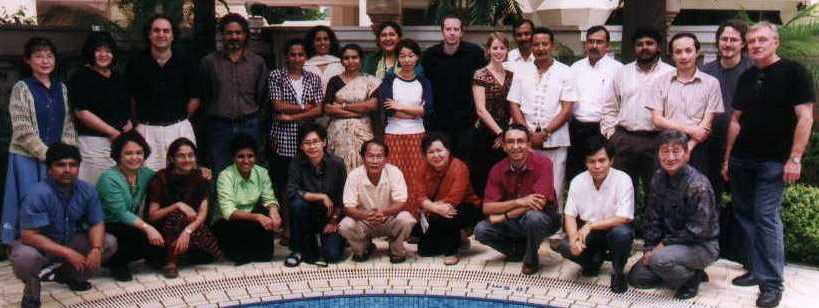
participants-at-tveap-partner-workshop-singapore-nov-2002.jpg

Photo of Singapore TVEAP workshop participants: Joey Lozano is 6th from left on the frontmost row

Follow Seeing is Believing storyboard on the film’s website

We screened the film, made by Katerina Cizek and Peter Wintonick, and heard first hand from Joey on what his struggles entailed. The film followed Joey as he delivers a new “Witness” donated video camera to Nakamata, a coalition of Indigenous groups in Central Bukidnon. Together, Nakamata and Joey begin documenting a dangerous land claims struggle, and it doesn’t take long for tragedy to unfold in front of the camera.

Watching the film and then listening to Joey — and his Witness colleague Sam Gregory — describe the on-going struggle, was one highlight of our week-long workshop. Some of us saw in Joey the activist-campaigner that we wanted to be, but were too scared or too polite to really become.

Not everyone shared that view. The cynicism — sometimes bordering on disdain — of a fellow Filipino from Metro Manila was palpable. No wonder Joey moved away from the city.

We at TVE Asia Pacific were extremely keen to distribute Seeing is Believing, for it held such a powerful and relevant message for our region, but it was not to be. Our enquiries showed that like most documentaries, it was tied up in too many copyrights restrictions and commercial distribution deals.

Following the Singapore workshop, I did keep a watchful eye on what Joey Lozano was up to. The film’s website provided occasional updates, and sometimes blog posts from Joey himself.

Our paths never crossed again. Almost three years after our single encounter came the news that Joey had passed away. It wasn’t the assorted goons who hated his guts that finally got him. His own body turned against him.

His tribute on the film’s website started as follows:

Joey Lozano defied the odds. For three decades, he survived dangerous missions to defend human rights using his video camera, in the Philippines, a country that ranks high, year after year, for most journalists killed. Joey went into hiding numerous times, and he dodged two assassination attempts. Once, bullets whizzed past his ear as he made his escape on motorbike.
But Joey couldn’t beat the odds of cancer. He died in his sleep on September 16, 2005 – at home and surrounded by his family.

Joey R B Lozano - image courtesy Seeing is Believing

The spirit and legacy of Joey R B Lozano live on. He inspired a large number of journalists and activists to stand up for what is right and just — and to be smart about it in using modern information and communication technologies, or ICTs.

Joey and other Witness activists were pioneers in different parts of the world who turned handicams away from weddings and birthday parties to capture less cheerful sights and sounds the world must see — and then act on. They were at it years before mobile phone cameras, YouTube and user-generated content in the mainstream media.

And now, Witness has established an award at the Silverdocs film festival. The WITNESS Award in Memory of Joey R.B. Lozano will be awarded to the qualifying SILVERDOCS filmmaker of a feature-length film who has produced a well-crafted and compelling documentary about a human rights violation or social justice issue. The winning filmmaker will also have a thoughtful, creative, and feasible outreach plan to use their film as a tool to raise awareness of the human rights or social justice issue explored in the film with a goal to bring about change.

The inaugural award was announced on June 17 — and has been won by “The Devil Came on Horseback” by Annie Sundberg and Ricki Stern.

Joey was a Witness partner and board member. He co-produced many films and collaborated on others that helped raise awareness about threats to indigenous people’s rights in the Philippines from corporations, and the complicity of the government in the abuses. Witness was founded in 1991 by musician peter Gabriel and the Lawyer’s Committee for Human Rights to put new technologies into the hands of local activists around the world.

Joey R B Lozano with his handycam

Read International Wildlife May 1999: Why Joey Lozano Is A Marked Man – investigative reporter works for the environment

Read about and watch Rule of the Gun in Sugarland