Asian Tsunami of December 2004: A moving moment frozen in time

An Indian woman mourns the death of a relative killed in the Asian Tsunami

An Indian woman mourns the death of a relative killed in the Asian tsunami. The picture was taken in Cuddalore, Tamil Nadu, on 28 December 2004 (REUTERS, Arko Datta)

From every disaster, conflict or tragedy emerges a single photograph that captures its essence in a way that becomes iconic. This image, showing the sheer haplessness of those who survived only just barely but lost everything they had, could well be that for the Asian tsunami of December 2004.

It was taken by Indian photojournalist Arko Datta, who won the 2004 World Press Photo Award for this image.

Indian journalist Max Martin (editor of indiadisasters.org) recently interviewed Arko Datta for a chapter in Communicating Disasters: An Asia Pacific Resource Book (co-edited by myself and Frederick Noronha, and just released). The chapter is titled ‘Stop All the Clocks! Beyond Text: Looking at the Pics’, which argues that disaster photography needs to break away from the constraints of time and space.

Excerpts from that interview:

On frames
I actually do not plan a frame. I am merely a messenger and do not try to bring in subjectivity or my priorities (in my photographs). I have to be very objective when I am covering any event. I leave the viewers to interpret the pictures according to their perspective. However, of course there are certain parameters I like to follow.

I do not like showing corpses or any (image of) morbidity unnecessarily. In natural disasters it is mostly unnecessary; however, in a war, one may need to show the victims as that may be the strongest way of making people aware of the fallout of wars.

In a natural disaster, the story is generally about the survivors — their struggle to cope with the loss of their near and dear ones, their struggle to get back to normalcy. It’s the story of their grit and determination to survive and live.

On emotions
The first viewer of my pictures is myself. When I am touched by a situation, I plan to capture it in my camera and show it to others too. So, definitely, as any other human being, I react to every situation too. However, while on work one has to control and restrain one’s emotions, as no productive work can emerge during an emotional state of mind.

Arko Datta
While covering an event, and covering several events over the years, these emotions keep getting suppressed and bottled up. One needs to know how to tackle this in the long run, or it can deeply effect one’s mind. And everyone has his or her own way of tackling it. I do so by talking to my family and very close friends about my experiences.

On interfacing with humanitarian workers
I feel, on the field, humanitarian workers have their own work to do and the press has its own. The humanitarian workers should not get concerned about the press, as definitely the victims will be their top priority. The press can surely manage on its own. In fact, the press should not come in the way of relief and rescue work.

Here’s his profile from World Press Photo:

Arko Datta started his professional photojournalistic career in an Indian dailies in Madras and Calcutta. He then worked at AFP, and joined Reuters in 2001. His awards include national photo competition prizes from the Indian government, a prize in the Canon International photo competition, a Publish Asia award in Malaysia, Best Photojournalist of the Year award from Asian Photography magazine in India, the Picture of the Year award in Bombay and awards in the General News and Daily Life categories of the Indian Express Photo Competition. His publications include “Lost Childhood”, a book on child labor sponsored by the International Labor Organization, and his pictures are featured in a coffee table book of the most memorable pictures of India in the last 100 years and in the Reuters picture book “On the Road”.

Download the full book chapter by Max Martin, titled: Stop All the Clocks! Beyond Text: Looking at the Pics

Read or download the full book’s contents at TVEAP website

Communicating Disasters: Lessons From Titanic to Asian Tsunami by Arthur C Clarke

What do the RMS Titanic, which sank on her maiden voyage in April 1912, and the Asian Tsunami of December 2004 have in common?

Both were maritime disasters and, when they happened, both shook the world as few others did before or since.

And now, Sir Arthur C Clarke has linked the two tragedies that happened 92 years apart: he says they both illustrate how communications failures can compound the impact of a disaster.

Writing a foreword to Communicating Disasters: An Asia Pacific Resource Book (co-edited by myself and Frederick Noronha, and just released), the inventor of the communications satellite revisits the two disasters that left deep impressions in his mind.

communicating-disasters-an-asia-pacific-resource-book-by-tveap-and-undp.jpg sir-arthur-clarke-by-shahidul-alam.jpg

Arthur C Clarke was born five years after the sinking of the ‘unsinkable’ RMS Titanic while on her maiden voyage. His home town Minehead, in Somerset, was not more than a couple of hundred kilometres from Southampton, from where the Titanic set off, he says, adding: “All my life, I have been intrigued by the Titanic disaster.”

He is particularly interested in what happened to the Titanic’s distress call after she hit the iceberg at 11.40 pm on the night of 14 April 1912. “A series of unfortunate factors compounded the disaster. The most ironic among them was that the wireless operator on the Californian, located closest to the Titanic, had shut down for the day just 30 minutes before the first distress call was sent out. Had the Californian been listening, it could have responded hours before the Carpathia, the eventual rescue vessel.”

The Titanic disaster prompted the shipping community to introduce a 24-hour radio watch on all ships at sea. It also consolidated the role of maritime radio in distress signalling and rescue operations.

But, as fate would have it, the absence of a timely warning once again characterised the second disaster to touch Sir Arthur’s life. Arriving 10 days after his 87th birthday, the Asian Tsunami of December 2004 left a massive trail of destruction in his adopted country Sri Lanka and several other countries bordering the Indian Ocean.

He reflects:
“Astonishingly, a full century after the invention of radio, the Tsunami arrived without any public warning. The disaster’s death toll could have been drastically reduced if its occurrence — already known to scientists — was disseminated quickly and effectively to millions of coastal dwellers living on its predictable path. Even a half hour’s notice would have allowed people to run away from the coast, and in many affected locations there was just enough time to get to safety. But alas, that didn’t happen — and tens of thousands perished.

“It was appalling that our sophisticated local and global communications systems completely failed us that fateful day. The communications satellites that I invented, and the global Internet that one of my stories inspired, could have spread the warning, with the hundreds of radio and television channels across coastal Asia amplifying it.

“It is now known that the failures were human, not technological. To ensure better results next time, we need to achieve an optimum mix of technology, management systems and community preparedness — not just for tsunamis, but for many other hazards that we live with. We have to remember that delivering credible early warnings to those who are most at risk is both an art and a science.”

copy-of-tsunamis-legacy-in-southern-sri-lanka.jpg

In his foreword, Sir Arthur sees the Asian Tsunami as a turning point for citizen journalism – ordinary people armed with digital tools bearing witness to unfolding events and then sharing it with others. He writes: “On 26 December 2004, many holiday-makers on affected beaches were armed with video cameras, and it was their ‘amateur’ images that later showed us the full force and fury of the unfolding disaster. Because it was distributed over a large area and occurred during peak holiday season, the Asian Tsunami was probably the most widely filmed disaster in history.”

This was not the first disaster that ‘citizen journalists’ covered, says Sir Arthur, but it marked a turning point in the growing phenomenon enabled by information and communications technologies (ICTs). “The post-Tsunami coverage showed that the professional and amateur divide had now blurred; there is a clear (and complementary) role that each can play.”

ICTs can do much in good times and bad, but as Sir Arthur recalls, the Tsunami also reminded us how disasters can make our information society vulnerable. “When electricity and telephone services — both fixed and mobile – went down in the worst affected areas, a century old technology came to the rescue: amateur radio enthusiasts restored the first communication links with the outside world, sometimes using the Morse Code to economise the power of car batteries.”

He quotes the President of the Radio Society of Sri Lanka as saying, “When all else is dead, short wave is alive.”

Sir Arthur’s perceptive foreword is a sobering counterpoint to the post-tsunami frenzy that we witnessed in the Indian Ocean rim countries. Yes, lacking a tsunami warning system – such as the one Pacific Ocean countries have – is a big gap that needed to be filled. But governments and development donors have rushed into setting up high tech, high cost early warning systems without due consideration for social, cultural and political realities of the intended beneficiary countries.

As we saw with some subsequent undersea quakes – such as the one off the resort town of Pangandaran, Java, on 17 July 2006, and the one off off Bengkulu, Sumatra, on 12 September 2007 – we have yet to achieve the right mix of technology, management systems and community preparedness in most coastal countries in Asia.

Governments, donors and UN agencies would do well do heed the wise words of Sir Arthur Clarke, who concludes his Foreword with these words:

“Communicating disasters — before, during and after they happen — is fraught with many challenges. Today’s ICT tools enable us to be smart and strategic in gathering and disseminating information. But there is no silver bullet that can fix everything. We must never forget how even high tech (and high cost) solutions can fail at critical moments. We can, however, contain these risks by addressing the cultural, sociological and human dimensions — aspects that this book explores in some depth and detail, from the perspective of both media professionals and disaster managers.

“The lessons of history are clear: if we are not careful, we can easily lull ourselves into the same kind of false confidence that doomed the Titanic.”

Read the full text of “Communicating Disasters: A Century of Lessons”, By Sir Arthur C Clarke
communicating-disasters-a-century-of-lessons-by-arthur-c-clarke.pdf

Or download foreword as contained in the printed book

GlobalVision at 20: Insiders turned outsiders keep kicking


GlobalVision, the path-breaking media company anchored in New York with a truly global outlook and a strong commitment to social justice, completed 20 years this week.

It was launched in November 1987 out of one room in Soho (New York) as a mission-driven company with little money but a big idea: to improve news coverage of the world through an “inside-out” approach that would offer voices not usually heard on the air in the US.

The founders were Danny Schechter, who became, in his words, a “network refugee” from ABC News 20/20 and Rory O’Connor, then with CBS News 48 Hours.

As the company introduction says:

“The whole world is watching… From Baghdad to Beijing, from Madrid to Manhattan, information is moving at the speed of light. Media and communications technology are transforming our lives — and those of our six billion neighbors. But in the emerging global village, whose stories get told — and who gets to tell them?

“At Globalvision, we believe in telling stories from the inside out. That means working with other cultures — not at them –and helping people to tell their own stories in their own way, to a world that’s getting smaller every day.”

In an industry saturated with media companies known more for their style than substance, Global Vision has not only blazed new trails, but used moving images in ways that moved people towards social change, political reform and – just as importantly – constantly question and challenge conventional wisdom and traditional authority.

They have also never hesitated to challenge the fellow journalists and corporate media on their servility, acquiescence and willing suspension of journalistic norms in the United States, especially under the current Bush administration.

They have won numerous awards and professional recognition for its pioneering international newsmagazine South Africa Now, which first broke through censorship to smuggle footage out of what was once the land of apartheid — and later chronicled Nelson Mandela’s transition from prisoner to President.

The company followed up with another award winning series, Rights & Wrongs: Human Rights Television with Charlayne Hundter-Gault, which aired for four years in sixty-two countries around the world.

Danny and Rory have also directed and produced more than thirty hard-hitting documentaries, many involving controversial issues and investigations — some for the PBS “Frontline” series” and others for television systems worldwide. Current films deal with subjects such as America’s child farm workers, bridging the global digital divide, flawed media coverage of the War in Iraq, and the ongoing debt crisis that threatens the global economic system.

I met Danny in person only once – in the Fall of 1995, when I spent a few weeks in New York on a fellowship to study the United Nations. Danny was one of the more colourful people we met (besides lots of men in suits from the UN, only a few of whom I can now recall by name). Danny introduced himself as a (TV) ‘network refugee’ — and gave a workshop on television journalism in defence of the public interest and human rights that had a lasting influence on myself.

Ever since, I have followed his books, incisive NewsDissector blog and Global Vision output with much interest.

So here’s wishing Danny, Rory and team at GlobalVision many more years of kicking ass!

MediaChannel.org: Global Vision marks 20th anniversary

Read Danny Schechter on: The Days of Our Dominion: Global Vision celebrations 20 years in the trenches

Rory O’Connor’s tribute to the late Anita Roddick, a long-standing supporter of Global Vision

“Hands up who is poor, speaks English – and looks good on TV!”

“Hands up who is poor, speaks English – and looks good on TV!”

With that title, I opened my panel remarks to the 8th Annual Symposium on Poverty Research in Sri Lanka on the morning of 30 November 2007.

Sri Lanka’s Centre for Poverty Analysis (CEPA) had invited me to speak during a session on ‘Taking it off the page: Alternative mediums of communication to influence change’. The theme of the overall symposium was ‘Communicating research and influencing change’.

Part of my talk was on challenges in using moving images to communicate development related research. The other part was on how most sections of the mainstream media covers stories of the poor — or those living at the bottom of the income pyramid.

I noted that as Asia’s billions strive for a better today and better tomorrow, there are millions of stories at the bottom of the pyramid. But most mainstream media manage to miss these stories due to their ignorance, or arrogance, or both.

But reporting from the bottom of the pyramid need not be all about doom, gloom and alarm. In fact, so much is happening there that a well informed story-teller won’t have much time to spend on negativity (while acknowledging a great deal of suffering that remains).

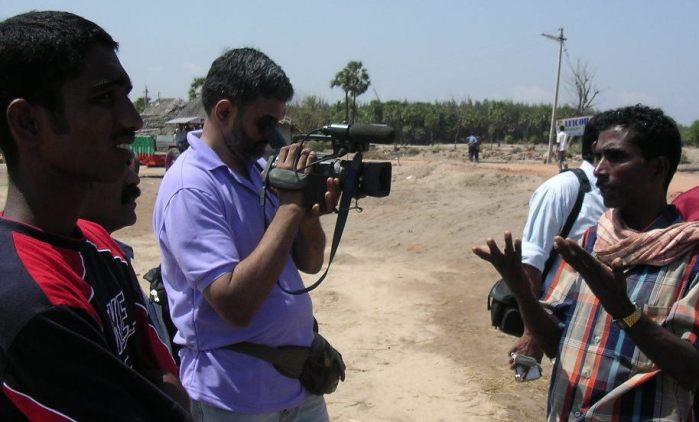
interviewing-tsunami-survivor-in-tamil-nadu-india.jpg

In my remarks, I emphasised that to discover these stories and tell them with empathy and accuracy, we as story-tellers need to recognise a few basic realities:
• The poor are not another species to be treated as if they were endangered! They are living and loving human beings as complex and nuanced as anyone in this room.
• Nor are the poor a ‘sub-human species’ with a simpler set of needs and aspirations. They have as many primary, secondary and tertiary needs – just like anyone else!
• When it comes to information, they have not only survival and practical information needs (which many development projects try to provide), but also what I call ‘information wants’ – cultural and social information – which many development projects completely ignore.
• The poor have opinions too — and are often more articulate and expressive when someone cares to listen and capture these.

So telling media stories from the Bottom of Pyramid needs the knowledge base, socio-cultural understanding and ethical framework in which to gather and process these stories. We at TVE Asia Pacific don’t claim to have got everything right, here are our basic rules of engagement:
• We treat the rich, middle class and poor alike – extending the same courtesy and respect (including obtaining personal clearances for interviews).
• We caption everyone on-screen by name and location, irrespective of their social and economic status.
• We film people – for interviews or generic footage – only with informed consent.
• Wherever possible, we take our the finished TV products back to where they were filmed and share with those who told us their stories. (We are not alone in this: I have written blog posts about Earthcare Films of India and the Brock Initiative of the UK who are also doing this.)

Our industry of broadcast TV is not always known for its class-less treatment of every human being with respect and dignity. In fact, the poor often become ‘Canon-fodder’ for camera crews looking for dramatic images of human suffering.

from-mediachannelorg.jpg from-mediachannelorg.jpg

The globalised media continue to use stereotyped images of the global South – captured mostly by northern photographers and camera crews. As my friend Shahidul Alam, founder of Drik Picture Library in Bangladesh, says: “Invariably, films about the plight of people in developing countries show how desperate and helpless they are…. Wide angle black and white shots, grainy, high contrast images characterise the typical third world helpless victim.”

This explained my title: “Hands up who is poor, speaks English and looks good on TV!” It’s a caricature of how some camera crews go looking for that convenient sound-bite with some doom-and-gloom visuals to match.

But it’s not just the northern media who sensationalise and oversimplify life at the bottom of the pyramid in the South. Many of our own media outlets, rooted in the cities and obsessed with middle class life styles, are also good (or bad) in this game!

And the media are not alone. When development agencies and ‘pro-poor’ activists presume – in their middle class arrogance – that the poor only need survival or sustenance related information, the latter is immediately reduced to sub-human status.

Nov 2005 op ed: Communication rights and communication wrongs


Nov 2006 op ed: Ethical news gathering: Al Jazeera’s biggest challenge

Aug 2007 blog post: Wanted: Ethical sourcing of international TV News

Road to Bali: Beware of ‘Bad weather friends’!

unfcccnew-c.jpg

All the environmental roads — well, actually flights — seem to lead to Bali in the coming days.

The Indonesian ‘Island of the Gods’, famed as a tourist resort, will play host to the 13th United Nations Climate Change Conference from 3 to 14 December 2007.

The Conference, hosted by the Government of Indonesia, brings together representatives of over 180 countries together with observers from inter-governmental and non-governmental organizations, and the media. The two week period includes the sessions of the Conference of the Parties to the UN Framework Convention on Climate Change (UNFCCC), its subsidiary bodies as well as the Meeting of the Parties of the Kyoto Protocol.

The Bali meeting will be a turning point in the global response to climate change, an issue which has moved above and beyond being a simple ‘green’ concern to one with economic, security and social implications. The annual meeting returns to Asia after five years, since New Delhi, India, hosted the 8th meeting in November 2002.

In the build up to Bali, a new report released on 19 November 2007 says that without immediate action, global warming is set to reverse decades of social and economic progress across Asia, home to over 60 per cent of the world’s population.

Up in Smoke? Asia and the Pacific – with a foreword by Dr Rajendra K Pachauri, Chairman of the Nobel prize-winning Inter-governmental Panel on Climate Change (IPCC) – is the most extensive and concluding chapter of a unique, four-year long exercise by the Up in Smoke coalition, an alliance of the UK’s major environment and development groups.

The report shows “how the human drama of climate change will largely be played out in Asia, where almost two thirds of the world’s population live, effectively on the front line of climate change.”

When our friends at the International Institute for Environment and Development (IIED) in London sent me the press release about the report last week, something caught my eye. Among the several accompanying quotes was this one concerning the media:

“In many Asian countries climate change stories don’t make it into the media, so the public are left out of the debate. The challenge for decision-makers and the media is to stimulate interest in their work and translate the complex issues into stories that capture the public’s imagination. Climate change above all requires the engagement of everyone in creating the changes required.”

This sweeping statement is attributed to Rod Harbinson, Head of Environment, Panos London.

I know Panos London well, and am surprised to read an official remark of this nature emerging from that organisation which, until recently, has tried to relate to the majority world media as a friend and supporter. In fact, the first time I had one of my own pieces internationally syndicated was by Panos Features, back in 1989.

Come to think of it, the second article I wrote for Panos Features concerned how the low-lying, Indian Ocean island nation of Maldives was preparing for adverse impacts of climate change. That was years before the web, so there’s no link I can provide.

As a development writer and journalist who has covered global climate change among other issues for two decades, I have problems with Mr Harbinson’s remark.
Drik/Majorityworld
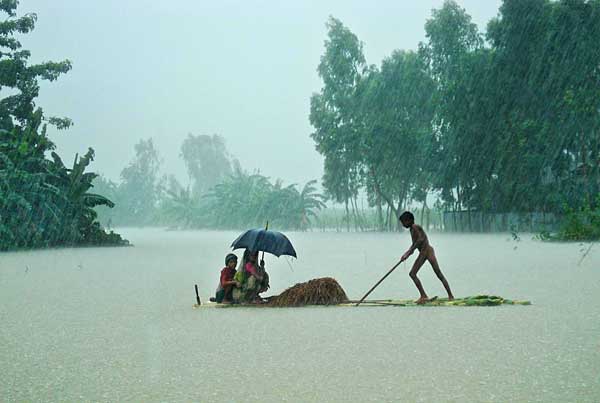
Photo: A family looks for shelter using a raft made of banana trees during the last Monsoon: 31 July 2007: Gaibandha, Bangladesh © Quddus Alam/DrikNews Linked from Shahidul News

I’m in full agreement on the need to ‘translate the complex issues into stories that capture the public’s imagination’. There is also no argument that climate change requires the engagement of everyone.

But I would be very interested to know on what statistical or analytical basis he says “in many Asian countries climate change stories don’t make it into the media, so the public are left out of the debate’.

Asia, as Mr Harbinson should surely know, is not just China, India and Indonesia. It is large and highly diverse region, containing five sub-regions as defined by the UN. It is home to nearly two thirds of humanity, who live in over three dozen independent states or dependent territories.

Living in Asia and trying to work at regional level, I know how difficult it is to make any generalisations about this rich and constantly changing assortment of economies, cultures and societies branded as Asia (which, taken together with the small island nations of the South Pacific, is known as the Asia Pacific). In fact, it’s wise not to speak about Asia as a whole, for there is little in common, say, between Japan and Laos, or between China and Maldives.

The Asian media are as diverse as the region, and have been undergoing rapid change in recent years. Unshackled from the state’s crushing grip in most countries, the broadcast media (radio, TV) have proliferated and emerged as the primary source of information for a majority of Asians. New media – web, mobile devices and multimedia combinations – are now changing the way many Asia’s communicate and access information.

I have always been curious how Panos London, perched at its cosy home in London’s White Lion Street, assesses what goes on in the majority world. In this case, how much of Asia does Mr Harbinson know and is really familiar with? How many Asian media outlets has he or Panos monitored, assessed and sampled before coming to this sweeping and damning conclusion about the lack of climate change stories in the Asian media?

And how many of these outlets are radio and TV, and in languages other than English? I would really like to know.

If Panos London believes in evidence-based analysis, then it owes us in Asia an explanation as to on what basis its head of environment makes such statements about an entire continent, whose media output is predominantly in Asian languages, not English. And whose principal media are broadcast, not print.

And what constitutes a climate story? Tracking the endless array of inter-governmental babble in the name of working out some compromised partial solution to the major problem? Or reporting on campaigns to clean up polluting industries or sectors (such as transport) that generate most of the greenhouse gases? Or focusing on how humble communities in remote corners of the world are finding how their lifestyles and livelihoods are suddenly threatened by something they hardly understand?

To me, it’s all of the above — and a lot more. Climate change is akin to a prism through which many, many development issues and topics can be analysed. Just as HIV/AIDs long ago ceased to be a simple medical or health story, climate change has moved well beyond being an environmental story.

The more angles, perspectives and topics that are covered in the media, the better. And all of it need not be in that staid, cautiously balanced style of The Guardian or BBC that Panos London must be more familiar with.

Panos London, in its statement of beliefs, says ‘Freedom of information and media pluralism are essential attributes of sustainable development’. Surely, then, they realise that media pluralism includes speaking in a multitude of tongues, and analysing from many different perspectives — as happens in the Asian media 24/7, if Mr Harbinson and his colleagues care to spend more time in the region and keep their eyes and ears open.

But instead, they seem more like a group of well-meaning people with a solution in search of a problem. For the past many months, Panos London has been crying wolf about the allegedly poor coverage of climate issues in the majority world media.

That was the main thrust of a report they published in late 2005, titled Whatever the weather – media attitudes to reporting climate change.

According to Panos London website that I have accessed today, “…the survey found that there is little knowledge among journalists about these important choices and they are rarely discussed. The dramatic impacts of extreme weather events, for example, rarely feature in relation to climate change and the topic remains low on editors’ story sheets.”

The survey was based on ‘interviews conducted with journalists and media professionals in Honduras, Jamaica, Sri Lanka and Zambia’ and claimed to ‘give insights into the attitudes of journalists and the status of the media in these countries.’

Well, I was one of those majority world journalists covered by the survey — and I had major reservations about how they used my responses. Being cautious, I had used email (and not the phone) to respond to their survey questions – I therefore have a complete record of everything I said. When the draft report was shared on my request, I found some of my responses being distorted or taken out of context. I had to protest very strongly before some accuracy was restored. I later regretted having agreed to be part of this dubious survey.

It was flawed in many ways. The questionnaire was very poorly conceived and structured. I actually declined to answer some questions which were worded in such a way as to elicit just the kind of response that Panos London wanted — to make a case that journalists in the majority world are so incompetent that they need help.

A glaring omission in the final report was that it carried no list of journalists interviewed. I had to ask several times before I could even find out how many others participated in the survey (apparently some three dozen). But my requests for a list of other survey respondents were repeatedly declined by Panos London, who said it was privileged information. They later took the position that European data protection laws did not allow them to disclose this information!

In an email sent to Rod Harbinson on 22 Feb 2006, I said: “I would argue that Panos London had pre-conceived notions that it wanted to present in this report, and used superficial and largely unprofessional interview surveys with a few scattered journalists as a rubber-stamping exercise to publish what it wanted to say anyway. This is further borne out by the fact that some of my more outspoken responses have been completely ignored.”

I have seen or heard nothing since to change the above view. And the contents of Whatever the weather – media attitudes to reporting climate change are consistent with what Rod Harbinson says in the IIED press release that prompted me to make this comment.

Yes, climate change is the Big Issue of our times that needs everyone to rally around and search for ‘common but differentiated’ solutions and responses. But no issue or global threat is too big to warrant the willing suspension of time-honoured journalistic or academic values of honesty, integrity and balance. Issuing lop-sided ‘survey reports’ and making sweeping negative statements do not help the cause of improving public discussion and debate on climate change.

The road to Bali and beyond is going to be an arduous journey. On that treacherous road, we in the majority world need to beware of ‘bad weather friends’ who come bearing bad surveys and self-serving offers of ‘help’.

— Nalaka Gunawardene

Note: In the spirit of communication for development and media pluralism, I invite Panos London to respond to the above critique, and offer to publish their response in full.

I remain a critical cheer-leader of the global Panos family, and serve on the Board of Panos South Asia, an entirely independent entity that has excellent relations with Panos London. Like all families, we don’t always agree – and that’s part of media pluralism!

Related blog posts:

Nov 2007: True ‘People Power’ needed to fight climate change
Nov 2007: Beyond press release journalism: Digging up an environmental business story
Oct 2007: The Al and Pachy Show: Climate Change gains public momentum

Aug 2007: Arthur Clarke’s climate friendly advice: Don’t commute; communicate!
June 2007: Sex and the warming planet: A tip for climate reporters
April 2007: Can journalists save the planet?
April 2007: Beware of Vatican Condoms and global warming
April 2007: Pacific ‘Voices from the Waves’ on climate change
April 2007: Wanted – human face of climate change!

Al Jazeera English is one: Getting better at imitating its rival BBC World!

al-jazeera.jpg

Al Jazeera English (AJE), the world’s newest global news and current affairs channel, completed one year on the air on 15 November 2007.

This in itself is a commendable accomplishment, and we extend heart-felt first birthday greetings to the channel that entered the highly competitive arena of global newscasting offering to ‘balance the information flow from South to North, providing accurate, impartial and objective news for a global audience from a grass roots level, giving voice to different perspectives from under-reported regions around the world.

AJE wanted to revolutionise English language TV in the same way Al Jazeera turned Arabic TV world upside down, ending the monopoly of the airwaves by state broadcasters.

First, the good news. AJE has done well on some fronts, adding to the diversity in international news and current affairs television, and enriching the often endangered media pluralism in a world that is, ironically, having more broadcast channels than ever before in history. It has brought to us stories ignored by other news outlets, while offering us somewhat different takes on widely covered stories.

In a self-congratulatory note and video clip posted this week on YouTube, the channel says: “A year ago Al Jazeera English was launched, marking the start of a new era in international journalism. In the last 12 months we have brought a fresh perspective to world events and shed light on many of the world’s little reported stories.”

Here are some of the highlights compiled by AJE.

In another post on its own website, AJE offers a selection of exclusive video stories from its correspondents to show how it ‘continues to set the news agenda’.

We also salute AJE for withstanding the unofficial yet widespread ‘block out’ of its distribution by North American cable operators, depriving most viewers in the US and Canada the opportunity of watching it on their TV screens. In a nifty move, the channel started placing some of its more consequential content on YouTube, making it available to anyone, anywhere with a sufficiently high speed Internet connection.

Image courtesy Al Jazeera

And now, on to the not-so-good news…

If AJE in its first year somewhat stood apart from the other two global newscasters – BBC World and CNN International – that was occasional and superficial, and not quite consistent or substantial. In fact, the only thing that AJE has consistently done is to under-deliver on its own lofty promise of doing things differently.

As I wrote in a blog post in August 2007: “I’m looking long and hard for the difference that they (AJE) so emphatically promised. Instead, I find them a paler version of BBC World, at times trying oh-so-hard to be just like the BBC!”

Of course, AJE – or any other broadcaster, for that matter – is fully entitled to set a trend or follow a model already set by another channel, even that of a rival. But to so blatantly imitate the BBC while all the time claiming to be different is simply not credible.

And credibility is the most important virtue for a news and current affairs media operation. Earn and sustain it and the world will be on their side. Lose it, and they will be the laughing stock on the air.

I’m not suggesting that has happened yet. But as I cautioned in an op ed written days after AJE started broadcasting in November 2006, “unless it’s very careful and thoughtful, AJE runs the risk of falling into the same cultural and commercial traps that its two rivals are completely mired in.”

Here’s a simple test. If viewers were to watch AJE, BBC World and CNN International without logos and any other tell-tale branding, how many would be able to tell the channels apart?

To me, CNN is in a league of its own for a variety of positive and negative reasons. Their offering is technically and professionally superior, even if I have objections to some of their editorial choices and analysis.

However, it’s harder to discern differences between the often befuddled BBC World and its enthusiastic imitator, Al Jazeera English. Perhaps it’s no coincidence that the latter has a significant number of former BBC reporters and presenters, many of who have been poached. While that again is a choice for AJE’s management, they must realise that we the viewers in the global South do not want a global channel rooted in our part of the world to dress up in the BBC’s increasingly discredited clothes.

And then there is the whole question of ethical sourcing of content — an important consideration which most global, regional and national TV channels continue to ignore. Many roaming news journalists’ key operating guideline seems to be: get the story ahead of rivals, no matter what — or who gets hurt in that process.

That business as usual must end. As I have argued in this blog and elsewhere: “If products of child labour and blood diamonds are no longer internationally acceptable, neither should the world tolerate moving images whose origins are ethically suspect.”

Aug 2007 blog post: Wanted: Ethical sourcing of international TV news

Nov 2005 op ed on SciDev.Net: Communication rights and communication wrongs, by Nalaka Gunawardene

In August 2007, I critiqued some Sri Lanka related stories appearing on AJE’s People & Power strand, pointing out some ethically questionable practices in how their reporter got the story, possibly placing some of her sources and interviewees at personal risk. To her credit, the reporter Juliana Ruhfus engaged me in this blog, explaining her side. Read the full exchange here.

But there are other key areas where AJE needs to very carefully guard its image and credibility. In the past year, the world’s assorted development and humanitarian agencies have realised that it’s ‘cool’ to be seen on Al Jazeera than on BBC and CNN. Some of their propagandists (sorry, public information officers) had beaten a path to AJE offices in London, Doha and Kuala Lumpur, seeking to cut various deals to get coverage.

Yes, the development and humanitarian communities certainly have worthwhile messages and issues to communicate, many of which need urgent, wide dissemination. Tragically, what most agencies seek is self-promotion and ego-massaging, not issue based discussion. It is precisely this alarming trend of paying media outlets to carry agency propaganda that I have labelled ‘cheque-book development’.

Aug 2007: ‘Cheque-book Development’ – paying public media to deliver development agency logos

It’s no secret that BBC World has shamelessly allowed its airwaves to be sold for cash by assorted ‘touts’ claiming to have privileged access to the once-respected broadcaster. In the past year, some of these touts have extended their tentacles to AJE. We don’t yet know if these are entirely pro bono acts of goodwill by AJE, or if money has exchanged hands somewhere along the line.

If the latter has happened, we ardently hope that someone within AJE would blow the whistle in their own collective self interest. Or perhaps AJE wants to be too much like BBC World in every respect — including the corruption part?

Meanwhile, the real challenge to Al Jazeera remains exactly what I said one year ago: to usher in real change, it needs to transform not just how television news is presented and analysed, but also how it is gathered.

Despite having a code of ethics for its conduct, the well-meaning, south-cheering channel has yet to rise to that part of the challenge. Let’s hope that in its second year, Al Jazeera English would spend less time imitating its rivals, and more time in living up to its own promise.

Personal note: Some readers have asked why I continue to hold AJE to higher standards in a world where media ethics are being observed in the breach all the time. It’s simply because I still see AJE as the best hope for the majority world to tell its own stories in its own myriad voices and accents. I desperately want AJE to succeed on all fronts, not just in audience ratings, signal coverage and market penetration. For that, it must fast find its identity and stop defining itself by its rivals.

Protect journalists who fight for social and environmental justice!

In June 2007, I wrote about the late Joey R B Lozano, a courageous Filipino journalist and activist who fought for human rights and environmental justice at tremendous risk to his life.

For three decades, Joey survived dangerous missions to defend human rights using his video camera in the Philippines, a country known for one of the highest numbers of journalists killed in the line of duty. Joey went into hiding numerous times, and he dodged two assassination attempts.

Last week, a leading Filipino academic and social activist called for greater protection for local level journalists who cover social and environmental justice issues risking their life and limbs.

“Things are pretty savage at the grassroots level in some of our countries. Journalists who investigate and uncover the truth take enormous personal risks – the vested interests hire killers to eliminate such journalists,” said Professor Walden Bello, executive director of the Focus on the Global South (photo, below).

He was speaking at the Greenaccord Media Forum on 10 November 2007 in Frascati, Rome, where several dozen journalists covering environmental issues had gathered for a four-day meeting.

He delivered an insightful survey of social movements across Asia on environmental and public health issues
, where he questioned the role of elites in the global South in standing up for what is right and fair for all people.

During question time, I asked him how he saw the media playing a role in social movements that he’d just described. It varied from country to country, he said, and gave several examples.

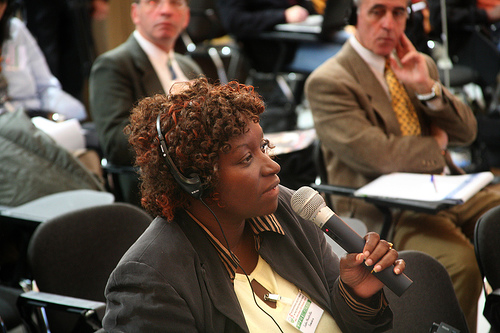
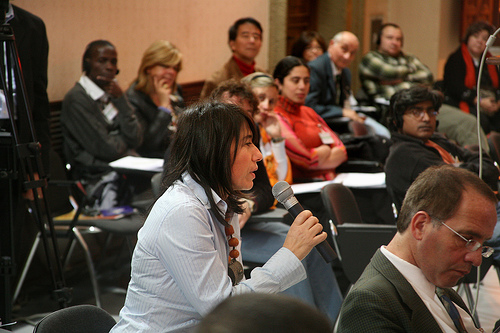
zadie-neufville-from-jamaica-makes-a-point.jpg

In China, most environmental exposes in recent years have been made by ‘very brave journalists’. Their investigations have compelled the local and central authorities to address the massive incidents of pollution and environmental degradation resulting from China’s economic march forward.

In South Asia, the record is uneven. Indian publications like The Hindu newspaper and Frontline magazine are at the forefront in reporting and analysing ‘almost exhaustively’ on environmental struggles in the world’s largest democracy.

In contrast, Singapore and Malaysia have no critical mass media to turn the spotlight on excesses or lapses, he said. In these countries, journalists as well as activists have turned to the web to express themselves — but even they are under pressure from their governments.

In Thailand, the two English language newspapers The Nation and Bangkok Post have both have a long tradition of covering environmental issues and supporting mass movements. A number of Thai language newspapers also have sustained coverage.

In his native Philippines, Prof Bello singled out the Philippine Daily Enquirer for persisting with environmental coverage and exposing environment related scandals. But that comes with its own risks.

“At the local levels, journalists who take up these issues face many threats, including the very real risk of extra-judicial killings. The Philippines is one of the most dangerous countries in the world today for independent journalists and human rights activists,” he added.

Journalists living in the provinces and reporting from the grassroots are more vulnerable than those based in the cities. This is precisely why local journalists need greater support and protection to continue their good work.

The local elites and officials would much rather silence such journalists. International solidarity for such journalists could make a big difference, Prof Bello said.

He had a suggestion for his hosts, Greenaccord, which annually organises what is now the world’s largest annual gathering of journalists and activists concerned about the environment: Invite and involve more local level journalists in the future forums.

That will give them a voice, and strengthen their resolve to continue the very important work they do.

Read April 2007 blog post: Can journalists save the planet?


Meeting photos courtesy Adrian Gilardoni’s Flickr account

Beyond coffee and bananas: We need fair trade in international media!

Fair trade is gaining momentum worldwide. More products are coming within the scope of fair trade in more countries.

That’s certainly good news in a world full of exploitation, inequality and unfairness at various levels.

But are we, in the mass media whose business it is to gather and deliver news and information, yet part of this good news ourselves? In other words, isn’t it high time there was fair trade in international media products too?

This is the simple question I raised this week at the V Greenaccord International Media Forum on the Protection of Nature, held from 7 to 11 Novmeber 2007 at the historic Villa Mondragone in Frascati, some 20km southeast of Rome.

During the 3.5 day international gathering of journalists and scientists concerned about the environment, we had several speakers referring to fair trade in Europe and at a global level. As more consumers become aware of environmental and social justice considerations, they are doing something about it in their buying of goods that are fairly traded, we heard.

The Wikipedia describes fair trade as ‘an organised social movement and market-based model of international trade which promotes the payment of a fair price as well as social and environmental standards in areas related to the production of a wide variety of goods.’

The movement focuses in particular on exports from developing countries to developed countries, most notably handicrafts, coffee, cocoa, tea, bananas, honey, cotton, wine and fresh fruit.

Fair trade is all about creating opportunities for small scale producers in the developing countries to get organised and supply directly to consumers in different parts of the world. When they sell direct, with few or no intermediaries, they can earn three or four times more, and that money will enhance their incomes, living standards and societies.

Read more about fair trade at Oxfam website, Make Trade Fair

Fair trade is certainly a cherished ideal, but it’s mired in complex economic and political realities. The globalised march of capital, profit-maximising corporations and developed country farm subsidies are among many factors that make fair trade difficult to achieve.

Fair trade activists are well aware of these realities. Their success is built on connecting producers with individual consumers. The proliferation of new media – especially the Internet – has made it easier to sustain such communications.

But the fair trade movement is still largely rooted in goods, not services. In my view, this is necessary but not sufficient in a modern world economy where nearly two thirds of global GDP comes from the services sector. (The Wikipedia’s breakdown for global GDP is agriculture 4%; industry 32%; services 64%).

I can’t immediately find how much the print, broadcast and online media contribute to that 64%, but it must be significant in the media saturated world today. And certainly the flow of media products — text, audio, photographs, moving images, online content and derivatives of these — has become more globalised in the past two decades.

So why not begin to agitate for fair trade in media products when they cross borders? Why aren’t we practising fair trade in our own media industry even as we cover fair trade as a story in our editorial content?

I didn’t get a very clear answer from fair trade activists that I posed this question to this week. While agreeing with me that the same fair trade principles can be applied to the media sector, they acknowledged that each sector has its own dynamics and must develop realistic ways to accomplish fair trade.

So it’s up to us who produce, distribute and manage assorted media products to begin this transformation from within.

Let’s not kid ourselves about what we are taking on. As I wrote in a blog post in September 2007:

“In the media-rich, information societies that we are now evolving into, media and cultural products are an important part of our consumption — and therefore, more of these have to be produced. In the globalised world, more television and film content is being sourced from the majority world — or is being outsourced to some developing countries where the artistic and technical skills have reached global standards.

“But in a majority of these media production deals, the developing country film and TV professionals don’t enjoy any fair terms of trade or engagement. Their creativity and toil are being exploited by those who control the global flow of entertainment, news and information products.

“This is why the top talent in the global South become assistants, helpers and ‘fixers’ to producers or directors parachuting in to our countries to cover our own stories for the Global Village. Equitable payments and due credits are hardly ever given.”

In the same commentary, I added:
“Unfair trade in film and TV is also how the unsung, unknown creative geniuses contribute significantly to the development of new cartoon animation movies or TV series, as well as hip video games that enthrall the global market. Lacking the clout and skill to negotiate better terms, freelancers and small companies across the global South remain the little elves who toil through the night to produce miracles. They work for tiny margins and even tinier credit lines. Some don’t get acknowledged at all.”

Read my blog post: Wanted: Fair trade in film and television!

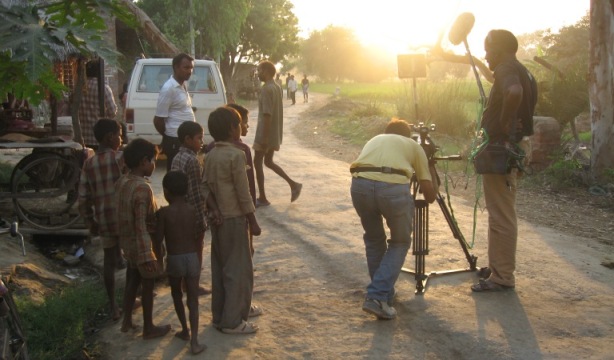
tveap-camera-crew-in-lucknow-india.jpg

Raising this amidst 60 journalists and producers from Africa, Asia, Europe, Latin America and the Caribbean attending the annual Greenaccord meeting, I pointed out that many of us were keen to contribute to media outlets beyond the countries where we are based. It gives us a chance to tell our stories to a bigger audience, and to have our voices heard about a range of issues and topics important to our communities.

And yes, the additional income that such work brings in is quite useful too, thank you.

Heads were nodding when I pointed out how hard it is for a talented, hard working journalist based in the majority world to break into the tightly controlled international media outlets. Even when they make an occasional breakthrough, they are often exploited by being paid lower professional fees for the same output and quality of work.

Or worse, majority world journalists are slighted and insulted for being where they are and who they are, rather than be judged on the merit of their work. As I wrote in a commentary published by SciDev.Net in November 2005: “Media gatekeepers in the North often dismiss the better-informed and equally competent Southern professionals — saying, insultingly, that ‘they don’t have the eye’! And for years, I have resisted the widespread practice of Northern broadcasters and filmmakers using the South’s top talent merely as ‘fixers’ and assistants.”

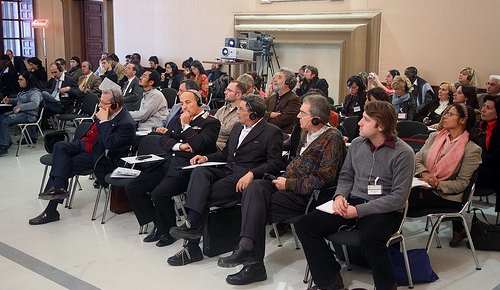
greenaccord-v-forum-in-progress-nov-2007.jpg

All this makes it imperative for us in the globalised media — in the developed North and developing South — to begin agitating for fair trade in media products and services. As in other products, we are not looking for charity or tokenism or a lowering of standards. We must strive for fairness and equality while working on building the capacity of southern journalists to generate world class media products.

And as my friend Darryl D’Monte — whom we missed dearly at this year’s Greenaccord forum — has been saying for years, publishing each other’s stories is one great step forward.

Mahatma Gandhi put it this way: we must be the change we wish to achieve.

Note: My own organisation, TVE Asia Pacific, practises what I preach here, and always engages local camera crews when we film TV stories across Asia. We will be taking up Fair Trade in Film and Television (FTinFT) as a campaign from 2008.

Read other related blog posts:

Images from the Majority World: Global South telling its own stories

Wanted: Fair trade in film and television!

Image of camera crews courtesy Pamudi Withanaarachchi of TVEAP.

Meeting photos courtesy Adrian Gilardoni’s Flickr account

Beyond press release journalism: Digging up an environmental business story

“Don’t reproduce press releases from companies, or accept their corporate PR. To get to the real stories, journalists have to dig deeper and work a bit harder.”

Paolo Pietrogrande
, Chairman of Atmos Holding, offered this piece of advice when talking to an international group of journalists at the V Greenaccord International Media Forum on the Protection of Nature, held from 7 to 11 Novmeber 2007 in Rome, Italy.

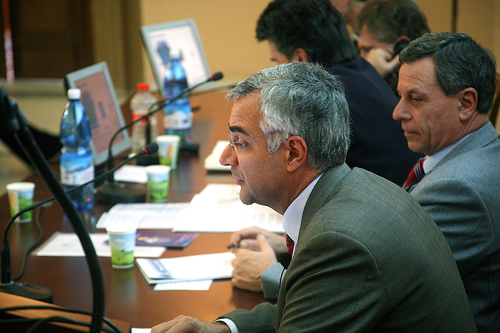
Pietrogrande (seen speaking in photo, below) was talking on ‘new investment scenarios in renewable energy sources’ during a session on sustainable economic mechanisms. A New York based Italian businessman with past experience in Ducati Motor, General Electric, Bain&Company and Ryanair, he suggested that many positive environmental business stories were being overlooked by the media.

paolo-pietrogrande-addressing-greenaccord-v-meeting-nov-2007.jpg

According to him, there are billions to be made in clean energy and clean technology sectors in the coming years — and venture capitalists and other investors have already recognised this potential. Real Money is now being invested in these sectors, often below the media’s radar and without any fanfare.

This is not corporate social responsibility (CSR), philanthropy or ‘greenwashing’ PR. These are hard-nosed investors who fully expect good and dependable returns on what they put in. They do due diligence and take expert advice before putting in their billions into such emerging sectors.

Yet, immersed in peddling doom and gloom stories – especially on climate change these days – most media outlets miss out on these stories which have significant business and environmental angles.

His advice to journalists included these tips:
* Don’t look at press/media sections on corporate websites, which is usually full of PR. Even CSR reports are carefully crafted to give a rosy picture. The real stories lie elsewhere.
* Instead, read the annual reports of companies, especially the CEO’s letter to shareholders. That’s a carefully crafted statement and analysis which contains a good deal of information.
* Stop replying on press releases, and certainly don’t get into the habit of recycling them in news stories. Instead, look at public disclosure documents of companies for leads and insights.

The environment has moved way beyond CSR and corporate PR, he said. More and more companies realise how environmental compliance increases their efficiency and thus profitability. Whole new business areas and opportunities are opening up for those working on clean energy and clean technologies. The impetus has come from concerns on global climate change.

greenaccord-v-forum-in-progress-nov-2007.jpg

If Pietrogrande sounded a bit like Carl Sagan – talking of billions and billions – that is understandable. He sees vast potential in clean energies and clean technologies that can help reduce carbon emissions causing global warming. Industry has traditionally made profit emitting carbon, and now there is money – and profit – to be made cleaning it up.

Investors are lining up with the money, but good ideas and projects are in short supply, he said.

Which reminded me of something that the American engineer, architect and visionary Buckminster Fuller once said: “There is no shortage of energy on this planet. There is, however, a serious shortage of intelligence”.


Meeting photos courtesy Adrian Gilardoni’s Flickr account

Journalists and scientists seeking Green Accord

Can journalists save the planet?

This was the question I raised in a blog post written in April 2007. Arguing that environmental journalists alone cannot adequately address the multitude of complex environmental challenges faced today, I wrote: “We urgently need more good journalism that covers sustainable development as an integral part of mainstream human affairs.”

For the past five years, an Italian non-profit cultural association named Greenaccord has been attempting just this. In the (northern hemisphere) Fall of each year, they invite and host 50 – 60 journalists and scientists from all over the world to discuss how the media can be an integral part of society’s response to today’s environmental crises. In fact, they believe the media must play a path-finder role in our search for solutions.

During this week, I have been attending the V Greenaccord International Media Forum on the Protection of Nature, held from 7 to 11 Novmeber 2007 at the historic Villa Mondragone in Frascati, some 20km south east of Rome.

It has been a time to meet old friends again and to make new ones. I have been part four of the five Greenaccord media forums since the first one was held in Rapolane Terme, in the Tuscany valley in northern Italy in 2002.

Greenaccord is the only regular (annual) meeting that I know of where practising journalists and media gatekeepers come together from all regions of the world to discuss the state of the planet and state of their profession.

Each year, we have some ‘regulars’ returning while new participants join the growing network. As some old hands noted this week, it is evolving into an extended family.

That family consists mainly of print and broadcast media journalists from Africa, Asia, Europe, Latin America and the Caribbean. Many are engaged in ‘deadline journalism’ of news and current affairs, while a few of us, like myself, have moved on to more reflective and analytical kind of journalism. We also have a few researchers, activists and public information officers among us, enriching our discussions with a diversity of perspectives.

To engage this group of participants over three and a half days, Greenaccord invites a dozen or so scientific or industry experts from different regions of the world and different disciplines. This year’s theme, ‘Capitalising on the Environment’, was explored by business leaders, fair trade activists, economists and a number of technical experts specialising in fields such as clean energy, clean technology and organic farming.

greenaccord-v-forum-in-progress-nov-2007.jpg

As with all meetings, some speakers were far more interesting than others. And some sessions were blessed with competent chairpersons who kept overenthusiastic speakers in check and allowed meaningful discussion and debate to happen.

Sitting through such meetings is a bit like gem mining. One has to sift through a lot of gravel to find a rare precious gem. When that happens, it’s well worth the hassle.

Well, I’ve had my share of gravel moments (zzzzzzzzzzzzzzzzz!) and precious moments (Eureka!) this week. I’ll write separate blog posts on some of the latter. They are indeed worth sharing.

The real stars (or gems if you like) in this whole exercise are the participants themselves. We come from such diverse backgrounds – the sessions are supported by simultaneous interpretation in English, Spanish and Italian, with an occasional remark in French – that we enrich each other by simply being there.

emanuela-gasbarroni-from-tve-med-intervenes.jpg

Some of us can barely contain our passion for what we do, and keep making comments or asking questions at every available opportunity. Others are more quiet during sessions but expressive during the many hours of networking and socialising over fine Italian wine, coffee and gastronomical treats. All these are part of Greenaccord’s cultural diversity that we contribute to, and then celebrate.

Even if we don’t take ourselves too seriously, we do discuss sobering issues. On the one hand, the planet is in peril, largely thanks to human bungling over generations. On the other, mass media itself is in crisis in many countries — under siege from oppressive governments, grappling with limitations of money and skills, and facing competition from new media platforms grabbing audiences and revenue.

For example, a colleague from Cameroon found the government closing down his privately owned FM radio station just a couple of days before he left for Rome. Others had worrying tales to share about official censorship, physical violence unleashed on media organisations and journalists, and the tension between media owners’ interests and the public interest.

We expressed solidarity and support for all Greenaccord colleagues currently experiencing difficulties of various kinds. The spirit of camaraderie in this network is strong – and keeps growing.

So is all this networking and meeting hopping a distraction from real work, which each one of us have to perform at our desks, or in our studios, on an individual basis? I don’t think so. Far from being a drag on my time, I find gatherings like Greenaccord inspiring and energising. They also remind me that I’m not alone in the daily struggle and drudgery of deadlines, government bureaucracies, funding crises and a never-ending race to keep up with new media technologies.

A planet in peril and a media in crisis need more platforms like this to connect and support many more of our kind who weren’t in Rome this week. Greenaccord isn’t perfect (we’re working on it), but it has lit more than a few candles against the looming darkness.

– Nalaka Gunawardene, Frascati, Rome: 10 November 2007

zilia-castrillon-speaking-at-greenaccord-v-nov-2007.jpg


Meeting photos courtesy Adrian Gilardoni’s Flickr account