Financial Meltdown: Putting pieces together of a gigantic whodunnit

this says it all...
My cartoon of the year: this says it all...

This cartoon by Pulitzer prize winning Tom Toles first appeared in the Washington Post in 2007 – it brilliantly anticipated the global financial meltdown that we’re now experiencing. Coming in the wake of confirmed global warming, it is a double whammy.

America has been hit hard by the sub-prime crisis. The social and human cost of financial failure has been enormous. An epidemic of home repossessions has left thousands of houses abandoned and boarded-up: whole suburbs are falling into disrepair and dereliction.

Financial institutions in America and in Britain had poured billions into investments backed by these mortgages. As more and more people have defaulted on their mortgage repayments, financial markets have collapsed, causing a crisis that has rippled across the Atlantic, sending the City of London into turmoil and pulling the plug on one now infamous British bank.

Some call it a financial tsunami not been seen since the Great Depression in the 1930s….a crisis that has forced the US government to step in and save the financial system after trillions were wiped off global stock markets and once revered institutions were swept off the face of Wall Street. Is the US intervention too little, too late to save the economy?

In fact, just a few days ago, the People’s Daily of China warned that a “financial tsunami” was approaching, which recalled the Great Depression in the US. It said: “As the contemporary economy has been integrated globally, American consumption and currency exchange rates will directly influence countries dependent on the US as the main export destination for economic growth and employment”.

The Chinese Communist Party organ complained that the US had unleashed financial “weapons of mass destruction” on the world economy in the form of subprime debts and related financial derivatives.

The world’s media have been scrambling to cover these rapidly unfolding events. In fact, many have been caught napping, or worse, been uncritical cheerleaders of the march of capital and credit. Most of them – even the respected financial journals – just didn’t see the crisis building up…or ignored the tell-tale signs that constituted an inconvenient truth.

Danny Schechter - wasnt crying wolf!
Danny Schechter - wasn't crying wolf!
“This didn’t just happen in the course of a usual business cycle,” insists the American investigative journalist and media analyst Danny Schechter, who has been tracking this issues for many months on his influential News Dissector blog and the MediaChannel that watches and critiques the media.

In his new book, aptly titled Plunder, Danny offers an in-depth investigation into the decline of the economy that’s causing millions to lose jobs and face foreclosures and across-the-board price hikes.

He says: “You wouldn’t know it by relying on our media, but the subprime scandal masks massing looting by Wall Street firms using carefully calculated predatory lending schemes enabled by regulators who don’t regulate and a media that looked the other way. We have lost trillions and dislocated millions with no relief in sight. Every American is paying for the greed of our financiers in the grocery store, gas pump and unemployment line. Bank robberies are not new — but banks doing the robbing is.”

Read the introduction to Danny Schechter’s Plunder.

In 2007, his film IN DEBT WE TRUST was the first to expose Wall Street’s connection to subprime loans, predicting the economic crisis that this book investigates.

I have been watching various news media analysis of the current crisis and want to share two that stood out from the rest: Inside Story by Al Jazeera English, and Dispatches by UK’s Channel 4.

In a special show from New York, Inside Story looks at the financial turbulence that rocked the US last week. Will the emergency measures by the US government be enough to stabilise the markets or has the financial system in the US been changed forever? The introductory report from AJE’s Washington correspondent Reynolds is particularly illuminating – he also writes the story for their website.

Inside Story – The US financial crisis – 21 Sep 2008 – Part 1

Inside Story – The US financial crisis – 21 Sep 2008 – Part 2

From the other side of the Atlantic comes a more investigative, one-hour special that was produced and broadcast in March 2008, when the early signs of the banking crisis were beginning to show – for anybody who cared to notice.

As Channel 4 introduces it: “This is a story about the destructive power of finance: what happens when banks are driven by short-termism; when bankers are rewarded with vast bonuses, free to operate under inadequate regulatory supervision, and with the complicity of a government too in awe of big business to step in.”

Dispatches: How The Banks Bet Your Money UK & US – part 1

In this edition of Dispatches, private equity financier Jon Moulton delivers a stinging rebuke to the banks for causing this financial meltdown and explains why the British taxpayer will now pay the price.

Dispatches: How The Banks Bet Your Money UK & US – part 2

Dispatches: How The Banks Bet Your Money UK & US – part 3

Dispatches: How The Banks Bet Your Money UK & US – part 4

Dispatches: How The Banks Bet Your Money UK & US – part 5

Thailand’s people power gets a boost from satellite TV

Street protests in Bangkok - image from DayLife

Thailand, which had built up a reputation as a relatively stable country, has been under siege for much of this year. Confrontations between the coalition government, elected in December 2007, and the anti-government People’s Alliance for Democracy (PAD) have affected civil administration, law enforcement and economy, especially tourism.

On 10 September 2008, Thai prime minister Samak Sundaravej was forced to step down when a court found him guilty of accepting money from a TV station to host a popular cooking show. Bizarre as this reason was for his ouster, it has only added to the confusion that currently dominates Thai life.

Although I have been visiting Thailand regularly for the past 20 years, I don’t claim to understand the murky world of Thai politics. But until recently, Thais had somehow managed to keep their politics and business separate, allowing the latter to continue largely unaffected.


Pro-democracy struggles are not new to Thai people. But this time around, there is a new player involved: Asia Satellite Television (ASTV) a relatively new entrant into Thailand’s TV world which is dominated by commercial TV stations that offer a staple of light talk shows, soap operas and gossip programmes.

ASTV’s programmes, since May 2008, has consisted of speeches beamed from a stage set up at the site of a Bangkok protest rally, led by the PAD.

In early September 2008, around 200 PAD supporters banded together to guard the ASTV station and Manager newspaper offices on Phra Athit road amid rumours Prime Minister Samak Sundaravej was going to take the cable TV channel off the air.

In an interesting news analysis filed from Bangkok, Inter Press Service (IPS) noted on 5 September: “ASTV makes little effort to hide its political mission as the principle broadcaster of the PAD. After all, its founder, Sondhi Limthongkul, a fiery speaker, is one of the PAD’s leaders. His sustained attacks on the government and Thai democracy — that the prevailing elections system does not work, and the country needs a largely appointed parliament — have resonated with the thousands drawn to the PAD rallies after first hearing them on ASTV.”

Much of the PAD’s mass mobilisation has been possible due to ASTV’s reach, which is currently estimated at 20 million viewers. ‘’Our audience has doubled since 2006, when we had 10 million viewers, because we present the political side of the news that is not available on national TV,” the article quoted Chadaporn Lin, managing editor of the station’s English-language channel, as saying.

The Manager owns ASTV
Viewers who cannot access the station through a satellite dish or a provincial cable company turn to the website of ‘Manager,’ the newspaper produced by ASTV’s parent company. The site has seen the number of regular visitors rise and is now placed third among the top 10 Thai-language websites.

Read the full IPS article: THAILAND: Satellite TV Boosts Anti-Gov’t Protests By Marwaan Macan-Markar

To make sense of what’s going on, I turned to Pipope Panitchpakdi, a Thai friend who has worked in the broadcast media industry for many years:

Pipope Panitchpakdi, independent Thai journalist

He says: “It’s just too bad that the ideology behind the ASTV movement is identified by many as right-winged and nationalistic. For me, the movement itself is quite progressive in its post-modernistic use of everything that works to topple the existing government. In a way, it’s going back to the muckraking days of partisan journalism, which may be in need when mainstream media are no longer functioning during Thaksin/Samuk’s administration (with his equally keen media strategist team).”

Pipope adds: “Few mentioned that ASTV is self sponsoring through viewers’ subscriptions. That’s, to me, says a lot about the station. In my opinion what is unacceptable is when NBT (National Broadcasting Television) starts to give air time to government politician to bash the ASTV and to report heavily distorted news on the anti-government movement. They said it is the counter measure to what the ASTV is doing.”

He continues: “NBT, which is a free to air TV, funded by tax money and has a nation wide coverage, now becomes the state propaganda in the true sense of the word and by being such, there is no telling what kind of political fervor the NBT can stir.”

The argument of using NBT to project government view is a familiar one in other fragile or immature democracies across Asia. To understand it, we need to recall how rapidly broadcasting has changed in the past two decades.

In 1990, most Asian viewers had access to an average of 2.4 TV channels, all of them state owned. This has changed dramatically — first with the advent of satellite television over Asia in 1991, and then through the gradual (albeit partial) broadcast liberalisation during the 1990s. Asian audiences, at last freed from the unimaginative, propaganda-laden state channels, exercised their new-found choice and quickly migrated to privately owned, commercially operated channels. Soon, state owned TVs and radios found themselves with ever-shrinking audiences and declining revenue. For the past decade, most have survived only because governments infused them with massive amounts of tax payer money. Their public service remit is long forgotten.

In recent years, some governments have taken the view that since a growing number of private channels provide an outlet to political opposition and other dissenting views, the state channels are justified in peddling the ruling party (or ruling military junta) view – often exclusively. This convenient argument overlooks the fact that Pipope points out: state channels are funded mostly or wholly by tax payer money (as many lack the entrepreneurial skill to compete in a market environment). They have a moral and legal obligation to serve the public interest — and that does not coincide with the ruling party’s or junta’s self interest.

There are some who accuse ASTV of Thailand, and its equivalents such as courageous Geo TV of Pakistan (which stood up to the once mighty, now fallen general Musharaf), of being partisan. Perhaps they are, and in ASTV’s case it unashamedly and openly is. But in my view, they offer a much-needed counter balance to the disgusting excesses of state TV that prostitute the airwaves.

Supinya Klangnarong
Supinya Klangnarong

Supinya Klangnarong, deputy head of the Campaign for Popular Media Reform (CPMR), an independent local group lobbying for media rights, told IPS: “ASTV is offering knowledge and political information and new ideas that have never been seen on Thai TV. They have opened a new space for TV. There is 100 percent media freedom. You can say anything against the elected government and get away.’’

But she warned that while such a media agenda has tapped into an older audience that has felt left out by the dominant trends on the existing commercial stations, where youth is the focus, it is also creating a following that could become increasingly intolerant. “They are creating a culture of hate by the one-sided opinions being broadcast. They are promoting very conservative and very nationalistic ideas.’’

She added: “And if it attracts more people, ASTV may take over the role that has always been played by Thai newspapers of setting the political agenda for the country. That will be a win for those who say that Thailand has become too liberal, open and globalised… like my mother’s generation.’’

PAD protests hold Thai capital under siege - image from DayLife

Olympics on TV: How the World is One

When Lopez Lomong led the US team into the opening ceremony of Beijing 2008 Olympics as its flag-bearer, he was completing a journey that started eight years earlier, on another continent. And under very different circumstances.

In September 2000, as a Sudanese refugee, he walked eight kilometers from a refugee camp in Kenya, and paid five Kenyan shillings, to watch the Sydney Olympics on a black and white television. There, he saw Michael Johnson win the gold medal in the 400 meters, and that gave him a dream.

Until then, he’d not even heard of the Olympics. From then onwards, he wanted to be an Olympic runner. In Beijing, he is competing as a 1,500-meter track runner. Just as important, he is a leading member of Team Darfur, an international coalition of athletes committed to raising awareness about and bringing an end to the genocide in Darfur, Sudan.

According to his website, at age 6 he was abducted from a Sudanese church by a militia faction that wanted to turn young boys into child soldiers. He eventually escaped the militia camp through a hole in a fence with three older boys who carried them on their backs as they walked for three days until they reached Kenya, where police arrested them and sent them to a refugee camp. He spent 10 years in the camp, living on one meal a day.

Read Lopez Lomong biography on his website

Read New York Times profile of Lopez Lomong, 2 July 2008

Through a combination of persistence, determination and luck, Lopez came to the United States through the help of Christian charities. There, he could pursue his dream – he became a naturalised citizen only about a year before the Beijing Olympics.

“I come here to inspire kids who are out there watching this Olympics, as I did watching the Sydney Olympics,” Lopez told the media in Beijing. “All the countries and all the nations are out there watching. I’m very honored to be here and I am very honored to lead the American team into the opening ceremony.”

Indeed, the summer Olympics have become one of the most widely watched events in the world. An estimated four billion people worldwide watched the Beijing Olympics opening ceremony on 8 August 2008. (Even if two complete spoilsports – Russia and Georgia – started a little war that very day, many news media outlets didn’t pay them much attention until the Beijing opening ceremony was over.)

And for the first time, that viewing was not confined to television alone: a small but growing number followed the event online, heralding the arrival of another distribution medium for this global event.

Olympic broadcasts go back to nearly half a century, when the 1960 Rome games became the first to be covered live on television. Olympic games have enjoyed a mutually beneficial relationship with television, with the medium popularizing the event to the point that the global audience is now counted in billions of viewers.

As I have commented in another blog post, this close relationship between the Olympics and television does have its downside. The medium’s showbiz driven demands for style over substance can and do sometimes distort reality and even threaten the integrity of the Olympics movement as a sporting event.

The International Olympics Committee (IOC) tries hard to strike a balance between revenue optimisation and safeguarding the Olympics ideals. This is why, for example, the IOC has often declined higher fee offers for broadcast on a pay-per-view basis or because a broadcaster could reach only a limited part of the population, as this is against Olympic Broadcast Policy.

As the IOC explains on its website: “This fundamental IOC Policy, set forth in the Olympic Charter, ensures the maximum presentation of the Olympic Games by broadcasters around the world to everyone who has access to television. Rights are only sold to broadcasters who can guarantee the broadest coverage throughout their respective countries.”

This is extremely important. It’s impossible to put a dollor or Euro figure to the inspirational value of television (and now online) coverage of the Olympics. For the couple of weeks that the summer Olympics are held, moving images from the host city captivate the world’s eyeballs in a way that few other events can.

Among the Beijing 2008’s billions of viewers might well be the next Lopez Lomong. We have no way of knowing that yet…but if not for the worldwide broadcasts and webcasts, the global event in Beijing will not be shared by most members of the Global Family.

Read more about Olympics and television

Blog post on 13 Aug 2008: Beijing 2008: So what’s a little fake for a cuter Olympics?

Blog post on 8 Aug 2008: Olympics 2008 Campaign: The Best of Us

Beyond Babu SAARC: Liberating airwaves for South Asians

“Watching the current SAARC jamboree unfold over television news, my young daughter asked why none of the officials were smiling. The SAARC Secretary General, Dr. Sheel Khant Sharma, was always scowling. Others didn’t have smiles on their faces either, even insincere ones. They all looked stressed out, wearing glum, miserable faces.

“I could only hazard a guess. Perhaps the assorted babus have too much to worry about, as they get through their very serious and grim business of fostering regional cooperation. On the other hand, after all these years of endless meetings and declarations, they might have forgotten the simple joys of smiling and enjoying each other’s company.”

With these words I open my latest op ed essay, just published on the Sri Lankan citizen journalism website Groundviews.

Anti-people, Pro-Babu SAARC in Colombo

The essay is my personal response to the meetings of the South Asian Association for Regional Cooperation or SAARC, taking place in my home city of Colombo this week. Assorted babus (a derogatory South Asian term for pompous officials) from all over South Asia have invaded the city, displacing its people and severely disrupting normal life and work.

And all for what? So that the unsmiling babus can congratulate each other on how little they have accomplished since the last such gathering in New Delhi in April 2007!

As I note in my essay: Make no mistake: SAARC is a good idea hijacked by unimaginative and pompous, unsmiling babus of South Asia and run to the ground. The self-congratulatory rhetoric of the inter-governmental merry-go-round is once again deafening us as the 15th SAARC takes place in Colombo. In reality, SAARC at 23 has the mental development of a 3-year-old (if that). There isn’t, in fact, much to smile about.

The SAARC Sec Gen is always scowling, with never a smile on his face...

I go on to note:
The proof of the SAARC pudding is not in over-hyped Summits or crusty declarations, but in the free flow of people, ideas, creativity and culture across the political boundaries jealously guarded by governments and their militaries. Most SAARC initiatives miserably fail this test. Typical of this arrested development is the SAARC Audio-Visual Exchange, SAVE.

The rest of my essay is a critique of SAVE, and how it has failed to foster greater regional understanding among the people of South Asia through the airwaves. This is because SAVE brought together only the state-owned radio and television stations of South Asia which are no more than propaganda organs for ruling parties and/or militaries that are running our countries.

I go on to cheer the recent initiative called TV South Asia, a collaboration involving 5 private TV broadcasters in South Asia. Without any of the pomposity of SAVE or SAARC, TV South Asia is quietly doing what SAVE has failed for nearly a quarter of a century.

The essay builds on my 6 July 2008 blog post TV South Asia: Nothing official about it, yipee!

Read my full op ed essay on Groundviews

More unsmiling SAARC babus - they certainly dont speak for me!
More unsmiling SAARC babus - they certainly don't speak for me!
Never a smile on their faces!
Foreign secretaries of SAARC: Never a smile on their faces!

All images courtesy Daily News, Sri Lanka

Celebrating Nelson Mandela…and South Africa’s television revolution

Nelson Mandela

Nelson Mandela‘s long walk to freedom is an epic story of our times, one that continues to inspire millions everywhere who are deprived of that freedom by state tyranny or economic hardships.

As Mandela turns 90 years today, we join people all over the world to celebrate his life and reiterate his message.

Send your greetings to Nelson Mandela on his birthday!

And as Mandela himself reminded us in London during the June 2008 mega musical concert to celebrate his 90th birthday: “Even as we celebrate, let us remind ourselves that our work is far from complete. Where there is poverty and sickness, including AIDS, where human beings are being oppressed , there is more work to be done. Our work is for freedom for all.

American film-maker, social activist and blogger Danny Schechter — who filmed Mandela’s struggle to end apartheid and restore democracy in South Africa — has just remarked: He (Mandela) is one of those leaders who not only helped free his own country and people but became an icon and symbol for freedom in the world. At a time when darkness seems to be descending again, with the economy on the edge amidst protracted wars and pervasive abuses of powers, he is the one person that people the world over look to as a symbol of that saying that ‘another world is possible.’ He is not perfect – who is? He has taken great risks, and made his share of mistakes, but the love and adoration he inspires speaks to how special he is – even as he sees himself as part of a collective, a movement…

The Mandela story has been told many times by many film-makers, writers and journalists. Few other leaders have engaged the media’s attention and popular imagination — both in and out of office — as Mandela has, and with reason.

This is how the BBC in the UK reported the release of Nelson Mandela, by then the world’s most celebrated prisoner, on 11 February 1990.

I find it interesting to go back and watch TV coverage of important events as they unfolded. They say journalists write the first draft of history — that’s done on the run, without the benefit of hindsight or chance to reflect for too long.

In that sense, this BBC television reportage did reasonably well to capture the historic moment of Mandela’s release — the reporter and presenter couldn’t have known what lay ahead for South Africa.

In the report, available on YouTube, there’s a reference to South African television giving live coverage for Mandela’s release. That would have been perfectly logical from a ‘breaking news’ point of view — but there is something very significant and symbolic about that.

During the 1950s and 1960s, South Africa was the only wealthy country in the world that did not have a national television broadcasting service. In fact, despite being the most economically advanced country on the continent, South Africa was among the last in Africa to introduce television broadcasting. The main reason: television was viewed as potentially undermining the apartheid government’s ideology. The white minority regime saw it as a threat to its control of the broadcasting media, even though the state-controlled South African Broadcasting Corporation (SABC) had a virtual monopoly on radio broadcasting.

The minister of broadcasting, Albert Hertzog, simply refused to permit television. He said that TV would come to South Africa “over my dead body”. He denounced it as “a miniature bioscope [cinema] over which parents would have no control.” He also argued that “South Africa would have to import films showing race mixing; and advertising would make (non-white) Africans dissatisfied with their lot.”

Many white South Africans, including Afrikaners, didn’t share Hertzog’s views, and regarded the hostility towards what he called “the little black box” as absurd. When Neil Armstrong became the first man to walk on the moon in 1969, South Africa was one of the few countries unable to watch the event live, prompting one newspaper to remark that “The moon film has proved to be the last straw… The situation is becoming a source of embarrassment for the country.”

But Hertzog was adamant. A few months later, in an interview with The Cape Times on 1 Dec 1969, he admitted: “If, at the present time, you introduce television, you will pay for it with the end of the white man…”

That was an extremely perceptive remark. From the white minority regime’s point of view, the minister was right: if the pen is mightier than the sword, the camera can be mightier than both.

No wonder that most governments, whether liberal or otherwise, try to control – or manipulate – what appears on television, especially domestic transmissions that a majority of their people regularly watch. The power of the idiot box is not to be underestimated, even if it’s often dominated by….well, idiots.

As events turned out, the national and international media – especially television – did play a major role in the transformation of South Africa during the last two decades of the twentieth century.

And we now know: Albert Hertzog’s worst fears came true.

But the world’s worst fears of South Africa descending into utter chaos did not — thanks, largely, to the compassionate vision and leadership of Nelson Mandela.

Watch Nelson Mendela’s inauguration speech, when he was sworn in as the 11th President of South Africa on 27 April 1994:

Historical footnote from Wikipedia:
In 1971, the SABC was finally allowed to introduce a television service. Initially, the proposal was for two television channels, one in English and Afrikaans, aimed at white audiences, and another, known as TV Bantu, aimed at black viewers, but when television was finally introduced, there was only one channel. Experimental broadcasts in the main cities began on 5 May 1975, before nationwide service commenced on 5 January 1976.

The Mandela legacy continues, on air and off air, and more films are still being made about his remarkable life and times. The latest is a new documentary being released this month to mark his 90th birthday. SABC television will premiere it in 18 July during prime time – how times have changed!

Here’s part of the press release from the South African production company that made it:

Viva Madiba: A Hero For All Seasons, a feature length film produced by Anant Singh and Videovision Entertainment as a 90th Birthday Tribute to former president, Nelson Mandela, will have its World Premiere when it is broadcast on Friday, 18 July 2008 on SABC 2 at 21h00.

Viva Madiba: A Hero For All Seasons is a celebration of Nelson Mandela’s epic life and his status as an international icon. In this, the year of his 90th birthday, he remains a man at the centre of attention, not only in South Africa, but around the world as a moral leader, an elder statesman and an exceptional human being.

Viva Madiba: A Hero For All Seasons takes one on a journey behind the headlines and away from the public eye and looks at Madiba as a loyal friend, a dependable comrade, a trusted confidant, a respected mentor, and a man who has touched and transformed countless lives.

For the first time his complete story is being told – a life of struggle, humanity, destiny and greatness is recalled and celebrated by those who knew him best and who worked with him in the quest to break the chains of oppression, taking us beyond the political and into the personal. The programme features exclusive interviews with politicians, close friends and comrades of Madiba, among whom are Archbishop Desmond Tutu, Oliver Tambo, George Bizos, Ahmed Kathrada, Pik Botha, Dorothy Masuka, Nthato Motlana, Cyril Ramaphosa, Helen Suzman, Zolani Mkiva, Jessie Duarte, Francois Pienaar, Sydney Kentridge, Mac Maharaj, Christo Brand and Gill Marcus.

Read and watch Danny Schechter talk about his role supporting the making of Viva Madiba


TV Southasia: Nothing official about this, yipee!

TV South Asia

Nearly one year ago, I wrote a blog post titled: Channel South Asia? Yes and No!

My closing words at the time were:
“I, for one, am relieved that South Asian governments are unlikely to come together in such a venture – we’ve suffered long enough and hard enough with our state-owned, government-controlled, ruling party mouthpieces (both radio and TV) that pollute our airwaves (a public commons) every day and night. Euphemistically called ‘national television’, these conduits of governmental propaganda have progressively lost audience share — and influence — since private channels started operating in the early 1990s. They are today reduced to vanity channels for vane politicians and bureaucrats. The mass audience has long ago abandoned them. I’d rather take chances with a South Asian Murdoch, than with our unaccountable, selfish governments.”

Chevaan Daniel, head of Sri Lanka’s enterprising Channel One MTV, posted a comment soon afterwards, on 27 July 2007, saying: “Maharaja Channels have pioneered this for Sri Lanka, by joining together in an initiative involving media companies from India, Pakistan, Nepal and Bangladesh to launch ‘The SouthAsian’. This collaboration includes a weekly programme produced in Calcutta, aired at the same time in the region. The next step is indeed a SouthAsian Channel, which we are working towards.

Well, I’m delighted to find that over the past 12 months, they have indeed been investing time, creative effort and money in this venture. TV Southasia is now a reality!

It’s a collaborative venture of commercial broadcasters in five countries of South Asia, who have joined hands to produce and share content across their national borders. Mercifully, no governments are involved and certainly none of the state-owned broadcasters (Babu TVs) whose lack of vision and creativity is only matched by their depleting audiences these days.

TV Southasia

Indeed, there’s nothing official about TV Southasia (TVSA), and that’s to be celebrated on its own merit. And if they get it right, TVSA founders — Rtv of Bangladesh, TARANEWS of India, Image Channel of Nepal, Aaj TV of Pakistan and News 1st of Sri Lanka — can tap into an enviably large audience. Between them, their countries have more than 1.5 billion people, most of who have access to television.

TVSA founders are taking one step at a time, perhaps knowing very well that cross-border ventures in South Asia need to be nursed slowly and incrementally, while dealing with assorted historical hang-ups and tonnes of red tape (or these days the colour could well be saffron or khaki, depending on where you live!).

It all started when a group of broadcasters and activists from across South Asia came together in Kolkata in December 2006 and agreed to forge the Southasian initiative. They swapped content to start producing a half-hour magazine programme (containing news analysis, music, features and interviews) from April 2007. Called Southasian, it was produced by Taranewz drawing on content from the participating channels, who then broadcast it weekly and also made it available online.

Taking the next logical step, the five broadcasters decided in August 2007 to form a channel, branded as TV Southasia. It started being previewed on 19 April 2008.
Read more about TV Southasia on its own website

The channel is being distributed by Thailand’s ThaiCom5 satellite, and would be available through cable operators across South Asia. It’s an English language channel, based on the reality that English is the only link language shared and understood by all countries of South Asia.

TVSA says it’s concentrating on talk shows, interviews, lifestyle, music, short films, sports, cuisine and quiz — most of this content is already available through many national channels and occasionally from global channels too. But TVSA can bring in a trans-boundary, pan South Asian outlook which is largely missing in these channels. In fact, it would be refreshing to see a TV channel covering South Asia as a whole, without giving into the frequent pressures or temptations of national tribalism and geopolitical posturing that we see all the time on both BabuTVs and many commercial channels.

Click here for programme lineup on TV Southasia

I have so far only caught glimpses of their offering, when Channel One MTV shows the Southasian magazine show. Going by this limited exposure, I can confirm that the products of this collaboration are superior to what BabuTVs have been struggling to do for two decades through the very official (read: officious and unimaginative) framework of SAARC Audio-Visual Exchange, or SAVE.

Started in 1987, just two years after the South Asian governments formed the regional grouping called South Asian Association for Regional Cooperation or SAARC, SAVE brought together the so-called national broadcasters in radio and TV. Trapped in inter-governmental bureaucracies, they tried to share and carry each other’s broadcast content. The officially sanctioned programmes, often made by committees, completely failed to capture the diversity and vibrancy of what’s going on in each South Asian country that interests the rest of the sub-region. I have no idea if SAVE still exists, because I don’t watch BabuTV anymore (does anybody?). Even in its formative days, I could tell that SAVE was beyond saving…

TV Southasia

Enter TV Southasia – and not a moment too soon. As its website says: “It is for the first time in history that the private electronic media channels have come together and have formed a collaborative channel sharing the same view points on diversity, heritage, bondage and possibilities.”

Unlike many broadcast ventures, TVSA declares its agenda – and it’s a lofty one. It wants to promote highly desirable values like liberalism, scientific temperament, education, heritage and cultural diversity. Rather courageously, it also declares what it is explicitly opposed to, which includes superstition, fundamentalism, corruption, violence, cultural hegemony and communalism — the long and depressing list of evils that keeps hundreds of millions of South Asians in misery, fear and trapped at the bottom of the development ladder. Read TVSA’s vision, mission and ideals

This agenda resonates with the equally passionate, secular idealism of Ujala TV, another satellite broadcast venture aimed at beaming to South Asia since mid 2006. I have been cheering them from the beginning, while my organisation TVE Asia Pacific has been a regular supplier of factual programming for them. Read my July 2007 blog post on Ujala TV – Enriching South Asian airwaves

Well, we need as many idealists as we can find in South Asia. Encouragingly, TV Southasia has already involved Himal Southasian founder and editor Kanak Mani Dixit, a great champion of people-to-people collaboration in South Asia. Perhaps it’s due to Kanak’s influence that the brave new channel is spelling Southasia as one word, as Himal Southasian has been doing for some years now. It might seem an aberration in spelling to some, but in fact, it separates these entirely unofficial, people’s ventures from the many committees and initiatives of the official SAARC, which are endlessly meeting yet constantly failing to forge regional trust, cooperation and cohesion.

The official, officious and unproductive SAARC will be on parade once again at the next Summit due in late July 2008. My SAARCasm is shared by many journalists, intellectuals and activists across South Asia who have tracked the origins and evolution of this grouping since its founding in Dhaka in 1985. To put it charitably, at 23 years of age, SAARC has the mental development of a 3-year-old (if that). We only need to take a look at the People’s SAARC Declaration, adopted in Kathmandu in March 2007, to realise how much the official SAARC has failed to accomplish.

That’s in spite of its frequent and highly expensive meetings. Alas, this time they have chosen to meet in my city of Colombo, which means – after footing a massive Summit bill of LKR 2.8 billion (over USD 27 million) – we ordinary citizens will very likely be kept under virtual house arrest for its duration. All in the name of security, of course.

I hope I can catch a bit more of TV Southasia when the visiting SAARC-babus drive us off our own streets.

Photos and images all courtesy TV Southasia

Below – photos from TV Southasia launch

Who’s Afraid of Citizen Journalists 2: Reflections from Asia Media Summit 2008

On World Press Freedom Day 3 May 2008, I wrote a blog post titled Who is Afraid of Citizen Journalists. The answer included the usual suspects: tyrannical governments, corrupt military and business interests, and pretty much everybody else who would like to suppress the free flow of information and public debate.

By end May, I realised that some people in the mainstream media (abbreviated MSM, and less charitably called old media or dinonaur media) are also afraid of citizen journalists. That was one insight I drew from attending Asia Media Summit 2008 in Kuala Lumpur, Malaysia (27-28 May 2008).

Asia Media Summit 2008

The two day event drew 530 broadcast CEOs, managing directors, media experts and senior representatives of development and academic institutions from more than 65 countries in Asia, Europe and the Middle East. Over eight plenary sessions and twice as many pre-summit events, they examined ‘new visions and new strategies broadcasters need to pursue to address the demands of new technologies, stiff competition, media liberalization and globalization’.

As I shared in my first impressions from the Summit, this annual event is still warming up to the new media. That’s understandable considering that most participants are those who work in MSM/OM/DM. Some, like myself, have been flirting or experimenting with new media in recent years, but even my own organisation, TVE Asia Pacific, still works largely with television broadcasters going out on terrestrial, cable or satellite platforms.

While the death of MSM/OM/DM has been greatly hyped, it’s a fact that they face more competition today than ever before. And instead of competing for eyeballs (and other sensory organs) with better content and higher levels of product customisation, some sections of MSM/OM/DM are trying to impose their own, obsolete mindset on the new media.

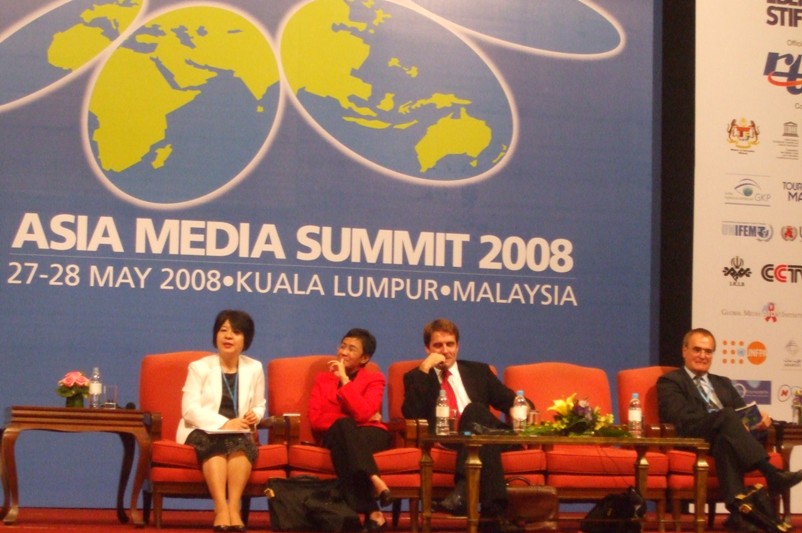
A session on ‘Regulations and New Media Models’ brought this into sharp focus. The session raised questions such as: Should we apply some principles from traditional media (meaning MSM) to the new media? Should we adopt some minimum rules to allow for sufficient legal space for new media businesses to find their niche in the market and evolve to fit the needs of consumers? What are the policy implications of User-Generated Content (UGC) with regard to copyright infringement, information accuracy and content quality?

The panel comprised three Europeans and one American, all working in MSM or academia (it wasn’t immediately clear if any of them blogged personally). For the most part, they said predictably nice and kind things about new media. It was interesting to see how these professionals or managers – who have had their careers entirely or mostly working in or studying about MSM – were trying to relate to a new and different sector like the new media.

But the panel’s cautious attitude about the new media went overboard on the matter of regulation. This is where matters are highly contentious and hotly debated: while most of us agree that there should be some basic regulation to ensure cyber security and to keep a check on content that is widely deemed as unacceptable – for example, hate speech – there is no consensus on what content should be regulated by whom under which guiding principles.

Ruling unanimously in Reno v. ACLU, the US Supreme Court declared the Internet to be a free speech zone in 1997, saying it deserved at least as much First Amendment protection as that afforded to books, newspapers and magazines. The government, the Court said, can no more restrict a person’s access to words or images on the Internet than it could be allowed to snatch a book out of a reader’s hands in the library, or cover over a statue of a nude in a museum.

It was during question time that the discussion took a cynical – even hostile – attitude on the new media. Some members of the audience engaged Dr Venkat Iyer, a legal academic from University of Ulster in the UK, in a narrowly focused discussion on how and where bloggers may be sued for the opinions expressed on their blogs. The issue of multiple jurisdictions came up, along with other aspects of cyber libel and how those affected by criticism made online by individual bloggers (as opposed to companies or organisations producing online content) may ‘seek justice’.

These discussions were more than academic, especially in view of worrying trends in host Malaysia and neighbouring Singapore where bloggers have been arrested or are being prosecuted in recent weeks.
Asia Media Forum: Restrictions follow critics to cyber space
IHT: Malaysian blogger jailed over article


From the floor, I remarked that I was disturbed by the tone and narrow vision of this discussion, which merely repeated new media bashing by those who failed to understand its dynamics. Acknowledging the need for restraint where decency and public safety were concerned, I argued that it is a big mistake to analyse the new media from the business models or regulatory frameworks that suit the old media.

There are mischief makers and anti-social elements using the new media just as there have always been such people using the old media. Their presence, which is statistically small, does not warrant a knee-jerk reaction to over-regulate or over-legislate all activity online, as some Summit participants were advocating. To do that would be akin to throwing the baby out with the bathwater.

I continued: “This is not a healthy attitude to adopt, especially when we look at the bigger picture. In many countries where freedom of expression and media freedom are threatened or suppressed by intolerant governments and/or other vested interests, new media platforms have become the only available opportunity for citizens to organise, protest and sustain struggles for safeguarding human rights, better governance and cleaner politics. In countries where the mainstream media outlets are either state owned or under pressure from government (or military), and where newspapers, radio and TV have already been intimidated into silence, citizen journalists are the last line of defence…”

I also noted with interest that on this panel was Mogens Schmidt, UNESCO’s Deputy Assistant Director-General for Communication and Information (in charge of freedom of expression), and said that this was not the kind of rolling back of freedoms of expression that UNESCO was publicly advocating. In a brief response immediately afterwards, Schmidt said that he fully agreed with my views, and that this was UNESCO’s position as well.

Another panel member, Dr Jacob van Kokswijk, secretary of the International Telecom User Group in the Netherlands, noted that the new media required a totally new thinking and approach where its content is concerned – the rules that have worked for the old media can’t be applied in the same manner. He added that only 3 to 4 per cent of Internet content could be considered as ‘bad’ (by whatever definition he was using), and that should not blind us to seizing the potential of new media.

Another panel member, Joaquin F Blaya, a Board member of Radio Free Asia (RFA), made a categorical statement saying he was opposed to any and all forms of censorship. He knows what that means – RFA says its mission is ‘to provide accurate and timely news and information to Asian countries whose governments prohibit access to a free press’.

By the end of the session, I was relieved to see a more balanced view on the new media emerging in our discussion, with more moderate voices taking to the floor. No, we didn’t resolve any of the tough issues of new media regulation during the 90 mins of that session, but we at least agreed that the old media mindset of command-and-control was not going to work in the new media world.

From its inception in 2003, the annual Asia Media Summit has been very slow to come to terms with this reality, but this year the event moved a bit closer to that ideal – partly because they invited leading new media activist Danny Schechter to be a speaker.

We just have to wait and see if this momentum can be sustained next year when the Summit is hosted by the Macau Special Administrative Region of China.

I’m going to keep an open mind about this — but won’t bet on it…

3 May 2008: Who’s afraid of citizen journalists? Thoughts on World Press Freedom Day

Asia Media Summit 2008: Still warming up to new media…

Asia Media Summit 2008

Last week, I tried being in two places at once: executive producing an ambitious new TV debate series in my city of anchor Colombo (Sri Lanka) and participating in Asia Media Summit 2008 (AMS 2008) taking place in the Malaysian capital of Kuala Lumpur, May 27-28.

The two cities are 2.5 hours and a few thousand kilometres apart, and I just about managed being productive on both fronts. But I don’t recommend the experience: I ended up with a massive sleep deficit that I’m still trying to shake off.

According to the summit organisers, some 530 CEOs, managing directors, media experts and senior representatives of development and academic institutions from 65 countries joined the two-day event and 16 pre- Summit workshops.

The Summit had its moments — a few ‘Aha!’ ones and quite a few others where I found myself nodding (bored out of my mind, and not in agreement with what was going on). Unlike last year, when I chaired part of a pre-Summit seminar and also served as a plenary speaker, I was merely participating this year — which gave me the chance to network, take things easy and ask more questions from the audience.

Of the five Summits held since 2004, I’ve attended four (I missed the first one). The scope, content and quality of this annual event have certainly improved in this time. But I find the Summit still very much a gathering of the movers and shakers in the mainstream media, primarily radio and TV (which dominate the Asian media landscape). Very few new media practitioners – individual bloggers like myself, as well as online audio/video publishers and operators of web portals – turn up at this event.

And the Summit discussions in the past have sometimes been decidedly cynical or dismissive of new media. When this happened in the opening plenary itself at Asia Media Summit 2007, I was so disappointed that I asked if I was actually attending the Asia ‘Mediasaurus’ Summit.

Things could only get better this year – and they did. For one thing, they had invited new media practitioners to speak of their chaotic new world (unlike last time, when we heard fossilised old media worthies pontificate fuzzily on the new media). Perhaps this was the organisers heeding our critique of last year. Or it had something to do with the rise and rise of bloggers in the host country Malaysia: the March 2008 general election there saw five active bloggers being elected to national Parliament from the opposition in the biggest political upheaval Malaysia had seen in half a century.

Asia Media Summit 2008

For this reason, we were looking forward to the Summit’s opening by Malaysian Prime Minister Abdullah Ahmad Badawi, but for the second year running, he decided to skip the event. Instead, he sent his deputy Mohd Najib Tun Abdul Razak in his place to read his speech.

As Malaysia’s pro-government New Straits Times newspaper reported the next day, he urged journalists not to be too taken in by the “bells and whistles of technology”, but to hold to established virtues of accuracy, intelligence, fairness and grit as these formed the competitive advantage of the traditional press in the “anarchic environment of the new age”.

He added: “The right to freedom of speech and expression cannot be used as a pretext or excuse to violate and abuse the reputation and dignity of a people, to slander and libel or to defame religions or religious symbols. If this were the case, there would be no laws of defamation or libel and laws against those who incite racial or ethnic violence.”

During question time, the well known American blogger and media analyst Danny Schechter had an interesting exchange with the chief guest. Danny referred to the case of Malaysian blogger Raja Petra bin Raja Kamarudin who was recently charged of sedition for having written a political blog post.

DPM Najib and Schechter had very different views on the limits of freedom of speech and how far the new media can and should be allowed to comment on current affairs, especially politics. On the wider issue of human rights, Najib took the populist line and made references to America’s detention camps in Guantanamo Bay and the CIA outsourcing torture. Danny shot back saying that only 20% of the American people now support their president and his policies (and Danny certainly wasn’t one of them). He argued that human rights should be universal. Read Danny’s take on it here, and the more official version in the New Straits Times.

With that slightly bumpy start, AMS 2008 went on to display the mainstream media’s still uneasy relationship with the new media. For sure, the Summit had sessions on user-generated content and new media business models. But for the most part, these sessions brought out the narrow perspective of mainstream media’s managers or its long-standing researchers. With notable exceptions like Danny Schechter, other speakers talked about a fast-changing, rapidly-evolving reality that they’d barely skimmed or experienced themselves.

I would belatedly write more blog posts on some of the discussions that took place in later sessions, which prompted me to intervene several times from the audience.

Sri Lanka 2048: Talking today for a better tomorrow!

Sri Lanka 2048 - TV Debate series on sustainable futures for Sri Lanka

I’m just coming up for fresh air after two hectic weeks – this blog was silent during that time as I was deep immersed in doing something new and interesting.

With my team at TVE Asia Pacific, I’m involved in producing a new TV series started airing on May 22 on Sri Lanka’s ratings-leading, privately-owned, most popular channel, Sirasa TV.

Named Sri Lanka 2048, it is an innovative series of one-hour television debates that explore prospects for a sustainable future for Sri Lanka in the Twenty First Century.

Each debate will involves -– as panel and studio audience -– over two dozen Sri Lankans from academic, civil society, corporate and government backgrounds. They are recorded ‘as live’ and broadcast every Thursday at 10.45 pm, which, in Sri Lankan TV viewing patterns, is the favoured time for serious current affairs and political programmes.

The debates are being co-produced by TVE Asia Pacific, the educational media foundation that I head, in partnership with IUCN, the International Union for Conservation of Nature, and MTV Channel (Private) Limited, which runs a bevy of radio and TV channels including Sirasa TV and Channel One MTV.

The editorially independent series will accommodate a broad spectrum of expertise and opinion.
The debates are based on topics such as managing our waste, reducing air pollution, protecting biodiversity on land and in the seas, and buffering communities from disasters. Two debates in English will look at the nexus between business and the environment, and coping with climate change.

Read detailed news story on TVEAP website
Read series line up and broadcast schedule

Sri Lanka 2048 image montage by The Nation newspaper

The series is based on the overall premise that Sri Lanka has abundant land and ocean resources that can be used to build such a future -– but it faces many challenges in taking the right action at the right time. We believe that public discussion and debate on issues, choices and alternatives is an essential part of this process. Read more on why this series.

Why 2048? For one thing, it’s the year Sri Lanka will mark 100 years of political independence. Being 40 years in the future, the year lies slightly more than a generation ahead, allowing ample time and opportunity to resolve deep-rooted problems of balancing development with conservation.

Sri Lanka 2048 follows an informal, talk show format that allows ample interaction between the panel and empowered audience. Although they take place within a clearly defined scope that enables some focus, all debates are unscripted.

Our amiable moderator Kingsly Rathnayaka (centre in the photo montage above), one of the most versatile presenters on Sri Lankan television today, keeps the panel and audience engaged. By design, we ask more questions than we are able to answer in a television hour (48 mins). But then, we don’t expect to resolve these burning issues in that time – all we can hope to do is to stretch the limits of public discussion.

Logistics and studio size limit the number of our audience to a two dozen. We’ve tried hard to ensure a good mix among them, drawn from all walks of life. To bring in additional voices and perspectives, we insert into each debate 2 or 3 short video reports produced in advance. These highlight solutions to environment or development problems that have been tried out by individuals, communities, NGOs, government agencies or private companies. Played at key points during debates, these help steer discussion in a particular direction.

Sri Lanka 2048 by TVE Asia Pacific

We are already receiving favourable media reviews and coverage. Here are some that appeared in English language newspapers (more have come up in Sinhala newspapers, the language in which most of this series is produced and broadcast):
The Morning Leader, 28 May 2008: Timely action to sustain Sri Lanka’s development

The Sunday Times, 18 May 2008: TV Debate series to create a sustainable future
The Nation, 1 June 2008: Pick the best at Sri Lanka 2048

Sri Lanka 2048 is the culmination of months of research, development and pre-production work carried out by TVE Asia Pacific’s production team in collaboration with IUCN Sri Lanka. Our preparatory work involved consultations with dozens of experts, activists, officials, entrepreneurs – and their various organisations or companies. We synthesize and package their information, opinions and experiences with the dynamic and creative production team at MTV Channel (Pvt) Limited.

The inspiration for this series came from my mentor Sir Arthur C Clarke, with whom I wrote an essay 10 years ago that outlined his personal vision for his adopted country in 2048. The celebrated futurist that he was, Sir Arthur often said that there is a range of possible futures, and our actions – and inaction – determine what kind of future actually happens. Desirable futures don’t just happen; they need to be worked on.

Sri Lanka 2048 is an attempt to discuss how Sri Lankans can pursue economic prosperity without trading off their good health, natural wealth and public order. This is not a series preaching narrowly focused green messages to a middle class audience. We want to rise above and beyond the shrill of green activists, and engage in informed, wide ranging discussions on the tight-rope balancing act that emerging economies like Sri Lanka have to perform between short term economic growth and long term health of people and ecosystems.

Contrary to popular perception, ‘sustainable development’ is not some utopian or technical ideal of environmental activists. It’s about creating a liveable society here and today – where everyone has an acceptable quality of life, ample opportunities to learn and earn, and the freedom to pursue their own dreams.

Doing good television takes a good deal of time, effort and money. This TV series is supported under the Raising Environmental Consciousness in Society (RECS) project of IUCN Sri Lanka, which is funded by the Government of the Netherlands. But neither is responsible for editorial content or analysis, which rests on my shoulders as the executive producer of the series.

And I, in turn, stand on the shoulders of dedicated, hard working production teams drawn from TVE Asia Pacific and MTV Channel (Pvt) Limited. Doing good television is all team work.
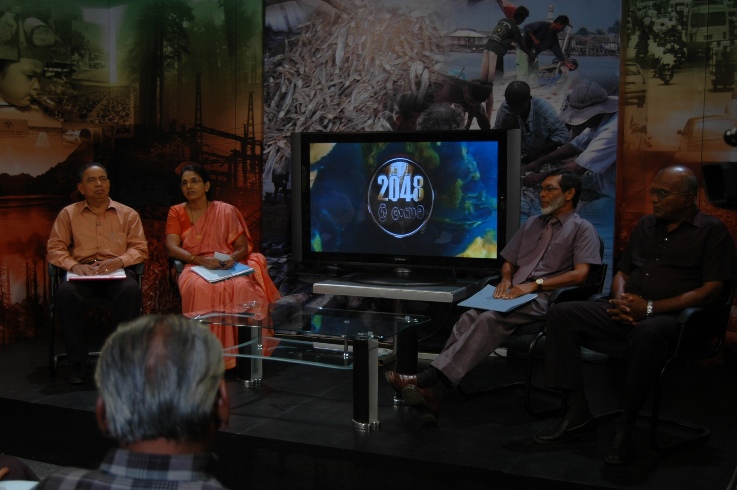
Sri Lanka 2048 - Fisheries panel at Sirasa Studio - Photo by TVEAP

All photos courtesy TVE Asia Pacific

Burmese television: Meet Asia’s model public broadcaster!

Photo courtesy Associated Press

In the wake of Cyclone Nargis that wreaked havoc in Burma, the world has once again realised the brutality and ruthlessness of the military regime that runs the country.

And as the United Nations and aid agencies struggle with the incredibly uncaring Burmese bureaucracy to get much needed emergency relief for the affected Burmese people, the media outside Burma are having great difficulty accessing authentic information and images.

Despite the massive disaster and resulting tragedy, Burma remains closed to foreign journalists, especially the visual media. No doubt the memories of the monk-led pro-democracy protests of late 2007 are still fresh in the minds of the ruling junta and their propagandists. The few courageous foreign reporters who managed to get in at the time ran enormous personal risks, and Japanese photojournalist Kenji Nagai was shot dead by a Burmese soldier while filming demonstrations.

Unable to report from the multiple scenes of disaster, and lacking a wide choice of reliable local sources willing to go on the record, international news agencies and broadcasters have been forced to quote the government-owned Burmese television station, MRTV.

Global news leaders like Al Jazeera, BBC and CNN have all used MRTV visuals to illustrate their news and current affairs reportage. A recent example from Al Jazeera, posted on 8 May 2008:

The image monopoly by MRTV wouldn’t have mattered so much if they at least provided an accurate account of the unfolding events in its own country. But that seems far too much to expect of this mouthpiece of the Rangoon regime. In Burma’s darkest hour in recent memory, MRTV would much rather peddle the official propaganda – never mind the millions made homeless by the recent disaster.

Here’s an insight from the Inter Press Service, the majority world’s own news agency, reporting from their Asia Pacific headquarters in Bangkok, Thailand:

BURMA: Cyclone Nargis Exposes Junta’s Anti-People Attitude
By Larry Jagan, IPS

Worse, there is evidence emerging that the military authorities had ample warning of a storm brewing in the Bay of Bengal but chose to ignore, or even suppress, it.

The Indian Meteorological Department (IMD) which keeps a close track of geo-climatic events in the Bay of Bengal and releases warnings not only to provinces on the Indian east coast but also to vulnerable littoral countries said it warned Burmese authorities of Cyclone Nargis’ formation and possible approach as early as on Apr. 26.

“We continuously updated authorities in Myanmar (as Burma is officially called) and on Apr. 30 we even provided them a details of the likely route, speed and locations of landfall,’’ IMD director B.P. Yadav told IPS correspondent in New Delhi, Ranjit Devraj.

Burma’s meteorology department did post a warning on its official website on Apr. 27 but no effort was made to disseminate information to the people, much less to carry out evacuations along the coastline or from the islands on the Irrawaddy Delta.

By the time state-run media, which has been continuously spewing propaganda and exhorting the public to vote ‘yes’ to Saturday’s constitution referendum, issued its first cyclone alert on Friday afternoon it was too late for the hapless residents of Rangoon.

courtesy Reuters

Elsewhere in the report, IPS says:

Pictures of soldiers removing fallen trees and clearing roads in Rangoon on the state-run television have further infuriated many in the city. “This is pure propaganda and it’s far from the truth,” e-mailed a Burmese journalist, asking not to be identified for fear of the consequences. “Why do foreign broadcasters show them too –Burmese government propaganda is a disgrace enough to journalism,” he fumed.

“I saw some soldiers getting onto a truck yesterday,” said a 50-year-old resident. “They had no sweat on their shirts, despite what was shown on TV!”

“My wife saw three truckloads of soldiers parked in front of a fallen tree, none of them got down to remove it,” he added.

And here is what Dinyar Godrej has to say on the website of New Internationalist, another pro-South, liberal media outlet. In a post titled ‘Seeing but not believing’, he says:

“Burma is shut off from foreign journalists (unless they are invited in by the military regime to cover specific showpiece events). Western news channels have had to rely on state run television for their moving images.

“So while the death toll is now officially 22,000 (unofficially up to 50,000), with 40,000 people missing and a million homeless; and while the regime is coming in for bitter criticism for its foot-dragging over opening up to international aid and the utter incompetence of its own relief effort so far (which has reached only a tiny fraction of the people affected), we are watching on our television screens soldiers handing over food parcels. We can see nothing of the grief or rage of the people going hungry and thirsty (many water sources are too contaminated to use). They do not talk on camera. Instead they sit obediently in the state TV images, taking what’s given to them. And we watch them, while listening to the numbers and being told of the heightening crisis.”

Appalling as these revelations are, they don’t surprise us. Indeed, MRTV is not alone in this kind of shameless abuse and prostitution of the airwaves, a common property resource. A vast majority of the so-called ‘public’ broadcasters in Asia behave in exactly the same callous manner. This is why I don’t use the term ‘public broadcaster’ to describe these government propaganda channels – because, whatever lofty ideals their founding documents might have, most of them are not serving the public interest any more (if they ever did).

As I commented in Feb 2008: “In developing Asia, which lacks sufficient checks and balances to ensure independence of state broadcasters, the only thing public about such channels is that they are often a drain on public money collected through taxes. Their service and loyalties are entirely to whichever political party, coalition or military dictator in government. When the divide between governments and the public interest is growing, most ‘public’ channels find themselves on the wrong side. No wonder, then, that discerning views have abandoned them.”

Read Feb 2008 post: Why do development Rip van Winkles prefer ‘Aunties’ without eyeballs?

I don’t hold a grudge against the hapless staff of MRTV, who simply must remain their Masters’ Voice at all times to stay alive. Those working for government channels in countries with greater levels of democratic freedom can’t take refuge in this excuse. They must be held accountable for their continuing propagandising and the disgusting pollution of the airwaves.

And the incredibly naive and sycophantic UN agencies – especially UNESCO – also share the blame for their feeble yet persistent defence of the so-called public broadcasters. Years ago, I stopped attending meetings discussing public service broadcasting (PSB) in Asia, which these agencies equate with what the government channels are doing. I see yet another of these exercises in futility being lined up as part of the Asia Media Summit 2008 coming up in a few days in Kuala Lumpor.

As I wrote in February, if these development agencies are seriously interested in broadcasting that serves the public interest, they must engage the privately-owned, commercially operated TV channels, which are the market leaders in much of Asia.

Except, that is, in tightly controlled, closed societies like Burma, where government channels are the only terrestrial TV available for the local people.

Images courtesy AP and Reuters, as published by The New York Times online