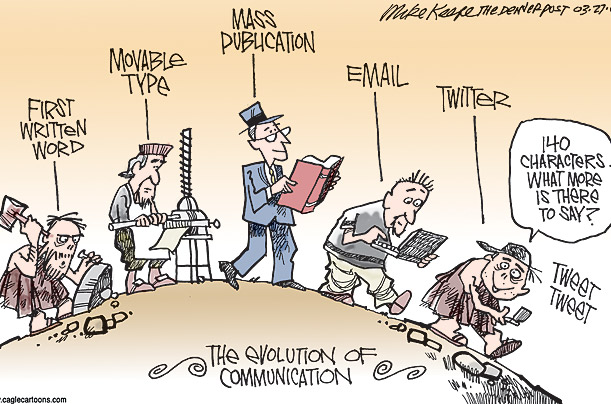
Evolution or revolution?
I was born three years before the Internet (which turned 40 a few weeks ago), and raised entirely on newspapers and radio in a country where broadcast television didn’t arrive until I was 13.
From the time I could read and write, I always wanted to be a media publisher. In that pre-history of the Personal Computer and Internet, my choices were pretty limited: I published a hand-written household newspaper and was its editor, reporter, printer and distributor all rolled into one. But I was obsessive in my work even then, and the newspaper lasted a couple of years in which over two dozen issues were released (all of them now mercifully lost).
My school teacher parents were my first patrons, supplying me with plenty of paper, pencils and ink. But there must have times when they rather wished that I didn’t indulge in my own brand of independent journalism. I loved to criticise and lampoon the ‘management’ in my editorials — even as a kid, I was already critical of the establishment!
Fortunately for me, the ‘management’ left me alone and to my own devices, but most independent editors in history haven’t been so lucky. As the American journalist A.J. Leibling (1904 -1963) once said, “Freedom of the press is guaranteed only to those who own one.” In his time, this was perfectly true.
There was a time, until recently, when press barons and media moguls led, and the rest of society followed. In our topsy-turvy times, however, the reverse is increasingly true.
In theory, at least, anyone can be a global broadcaster and publisher in less than two hours using free tools that can be downloaded and activated in minutes.
David Brewer (photo from http://www.i-m-s.dk)My British media activist friend David Brewer has just published an online guide on how to become a publisher or broadcaster in 100 minutes. (Okay, the non-geeks among us might need a bit longer than that, but still, you can be in business in just a few hours.)
David Brewer’s journalistic and managerial experience spans newspapers, radio, television, and online, and he now runs Media Ideas International Ltd, a media strategy consultancy with clients in Europe, the Balkans, the CIS, the Middle East, Asia, Africa and Central America.
David has worked with what I like to call the A-B-C of global broadcasting. He was the launch managing editor of BBC News Online in 1997, and moved to CNN, as managing editor, to set up CNN.com Europe, Middle East and Africa and CNNArabic.com. He was an editorial consultant for the launch of Al Jazeera English in 2006 and continues to work with Al Jazeera English as a new media consultant.
In his spare time, he runs Media Helping Media , a network and online resource to support media in areas where freedom of expression is under threat.
Dilrukshi Handunnetti: Making wavesMy good friend Dilrukshi Handunnetti, a leading investigative journalist in Sri Lanka, is currently on a Jefferson Fellowship traveling in the United States. She is one of a dozen journalists from the Asia Pacific who have been competitively chosen to participate in this prestigious programme, which in 2009 is focusing on the theme, The Right Climate for Confronting Climate Change?
I finished my latest climate film, Small Islands – Big Impact, only the day before Dilrukshi left for Hawaii, her first stop in the multi-destination, intensive programme. Given her long standing coverage of the Maldivian political affairs as well as Asian/global environmental issues, I gave her a DVD of the film to take along.
I’m delighted to hear that she has been showing Small Islands – Big Impact in various presentations, often producing a…big impact wherever it was shared. It’s always good to have such feedback — here’s an excerpt from an email she has just sent me from Boulder, Colorado:
“I liked presenting your short film and the response it generated. The film generated a discussion on promoting the concept of (climate) adaptation as a human right – just as I felt it would be such a catch phrase here. I also had the (media coverage of) the underwater Cabinet meeting with me. So Maldives got a lot of attention despite not having a Maldivian here.
“Several wanted to know about the actual risk level of the Maldives and the possibility of the islands being submerged. They also asked about purchasing land elsewhere and whether the Maldives had the financial capability to do that. Others wanted to know about depleting fish catch President Nasheed spoke about as this was a common concern to Indonesia, Southern India and Vietnam.
President Nasheed: Stop pointing fingers, extend a helping hand...“Some queried whether President Nasheed was going to Copenhagen to state his case. Two others asked whether lobby groups were behind his thinking. Several found, including American, Chinese and Indian participants, that President Nasheed’s call to end the blame game should be heeded by all. There was collective agreement that others’ behaviour impacted on the likes of President Nasheed and vulnerable communities.
“Interestingly, everyone found his interview a STORY. Something that they would want to report on in their respective media. We continue to discuss the same on our tours and walkathons from venue to venue for various meetings. In fact, I had the American participant asking our resource persons (IPCC types, no less!) whether they were willing to acknowledge the concept of climate refugees directly in relation to the Maldives.
“I think the movie served a great purpose of awakening the minds of many to the threat level faced by some communities on low lying coastal nations – like the pacific Islands and the Maldives. A senior broadcaster from the Tonga Broadcasting Corporation personally thanked me for wanting to highlight their plight as a small island nation.”
You can watch Small Islands – Big Impact online here:
A journalist for over 17 years, Dilrukshi Handunnetti has extensively covered politics, the environment, culture, and history and gender issues. In her current role, she writes the parliamentary column for the newspaper in addition to writing and editing investigative stories carried in her publication. Dilrukshi has also covered the ethnic conflict from a non-military perspective and written extensively on issues of good governance, graft and corruption. Dilrukshi is the recipient of many national journalism awards in Sri Lanka, including: the Young Reporter of the Year 2001, Best Environment Reporter of the year 2002, Best Environment Reporter of the year 2003, Best English Journalist of the Year 2004 (Merit) Award and D B Dhanapala Award for the Best English Journalist of the Year 2005, all presented by the Editors’ Guild of Sri Lanka.
In this extract from our 2005 film Deep Divide, Dilrukshi talks about Sri Lanka’s coastal resource development challenges before and after the 2004 Asian Tsunami:
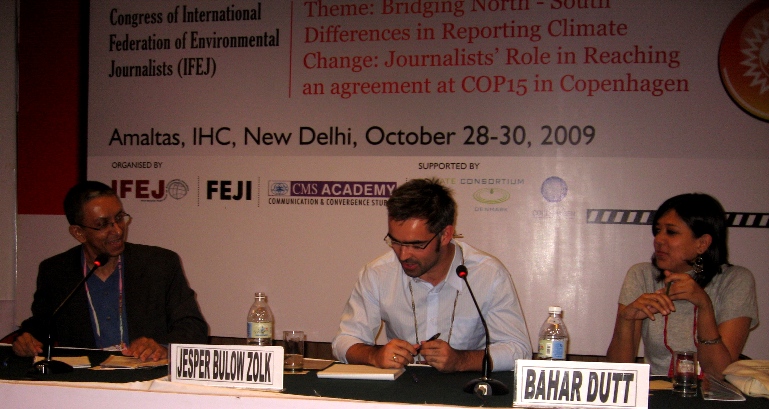
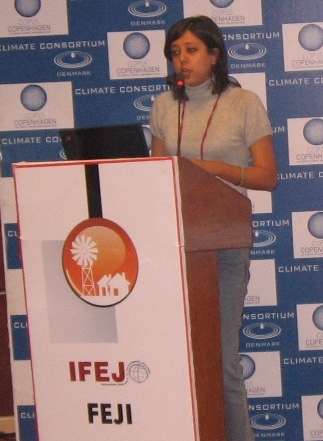
At IFEJ 2009 Congress on 28 Oct 2009: From L to R: Nalaka Gunawardene, Jesper Zolk and Bahar Dutt
I used to describe my job as one where I try to make sense of our topsy-turvy world. But I’d happily settle for the simpler description ‘connecting the dots’. This is what we as journalists covering development issues must do everyday in our work:
• link the macro with the micro; and
• find inter-relationships and inter-dependencies that aren’t always very self-evident.
This reminds of me a piece of advice given by the late Tarzie Vittachi (1921-1993), the Sri Lankan-born journalist and editor who was a pioneer in development journalism in the 1960s and 1970s. Long before climate change became an issue, he was speaking metaphorically to fellow journalists when he said: “Ordinary people live and work in the day-to -day weather. Most can’t relate to long-term climate. It’s our job, as journalists, to make those links clear.”
When Tarzie made this remark, some three decades ago, he was speaking metaphorically. Times have changed and now we are literally dealing with weather and climate issues.
Making those links is not always easy, especially if we want to avoid sensationalism, scare-mongering and other excesses that often characterize media coverage on climate change.
I made these observations when chairing a session on the North-South differences in the electronic media (television) coverage of climate change in New Delhi, India, this week. It was part of the latest international congress of the International Federation of Environmental Journalists (IFEJ), held at India Habitat Centre from 28 to 30 October 2009. Its theme was “Bridging North-South Differences in Reporting Climate Change: Journalists’ role in Reaching an Ambitious Agreement at COP15 in Copenhagen”.
Participants – over 100 journalists covering science and environmental issues, from all over the world – recognised how climate concerns have extended beyond strict environmental (or ‘green’) issues to mainstream political, business and even security coverage in the media.
Joining me on the TV panel were two experienced journalists from news and current affairs channels — Jesper Zolk, Climate Editor of TV2 News, Denmark, and Bahar Dutt, Environment Editor of CNN/IBN, India.
As it turned out, they were a great panel – they knew a lot, and being TV journalists, also knew how to say it well and concisely. This was the second time that Bahar – one of the best known faces on Indian television today – and I have been on a panel together: almost four years ago, at IFEJ Congress 2005, also in New Delhi, she joined me to discuss ‘Does TV do a better job on environmental reporting?’
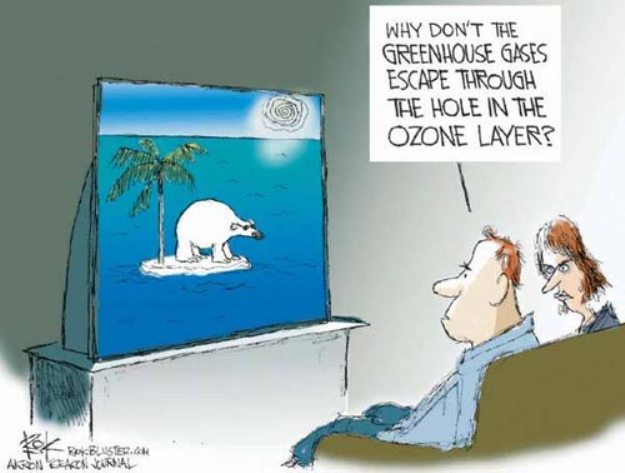
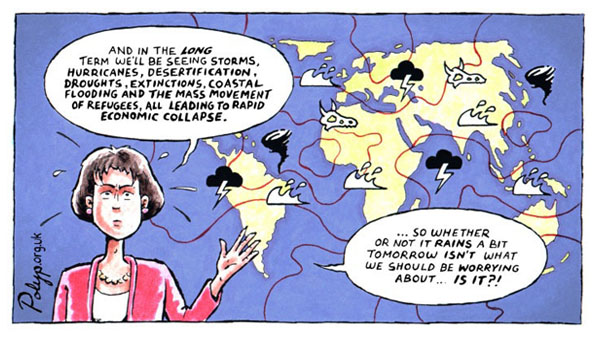
I opened my panel by showing this cartoon, one of my favourite when it comes to climate coverage in the media:
Can we blame him for the confusion?
We cannot assume much more knowledge and understanding in our average TV viewer than the confused guy in this cartoon, I said. So just how do we reach out and engage millions like him (and also the better informed viewers like his fellow viewer)? How do we tell this complex, still unfolding story within the time limits of 24/7 news television, I asked.
We didn’t find all the answers in 75 minutes of our session, but at least we clarified and agreed on a few points. Bahar Dutt’s observations were particularly relevant, especially since India now has over 500 news and current affairs TV channels broadcasting to a billion plus audience in over a dozen languages.
At a time when mainstream media elsewhere in the world are struggling to stay on in business, the Indian broadcast media remain ‘chaotic but robust’, she said. “But editorial filtering is not always very strong in some of our channels, which sees climate coverage ranging from no coverage at all to hysteria,” she added.
According to Bahar, much of the climate coverage in the Indian media overlooks the links with broader development issues. “Focus is often on climate treaty negotiations, or what individual experts or politicians say. These elements are only part of the bigger picture, and we need to look further and dig deeper.”
Bahar Dutt at IFEJ 2009“Environmental journalists are not green activists, and our role is to be watchdogs – keeping a sharp eye on government, industry and even civil society,” Bahar said. “But sometimes I find this watchdog role lacking in our media.”
Her advice to fellow journalists: stop seeing environment as simply a green and ‘cuddly’ sector, and move it into the political arena.
Jesper Zolk, Climate Editor of Denmark’s TV2 News, said his biggest challenge was how to get the pampered western viewers to change their lifestyles to be more climate friendly.
He urged journalists to focus not just on problems, but also on viable solutions. He expressed a concern that some journalists covering environmental issues sound more like green activists — a point that Bahar Dutt also agreed on.
She made another perceptive observation: people who have the least carbon footprint are the most keen to take action to mitigate climate change. That’s because they realise they are often the first to be impacted.
Our genial and erudite host Darryl D’Monte, chair of the Forum of Environmental Journalists of India (FEJI), had earlier asked participants to reflect on whether the media is part of the problem or the solution in the current crisis.
On the road to Copenhagen and beyond, we have our work cut out for us. As the Danish Ambassador to India, Ole Lønsmann Poulsen, quoted John F Kennedy in his opening remarks as saying: “The great enemy of the truth is very often not the lie, deliberate, contrived and dishonest, but the myth, persistent, persuasive and unrealistic.”
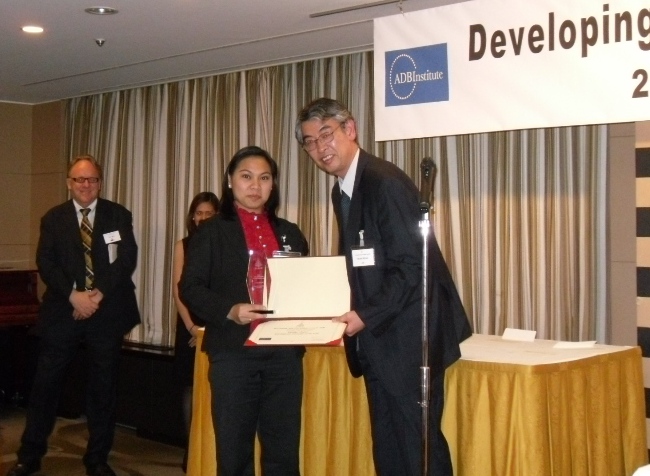
“We are all winners,” said Imelda at the Awards ceremony organized by the Asian Development Bank Institute (ADBI) at the Foreign Correspondents’ Club of Japan. “We should continue writing compelling stories to make a difference.”
Imelda Abano, whom I have known and admired for several years, won one of two special awards for her story titled “Scorched Earth”, published on 19 May 2009, in the Business Mirror newspaper in the Philippines.
“Among all the articles, the judges were very impressed with the way Abaño’s article presented the
complex issues on climate change. It was a comprehensive and extra-ordinary piece that was made simple for the readers to understand,” said Monzurul Huq, one of the four judges and the president of the Foreign Correspondents’ Club of Japan.
“We judges were each very impressed by the overall high quality of entries for this year. The awards were meant to recognize the efforts made by Asian and Pacific journalists who provide high-quality coverage of issues affecting growth and development in developing countries,” said Anthony Rowley, presiding judge of the 2009 ADBI awards.
Imelda Abano was honored last year by the United Nations as the Gold Prize Winner for excellence in reporting on humanitarian and development affairs. She was also this year’s recipient of the 10 Young Leaders Award in the Philippines given out by the Philippines Graphic magazine for her reporting on development and environmental issues. In 2002, she won the Asian category of the Global Awards on Environmental Reporting organized by Reuters and IUCN.
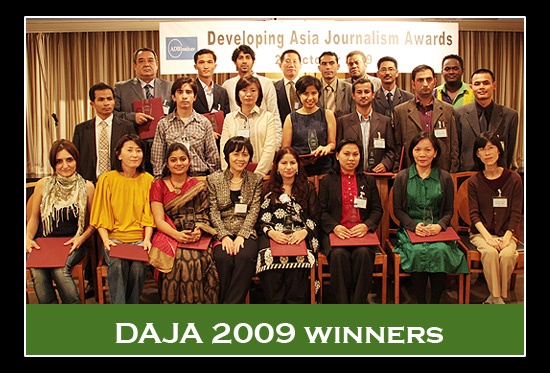
The Developing Asia Journalism Awards (DAJA) scheme was launched in 2004 by the Asian Development Bank Institute in Tokyo, for journalists covering development issues in the Asia Pacific. It received around 200 entries this year, of which 22 journalists from 17 ADB developing nations were selected as finalists.
Supriya Khandekar from India won Young Development Journalist of the Year Award. Other winners are Sithav An from Cambodia for the Poverty Impact of the Global Financial Crisis category, Raknish Wijewardene from Sri Lanka for the Government Responses to the Global Financial Crisis category, Zhu Yan from China for the Infrastructure Development category and Moffat Ghala Mamu from the Solomon Islands for the Climate Change Adaptation category. Full list of winners
“Environmental journalism would be a whole lot better if it had more of the three Ss: science, substance and (good) stories. First and last, it has to be good journalism, and that requires accuracy, balance and credibility. Trying to save the world – as some environmental journalists claim to do – does not give them a license to indulge in sloppy journalism, or to peddle conspiracy theories or half-truths.”
This has been my view on environmental journalism for sometime. Several years ago, my good friend (and former editor, The Times of India) Darryl D’Monte quoted me as saying this in UNEP’s Our Planet magazine while surveying the environmental coverage in the media in developing countries.
I reiterated these views today in a talk given to an international group of environmental journalists. The occasion was the 18th APFEJ Congress of Environmental Journalists being held in Colombo, Sri Lanka, from 19 to 21 October 2009.
My topic was a familiar one: Changing climate and moving images. I used it as a spring board from which to explore some broader issues that concerns every journalist who cares for life on Earth.
I returned to the time-honoured core values of good journalism – Accuracy, Balance and Credibility – and suggested we need one more letter, E – for Empathy. Without this latter attribute, our reportage and analysis would remain clinically cold while the planet warms up, I cautioned.
I also reflected on what it means to be an ‘environmental journalist’ in our troubled times.
For several years, I proudly called myself an ‘environmental journalist’. But I now question whether the growth of environmental journalism as a media specialisation has, inadvertently, ghettoised environmental issues within the editorial considerations of media organisations.
This is not to argue against media professionals specialising in environment or other development sectors such as health, gender or human rights. As issues become more complicated, journalists require sufficient background knowledge, sustained interest and some specialisation to do their job well. But it’s poor strategy to leave sustainable development issues entirely in the hands of ‘environmental journalists’.
At best, they can only weave part of the much-nuanced, multi-faceted tapestry of sustainable development. To grasp that bigger picture, and to communicate it well, we need the informed and active participation of the entire media industry -– from reporters, feature writers and producers to editors, managers and media owners.
Climate change, rapidly emerging as the charismatic mega-issue of our troubled times, could become a rallying call to unify the media and communication industries for this purpose.
In this scenario, we urgently need more good journalism that covers sustainable development concerns as an integral part of the mainstream of human affairs. Noble intentions of saving endangered species or ecosystems do not give anyone the license to engage in shoddy journalism.
The pursuit of plain good journalism will make us:
• rigorous in our field investigations and amassing of facts;
• balanced in our analysis of issues, impacts, choices and alternatives;
• committed to staying with evolving, fast-moving stories; and
• adaptable to accommodating new perspectives and knowledge.
It will also give us the courage of our convictions to question conventional ‘wisdom’, challenge established notions and take unfashionable positions when we have to. April 2007 blog post: Can journalists save the planet?
Celebrating Heroes
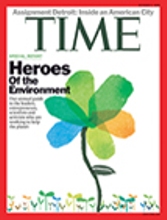
Asian environmental leaders, activists and visionaries feature prominently in TIME Magazine’s Heroes of the Environment 2009 list, published in its issue dated 5 October 2009.
This isn’t surprising, since the Asia Pacific accounts for nearly two thirds of humanity. As I’ve been saying for some years, the quest for sustainable development will be won – or lost – in Asia.
By happy coincidence, I have met three of the two dozen remarkable men and women in this year’s Heroes list — and count two of them among my extended network of friends across Asia.
One friend is the Indian film-maker Mike Pandey, who has been making environment and wildlife films for over 30 years in India, where he is one of the most respected names in conservation circles.
The other is Sheri Liao, Founder of the Global Village of Beijing (GVB), one of the earliest non-governmental organisations addressing environmental issues in China. She is an indefatigable Chinese activist and campaigner whom I first met on my first visit to Beijing in 1996. Our paths have crossed a couple of times since then, and I have always admired her zeal and single-minded pursuit of ‘greening’ China. Added on 17 Oct 2009: Blog post on Sheri Liao and greening the airwaves in China
The third ‘hero’ is the amiable and technocratic Mohamed Nasheed, President of the Maldives. I filmed an exclusive TV interview with him a few weeks ago, which I am currently editing into a short documentary on climate change. His country, the smallest independent state in Asia (by both land area and population), is on the frontlines of impact from rising sea levels and extreme weather events triggered by global warming.
“From saving wild mountain rivers in China to measuring the Arctic’s icy expanse, our green heroes are informed by this simple notion: We can all make a difference,” Time editors wrote in introducing this year’s list.
And I have already blogged about another TIME Hero well ahead of their selection: environmental lawyer Syeda Rizwana Hasan, a determined environmental activist who keeps dozens of ships from coming to die on the beaches of her native Bangladesh.
In the coming days and weeks, I plan to write separate posts on these other heroes whose selection is both timely and inspiring to all of us working in the broader development sector.
I quoted the Filipino academic and social activist Professor Walden Bello, as saying: “Things are pretty savage at the grassroots level in some of our countries. Journalists who investigate and uncover the truth take enormous personal risks – the vested interests hire killers to eliminate such journalists.”
Bello, executive director of the Focus on the Global South, further said: “Journalists living in the provinces and reporting from the grassroots are more vulnerable than those based in the cities. This is precisely why local journalists need greater support and protection to continue their good work.”
Last week, Reporters Without Borders echoed this call, saying: “We must defend journalists who expose attacks on the environment”.
The press freedom activist group released a new report titled “The dangers for journalists who expose environmental issues.” It highlights the indifference – and even complicity – of some governments and local authorities that make little attempt to protect journalists who take risks to investigate attacks on the environment.
The report looks at 13 cases of journalists and bloggers who have been killed, physically attacked, jailed, threatened or censored for reporting on the environment, and highlights the need for a free press to tackle ecological challenges.
In countries such as Russia, Cambodia, Brazil or even Bulgaria, in Europe, journalists run considerable risks when they try to alert the world about the misdeeds of those who prey on the environment.
It’s a show called the XYZ Show, broadcast weekly on Kenya’s Citizen TV. Started in mid May 2009, the first season introduced Kenyan viewers to a new form of satire television, with life-sized puppets made to resemble famous persons, mostly politicians.
Now comes the report that the show has riled some Kenyan politicians – surprise, surprise! I have only just come across this Citizen TV news report, broadcast a couple of weeks ago:
Controversy Over The XYZ Show
The satirical puppet show XYZ on Citizen Television every Sunday night, has attracted the attention of non other than the Public Service Minister Dalmas Otieno. The Minister says the caricature show is depicting politicians in bad light. The Director of Communication Ezekiel Mutua avers that, the show is representative of just how free the media is, in Kenya.
Well, what can we say? We thought politicians in general had thicker skins. Perhaps some Kenyan politicians are in danger of forgetting that timeless piece of Swahilian advice: Hakuna matata!
Hakuna matata is a Swahili phrase that is literally translated as “There are no worries”. It is sometimes translated as “no worries”, although is more commonly used similarly to the English phrase “no problem”.
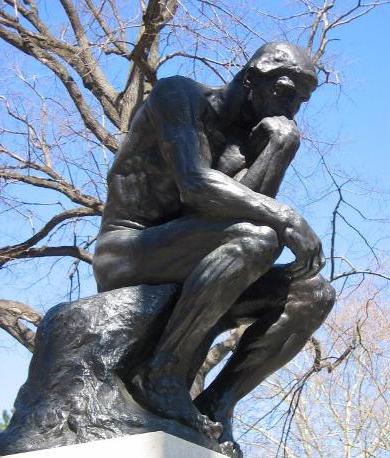
I explained: I keep asking more questions than I can answer. The ancient Greeks did the same – they were the first to ask many fundamental questions in philosophy and science. They didn’t always get the answers right, but started quests that lasted for millennia…
As Ed Johnson recently wrote: “We have so many things to thank the Greeks for, from philosophy to democracy. They were the ones who established the first civilization, governed by free citizens. Individual liberty has been the basis of civilization ever since.”
It so happens that I recently completed 40 years in this business of playing the Greek. As I recalled a few weeks ago on the 40th anniversary of the first Moon landing, I had an early start in asking difficult, sometimes irritating, questions.
I’m fortunate to be welcomed among media practitioners as well as media researchers. I’m not a card-carrying member of either group, but I have great fun hobnobbing with both. This is what Irish journalist-cum-academic Conor Cruise O’Brien once called ‘having a foot in both graves’!
And I’m also grateful for being allowed into the community of geeks, especially of the IT, ICT and gadget-wielding kind.
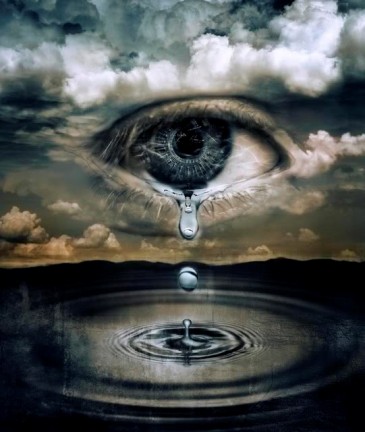
I cry, therefore I am“If you have tears, prepare to shed them now,” urged Mark Antony to fellow Romans after Julius Caesar died.
But what if you simply don’t have any tears to shed? That’s what my eye doctor recently cautioned me, after a routine examination. The natural tearing in my eye, necessary for keeping it moist and clean, wasn’t quite working. There is nothing to worry, he hastened to add, for it sometimes happens as our bodies slowly age. He asked me to use eye drops twice a day for a while.
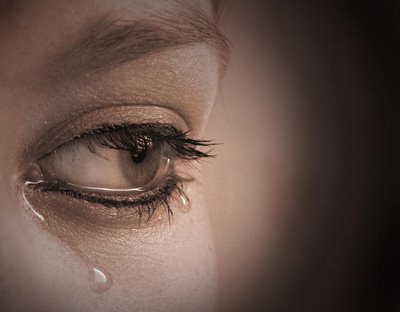
This set me thinking about the value and power of tears. Although most land mammals have a lacrimation system to keep their eyes moist, humans are the only mammal generally accepted to cry emotional tears.
In my circles, I’m known to be an emotional guy. I have never believed in that macho myth of men not crying. I shed tears of joy and tears of sorrow, sometimes in public. I cry when people I know, admire or love leave this world, sometimes at the most unexpected moments. Powerful movie moments of triumph or despair often move me to tears, as do simple joys of life — such as seeing my kid perform well on stage in a school concert.
Despite what my doctor says, I’ve been shedding plenty of tears this year.
I openly wept when journalist colleague Lasantha Wickrematunge was gunned down in broad daylight on a cruel January day. He was Sri Lanka’s real leader of the opposition.
My eyes were completely misty when the news of the original TV news anchorman and broadcast giant Walter Cronkite passed away on 18 July 2009 after an illustrious career spanning decades.
Have tears, will shed...Two weeks later, I joined millions of Filipinos in mourning the passage of Cory Aquino, the courageous woman who led the world’s first People Power revolution, toppling one of the worst tyrants of the 20th century.
In contrast, Michael Jackson’s death on 25 June didn’t immediately move me to tears, even though I quickly wrote a tribute. But the live broadcast of his star-studded funeral service on 6 July did. I watched it in the solitude of a hotel room in Amsterdam on a warm summer evening, and cried — as much for the tragic end of the man as what he stood for. Those tears inspired the op ed essay on the two Moonwalks.
I can add more to this list if I think long enough. The point is: my eye specialist’s clinical examination didn’t capture these highlights (lowlights?). There’s a part of our emotional lives that our doctors may never fathom. We ourselves are often barely aware of it.
A recent article in Reader’s Digest (March 2009 issue), titled Big Boys Don’t Cry — and Other Myths About Men and Their Emotions, said new research reveals that a man’s emotional life is as complex and rich as a woman’s, but often remains a mystery to him as well as to any woman who loves him. You can say that again!
Conventional wisdom doesn’t encourage or celebrate grown men crying. One of my favourite poems is ‘Solitude’ by Ella Wheeler Wilcox, which opens with these memorable lines:
“Laugh, and the world laughs with you;
Weep, and you weep alone;
For the sad old earth must borrow its mirth,
But has trouble enough of its own.
Sing, and the hills will answer;
Sigh, it is lost on the air;
The echoes bound to a joyful sound,
But shrink from voicing care.”
My close friends think I’m melancholic by nature, and long ago I came to terms with who and what I am. I don’t spend my days lamenting or weeping, for sure, but I also don’t hesitate to cry when the emotion warrants it.


 “From saving wild mountain rivers in China to measuring the Arctic’s icy expanse, our green heroes are informed by this simple notion: We can all make a difference,”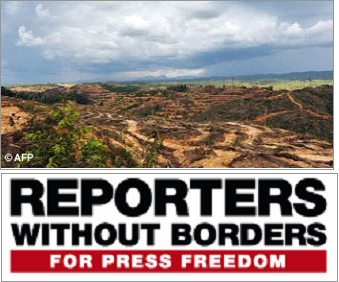

 Open Minds!