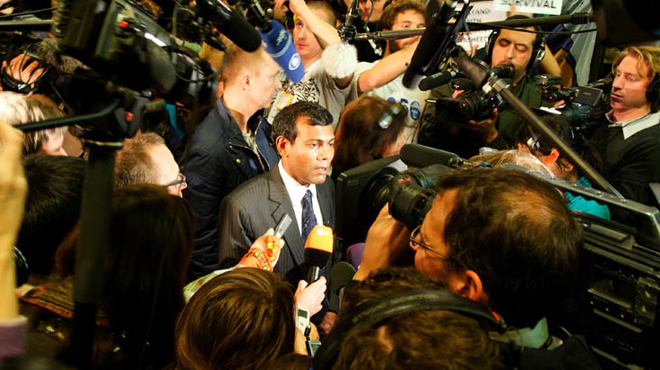
When it comes to climate change, we're all Maldivians!President Mohamed Nasheed of the Maldives is an articulate, passionate climate witness on behalf of his endangered island nation of 350,000 people. The technocratic and amiable President is one of the youngest heads of state in the world today. The one-time freelance journalist (who worked with and for various media when he was in political exile) remains very accessible to the international media. He knows the power of old and new media — and how to leverage it for his cause.
I admit to being a Nasheed fan. During the past couple of years, I have blogged about, interviewed and made a short film about President Nasheed. In the less than three years he has been in office, he has faced more than his fair share of economic and political challenges at home, but he has never lost sight of the long-term, bigger issue of climate change advocacy.
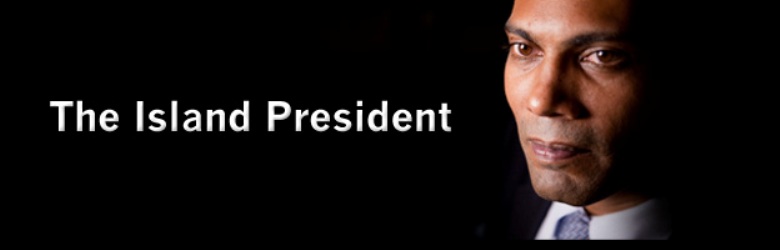
And now, his global status as the ‘rock star of climate change’ is enhanced by ‘The Island President’, a 90-minute, feature-style major documentary about him produced by a leading American production company, Actual Films. The film is to be released this summer at various film festivals. I can’t wait to catch it.
The Island President has been in the making for nearly two years. The film makers had exclusive access to the President both in his island nation and on his international travels.
The Island President: Official Trailer
The official Synopsis reads: “The Island President is a a dramatic feature documentary that lifts the issue of global warming out of the theoretical and into the personal. President Mohamed Nasheed is trying to save 385,000 people from drowning. His nation of 1,200 low-lying islands, the Maldives, is sinking into the Indian Ocean as sea levels rise due to global warming.
“With a young, charismatic South Asian leader updating a role once played by Jimmy Stewart, The Island President is like a non-fiction Mr. Smith Goes to Washington elevated to the world stage. Actual Films has secured exclusive access to follow President Nasheed as he prepares over the coming months for the 2009 Copenhagen Climate Summit in December. The terms of the 1997 Kyoto Treaty on Climate Change are about to expire, and leaders from around the world will converge on Copenhagen to hammer out a new treaty with renewed urgency. As the Danish Minister for Climate and Energy acknowledged, “the December days in Copenhagen in 2009 will be…a political thriller on an international scale.” The Summit will be an international showdown where President Nasheed will try to convince world leaders to finally take serious action against looming danger of climate change. The stakes couldn’t be higher-President Nasheed sees this as the last chance to save his homeland, and the world.”
The Island President is a co-production involving Actual Films, AFTERIMAGE PUBLIC MEDIA and the Independent Television Service (ITVS), with funding provided by the Corporation for Public Broadcasting (CPB).
Coming soon to a planet near you: 7 Billion...and counting
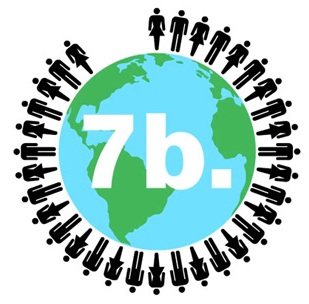
Sometime during 2011, human numbers will add up to 7 billion.
That is 7,000,000,000 living and breathing people — all of who will need to be fed, clothed, sheltered and cared for in many other ways.
During this year, National Geographic magazine will publish a 7-part series examining specific challenges and solutions to the issues we face. The magazine introduces the series with its January cover story “7 Billion,” offering a broad overview of demographic trends that got us to today and will impact us all tomorrow. The first in-depth story will appear in the March issue, focusing on humans’ impact on the planet’s geology. Other stories will follow throughout 2011.
This clever video accompanies the coverage:
Correction added by NatGeo editors: in 2050, 70% of the population will be living in “urban areas,” not “megacities” as stated in an earlier version of this video.
I don’t like the word population: it sounds cold, clinical and detached. Zoologists can talk about ant populations or elephant populations, but when demographers (and others, including journalists) refer to our the counting of species as human population, I somehow feel it’s too impersonal. Aren’t we more than mere numbers?
So in my own writing and TV scripts, I use the phrase human numbers.
Can you visualise 7 billion?Semantics apart, our rising numbers are indeed a cause for concern. We didn’t quite see the ‘population bomb’ go off the way we were warned about – thank the secular Force – but we still face formidable challenges.
In 1987 — the year I entered journalism — human numbers passed five billion. A dozen years later, in 1999, the six billion was reached. By then, I too had added my contribution of one co-produced human being. Soon in 2011, we will be seven billion.
Our planet’s natural systems are over-stretched not only by our sheer numbers, but also by our technologies and consumption. The many signs of planetary stress include accelerated loss of species, fast spreading deserts, and declining air and water quality. To cap it all, scientists now confirm that human activity is changing our climate.
On the New York Times Dot Earth blog, science writer Andrew C. Revkin regularly examines efforts to balance human affairs with the planet’s limits.
What do you think of higher education in Sri Lanka, a young documentary film maker asked me a few weeks ago.
That would be a good idea, I replied. I wasn’t trying to be too cynical, but that’s the stark reality.
Sri Lanka’s 20 million population is served by 15 public universities. Between them, these had a total of 65,588 students (not counting those enrolled with the Open University) and 4,738 faculty members in 2009.
None of these universities come anywhere near the top 1,000 (or even top 2,000) of the world’s universities as independently ranked using measurable criteria. Some say we have universities in name only, which of course those inside the system protest and deny vehemently.
University World News, an online global higher education publication focusing on international higher education news and analysis, recently asked me for a comment article on the crisis in Sri Lanka’s higher education sector. When I said I was a complete outsider to the system, they replied that’s precisely why they wanted my view.
So I wrote a 1,100 words which has just been published. My original title was ‘Squabbling while our future burns’ but some editors like to understate (their prerogative). I’m glad the rest of my text has largely survived their considerate editing.
Here are the opening paras:
“Sri Lanka’s university system is overburdened, outdated, and badly in need of reform. But politicians, academics and students just can’t agree on how to do it. So they fight.
“The recent wave of student protests have focused on one element of a wider package of proposed reforms: inviting private universities into a country where publically -funded universities currently dominate.
“In Sri Lanka’s heavily polarised political culture, the much-needed reforms have become the latest source of bickering. Yes, we need public discussion and debate to make the best policy choices. But what progress can be achieved when rhetoric replaces reason?
“As a concerned citizen and anxious parent, I call this reckless squabbling while our children’s future burns…”
The essay ends with the brief author bio, part of which reads: “Nalaka Gunawardene sometimes calls himself a ‘higher education refugee'”. My regular readers know how and why.
Smart but fleeting mobs?‘Smart mobs’ is an interesting term for like-minded groups that behave intelligently (or just efficiently) because of their exponentially increasing network links.
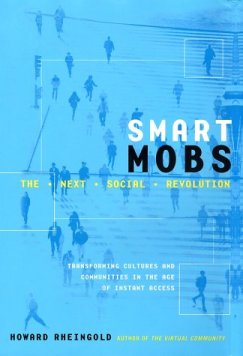
The idea was first proposed by author Howard Rheingold in his 2002 book, Smart Mobs: The Next Social Revolution. It deals with the social, economic and political changes implicated by developing information and communications technology. The topics range from text-messaging culture and wireless internet to the impact of the web on the marketplace.
In the eight years since the book first appeared, we’ve seen a proliferation and evolution of smart mobs, fuelled by the growth web 2.0 tools and, more recently, the many and varied social media. In fact, author Rheingold is credited with inventing the term virtual communities.
But the reality is that smart mobs can also be very fickle — their attention can be easily distracted. A smart mob can disperse just as fast as it forms, even while its original provocation remains.
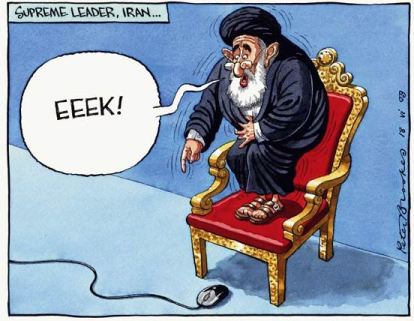
This was demonstrated in dramatic terms in June 2009. Following a hotly disputed presidential election in Iran, there was a surge of online support for pro-democracy activists there who launched a massive protest. A main point of convergence for online reporting and agitation was micro-blogging platform Twitter. Within a few days, mainstream media like TIME and Washington Post were all talking about this phenomenon in gushing terms.
As I wrote at the time: “I have no idea if the Ayatollahs are closet fans of Michael Jackson. But they must surely have thanked the King of Pop for creating a much-needed diversion in cyberspace precisely when the theocracy in Tehran needed it most.”
Other recent experiences have demonstrated how online interest can both build up and dissipate very fast. Staying with a single issue or cause seems hard in a world where news is breaking 24/7.
Here’s a current example. Following the massive oil spill in the Gulf of Mexico that started on 20 April 2010, local communities and environmental activists deployed various social media tools to track the unfolding disaster. BP, the giant oil company implicated in the disaster, has also tried to use social media to communicate its positions, but not too successfully. On Twitter, it was not BP’s official account but the satirical @BPGlobalPR that was dominating the online conversation. As one commentator wrote: “It is an object lesson in how social media can shape and control a company’s message during a crisis.”
Beyond PR?By early July 2010, however, there were already signs that online interest on the issue was already waning — even as the oil continued to leak from this largest offshore oil spill in US history. In a detailed analysis of main social media platforms’ coverage of the issue, Mashable noted last week: “An estimated 100 million gallons or more of oil have surged into the Gulf of Mexico…Yet on Twitter, Google, blogs and even YouTube, we’re already wrapping up our collective discussion of the oil spill and how to repair its damage.”
Riding the wave can be fun, but waves form and break quickly. Those who want to use social media tools for social activism still need to learn how to hitch a ride with the ocean current beneath the fickle waves.
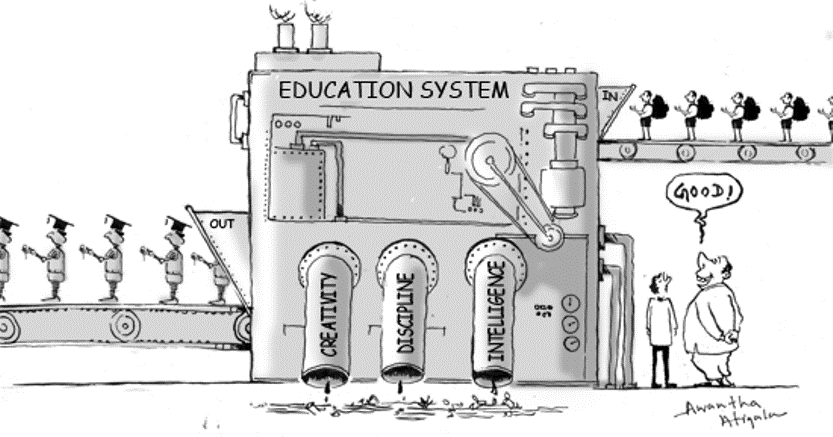
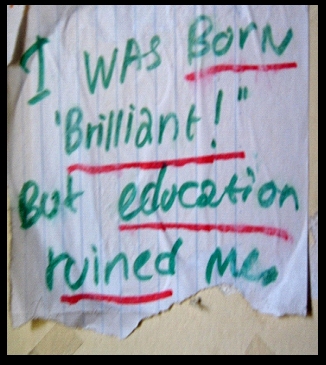
Look what education is doing to me!A few days ago, while cleaning the spare room in our home, I came across a piece of paper stuck on to the wall. These words were scribbled on it: “I was born brilliant – but education ruined me!” (see photo).
My daughter Dhara, 14, admitted authorship without any hesitation. It’s not her original line, of course — but a clear reflection of how she feels about schooling and formal education. When we think about it, these few innocent words become a severe indictment of a mass-scale system in which families, societies and countries invest so much money, time and hope.
She’s certainly not alone in her misgivings about the value of institutionalised education. As George Bernard Shaw once declared, “The only time I interrupted my education was in school.”
Although I had a happy school life, I can well appreciate how and why many people feel like this about school. Don’t take my word for it – do a quick, random sampling of those around you. How many of them will admit to having happy memories of their school days?
Let’s face it: the whole concept of a school is flawed. Education may be a great leveller among human beings, but schooling in most parts of the world operates at the lowest common denominator level. How can you group together 30 or 40 children at random, expose them to the same curriculum, imparted at the same pace, and expect all to thrive? Some will keep up; others will lag behind; and a few will be completely bored out of their minds – like I was, for a good part of my primary and secondary schooling.
Yet there is not much that even the most dedicated teacher could do under such trying circumstances. Oddly enough, no one in any self-respecting healthcare system would want to prescribe the same medicine for patients with very different ailments. Yet the one-size-fits-all approach is never questioned when it comes to education. Why?
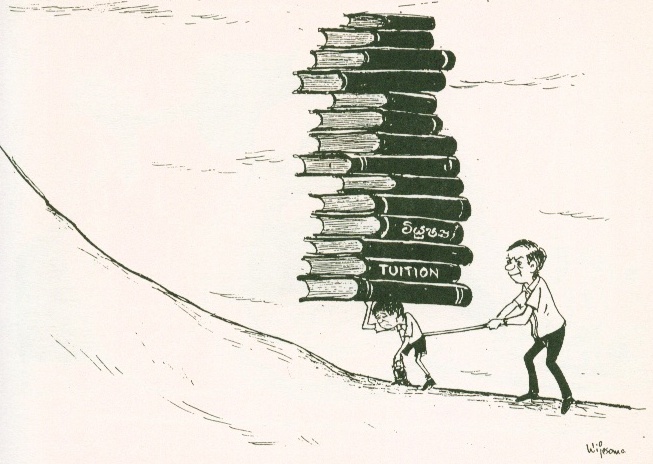
A hapless school kid being primed for the Great Rat Race - cartoon by W R Wijesoma, 1994
One reason why this abuse has thrived is because no one listens to the most important voice in this debate: the average schoolgirl and schoolboy. The learner’s perspective is largely missing in most educational policies and plans. There is so much emphasis on teaching, infrastructure, performance and resources. The handful of men and women who decide what should be taught in our schools hardly ever pause to think how their decisions affect the last link in the chain: the hapless, overburdened, over-driven student. Over 4 million of them — like the one in the cartoon above.
Must things remain like this forever? Is there any hope that our much-tinkered (and much-maligned) education system could one day be more student friendly, more learning oriented and more responsive to the different needs of different students? Will those in charge of the system begin to treat students and teachers as something more than movable statistics? And most importantly, can we restore the joy of learning, the sense of wonder and fun of schooling?
I don’t have easy answers to these – nobody does. But these are worth asking, even if they are uncomfortable and unpopular questions to pose. For too long, the formal education sector has carried on with its business-as-usual with the typical self-righteousness and arrogance of a matronly school principal.
It’s time for us to storm the citadels of learning and make them more caring, accommodating and sensitive to the needs of the most important people in the system: the learners.
Nothing less than our children’s individual and collective futures are at stake.
“Reading computer manuals without the hardware is as frustrating as reading sex manuals without the software!”
This is one of the less known, but more entertaining, dicta by Arthur C Clarke – he called it ‘Clarke’s 64th Law’, and I personally know he used to bring it up when meeting with particularly crusty or glum intellectuals. (Not all were amused.)
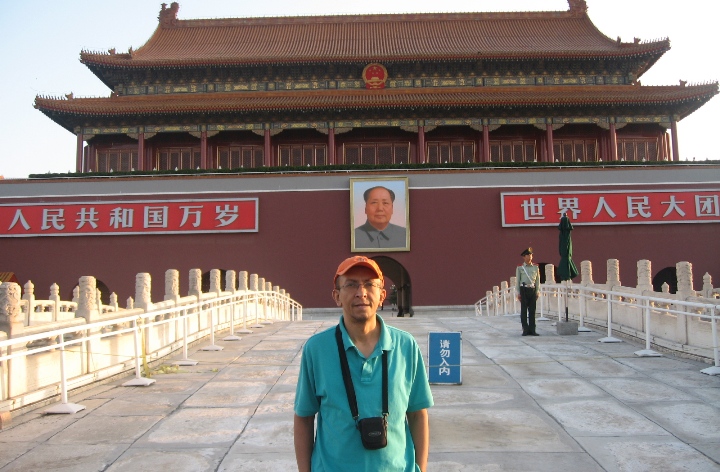
Clarke’s words kept turning in my mind as I moderated and spoke at a session on social media at Asia Media Summit 2010 held in Beijing China from 24 to 26 May 2010. The country with the world’s largest media market is not exactly the world’s most open or free – and certainly when it comes to social media, it’s a very different landscape to what we are used to…
These days, International visitors arriving in China discover quickly that access to YouTube, Twitter and Facebook is completely blocked. Apparently the brief ‘thaw’ in restrictions, seen before and during the 2008 Beijing Olympics, is now over — the current restrictions have been in place since the spring of 2009.
This doesn’t mean there is no social media in China. In fact, I heard from several Chinese friends and colleagues that there is a very large, dynamic and fast-evolving social media scene in China. For the most part, however, it’s not based on globally used and familiar platforms, and is happening in a digital universe of China’s own — under the watchful eye of the government.
Jump in...but some conditions apply!For example, I found from this March 2010 blog post by Merritt Colaizzi that:
* 221 million people have blogs, largely in a diary-style.
* 176 million Chinese connect via social networking system (SNS) with their “real” friends and online networks.
* 117 million connect anonymously via bulletin board system (BBS). These interactive online message boards are the heart of social media in China. They’re where people go to find topic-based communities and where consumers talk about products and services.
There are lots of other blogs, mainstream media reports and research commentary on social media in China — just Google and see (now that’s another thing with limited – and uneven – access in China: Google itself is available, but search results come with lots of links that simply aren’t accessible). Much or all of this interaction happens in Chinese, of course. It’s a significant part of the web and social media landscapes, but if you’re in China on a short visit and want to stay connected to your own social media networks, that’s not at all helpful.
And, of course, it undermines one of the key attributes of a globally integrated information society: the interoperability of systems and platforms.
Luckily for me, perhaps, I can survive a few days without my social media fix: I have an appalling record of updating my Facebook account: days pass without me even going there. For the moment, at least, I’m also taking a break from regular blogging (well, sort of). But I’m more regular in my micro-blogging on Twitter, and visit YouTube at least once a day, sometimes more often. I could do neither during the few days in Beijing – and that was frustrating.
So imagine having to talk about social media as a new media phenomenon in such a setting. That’s only a tiny bit better than reading computer manuals without the hardware…But this is just what I did, with all the eagerness that I typically bring into everything I do. I planned and moderated a 90-minute session on Social Media: Navigating choppy seas in search of Treasures?
With access to key global social media platforms denied, we visitors and Chinese colleagues in the audience could speak mostly generically, theoretically and aspirationally. I didn’t want to place my hosts and seminar organisers in difficulty by harping on what was missing. Instead, we focused on what is possible and happening: how development communicators are increasingly social media networks and platforms to get their messages out, and to create online communities and campaigns in the public interest.
The thrust of my own opening remarks to the session was this: In the brave new world of social media, we all have to be as daring as Sinbad. Like the legendary sailor of Baghdad, we have to take our chances and venture into unknown seas. Instead of maps or GPS or other tools, we have to rely on our ingenuity, intuition and imagination.
More about the session itself in future blog posts.
For now, I want to share this TED Talk by American watcher of the Internet Clay Shirky on how cellphones, Twitter, Facebook can make history. Shirky shows how Facebook, Twitter and TXTs help citizens in repressive regimes to report on real news, bypassing censors (however briefly). The end of top-down control of news is changing the nature of politics.
I haven’t been blogging much during April. One reason is that I’ve been travelling across space — and time.
I was in London for 10 days, and with its lovely Spring weather, I had every reason to be offline. I’ve also been spending a good deal of time back in 1966-67, and having a great deal of fun doing so. (The 1960s had a charm of their own that’s never been repeated…)
Let me explain. I’ve been watching the digitally remastered original Star Trek episodes, which had their first broadcast in that now far-away year — the same year I was born. And what an exhilerating experience to go back to these superbly crafted stories: they offer me both timeless mental stimulation and a sentimental journey to my own childhood/boyhood.
I’d heard of the digitally remastered DVDs’ release a couple of years ago, and was delighted when I found the last copy of Season 2 in a DVD store in Amsterdam in late March. The remastered episodes look and sound crisp, thanks to digitally restored imagery and audio. But the more daring work involved updating the shows’ visual effects with CGI to bring them more in line with the look and quality of later Trek efforts. That’s proving to be a real treasure – well worth waiting for…
As the promotional blurb reads on Amazon.com: “Star Trek, the NBC series that premiered on 6 September 1966, has become a touchstone of international popular culture. It struggled through three seasons that included cancellation and last-minute revival, and turned its creator, Gene Roddenberry, into the progenitor of an intergalactic phenomenon. Eventually expanding to encompass five separate TV series, an ongoing slate of feature films, and a fan base larger than the population of many third-world countries, the Star Trek universe began not with a Big Bang but with a cautious experiment in network TV programming. Even before its premiere episode (“The Man Trap”) was aired, Star Trek had struggled to attain warp-drive velocity, barely making it into the fall ’66 NBC lineup.”
To boldly go where no man has gone before...
As I’ve said before, I’m as old as Star Trek: we were born a few months apart in 1966 (I’m older by seven months). But because we grew up on opposite sides of planet Earth in the pre-Internet era, our worlds didn’t collide until we were both well into our teens.
I have vivid memories of that delightful first encounter, which changed the course of my life forever. In mid or late 1982, Sri Lanka’s newly launched national TV channel Rupavahini started airing a space adventure series called Star Trek. Although I was already familiar with Star Wars movies (of which two had been made by then), I’d not heard about Star Trek until the publicity accompanying the local broadcast.
Star Trek (the original series, now abbreviated as TOS) aired on my local TV – we had just two channels back then – on Wednesdays from 7 to 8 pm, which was prime time just before the evening news at 8. I remember the series ran for at least a year, during which time around 50 episodes were broadcast. I managed to watch most of them.
That wasn’t as easy as it sounds. Our household didn’t yet have a television set, so I had to go across to my aunt’s house next door to watch Star Trek. My school teacher parents took a long time to warm up to the new medium – we didn’t acquire a TV set until early 1983, almost four years after TV was introduced to Sri Lanka in April 1979. And because they placed such emphasis on studies, I was allowed only an hour of television per week. I have absolutely no regrets that while it lasted, I devoted my entire weekly TV quota for Star Trek.
So every week at the appointed time, the United Star Ship Enterprise and its intrepid crew took my young mind roaming around the universe, providing me a welcome escape from the dull and monotonous routine of my teenhood. Even today, hundreds of movies and many thousands of TV hours later, I can just close my eyes and instantly replay in my mind the evocative theme narration and music of Star Trek TOS:
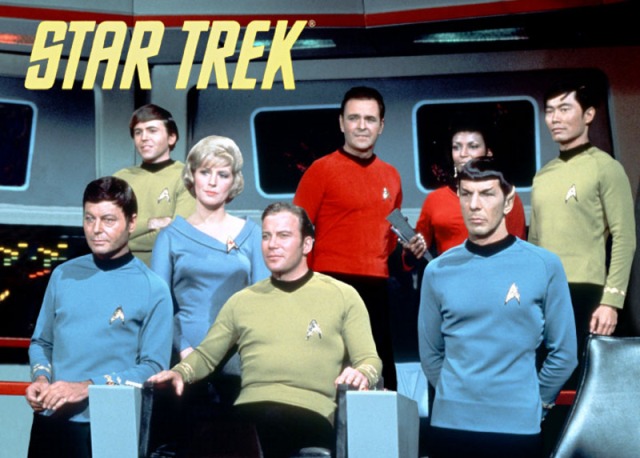
I sat awestruck by the adventures of Captain James T Kirk (played by William Shatner), First Officer Spock (Leonard Nimoy), chief engineer Lieutenant Commander Montgomery Scott (James Doohan), Dr. Leonard “Bones” McCoy (DeForest Kelley), Communications Officer Uhura (Nichelle Nichols) and others. The stories appealed to me as much for insights into the infinite possibilities (and combinations) of life, technology and power at a cosmic scale, as for the glimpses of the near-Utopian human society in the 23rd century.
The series was already 15 years old, and it was showing signs of age. It had the faded Technicolor look and feel of films and TV programmes made in the 1960s and 1970s. The sets were basic and special effects appeared simple — computer-generated images (CGI) was not yet invented. On such technical merits, Star Trek TOS appears elementary when compared to the original Star Wars movie that would roll out just a decade later, in 1977. (A decade is a very long time in the entertainment industry.)
But what the series lacked in looks, the show more than made up in its brilliant story lines and rich imagination. Inadequacies in production values didn’t really matter to me — or to millions of other ‘Trekkies‘ scattered across the planet. The storylines were entertaining and mind-stretching, frequently carrying concepts distilled from the finest in science fiction literature (in fact, some of the genre’s accomplished writers were involved in writing stories for the series, e.g. Robert Bloch, Normal Spinrad, Harlan Ellison and Theodore Sturgeon). The characters were strong, diverse and played by actors who soon developed global fan clubs of their own.
And now, I can relive those journeys again — this time at my leisure, packing as many, or as few, into my private screening schedule. No broadcaster or parent holds me captive any more.
Here’s how the digitally remastered version of the same series opens (aficionados, please spot the differences):
And here are a couple of comparisons between the old and remastered versions that fans have done and released on YouTube:
Of course, remastering a series held in such awe and regard by millions of fans worldwide was a calculated risk.
As Wired noted in a December 2008 story: When Star Trek designer Mike Okuda began remastering the original Star Trek episodes for a series of DVD releases, there was a chance that the show’s more devoted fans would want him beamed to a Klingon prison planet for altering the 1960s classic. To guard against this, Okuda insisted that the new effects would have to be closely based on the originals to retain the visual spirit of the ’60s series.
To melancholic Hamlet, death was an undiscovered country. In Shakespeare’s most famous soliloquy, the Prince of Denmark hesitates in his consideration of suicide not because of an absolute Christian belief in divine retribution, but because he is afraid of an afterlife of which he cannot be sure.
For the more cheerful among us, the Future is the great Undiscovered Country. It’s a notion that has been used widely by science fiction writers, and in 1991, it was popularised by Star Trek VI: The Undiscovered Country is the sixth feature film in the Star Trek science fiction franchise.
In the movie, Klingon Chancellor Gorkon – talking peace with the Earth Federation – gives a toast to “the undiscovered country — the future”. Spock recognizes the line from Hamlet, and Gorkon tells Spock that one has never read Shakespeare properly until reading the text in “the original Klingon”…
All this forms the backdrop (well, sort of!) to my latest op ed essay, just published by Groundviews citizen journalism website. Titled Voting for the ‘Undiscovered Country’?, and timed for Sri Lanka’s general election 2010, it takes a look at the most important common element discussed and debated during the election campaigns by all parties: Sri Lanka’s future prosperity.
As I note: “Our endlessly bickering political parties rarely agree on anything, so it’s refreshing to see a broad consensus on what this election is fundamentally about: future prosperity.
“That’s no coincidence. This is the first time we elect our law makers since the long drawn and brutal civil war ended in May 2009. We have been looking back — or nervously looking around — for much of the past three decades. It’s about time we finally looked forward.”
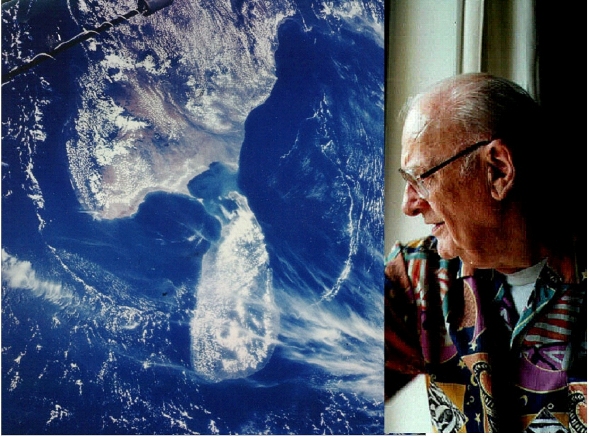
I go on to say: “How we wish Sir Arthur C Clarke was still with us at this crucial juncture in our history! For half a century up to his death in March 2008, the author, explorer and visionary was Sri Lanka’s amiable ‘tour guide’ to that ‘Undiscovered Country’ called the Future.
“Whoever wins this week’s election, shaping a better future will need clarity of purpose, hard work and persistence. Those looking for long term vision can start with the substantial volume of essays, interviews and speeches that Clarke has left behind…”
The rest of the essay is a concise exploration of Sir Arthur Clarke’s advice offered to his adopted homeland over several decades, and covering different areas of public policy and public interest such as education, technology, environmental conservation and managing human diversity.
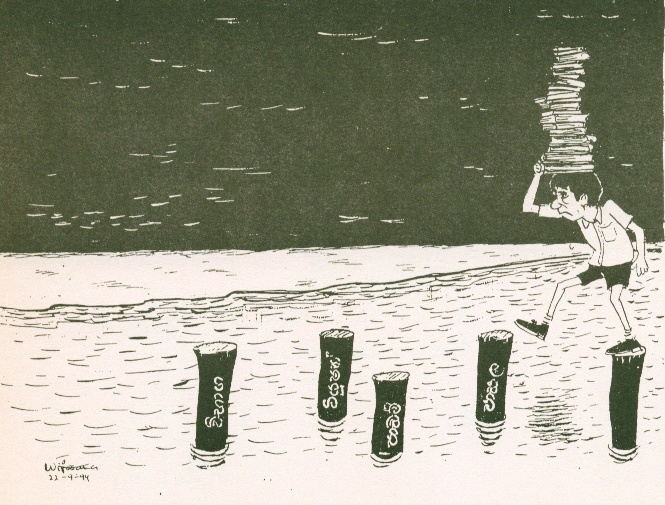
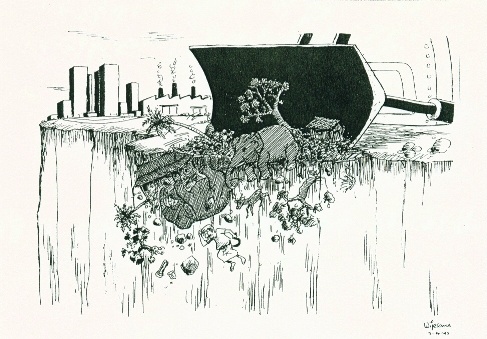
Price of Development, as seen by Cartoonist W R Wijesoma, 1993
Environmental activist and communicator Piyal Parakrama’s sudden death last week, of a heart attack, jolted Sri Lanka’s closely-knit green community. The activist community may bicker and argue endlessly among themselves, but there is also strong kinship among its cacophonous members. Many of them are still trying to come to terms with the loss.
As indeed am I – even if I’m not quite a certified member of the activist community, I consider myself a fellow traveler. I turn to words – either reflective prose or verse – when I want to make sense of something, and over the last weekend I wrote a new essay. It runs into 1,800 words and, as with all my tributes to public figures, this one is also social commentary laced in anecdotal reminiscence. It expands on initial thoughts that first appeared on this blog .
Here’s an excerpt where I talk about challenges faced by Sri Lanka’s environmental activists:
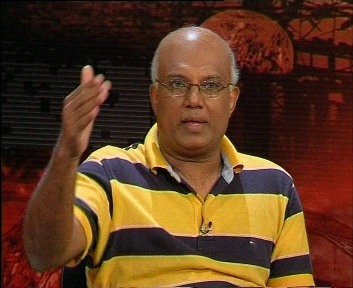
Piyal Parakrama on Sri Lanka 2048 TV showDuring the past three decades, Piyal and fellow activists have taken up the formidable challenges of conserving Sri Lanka’s biodiversity, long under multiple pressures such as growing human numbers, rising human aspirations, and gaps in law enforcement. Adding to the sense of urgency was the 1999 designation of Sri Lanka as one of the world’s biodiversity hotspots, where high levels of endemic species (found nowhere else in the wild) were threatened with extinction. Public and media attention is disproportionately focused on a few charismatic mega-fauna like elephants and leopards; in reality, dozens of other animal and plant species are being edged out.
In search of viable solutions for entrenched conservation problems, Piyal collaborated with scientists, educators, journalists and grassroots activists. Some industrialists and investors hated his guts, but he was much sought after by schools, universities and community groups across the country. Concerned researchers and government officials sometimes gave him sensitive information which he could make public in ways they couldn’t.
Some eco-protests grew into sustained campaigns. Among them were the call to save the Buona-Vista reef at Rumassala and struggles against large scale sugarcane plantations in Bibile. A current campaign focuses on the Iran-funded Uma Oya multipurpose project, which involves damming a river for irrigation and power generation purposes.
While environmentalists ultimately haven’t block development projects, their agitations helped increase environmental and public health safeguards. Occasionally, projects were moved to less damaging locations – as happened in mid 2008, when Sri Lanka’s second international airport was moved away from Weerawila, next to the Bundala National Park.
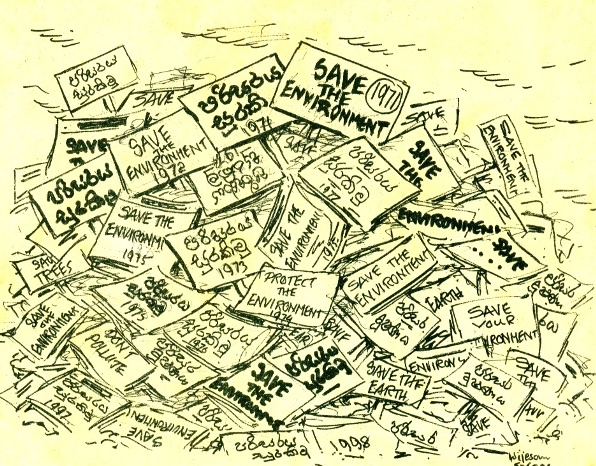
The hard truth, however, is that our green activists have lost more struggles than they have won since the economy was liberalized in 1977. They have not been able to stand up to the all-powerful executive presidency, ruling the country since 1978 — most of that time under Emergency regulations. In that period, we have had ‘green’ and ‘blue’ parties in office, sometimes in coalitions with the ‘reds’. But their environmental record is, at best, patchy. In many cases, local or foreign investors — acting with the backing of local politicians and officials — have bulldozed their way on promises of more jobs and incomes. Environmentalists have sometimes been maligned as anti-development or anti-people. In contemporary Sri Lanka, that’s just one step away from being labeled anti-national or anti-government.
At the end of the essay, I try to sum up the multiple challenges faced by ALL activists in Sri Lanka today:
“Activism is not an easy path anywhere, anytime, and especially so in modern day Sri Lanka. All activists – whether working on democracy, governance, social justice or environment – are struggling to reorient themselves in the post-conflict, middle-income country they suddenly find themselves in. Their old rhetoric and strategies no longer seem to motivate the people or influence either the polity or policy. Many of them haven’t yet crossed the Other Digital Divide, and risk being left behind by the march of technology.”
After all, I want our activists to be effective and successful as society’s conscience. My suggested author intro for this latest essay, somehow now included in the published version, read: “Science writer Nalaka Gunawardene dreams of becoming an activist one day, but for now, he remains a ‘critical cheer-leader’ of those who are more courageous.”
Piyal Parakrama died so suddenly and unexpectedly on the night of March 3 that it’s hard to believe that he is no longer among us. Another public-spirited individual has left the public space all too soon.
Piyal combined the roles of environmentalist, educator, researcher and media personality. He was also a colleague who became a friend, and a fellow traveller for many years.
In a public career spanning 30 years, he wore multiple hats, among them: Executive Director of the Centre for Environmental and Nature Studies, founder President of the Nature Conservation Group (NatCog), President of the Green Party of Sri Lanka, and consultant to various state and academic institutions. He also worked for the now-defunct Sri Lanka Environmental Congress (SLEC) and now dormant Sri Lanka Environmental Television Project (SLETP).
But Piyal Parakrama was more than an amalgamation of these parts: he was his own distinctive brand — admired, trusted or feared by different sections of society. Even his ardent detractors (and he had a few) would readily agree that he gave far more to the public good than he took back personally.
Piyal’s forte was biodiversity. His interest and knowledge were nurtured first at the Young Zoologists Association (YZA) – where he remained a volunteer for 30 years – and later at the Lumumba Friendship University in Russia, where he studied biology from 1983 to 1986.
In searching for viable solutions for entrenched conservation problems, Piyal collaborated with scientists, educators, journalists, school children and local activists. Some industrialists and investors simply hated his guts, while concerned researchers and government officials sometimes gave him sensitive information which he could make public in ways they couldn’t.
Given our common interests in development issues and the media, Piyal and I moved in partly overlapping circles. Our paths crossed frequently, and we shared public platforms, newspaper space and broadcast airtime. We even worked together for a few months in the late 1990s at the SLETP. His communications skills were invaluable in rendering a number of international environmental films into Sinhala.
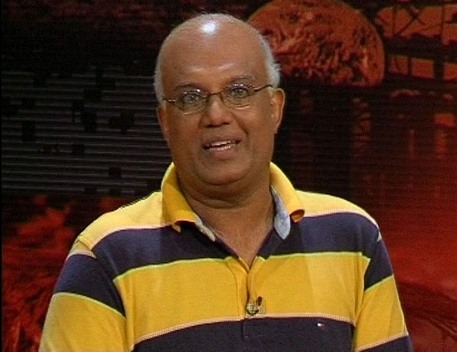
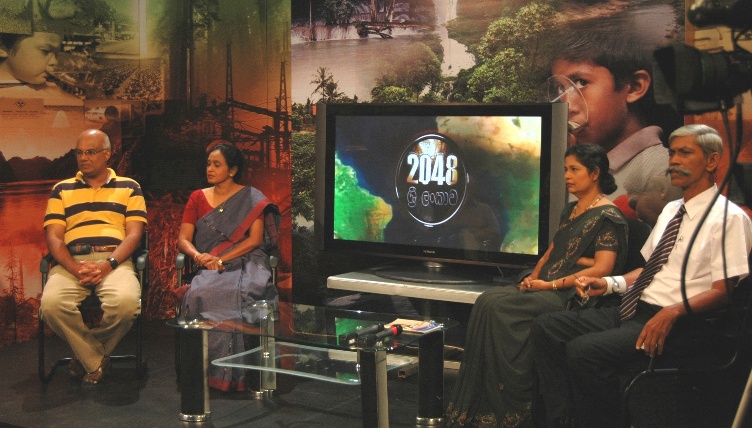
Piyal Parakrama (left) on the set of Sri Lanka 2048 - debate on Water Management
The last time we collaborated was in such a media venture. In mid 2008, Piyal joined an hour-long TV debate we produced as part of the Sri Lanka 2048 series. The show discussed the various choices and trade-offs that had to be made today to create a more sustainable Sri Lanka over the next 40 years. Taking such a long term view is rare in our professional and media spheres preoccupied with the challenges of now and here (or restricted in vision by short-termism).
Piyal could speak authoritatively on several topics we covered in the 10-part series, but I invited him to the one on managing freshwater, one of Sri Lanka’s once abundant but now threatened natural resources. With his deep knowledge and understanding of traditional water and soil conservation systems, he was truly in his element in that debate. He was also the ‘star’ among the diverse panel and studio audience we had carefully assembled.
I’m working on a longer tribute where I try to position Piyal’s role in Sri Lanka’s conservation movement. Watch this space…



 Open Minds!