Women on the Frontline: Reporting from the battlefront at…home!

“Violence against women threatens the lives of more young women than cancer, malaria or war. It affects one in three women worldwide. It leaves women mentally scarred for life — and it is usually inflicted by a family member.”

With these words, Annie Lennox, the British singer and social activist, presents a new global series of investigative television documentaries called Women on the Frontline that begins on the global satellite TV channel BBC World today, 18 April 2008.

The seven half-hour films shine a light on violence against women and girls in different parts of the world – East and West, North and South. The series takes the front to homes, villages and cities of our world where a largely unreported war against females is being waged.

Read my Feb 2008 blog post: Half the sky, most of the suffering…

The films cover Nepal, where thousands of women are trafficked each year; Turkey, where killing in the name of honour continues; Morocco, where women political activists who have survived torture and imprisonment testify before a government truth and reconciliation commission; the DRC, where women bear the brunt of a 10-year war in the eastern provinces; Colombia, where women have been tortured in the shadow of a guerilla war; Mauritania, where women who have been raped may go to prison; and Austria, where, under a new law, perpetrators of domestic violence are forced to leave home.

Here’s the line up of depressing reports in this series, produced by Geneva-based dev tv and London-based One Planet Pictures – both international partners of TVE Asia Pacific.

Nepal: A Narrow Escape
Turkey: Killing in the Name of Honour
Morocco: Never Again
Democratic Republic of Congo: Find a Word for It
Austria: Showing the Red Card
Mauritania: No film name known yet
Colombia: Justice in the Region of Death

Check dev tv website for broadcast times on BBC World

On the Frontline… is a ‘vehicle’ for independent producers to tell compelling stories about the people who uphold civil society where it is most at threat. The strand started with the 2006 pilot series Doctors on the Frontline, a profile of Medecins Sans Frontieres (MSF) field doctors made by Dev TV film-makers.

Since then, the series has covered villages battling desertification and land degradation, nurses and para-medics on humanitarian missions in hot spots of the world, and children living with social and environmental disintegration.

On the Frontline has gone behind the lines with rebels and filmed among violent street gangs but this time we’ve taken the frontline mostly into the home, where even after 20 years in production, I’m still shocked to see how many obstacles lie between women and equality, and the violence they must still endure,” said Robert Lamb, Executive Director of the series.

A number of UN agencies, including UNFPA and UNIFEM, donor countries such as Austria, non-governmental organizations and other partners provided information and support for the latest series of Women on the Frontline.

Soon after its initial run on BBC World, the series will be distributed in the Asia Pacific region by TVE Asia Pacific.

Read official brochure of Women on the Frontline TV series

March 2008 blog post: Unseen women, unheard voices

Crude: The incredible journey of oil (humanity’s substance addiction)

My colleague Manori Wijesekera returned last month from Tokyo, having participated in Earth Vision – the 16th Earth Vision Global Environmental Film Festival. She represented TVE Asia Pacific as director of one of its finalist films.

The grand prize of the festival was awarded to a stunning science documentary on the story of oil, produced by the Australian Broadcasting Corporation (ABC). Here’s the basic information:

Crude: the Incredible Journey of Oil
The world’s oil fields are deposits of phytoplankton on the ocean floor from the Jurassic period. Will our mass consumption of oil in the last 150 years thrust us back climatically to the warm primeval age when oil fields were formed?
(2007/Australia/90min/Director:Richard Smith)

See the full list of awards presented at Earth Vision 2008

Crude is one of several films that have come out recently exploring the many facets of oil and our civilisation’s dependence (addiction) on it. In March 2007, I wrote about Addicted to Oil, a documentary presented by the New York Times columnist Thomas L Friedman.

David Suzuki, environmentalist, author and long-standing presenter of the natural history series The Nature of Things has called this “a thoughtful, surprising and really important film”.

This is what Manori reported about Crude:

Produced and directed by Richard Smith, this 90 min journey sweeps through the ages: from the birth of oil deep in the dinosaur-inhabited past, to its ascendancy as the indispensable ingredient of modern life.

As Smith states, “Oil is perhaps the single most important commodity shaping the economy, politics and environment of the modern world, and yet most people have only vague notions of where it comes from. I wanted to take the audience back into the ancient oceans in which oil was formed and reveal how intimately the creation of a major oil deposit is connected to the long-term regulation of the planet’s climate”.

“I saw the film as a sort of essential primer for people to begin to make sense of both the coming oil and climate crises. I make no apologies for such apparent certainty that we will face these two dilemmas. From my understanding of the science and the facts, these are the logical conclusions to the planet carrying on with a business-as-usual, or indeed a business-at-any-cost approach. The worst effects of both are probably avoidable, but only if people understand why there is an urgent need to act.”

Crude was first broadcast on ABC TV in May 2007 and is now being distributed worldwide. It has already won two awards at the 2007 Jackson Hole Wildlife Film Festival: the Best Earth Sciences Film award and the Special Jury Recognition Award.

Watch Crude: The incredible journey of oil at ABC’s interactive website

Read production details and short profiles of the film-makers

Krishnendu Bose, Manori Wijesekera and Richard Smith at Earth Vision 2008

Photo: Finalist film directors Krishnendu Bose, Manori Wijesekera and Richard Smith at Earth Vision 2008 in Tokyo

All images of Crude courtesy ABC

Arthur C Clarke tribute: Science’s critical cheerleader

scidevnet-logo.jpg scidevnet-logo.jpg

My guest editorial on the late Sir Arthur C Clarke has just been published by the London-based Science and Development Network, SciDev.Net:

Arthur C Clarke: Science’s critical cheerleader

In this, I briefly comment on Sir Arthur’s accomplishments in popular science communication and his life-long crusade against pseudo-science — two important facets of the multi-faceted author, science populariser and underwater explorer who died on 19 March 2008.

Excerpts:

“Clarke’s forte was not only extrapolating about humanity’s technological abilities, but also exploring the nexus between science and society. With his death, science has lost an articulate and passionate promoter who challenged scientists to play a greater role in public policy and demanded that political leaders should take science seriously.

“But he was never an uncritical cheerleader for science, and that will be part of his enduring legacy. In an essay in Science, he cautioned, ‘For more than a century science and its occasionally ugly sister technology have been the chief driving forces shaping our world. They decide the kinds of futures that are possible. Human wisdom must decide which are desirable.'”

In my essay, I talk about how Sir Arthur readily took on a formidable array of anti-science beliefs and superstitious practices, from creationism and scientology to astrology and fire-walking. In these endeavours he joined other campaigners against pseudoscience, including scientists Carl Sagan and Stephen Jay Gould and the magician James Randi.

“For a while, Clarke even made a modest living as a professional sceptical enquirer. Beginning with Arthur C Clarke’s Mysterious World (1980), he hosted three television series that probed – and sometimes exposed – numerous mysteries, superstitions and the paranormal.

“Even when Clarke didn’t find full explanations, he invariably demonstrated the value of keeping an open mind and asking the right questions. And instead of ignoring or dismissing popular obsessions, he tried engaging their proponents in rational discussion. That was characteristic of Clarke, a genial moderator who always sought to build bridges — whether between scientists and the public, or across the “two cultures” divide between the arts and the sciences.”

In all, Sir Arthur hosted three TV series over 15 years:
Arthur C Clarke’s Mysterious World (1980)
Arthur C Clarke’s World of Strange Powers (1985)
Arthur C Clarke’s Mysterious Universe (1994)

These series had numerous re-runs for years on Discovery and other TV channels all over the world. They are still available on DVD. While some of the content is now dated by more information or insights emerging since their production, the series still inspires critical thinking – not to mention TV emulations that come out with many more frills than was possible in the 1980s.

Watch the opening of the first series, where Sir Arthur offered his own classification of mysteries (9 mins 21 secs):

Sir Arthur filmed all his pieces to camera from different, scenic locations in his adopted home in Sri Lanka. Few Sri Lankans realised at the time that this generated millions of dollars worth of free promotion for the country as a tourist destination.

In fact, I end my editorial by looking at Arthur C Clarke the public intellectual in Sri Lanka, where he lived since 1956. I look at how he won some battles with rational arguments while lost others (e.g. Sri Lankan obsession with astrology). This is clearly a subject I will return to in greater depth and analysis in the coming months.

In the modest cough department, I am immensely proud of how I sign off on this editorial:
Arthur C. Clarke mentored Sri Lankan journalist Nalaka Gunawardene and they worked together for 20 years.

SciDev.Net – the Science and Development Network – is a not-for-profit organisation dedicated to providing reliable and authoritative information about science and technology for the developing world. Through http://www.scidev.net, it gives policymakers, researchers, the media and civil society information and a platform to explore how science and technology can reduce poverty, improve health and raise standards of living around the world. SciDev.Net is co-sponsored by the leading journals Nature and Science.

TVE Asia Pacific says Thank You to Sir Arthur C Clarke

In his 1992 book How the World Was One, Sir Arthur C Clarke described a dream: one day in the near future, CNN founder (and then owner) Ted Turner is offered the post of World President, but he politely turns it down – because he didn’t want to give up power!

Just three years later, the then Secretary General of the UN suggested that CNN should be the 16th member of the Security Council. Sir Arthur was fond of quoting this, and once famously told Turner: “You owe me 10 per cent of your income”.

These references – illustrating the power of globalised satellite television – are recalled in TVE Asia Pacific‘s official tribute to Sir Arthur C Clarke, who passed away on March 19 aged 90.

“With the death of Sir Arthur C Clarke, TVE Asia Pacific has lost a long-standing friend and supporter,” the tribute says.

It adds: “Since our establishment in 1996, Television for Education Asia Pacific – to use our full name – has been engaged in pursuing Sir Arthur’s vision of using the potential of moving images to inform and educate the public. Our founders chose to focus on covering development and social issues, with emphasis on the Asia Pacific region – home to half of humanity and where Sir Arthur spent the last half century of his life.”

Although he never held a formal position at TVEAP, Sir Arthur was an informal adviser and mentor to the regional media organisation whose work across Asia Pacific is only possible thanks to the comsat that invented and the web that he inspired.

By the time TVEAP was created in the mid 1990s, the satellite TV revolution was well underway in the Asia Pacific region, and the internet revolution was just taking off. In informal discussions, Sir Arthur advised us to always keep our eyes open on what’s coming up. In the ICT sector, he cautioned, being too closely wedded to one technology or system could lead to rapid obsolescence.

The tribute mentions Sir Arthur’s specific support for the Children of Tsunami media project, and the Communicating Disasters publication.

We also talk about Sir Arthur’s concerns about using information and communication technologies (ICTs) to benefit the poor and other disadvantaged groups – a process that he aptly described as ‘geek to meek’.

We end by recalling how TVEAP recorded and uploaded to YouTube Sir Arthur’s last public video address – his 90th birthday reflections in December 2007.

Read TVEAP’s tribute to Sir Arthur C Clarke, 1917-2008

sir-arthur-clarke-reflecting-on-90-orbits.jpg

The Meatrix Reality: Mixing animation, activism and spoof

When I gave up eating all meat nearly 15 years ago, I had some explaining to do.

Breaking away from the pack is never that easy. Friends and colleagues wanted to know if I had suddenly gone religious (most certainly not: I practise no religion and frown upon all); or become an animal-hugger (well, not quite); or if I was too sick to eat a ‘normal diet’ anymore.

That last one was closer to the truth. I became a partial vegetarian because I wanted to stay healthy. I realised how unhygienic meat production and distribution were in my part of the world, and yes, I was also sensitive about the excessive cruelty to animals who end up on dining tables.

And it’s not just in Asia that organised meat production is increasingly hazardous to human health (not to mention the untold suffering by farm animals and the growing power of big agri-business companies). Animal rights and environmental activists have been pointing these out for years. And as powerful documentaries like Fast Food Nation (2006) documented, it is not only meat that’s crushed in the powerful mincing machine, but the whole of society.

But just how do we carry this message to the young Digital Natives who are the most eager consumers of meat and fast food? As we discussed some months ago, the big challenge is to take complex development issues in the right durations (shorter the better) and right formats (mixed or pure entertainment).

The Meatrix Moopheus

I was delighted, therefore, to belatedly discover the innovative and insightful series called The Meatrix. Funnily, I heard about it from two sources almost at the same time. A Malaysian activist I was visiting in Georgetown, Penang, last week highly recommended it. Two days later, my colleague Manori Wijesekera returned from having screened one of our own films at the 16th Earth Vision Film Festival in Tokyo – where The Meatrix was a finalist in the children’s environmental film category.

The Meatrix is an animated spoof on The Matrix trilogy (1999 – 2003). It uses humor and thinly veiled characters and situations from the original Matrix films to educate the uninitiated about factory farms.

Evidently, it was made with the blessings of the Wachowski brothers who created the science fiction thriller series. The first animation, The Meatrix, starts when Moopheus the Cow finds Leo the Pig at a family farm and informs him that corporations are taking over the way farms used to be. By taking the blue pill, Leo can remain at ease in his current situation, or by taking the red pill, Leo can see just how far the rabbit hole goes. (Of course, the good Leo takes the red one.)

Watch the first animation on YouTube:

In this case, the Meatrix is the illusion created by big time agricultural corporations who have taken over most family-run farms in the west, and turned them into ruthless factories producing meat and dairy products. Those who take on the Meatrix – at grave risk to their life and limbs – reveal how these factory farms are pumping steroids, antibiotics and growth hormones to maximise production, exposing unsuspecting consumers to major health risks like mad cow disease and antiobiotic resistance.

There are two short sequels to the original Meatrix: The Meatrix II: Revolting, and The Meatrix II½. They all pack action, suspense and even a bit of romance….just like the Matrix films did. And all the Meatrix animations are under five minutes in duration – just right for the fast media generation!

The Meatrix is collaboration between GRACE (Global Resource Action Center for the Environment) and Free Range, a cutting-edge design company with a social conscience. It’s the mission of GRACE to eliminate factory farming and to preach the message that sustainable agriculture is both a better environmental and economic choice for rural communities.

In February of 2003, Free Range developed the Free Range Flash Activism Grant, offering the prize of a flash movie production to forward the work of a worthy nonprofit. GRACE was the first recipient, in recognition of its important work on farm reform.

When The Meatrix I launched in November 2003, the viral grassroots film broke new ground in online advocacy, creating a unique vehicle in which to educate, entertain and motivate people to create change. The Meatrix movies have been translated into more than 30 languages and are now the most successful online advocacy films ever with over 15 million viewers worldwide.

Read more about the creators of The Meatrix.

Read more about healthy farm products – information from Sustainabletable

Get involved – what you can do to stop the Meatrix from marching on and on to restaurants and homes of the world

The Meatrix animations and the interactive website built around them are fine examples of crossing the other digital divide (between Digital Immigrants and Digital Natives) that I have been writing about. This is Education for Sustainable Development (ESD) with none of the pomposity and preaching of UN agencies and other development organisations who are, sadly, trapped in their own version of a Verbiage Matrix where text, text and more text seems to be their whole reality.

It’s time some of our development friends took a red pill to see what lies outside their charmed and illusory circles.

PS: By the way, I still eat fish and other seafood, largely because on my frequent travels in Asia I turn up in places where being a complete vegetarian is simply not realistic (try Korea, for example). I now say I eat only those creatures that swim, but none that walks on land. One of these days, I will give up temptations for all flesh…

Unseen women, unheard agonies

In January 2008, I wrote about Lakshmi and Me, a recent Indian documentary that portrayed a domestic worker woman whom my friend Kalpana Sharma aptly called an invisible superwoman.

A colleague who read my piece reminded me about a series of five short films on working women in Sri Lanka that I had executive produced in 1999-2000. Produced originally in Sinhala for a national audience, the series was titled Oba Nodutu Eya (The Unseen Woman). In fact, it featured not one but several women workers in two different sectors in the country’s informal economy: the coconut husk (coir) industry in the south and agricultural settlements in the Dry Zone in the north-central areas of the island.

The following is adapted from a story I wrote about this series for a book that TVE Asia Pacific published in 2002. I have not gone back to my sources to check how much – or how little – has changed in the past several years.

yasawathie-from-a-voice-without-a-sound.jpg

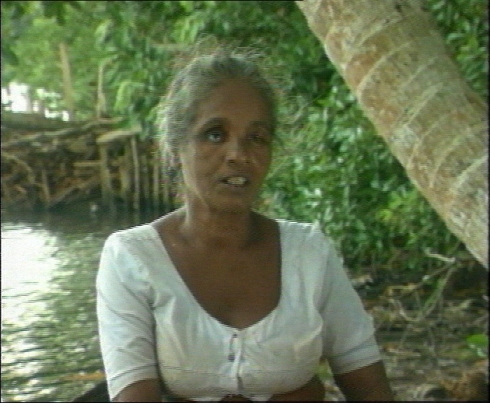
This is Yasawathie. She has suffered physical and mental abuse most of her adult life. Her alcoholic husband beat her regularly for years, but she dared not complain for fear of reprisal.

“He injured my head, stabbed me and once fractured my arm” she says, showing a scar of a healed wound.

As if this suffering was not enough, she lost sight in one eye a few years ago in a bizarre hospital accident. She had gone to the government hospital seeking treatment for a chest ailment. There were more patients than beds, so she was forced to sleep on the floor. While sleeping, a nurse carelessly dropped a saline stand on to Yasawathie’s face.

The entire incident was hushed up, and the poor woman was intimidated into silence. “Sometimes patients even die at our hands,” the nurse told her threateningly.

Injured by the healthcare system, battered by her own husband and pressurised by her family circles to keep quiet about, this middle aged Sri Lankan woman has run out of options. She was not aware she could claim damages for the accidental loss of her eye. She does not realise there is legal redress for domestic violence – her family and in laws wouldn’t allow it in any case.

Sadly, Yasawathie is not alone. There are tens of thousands of women like her who live on the margins of society, and whose suffering goes largely unnoticed. The island nation is often cited as a South Asian success story: its women were the first in Asia to vote; female literacy is nearly universal; and a higher percentage of girls and young women are in school than boys.

But hidden beneath these national accomplishments, there are huge gender-based disparities and gaps, especially in economic, labour, family and property related matters. Studies have found that many women, particularly the poorer ones, don’t know their human and legal rights.

And even women who do know their civil and political rights often do not assert their right to safeguard themselves from domestic violence or gender-based discrimination in family and society.

Yasawathie’s story was one of several that were featured in a television documentary series that probed how Sri Lankan women’s economic and legal rights operate in the real world. Produced in 1999-2000 by TVE Asia Pacific in collaboration with the Sri Lanka Environmental Television Project (SLETP), the series went beyond the oft-repeated claim of women’s emancipation in Sri Lanka. It uncovered a shocking reality of wide spread rights denial, physical abuse and gender-based violence.

The series used a mixture of short drama segments, interviews and background commentary. “These films don’t offer comprehensive surveys of the situation, but they provide useful glimpses of how economic and legal rights apply at the grassroots for women,” said accomplished fim-maker Inoka Satyangani, who directed the series. “We raise broader concerns, and point out changes that society needs to make to ensure that women can assert their rights.”

Violence against women is both a public and private matter in Sri Lanka, says the Committee on the Elimination of Discrimination against Women (CEDAW), a body of global experts which monitors whether governments are honouring their commitments to the 1981 United Nations’ Women’s Convention. Although violence affects women of every class and ethnicity, it is seldom reported.

In recent years, human rights abuses in Sri Lanka’s conflict ridden north and the east have received international scrutiny; both the government forces and Tamil Tiger rebels have committed atrocities. But violence against women is not confined to the war or the conflict-affected areas: as one rights activist has remarked, “everyone becomes part of the larger system of brutality”.

CEDAW has stressed that Sri Lanka needs specific legislation to address violence behind closed doors.

from-oba-nodutu-eya-tv-series.jpg

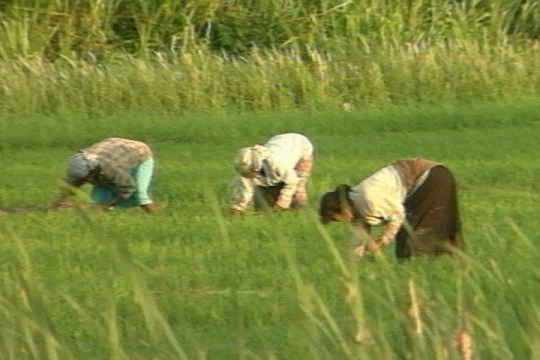
The TV series also found how women get paid less than men for agricultural manual labour, and how government-driven land development schemes favour men to inherit state land distributed among the landless. Government agricultural extension programmes help male farmers to obtain skills training, credit and subsidies while women farmers are constantly ignored. Women interviewed had stories that shattered the myth of women’s liberation and equality in Sri Lanka.

Read individual synopses of the five films in The Unseen Woman series

Read recent blog post: Half the sky, most of the suffering and seeking everyone’s attention

Can Rambo take on the Burmese junta? Not quite in 90 minutes…

Hollywood’s attempts to support progressive causes in movies continue with Rambo 4, starring Sylvester Stallone.

In the fourth and latest installment of the violent adventures of John Rambo, the Vietnam veteran takes on the Burmese junta who have held the Southeast Asian country in its crushing, ruthless grip since 1962.

Inter Press Service (IPS) journalist Lynette Lee Corporal has just written an interesting article where she talked to Burmese exiles and others involved in Burma issues. Excerpts:

“In his latest caper, a bored-looking Rambo ekes out a living catching cobras in the jungles of Mae Sot in Thailand, near the border with Burma. But the arrival of a group of Christian missionaries, whose idealism and naivete literally led them to a slaughterhouse, changes Rambo’s zombie-like existence and brings back the days of gore and bloodbath.

“The film is unapologetic in its use of cliches. It’s the same tired story: Everything is black and white, good and evil, with lots of do-or-die moments thrown in for good measure.

“‘Rambo IV’ – which started showing in Asian cinemas in January and is due to open in mid-March in Thailand — is replete with stereotypes, especially when it comes to pointing out differences between the east and the west, symbolically played out in the kindness, idealism and determination of the Caucasian missionaries and the uncouth, barbaric bad guys in the form of the Burmese pirates and military.”

She says that while reports of the cruelty of the Burmese junta have been well-documented, the depiction of these stereotypes glosses over much more complex issues too deep to dig up in a 90-minute action movie.

Her article quotes freelance Burmese journalist Phyo Win Latt as saying: “The Burmese army in the movie is different from real-life. The film is filled with exaggeration and inaccuracies. Army officers, for example, don’t wear sunglasses while engaged in battle and although there are rape cases in remote ethnic villages, I’ve never heard of such things like ethnic women being forced to dance in front of the soldiers.”

Exiled Burmese appear to have given it some positive feedback. According to a report by the Norway-based Democratic Voice of Burma (DVB), about 600 Burmese who watched the film in Singapore became very emotional, chanted slogans and distributed political leaflets at the screening.

The crowd “clapped non-stop for 80 seconds to show respect to the movie audience gathered there and to show unity” in their fight for democracy, DVB reported.

Read her full article on Asia Media Forum

I’ll just take Lynette’s word for all this, because I’m not going to see this film – I can’t take a killing every few seconds.

Watch Rambo 4 official trailer on YouTube:
Caution: Extreme violence – but then, what else do you expect in Rambo?

Rambo may have discovered Burma’s long-drawn suffering only recently, but activist film-makers have been using moving images for many years to sustain international attention on Burma’s human rights and humanitarian issues.

Almost five years ago, in May 2003, TVE Asia Pacific website ran a feature titled ‘Documentaries keep Burma issues alive‘. It was written by Indian film-maker and journalist Teena Amrit Gill, who at that time was based in Chiang Mai, Thailand — where many Burma activists are concentrated.

Excerpts:

“Long drawn internal conflicts are often overlooked or completely ignored by the global media that often chase the latest stories as they unfold. It often takes a few dedicated activists and committed film-makers to sustain focus on conflicts that no longer grab headlines – but continue to affect hundreds of thousands of people.

“As Burma and the struggle of its people, especially its ethnic minorities, against four decades of military dictatorship begin to fade from international attention, a number of new television documentaries are attempting to keep the issue alive.

“Some have been made by television professionals for international broadcast. Others have used amateur or activist footage and aim at mobilising public concern and supporting campaigns to maintain pressure on the regime.”

Teena reviewed three new films that had been produced in 2001-2002 about the plight of minority groups like the Karen, Shan and Karenni who live along Burma’s borders with Thailand, China and Laos. These minorities are the target of repressive policies of the ruling military junta in Rangoon.

Read the full article, Documentaries keep Burma issues alive

Sep 2007 blog post: Kenji Nagai (1957 – 2007): Filming to the last moment

Another point of view: Entertainment the Burmese military way, by Ye Thu on DVB website

Fighting for our right to ‘shoot’: A struggle in New York…and Colombo!

Courtesy AP

Photojournalists usually bear witness to unfolding events, and then share it with the rest of us. It’s not everyday that they make the news themselves.

This photojournalist, Gemunu Amarasinghe working for Associated Press in Sri Lanka, just did. Earlier this week, he was detained, questioned and released by police — all for taking photographs near a well-known Colombo school.

According to news reports, Gemunu was apprehended by a group of parents who formed the school’s civil defence committee. They had handed him over to soldiers on duty near by, and he was briefly detained by the Narahenpita police. Sri Lanka’s Free Media Movement has already protested to the police chief on this – the latest in a series of worrying incidents.

This might seem a minor incident in the context of highly dangerous conditions in which Sri Lankan journalists operate today. It was only a few days earlier that the World Association of Newspapers ranked Sri Lanka as the third deadliest place for journalists (6 killed in 2007), behind only Iraq and Somalia.

In an op ed essay published today on the citizen journalism website Groundviews, I have discussed the far reaching implications of this latest trend – when misguided citizens turn on professional or citizen journalists simply taking photos in public places. That’s still not illegal in Sri Lanka, where many liberties have been curtailed in the name of anti-terrorism.

Read my full essay: Endangered – Our Right to ‘Shoot’ in Public

As I write: “Gemunu’s experience is highly significant for two reasons. Firstly, it is depressing that some members of the public have resorted to challenging and apprehending journalists lawfully practising their profession which responds to the public’s right to know. Battered and traumatised by a quarter century of conflict, Sri Lankan society has become paranoid. Everything seems to be ‘high S’: practically every city corner a high security place; every unknown person deemed highly suspicious; and everybody, highly strung.

Courtesy Daily Mirror - Sri Lanka Cartoon from Daily Mirror, Sri Lanka

“Secondly, far from being an isolated incident, this seems to be part of a disturbing new trend. Anyone with a still or video camera in a public place is suspected – and presumed guilty until proven otherwise. This endangers everyone’s basic right to click for personal or professional purposes.”

I mention some examples of this cameraphobia. In recent months, pedestrians who filmed public bomb attacks on their mobile phones have been confronted by the police. One citizen who passed on such footage to an independent TV channel was later vilified as a ‘traitor’. Overly suspicious (or jealous?) neighbours called the police about a friend who was running his video editing business from home in suburban Colombo.

None of these individuals had broken any known law. Yet each one had to protest their innocence.

It may not be illegal, but it sure has become difficult and hazardous to use a camera in public in Sri Lanka today. Forget political demonstrations or bomb attacks that attract media attention. Covering even the most innocuous, mundane aspects of daily life can be misconstrued as a ‘security threat’.

I stress the point that, unlike journalists working in the mainstream media, citizen journalists lack trade unions or pressure groups to safeguard their interests. The citizen journalist in Sri Lanka is very much a loner — and very vulnerable.

And it’s not just in war-torn Sri Lanka that the right to take photos or film video is under siege. I cite a recent example from what is supposed to be a more liberal democracy: in the US, where New York city officials last year proposed new regulations that could have forced tourists taking snapshots in Times Square and filmmakers capturing street scenes to obtain permits and $1 million in liability insurance. The plans were shelved only in the face of strong public protests, spearheaded by an Internet campaign that included an online petition signed by over 31,000 and a rap video that mocked the new rules. Photographers, film-makers and the New York Civil Liberties Union played a lead role in this campaign, which asked people to ‘picture New York without pictures of New York’.

Read my full essay: Endangered – Our Right to ‘Shoot’ in Public

Sep 2007 blog post: Kenji Nagai (1957 – 2007): Filming to the last moment

Dec 2007 blog post: Asian tsunami – A moving moment frozen in time

Suharto’s legacy: Mass grave Indonesia

“One death is a tragedy. A million deaths is just a statistic,” said Joseph Stalin — and he knew what he was talking about.

These words came to my mind as I followed the news coverage and commentary about the death on 27 January 2008 of Suharto, the former Indonesian military leader, and the second President of Indonesia, who was in office from 1967 to 1998.

Many western and globalised media reports touched on Suharto regime’s alleged mass-scale corruption, and the dizzy heights that crony capitalism reached under his watch.

But few talked about the genocide of unarmed, innocent civilians that took place in the years that brought him to power, 1965-67. Another blood bath took place in 1975 when Indonesian forces invaded and took over East Timor. Even those that touched on the subject used varying estimates of how many perished.

The Guardian (UK) obituary estimated the number killed in 1965-67 to be around 600,000. Others, such as BBC News, placed it at half a million, noting that “the bloodshed which accompanied his rise to power, after a mysterious coup attempt in 1965 which he blamed on Indonesia’s then-powerful Communist Party, was on a scale matched only in Cambodia in this region”.

In all probability, no one really knows the real number of Indonesians were slaughtered as the army – cheered by anti-communist west – cracked down on members and supporters of the Communist Party of Indonesia, at that time a legal political party. Genocidists don’t like to keep detailed records.

The New York Times, a long-standing cheer-leader of the ‘smiling general’, acknowledged that Suharto’s 32-year-long dictatorship was ‘one of the most brutal and corrupt of the 20th century’.

NYT added: “His rule was not without accomplishment; he led Indonesia to stability and nurtured economic growth. But these successes were ultimately overshadowed by pervasive and large-scale corruption; repressive, militarized rule; and a convulsion of mass bloodletting when he seized power in the late 1960s that took at least 500,000 lives.”

On the whole, however, the mainstream media has been far more preoccupied with the (admittedly important) issue of how much Suharto and family stole than how many people were killed extra-judicially during his regime.

In that respect, things haven’t changed all that much since Suharto was driven out of power by mass protests. American economist and media analyst Edward S Herman, who co-authored Manufacturing Consent with Noam Chomsky, wrote a commentary nearly 10 years ago titled Good and Bad Genocide: Double standards in coverage of Suharto and Pol Pot.

His opening para:
“Coverage of the fall of Suharto reveals with startling clarity the ideological biases and propaganda role of the mainstream media. Suharto was a ruthless dictator, a grand larcenist and a mass killer with as many victims as Cambodia’s Pol Pot. But he served U.S. economic and geopolitical interests, was helped into power by Washington, and his dictatorial rule was warmly supported for 32 years by the U.S. economic and political establishment. The U.S. was still training the most repressive elements of Indonesia’s security forces as Suharto’s rule was collapsing in 1998, and the Clinton administration had established especially close relations with the dictator (“our kind of guy,” according to a senior administration official quoted in the New York Times, 10/31/95).”

Suharto’s demise reminded me of a powerful short documentary I saw a few years ago. Titled Mass Grave Indonesia, it was directed by courageous young Indonesian journalist Lexy Junior Rambadeta (photos below).

Lexy Rambadeta

He works as a freelance TV journalist for international news agencies, and is a key member of the Jakarta-based media collective Off-Stream. It was started Off Stream in 2001 by journalists, filmmakers, photographers and multimedia artists “who have strong commitments and creativities on catering, promoting, covering, documenting and producing multiculturalism documentary video/film, photography and multimedia products”.

OffStream lists as its mission: To give a voice to “survivors of horror”; To tear down walls of “silence”; and To denounce “injustice” and “barbarism”.

One of their first productions was Mass Grave Indonesia, whose synopsis reads:
“Approximate between from 500 000 to 3 million of people in Indonesia have been killed by Soeharto’s regimes and buried somewhere in the wood distributed. A full and frank account of what happened in the reburial of 26 victims of horror in the 1965 mass killings. This documentary film weaves its story against the tide by presenting evidence of cruelties sponsored by the military in two regions of Central Java.”

I have just tracked down the 19-minute film on YouTube, presented in two parts:

Mass Grave – Indonesia: Part 1 of 2

Mass Grave – Indonesia: Part 2 of 2

This is no western film, filmed by visiting foreign journalists who might be accused of having one agenda or another. This is a film made by Indonesia’s own journalists who found their voice and freedom after the Suharto regime ended in 1998.

I have emailed Lexy this week asking how this film – and agitation by many human rights and democracy activists – have helped bring about belated justice to his own people. I await his reply, which will be published when received.

Race to Save the Sky…by 2010

This is the opening segment of an Asian film that we at TVE Asia Pacific produced in 2006 for the UN Environment Programme (UNEP).

Called Return of the Ozone Layer: Are We There Yet? (30 mins, 2006), it tells the story of how the Asia Pacific – home to half of humanity – holds the key to saving the ozone layer…from man-made chemicals eating it up.

We presented it as a race…against time, and against many odds. Here’s how it opens.

You wouldn’t notice it even if you look carefully…but the Asia Pacific is running an important race.

It’s a race to phase out a group of chemicals used in industry, agriculture or consumer products.

When released to the atmosphere, these chemicals damage the Earth’s protective ozone layer. This ‘ozone shield’ protects all life from the Sun’s harmful ultraviolet rays.

These chemicals are used in refrigerators, air conditioners, fire fighting equipment, farming and a range of other products and processes.

The industrialised countries have already stopped producing these chemicals. This happened thanks to an international environmental treaty called the ‘Montreal Protocol on Substances that Deplete the Ozone Layer’. It was adopted in 1987 in response to the thinning of the ozone layer – or the ‘Ozone Hole’ –discovered two years earlier.

The Montreal Protocol sets time-bound, measurable targets for managing nearly 100 different chemicals.

These are closely tied to economic activity, public health and safety. Therefore, developing countries and economies in transition were given more time to reduce consumption — with the same goal of eventually phasing them out.

20 years on, the Montreal Protocol’s implementation has produced tremendous benefits to our health and environment.

But it’s a bit too early to celebrate.

Many challenges remain.

Developing countries now have to show they are making good use of the extra time and resources given to them.

It is the Asia Pacific that now produces and consumes most of the world’s Ozone Depleting Substances – or ODS. .

All production and use of CFCs in developing countries must stop in 2010.

But it’s easier said than done. The region has tens of thousands of small scale industries and farms that still use ozone damaging chemicals.

To accomplish the remaining phase-out targets, all
of them need to be engaged.

In this film, we look at key challenges the Asia Pacific region faces on the road to 2010. Meeting these challenges would ensure timely compliance of phase-out targets.

Clearly, governments alone cannot win this race. Millions of ordinary citizens have to join in.

Millions like the five we feature in this film.

Making this 30-minute documentary was a challenge. For a start, we had to grapple with complex scientific, economic and political issues and present them in a non-technical, accessible manner. We knew the average viewer was not interested in the intricacies of inter-governmental negotiations or atmospheric chemical reactions.

Talking about the ozone layer – which is out of sight, lying a few kilometers above the Earth’s surface – is never easy. It’s harder to get people to pay attention that sustained action is needed to remove man-made threats to the ozone layer.

Our challenge was to tell the story in a simple, engaging way — and UNEP wanted it to be different from many ozone layer documentaries already made. That’s when we decided to focus on five ordinary Asians who were doing their bit to save the ozone layer.

As our opening narration put it:

Five ordinary people, living and working in the Asia Pacific – the world’s largest and most diverse region.

Their actions will impact the future of life on our planet.

And there are millions more like them.

This is their story.

Watch the entire film (in several parts) on TVEAP’s YouTube channel.


September 2007 blog post: Ozzy Ozone: The Little molecule on a big mission