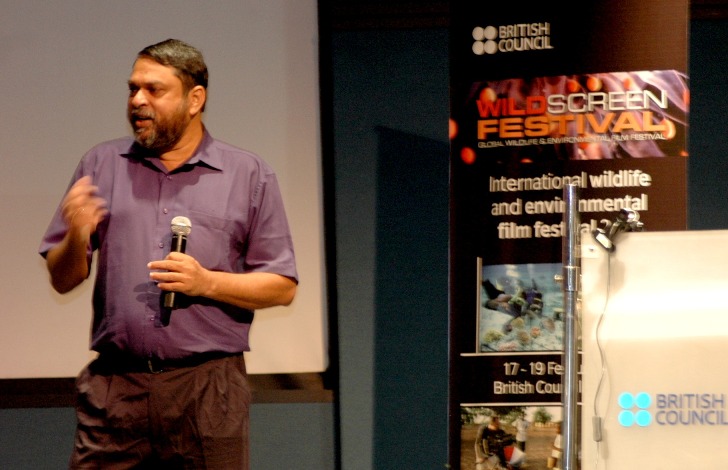
Taya Diaz conducts film making master class during Wildscreen 2011 in Colombo
“Taya Diaz has the shortest name in Sri Lanka but is a big man with a personality to match and a bushy black beard. Apart from being an excellent guide with good knowledge of all aspects of Sri Lankan Wildlife, he’s also a writer and film maker and is excellent company.”
That’s how a bird-watching website once described Taya Diaz, Sri Lankan conservationist turned wildlife film maker.
During the past two decades, Taya has collaborated in making over 20 full-length international wildlife documentaries, all showcasing Sri Lanka’s rich biological diversity and ecosystems. He has been a scientific investigator, presenter, narrator or Sinhalese scriptwriter.
One of his earliest involvements in international film making was with The Temple Troop. Made in 1997, for the BBC and Discovery Channel, it documented a year in the life of a troop of monkeys living in Sri Lanka’s ancient city of Polonnaruwa. These monkeys have been the subject of a long-running study by the Smithsonian Institution’s Primate Biology Program.
Trained as a scientist, Taya has worked in a number of field based conservation projects including the Smithsonian study of monkeys. But it’s as a wildlife and natural history that he now makes a name both in Sri Lanka and overseas.
The Urban Elephant (2000, for PBS/National Geographic), and The Last Tusker (2000, for BBC/Discovery) are two other productions that used Taya’s ground knowledge and scientific expertise. He has provided local liaison for broadcasters such as New Zealand TV, Canal+, Discovery channel, and BBC1.
Taya Diaz: Enough stories to last a lifetime!For all these reasons, Taya was a natural choice when TVE Asia Pacific was asked to recommend a Sri Lankan film maker to present a master class when the Wildscreen traveling film festival held in Colombo from 17 to 19 February 2011. His master class, titled “Untold Stories of Sri Lanka”, looked at Sri Lanka’s as yet largely untapped potential for authentic, factual stories related to wildlife, natural history and the environment.
He explained the premise for his master class: “Sri Lanka is a pot of plenty in every aspect — the opportunities for a documentary filmmaker are astounding. But sadly, what most audiences see on the airwaves is very standard and boringly similar, touching on the same topics year in and year out.”
Taya feels that documentary films and TV programmes are also essential for educating Sri Lankans about their own natural heritage. Sri Lanka has an impressively high number of plant and animal species for its relatively small land area — which makes it one of the most biologically diverse countries in the world.
“Sri Lankan naturalists, wildlife experts and environmentalists should collaborate more closely with film makers and/or broadcasters to make more local films aimed at local audiences,” he said during a panel discussion I moderated on February 17. “This is essential for raising awareness on environment and sustainable development issues as Sri Lanka pursues rapid economic development after the war.”
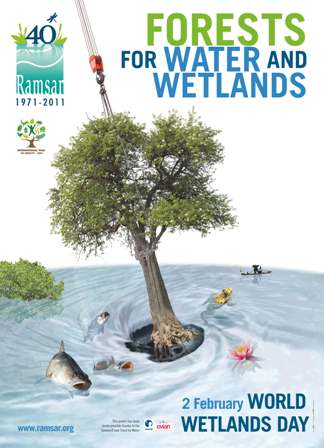
World Wetlands Day 2011 posterWorld Wetlands Day is observed every year on 2 February. It marks the date of adopting a global treaty on wetlands 40 years ago, on 2 February 1971, in the Iranian city of Ramsar on the shores of the Caspian Sea.
Each year since 1997, government agencies, conservation organisations and citizen groups around the world have used this anniversary to undertake actions aimed at raising public awareness of wetland values and benefits in general — and of the Ramsar Convention in particular.
In this International Year of Forests 2011, the theme for World Wetlands Day is: Forests for water and wetlands. It also marks the 40th anniversary of the Ramsar Convention.
Bordering between dry land and total water, wetlands are one of Nature’s most productive regions, and home to a high number of plant and animal species. Covering about 6 per cent of the Earth’s surface, wetland types include swamps, marshes, lakes, salt marshes, mudflats, mangroves, coral reefs, fens, peat bogs, and other bodies of water – whether natural or artificial, permanent or temporary. Water within these areas may be static or flowing; fresh, brackish or saline; and can include inland rivers and coastal or marine water to a depth of six metres at low tide. There are even underground wetlands.
How fluid is your wetlands knowledge?My weekly quiz in Daily News this week is devoted to the theme of wetlands — exploring their diversity, ecosystem services and threats to their survival.
Time is ticking away...but crises also mean opportunities
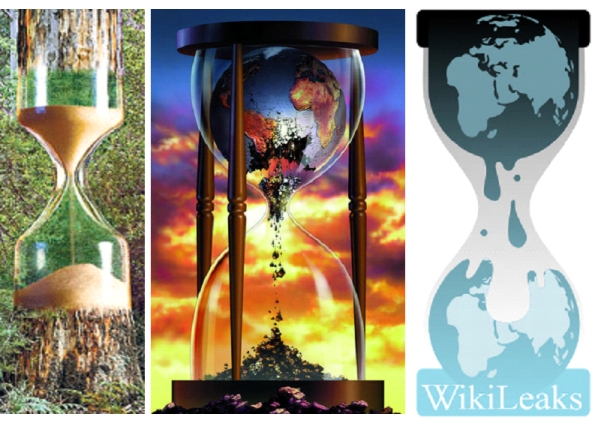
I like to think and speak in metaphors, especially visual metaphors. Sometimes I coin or design new ones. This illustration is the latest example.
Individual elements in this came from very different sources (thanks to them all). I just mixed them together to make two points during a talk I just gave at the Colombo University.
We live in a crisis-ridden world where we have to cope with multiple emergencies unfolding at the same time, impacting us on different fronts. This illustration captures three of them: crisis in biodiversity, man-made climate change, and the new reality of living in a rapidly WikiLeakable world — what I called the Global Glass House.
We don’t get to choose the timing, severity or duration of any challenge. But we do have some choice over how we respond: we can despair and grumble (blaming the Gods or karma if we believe in those); we can become really alarmist (a la Chicken Little); or we can be measured and smart in how we deal with the seemingly overwhelming situations.
Speaking at the Leaders in Environmental Advocacy Forum (LEAF) on Preserving the Past, Securing the Future on 22 January 2011 at the University of Colombo, I advocated this last option. I also pulled together a number of ideas mentioned on this blog over the past four years.
LEAF was a two-day summit held in Colombo, Sri Lanka, hosted by members of the Elon University’s Periclean Scholar Class of 2011, in partnership with the University of Colombo, the United States Embassy in Colombo, the National Science Foundation of Sri Lanka and Rainforest Rescue International.
In fact, some challenges of living on a warming planet are comparable to coping with a WikiLeakable world: both demand quick adaptation to a new reality. In both cases, governments and society have to change mindset and practices on the go — business as usual is no longer an option. Denialism, or demonising the messenger, won’t take us forward. We need more measured, sometimes even pragmatic responses.
In that process, all-or-nothing is not a viable approach. Waiting for full knowledge and understanding is not feasible either. As I once described it, responding to the planet’s climate and other ecological crisis with partial scientific understanding is akin to many pages of our planet’s ‘operations manual’ being still completely blank — and yet we have to manage the planet to the best of our knowledge, intuition and common sense.
Many of the same principles apply to living in the modern networked info society, where no secrets can be kept that way for too long. The sooner we come to terms with this new reality and adapt, the better.
I’m delighted to see others are addressing these parallels. In my talk, I mentioned a recent essay titled Could climate science become open source? by Brendan Barrett and Sulayman K. Sowe, published earlier this month on the UN University’s Our World 2.0 website.
In their perceptive piece, the authors ask whether climate science would benefit by being more firmly grounded in the principles of openness, perhaps along the lines of the free and open source software communities and open content movements. “The concept of openness behind free and open source software describes a mode of creative knowledge production and sharing in which individuals and communities freely generate and adapt or remix resources (content or software) without licensing restrictions.”
They add: “Proposing a move to a new model of climate science in no way suggests that climate change is not a real and present threat or that we cannot rely on the integrity of our contemporary climate science institutions and scientists. Rather, the argument here is that learning from the way free and open source software projects and communities work may be an important way forward in engendering more effective global, national and local responses to climate change.”
I have always worn multiple ‘hats’, and dabbled in multiple pursuits rather than follow narrow paths of enquiry. I see myself continuing to oscillate between the ‘geeks’ and greens, and where possible, bridging their worlds. It’s really encouraging to see some others straddling the two spheres.
The Earth is one, but the world is not... As I wrote the other day, during 2011, human numbers will add up to 7 billion. That is 7,000,000,000 living and breathing people.
But how many of us can grasp such a large number? I can size up a gathering of a few hundred people, or at the most, a couple of thousand. After that, I lose count…and I’m not alone.
That’s why the idea of a Global Village of 100 is so very useful. It’s based on a simple yet profound premise: if we could reduce the world’s population to a village of precisely 100 people, with all existing human ratios remaining the same, what would it look like?
The idea was the brainchild of Donella Meadows, a pioneering American environmental scientist, teacher and writer. She is best known as lead author of the influential book The Limits to Growth (1972).
It was first published in May 1990 with the title “State of the Village Report”, and Meadows originally envisaged a village of one thousand people. This approach to showing the global disparities was so refreshing and accessible that it soon spread among educators, journalists and activists — in today’s Internet terms, we would call that ‘going viral’.
David Copeland, a surveyor and environmental activist, revised the report to reflect a village of 100 and single-handedly distributed 50,000 copies of a Value Earth poster at the 1992 Earth Summit in Rio de Janiero.
What happened after that is recounted in this brief history by Carolyn Jones, adapted by Bob Abramms.
The analogy has been revised every few years to reflect the changing demographics and global development trends. The practice is now sustained by the Miniature Earth Project, whose latest animated video version for 2010 runs as this:
There is also the 100 People Foundation (www.100people.org) which is “committed to simplifying and humanizing complex global statistics by looking at the world as a community of 100 people”. They provide media and educational tools to teachers around the world to help them teach a global view, and inspire their students to learn more about their global neighbors. Here’s their own video:
100 People: A World Portrait Trailer
Here’s another variation on the theme, set to John Lenon’s ‘Imagine’:
If the world were a village of 100 people…
This cartoon animation uses the same approach, but with emphasis on linguistic and cultural diversity.
Coming soon to a planet near you: 7 Billion...and counting
Sometime during 2011, human numbers will add up to 7 billion.
That is 7,000,000,000 living and breathing people — all of who will need to be fed, clothed, sheltered and cared for in many other ways.
During this year, National Geographic magazine will publish a 7-part series examining specific challenges and solutions to the issues we face. The magazine introduces the series with its January cover story “7 Billion,” offering a broad overview of demographic trends that got us to today and will impact us all tomorrow. The first in-depth story will appear in the March issue, focusing on humans’ impact on the planet’s geology. Other stories will follow throughout 2011.
This clever video accompanies the coverage:
Correction added by NatGeo editors: in 2050, 70% of the population will be living in “urban areas,” not “megacities” as stated in an earlier version of this video.
I don’t like the word population: it sounds cold, clinical and detached. Zoologists can talk about ant populations or elephant populations, but when demographers (and others, including journalists) refer to our the counting of species as human population, I somehow feel it’s too impersonal. Aren’t we more than mere numbers?
So in my own writing and TV scripts, I use the phrase human numbers.
Can you visualise 7 billion?Semantics apart, our rising numbers are indeed a cause for concern. We didn’t quite see the ‘population bomb’ go off the way we were warned about – thank the secular Force – but we still face formidable challenges.
In 1987 — the year I entered journalism — human numbers passed five billion. A dozen years later, in 1999, the six billion was reached. By then, I too had added my contribution of one co-produced human being. Soon in 2011, we will be seven billion.
Our planet’s natural systems are over-stretched not only by our sheer numbers, but also by our technologies and consumption. The many signs of planetary stress include accelerated loss of species, fast spreading deserts, and declining air and water quality. To cap it all, scientists now confirm that human activity is changing our climate.
On the New York Times Dot Earth blog, science writer Andrew C. Revkin regularly examines efforts to balance human affairs with the planet’s limits.
Global Green Awards for Creativity in Sustainability 2010
China’s emergence as a major automobile market has led to high levels of air pollution in the cities. It has also caused an increase in the country’s carbon dioxide emissions that warm the planet.
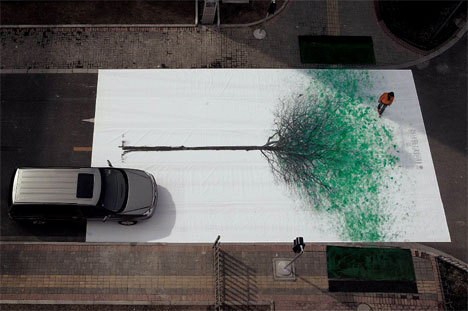
Now, an innovative outdoor campaign, called green pedestrian crossing, is urging Chinese people to walk more and drive less.
This campaign targeted young Chinese people who chose to drive over walking. The campaign involved the creation of an outdoor poster advertisement on pedestrian crossings across 7 thoroughfares in Shanghai.
The Green Awards, presented from the UK, culminated on December 2 with a glittering, ‘green carpet’ event at the Natural History Museum in London. The awards ceremony announced winners for all 16 categories and the 2010 Grand Prix. I was one of the international judges for this year’s awards.
The Green Awards Grand Prix is given to the overall winner which is judged the best amongst all the entries. It is meant to recognise a campaign which, in the opinion of the expert judging panel, best exemplified an outstanding environmental message, and had the greatest capacity to raise public awareness.
Judges were impressed by the creativity shown by the campaign and the simple and effective use of local knowledge. Moreover, the results of the campaign supported the judges’ decision. The campaign reached an estimated 3.9 million people and increased general public awareness about environmental awareness by 86%.
The United Nations designated 2010 as the International Year of Biodiversity (IYB). It is a celebration of biological diversity and its value for life on Earth, taking place around the world throughout the year 2010.
The 10th meeting of the Conference of the Parties (COP 10) of the Convention on Biological Diversity is being held in Nagoya, Aichi Prefecture, Japan, from 18 to 29 October 2010.
To mark these twin events, we feature some short videos on biodiversity found online.
Official video of the International Year of Biodiversity 2010
This video, produced by our friends at dev.tv in Geneva for the CBD Secretariat, is superbly crafted and engagingly presented. It visualises the core message of IYB 2010:
Biodiversity is life
Biodiversity is our life
Biodiversity Countdown 2010 video
In the puzzle of life each element is essential. Man has the power to do good, do bad, destroy or protect. What will you do?
Nature Our Precious Web: A photo montage
The exhibition is the result of a collaboration between Geo Magazine, GTZ, Countdown 2010, the Secretariat of the Convention on Biological Diversity and the United Nations Development Programme.
And finally, here’s an example of how not to produce a video on biodiversity. This 2006 film, made for the CBD Secretariat, has a good sound track and some excellent still photos. But it’s evidently been put together by a committee of UN agency officials and/or researchers who wanted to pack everything into 5 mins. The result – a wasted opportunity.
If we put a cash price on the economic services that, say, watersheds or insects or coastal mangroves provide, would we value Nature more? Would we be prepared to change our ways of measuring wealth and economic growth? And if we did, would that slow down the extinctions and collapse of ecosystems?
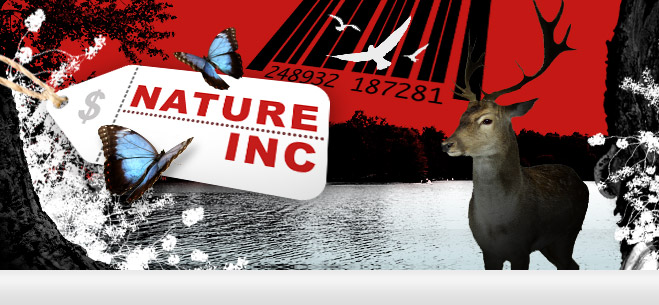
These are some of the issues that are explored in Nature, Inc., a path-breaking TV documentary series that puts a price-tag on environmental services such as forests, wildlife and coral reefs.
First broadcast in 2008 and 2009 on BBC World News, Nature Inc. broke new ground for environmental programming by seeking out a new breed of investor – those who believe they can make money out of saving the planet.
Watch Nature, Inc. series trailer:
Nature Inc. offers new insights into valuing the benefits of natural systems and biodiversity. It takes its lead from economists who have worked out that ecosystem services are worth more than the total of all the world’s national economies.
The first and second series are now available from TVE Asia Pacific (TVEAP). Each series comprises six half-hour episodes, compacting stories filmed in different parts of the world. Broadcast, civil society and educational users across the Asia Pacific may order copies at the cost of duplication and dispatch, and without having to pay a license fee.
The series was produced by One Planet Pictures of the UK, in association with dev.tv of Switzerland.
“There is new green thinking out there and some of it is grappling with pricing renewable assets. As such we felt it was a legitimate new area to take as an organising theme for the new series,” says Robert Lamb, series producer of Nature, Inc. “Perhaps the global recession has made viewers more aware of the ‘eco’ in economics”.
Robert LambThe series is based on new research and analysis being done on the subject. Among these new studies is the Economics of Ecosystems and Biodiversity (TEEB), a major international initiative to draw attention to the global economic benefits of biodiversity, to highlight the growing costs of biodiversity loss and ecosystem degradation, and to draw together expertise from the fields of science, economics and policy to enable practical actions moving forward.
But adding a price tag to Nature is not something that pleases all scientists or activists. Robert says the producers received “an overwhelmingly positive reaction” to the first series, but there was also a small minority who wrote in to say they hated the premise of the whole series.
He adds: “That’s good, we want to foster discussion in Nature Inc. which is why we are encouraging viewers to contribute ideas for the next series.”
Here’s a sample episode from the series, titled Coral Cashpoint. In this, Nature Inc investigates a claim that our coral reefs are worth $30 billion a year. In this fourth episode, we go diving on the Great Barrier Reef, the Maldives and to the bottom of the North Sea to find out how coral reefs supply 500 million of us with food and work. But we are destroying the reefs so quickly, they could vanish entirely in less than a hundred years.
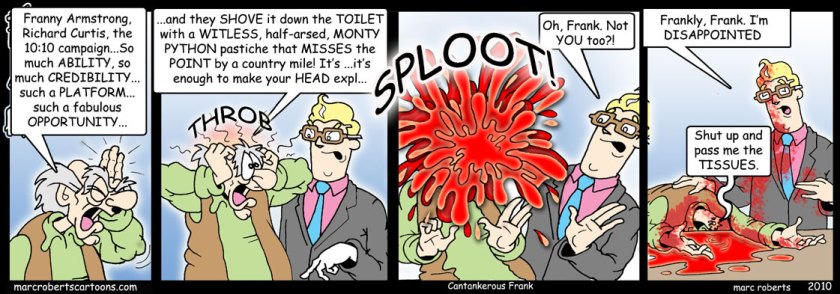
Still from No Pressure film: We do live in The Age of Stupid!Shock therapy is known to work, when handled carefully. We can sometimes shock people out of apathy or indifference, for sure — but the same shock, if overdone, can also numb people or turn them off completely.
That’s certainly the case with a new climate advocacy video film called No Pressure, released on 1 October 2010 by the by the climate mitigation campaign named 10:10.
Written by Richard Curtis and Franny Armstrong (who made the acclaimed 2009 climate documentary, The Age of Stupid) and directed by Dougal Wilson, the film is a tragi-comic attempt to ridicule those who don’t share the same level of concern on global climate change as the climate activists do.
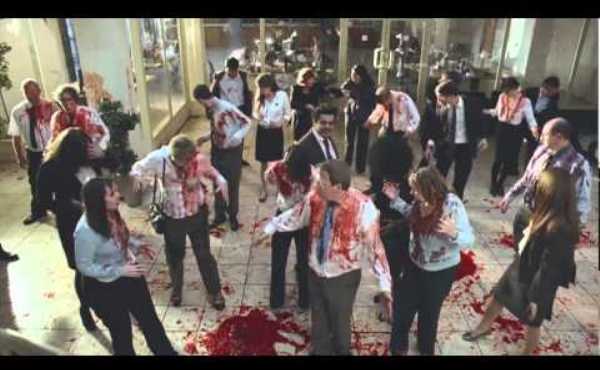
The four-minute film consists of a series of short scenes in which groups of people are asked if they are interested in participating in the 10:10 project to reduce carbon emissions. Those failing to show sufficient enthusiasm for the cause, including two schoolchildren, are gruesomely executed by being blown to pieces.
Well, see for yourself. Caution: this video contains violent scenes that can be offensive to most sensible people:
The normally balanced UK’s Guardian newspaper, which got the online exclusive, introduced the video on 30 September 2010 calling it “attention grabbing” and “pretty edgy.” There were a few others who found artistic or creative merit in the film, which has got high production values — no basement production, this.
But where it fails miserably is in winning any new friends for the climate cause, or at lease to influence people to change their high carbon lifestyles.
Amdrew RevkinAs Andrew Revkin, who writes the Dot Earth blog for the New York Times,wrote on 1 October: “If the goal had been to convince people that environmental campaigners have lost their minds and to provide red meat (literally) to shock radio hosts and pundits fighting curbs on greenhouse gases, it worked like a charm.”
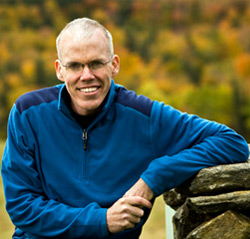
He isn’t alone. Bill McKibben, author, educator and environmentalist — who founded the serious climate group 350.org — wrote on the same day: “The climate skeptics can crow. It’s the kind of stupidity that hurts our side, reinforcing in people’s minds a series of preconceived notions, not the least of which is that we’re out-of-control and out of touch — not to mention off the wall, and also with completely misplaced sense of humor.”
His group, 350.org, issued a statement that emphatically said they had nothing to do with this misplaced British climate extremism. McKibben added, more reflectively: “What makes it so depressing is that it’s the precise opposite of what the people organizing around the world for October 10 are all about. In the first place, they’re as responsible as it’s possible to be: They’ll spend the day putting up windmills and solar panels, laying out bike paths and digging community gardens. And in the second place, they’re doing it because they realize kids are already dying from climate change, and that many many more are at risk as the century winds on. Killing people is, literally, the last thing we want.”
Bill McKibbenNow contrast such concern with the initial reaction from British film maker Franny Armstrong, who wrote a half-hearted, almost defiant apology on the 10:10 UK website, saying: “With climate change becoming increasingly threatening, and decreasingly talked about in the media, we wanted to find a way to bring this critical issue back into the headlines whilst making people laugh. We were therefore delighted when Britain’s leading comedy writer, Richard Curtis – writer of Blackadder, Four Weddings, Notting Hill and many others – agreed to write a short film for the 10:10 campaign. Many people found the resulting film extremely funny, but unfortunately some didn’t and we sincerely apologise to anybody we have offended.”
Adding gross insult to injury, Armstrong signed off saying: “As a result of these concerns we’ve taken it off our website. We won’t be making any attempt to censor or remove other versions currently in circulation on the internet.”
Both the 10:10 UK campaign and its sponsors Sony have been more unequivocal in their apologies in the days that followed. But that’s too little, too late. Enough damage done — climate activists and campaigners worldwide will take months, if not years, to live down this one.
And nothing really goes away on the web — this video will be lurking somewhere for a long time. YouTube currently carries the video in several places, with the warning: “This video or group may contain content that is inappropriate for some users, as flagged by YouTube’s user community.”
Andrew Revkins has posted comments from those who condemned as well as those who found some merit in the offensive climate video. Some of these comments take a dispassionate view, which is to be welcomed.
This incident teaches all of us engaged in environmental communication some important lessons. Environmentalists have over-stated their case before, and every time, that did them (and their causes) far more harm than good. Crying wolf, and ridiculing the non-believers, are never good tactics in winning friends or influencing people.
As Bill McKibben noted: “There’s no question that crap like this (video) will cast a shadow, for a time, over our efforts and everyone else who’s working on global warming. We’re hard at work, as always, but we’re doing it today with a sunk and sad feeling.”
One more thing: even in this age of globalised media, humour doesn’t travel well across cultures and borders. As mainstream corporate media companies have often found out, British humour sometimes doesn’t even cross the Atlantic very well — let alone to other parts of the world. Perhaps this is a key point that this all-British team of film makers and campaigners simply missed.
The world is a bit bigger — and more diverse — than your little island, Ms. Armstrong. By failing to grasp that, and with your crude display of insensitivity, you have really proved the premise of your good climate film.
Ray Wijewardene on the set of 'Sri Lanka 2048' TV show, June 2008: Cautiously optimistic about the future...The small farmers, buffaloes and earthworms all over the world lost a true friend and spokesman this week when Lankan scientist Ray Wijewardene passed away.
Ray packed multiple interests and pursuits into his 86 years of life – including engineering, building and flying light aircraft, and Olympic-level competitive sailing. But he was happiest being a farmer and mechanic, and had strong opinions on the subject. He was vocal about misguided priorities in tropical farming his native Sri Lanka – and across the developing world.
He was especially passionate when speaking about small farmers in the developing world, with whom he worked many years of his international career as an expert on tropical farming systems.
Educated at Cambridge and Harvard universities, and with impeccable technical credentials, he was no stranger to the ways of academia. But he remained a sceptic about the efficacy and benefits of agricultural research — on which hundreds of millions of development funding is invested every year.
The main problem with agricultural research, he used to say, is that those who engaged in such studies and experimentation didn’t have to rely on farming for their sustenance. There was not enough self interest. In contrast, the small farmer had to eke out a meagre existence from whatever land, water and seeds or livestock she had. In her case — and a majority of small farmers around the world today are indeed women — it’s a stark choice of innovate or perish.
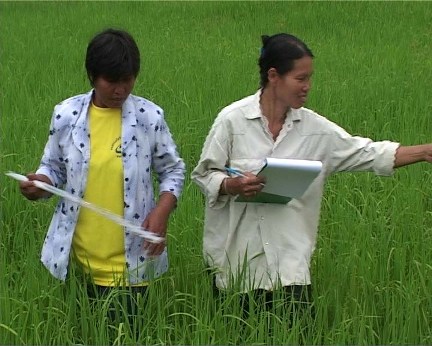
Thai researchers and farmers looking for field solutions (from Living Labs TV series)The heroic efforts of small farmers were rarely recognised by the rest of humanity who consume their produce — and the farmers themselves are too busy planting crops or raising animals to speak on their own behalf. This is where Ray Wijewardene came in: with his education, exposure and talent, he made an outstanding spokesman for small farmers all over the tropics.
In the 1960s, as the inventor and promoter of the world’s first two-wheeled (Land Master) tractor, Ray travelled all over Asia, Africa and Latin America working with tropical farmers.
For half a century, Ray has championed the lot of the small farmer at national, regional and global levels with UN agencies, academic and research groups, corporate sector and governments. But in later years, he questioned the wisdom of trying to mechanise tropical farming, and considered that phase of his career a ‘big mistake’. He dedicated the rest of his life to researching and promoting ecologically sustainable agriculture, on which he co-wrote an authoritative book in 1984.
Ray had the rare ability to ask piercing questions without antagonizing his audiences. He was an activist in the true sense of the word, but one whose opinions were well informed and grounded in reality, not rhetoric.
This comes through very powerfully in an extensive media interview I did with Ray in 1995, which I released online this week as a tribute to Ray — who has been my mentor and friend for almost 25 years.
At the outset, Ray points out where the Green Revolutionists went astray: “All along in the Green Revolution, its promoters focused on maximizing yields through massive inputs. But they forgot that what the farmer wants is to maximize profits, not necessarily yields!”
We then talked about the particular challenges faced in tropical farming, and the mismatch of temperate farming systems promoted widely in the tropics where climatic and soil conditions are different. One of Ray’s main concerns was agriculture’s profligate use of water – more for weed control than to meet the strict biological needs of crop plants themselves!
Ray, a grandmaster in summing up complex technical issues in colourful terms, said at the time: “Water is rapidly becoming the most expensive herbicide in the world — and freshwater is increasingly scarce!” [A decade later, I would go on to script and executive produce a global TV series called Living Labs on just this issue: how to grow more food with less water, or get more crop per drop.]
Ray wasn’t fundamentally opposed to external, chemical inputs to boost soil fertility but he advocated a mix of natural and synthetic options. In our interview, he asked: “We have multinational companies supporting — directly or indirectly — the extensive use of chemical fertilizers. But who supports cow-dung? Who extols the virtues of the humble earthworm?”
He then added: “For us in Asia, these elements are far more important. Indians have recognized this, but we still haven’t. As long as our agricultural scientists are trained in the western mould of high external input agriculture, this (mindset) won’t change. Cow-dung and earthworms won’t stand a chance – until some western academic suddenly ‘re-discovers’ them…“
It was Indian science writer and environmentalist Anil Agarwal who asked me, sometime in mid 1995, to interview Ray for Down to Earth, the science and environmental fortnightly magazine published by his Centre for Science and Environment. As Anil told me, “In Ray, you have not only one of the topmost agricultural experts in the developing world but one of its most original thinkers.”
By this time, I’d known Ray for almost a decade, and been exposed to several of his multiple facets. But each encounter with Ray was enriching for me, so I immediately seized the opportunity. The usually media-shy Ray already knew of and respected Anil, which helped.
Down to Earth is part of Anil Agarwal's legacyThe interview was audio taped over two long sessions, and I remember spending many hours transcribing it. I had to check some references with Ray, who cooperated wonderfully. I’ve been trained to observe the word limit set by editors, but in this instance, I sent in the full length Q&A, for it was so interesting. Down to Earth issue for 31 October 1995 carried a compact version, skillfully distilling the essence of that long exchange between Ray and myself — one of the most memorable interviews among hundreds I’ve done during 25 years of work in print and broadcast media.
How I wish the exchange was also preserved on audio tape! Indeed, it’s a small miracle that the original transcript survived for 15 years. The soft copy was lost in a hard drive crash of 1998, but fortunately I’d taken a full print-out. I’m grateful to a former colleague, Buddhini Ekanayake, for retyping the entire interview in mid 2008 when I considered releasing it in the wake of the global food crisis. That somehow didn’t work out, but the soft copy was ready at hand for me to rush to the editor of Groundviews on the day of Ray’s funeral. All I added was a new, 500-word introduction which tried to sum up the Ray Wijewardene phenomenon.





 Open Minds!