“There are no full-stops in good journalism, only commas,” he declared. He was referring to two of the most commonly used punctuation marks in modern writing.
This metaphor neatly sums up the nature of journalism, whose coverage of public affairs and society is often on-going, unfinished and open-ended. This prompted Phil Graham, the former publisher of the Washington Post, to describe journalism as the “first rough draft of history”. The reason is that journalists, in the performance of their duty often record important events, producing hurried written reports (in text, sound or pictures) often generated on short deadlines.
Panneer, who likes to call himself ‘a failed physicist and a failed journalist’, added that the intrinsic value of a journalist as one who tries to bring back the idea of commons — resources that are collectively owned, which can range from physical goods to artistic or creative products.
I always welcome occasions when his and my paths cross as we move in overlapping South Asian circles. Listening to him this time around, I recalled his clear, emphatic words on a previous occasion, at an Asian regional brainstorming on ‘Communicating Disasters: Building on the tsunami experience and responding to future challenges’ that I convened in December 2006 in Bangkok, Thailand.
He said the media is plural term, not a singular one. This implies that the media are not a monolith. Some are excellent; many are mediocre; some are downright bad. Some in the media are also indifferent to some issues but may be outstanding in addressing other issues.
He added that media is also very much a contested and contentious space where arguments rage on. Not everything is moderate, balanced or ‘evidence-based’.
Panneer’s day job is as the executive director of Panos South Asia. He was formerly the managing editor of Sun TV and bureau chief for Outlook magazine in India. Having been with the mainstream media for 20 years, he is now moving in that interesting overlap between media and development sectors. This gives him both insight and perspective.
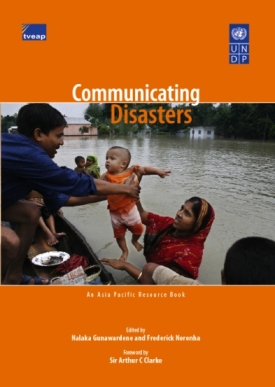
Contributing a chapter to Communicating Disasters: An Asia Pacific Resource Book in 2007, Panneer wrote: “Development agencies rarely bring journalists into their universe at a stage which can be called ‘work-in-progress’. They usually just come to the media with a finished product. There is hardly any joint exploration. When presented with a finished product, there is just one alternative for a reporter — that is, to review the product that is already done.
“Imagine a scenario where journalists are brought into the process right from the word go. There would have been a series of stories, and when the final report of the development agencies is realised, that may well serve as the winding-up story tracking the entire trajectory.
“A journalist is expected to report and not just reproduce. Development agencies like their versions to be reproduced to a large extent. This becomes an assault on the journalists’ work-pride. He or she would like to do a field report, taking a cue or two from the work of the development agency. But, to merely reproduce a report is seen only as providing a free plug, an unpaid advertisement, and doing a stenographer’s job.”
Dilrukshi Handunnetti: Making wavesMy good friend Dilrukshi Handunnetti, a leading investigative journalist in Sri Lanka, is currently on a Jefferson Fellowship traveling in the United States. She is one of a dozen journalists from the Asia Pacific who have been competitively chosen to participate in this prestigious programme, which in 2009 is focusing on the theme, The Right Climate for Confronting Climate Change?
I finished my latest climate film, Small Islands – Big Impact, only the day before Dilrukshi left for Hawaii, her first stop in the multi-destination, intensive programme. Given her long standing coverage of the Maldivian political affairs as well as Asian/global environmental issues, I gave her a DVD of the film to take along.
I’m delighted to hear that she has been showing Small Islands – Big Impact in various presentations, often producing a…big impact wherever it was shared. It’s always good to have such feedback — here’s an excerpt from an email she has just sent me from Boulder, Colorado:
“I liked presenting your short film and the response it generated. The film generated a discussion on promoting the concept of (climate) adaptation as a human right – just as I felt it would be such a catch phrase here. I also had the (media coverage of) the underwater Cabinet meeting with me. So Maldives got a lot of attention despite not having a Maldivian here.
“Several wanted to know about the actual risk level of the Maldives and the possibility of the islands being submerged. They also asked about purchasing land elsewhere and whether the Maldives had the financial capability to do that. Others wanted to know about depleting fish catch President Nasheed spoke about as this was a common concern to Indonesia, Southern India and Vietnam.
President Nasheed: Stop pointing fingers, extend a helping hand...“Some queried whether President Nasheed was going to Copenhagen to state his case. Two others asked whether lobby groups were behind his thinking. Several found, including American, Chinese and Indian participants, that President Nasheed’s call to end the blame game should be heeded by all. There was collective agreement that others’ behaviour impacted on the likes of President Nasheed and vulnerable communities.
“Interestingly, everyone found his interview a STORY. Something that they would want to report on in their respective media. We continue to discuss the same on our tours and walkathons from venue to venue for various meetings. In fact, I had the American participant asking our resource persons (IPCC types, no less!) whether they were willing to acknowledge the concept of climate refugees directly in relation to the Maldives.
“I think the movie served a great purpose of awakening the minds of many to the threat level faced by some communities on low lying coastal nations – like the pacific Islands and the Maldives. A senior broadcaster from the Tonga Broadcasting Corporation personally thanked me for wanting to highlight their plight as a small island nation.”
You can watch Small Islands – Big Impact online here:
A journalist for over 17 years, Dilrukshi Handunnetti has extensively covered politics, the environment, culture, and history and gender issues. In her current role, she writes the parliamentary column for the newspaper in addition to writing and editing investigative stories carried in her publication. Dilrukshi has also covered the ethnic conflict from a non-military perspective and written extensively on issues of good governance, graft and corruption. Dilrukshi is the recipient of many national journalism awards in Sri Lanka, including: the Young Reporter of the Year 2001, Best Environment Reporter of the year 2002, Best Environment Reporter of the year 2003, Best English Journalist of the Year 2004 (Merit) Award and D B Dhanapala Award for the Best English Journalist of the Year 2005, all presented by the Editors’ Guild of Sri Lanka.
In this extract from our 2005 film Deep Divide, Dilrukshi talks about Sri Lanka’s coastal resource development challenges before and after the 2004 Asian Tsunami:
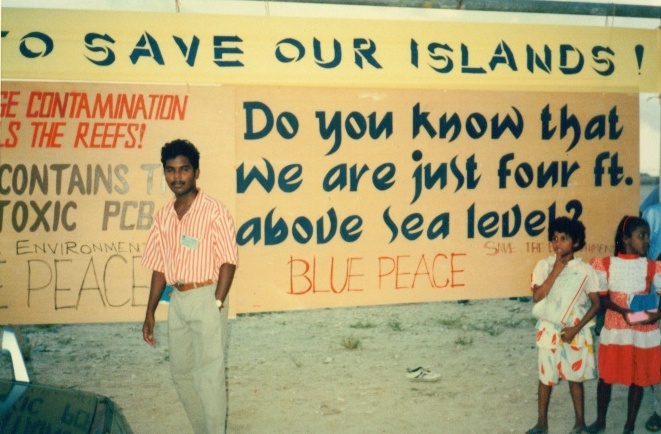
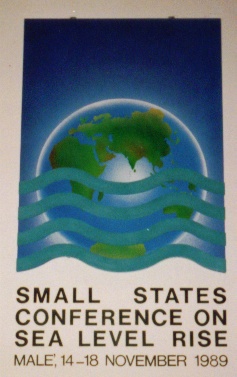
Bluepeace was vocal, even at 2 months. Photo by Nalaka Gunawardene: Male, November 1989
I’m not a professional photographer, but as a journalist I often carry a camera and take photos of what interests me. So I’m very glad to have captured that historic bill board as a journalist covering the conference. Bluepeace still uses it in their records, always with acknowledgement.
Ali Rilwan, Bluepeace co-founder whom I photographed as a young man, says: “Twenty years later, we need not ask the same question, as the world is well-aware of the dangers Maldives faces. However, we face the urgent need to talk and work with the rest of the world to find solutions.”
Now, Bluepeace is actively using photographs as part of their climate advocacy.
Images from the frontlines of climate impact...
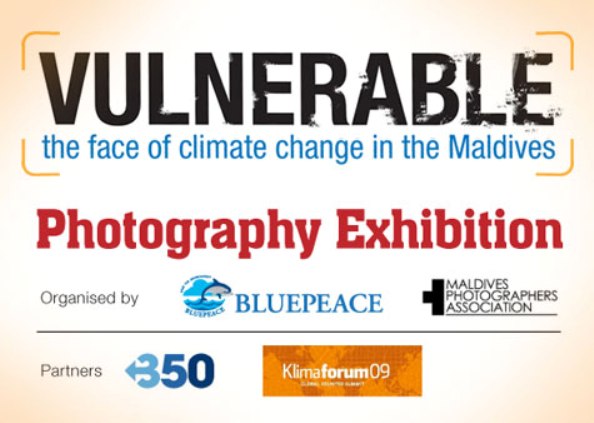
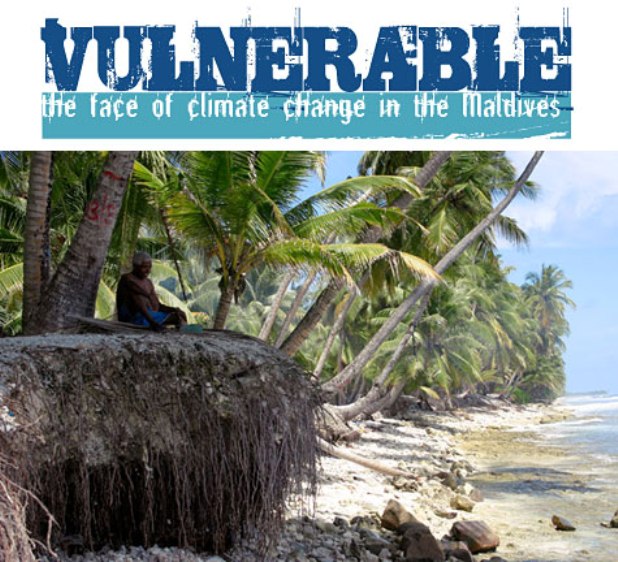
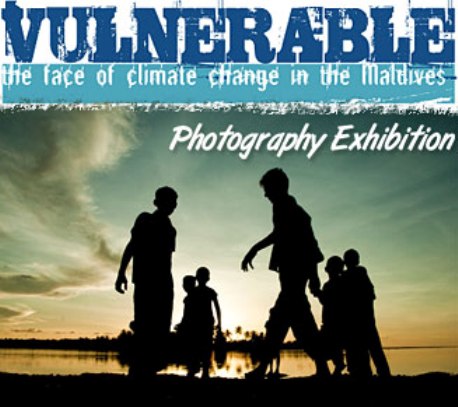
VULNERABLE is a photo exhibition organised by Bluepeace. To celebrate the 20th anniversary of Bluepeace, and to join the global environmental movement bringing attention to the dangers of climate change in the run up to United Nations Conference on Climate Change (COP15), Bluepeace presents VULNERABLE, which showcases the face of climate change in the Maldives. The exhibition documents the vulnerability of the fragile coral islands of the Maldives to climate change, through pictures from talented Maldivian photographers. It depicts a nation under threat, as it tries to safeguard an age-old culture and lifestyle that could be erased with rising seas and climate change.
VULNERABLE was launched online on October 24, the International Day of Climate Action organised by 350.org, which calls for a reduction of global carbon emissions below 350 parts per million.
In the coming weeks and months the exhibition will move to different locations in the Maldives and other countries, including Copenhagen in December 2009, where it will be hosted by Klimaforum09, an alternate climate summit with participation from global environmental movements and civil society organisations.
I can’t wait to see the exhibit in a physical display, which is more powerful than viewing it online. For now, here are some glimpses…
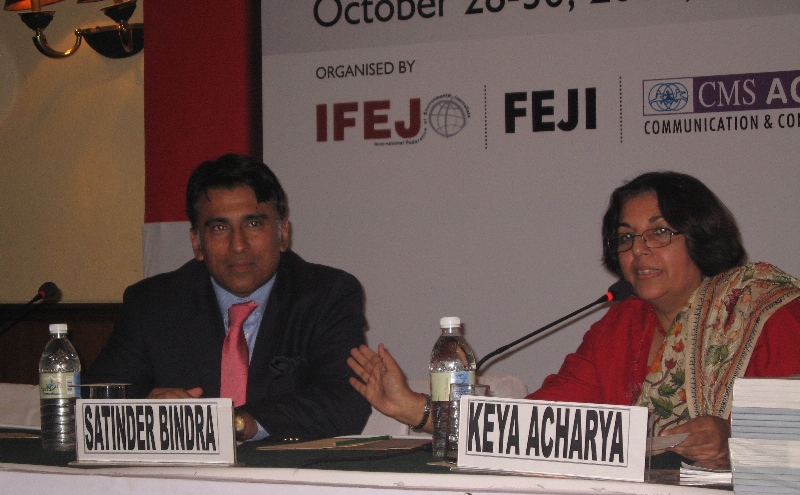
Satinder Bindra (left) and Keya Acharya at IFEJ 2009 Congress Satinder Bindra left active journalism a couple of years ago when he joined the UN Environment Programme (UNEP) as its Director of the Division of Communications and Public Information (DCPI) based at UNEP Headquarters in Nairobi. But thank goodness he still thinks and acts like a journalist.
We have gone beyond the cautionary stage of climate change, and are now acting out ‘Part II’ where we have to focus on what people can do, he said. “Climate change is no longer in doubt, and if anything, the IPCC’s scenarios are turning out to be under-estimates.”
He was referring to the IFEJ congress theme, “Bridging North-South Differences in Reporting Climate Change: Journalists’ role in Reaching an Ambitious Agreement at COP15 in Copenhagen”.
Satinder sounded emphatic when he said: “We have a limited time in which to reach as many people as possible. Environment is the single biggest challenge we face in the world today, and we as journalists have a tremendous responsibility in providing the latest, accurate information to our audiences.”
He added: “There is still a debate among journalists on whether or not we should be advocates for the environment. We should not be scared to push the best science, even if we don’t choose to engage in advocacy journalism.”
Satinder, who was a familiar face on CNN as its South Asia bureau chief until 2007, acknowledged that the media landscape was evolving faster than ever before. “Thanks to the web and mobile media, our distribution modes and business models are changing. YouTube has emerged as a key platform. Viral is the name of the game.”
His message to broadcasters, in particular, was: “You may be rivals in your work, but when it comes to saving the planet, put those differences aside.”
A call to the whole planet...Satinder is spearheading, on behalf of UNEP, the UN-wide Seal the Deal Campaign which aims to galvanize political will and public support for reaching a comprehensive global climate agreement in Copenhagen in December.
To me at least, the most important part of Satinder’s speech was when he said that he was not seeking to promote or position the UNEP or United Nations branding. His open offer to all journalists and broadcasters: “If you need to use the hundreds of UNEP films, or make use of our footage in your own work, go right ahead. We want you to make journalistic products. There’s no need or expectation to have the UN branding!”
Wow! This is such a refreshing change — and a significant departure — from most of his counterparts at the other UN agencies, who still think in very narrow, individual agency terms. They just can’t help boxing the lofty ideals of poverty reduction, disaster management, primary health care and everything else within the agenda setting and brand promotion needs of their own agencies.
“As development organisations compete more intensely for external funding, they are increasingly adopting desperate strategies to gain higher media visibility for their names, logos and bosses.
“Communication officers in some leading development and humanitarian organisations have been reduced to publicists. When certain UN agency chiefs tour disaster or conflict zones, their spin doctors precede or follow them. Some top honchos now travel with their own ‘embedded journalists’ – all at agency expense.
“In this publicity frenzy, these agencies’ communication products are less and less on the issues they stand for or reforms they passionately advocate. Instead, the printed material, online offerings and video films have become ‘logo delivery mechanisms’.”
Let’s sincerely hope that the pragmatic and passionate Satinder Bindra will be able to shake up the communication chiefs and officers of the UN system, and finally get them to see beyond their noses and inflated egos. It’s about time somebody pointed out that vanity does not serve the best interests of international development.
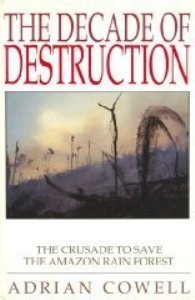
The Decade of Destruction A unique chronicle of the destruction of the Amazonian rainforest.
Whatever we might think about Al Gore’s film An Inconvenient Truth, I’m glad it has settled one question: can a single film make a difference in tipping public opinion about a matter of global importance? The answer, where climate change is concerned, is a resounding yes!
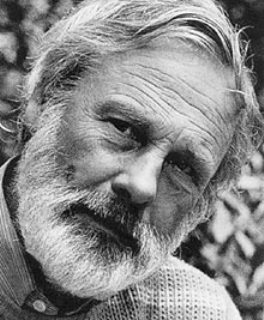
But years or decades before Al Gore, other film makers have had their own impact on other environmental issues. One of them is Adrian Cowell, the award-winning British film maker whose quest to tell the story of the destruction of the Amazon forest made politicians listen and the world take note.
According to the Centre for Social Media at the American University, “He catapulted the environmental movement to save the Amazonian rain forests through the television series The Decade of Destruction and Banking on Disaster.”
Adrian CowellAdrian, whom I have had the pleasure of meeting and talking on several occasions, is a world acclaimed leader in our field. Born in Tongshan, China in 1934 and educated at Cambridge University, Adrian has been making films longer than I have been alive — and luckily for all of us, he is still at it.
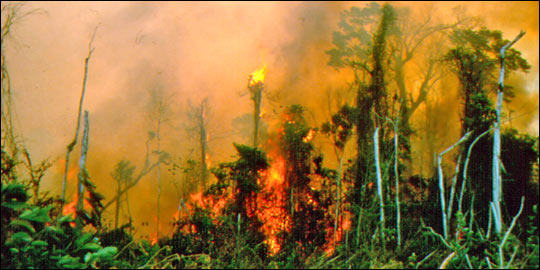
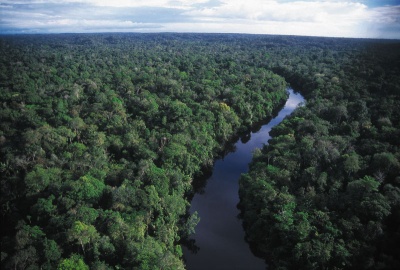
He began filming his path-breaking series called The Decade of Destruction in 1980, when the Amazon was first opened up to settlers and developers. He has documented the systematic destruction of the rainforest there into late 1990 when, for the first time, there was an indication that the fires were being brought under control.
As the synopsis says: “Each episode follows the real life stories of people caught up in the frontier’s web of need and greed, stories of personal tragedy and great courage. The programs relate the individual’s struggle to the wider developments going on around them. Together they illustrate the principal issues of Amazonia during the 1980s – its decade of greatest destruction.”
The Chicago Tribune called it an epic, “a brilliantly told story of greed, death, politics, violence, heroism and environmental holocaust.”
I recently came across this brief account by Adrian Cowell himself, looking back at his long engagement with the Amazon:
“In January 1980 we started 10 years of recording the destruction of the Amazon forest. We began by filming colonists invading the territory of the then unknown, and very vulnerable, tribe, the Uru Eu Wau Wau, in the Brazilian state of Rondonia. Many colonists had received, free of charge from the government, plots of 40-50 hectares in the forest traditionally hunted by the Indians. Tragically, within a decade, this ‘colonisation’ process, called the Polonoroeste Project, would not only leave three-quarters of the Indians dead, but also prove a disaster for the colonists themselves. They had been given such poor soil that, within six years, 60% of the land they had so hopefully deforested would be abandoned.
“So we were astounded when the World Bank moved in to lend nearly half a billion dollars to the project, and were even more astonished when we realised that what was being played out in front of our cameras was evidence of one of the most disastrous loans the Bank had ever made. Not unnaturally, I went to Washington to find out what could explain the Bank’s loan. And there I met three environmentalists, Bruce Rich, Barbara Bramble and Brent Blackwelder, respectively from the Environmental Defense Fund, the National Wildlife Federation and the Environmental Policy Institute. They were campaigning on how international economic development affected the environment. But by a remarkable coincidence they had decided to focus, not only on the World Bank, but on – of all its hundreds of loans all over the world – the very Polonoroeste Project that we were filming. They asked me to show our film in Congressional hearings and I telephoned José Lutzenberger – more or less the father of Brazilian environmentalism – to ask him to testify. By yet another happy coincidence, an American researcher, Brent Millikan, had written a report giving academic detail to the facts behind what we had filmed. And an American expert on Amazonia, Dr Philip Fearnside, added his authority to the diagnosis of what was going wrong.
“And so, some months later – after a complex chain of legislative and political developments – we were able to record Senator Robert Kasten, the chairman of the powerful Appropriation Committee’s subcommittee on foreign operations, cutting off 20% of the money the US donated annually to the World Bank. Nothing concentrates a banker’s attention more than the withdrawal of some of his money. Within a few months we were able to conclude our programme, Banking on Disaster, by filming World Bank president Barber Conable admitting, for the first time, that a Bank loan, specifically the Polonoroeste Project, had gone wrong. This was to be the beginning of a very slow and gradual greening of World Bank policies.
“Obviously, our television film had played a part in this political change. But though a film may sometimes be the most dramatic way to present a case, it is an illusion to think that it can be more than just one tool or facet of the very complex process behind international and environmental evolution.”
* * * * *
Here’s more biographical background about Adrian: Book of the TV seriesAdrian Cowell has been making documentary films for five decades. In 1955-56, he joined the Oxford and Cambridge Far Eastern Expedition, an experience which launched his film career and his interest in Burma. The following year, he made his first foray into the rain forest of Brazil, part of a joint Oxford-Cambridge expedition of young filmmakers. These early trips became the seeds of Cowell’s award-winning epic projects. His series Opium was filmed over an eight-year period (including nine months when he was trapped behind the lines in Burma). His ten-year chronicle of the destruction of the Brazilian rain forests during the 1980’s—broadcast as the television series The Decade of Destruction —stirred the world and contributed to the international debate on how the Amazon should be developed. In 1990, The Decade of Destruction was broadcast on Channel Four in Britain and on PBS FRONTLINE in the U.S. Adrian Cowell’s more recent British TV series include The Heroin Wars. It is a follow-up to The Opium Trail (1966), The Opium Warlords (1974) and Opium (1978).
Cowell is an environmental activist, co-founder of the Television Trust for the Environment and the author of two books on Brazilian Indians, The Heart of the Forest (Knopf) and The Tribe that Hides from Man (Stein and Day). He also wrote a companion book to the TV series The Decade of Destruction (Henry Holt and Company).
Life saving sand...This week marks the 10th anniversary of the deadly cyclone that hit India’s eastern state of Orissa.
The 1999 Orissa cyclone, also known as Cyclone 05B, and Paradip cyclone, was the deadliest Indian Ocean tropical cyclone since the 1991 Bangladesh cyclone, and deadliest Indian storm since 1971. The storm made landfall just weeks after a Category 4 storm hit the same general area.
A tropical depression formed over the Malay Peninsula on October 25. It moved to the northwest and became a tropical storm on October 26. It continued to strengthen into a cyclone on the 27th. On October 28, it became a severe cyclone with a peak of 160 mph (260 km/h) winds. It hit India the next day as a 155 mph (250 km/h) cyclone. It caused the deaths of over 10,000 people, and heavy to extreme damage in its path of destruction.
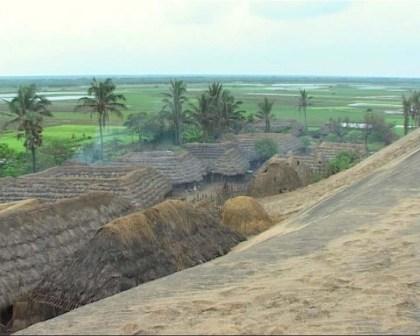
In 2006, during the production of TVE Asia Pacific‘s TV series The Greenbelt Reports, we visited the coastal village of Satabhaya, located on the edges of the Bhitara-kanika National Park in Orissa. A giant sand dune separates the village from the Indian Ocean.
The dune is the source of regular sand storms that force people to stay indoors for hours. Each storm can cover their houses with several inches of sand. Yet, they are not complaining. They remember the super cyclone of October 1999 – it was the natural sand dune that reduced the impact of that super-cyclone. The Satabhaya people know that it’s their only protection.
After the cyclone, they have devised traditional methods to trap the sand and create dunes to protect their village.
The Greenbelt Reportsseries It looks at how communities, researchers or environmental activists are trying to find a balance between conserving coastal greenbelts – coral reefs, mangroves and sand dunes – and deriving economic benefits for local people.
Watch The Greenbelt Reports: Surround Sand on YouTube:
Some films, like certain books, are in the making for years or decades. My latest film, Small Islands, Big Impact, just released online by TVE Asia Pacific, is quite short: slightly under 6 minutes long. But it has been forming in my mind for the past 20 years.
As a science journalist, I have been covering its story since 1989: how the Indian Ocean archipelago of the Maldives – Asia’s smallest country by area and population – is on the ‘frontline’ of climate change impact.
The Maldives packs 325,000 people into a combined land area just under 300 square kilometres spread over 1,192 islands and islets. With an average ground level of 1.5 metres (5 feet) above sea level, it is also the lowest country on the planet. When I first visited the Maldives in late 1988, they were still recovering from a massive storm surge in 1987. Although the damage was limited, the experience showed how vulnerable the Maldives can be to even a small rise in sea levels – this prompted the then President Maumoon Abdul Gayoom to take up the issue internationally. (It was President Gayoom who took up climate crusading at statesman level, well before Al Gore turned up on the scene.)
Interestingly, my first encounter with President Gayoom had nothing to do with climate – it concerned a celestial phenomenon: the Maldives was witnessing an annual solar eclipse and the President wanted to observe it in the company of amateur astronomers from their nearest neighbour, Sri Lanka. So he invited a couple of us over (I was active in the Young Astronomers’ Association of Sri Lanka at the time.)
I returned to the Maldives in November 1989, that time as a member of the international media covering the first ever small states conference on sea level rise. Held at the Kurumba island resort, it was one of the earliest international gatherings on climate impacts on low lying states, a topic that was to gain public interest and momentum in the years to come. Among the participants were delegates from practically all the small states in different parts of the world (defined as those with less than 1 million population), and scientists from disciplines such as oceanography, climatology, meteorology and geology.
This was one of the first international scientific events that I covered as an eager young science journalist. I was a foreign correspondent for Asia Technology, a monthly magazine on Asian science and technology published from Hong Kong (now defunct), and freelancing for The Island daily newspaper in Sri Lanka. (There’s nothing online from that coverage as it was in the pre-web era!)
The conference had technical sessions where experts debated scenarios and implications, and a political segment where delegations made their official statements. In the end, they issued the Malé Declaration on Global Warming and Sea Level Rise, which urged for inter-governmental action on the issue.
Our Maldivian hosts knew that scientists and officials alone couldn’t send out a powerful message to the world on what climate change meant for low lying islands of the world – many of them mere specks on the world map, barely registering in media’s radar. So on the last day of the conference, we were taken to the Maldivian capital of Malé, where a demonstration and public rally were held by school children and ordinary people.
That turned out to be the most striking moment of the whole week. I had been listening to experts and officials talk about impacts, scenarios and mitigation measures for several days, on which I’d filed several stories. But unless I go back to my personal archives, I can no longer remember those details. My lingering memories of this event are in a few photos I took, showing school children telling delegates – and the world – what it means to be living on the front lines of climate change impact.
After 1989, I visited the Maldives on a couple of occasions for professional purposes during the 1990s. After I started working with TVE Asia Pacific in 1996, I was keen to return to the story of the Maldives and climate change – this time, in moving images – but I never had the chance until this year.
But I was covering the bigger story of climate change and its impact on the Asia Pacific from other locations. For example, in 2002, I commissioned and executive produced Voices from the Waves, the first-ever documentary on climate change in the South Pacific made by a native Pacific islander. Directed by Fijian film-maker Bernadette Masianini, the story revolved around two teenagers growing up on Fiji and Kiribati, each facing an uncertain future because of climate change.
In November 2007, the Maldives once again hosted representatives from small island states to discuss climate change. Eighteen years after the original meeting, the subject was no longer a fringe concern; it was now on everybody’s agenda. The meeting urged the the human dimension of global climate change to be included in the agenda of UN Climate Change Summit in Bali (December 2007), and sought the international community’s commitment “to protect people, planet and prosperity by taking urgent action to stabilize the global climate change”.
This time, the Male’ Declaration on the Human Dimension of Global Climate Change called for the UN High Commissioner for Human Rights to assess the human rights implications of climate change and “to conduct a study into the effects of climate change on the full enjoyment of human rights”. It also requested the UN Human Rights Council to convene a debate on human rights and climate change.
I wasn’t present at the 2007 meeting, but followed the process online. While climate change emerged as a major global concern, political change and reforms were underway in the Maldives. The country moved to a multi-party democracy, and in November 2008, the Maldivian Democratic Party‘s candidate Mohamed Nasheed won the presidential election.
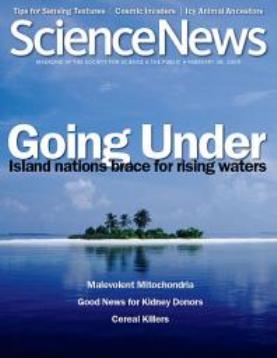
Science News cover - 28 Feb 2009President Nasheed continues the climate advocacy that President Gayoom had sustained for nearly a quarter of a century. President Nasheed has emerged as an outspoken and pragmatic voice speaking on behalf of his and other small island states, grouped under the Alliance of Small Island States (AOSIS).
In early 2009, President Nasheed announced that the Maldives would become the world’s first fully carbon-neutral nation within a decade. To accomplish this, they would vigorously pursue renewable energies and green energy sources to replace current dependence on fossil fuels.
The final inspiration for Small Islands, Big Impact came in February 2009, when Science News magazine in the United States carried a cover feature on the challenges faced by Kiribati and the Maldives because of climate change. Written by senior science writer Cristine Russell, the article noted: “The Maldives and Kiribati highlight a hidden challenge for coping with climate change. It’s not just about slowing the emissions of greenhouse gases. It’s also about figuring out what to do for localities threatened with the possibility of extinction from rising ocean waters.”
My original plan was to film interviews with President Anote Tong of Kiribati, and President Nasheed. While sharing the same overall concerns, the two leaders (and their governments) have adopted somewhat different responses to the challenges posed by climate change. Unfortunately, the interview with President Tong did not come through in time, even though I had a Kiribati TV crew standing by to film it. So I decided to go ahead with the film focusing solely on the Maldives.
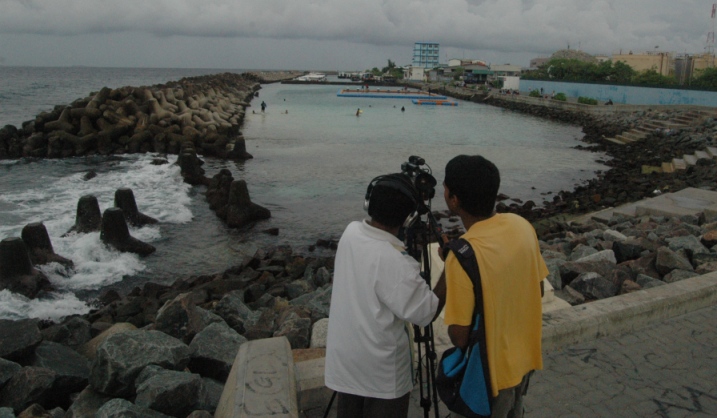
Location filming in Male - Hussein Makzoom (left) and Ibrahim Yasir As with all TVEAP films, I was keen to make it with a local crew. Mariam Niuma, an engaging young Maldivian woman who had worked for nearly two years with us as an intern, helped me find a very capable crew in Ibrahim Yasir and his colleague Hussein Makzoom.
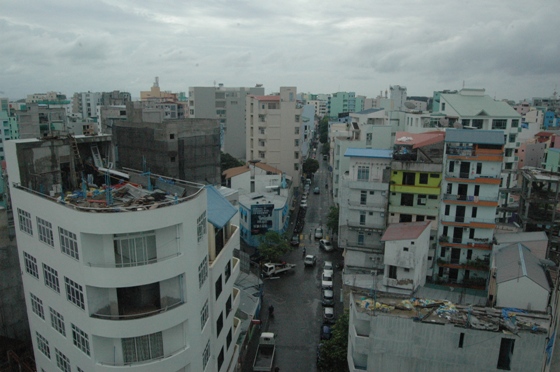
Niuma had been urging us to make a film about her country and was delighted that we were finally able to take it up. She helped us in numerous ways with local knowledge, introductions and advice. She also took time off her work with a local charity to show me around the Male’ island – which I was returning after a dozen years, in which time it had changed almost beyond recognition. (Male’ is one of the most crowded places on Earth – every one in four Maldivians lives on the tiny capital island.)
Small Islands, Big Impact was filmed on location over a few days in late August in Male’ and the nearby island of Vilingili. Our tiny production budget didn’t allow us to spend longer or venture further into the more remote islands and atolls (coral island formations, 26 of which make up the Maldives).
Overcrowded Malé, capital of the MaldivesThe timing wasn’t ideal either – the Monsoon was still active, and rain often interrupted our filming. There was some irony that a climate film was being shot in inclement weather. Sometimes we filmed in spite of the rain – one ferry ride we took from Male’ to Vilingili island had to cross very choppy seas that made me (a land lubber!) quite nervous. For our Maldivian crew, however, it was all in a day’s work…
President Nasheed’s media team had been quick and supportive in accommodating our interview request, but when actually filming it, we faced an unexpected challenge which I’ve described in an earlier blog post. (Clue: In addition to inclement weather, we had to deal with a nasty influenza virus). With the month-long Ramadan fast period about to begin, which would significantly affect the pace of work in the 100% islamic Maldives, we had no choice but to persist with our filming, improvising as we went along.
I returned to Colombo with five camera tapes rich in footage, one of which contained a 15-minute interview with the amiable and technocratic President Nasheed. Over the next few weeks, I worked with our editor Umesha Fernando in distilling this material into a short, compact film less than six minutes. It took a good deal of time and effort — especially since I chose not to have any narration and to let President Nasheed tell the story in his own voice, interspersed with text-supported transitions.
Because of this style, soundtrack mattered a great deal, and we agonised over custom-composing the music. As I put everything this together, I kept recalling the wise words of senior Australian film-maker Bruce Moir: “Film is a lousy medium to communicate information. It works best at the emotional level.”
I can’t judge my own film, but I have tried hard to strike a balance between its intellectual and emotional appeal. My team and I set out to tell a compelling story about a country on the frontlines of climate impact. No less a person than its dynamic head of state stars in our modest effort, made on an incredibly tiny budget.
Note: Small Islands, Big Impact was produced on an editorially independent basis by TVE Asia Pacific in collaboration with COM+ Alliance of Communicators for Sustainable Development. As with all other TVEAP productions, this series comes without license fees, where only copying and dispatch costs are payable. To order broadcast master tapes, please contact:
It may also be ordered in high resolution on DVD (without regional coding) from TVEAP’s e-shop.
Apart from the typhoons that blow in from the Pacific Ocean, the Philippines also sits on the Pacific Rim of Fire where periodic earthquakes occur, and active volcanoes are found.
Disasters not only kill or injure people and cause property damage; they also disrupt livelihoods and cultural practices. That’s what happened when the volcanic Mount Pinatubo erupted in 1991, its lava and ashes destroyed many surrounding villages – including the traditional homeland of the Ayta, indigenous people descending from the first inhabitants of the Philippines. They had fled to the hills from the lowlands during the protracted Spanish conquest of the Philippines which first commenced in 1565.
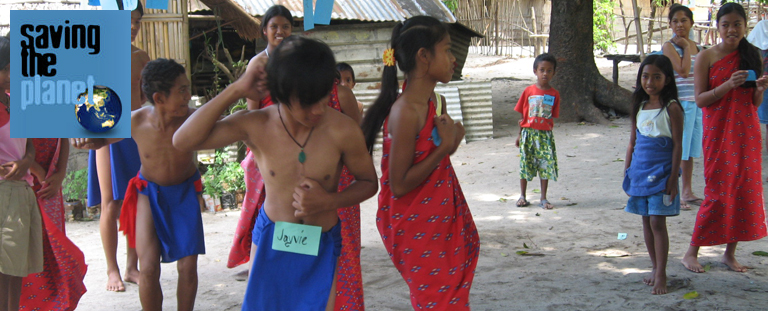
Today, resettled elsewhere on Luzon island, the Ayta are trying to preserve their traditional culture and community integrity through education and theatre. These efforts are supported by the Ayta organisation PBAZ, part of the Education for Life Foundation. Going back to the abandoned village is one way of keeping memories alive.
News by definition looks for the exception. What goes right, and according to plan, is hardly news. Deviations, aberrations and accidents hit the news.
It’s the same with disasters. Reducing a hazard or averting a disaster does not make the news; when that hazard turns into a disaster, that typically tops the news. Yet, as we discussed during a session at the 6th World Conference of Science Journalists held in London from June 30 – July 2, 2009, both aspects are important — and both present many challenges to journalists and the media.
The session, titled Covering a disaster from Sichuan to Sri Lanka, saw three science journalists share their own experiences and insights in covering two major disasters in Asia. Richard Stone (Asia News Editor, Science) and Hujun Li (senior science writer with Caijing magazine, China) both spoke about covering the Sichuan earthquake that occurred on 12 May 2008. I spoke on my experiences in covering the Indian Ocean tsunami of 26 December 2004. The session was chaired by the veteran (and affable) British journalist Tim Radford, who has been The Guardian‘s arts editor, literary editor and science editor.
Covering a disaster from Sichuan to Sri Lanka: L to R: Hujun Li, Nalaka Gunawardene and Richard StoneI recalled the post-tsunami media coverage in two phases — breaking news phase (first 7 – 10 days) and the aftermath, which lasted for months. When the news broke on a lazy Sunday morning, ‘Tsunami’ was a completely alien term for most media professionals in Sri Lanka. In newspaper offices, as well as radio and TV studios, journalists suddenly had to explain to their audiences what had happened, where and how. This required journalists to quickly educate themselves, and track down geologists and oceanographers to obtain expert interpretation of the unfolding events. We than had to distill it in non-technical terms for our audiences.
My involvement in this phase was as a regular ‘TV pundit’ and commentator on live TV broadcasts of MTV Channels, Sri Lanka’s largest and most popular broadcast network. Night after night on live TV, we talked about the basics of tsunami and earthquakes, and summed up the latest information on what had taken place. We also acknowledged the limits of science -– for example, despite advances in science and technology, there still was no way of predicting earthquakes in advance.
One question we simply couldn’t answer was frequently raised by thousands of people who lost their loved ones or homes: why did it happen now, here — and to us? Was it an act of God? Was it mass scale karma? As science journalists, we didn’t want to get into these debates — we had to be sensitive when public emotions were running high.
There were enough topics during the breaking news phase that had a scientific angle. Clinically cold as it sounded, the mass deaths required the safe, proper and fast burial of bodies with identities established. The survivors had to be provided shelter, food, safe drinking water and counselling. And when rumours were spreading on the possibility of further tsunamis, both officials and public needed credible information from trusted, competent sources.
Tsunami waves lashing Kalutara beach on western Sri Lanka on 26 December 2004: satellite image courtesy DigitalGlobe Quickbird satellite, http://www.digitalglobe.com
After the breaking news phase passed, we had more time to pursue specific stories and angles related to the tsunami. As an environmentally sensitive journalist, I was naturally interested in how the killer waves had impacted coastal ecosystems. Then I heard some interesting news reports – on how some elements of Nature had buffered certain locations from Nature’s own fury.
Within days, such news emerged from almost all Tsunami-affected countries. They talked about how coral reefs, mangroves and sand dunes had helped protect some communities or resorts by acting as ‘natural barriers’ against the Tsunami waves. These had not only saved many lives but, in some cases, also reduced property damage. Scientists already knew about this phenomenon, called the ‘greenbelt effect’. Mangroves, coral reefs and sand dunes may not fully block out tsunamis or cyclones, but they can often reduce their impact.
Researching this led to the production of TVE Asia Pacific‘s regional TV series called The Greenbelt Reports, which was filmed at a dozen tsunami impacted locations in South and Southeast Asia. By the time we released the series in December 2006, sufficient time had passed for the affected countries to derive environmental lessons of the tsunami.
The other big story I closely followed was on early warnings for rapid on-set disasters like tsunamis. Some believed that the tsunami caught Indian Ocean rim countries entirely by surprise, but that wasn’t quite true. While the countries of South and Southeast Asia were largely unprepared to act on the tsunami, the Pacific Tsunami Warning Centre (PTWC) in Hawaii, who had detected the extraordinary seismic activity, did issued a tsunami warning one hour after the undersea quake off western Sumatra. This was received at Sri Lanka’s government-run seismological centre in good time, but went unheeded: no one reacted with the swiftness such information warranted. Had a local warning been issued, timely coastal evacuation could have saved thousands.
All this shows the many and varied science or development stories that journalists can find in the aftermath of disasters. Some of these are obvious and widely covered. Others need to be unearthed and researched involving months of hard work and considerable resources. Revisiting the scenes of disasters, and talking to the affected people weeks or months after the event, often brings up new dimensions and insights.
My own advice to science journalists was that they should leave the strictly political stories to general news reporters, and instead concentrate on the more technical or less self-evident facets in a disaster. During discussion, senior journalist Daniel Nelson suggested that all disaster stories are inherently political as they deal with social disparities and inequalities. I fully agreed that a strict separation of such social issues and science stories wasn’t possible or desirable. However, science journalists are well equipped to sniff out stories that aren’t obviously covered by all members of the media pack that descends on Ground Zero. Someone needs to go beyond body counts and aid appeals to ask the hard questions.
As Hujun Li said recalling the post-Sichuan quake experience, “Politics and science are like twins – we can’t separate the two. What we as science journalists can do is to gather scientific evidence and opinion before we critique official policies or practices.”
Another question we were asked was how journalists can deal with emotions when they are surrounded by so much death and destruction in disaster scenes. Reference was made to trauma that some reporters experience in such situations.
I said: “We are human beings first and journalists next, so it’s entirely normal for us to be affected by what is happening all around us. On more than one occasion in the days following the tsunami, I spoke on live television with a lump in my throat; I know of presenters who broke down on the air when emotions overwhelmed them.”
And now...the sequelsSumming up, Tim Radford emphasized the need for the media to take more interest in Disaster Risk Reduction (DRR), which basically means preventing disasters or minimising the effects of disasters.
“DRR is perhaps less ‘sexy’ for the media, as it involves lots of policies and practices sustained over time,” he said. “But the potential to do public good through these interventions is enormous.”
As Tim reminded us, disasters already exact a terrible and enduring toll on the poorest countries. This is set to get worse as human numbers increase and climate change causes extreme weather and creates other adverse impacts. Living with climate change would require sustained investments in DRR at every level.
The stories are out there to be captured, analysed and communicated. In the coming years, the best stories may well turn out to be on disasters averted or minimised
Raised on popular culture, I have always been an admirer of tabloid journalism – which means using popular formats to reach out to a mass audience in newspapers or broadcasting. There’s nothing inherently wrong with this: we might even argue that the tabloid approach is the only way to achieve truly mass media (with all else being niche media reaching to smaller demographic groups).
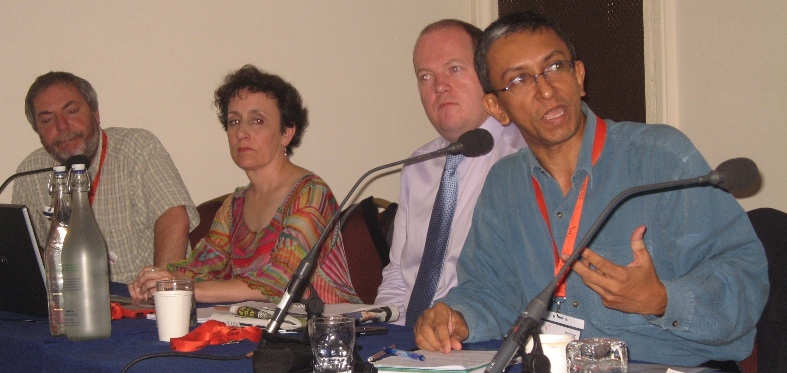
So I was delighted to be on a panel with two leading British tabloid journalists and a popular radio host from South Africa during the 6th World Conference of Science Journalists held in London from June 30 – July 2, 2009.
My own, personal answer is NO — it need not be! And I’ve spent a good part of my two decades of work in the media experimenting and showing that communicating science can be fun — both for us communicators and our audiences.
But I pointed out that science is still being covered in sections of Asian media in the more traditional, classical way, just like science itself is still an elitist pursuit in many of our societies.
L to R: Paul Sutherland, space correspondent of The Sun, UK; Christina Scott, radio and web journalist, South Africa; David Derbyshire, Environment editor, The Daily Mail, UK; Nalaka Gunawardene, Director/CEO, TVE Asia Pacific
I said: “We might call this coverage ‘broadsheet approach’ in print; or ‘bluechip documentary’ format on television. And they are both unsustainable! They are also endangered in these hard times for the mainstream media in most economies.
“So going the tabloid path is a practical and pragmatic way to deliver science stories and science information to a mass audience or readership. We’re doing it in different ways in the Asian media!”
In my remarks, I gave some examples where science is jazzed up (rather than dumbed down) for popular consumption on Asian television. For example, how solar and lunar eclipses provide fodder for endless stories on our numerous news channels. Such coverage, fleeting and superficial as it might often be, takes the wonders of science and Nature to more people than anyone else can.
I argued that the path to the mass audiences in Asia is through news, sports and entertainment programming. We have our own niche, factual channels – Discovery, National Geographic, Animal Planet and their local equivalents. They have a loyal but small audience. They do excellent work. But where numbers are concerned, they cannot – yet! – compete with the outreach and appeal of broadcast radio, TV and newspapers. Neither can the online and mobile media, even though their outreach is growing fast.
Things don’t always go right, however. Doing wall-to-wall coverage of news demands producers and reporters to tackle a variety of topics and subjects — including specialised science stories. Some handle this better than others. In their race for ratings and revenue, a few ‘dress up’ the stories a bit too much.
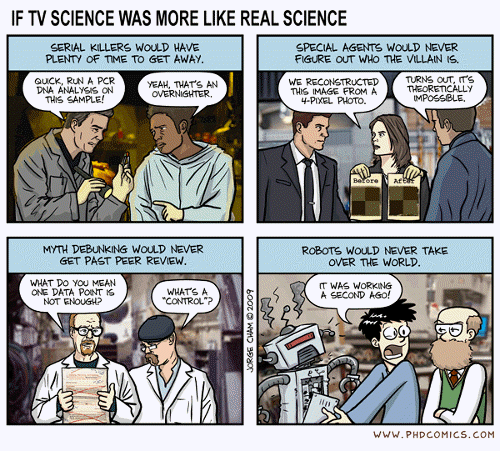
Television science: aspiration or reality?A good example was how some Indian news channels handled the so-called ‘Big Bang experiment’ in September 2008, when the Large Hadron Collider (LHC) was commissioned. The mega-science experiment was interesting in its own right, but it wasn’t apparently exciting enough for at least two channels — Aaj Tak and India TV. Their coverage running up to the event speculated about its “catastrophic effect on the world” – effectively end of the world.
Their coverage caused panic, which led to at least one attributable death. This prompted the Indian Ministry of Information and Broadcasting to caution the channels for spreading “misinformation, fear and horror” among viewers. It advised the channels to exercise restraint in presenting such issues.
I call this the ’24/7 TV Deficit’ in Asian broadcasting. The long term response to this is to invest in training and capacity building of journalists and producers already working in the media. For the most part, they learn on the job, making mistakes on the air. This is far from ideal.
Here’s how I summed up: ‘Tabloid science coverage’ – in print or broadcast – may be imperfect in some ways. But our choice is either that, or nothing. Our challenge is to make the process and product better as we go along.
We urgently need to unleash scientific knowledge and understanding in matters of public interest and public policy. We can’t afford the ALL or NOTHING approach.


 I returned to the Maldives in November 1989, that time as a member of the international media covering the first ever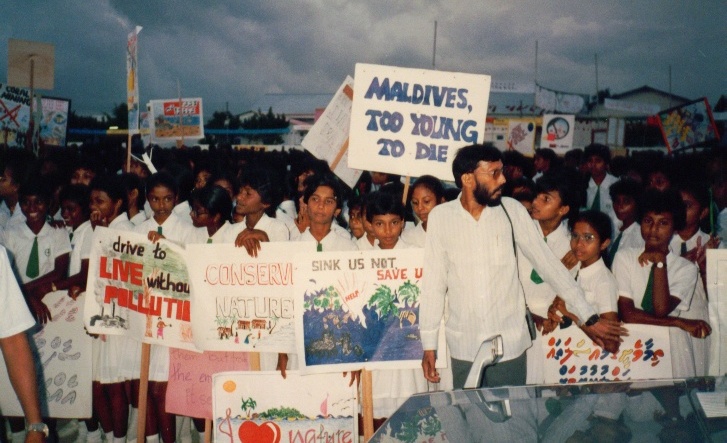


 Open Minds!
