This was the title of a talk I gave to Sri Lanka Rationalists’ Association (SLRA) in Colombo, Sri Lanka, on 7 June 2012 — two days after World Environment Day.
In this, I shared my observations on how attempts aimed at environmental conservation and sustainable resource use in Sri Lanka are often hindered by many misconceptions and myths about natural resources and our impact on them.
I invoked the words of George Monbiot, journalist/columnist, The Guardian, UK: “One of the most widespread human weaknesses is our readiness to accept claims that fit our beliefs and reject those that clash with them. We demand impossible standards of proof when confronted with something we don’t want to hear — but will believe any old cobblers if it confirms our prejudices…”
At the outset, I proposed a basic categorization of eco-myths as myths of the first, second and third kind – the last one being the most pervasive and harmful. Drawing on my 25 years of experience as a science writer and journalist, I cite several examples from air pollution, biodiversity and climate change.
There is also the mother of all eco-myths that Lankan nationalists never tire of repeating: romanticising the ‘good old days’ before modernisation and colonisation. Ah, if only real life were that simple…
I acknowledged that scientific knowledge and understanding on some ecological matters are evolving so have to keep an open, inquisitive mind: science does not have all the answers, but provides a framework in which to ask the right questions and to go in search of answers supported by evidence.
I also conceded that many individuals – and their societies – are not always rational. Governments (at least in democracies) take their cue from the people, and so…irrationality feeds on itself.
The bottomline: it’s a free world and individuals may cling on to any fantasy or belief. As long as it doesn’t harm others around the believer, and/or affects collective thinking. When it does, the good of the many must outweigh the good of one.
In this Ravaya column, in Sinhala and printed in the Ravaya newspaper of 3 July 2011,
I point out that a certain speech said to be uttered by a native American chief is, in fact, a latter day script by a filmmaker.
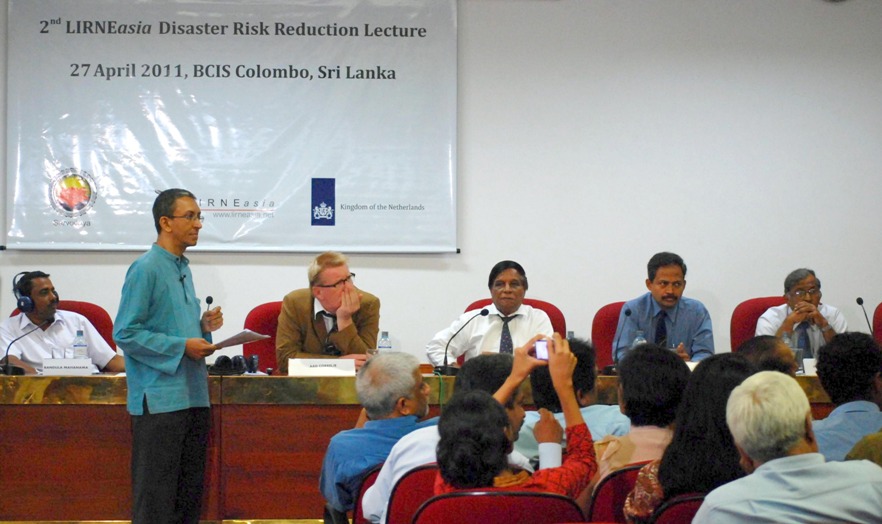
2nd LIRNEasia Disaster Risk Reduction Lecture, 27 April 2011 in Colombo: Nalaka Gunawardene (standing) moderates panel discussionWriting on 20 April 2011, exactly 25 years after the Kantale large dam breached and washed away downstream villages, I posed the question: “If there were to be a catastrophic dam failure in Sri Lanka today, is there a warning system in place to detect the failure and issue timely warnings? Have the downstream communities participated in evacuation drills and know what action needs to be taken when a warning is issued?”
I’ve been asking such questions for a while. In fact, the post-mortem of the Kantale dam breach was one of the bigger stories I covered soon after I entered mainstream journalism in late 1987. By then, a few months after the incident, a presidential commission of inquiry was looking into what caused that particular disaster.
My interest in this subject is perhaps inevitable. I live in a country that has a high concentration of man-made water bodies. There are approximately 320 large and medium sized dams in Sri Lanka, and over 10,000 smaller dams, referred to as “wewas”, most of them built more than 1,000 years ago. In fact, Sri Lanka probably has the highest number of man-made water bodies in the world. According to the Sri Lanka Wetlands Database, the major irrigation reservoirs (each more than 200 hectares) cover an area of 7,820 hectares, while the seasonal/minor irrigation tanks (each less than 200 hectares) account for 52,250 hectares. This adds up to 60,070 hectares or just over 600 square kilometres — nearly a tenth of the island’s total land area.
Lankans are justifiably proud of their ancient hydrological civilisation — but don’t take enough care of it. Nothing lasts forever, of course, but irrigation systems can serve for longer if properly maintained. In a world where extreme weather is becoming increasingly commonplace, we can’t afford to sit on 25 centuries of historical laurels. Unless we maintain the numerous dams and irrigation systems – most of which are still being used for farming – heritage can easily turn into hazard.
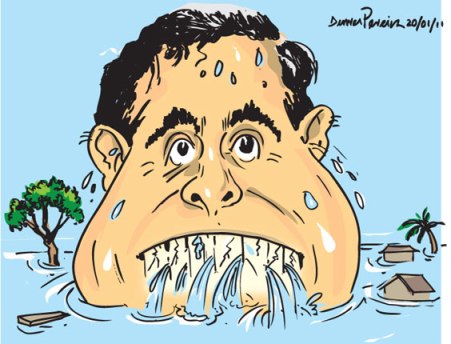
Cartoon from Daily Mirror, 20 Jan 2011As indeed happened in early 2011, when massive and successive floods lashed the country’s Dry Zone where most reservoirs are located. It was a strong reminder how dams and reservoirs not only attenuate the effects of heavy rains, but if breached, can magnify the effects of such rainfall.
More than 200 small dams did breach during those rains, causing extensive damage to crops and infrastructure. The most dangerous form of breach, the over-topping of the earthen dams of large reservoirs, was avoided only by timely measures taken by irrigation engineers — at considerable cost to those living downstream. This irrigation emergency was captured by a local cartoonist: the head in this caricature is that of the minister of irrigation.
In early February, Sri Lanka announced that it will expand its dam safety programme to cover more large reservoirs and will ask for additional funding from the World Bank following recent floods. Never mind the irony of a proud heritage now having to be maintained with internationally borrowed money. Public safety, not national vanity, comes first.
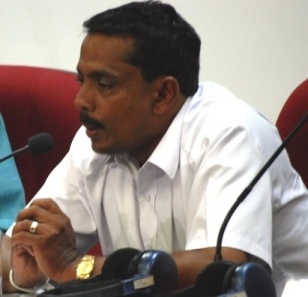
Bandula MahanamaThe main lecture was delivered by Dr Aad Correlje of the Delft University of Technology, the Netherlands. The response panel comprised Bandula Mahanama (a farmer organisation leader from one of the worst flood-affected areas in the Polonnaruwa District), S Karunaratne (Sri Lanka National Committee on Large Dams), Dr Kamal Laksiri (Ceylon Electricity Board) and U W L Chandradasa (Disaster Management Center). A summary is found on LIRNEasia’s blog.
Dams and irrigation systems are widely seen as the exclusive domain of civil engineers. They certainly have a critical role to play, but are not the only stakeholders. I was very glad that both our panel and audience included voices from many of these groups — especially the many communities who live immediately downstream of dams and reservoirs. Some of them are always in the shadow of a dam hazard, and yet helpless about it.
This was the gist of farmer leader Bandula Mahanama’s remarks – he made a passionate plea for a more concerted effort to improve proper maintenance of dams and reservoirs. “Wewas are part of our life, but right now our lives are in danger because the irrigation heritage is in a state of disrepair,” he noted.
I will write more about this in the coming weeks. My last thought from the chair was something I first heard many years ago in a global documentary. When it comes to water management, everybody lives downstream.
That’s certainly the case — but some are more downstream than others. And not everyone lives with the same peace of mind. We need to do something about it.
Talking to the last drop: All streams flow to Istanbul?
The 5th World Water Forum opens in Istanbul, Turkey, today. It will be held in the historic city – a bridge between the east and west – from 16 to 22 March 2009.
Held every three years, the World Water Forum is the main water-related event in the world. It seeks to put water firmly on the international agenda with a view to fostering collaboration – not confrontation – in sharing and caring for the world’s finite supplies of the life-giving liquid. The forums bring together officials, researchers, activists and media to a few days in which they can drown in their own cacophony…well, almost.
I haven’t been to one of these mega-events – I almost did in 2003, when it was hosted by Kyoto, Japan. That forum was almost entirely eclipsed – as far as the media coverage was concerned – by the United States deciding to invade Iraq during the same week. This inspired me to write an op ed essay on oil, water and media which was syndicated by Panos Features and widely reproduced at the time in newspapers, magazines and even in a few activist and development publications. But six years later, it’s hard to locate it online, so I’m publishing it here, unedited, exactly as I wrote in that eventful week in mid March 2003:
Oil on water: will the media get this Big Story?
By Nalaka Gunawardene: 20 March 2003
“If the wars of this century were fought over oil, the wars of the next century will be fought over water.” Ismail Serageldin, an eminent Egyptian architect and planner, made this remark in 1995 when he was vice president for sustainable development at the World Bank.
Well, we are in that new century now, but old habits die hard. The war in Iraq has been fuelled by oil interests, and – starting at the time it did, on March 20 –effectively sidelined global talks to secure freshwater for all.
Clean water, anyone?Even as the United States launched its attack on the country that sits on the world’s second largest oil reserve, the Third World Water Forum was in progress at the Japanese cities of Kyoto, Shiga and Osaka. The event, running from March 16 to 23, is this year’s biggest international conference on a sustainable development issue and involved hundreds of government and civil society representatives trying to resolve one of the major survival issues of our time: equitably sharing the world’s finite freshwater resources for our homes, farms and factories.
The two processes cannot be more different. One aims to use force while the other seeks to foster co-operation among nations to cope with water scarcity. The increasingly isolated United States has abandoned the United Nations process in its single-minded determination to disarm Iraq, a nation it considers a major threat to peace and security. Meanwhile in Kyoto, the nations of the world – including, but not led by, the United States – were discussing an issue that is far more central to humanity’s security. It has the full blessings of the UN, which has designated 2003 the International Year of Freshwater.
Yet the water forum seems hardly newsworthy to the major news organisations that are preoccupied with war. For months, the global television networks were gearing up for Iraq war coverage. The first Gulf War helped globalise CNN, and this time around, there are other international and regional channels competing for the eye balls. Locked in a battle for dominant market share, CNN International and BBC World are trying to outdo each other in covering the conflict exhaustively — and to the exclusion of everything else. In the do-or-die media marketplace, ‘soft issues’ such as water are easily edged over by conflict. As cynical news editors will confirm, if it bleeds, it leads.
The notions of national and global ‘security’ – on which the Iraq war is being waged – are relics of the Cold War that are completely out of sync with today’s global realities. Who says we have entered the 21st century?
In the closing decade of the last century, as the world grappled with one crisis after another – ranging from famine and drought to global warming and HIV/AIDS – the notion of ‘security’ was radically redefined to include ecological and social dimensions. What is now termed ‘human security’ is concerned not so much with weapons as with basic human dignity and survival. As first articulated in the UN Development Programme’s Human Development Report in 1994, human security includes safety from chronic threats such as hunger, disease and repression, as well as protection from sudden and harmful disruptions in the patterns of daily life.
Mahbub ul HaqThe rationale for this was brilliantly summed up by the late Mahbub ul Haq, former Finance Minister of Pakistan and architect of the Human Development Index: “If people are sleeping on pavements, ministers have no business shopping for modern jets and howitzers. While children suffocate in windowless classrooms, generals go about in their air-conditioned jeeps. Nations might accumulate all the weaponry they want, but they have no strength when their people starve…”
A world in which four out of every ten people live in areas of water scarcity is not secure. And if urgent action is not taken, this will increase to two thirds of humanity by 2005. Ensuring water quality is as important as basic access: preventable diarrhoeal diseases – including cholera and dysentery — kill more than seven million children every year. That is 6,000 deaths every day.
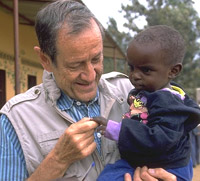
James P GrantJames Grant, former executive director of UNICEF, once used a powerful metaphor to describe this scandalous situation: it was as if several jumbo jets full of children were crashing everyday – and nobody took any notice.
If the media are obsessed with death and destruction, why aren’t these numbers registering on their radars? Why is it that silent emergencies forever remain ignored or are only superficially covered? Even statistics don’t set the media agenda: for example, according to the UN, twice as many people are still dying from diarrhoeal diseases as from HIV/AIDS in China, India and Indonesia. But the international donors and media assign far more importance to HIV than to clean water.
No other factor can distort reality as oil. Oil comes on top of water both in the physical world, and in the murky world of global politics. Our collective dependence on petroleum immediately ensures the Iraq war a disproportionately high rank in public and media concerns.
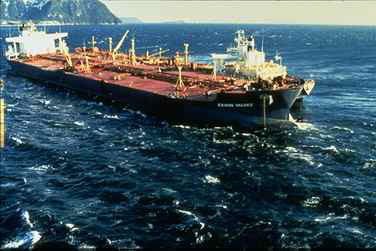
It’s not just the United States that is addicted to oil – we all are. Addicts tend to lose sight of the cost of their dependence, as we have. On 24 March 1989, the oil tanker Exxon Valdez ran aground on in Prince William Sound in Alaska and a fifth of its 1.2 million barrels of oil spilled into the sea, causing massive damage to over 3,800 km of shoreline. Investigations implicated its captain for grossly neglecting duty. Shortly afterwards, Greenpeace ran a major advertising campaign with the headline: “It wasn’t his driving that caused the Alaskan oil spill. It was yours.”
Exxon Valdez: Drunken driving!Greenpeace continued: “It would be easy to blame the Valdez oil spill on one man. Or one company. Or even one industry. Too easy. Because the truth is, the spill was caused by a nation drunk on oil. And a government asleep at the wheel.”
A nation drunk on oil is waging a war that has more to do with oil than anything else. Our news media are behaving just like cheer-leaders.
War is undoubtedly a big story. But so should be water. One in six humans does not have safe drinking water, and one third of humankind lacks adequate sanitation. We may be living on the Blue Planet, but the waters are muddy and life-threatening to billions.
For sure, a bunch of people huddling together in three Japanese cities won’t solve this crisis overnight. But unless knowledge and skills are shared, and a political commitment is secured, safe water for all will forever remain a pipe dream.
Will it take a full-scale war over water in one of the flashpoints around the world for the military-industrial-media complex take sufficient interest in this survival issue? (That might happen sooner than we suspect.)
It’s ironic that the World Water Forum was undermined by the Iraq war breaking out in the very same week. Washington has now poured oil over everybody’s water.
[Nalaka Gunawardene is an award-winning Sri Lankan science writer, journalist and columnist. He heads TVE Asia Pacific, a regional media organisation working on sustainable development issues, and is on the board of Panos South Asia. The views expressed here are his own.]
In the wake of Cyclone Nargis that wreaked havoc in Burma, the world has once again realised the brutality and ruthlessness of the military regime that runs the country.
And as the United Nations and aid agencies struggle with the incredibly uncaring Burmese bureaucracy to get much needed emergency relief for the affected Burmese people, the media outside Burma are having great difficulty accessing authentic information and images.
Despite the massive disaster and resulting tragedy, Burma remains closed to foreign journalists, especially the visual media. No doubt the memories of the monk-led pro-democracy protests of late 2007 are still fresh in the minds of the ruling junta and their propagandists. The few courageous foreign reporters who managed to get in at the time ran enormous personal risks, and Japanese photojournalist Kenji Nagai was shot dead by a Burmese soldier while filming demonstrations.
Unable to report from the multiple scenes of disaster, and lacking a wide choice of reliable local sources willing to go on the record, international news agencies and broadcasters have been forced to quote the government-owned Burmese television station, MRTV.
Global news leaders like Al Jazeera, BBC and CNN have all used MRTV visuals to illustrate their news and current affairs reportage. A recent example from Al Jazeera, posted on 8 May 2008:
The image monopoly by MRTV wouldn’t have mattered so much if they at least provided an accurate account of the unfolding events in its own country. But that seems far too much to expect of this mouthpiece of the Rangoon regime. In Burma’s darkest hour in recent memory, MRTV would much rather peddle the official propaganda – never mind the millions made homeless by the recent disaster.
Here’s an insight from the Inter Press Service, the majority world’s own news agency, reporting from their Asia Pacific headquarters in Bangkok, Thailand:
Worse, there is evidence emerging that the military authorities had ample warning of a storm brewing in the Bay of Bengal but chose to ignore, or even suppress, it.
The Indian Meteorological Department (IMD) which keeps a close track of geo-climatic events in the Bay of Bengal and releases warnings not only to provinces on the Indian east coast but also to vulnerable littoral countries said it warned Burmese authorities of Cyclone Nargis’ formation and possible approach as early as on Apr. 26.
“We continuously updated authorities in Myanmar (as Burma is officially called) and on Apr. 30 we even provided them a details of the likely route, speed and locations of landfall,’’ IMD director B.P. Yadav told IPS correspondent in New Delhi, Ranjit Devraj.
Burma’s meteorology department did post a warning on its official website on Apr. 27 but no effort was made to disseminate information to the people, much less to carry out evacuations along the coastline or from the islands on the Irrawaddy Delta.
By the time state-run media, which has been continuously spewing propaganda and exhorting the public to vote ‘yes’ to Saturday’s constitution referendum, issued its first cyclone alert on Friday afternoon it was too late for the hapless residents of Rangoon.
Elsewhere in the report, IPS says:
Pictures of soldiers removing fallen trees and clearing roads in Rangoon on the state-run television have further infuriated many in the city. “This is pure propaganda and it’s far from the truth,” e-mailed a Burmese journalist, asking not to be identified for fear of the consequences. “Why do foreign broadcasters show them too –Burmese government propaganda is a disgrace enough to journalism,” he fumed.
“I saw some soldiers getting onto a truck yesterday,” said a 50-year-old resident. “They had no sweat on their shirts, despite what was shown on TV!”
“My wife saw three truckloads of soldiers parked in front of a fallen tree, none of them got down to remove it,” he added.
“Burma is shut off from foreign journalists (unless they are invited in by the military regime to cover specific showpiece events). Western news channels have had to rely on state run television for their moving images.
“So while the death toll is now officially 22,000 (unofficially up to 50,000), with 40,000 people missing and a million homeless; and while the regime is coming in for bitter criticism for its foot-dragging over opening up to international aid and the utter incompetence of its own relief effort so far (which has reached only a tiny fraction of the people affected), we are watching on our television screens soldiers handing over food parcels. We can see nothing of the grief or rage of the people going hungry and thirsty (many water sources are too contaminated to use). They do not talk on camera. Instead they sit obediently in the state TV images, taking what’s given to them. And we watch them, while listening to the numbers and being told of the heightening crisis.”
Appalling as these revelations are, they don’t surprise us. Indeed, MRTV is not alone in this kind of shameless abuse and prostitution of the airwaves, a common property resource. A vast majority of the so-called ‘public’ broadcasters in Asia behave in exactly the same callous manner. This is why I don’t use the term ‘public broadcaster’ to describe these government propaganda channels – because, whatever lofty ideals their founding documents might have, most of them are not serving the public interest any more (if they ever did).
As I commented in Feb 2008: “In developing Asia, which lacks sufficient checks and balances to ensure independence of state broadcasters, the only thing public about such channels is that they are often a drain on public money collected through taxes. Their service and loyalties are entirely to whichever political party, coalition or military dictator in government. When the divide between governments and the public interest is growing, most ‘public’ channels find themselves on the wrong side. No wonder, then, that discerning views have abandoned them.”
I don’t hold a grudge against the hapless staff of MRTV, who simply must remain their Masters’ Voice at all times to stay alive. Those working for government channels in countries with greater levels of democratic freedom can’t take refuge in this excuse. They must be held accountable for their continuing propagandising and the disgusting pollution of the airwaves.
And the incredibly naive and sycophantic UN agencies – especially UNESCO – also share the blame for their feeble yet persistent defence of the so-called public broadcasters. Years ago, I stopped attending meetings discussing public service broadcasting (PSB) in Asia, which these agencies equate with what the government channels are doing. I see yet another of these exercises in futility being lined up as part of the Asia Media Summit 2008 coming up in a few days in Kuala Lumpor.
As I wrote in February, if these development agencies are seriously interested in broadcasting that serves the public interest, they must engage the privately-owned, commercially operated TV channels, which are the market leaders in much of Asia.
Except, that is, in tightly controlled, closed societies like Burma, where government channels are the only terrestrial TV available for the local people.
Images courtesy AP and Reuters, as published by The New York Times online
Yet no one had the capability – and vantage point – to take such images until satellites were launched into orbit, and later astronauts followed.
Beginning in the 1960s, thousands of stunning images — showing our planet in space, as well as the Moon and other celestial bodies in our Solar System — have entered the public domain. These are now part of our popular culture and represent a major educational resource.
These images didn’t come for free. It has cost space agencies – primarily NASA, the American space agency – literally billions of dollars over the decades to capture and deliver these images that we happily, freely bandy around. Contrary to what some people believe, NASA is not a world space agency. It’s the national space agency of a single country, financed by tax payers of that country.
Yet, early on, NASA adopted a very far-sighted, public spirited policy that all its space images would be made available free of copyrights to anyone, anywhere on the planet. This is what enables me to use space images on my blog – and keeps tens of thousands of such images in the public domain.
This is what the NASA official website currently has to say about it:
“NASA still images, audio files and video generally are not copyrighted. You may use NASA imagery, video and audio material for educational or informational purposes, including photo collections, textbooks, public exhibits and Internet Web pages. This general permission extends to personal Web pages.”
Significantly, this includes commercially produced and marketed products, even though NASA’s guidelines make it clear: “If the NASA material is to be used for commercial purposes, especially including advertisements, it must not explicitly or implicitly convey NASA’s endorsement of commercial goods or services…”
I was curious to see what copyright policy the space agencies of other leading space-faring nations follow. This is what I found on the European Space Agency’s website:
“The contents of the ESA Web Portal are intended for the personal and non-commercial use of its users. ESA grants permission to users to visit the site, and to download and copy information, images, documents and materials from the website for users’ personal non-commercial use. ESA does not grant the right to resell or redistribute any information, documents, images or material from its website or to compile or create derivative works from material on its website. Use of material on the website is subject to the terms and conditions outlined below.”
As we can see, it’s a lot more restrictive than NASA’s. I haven’t been able to check the policy of Russian, Chinese or Japanese space agencies, and wonder how liberal or restrictive their copyright policies are.
On strict legal terms, I suppose, creators or finders can be keepers. Arguments can be made that space images obtained at tremendous cost to tax payers can be owned, copyrighted and managed by those agencies and nations footing the bill. This is what makes NASA’s open copyright policy so creditable. Our visual public media — broadcast television, video, DVD and the web — would all have been so much poorer if some nitpicking lawyer or bureaucrat had succeeded in persuading the early NASA management to be more restrictive.
While still on the subject of space images, I wonder why so many images of Earth from space show Africa. I had to search for some minutes to find an image that showed Asia – the largest continent – from space. Next to Africa, the one showing the Americas seems the most popular.
We have to remember that some images we find online are composite images, carefully assembled by combining the best attributes of many images taken over time. Photographing or video filming our planet is not as simple as just going to space, aiming a camera and shooting. It involves a great deal of skill, resources and effort.
And keeping the resulting images in the public domain and open to access takes foresight and public spirit. As the Space Age turns 50, we must acknowledge this aspect of space exploration, which allows compositions like this, found on YouTube, for all of us to enjoy.
I’m strongly committed to promoting media freedom, but have never been the placard-carrying, slogan-shouting type. Street activism is necessary — but not sufficient.
I’ve been more interested in studying trends and conditions, trying to anticipate what the next big threats, challenges and opportunities are, and how best we can respond to them.
I’ve just adapted my Sydney panel remarks into an op ed essay, just published by the UK-anchored media website, Media Helping Media.
Here are the first few paras:
On May 3, the annual World Press Freedom Day will once again be observed worldwide, focusing public attention on a multitude of threats to freedom of expression through the mass media.
But amidst the extremely relevant and necessary slogans, we are unlikely to hear this one: Hands off our spectrum!
Yet saving our spectrum is critical for ensuring media freedom.
The electro-magnetic spectrum has been called the ‘invisible wealth of nations’ — conventional broadcasting relies on the fair, equitable and sound management of this common property resource.
And as economic and cultural practices move more and more into the digital realm, the spectrum’s value is only set to increase.
But few people -– even within the media profession and industry -– appreciate our dependence on this finite resource. Out of sight does seem to push it out of most people’s minds.
Therein lurks a danger: what we don’t see and value can be quietly taken away, without many of us realizing it.
I agreed because I have written and spoken for years about how we in developing Asia are blissfully ignorant about the gross misuse and abuse of our electro-magnetic spectrum by its custodians – our governments.
I was the odd one out on this panel, as all others were from Australia -– I don’t even live in a country that has set a timeframe for transition from analog to digital spectrum in broadcasting.
Only a few countries in Asia have as yet announced a timeframe for this -– Japan, Korea and Malaysia among them. Some have not even thought of this issue – they are dealing with more basic concerns in broadcast regulation and policy formulation. Yet I found this discussion instructive: sooner or later, all countries will have to go through this transition. It certainly helps to know the issues you are debating and grappling with.
An extract from my remarks:
We should address fundamental reforms in broadcast policy, law and regulation before embarking on the high-cost, tedious and slow process of moving the entire production and distribution process to digital. We who haven’t derived and shared the full benefits of analog broadcasting must get our fundamentals right before going digital.
And therein lies the challenge for all of us who want to safeguard media freedom and promote the freedom of expression and cultural production. In my view, many activists in our region are not paying enough attention to how the electro-magnetic spectrum has been mismanaged and abused by various governments. Activist attention has been held by the more tangible, physical threats to media freedom: issues such as censorship, media ownership and political economy of the media.
All these are worthwhile and necessary — but not sufficient on their own.
During discussion, I also made the points:
The spectrum has been called the ‘invisible wealth of nations’. As economic and cultural practices move more and more into the digital realm, we’re going to increasingly feel the value of this common property resource. All our gains in the physical world would be undermined if we find the spectrum has been irretrievably allocated to a handful of privileged users ignoring the public interest. We need to wake up to this reality.
Perhaps it’s just as well we in developing Asia don’t have tight timeframes to switch from analog to digital spectrum use. We’ve got a good deal of cleaning up and streamlining to do in the analog realm.
This window will be open only for a few years. If we don’t act, we run the risk of making an equal mess in the digital spectrum, only far worse.
In terms of action, I suggest three simple yet important steps:
For us in the developing countries – or emerging economies – in Asia, I suggest three actions:
• Look forward to the transition from analog to digital spectrum
• Look sideways to see how we’re currently doing in the analog domain
• Look back to reflect on the mistakes we’ve made along the way (and learn)
 We Can’t Save the Planet with Green Myths!






 Open Minds!