‘Can you hear us now?’ India’s bottom millions connect to information society

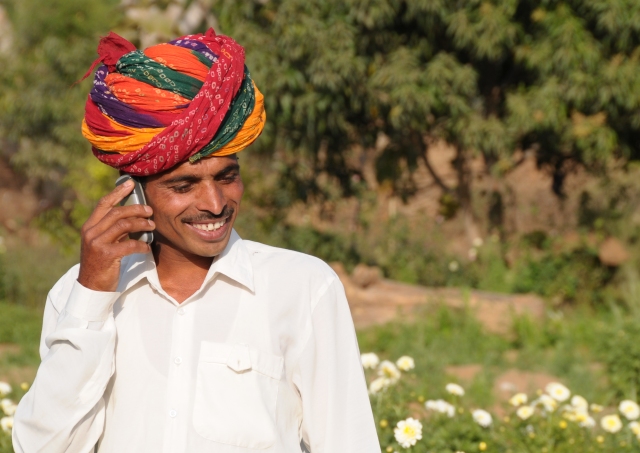
Mobile champion: farmer Sayar Singh in Rajasthan, India - photo by Suchit Nanda for TVEAP
At the end of the world’s largest general election that lasted nearly a month, Indians have just re-elected the Congress Party to govern over the world’s largest democracy for another five year term.

It’s too early to discuss what role, if any, the recently enhanced telecommunications services played in this outcome. But there is no doubt that access to telephones – especially mobiles – has revolutionised the life of the billion plus Indians in the past few years.

Farmer Sayar Singh epitomises this change. Earlier this year, we filmed a day in the life of Sayar, a resident of Pushkar Nala in India’s Rajasthan state. This was part of a profiling of telephone users at the bottom of the (income) pyramid – or BOP – in emerging Asian economies, undertaken by TVE Asia Pacific on behalf of LIRNEasia.

Sayar is definitely BOP: growing wheat and flowers on his ancestral land, he makes around INR 6,000 (USD 115) a month – on which income he sustains an extended family that comprises his wife, four children, elderly father and an unmarried sister. Life isn’t easy for this 33-year-old, but his spirit of enterprise is as abundant as his praise for his newly acquired mobile phone.

He only bought a mobile in mid 2008, but eight months later, that investment had definitely improved business and social life for him. So much so that his life’s narrative is clearly divided as Before Mobile and After Mobile.

“Our life before the mobile phone was hard,” he says. “I took two days to do what I can now do in a day. Now I can get in touch immediately and all my work happens faster and more easily!”

He now tracks market prices and moves his produce quickly for better profits. With workload reduced and income doubled, Sayar has reaped dual benefits from his mobile.

Watch our short profile of Sayar Singh, ardent promoter of mobile phones in rural India:

This isn’t Sayar’s first experience with owning a telephone. Earlier, he was frustrated with a fixed phone that didn’t work half the time. The service was so bad that he gave up the phone after a while.

He recalls: “Phone wires in our village were often faulty. They used to be out of order for 2 or 4 days, sometimes even half a month! All my work was affected. I couldn’t talk to my brothers and sisters. Call charges were also high. When my phone line was down, I had to call from STD booths or neighbours’ phones.”

In our interview, Sayar kept referring to his fixed phone connection as ‘government phone’ – a reflection of the state-owned former monopoly. It was a reminder of just how bad telecom services were in India until only a few years ago.

As Shashi Tharoor, the former UN Undersecretary General – who, incidentally, has just been elected into Indian Parliament from his native Kerala state – has remarked, India had possibly the worst telephone penetration rates in the world.

He wrote in 2007: “Bureaucratic statism committed a long list of sins against the Indian people, but communications was high up on the list; the woeful state of India’s telephones right up to the 1990s, with only eight million connections and a further 20 million on waiting lists, would have been a joke if it wasn’t also a tragedy — and a man-made one at that.”
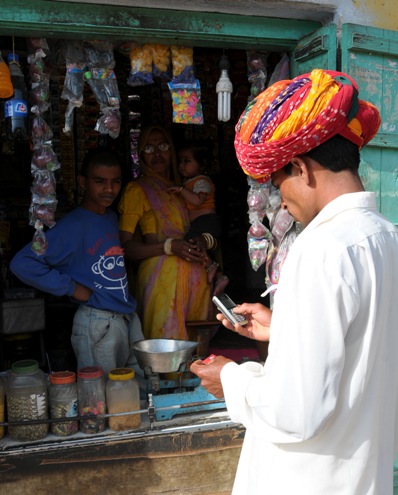
Connected and contented: Sayar Singh by Suchit Nanda for TVEAP
Tharoor recalled the infamous words of Prime Minister Indira Gandhi’s communications minister in the 1970s, C.M. Stephen. In response to questions decrying the rampant telephone breakdowns in the country, the minister declared in Parliament that telephones were a luxury, not a right. He added that ‘any Indian who was not satisfied with his telephone service could return his phone’ — since there was an eight-year waiting list of people seeking this supposedly inadequate product.

According to Tharoor, Mr Stephen’s statement captured perfectly everything that was wrong about the government’s attitude: ignorant, wrong-headed, unconstructive, self-righteous, complacent, unresponsive and insulting. “It was altogether typical of an approach to governance in the economic arena which assumed that the government knew what was good for the country, felt no obligation to prove it by actual performance and didn’t, in any case, care what anyone else thought.”

All this didn’t change overnight, and as Tharoor reflects, the key contribution of the government was ‘in getting out of the way’ — in cutting license fees and streamlining tariffs, easing the overly complex regulations and restrictions that discouraged investors from coming in to the Indian market, and allowing foreign firms to own up to 74 per cent of their Indian subsidiary companies. “The Telecom Regulatory Authority of India (TRAI) has also been a model of its kind, a regulatory agency that saw its role as facilitating the growth of the business it was regulating, rather than stifling it with rules and restrictions.”

It still took time for this revolution to be felt at the bottom of the pyramid. As LIRNEasia says: “Just five years ago, the Indian telecom industry’s massive momentum barely included the poor. The country had slightly over seven access paths (fixed and mobile connections) per 100 people, but in rural India 100 people were served by only 1.5 access paths. Even in urban India, the poor were unconnected.”

Then things started changing rapidly. According to LIRNEasia’s latest teleuse@BOP survey, 45 per cent of Indian BOP teleuser households had a phone in late 2008: 37% had a mobile only; 5% had a fixed phone only; and 3% had both. This is massive progress from the 19 percent of BOP homes with a phone just two years ago. Read more about BOP telephone penetration and use in India.

Tharoor has called this the “mobile miracle” — one that has accomplished something socialist policies talked about but did little to achieve: empowering the less fortunate. Rapid mobile penetration in my native Sri Lanka has had a comparable social transformation – in a commentary last year, I called the ubiquitous mobile ‘Everyman’s new trousers’.

Of course, the mobile revolution is far from over. There are many more millions yet to be connected, and those already connected expect affordable, reliable and value-added services.

“Indian BOP is still in the mobile 1.0 mode using mainly voice and missed calls functionality. Messaging is being used by only a third of the BOP population. Mobile payment and government services use is almost non-existent,” Rohan Samarajiva, chairman and CEO, LIRNEasia, was quoted as saying soon after the latest study was presented in India in February 2009.

How far and how much value added mobile services can penetrate the BOP remains to be seen. Sayar Singh, for example, currently spends US$ 8.6 to 9.5 a month on phone services – over 8% of his enhanced monthly income.

“I haven’t subscribed to any services like cricket news or astrological forecasts. I don’t need them…and I don’t want to spend on them,” he said in our interview.

But mobile telephony is an area where the boldest projections have been exceeded – so never say never.

Photos by Suchit Nanda for TVE Asia Pacific

Cellphones and the Economic Modernization of India: Listen to Shashi Tharoor at Asia Society, NY, in 2007:

Now on MediaChannel.org: Good communications to combat swine flu?

They turn the spotlight inwards...

MediaChannel.org has just published my latest op ed essay titled: Good communications to combat swine flu?

7 May 2009: New Age newspaper in Bangladesh has reprinted the essay

24 May 2009: The Hindu newspaper in India has reprinted the essay in its Sunday Magazine

In this essay, I have expanded some points originally made in two recent blog posts, on 30 April and 1 May 2009.

Here’s an excerpt:

“Flu shots, quarantine measures and hospital care alone cannot counter the current flu outbreak. While medical doctors and researchers spearhead the public health response, we need the mass media and other communicators to mount the public awareness response. Ideally, they should reinforce each other.

“For the first time in history, we now have the technological means to quickly reach out to most of humanity. More than four billion mobile phones are in use, a majority of them in the developing world. Nearly a quarter of the world population (over 1.5 billion people) have access to the web, even if at varying levels of bandwidth. Thousands of radio and TV channels saturate the airwaves – these still are the primary source of news and information for billions.

“Can these information and communication technologies (ICTs) help disseminate the right kind of flu awareness? How fast can we mobilise 24/7 media outlets and telecom networks to inspire preventive and curative action? What can the blogging, texting and twittering new media activists do in such efforts?”

Stop the virus, but not the news!
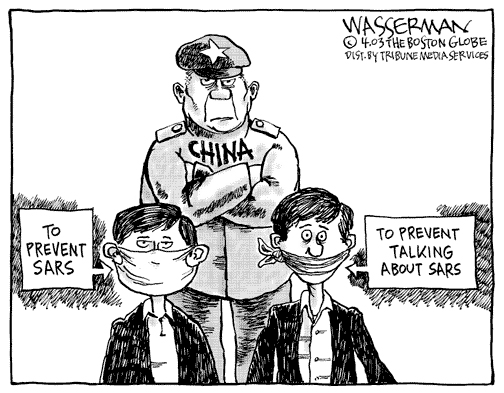
Looking for models of communicating against an infectious epidemic, I recall the Asian experience with Severe Acute Respiratory Syndrome (SARS) . I summarise in this essay the public interest roles played by Asian media during the SARS crisis, which has been studied and analysed in considerable detail.

I then return to one of my favourite points about communicating disasters and crises: the need for credible messages and credible messengers. This was a core theme in the Asian book on Communicating Disasters that I co-edited in 2007. I also highlighted it in this interview given to APC in early 2008.

Here’s how my essay ends: “Whether it is SARS, HIV or tsunami, many Asian governments have suffered from a credibility gap in managing information about emergencies. For example, the initially slow and guarded media reporting on SARS allowed the virus to spread quickly in China, with devastating results. We cannot afford to repeat these mistakes with the latest flu pandemic.

“Nearly a century ago, British author H G Wells talked about human history being a race between education and catastrophe. In the coming weeks, we would find out if humanity has what it takes to outrun and outsmart a stubborn virus.

Read the full essay at MediaChannel.org

Read my op ed essay in SciDev.net in Dec 2005: A Long Last Mile: The lesson of the Asian tsunami

MediaChannel have published my op ed essays before. They were the first to publish, in June 2006, my global call for the broadcast industry to recognise poverty as a copyright free zone. And when Al Jazeera English channel was launched at the end of 2006, MediaChannel carried my essay on ethical news gathering as the biggest challenge for the new global TV network.

My latest essay is a humble birthday present to MediaChannel.org as it completes 10 years. Unique among websites, MediaChannel.org holds the rest of the media accountable with the best of the world’s media criticism and analysis — offering news, diverse global perspectives, and commentaries tracking international news flows. They cover breaking controversies, showcase change-makers, trends and cutting edge issues that you need to know about – produced by journalists for journalists and citizens.

MediaChannel’s co-founder Danny Schechter is one of my media heroes – he was Moving Images Person of the Year 2008.

“Our survival alone is a cause for celebration – a decade of growth and impact is impressive in ‘Internet years’,” wrote the website’s founders in a special 10th anniversary message. They added: “Over the past 10 years, we have survived financial crises and organized hack attacks. We have managed to remain relevant and on the cutting edge in a quickly evolving online landscape when many other sites and organizations have come… and gone.”

The team is making an urgent appeal for donations to keep this excellent service going. I’m very happy to amplify this – few services can deliver better value for money, and our troubled times and troubled media sure need the soul-searching constantly provided by MediaChannel.org

Ten years of kicking ass!

How ‘Hole in the Wall’ ICT experiment inspired ‘Slumdog Millionaire’

21st Century, here we come...
With the 81st annual Academy Awards (Oscars) to be announced on February 22, all eyes are now on the nominated movies.

Updated on Oscar night: Slumdog wins 8 Oscars out of 10 nominations!

Few films in recent years have generated as much buzz as Slumdog Millionaire, the British-Indian film based in the slums of Mumbai. It has won five Critics’ Choice Awards, four Golden Globes and seven BAFTA Awards, and is nominated for ten Academy Awards, including Best Picture.

Much has been written about the movie’s depiction of India’s stark urban realities of poverty, organised crime and street children. But there is another face of India that the movie captures: how information and communication technologies (ICTs) are changing culture, economy and social relations in the world’s largest democracy.

I just called to ask...
Early on, film critic Ben Walters spotted this aspect. He asked in The Guardian on 9 December 2008: Is Slumdog Millionaire the first truly 21st-century film? Among his reasons: “Jamal works in a call centre decorated with London Underground paraphernalia and whose employees are kept up to date on EastEnders plotlines to improve their chances of successful small talk with their customers. Aptly enough, the customers are mobile phone users – another emblem of 21st-century connectivity – and a mobile plays a crucial part in the story’s climax.”

Indeed, the mobile phone combined with live broadcast television both feature in the story’s climax. The film was partly shot on the actual studio set used by Kaun Banega Croreparti (KBC), the Indian version of Who Wants to be a Millionaire. As I wrote earlier, the cerebral world of quizzing blends seamlessly with the rough world of Mumbai slums to produce an enthralling 120 minutes.

And now it turns out that a real life ICT experiment triggered the idea of the Slumdog story.

Indian author Vikas Swarup, on whose 2005 novel Q&A the movie is based, has recently revealed how he was inspired by the hole-in-the-wall project. This was an initiative by Dr. Sugata Mitra, chief scientist at NIIT, a leading computer software and training company in New Delhi. Mitra embedded a high-speed computer in a wall separating his firm’s headquarters from an adjacent slum, he discovered that slum children quickly taught themselves how to surf the net, read the news and download games and music. He then replicated the experiment in other locations. Each time the results were similar: within hours, and without instruction, the children began browsing the Internet.

Swarup told Indian Express in January 2009: “That got me fascinated and I realised that there’s an innate ability in everyone to do something extraordinary, provided they are given an opportunity. How else do you explain children with no education at all being able to learn to use the Internet. This shows knowledge is not just the preserve of the elite.”

Discover your world...
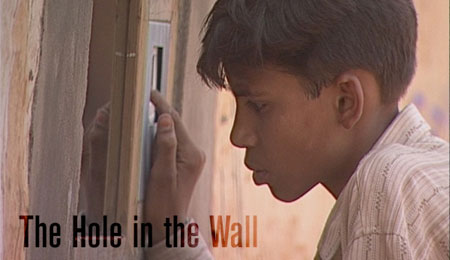
Dr Mitra’s project was the subject of a 2002 documentary film, called Hole in the Wall, made by the New York based production company GlobalVision.

The film was introduced as follows: A revolution in information technology is redefining poverty, as how much you know is becoming just as important as how much you own. “The Hole in the Wall” examines one possible solution to the growing technological gap between rich and poor — the so-called ‘digital divide’ — that threatens to consign millions to an “information underclass.”

The film was made by Rory O’Connor and Gil Rossellini. An 8-min version was broadcast by PBS in October 2002 in their program Frontline/World. A 60-min version was screened at the United Nations in New York City in December 2002. The film has been widely screened, and won several awards.

Initiator of the Hole in the Wall project carries on his mission to adapt ICTs to serve the unmet needs of India’s poor. Watch Dr Sugata Mitra talk about his work in this TED Video:

Mobile phones in Sri Lanka: Everyman’s new trousers?

Mobile phones - social leveller in Sri Lanka

Mobile Phones in Sri Lanka: Everyman’s new trousers?

This is the title of my latest op ed essay, published this week on Groundviews, the leading citizen journalism website in Sri Lanka.

In this, I try to place in a social and cultural context a series of discriminatory laws, regulations and taxes that my native Sri Lanka has introduced – or threatened – in the past few months all aimed at mobile phones, and only mobiles.

This, despite the fact that the proliferation of mobiles has brought telecom services within reach of millions of Sri Lankans in the past decade, helping raise the country’s overall tele-density (mobiles+fixed phones) to 54 telephones per 100 population. With over 11 million SIMs issued, mobiles today outnumber fixed phones by three to one.

In my essay, I cite specific examples, and ask the crucial questions:

Why is this already licensed and regulated technology often targeted for ‘special treatment’ by different arms of government?

Where is this wide-spread suspicion and hostility towards mobiles coming from?

I argue that it is rear-guard action by the traditional elite and bureaucracy who’d rather not allow such digital empowerment to spread. And this has historical parallels.

Here’s the crux of it:

“There is a numerically small (but influential) privileged class that resents information and communication access becoming universal. They might talk glibly in public on using ICTs for social development or poverty reduction. But back inside the corridors of power, they make policies and regulations to undermine the very utility of these tools. This is no accident.

“The mobile phone is the biggest social leveller in Sri Lankan society since the trouser became ubiquitous (initially for men, and belatedly for women). Our elders can probably recall various arguments heard 30 or 40 years ago on who should be allowed to wear the western garb: it was okay for the educated and/or wealthy mahattayas, but not for the rest. Absurd and hilarious as these debates might seem today, they were taken very seriously at the time.

“Make no mistake: the mobile is the trouser of our times –- and thus becomes the lightning rod for class tensions, petty jealousies and accumulated frustrations of an elite that sees the last vestiges of control slipping away.

Read the full essay on Groundviews

Relevant to this discussion is a short film that TVE Asia Pacific produced for LIRNEasia in late 2007, summarising the findings of the latter’s large sample survey on tele-use at the bottom of the pyramid in five emerging markets (which included Sri Lanka).

TVEAP News, Nov 2007: Film highlights telephone revolution in Asia’s emerging markets

Watch the film online:

Teleuse@BOP – Part 1 of 2

Teleuse@BOP – Part 2 of 2

Photo courtesy TVE Asia Pacific

I just called to say….I love my mobile phone!

On this World Telecommunication and Information Society Day (May 17), I have a confession to make. I carry a murder weapon on my person every day and night, and I go to bed with it next to me within easy reach. I rely on it for my work, my leisure and my pleasure. And I won’t part with it under any circumstances.

Neither would more than 3.3 billion people worldwide — or half of humanity.

I’m talking about the humble and increasingly ubiquitous mobile phone, now the world’s most widely used and fastest spreading consumer technology item.

And if any paranoid law enforcement agency worries about its murder potential…relax, people – we are talking figuratively here!

How come it’s a murder weapon when it has no sharp edges and is too light weight to do much damage?

What the mobile has already stabbed, and is in the process of effectively finishing off, is the development sector’s over-hyped and under-delivered phenomenon called the ‘telecentre’.

For those outside the charmed development circles (which is most of humanity), the Wikipedia describes telecentre as “a public place where people can access computers, the Internet and other digital technologies that enable people to gather information, create, learn and communicate with others while they develop essential 21st century digital skills.”

So how is the mobile phone slowly killing the telecentres, into which governments, the United Nations agencies and other development organisations have pumped tens of millions of dollars of development aid money in the past decade?

Well, it’s rapidly making telecentres redundant by putting most or all of their services into literally pocket-sized units. If everyone could carry around a miniaturised, personalised gadget that has the added privacy value, why visit a community access point?

At least this is the persuasive point made by LIRNEasia researcher Helani Galpaya, who made a presentation in September 2007 at the Annenberg School for Communication in the US.

Courtesy Joy of Tech

She argued that, although telecentres, which have become the bright “stars” in many e-development programs in Asian countries, do have a role to play in providing ‘higher’-end citizen services to people at the bottom of the pyramid (BOP) in India, Sri Lanka, Pakistan, Philippines and Thailand, telephones are the cheaper, immediate and ubiquitous tool for Asian governments to inform, transact and interact with almost 400 million of their most needy citizens.

And in these emerging Asian economies, when we talk of telephones it’s predominantly mobiles. In my native Sri Lanka, for example, there were 10.7 million phone subscribers by end 2007 – of them, almost 8 million were mobile users. Mobiles outnumber fixed phones by 3 to 1, and the disparity continues to widen.

Mobile kills the telecentre star‘ was the title of Helani’s presentation – it’s a play on a 1979 song celebrating the golden era of radio, “Video killed the radio star.” For the trivia buffs, it was the first music video shown on MTV.

The song has been the subject of various parodies, and Helani’s isn’t the first or last. But in this instance, I would heartily cheer the rapid demise of the telecentre, which is both conceptually and operationally flawed in many developing countries where it has been tried out. (While at it, let me repeat something that baffles me: how is it that not a single development donor or UN agency foresaw the phenomenal rise of mobile phones in the majority world, and instead bet all their ICT money on computers and internet? And why can’t some of them still appreciate the potential of mobiles, keep harping on obsolete telecentres and other troubled initiatives like One Laptop Per Child?).

It’s also worth noting that hard core development activists were initially against mobile phones, arguing instead for more public payphones, especially in rural areas. Only very recently have they started acknowledging that, just maybe, mobile phone can create or improve jobs, generate incomes and move millions out of poverty. In the humanitarian sector, as I wrote in October 2007, aid workers are still uncertain how to make best use of mobiles in their relief work.

Why are mobile phones somehow not ‘sexy enough’ for these men and women in suits who typically look at our real world problems from 33,000 feet above the ground?

But hey, why bother with doomed concepts like telecentres, when we can instead discuss about the lively and vibrant mobiles? (When the telecentres finally die after being kept on life support by gullible aid donors for a few more years, I hope to write a suitable obituary.)

Meanwhile, who’s afraid of mobile phones except the failed prophets of development and unimaginative humanitarian workers? There’s a handful of crusty, old fashioned people, usually those who can’t figure out just how to use the new fangled devices that do a lot more than just talk. Then there are tyrannical governments who fear the power of instant communication being in the hands of their own people.

The rest of us have now adjusted to Life After the Mobile Arrived. We may love it, or love to hate it — but can we imagine life without it?

And since we’re a blog about moving images, here’s a short film that I wrote and TVE Asia Pacific produced for LIRNEasia in late 2007. It was filmed in the Philippines and Sri Lanka, and was based on
LIRNEasia’s path-breaking 2006 survey on telephone use at the bottom of the pyramid in emerging Asia. We
premiered at the 3rd Global Knowledge conference in Kuala Lumpur in December 2007.

The film’s synopsis reads:
With the next billion telecom users expected mainly from the emerging markets, we urgently need to understand telecom use, especially at the bottom of the pyramid. Who is using what devices for which purposes — and how much are they willing or able to pay? Capturing highlights of LIRNEasia’s 2006 survey in India, Pakistan, the Philippines, Sri Lanka and Thailand, this film shows that when it comes to phone use, the poor are not very different from anyone else.

Teleuse@BOP Part 1 of 2

Teleuse@BOP Part 2 of 2

And now, just when you think I’m a harmless mobile junkie, here’s my real confession:
I own more than one mobile phone (hey, doesn’t everybody?) and stashed away in my travel bag I have a collection of SIM cards with active mobile accounts in half a dozen Asian countries that I visit regularly.

One day soon, when there are enough people like myself moving across jealously guarded political borders, those ITU statistics on ICTs would become seriously skewed….

TVE Asia Pacific News: Film highlights telephone revolution in Asia’s emerging markets
Teleuse@BOP Film screened at GK3
LIRNEasia 2006 survey on telephone use at the bottom of the pyramid in emerging Asia