From Tropical Isle to Frozen Continent: Interview with Imalka de Silva, first Lankan woman in Antarctica

Published in Ceylon Today newspaper, Sunday 10 Feb 2013
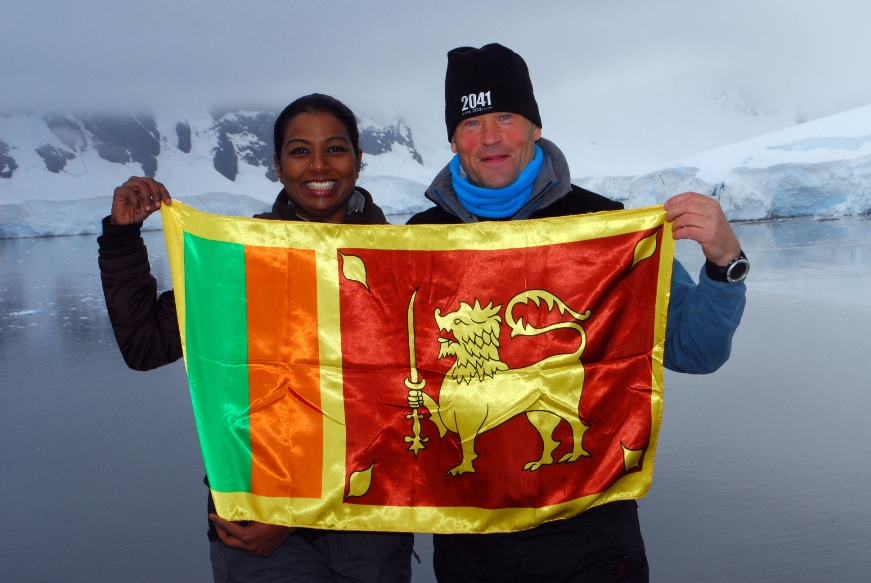
Imalka de Silva with Sir Robert Swan in Antarctica, March 2010

In March 2010, Imalka de Silva became the first Lankan woman to visit Antarctica, when she joined an international team who spent two weeks on an expedition to the frozen continent.

The expedition was organized by the non-profit foundation known as 2041 (www.2041.com), which operates the world’s first educational base (E-Base) in Antarctica. Its founder and head is Sir Robert Swan, the first person in history to walk to both the North and South poles.

Swan, now an environmental activist and motivational speaker, introduced Imalka to a packed Colombo audience last November as a promising new environmental activist. She then announced the formation of ‘V4C – We Foresee’, a non-profit entity to champion sustainable leadership initiatives in Sri Lanka.

Imalka invited Lankans to join future visits to Antarctica. “I want more young professionals and people to have that amazing experience, so that they too can champion local environmental initiatives in a global context,” she said.

Imalka, who is currently studying for a PhD in climate economics in Delhi, recently talked to Nalaka Gunawardene about her plans for broadening the horizons of environmental vision and sustainability leadership. She confirmed that a Lankan team is being finalized to visit Antarctica in the coming weeks, during the South Pole’s current summer.

Looking back, what drew you to the Frozen Continent three years ago?

Her vastness and how she holds such capacity as well as her (scientific and environmental) importance.

How did you join 2041’s Antarctic expedition in early 2010?

I believe it was the search to do something meaningful and different at the same time. It was something that challenged me personally, motivated and defined my work differently and also created a platform to witness reality and nature at its best.

How competitive is to get on 2041’s Antarctic expeditions? And how much does it cost, when you do qualify?

I would not say it’s competitive but you need a lot of confidence in yourself, commitment and drive to the work you’re doing and planning to do in the future and patience to go through the entire selection process. The expedition costs US$ 25,000 – 30,000 (all inclusive). [Note: Imalka’s Antarctic trip was fully sponsored by StreamServe, Inc., a company based in Burlington, Massachusetts, and engaged in providing business communication solutions.]

What preparations and acclimatisation did you have to undergo before visiting Antarctica?

The 2041 International Antarctic Expedition (IAE) to me was a combination of adventure, science and capacity building, as a result Rob (Sir Robert Swan) and his team package its contents in such a way to deliver the message and highlight the importance of sustainable leadership, the individual responsibility towards preserving nature’s balance and how one could take on this message, understand it and implement it within their own context.
There were four key elements regarding preparation:
• Fitness – metal and physical was key, experience in hiking and long distance running being a plus.
• Discipline and focus – from your food to understanding what your mission is and why.
• Background knowledge – understanding the history of the continent – since our expedition also involved work on the Antarctic Treaty it was good to know the background, evolution and its geo-politics.
• Science – the climatic importance, nature and its unique wildlife
Preparation before the expedition is a must. However, what is important about IAE is that it also prepares you for what is waiting for you on your return…

When exactly did you visit the Antarctica? What did you do there, and for how long did you stay?

I visited in March 2010. We were exploring the Peninsula and Continent for 14 days. It ranged from exploring, camping on ice, hiking, observing wildlife (e.g. migration patterns, etc.), research, visiting the 2041 education base – the only e-base in Antarctica which is run on renewable energy — lectures and presentation from top sustainability leaders, team work…and lots of laughter!

What were your impressions of the place when the visit ended?

Responsibility in action, the beauty of balance and nature’s truth.

You have been very low key despite becoming the first Lankan woman to visit Antarctica. There was no mainstream media or even social media mention of it until months later. Why?

I believe one has to wait for the right time. I had just started my PhD in 2010 in Delhi, so I was mostly away from home, although behind the scenes, I was working very hard to get Rob to visit Sri Lanka. My mission with V4C (still) was a work in progress since I was waiting patiently for Rob to meet me during his trips to Delhi in 2011 and guide me to ground what I have planned for Sri Lanka.

My aim was also to wait for the right time to make the best and lasting impression, and in this case, a number of factors had to come together. In addition to putting Sri Lanka in to Rob’s supra-busy schedule and getting the local mission finalised, I also had to find a Sri Lankan corporate that understood the meaning of what my mission was and the importance of Rob’s introduction to Sri Lanka re: his work on sustainable leadership. It was critical that they introduced Rob, his work, V4C mission and message in the right way. Thanks to Mr. Dian Gomes and his wonderful team at MAS Holdings and Intimates, it was delivered exactly or even better than what Rob and I envisaged. It was a test of patience and perseverance…

What is your new organisation, V4C? What are your plans?

‘V4C – We Foresee’ works towards championing and celebrating sustainable leadership initiatives in Sri Lanka. We are also working in partnership with 2041 as the coordination unit for IAE in Sri Lanka. Our second project relating to Sustainable Leadership will be launched in April 2013.

You’ve mentioned about a Sri Lanka team to go to Antarctica for the next Expedition in February 2013. Is this happening? Who has been chosen? And on what basis or considerations?

Yes, we have selected a number of participants and since we are focusing on ‘Business and Sustainability’ at present, the team comprises of corporate representatives from Sri Lanka.

The selection starts with nominations and/or an open application process within the companies, the CEO and their teams will then evaluate according to company requirements as well as 2041 criteria and select the final set. These applications are then sent to 2041 for final selection/approval. There is also a possibility of the first Sri Lankan Youth Ambassador joining the team. I will be able to confirm the details (soon) once finalized.

Are you planning to return to Antarctica?

Yes, fingers crossed! I am planning to go there within the next five years with my two colleagues from V4C. This time it will be to highlight and share our experiences in Sri Lanka on sustainable leadership. This is what 2041 does: it creates a platform for learning and knowledge exchange.

Should Sri Lanka, as an Indian Ocean state, take a scientific interest in Antarctic research and exploration – as India and Pakistan already do?

It depends on the priorities we hold as a Nation and why such research would be important to Sri Lanka.

You’ve studied NGO management and yet work for a state entity in Sri Lanka. How do you see you making a difference in Sri Lanka?

I am currently on full-time study reading for my PhD in Climate Economics. I believe working and studying in areas relating to environmental science, socio-economic policies, etc., relating to sustainable development make me understand the different facets of sustainability and how we could promote it in different ways.

For example, the exposure I am getting by working with the private sector is giving me ways of branding sustainability. This enables me to see the best fit, the do-ability and how we could at best engage Sri Lankan young professionals, entrepreneurs and environmental champions to create sustainable initiatives.

So I believe V4C will contribute by bringing in a new perspective and a unique way of looking and working with sustainability. After all, we as a nation have our own story and this has to be incorporated, showcased and celebrated globally.
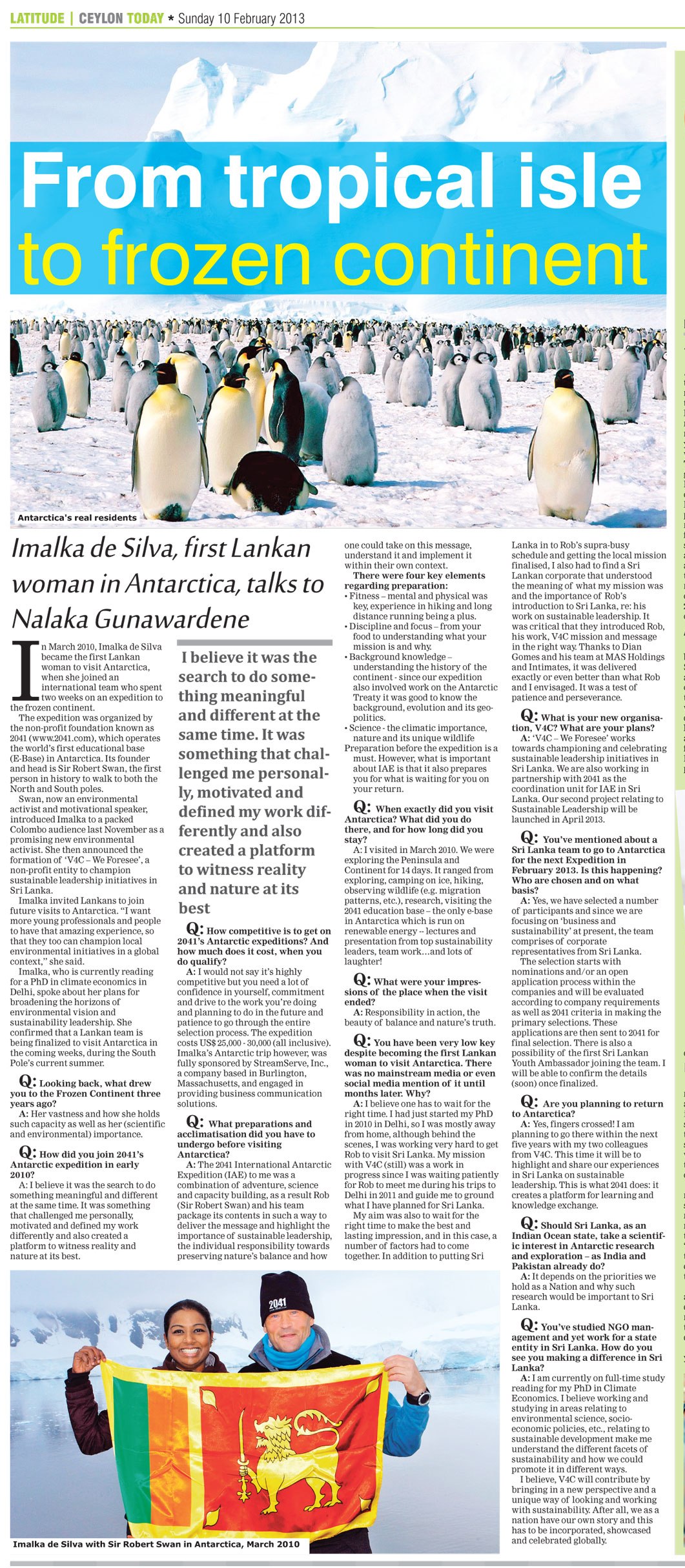
Interview with Imalka de Silva - Ceylon Today, 10 Feb 2013

21 Dec 2012 is here: So where’s the End of the World I was promised?

The much touted ‘Doomsday’ has finally arrived: today is 21 December 2012.

According to the assorted peddlers of doom and gloom, the world should be ending today. Hmm…

Perhaps THEIR WORLD of myth and fantasy would indeed end today — and not a moment too soon!

For the rest of us, however, it’s another day. And from today, I would call the misguided “star-readers” ass-trologers.

Ass-trologers and other dabblers in pseudo-science and non-science will now have a lot of explaining to do. The religious zealots, of course, would probably claim that their pious conduct and non-stop prayers earned us a stay of execution…

The US space agency NASA was so sure that the world won’t come to an end on 21 Dec 2012, that last week they released this simple explanatory video for “the day after”. It has already been seen by over 2 million viewers on YouTube:

A perceptive commentary on the End-of-the-World hysteria, written by the leading Indian rationalist Sanal Edamaruku, is well worth reading:
WAITING FOR A FLYING SAUCER AGAIN…Of psychopaths, profiteers and big doomsday biz, by Sanal Edamaruku

Here’s an excerpt: “Doomsday prophecies may not be the most dangerous part of the problem. But as they are bound to collide always so harshly with the continued existence of the world after zero hour, they allow us a glimpse at a process – here in fast motion – that normally would play out too slowly to be understood. It is a process of immunization against reason…”


Read my 4 Nov 2012 Sunday column: End-of-the-World, Inc.

Montreal Protocol at 25: Celebrating Ozone Safe Generation!

On 16 September, the International Day for the Preservation of the Ozone Layer will be observed once again all over the world. This year’s theme is “Protecting our atmosphere for generations to come”.

Exactly 25 years ago, governments of the world came together at a historic conference in Montreal, Canada, to adopt the Montreal Protocol on Substances that Deplete the Ozone Layer.

In a quarter century, it has rallied governments and industries in both developed and developing countries to phase out, or substantially reduce, nearly 100 chemicals that damage the ozone layer in the upper atmosphere.

The Ozone Secretariat and UNEP OzonAction have jointly produced two 30-second videos mark the 25th anniversary of the Montreal Protocol (MP).

These Public Service Announcements (PSAs) hail the extraordinary achievements of this Multilateral Environmental Agreement over a quarter century. They also project the MP as a protector of our shared atmosphere for generations to come.

The first PSA briefly introduces the ozone layer depletion issue and highlights its recovery that was made possible when countries of the world joined hands for saving the ozone layer – a global action at its best.

The second PSA revolves around the multiple benefits of the Protocol: it is not just a treaty protecting the ozone layer, but has multiple benefits for our biodiversity, climate, human health and the global economy.

The third version of this PSA (below) is twice as long, gives more info and moves at a more leisurely pace.

These PSAs, made by friends in the UK are proof that even a highly esoteric and technical subject like ozone protection can be presented in engaging, human interest terms.

Growing up in an Ozone Safe World: that’s worth celebrating!

සිවුමංසල කොලූගැටයා #80: මහා රාවණා කොටුවෙන් රන් මුතු දුවට…

In my Ravaya column (in Sinhala) for 26 August 2012, I’ve written about the making of Ran Muthu Duwa, the first colour Sinhala feature film made in Sri Lanka, was released 50 years ago in August 1962.

Ran Muthu Duwa was a trail-blazer in the Lankan cinema industry in many respects. It not only introduced colour to our movies, but also showed for the first time the underwater wonders of the seas around the island.

I covered similar ground in my English column on 12 Aug 2012: From Great Basses Reef to ‘Ran Muthu Duwa’ – Story of Ceylon’s First Colour Movie

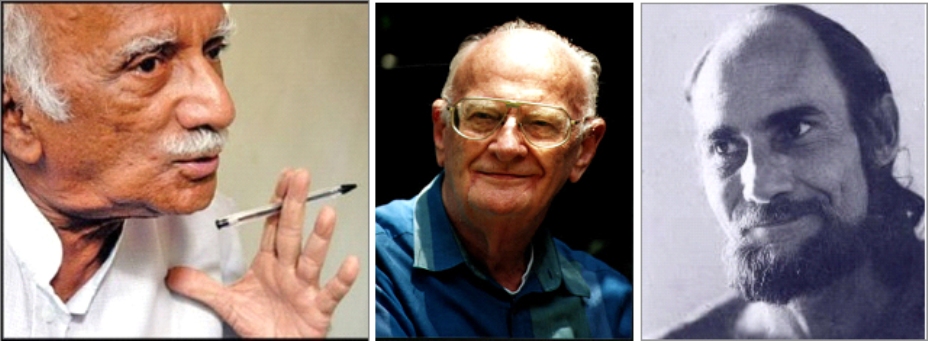
The Serendib Trio in later years – L to R: Shesha Palihakkara, Arthur C Clarke, Mike Wilson

මුළුමනින් ම වර්ණයෙන් නිෂ්පාදිත මුල් ම සිංහල චිත‍්‍රපටය වු “රන් මුතු දුව” මුල් වරට තිරගත වීම ඇරුඹී අඩ සියවසක් පිරෙන්නේ මේ මාසයේ. 1962 අගෝස්තු 10 වනදා සිනමා රසිකයන් හමුවට ආ “රන් මුතු දුව” කෙටි කලෙකින් අතිශයින් ජනප‍්‍රිය වූවා.

රන් මුතු දුව සිනමා තාක්‍ෂණ ශිල්පීන් හා නළු නිලියන් රැුසක් එක් තැන් කළ, එ වන තුරු පැවති ශෛලියට වඩා වෙනස් වූ ආරක චිත‍්‍රපටයක්. එය කලාත්මකව මාහැගි නිර්මාණයක් නොවුවත් සංත‍්‍රාසය හා වින්දනය නොඅඩුව ලබා දුන් නිසා බෙහෙවින් ජනප‍්‍රිය වුණා. වාණිජ මට්ටමින් අති සාර්ථක වූ රන් මුතු දුව ලැබු ආදායම් වාර්තාව 1979 දක්වා නොබිඳී පැවතුණු බවයි මෙරට චිත‍්‍රපට ඉතිහාසඥයන් සඳහන් කරන්නේ.

රන් මුතු දුව සිනමා සමාගමක් හෝ චිත‍්‍රාගාරයක් මුල් වී තැනු චිත‍්‍රපටයක් නොවෙයි. එයට මුල් වූයේ බි‍්‍රතාන්‍ය ජාතිකයන් දෙදෙනෙක්. එහි කථාව, තිර රචනය, කැමරාකරණය හා අධ්‍යක්‍ෂණය කලේ මයික් විල්සන්. ඔහු ලේඛනයට, ජායාරූප කලාවට, සිනමාවට මෙන් ම කිමිදීමටත් හපන්කම් දැක් වූ අයෙක්. එය නිෂ්පාදනයට අවශ්‍ය මුදල්වලින් වැඩි කොටසක් යෙදවූයේ විද්‍යා හා විද්‍යා ප‍්‍රබන්ධ ලේඛකයකු ලෙස එ් වන විටත් ලොව පුරා නමක් දිනා ගෙන සිටි ආතර් සී. ක්ලාක්.

මේ දෙදෙනා 1950 දශකය මැදදී ලංකාවට පැමිණ, මේ දුපත අවට මුහුදේ කිමිදීමේ ලැදියාව නිසා මෙරට පදිංචිවීමට තීරණය කර තිබුණා. ඉන්දියානු සාගරයේ පුරෝගාමී කිමිදුම්කරුවන් අතර සිටි ඔවුන් කිමිදීමේ පුහුණුව ලැබු ලාංකිකකයන් කිහිප දෙනෙකු ද සමඟ දකුණුදිග හා නැගෙනහිර වෙරළෙන් ඔබ්බෙහි පිහිටි බොහෝ ස්ථාන ගවේෂණය කරමින් සිටියා. මේ අතර සත්ත්‍ව විද්‍යාඥ රොඞ්නි ජොන්ක්ලාස් (Rodney Jonklaas) හා බොක්සිං ශූර හෙක්ටර් එකනායක ද සිටියා.

1956දී දිවයිනේ වෙරළාසන්න ස්ථාන රැසක කිමිදෙමින් ගවේෂණය කළ ඔවුන්ගේ අත්දැකීම් එක් රැුස් කර ක්ලාක් රචිත The Reefs of Taprobane ^1957& චාරිකා සටහන, ඔහු ශ‍්‍රී ලංකාව ගැන ලියු මුල් ම පොතයි.

1961 මාර්තු මස මැදදී දකුණු වෙරළේ යාලට කිමී 13ක් මුහුද දෙසින් පිහිටි මහා රාවණා කොටුව (Great Basses Reef) හා කුඩා රාවණා කොටුව (Little Basses Reef) නම් වන ප‍්‍රදීපාගාර අසල මුහුදේ කිමිදෙමින් සිටි මේ පිරිසට මුහුදුබත් වු නැවක සුන්බුන් හමු වුණා. මේ නැවේ තිබී 1703 වසරේ ඉන්දියාවේ මෝගල් අධිරාජයකු නිෂ්පාදිත රිදී කාසි තොගයක් ඔවුන් සොයා ගත්තා.

සාගරයේ කිමිදෙමින් ගවේෂණය කරන බොහෝ දෙනාට ජිවිත කාලයකට වරක් හෝ මෙබඳු සොයා ගැනීමක් අහම්බෙන්වත් හමු වන්නේ නැහැ. මේ අසාමාන්‍ය සොයා ගැනීම තව දුරටත් ගවේෂණය කරන්නට තමන්ගේ ම බෝට්ටුව්ක් මිළට ගැනීමේ උවමනාව අපේ කිමිදුම්කරුවන්ට මතු වුණා. එ් දිනවල අමෙරිකානු ඩොලර් 10,000ක් පමණ එයට අවශ්‍ය වුණා. චිත‍්‍රපටයක් තනා එයින් ලැබෙන ආදායමින් බෝට්ටුව මිළට ගැනීමට ඔවුන් තීරණය කළා.

එ වන මයික් විල්සන් විට මෙරට දිය යට රූපගත කළ මුල් ම වාර්තා චිත‍්‍රපටය වූ Beneath the Seas of Ceylon (විනාඩි 25, 1958) නිපදවා යම් පිළි ගැනීමක් ලබා තිබුණා. එහෙත් වෘතාන්ත චිත‍්‍රපටයක් අධ්‍යක්‍ෂණය කොට අත්දැකීම් තිබුණේ නැහැ.

ගිලූණු නැවක නිධානයක් සොයා යන, දිය යට ජවනිකා රැගත් කථාවක් චිත‍්‍රපට කිරීමේ දැඩි ආශාවෙන් හා අධිෂ්ඨානයෙන් සිටි මයික් විල්සන්, එයට ආතර් ක්ලාක් ද කැමති කරවා ගත්තා. නළු නිලියන් යොදා ගනිමින් කථාන්තරයක් පැය දෙකහමාරක් පුරා කියැවෙන වෘතාන්ත චිත‍්‍රපටයක් නිපදවීම ලෙහෙසි පහසු වැඩක් නොවන බව ක්ලාක් පෙන්වා දුන්නා. එහෙත් තම සගයාගේ උද්‍යොගය නිසා එයට යම් මුදලක් වැය කරන්නට ඔහු එකඟ වුණා. ඉතිරි මුදල මයික් සොයා ගත්තේ මෙරට ප‍්‍රමුඛ පෙලේ චිත‍්‍රපට සමාගමකින්.

මෙය චිත‍්‍රපටය සඳහා නිෂ්පාදකයා ලෙස ශේෂා පලිහක්කාර සම්බන්ධ වුණා. වෘත්තියෙන් නැටුම් කලාවේ නියැලි සිටි ශේෂා, 1956 ලෙස්ටර් ජේම්ස් පීරිස් තැනු “රේඛාව” චිත‍්‍රපටියේ බොරුකකුල්කාරයාගේ චරිතයත්, තවත් චිත‍්‍රපට චරිතත් රඟපා නමක් දිනා ගෙන සිටියා.

ක්ලාක්, විල්සන් හා පලිහක්කාර ත‍්‍රිත්වය එක්ව පිහිටුවා ගත් සෙරන්ඩිබ් ප‍්‍රඩක්ෂන්ස් Serendib Productions නම් සමාගම නිපද වූ ප‍්‍රථම චිත‍්‍රපටය රන් මුතු දුවයි.

රන් මුතු දුවේ නළු නිලි පිරිසට එවකට සිටි ප‍්‍රමුඛ පෙළේ මෙන්ම නැග එන තරු ද සම්බන්ධ කර ගනු ලැබුවා. ගාමිණි ෆොන්සේකා, ජෝ අබේවික‍්‍රම, ජිවරානි කුරුකුලසුරිය, ඔස්ටින් අබේසේකර, තිලකසිරි ප‍්‍රනාන්දු, ෂේන් ගුණරත්න හා වින්සන්ට් වාස් ඔවුන් අතර වුණා.

ගාමිණි ෆොන්සේකා කථාවේ වීරයා වන විට ඔහුට එරෙහි වන දුෂ්ඨයාගේ චරිතයට වෘත්තීය නළුවකු නොවු කිමිදුම්කරු හෙක්ටර් එකනායක යොදා ගන්නට මයික් තීරණය කළා. ගාමිණි ෆොන්සේකාට කඩිමුඞ්යේ කිමිදුම් ශිල්පය ඉගැන්විම ද හෙක්ටර්ට භාර වුණා.

රන් මුතු දුව චිත‍්‍රපටයේ බොහෝ ජවනිකා රූපගත කරනු ලැබුවේ ති‍්‍රකුණාමලයේ. දිය යට දර්ශන හා සටන් මිලිමීටර් 16 සේයා පටවල රූපගත කොට පසුව මිමී35ට විශාල කරනු ලැබුවා. චිත‍්‍රපටයේ සංස්කරණ හා නිම කිරීමේ කටයුතු ලන්ඩනයේ ටෙක්නිලකර් රසායනාගාරයේ සිදු කළා. කිමිදෙමින් සිනමා රූපගත කිරීම් එතරම් ප‍්‍රචලිත නොවු එකල, මයික්ගේ දිය යට කැමරා කෝණ හා අධ්‍යක්‍ෂණය ගැන බි‍්‍රතාන්‍ය සිනමා ශිල්පීන් පවා මවිත වූ බව වාර්තාගතයි.

මයික්ට සිංහල බස එතරම් හුරු නොවු නිසා සහාය අධ්‍යක්‍ෂණයෙන් හා සිංහල දෙබස් රචනයෙන් දායක වුයේ සිනමා ශිල්පී තිස්ස ලියනසුරියයි. රන් මුතු දුව සංස්කරණය කළේ ටයිටස් තොටවත්ත සිංහල සිනමාවේ මුල අඩ සියවසේ බිහි වූ තාක්‍ෂණික හා නිර්මාණශීලී වශයෙන් ඉතා ම කෘතහස්ත සංස්කාරකවරයා හැටියට පිළිගැනෙනවා. ඔහු එ වන විට රේඛාව (1956), සන්දේශය (1960) හා දස්කොන් (1962) වෘතාතන්ත චිත‍්‍රපට සංස්කරණය කොට සිටියා.

රන් මුතු දුව සංස්කරණයට ටයිටස් බි‍්‍රතාන්‍යයේ ටෙක්නිකලර් රසායනාගාරයේ වර්ණ චිත‍්‍රපට පිළිබඳ පුහුණුවක් ලැබු බවත්, වර්ණ තුලනය හා ශබ්ද පරිපාලනය වැනි තාක්‍ෂණික අංශ ගැන මනා අවධානයකින් ටයිටස් මේ චිත‍්‍රපටය නිම කළ බත් නුවන් නයනජිත් කුමාර ලියු තොටවත්ත චරිතාපදනායේ කියැවෙනවා. දුර්වල කථාවක් වුවත් දක්‍ෂ සංස්කරණය හරහා විනෝදාස්වාදය ගෙන දෙන චිත‍්‍රපටයක් බවට පත් කරන්න ටයිටස්ට තිබු හැකියාව ශේෂා පලිහක්කාර එහි පසසා තිබෙනවා.

රන් මුතු දුවේ සංගීත අධ්‍යක්‍ෂණය කළේ විශාරද ඩබ්ලිව්. ඞී. අමරදේව. එය ඔහු චිත‍්‍රපටයකට එබඳු දායකත්වයක් සැපයු මුල් වතාවයි. ශ‍්‍රී චන්ද්‍රරත්න මානවසිංහයන් ලියු ගීත තුනක් චිත‍්‍රපටයේ ඇතුළත් වුණා. නාරද දිසාසේකර හා නන්දා මාලීනි ගැයු ”ගලන ගඟකි ජිවිතේ” ගීතයට 1964 පැවති ප‍්‍රථම සරසවිය චිත‍්‍රපට උළෙලේ 1962 හොඳම චිත‍්‍රපට ගීතයට පිරිනැමෙන සම්මානය හිමි වුණා.

මේ කලා හා තාක්‍ෂණික සුසංයෝග දෙස හැරී බලන චිත‍්‍රපට ඉතිහාසඥ රිචඞ් බොයිල් කියන්නේ දක්‍ෂයන් රැසක් එක් තැන් කර ගෙන අළුත් විදියේ වැඩ කරන්නට මයික් විල්සන්ට හොඳ හැකියාවක් තිබ බවයි. ”ඔහු සමඟ එකට වැඩ කළ පිරිසේ බොහෝ දෙනෙකු පසුව සිංහල සිනමාවේ ලොකු හපන්කම් කළා. මයික් නිර්මාණය කළ චිත‍්‍රපටවලට වඩා එ් දායකත්වය වටිනවා” බොයිල් කියනවා.

1962 අගොස්තු මුල් වරට මහජන ප‍්‍රදශනය ඇරඹුණු රන් මුතු දුව, ඇතැම් සිනමාහල්වල දින 100 ඉක්මවා ප‍්‍රදර්ශනය වුණා. ඉන්ක්බිති මේ චිත‍්‍රපටය තවත් කිහිප වතාවක් ඉදිරි දශක දෙක තුන තුළ ප‍්‍රදර්ශනයට ආවා. එහෙත් අඩ සියවස සපිරෙන මේ මොහොතේ මේ පළමු සිංහල වර්ණ චිත‍්‍රපටයේ එක් පිටපතක් හෝ ශ‍්‍රී ලංකාවේ ඉතිරි වී නැහැ. චිත‍්‍රපට සංරක්‍ෂණාගාරයක් නැති අපේ රටේ බොහෝ පැරණි චිත‍්‍රපටවල ඉරණම එයයි.

රන් මුතු දුව හදන්නට අත්වැල් බැඳගත් සෙරන්ඩිබ් තුන්කට්ටුව යළිත් චිත‍්‍රපටයක් සඳහා එ්කරාශි වුයේ නැහැ. සෙරන්ඩිබ් සමාගම තවත් චිත‍්‍රපට දෙකක් නිපද වුවත් එයට මුල් වුයේ මයික් හා ශේෂා දෙපළ පමණයි.

1964-68 කාලය පුරා ලෝකයේ සම්භාව්‍ය චිත‍්‍රපට අධ්‍යක්‍ෂකවරයකු වූ ස්ටැන්ලි කුබ්රික් සමඟ එක්ව 2001: A Space Odyssey නම් අමුතු මාදිලියේ විද්‍යා ප‍්‍රබන්ධ චිත‍්‍රපටය හැදීමට ආතර් ක්ලාක් යොමු වුණා. එය වෙනම ස්මරණය කළ යුතු නිර්මාණ ක‍්‍රියාදාමයක්.

1970 දශකයේ සියළු ලෞකික සම්පත් හා දු දරුවන් හැර දමා හින්දු පූජකයකු බවට පත් වූ මයික් විල්සන්, සිය ජිවිතයේ අවසන් දශක දෙක ගත කළේ ස්වාමි සිවකල්කි නමින්.

චිත‍්‍රපට ලෝකයෙන් වෙනත් ව්‍යාපාරවලට හා කලා කටයුතුවලට ඇදී ගිය ශේෂා පලිහක්කාර 2000 දශකයේ නැවත වරක් චිත‍්‍රපටයකට සම්බන්ධ වුණා. එහෙත් පෙර කළ වික‍්‍රමයන් කරන්නට අවකාශයක් තිබුණේ නැහැ. මයික් 1995දීත්, ක්ලාක් 2008දීත්, ශේෂා 2009දීත් මිය ගියා.

1990 දශකය අගදී රන් මුතු දුවේ පිටපතක් ලොව කොතැනක හෝ ඉතිරිව ඇත්දැයි ක්ලාක් සිය ජාත්‍යන්තර සබඳතා හරහා විපරම් කළා. ටෙක්නිකලර් හා Rank සමාගම් ඔස්සේ ලද ආරංචිය වුයේ ඉතාලියේ එක් සංරක්‍ෂණාගාරයක එබන්දක් ඇති බවයි. එයින් එක් ප‍්‍රදර්ශන පිටපතක් පිට කරන්නට ඔවුන් බි‍්‍රතාන්‍ය පවුම් 18,000ක් (අද රු 3,748,000) ඉල්ලා සිටියා.

චිත‍්‍රපටය අළුත් ලාංකික පරම්පරාවකට පෙන්වන්නට ක්ලාක්ට හා ශේෂාට ලොකු ඕනෑකමක් තිබුණා. එහෙත් මෙරට කිසිදු ප‍්‍රදර්ශන මණ්ඩලයකින් හෝ චිත‍්‍රපට සංස්ථාවෙන් හෝ එයට නිසි උනන්දුවක් ප‍්‍රකාශ නොවු නිසා එතරම් මුදලක් වැය කොට රන් මුතු දුව යළි ලංකා දුපතට ගෙන එමේ අවදානම ඔවුන් ගත්තේ නැහැ.

රන්මුතු දුවේ හරිහමන් DVD පිටපතක්වත් අද සොයා ගන්නට නැහැ. දැනට සංසරණයේ ඇත්තේ මීට කලකට පෙර එය රූපවාහිනී නාලිකාවේ පෙන්වූ විටෙක එයින් පටිගත කර ගත් දුර්වල පිටපත්. YouTube හරහා වෙබ් මාධ්‍යයට එක් කර ඇත්තේත් මෙබඳු පිටපත්. 1960 දශකයටත් පෙර තැනු වෙනත් චිත‍්‍රපට ඩිජිටල් ක‍්‍රම හරහා යළි උපදින (Digital Remastering) මේ කාලයේ රන් මුතු දුවේ පලූදු නොවූ ෘඪෘ පිටපතක්වත් නොතිබීම කණගාටුදායකයි.

සිංහල සිනමාවේ මුල් යුගයේ දකුණු ඉන්දියානු ආභාෂය හා දමිල අධ්‍යක්‍ෂවරුන් හා නිෂ්පාදකයන්ගෙන් ලැබුණු දායකත්වය ගැන අධ්‍යයන කෙරී තිබෙනවා. මෙරට වාර්තා චිත‍්‍රපට කලාවේ මුල් යුගයේ බි‍්‍රතාන්‍යය හා ඉතාලි ජාතික සිනමා ශිල්පීන් රජයේ චිත‍්‍රපට එකකය (GFU) හරහාත් සම්බන්ධ වුණා.

එහෙත් මෙරට සිංහල වෘතාන්ත චිත‍්‍රපට කලාවේ හා කර්මාන්තයේ මයික් විල්සන්ගේ භූමිකාව තවමත් අගැයීමකට ලක් වී නැති බව මගේ වැටහීමයි. මේ අසාමාන්‍ය හා විචිත‍්‍ර චරිතය ගැන කවදා හෝ ලේඛනගත විය යුතුයි.

විද්‍යා ක්‍ෂෙත‍්‍රයේ ආතර් සී. ක්ලාක්ගේ මෙහෙවර ගැන අඩු වැඩි පමණින් දන්නා බොහෝ දෙනා පවා ඔහු කිමිදුම්කරුවකු හා සිංහල චිත‍්‍රපට ආයෝජකයකු ලෙස ලබා දුන් දායකත්වය ගැන දන්නේ ඉතා අඩුවෙන්.

සිවුමංසල කොලූගැටයා #77: විශ්ව ගම්මානය එක්තැන් කරන ඔලිම්පික් ටෙලිවිෂන්

This is the (Sinhala) text of my Sunday column in Ravaya newspaper on 5 August 2012. This week, I trace the moving images coverage of the Olympics, from the early days of cinema to the modern instantaneous live coverage that makes the whole world watch the Games as they unfold.

I covered similar ground in my English column on 29 July 2012: When Worlds Collide #26: Olympics on TV – How the World is One! (But no, I don’t translate – even my own writing.)

2012 ලන්ඩන් ඔලින්පික් උළෙල, 116 වසරක නූතන ඔලිම්පික් ඉතිහාසයේ මාධ්‍ය මගින් වැඩියෙන් ම ආවරණය කැරෙන හා වඩාත් ම ඩිජිටල් ඔලිම්පික් උළෙල බවට පත්ව තිබෙනවා.

ලන්ඩන් ඔලිම්පික් සංවිධායකයන් වෙතින් නිල මාධ්‍ය ආවරණ පහසුකම (media accreditation) ඉල්ලූම් කළ ලෝක ව්‍යාප්ත මාධ්‍යවේදී සංඛ්‍යාව 22,000 ඉක්මවා ගොස් තිබෙනවා. එතරම් සංඛ්‍යාවක් නිල නොවන අයුරින් ද විවිධාකාර ඩිජිටල් මාධ්‍ය හරහා තමන් රිසි තරග ඉසව් හා ක‍්‍රීඩක ක‍්‍රීඩිකාවන් ගැන වාර්තාකරණයක යෙදෙනු ඇතැයි සංවිධායකයන් අනුමාන කරනවා.

ලන්ඩන් නුවර මෙවර පැවැත් වෙන්නේ ඔලිම්පික් තරඟ මාලාවේ 30 වැන්නයි. 1896දී ග‍්‍රීසියේ ඇතන්ස් නුවර මුල් ම නූතන ඔලිම්පික් උළෙල පවත්වන විට තිබුණේ මුද්‍රිත හා ඡායාරූප මාධ්‍යයන් පමණයි. එහෙත් එතැන් පටන් කෙටි කලක් ඇතුළත සිනමාව (1900), රේඩියෝ මාධ්‍යය (1910) හා ටෙලිවිෂනය (1927) බිහි වී කෙමෙන් ප‍්‍රචලිත වූවා. අළුතෙන් බිහි වූ හැම මාධ්‍යයක් ම ටික කලෙකින් ඔලිම්පික් ආවරණයට යොදා ගනු ලැබූ පරිදි ඉන්ටර්නෙට් හා ජංගම දුරකථන ද අද එම මාධ්‍ය මිශ‍්‍රණයට එක් ව තිබෙනවා.

ඔලිම්පික් තරගාවලි හැකි තාක් සජීව, විස්තරාත්මක හා විචිත‍්‍ර ලෙසින් ලොව පුරා සැමට වාර්තා කිරීමේ අභියෝගය එදා මෙන් ම අදත් පවතිනවා. එයට යොදා ගන්නා මෙවලම් හා තාක්ෂණයන් වෙනස් වූවත් එහි මුඛ්‍ය අරමුණ නම් මුළු ලොවට පොදු මහා ක‍්‍රීඩා උත්සවය කොයි කාගේත් ග‍්‍රහණයට හසු කර දීමයි.

ඔලිම්පික් තරග ඉසව් මෙන්ම ආරම්භක හා අවසන් කිරීමේ සංදර්ශනාත්මක උත්සවයන් සජීව ලෙසින් ටෙලිවිෂන් මාධ්‍යයෙන් විකාශය කිරීම ලොව බොහෝ ටෙලිවිෂන් ආයතනවල අවශ්‍යතාවයයි.

ඔලිම්පික් ව්‍යාපාරයේ පාලක මණ්ඩලය ලෙස ක‍්‍රියාකරන, ආණ්ඩුවලින් පරිබාහිර සංවිධානය ජාත්‍යන්තර ඔලිම්පික් කමිටුවයි (International Olympic Committee, IOC). එය ජාතික ඔලිම්පික් කමිටුවල නියෝජනය ලබන ලෝක මට්ටමේ සම්මේලනයක්. එහි සාමාජිකත්වය දරණ ජාතික ඔලිම්පික් කමිටු 205ක් තිබෙනවා. (ආණ්ඩුවලට පමණක් සාමාජිකත්වය හිමි එක්සත් ජාතීන්ගේ සංවිධානයේ සාමාජික රටවල් 193යි.)

සමස්ත ඔලිම්පික් ව්‍යාපාරය එහි ආරම්භක උතුම් අරමුණු හා සාරධර්මවලට අනුකූල වන පරිදි පවත්වා ගෙන යන ෂධක්‍ සංවිධානය, ඔලිම්පික් තරගාවලි ටෙලිවිෂන් හරහා ආවරණය කිරීමත් නියාමනය කරනවා. ඔවුන්ගේ ප‍්‍රධාන අරමුණ හැකි තාක් ටෙලිවිෂන් පේ‍්‍රක්ෂකයන්ට ඔලිම්පික් විකාශ නැරඹීමට අවස්ථාව උදාකර දීමයි. මේ නිසා නිදහසේ ගුවනට සංඥා විසුරුවා හරින, ඇන්ටෙනාවකින් හසු කර ගත හැකි (free-to-air, terrestrial) ආකාරයේ ටෙලිවිෂන් නාලිකාවලට ඔලිම්පික් විකාශ වරම දීමට ෂධක්‍ කැමතියි. එමෙන් ම රටක හැකි තාක් ජන සංඛ්‍යාවට නැරඹිය හැකි පරිදි ඇතැම් විට නාලිකා කිහිපයකට එම විකාශ වරම ලබා දෙනවා.

මේ සාරධර්මය උරගා බැලෙන සිදුවීමක් මෙරට සිදු වුණා. ලන්ඩන් ඔලිම්පික් මෙරට විකාශය කිරීමේ වරම ආසියා පැසිෆික් විද්යුත් මාධ්‍ය සංගමය (ABU) හරහා නිල වශයෙන් මෙරට රූපවාහිනී සංස්ථාවට මෙන් ම සිරස/ඵඔඪ මාධ්‍ය ජාලයට ද ලැබී තිබුණා. එහෙත් ශ‍්‍රී ලංකාවේ ඔලිම්පික් විකාශ වරම තනිකර ම තමන්ට ලැබිය යුතු බව කියමින් රූපවාහිනී සංස්ථාව අධිකරණයට ගියා. කොළඹ වාණිජ මහාධිකරණය වෙතින් තහනම් නියෝගයක් ද ලබා ගත්තා.

එයට එරෙහිව අභියාචනා කරමින් සිරස/MTV මාධ්‍ය ජාලය ශ්‍රේෂ්ඨාධිකරණයට පෙත්සමක් ඉදිරිපත් කළා. ඔවුන්ගේ ප‍්‍රබල තර්කයක් වූයේ මෙවර ලන්ඩන් ඔලිම්පික් තරග ඉසව් විශාල සංඛ්‍යාවක් එක්වර පැවැත්වෙන බවත්, දින 16ක් පුරා පැය 3,000කට වැඩි ටෙලිවිෂන් වාර්තාකරණයක් සජීව ලෙසින් සිදු වන බවත්. මෙය කිසිදු තනි නාලිකාවකට විකාශය කිරීමට නොහැකි තරම් විශාල ගුවන් කාලයක් නිසා එක ම රටක බහු විධ නාලිකාවලට ඔලිම්පික් විකාශයන් කිරීමට ඉඩ ලැබීම ඔස්සේ පේ‍්‍රක්ෂකයන්ට වැඩි පරාසයක ඔලිම්පික් තරග ඉසව් බලන්නට ඉඩ ලැබෙන බව ද ඔවුන් පෙන්වා දුන්නා.

ඔලිම්පික් තරගාවලි රූපගත කිරීම ඇරඹුණේ 1908 දී ලන්ඩන් උළෙලින්. එවකට නිහඬව පැවති සිනමාවේ සීමිත තාක්ෂණික පහසුකම් යොදා ගෙන එහි උත්සව හා තරග ඉසවූ චිත‍්‍රපට ගත කළා.

මුල පටන් ම සිනමාකරුවන් අවධානය යොමු කළේ හුදෙක් ඔලිම්පික් උළෙලේ උත්සව අසිරිය, තරග ජයග‍්‍රහණය හා පදක්කම් බෙදා දීම ගැන පමණක් නොවෙයි. ක‍්‍රීඩක ක‍්‍රීඩිකාවන්ගේ මානුෂික හැඟීම්, තරඟකාරීත්වය ඔස්සේ මතු ව එන දේශානුරාගය හා ධීරභාවය (human spirit) හා පරාජිතයන්ගේ හැඟීම් ආදිය ගැනත් සමීප දසුන් හරහා හසු කර ගන්නට ඔවුන් උත්සාහ කළා.

මේ සඳහා සැබෑ ලෝකයේ, තිර නාටක නැතිව දිග ශැරෙන සංත‍්‍රාසමය හා හැඟීම් බරිත අවස්ථා රැුසක් හැම ඔලිම්පික් උළෙලක ම තිබෙනවා. සංවේදී ඡුායාරූප හා චිත‍්‍රපටකරුවන්ට මානුෂික කතාන්දර ආකරයක් ලෙස ඔලිම්පික් තරගාවලී දැකිය හැකියි. අද දවසේ රියැලිටි ටෙලිවිෂන් වැඩසටහන් ගණයට වැටෙන සිදුවීම් එවායේ එමට තිබෙනවා.

London 2012 Opening Ceremony: Tinsel Town goes to Olympia

1908න් පසුව පැවැත් වූ සියළු ඔලිම්පික් තරගාවලි චිත‍්‍රපට කැමරා හෝ ටෙලිවිෂන් කැමරා හෝ මගින් රූපගත කරනු ලැබුවා. තරගාවලියේ උච්ච අවස්ථා කැටි කොට ගත් වාර්තා චිත‍්‍රපටයක් නිපදවීමේ සම්ප‍්‍රදාය ඇරඹුණේ 1924 පැරිසියේ පැවති ඔලිම්පික් උළෙලත් සමගයි. 1920 දශකයේ නිපදවනු ලැබූ ටෙලිවිෂන් තාක්ෂණය යොදා ගෙන 1930 මැද වන විට රූප විකාශය කිරීම ඇරඹුණු විට ඔලිම්පික් වාර්තාකරණයට ඉක්මනින් එය සම්බන්ධ වුණා.

ඔලිම්පික් තරගාවලියක් එය පැවැත්වෙන ක‍්‍රීඩාංගනයකින් බාහිර තැනෙක සිට එවේලේ ම නැරඹීමේ (සජීව) හැකියාව මුල් වරට ලැබුණේ 1936දී ජර්මනිය බර්ලින්හි පැවැත්වූ උළෙලේදී. බර්ලින් හා පොස්ඩාම් දෙනුවර එ සඳහා විශේෂයෙන් සැකසූ මහජන පේ‍්‍රක්ෂකාගාරවල සිට ඔලිම්පික් ඉසවු නැරඹීමේ සීමිත පහසුකම ජර්මන් තාක්ෂණවේදීන් ලබා දුන්නා.

එහෙත් බර්ලින් ඔලිම්පික් උළෙල ගැන වඩාත්ම වැදගත් හා කල් පවත්නා චලන චිත‍්‍ර මතකය නම් ජර්මන් සිනමාවේදිනී ලෙනි රයිෆෙන්ස්ටාල් (Leni Riefestahl) අධ්‍යක්ෂණය කළ Olympia නම් වූ නිල වාර්තා චිත‍්‍රපටයයි.

ඇය හිට්ලර්ගේ නාසිවාදයේ ප‍්‍රචාරණ කටයුතුවලට පක්ෂග‍්‍රාහී ව කටයුතු කළා යයි චෝදනාවක් හා ආන්දෝලනයක් ඇතත්, ඇගේ සිනමාවේ නිර්මාණශීලී බව හා නව්‍යකරණය ගැන විවාදයක් නැහැ. අද ක‍්‍රීඩා තරග ඉසව් රූපගත කොට සංස්කරණය කිරීමේදී යොදා ගන්නා බොහෝ ශිල්ප ක‍්‍රමවල පෙරගමන්කරුවා ඇයයි. මන්ද චලනය (slow-motion), අසාමාන්‍ය රූ රාමු සඳහා කැමරාකරුවන් තරග ධාවන පථ තුළට කිඳා බැස්වීම, පේ‍්‍රක්ෂක ප‍්‍රතිචාර සඳහා කැමරාවක් නරඹන්නන් අතරට ඇවිද ගෙන යාම, ජල ක‍්‍රීඩාවලදී පිහිනුම් තටාකයට ඉහළින්, බිම් මට්ටමින් මෙන්ම දිය යටින් ද රූපගත කිරීම් ආදිය හරහා ඔලිම්පික් ක‍්‍රීඩක ක‍්‍රීඩිකාවන්ගේ ගති සොබා, ආවේග හා ප‍්‍රතිචාර ඔවුන්ටත් නොදැනීම පාහේ හසුකර ගෙන හෘදයාංගම කථාන්තර බවට එක් තැන් කිරීමේ රූප කථා සම්ප‍්‍රදායට ඇගෙන් ලැබුණ ආභාෂය ඉමහත්.

දෙවන ලෝක යුද්ධය නිසා වසර 12ක විරාමයකින් පසු ඔලිම්පික් තරගාවලියක් යළිත් 1948දී ලන්ඩන් නුවර පැවැති අවස්ථාවේ ලන්ඩනයේ සිට සැතපුම් 50ක අරයක දුරින් පිහිටි නිවාසවලට ලක්ෂ 5ක් ජනයාට නිවසේ සිට තරග නැරඹීමට හැකි මට්ටමට ටෙලිවිෂන් තාක්ෂණය දියුණු වී තිබුණා.

එහෙත් රටකින් රටකට ටෙලිවිෂන් සංඥා එසැනින් යැවීමේ හැකියාව පැවතුණේ නැහැ. 1952 හෙල්සින්කි ඔලිම්පික් ටෙලිවිෂන් හරහා විකාශය නොවූ අතර 1956 මෙල්බර්න් ඔලිම්පික් විකාශය ඔස්ටේ‍්‍රලියාවට පමණක් සීමා වුණා. එම තරගාවලියේ සංවිධායකයන් ටෙලිවිෂන් වාර්තාකරණයට අවශ්‍ය තාක්ෂණය සම්පාදනය කර තිබුණත් වෙනත් රටවලින් ආ ටෙලිවිෂන් ආයතන එ සඳහා සංවිධායකයන් ඉල්ලා සිටි සුළු ගාස්තුව ගෙවීම ප‍්‍රතික්ෂේප කළා. ඔලිම්පික් වැනි මහජන ක‍්‍රීඩා උත්සවයක් රූපගත කිරීමට මුදල් ගෙවිය යුතු නැතැයි ඔවුන් තර්ක කළා.

එහෙත් මේ තර්කය වෙනස් කොට මුල්වරට ඔලිම්පික් තරගාවලියක් ආවරණය සඳහා ටෙලිවිෂන් ආයතන ගාස්තුවක් ගෙවූයේ 1960 රෝමයේ පැවති උළෙල සඳහායි. සමස්ත ගාස්තුව එවකට ඇමෙරිකන් ඩොලර් මිලියන් 1.2 යි. අද ඩොලර් බිලියන ගණනින් අලෙවි වන ටෙලිවිෂන් විකාශ වරම් ගාස්තු සමග සසඳන විට මෙය සුළු මුදලක්.

ලෝකයට ම එකවර ඔලිම්පික් උළෙලක් සජීව ලෙසින් ටෙලිවිෂන් හරහා දැක බලා ගැනීමේ හැකියාව ලැබුණේ 1964 තෝකියෝ තරගාවලියේ සිටයි. 1945දී බි‍්‍රතාන්‍ය විද්‍යා ලේඛක ආතර් සී ක්ලාක් මුල්වරට යෝජනා කළ පණිවුඩ චන්ද්‍රිකා සංකල්පය, අමෙරිකානු සමාගම් විසින් සැබෑවක් බවට පත් කළේ 1960 දශකය මුලදී. මුල්ම පණිවුඩ චන්ද්‍රිකාවක් වූ සින්කොම් 3 (Syncom 3) යොදා ගෙන තෝකියෝවේ ඔලිම්පික් දර්ශන යුරෝපයට හා අමෙරිකාවට සජීව ලෙසින් විකාශය කරනු ලැබුවා.

1964න් පසු අඩ සියවසකට ආසන්න කාලයක් තුළ පවත්වන 12 වන ඔලිම්පික් තරගාවලිය මේ දිනවල අප ටෙලිවිෂන් හරහා නරඹනවා. මේ හැම උළෙලක් ම සජීව ලෙසින් ලොව පුරා විකාශය කෙරුණු අතර ශ‍්‍රී ලංකාවේ මුල්වරට එය සිදුවූයේ 1984 ලොස් ඇන්ජලීස් ඔලිම්පික් උළෙලත් සමගයි.

වේලා කලාපයන් (time zones) අනුව අපේ දිවා කාලයේ හෝ රාත‍්‍රී කාලයේ සිදු වන ඔලිම්පික් ඉසව් එසැනින් නැරඹිම හරහා අප ලෝක ව්‍යාප්ත තොරතුරු සමාජයේ කොටස්කරුවන් මෙන් ම මාෂල් මැක්ලූහන් හා ආතර් සී. ක්ලාක් වැනි සන්නිවේදන විශාරදයන් කල් තබා දුටු විශ්ව ගම්මානයේ පදිංචිකරුවන් ද වනවා.

මෙය හැම කෙනකු ම එක සේ ආවඩන සංසිද්ධියක් ද නොවෙයි. ටෙලිවිෂන් විකාශ වරම් හරහා ලැබෙන අති විශාල මුදල් ප‍්‍රමාණයත්, නිල අනුග‍්‍රාහක වරම ලබන සමාගම් එ සඳහා ගෙවන ගාස්තුවක් නිසා ඔලිම්පික් ව්‍යාපාරය වාණිජකරණය වී ඇතැයි සමහරුන් චෝදනා කරනවා.

අන් හැම දෙයක්ම මිළ මුදලට විකිණෙන වත්මන් පාරිභෝගික සමාජයේ ඔලිම්පික් පමණක් ස්වේච්ඡාවෙන්, නොමිලේ හෝ ලාබෙට කිරීමේ ප‍්‍රායෝගික හැකියාවක් නැති බව අප පිළිගත යුතුයි. එමෙන්ම මේ වන විට ඔලිම්පික් තරගාවලි පත්ව තිබෙන දැවැන්ත පරිමානයට අනුව සුවිසල් ආයෝජන නොමැතිව උළෙලක් පැවැත්වීම සිතන්නටවත් බැරි දෙයක්. (ලන්ඩන් උළෙලට රටවල් 205කින් ක‍්‍රීඩක ක‍්‍රීඩිකාවන් 10,500 ක් පමණ ක‍්‍රීඩා 26ක ඉසව් 300කට වැඩි ගණනක තරක කරනවා.)

ඔලිම්පික් තරග ඉසව් එසැනින් ලෝකයේ ඕනෑ ම තැනෙක සිට ග‍්‍රහණය කිරීමේ හැකියාව අද වන විට ටෙලිවිෂන් මාධ්‍යයට අමතරව ඉන්ටර්නෙට් සබඳතා ඇති පරිගණක මෙන්ම ජංගම දුරකථන හරහා ද ලැබෙනවා.

මේ ප‍්‍රවණාතාව වඩාත් ප‍්‍රබල වන විට ටෙලිවිෂන් ඔලිම්පික් පේ‍්‍රක්ෂක සංඛ්‍යාව ටිකෙන් ටික අඩුවේදැයි සැකයක් තිබෙනවා. IOC මෙන් ම ඔලිම්පික් සංවිධානය කිරීමේ වරම ලබා ගන්නා සත්කාරක නගර ද සිය වියදමින් විශාල කොටසක් පියවා ගන්නේ ටෙලිවිෂන් විකාශ අයිතිය අලෙවියෙන්. එසේ ලබා ගන්නා විකාශ අතරතුර වෙළඳ දැන්වීම් පෙන්වීම හරහා ටෙලිවිෂන් ආයතන ආදායම් උපයා ගැනීම වෙළඳපොල ආකෘතියයි.

වෙළඳ දැන්වීම් රහිත වෙබ් මාධ්‍ය හරහා (උදා: YouTube) ඔලිම්පික් සජීව ලෙසින් නරඹන්නට හැකි නම් පේ‍්‍රක්ෂකයන් සමහරෙක් සජීව ටෙලිවිෂන් වෙතින් ඉවත් වෙයිද? 2008 බේජිං ඔලිම්පික් උළෙල නැරඹූ ලෝක ව්‍යාප්ත සමස්ත ටෙලිවිෂන් පේ‍්‍රක්ෂක සංඛ්‍යාව බිලියන් 4.3ක් (කෝටි 430) වුණා. මෙවර ලන්ඩන් පේ‍්‍රක්ෂක සංඛ්‍යාව එය අභිබවා යයි ද? නැතිනම් එයට අඩු වෙයි ද?

මේ ප‍්‍රශ්ණවලට පිළිතුරු ළඟදී ම දැනගත හැකියි. එහෙත් වෙබ් මාධ්‍ය ප‍්‍රගමනය හමුවේ සාම්ප‍්‍රදායික ටෙලිවිෂන් මාධ්‍යවලට මෙන් ම ඔලිම්පික් සංවිධායකයන්ට ද අළුත් විදියට සිතන්නට අභියෝග මතු වී තිබෙනවා.

Dispatch from Rio+20: Next Election or Next Generation?

Text of my news feature published in Ceylon Today newspaper on 22 June 2012

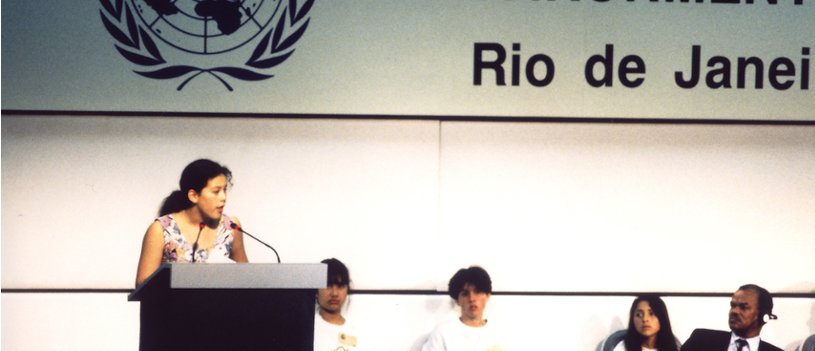
Severn Cullis-Suzuki addressing Earth Summit in Rio, June 1992

Next Election or Next Generation?
By Nalaka Gunawardene in Rio de Janeiro, Brazil

Twenty years ago, a passionate young girl addressed – and challenged – the world leaders gathered at the Earth Summit in Rio de Janeiro, Brazil.

They called it the speech that stopped the world for six minutes. All the platitudes and rhetoric of heads of state are long forgotten, but this speech endures. It has been viewed million of times online.

Her speech was uncluttered and sincere. “I am only a child and I don’t have all the solutions, but I want you to realize neither do you…If you don’t know how to fix it, please stop breaking it!”

Her name was Severn Cullis-Suzuki, and she was 12 years old. The young Canadian environmental activist closed a Plenary Session with her powerful speech that received a standing ovation.

Raised in Vancouver and Toronto, Severn is the daughter of writer Tara Elizabeth Cullis and environmental activist turned TV personality David Suzuki. When she was 9, she started the Environmental Children’s Organization (ECO), a small group of children committed to learning and teaching other kids about environmental issues.

They did various local projects and in 1992, raised enough money to go to the Rio Earth Summit. Their wanted to remind the world leaders that the future of all children – indeed, all future generations – were going to be impacted by decisions made at the Summit.

Listen to the memorable speech at the Earth Summit by Severn Cullis-Suzuki:

Two decades on, another young girl from the Asia Pacific earned her chance to address Rio+20, the follow up to the original Summit, this time with the theme ‘The Future We Want’

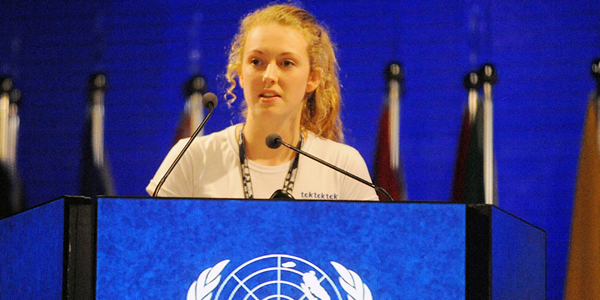
As it opened on the morning of 20 June 2012, Brittany Trilford, a 17-year-old school girl from New Zealand, spoke truth to power.

Brittany Trilford at Rio+20 conference on 20 June 2012

Addressing over 130 heads of state from around the world, assembled in Rio Centro conference centre, she said: “Please ask yourselves why you are here. Are you here to save face? Or are you here to save us?”

Brittany won an international competition to earn her five minutes of fame. The ‘Date with History Contest’ was a global online search for a person under 30 to represent youth and future generations at Rio+20.

Organised by the Global Campaign for Climate Action, Climate Nexus and the Natural Resources Defence Council (NRDC), contest participants were asked to upload a 2 to 3 minute short video speech about the future they wanted.

After entries closed in early May 2012, online voting was allowed for 22 finalists – which included at least 3 from each region of the world. The final winner was chosen by an international panel that included environmentalists, UN officials and celebrities such as actor Leonardo DiCaprio.

Brittany Trilford addresses world leaders at the UN Earth Summit

Brittany is a final year student attending school in Wellington, New Zealand. In her winning entry, she wished for more innovation and imagination.

“One solution would be to change our education system to embrace creativity and innovation. To tackle our problems there are definitely out there. Our leaders have to listen, be open-minded and persistent enough to give these ideas a chance,” she said.

As she ended the speech: “I want a future where education encourages innovative thinking, creativity and entrepreneurship. I want a future where we run with natural processes and not against them. I want a future where leaders will stop talking and start acting. I want a future where leaders lead.”

Her video was filmed at home with basic camera equipment. As she explained, “I entered to show solidarity with youth around the world, demanding that our leaders remember we are all their children and they owe us a fighting chance at a future we want to inherit.”

In a poignant media event hours before the Summit opened, the star of 1992 Severn Cullis-Suzuki joined the winner of 2012, Brittany Trilford.

Severn is now a writer and activist on culture and environmental issues, as well as the mother of two young boys.

“I have grown up a lot these 20 years but those six minutes of speaking to the UN two decades ago remains the most powerful thing I have ever done in my life to affect people,” she said wistfully.

Shortly after arriving in Rio – her first time since 1992 – Severn addressed a group of young delegates working with Green Cross International, the global environmental group created by Mikhail Gorbachev.

Severn’s message today remains the same, but now she also thinks about the future of her own children. She returned to Rio on their behalf to appeal for solutions to issues like global climate change which she called an “inter-generational crime”.

The world’s children have spoken loud and clear, twice over. But will they be heard by the world’s governments – preoccupied with multiple crises and more concerned about staying on in office.

Will the next generation prevail over the next election?

Don’t Be a Fossil Fool: A case for valuing Biotic Carbon in climate talks

Cartoon courtesy Down to Earth magazine, CSE India

• To tackle enhanced global warming that leads to climate change, we need to better understand the global carbon cycle.

• Critical to this understanding is distinguishing between fossil carbon (coal and petroleum) and biotic carbon (photosynthetic biomass – living matter capable of absorbing atmospheric carbon).

• Biotic Carbon offers a ‘lifeboat’ to a world in search of solutions. Valuing biotic carbon can transform the role of farmers and rural communities currently sidelined in global climate change negotiations.

• Current methodologies of carbon trading have seriously warped both economics and ecology. What takes place today is more like carbon laundering.

These outspoken views are expressed in a new web video by Dr Ranil Senanayake, a globally experienced systems ecologist with four decades of experience across Asia, Africa and Latin America.

Titled “Rethinking Carbon and Climate Change”, the 16 minute video is released on TVE Asia Pacific’s YouTube channel in time for World Environment Day 2012 and ahead of the UN Conference on Sustainable Development, or Rio+20 in Brazil.

This is edited from a long interview I filmed with the maverick scientist in mid March 2012.

Watch the full film online:

This film is released under Creative Commons Attribution-NonCommercial-ShareAlike 3.0 license.

Read Q&A style interview on Groundviews (covers much else):
Sri Lanka’s Fast-track to Post-war Development: Remember the Mahaweli’s Costly Lessons!

How can scientists use web videos to communicate climate science?

Let’s face it: not every scientist is a potential David Attenborough, David Suzuki or Carl Sagan. Such supernovae are rare in any field.

But in this digital age, most scientists can use online platforms and simple digital tools to communicate directly with the public and/or policy makers. At least some scientists try to tap this potential — and we are grateful.

The World Resources Institute (WRI), a respected non-profit research and advocacy group, is currently trying to understand “how recent climate science discoveries can best be communicated via video”.

With support from Google, and with the help of three climate scientists, WRI has recently produced 3 different video types in order to test which works best. They are currently on display on their website, with a request for readers to vote and comment:

1. “A webcam talk” uses a self-recorded video of the scientist discussing his findings

2. “A conversation” uses a slideshow with a voiceover of the scientist discussing his findings

3. “A whiteboard talk” is a professionally shot video of the scientist in front of whiteboard discussing his findings

Here is the comment I submitted: the challenges WRI face are common and widely shared. And I do have some experience covering climate and other complex science and environmental stories across Asia for the visual and print media.

First, thanks for asking — and for exploring best public engagement method, which most technical experts and their organisations don’t bother to do.

Second, Andy Dessler comes across as an eager expert — not all scientists are! Some are visibly condescending and disdainful in doing ‘public’ talks that they immediately put off non-technical audiences.

Third, the options you’ve presented above are NOT mutually exclusive. For best results, you can mix them.

Webcam method is helpful, but people don’t want to see any talking head for more than a few seconds at a time. They want to see WHO is talking, and also WHAT is being talked about. The images in Conversation method come in here.

I realise webcams are usually set up inside buildings, but visually speaking the more interesting backdrops are in the open. In this case, if Andy Dessler were to record his remarks outdoors, on a clear and sunny day with some clouds in the far background sky, that would have been great!

I’m personally less convinced about Whiteboard Talk: many in your audience probably don’t want to be lectured to, or be reminded of college days. I would avoid that.

More about my work at http://www.tveap.org/

Battle of Ceylon: 70 years on, still waiting for its place in the movies…

Memories of Battle of Ceylon, April 1942
While human memories fade and disappear, photographs and films help preserve moments of history – either as factual documentation, or as fictionalised stories.

The Battle of Ceylon, or the Easter Sunday Japanese air raid of Ceylon took place 70 years ago this week. There can’t be too many people who have personal memories of that eventful day, 5 April 1942.

The definitive feature film about this facet of WW2 remains to be made. This blog post explores what (little) that is available online.

The attack on Colombo Harbour and the nearby Ratmalana Airport took place exactly 119 days after the Pearl Harbour attack in Hawaii. In that relatively short time, the Japanese military had advanced westwards in the Indian Ocean with astonishing speed and success.

When Singapore fell in February 1942, it was widely believed that the next Japanese target was Ceylon. Once their battleships, aircraft carriers and submarines were based in Ceylon, their domination over the Indian Ocean would be consolidated.

If the Allies read Japanese intentions correctly, they completely underestimated their adversary’s capabilities. Lack – or deliberate blocking – of information had characterised the build up of Japanese military capabilities for years.

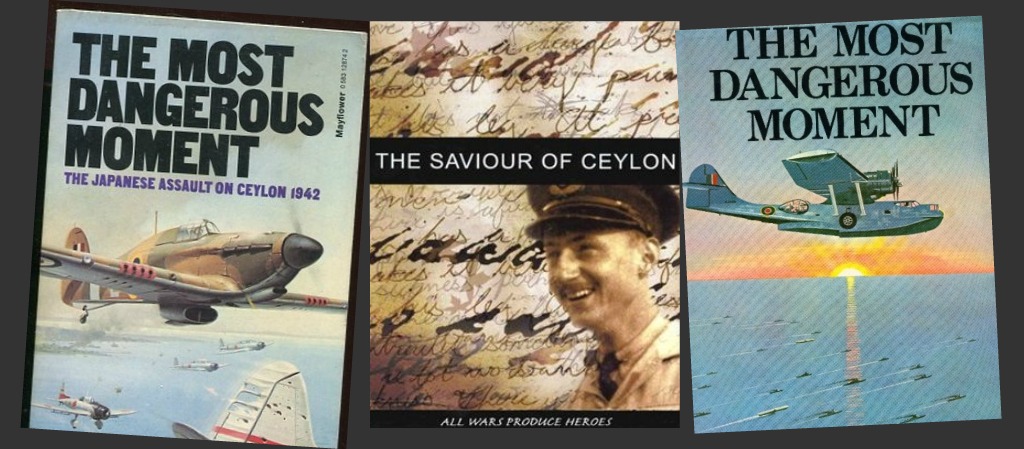
Michael Tomlinson, an Englishman who was posted in Ceylon with the Royal Air Force in 1942, later wrote the definitive book about those fateful days and weeks. Its title, The Most Dangerous Moment, was derived from a remark by British Prime Minister Sir Winston Churchill.

Looking back later, Churchill said the most dangerous moment of the Second World War, and the moment that caused him the most alarm, was when the formidable Japanese fleet was approaching Ceylon.

As it turned out, the Japanese fleet that mounted the air raid on Ceylon was under the command of Admiral Chuichi Nagumo, who, as commander of the First Air Fleet of the Imperial Japanese Navy, had earlier overseen the devastating attack on Pearl Harbour on 7 December 1941.

As Tomlinson has written, “True the [Pearl Harbour] attack was unleashed without a declaration of war and has thus been stamped as an act of infamy, though the Americans had very solid reasons for expecting it and the enormous surprise which the Japanese managed to achieve over the Americans was quite unexpected by their own flyers. Sadly enough when these same airmen, almost man for man the same, were to attack targets in Ceylon four months later, the British, though having extremely accurate and complete intelligence of the Japanese intentions and movements, were taken only a little less by surprise than were the Americans at Hawaii.”

Things didn’t start off that way. The island’s civilian administrators and British military high command had initiated preparations and precautions. These included building several new airstrips, and placing RAF squadrons on the island.

Operating from the Koggala lagoon, on the island’s southern top, Allied airmen conducted aerial patrols of the Indian Ocean using long-range Catalina aircraft – multipurpose ‘flying boats’.

With no satellites in orbit (the Space Age had not yet dawned), and radar still in its infancy, these ‘eyes in the air’ offered crucial surveillance. And the vigilance paid off.

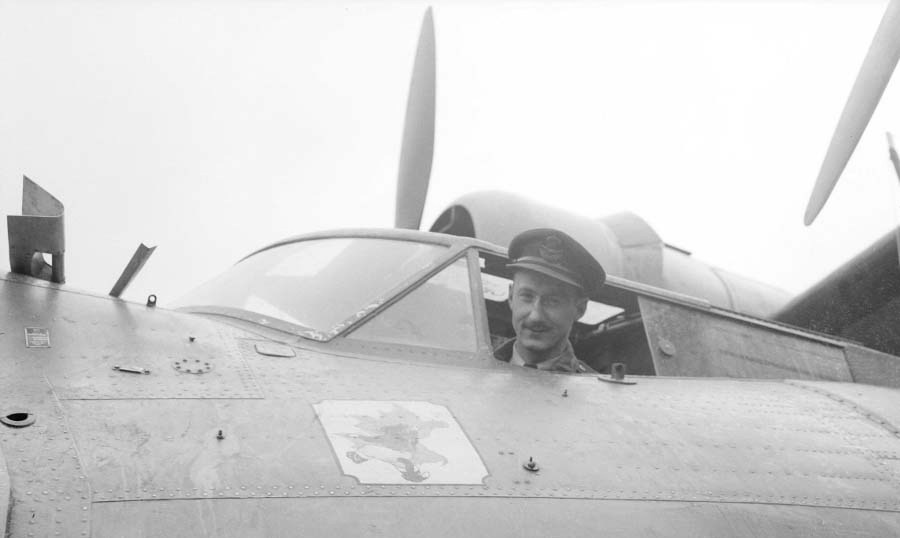
Sq Ldr Leonard Birchall, 'Saviour of Ceylon' aboard his Catalina aircraft

On the evening of 4 April 1942, just before dusk, one Catalina on patrol made a chance observation that changed the course of history. As they were about to turn back, Leonard Birchall, a young Squadron Leader of the Royal Canadian Air Force (RCAF), saw a ‘black speck’ in the Indian Ocean. Upon investigation, they discovered a Japanese aircraft carrier fleet, at the time 400 miles (640km) south of the island.

As the Catalina’s crew took a closer look, its radio operator radioed to Colombo the location, composition, course and estimated speed of the advancing fleet. Moments later, they were shot down by Zero fighters: Birchall and crew mates spent the rest of the War as Japanese prisoners.

The message reached Colombo “a little garbled but essential correct” and immediately passed on to all the Services. But what happened thereafter shows that an early warning by itself serves little purpose unless it is properly acted upon.

I have just written a column on how and why:
Near-misses in the ‘Battle of Ceylon’ (Japanese Air Raid on 5 April 1942)

“Failure in communications all around was to bring tragic results in its wake,” says Tomlinson. “Afterwards, there was even talk about sabotage, but this cannot be taken seriously.”

The Easter Sunday Raid, or the Battle of Ceylon, is well documented. Much to the surprise and disappointment of the Japanese, the Allied naval fleet had been moved out of the Colombo harbour. Another Pearl Harbour was thus avoided.

The Colombo air raid lasted some 20 minutes, and the civilian casualties amounted to 85 dead and 77 injured. The British claimed destroying “27 enemy aircraft” that morning, but the Japanese admitted losing only five. Tomlinson speculates that some damaged aircraft never managed the long flight back.

According to him, only three Japanese planes fell on Ceylonese soil: one each in Horana, on the playground of St Thomas’s College in Mount Lavinia and at Pita Kotte junction.

Hailing from this last area, an eastern suburb of Colombo, I had family elders who actually witnessed the incident. As a schoolboy, I used to walk past that crash site every week day.

Indian Ocean raid April 1942

On April 9, the Japanese bombed Trincomalee harbour on Ceylon’s east coast and also attacked British ships off Batticaloa. The strategic damage was greater, but somehow the defences held. Owing to a combination of factors, the Japanese never returned.

Close to a thousand Allied servicemen lost their lives defending Ceylon that week. But Leonard Birchall survived the notorious Japanese prison camps. Decorated and hailed as the ‘Saviour of Ceylon’, he died in September 2004 aged 89.

A few years ago, Norflicks Productions, a Toronto-based video company, produced a historical documentary about his life. Titled THE SAVIOUR OF CEYLON: The Story of Leonard Birchall (92 mins), it was directed by Marta Nielsen. Producer and Scriptwriter was Richard Nielsen.

See trailer online:

While Pearl Harbour attack and aftermath has been the basis of many documentaries and feature films, the Battle of Ceylon is still under-represented in moving images

While researching for my Sunday column, I stumbled upon two other interesting short video clips on this aspect the Second World War.

They are both evidently computer-generated scenarios, but seemingly well made. Despite some minor historical inaccuracies, they illustrate the rich story-telling potential of this vignette of history, largely overlooked by movie makers.

Easter Sunday Raid: The Battle of Ceylon. Prelude

Battle Of Ceylon

I recently tracked down their creator, Bob Baeyens, who goes by the online moniker Skinny. He says the two clips were made using IL-2 Sturmovik, a World War II combat flight simulator video game that focused on the air battles of the Eastern Front. Here is my brief email exchange with him a few days ago (slightly edited for clarity):

What made you choose the Battle of Ceylon?

We were always looking for (historical) scenarios to create multiplayer missions. Since the game is over 12 years old now, most theaters were covered pretty well, so I bumped in to this one searching for something new — and decided to try making a movie about it as it’s a rather compelling story.”

Do you have a personal link to Ceylon, WW2 or aviation?

No, no and a small one. I used to be a glider pilot.

Why hasn’t anything further happened with Battle of Ceylon film?

The whole jeep/battlefields things must have looked a little weird to you. That’s because its actually a critique and (an) inside joke. I couldn’t get my squad mates from battlefields (on UK dedicated server) to help out making that movie. I needed a couple of real pilots to fly some scenes, drive jeeps, etc. The a.i. in the game made it hard too to make them without human pilots. But I was getting no response or help, so I finally got frustrated and gave up.

I didn’t quite give up; I “finished” it with a parody and a jab! Hence the words, “Best IL2 movie never made”. See this also:

Do you make films for fun, or for a living?

Fun.

Finally, how may I describe you? Is there a website or blogsite or online intro that I can link to?

No need to describe me. If you want to refer to me, use my online
callsign “Skinny”.

9/11 plus 10: Remembering the WTC Twin Towers from the movies…

In the end, movie memories are all that we are left with.

As we remember the 9/11 tragedy 10 years later, a cool compilation released online last month packs extracts from lots of movies that featured the World Trade Centre Twin Towers.

As the Los Angeles Times noted, Dan Meth — a New York animator and filmmaker who generally works creating humorous videos for the Web — has put together a deceptively simple, deeply moving tribute to the twin towers by creating a montage of their appearances on film.

Twin Tower Movie Cameos 1969 – 2001

The filmmaker says about this creation:
“From 1969 to 2001, the Twin Towers made countless cameos in Hollywood films. Sometimes featured prominently in the foreground, sometimes lurking in the distance. This montage celebrates the towers’ all-too-short film career with songs that capture the passing decades. Man, I miss them.”

Read the story behind this compilation in the Los Angeles Times