Sri Lanka: What killer waves united, killer humans divided again…

Today is the third anniversary of the Indian Ocean tsunami, which left a trail of destruction in many countries in South and Southeast Asia.

Today we remember those who perished and salute those who survived and endured enormous hardships.

We thank everyone everywhere who donated to help, and curse those who plundered or squandered the outcome of that generosity.

As I wrote in my only published verse, When the Waves Came, written on 28 December 2004 – when the disaster’s full impact was dawning on the world:

When the waves came
Roaring and moving mightily,
Unleashing the power of
A million bombs exploding at once,
They didn’t care
And just didn’t discern
Who or what was in their way.

My basic premise was that the killer waves had been a brutal ‘equaliser’ of all men and women. It no longer mattered on which side of law, morality, economics or social class they stood. This was particularly apt for Sri Lanka, a land divided for a quarter of a century by an armed separatist struggle that has hardened fundamentalist positions at both Sinhalese and Tamil ends of our ethnic spectrum. Towards the end of the verse, I noted:

As we in the aftermath tiptoe
Through endless depressing scenes
Of death and utter devastation
Can we tell the difference
Between Sinhala and Tamil,
Or Muslim and Burgher,
Or soldier and rebel
Or policeman and prisoner
Or rich and poor?

For a few days after the tsunami, there was a flicker of hope that the lashing from the seas might finally convince everyone of the complete futility of war. Political cartoonists in Sri Lankan newspapers were among the first to make this point. One cartoon, appearing two days after the disaster, showed a government soldier and Tiger rebel swimming together in the currents, struggling to save their lives. (Indeed, there were some reports of them helping each other in the hour of need.)

The cartoonists and other media commentators asked a common question: what happened to the land, and the dividing border that both sides had fought so hard and long for?

Alas, what Nature proposed we humans (Sri Lankans) disposed. While the tsunami helped usher in a negotiated settlement to the long-drawn armed struggle in Aceh, Indonesia, it only created a temporary lull in the Sri Lankan conflict. As soon as both sides recovered from Nature’s blow, they were back at each others’ throats again. (This contrast has been studied by various groups – see, for example, the summary of a Worldwatch Institute study Beyond Disasters: Creating Opportunities for Peace).

Looking back three years later, all I can say is that the land killer waves temporarily and forcibly united, killer human beings have managed to divide again for petty political, communal and personal gains.
theeban-survived-the-tsunami-but-not-sri-lankas-conflict.jpg

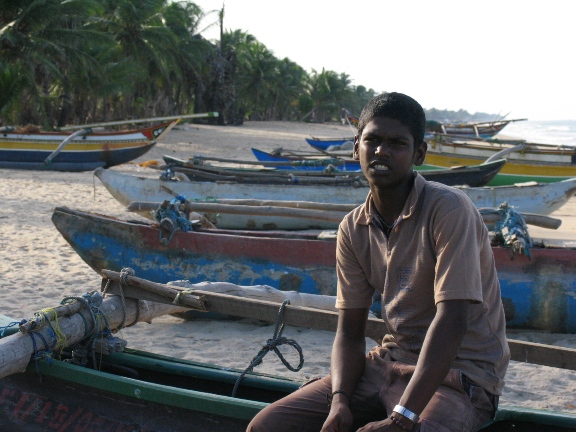
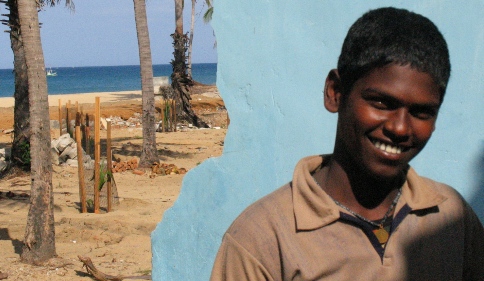
This boy, Thillainayagam Theeban, epitomizes that bigger tragedy. He survived the tsunami — but not the escalation of Sri Lanka’s ethnically driven civil war, which consumed his life in March 2007.

Theeban was one of eight surviving children – from India, Indonesia, Sri Lanka and Thailand – whose remaining families we tracked and filmed for a year in Children of Tsunami media project, a citizens’ media response to the Indian Ocean Tsunami.

Theeban was murdered by unidentified gunmen who stormed into his ‘temporary’ tsunami shelter on 3 March 2007. The death was linked to political violence that has engulfed Sri Lanka since 2006.
theeban.jpg

When the shocking news reached us three days later, our Sri Lankan camera team at Video Image and we at TVE Asia Pacific just couldn’t believe it. We were all in tears, and some of us were also angry. Theeban, who survived the killer waves 26 months earlier (but lost his mom and kid brother in the disaster) suffered many indignities in displacement. And now, he is gone.

We still don’t know who killed Theeban. He was abducted by an armed group sometime in 2006, from whom he escaped in early 2007. It is believed that Theeban was killed as a punishment for running away — and as a warning to all others.

He was 16 years at the time of his death. It is unlikely that his killers would ever face justice.

As I wrote in my personal tribute to Theeban in March 2007, published by UCLA’s Asia Media and MediaHelpingMedia, UK: “The disaster’s Sri Lankan death toll (close to 40,000 dead or missing) shocked the world when it happened within a few hours or days. Yet, at least twice as many people -– most of them unarmed and uninvolved civilians — have been killed in over a quarter century of fighting. That doesn’t always grab headlines.

“Thillainayagam Theeban has become another statistic in a ‘low-intensity conflict’ (as some researchers call it). And while this war lasts, it will continue to consume thousands of other young lives — a grim roll call of Sri Lanka’s Lost Generation.”

The third anniversary of the tsunami is a reminder – if any were needed – that man’s inhumanity to man is often worse than Nature’s fury.

March 2007 blog post: Remembering Theeban

April 2007 blog post: More memories of Theeban

Children of Tsunami: Documenting Asia’s Longest Year

Thillainayagam Theeban (1990 – 2007)

When the Waves Came – the story behind the verse

I am a word-smith. Trained as a journalist and writer, I play with words (and occasionally make an honest living of it ) — but almost all of my published output over more than 20 years has been in prose. Not yet a creative writer (maybe someday!), I write mostly fact-based analysis or opinions.

One rare exception was when the Asian Tsunami struck three years ago in the last week of 2004. Extraordinary situations prompt extraordinary responses – and I went on to write the only verse I have so far published: When the waves came.

I was recovering from chicken pox when the mega-disaster that struck on 26 December 2004. The killer waves spared the Colombo city on the western part of coastal Sri Lanka where I live – and we were extremely lucky. But with close to 40,000 persons dead or missing (which was 1 in 500 of us), it was not a time to heave sighs of relief. We all knew people who were directly affected in one way or another: losing loved ones, suffering property damage, or seeing their jobs go up in the waves.

In the days following the disaster, the entire country was a giant funeral house. For a short while, at least, our utterly divided nation of Lanka was united — first in horror and then in grief.

creating-disaster-resilience-everywhere.jpg

I first heard about the disaster on local television – whose newscasters were struggling to make sense of what was happening. Tsunamis were not known in the Indian Ocean until then, and most people had not even heard of the term. Broadcast journalists had to improve with terms like ‘ferocious wave action’, ‘seas flooding land’ and ‘seas spilling over to coastal areas’, etc.

As the international news media started reporting the extent of devastation from all over South Asia and Southeast Asia, we realised that Sri Lanka was not alone – even though it had been battered very badly.

By Monday 27 December, the scale of the disaster was clearer, and the Sri Lankan death toll was already past 25,000 -– and counting. Search and rescue efforts were now underway, and relief agencies were continually updating their assessments of damage. The grim statistics kept rising by the hour.

The global family first watched in shock — and then started to react. Around the world, hundreds of caring people were dropping everything they had lined up for their Seasonal holidays and rushing to volunteer in Sri Lanka and other disaster hit countries. Inspired by the saturation media coverage, especially on television, caring women and men in far away corners of our planet were donating generously for disaster relief support. Children were breaking open their tills in which they’d carefully saved small change for months or years. Church congregations had special collections. Performing artistes were getting ready to have Tsunami aid concerts. Spurred and partly embarrassed by these citizen actions, governments belatedly started pledging massive volumes of aid. The worldwide response to Asia’s tragedy was deeply moving (the bickering and swindling came later).

My office (TVE Asia Pacific) was closed that week for Seasonal holidays, but I decided to go in and follow the disaster’s news coverage online (I didn’t have ADSL at home then.) Websites were often giving better coverage than TV channels, and the bloggers were rising to the challenge from many locations in impacted Asia.

I spent most of December 27 and 28 in my office. Weakened as I was by chicken pox, I didn’t rush out to help with relief efforts. I knew my limits. Instead, I was emailing regular updates to our friends and partners from many parts of the world who were concerned and anxious about our safety and well-being. Not being a blogger myself then, I was doing it on a one-to-one basis.

I slowly came to terms with a deep anguish that had built up since I first heard the dreadful news. I was badly shaken and numbed by the unfolding human tragedy and humanitarian crisis all around myself. No, I didn’t lose a loved one, or suffer personal property damage, but it was impossible not to be moved by the carnage and destruction all around. And at a scale that was unprecedented in my lifetime.

For hours on 28 December 2004, I watched the ‘doom and gloom’ television news coverage and monitored news updates online. At that stage, with little news yet emerging from Aceh, Indonesia, Sri Lanka had reported the highest death toll and the greatest damage. It was the biggest disaster in the island’s living memory.

When I finally gathered enough sense and wits, I wrote a verse ‘When the waves came’ – it was one way of coming to terms with the calamity. Its basic premise was that the killer waves had been a brutal ‘equaliser’ of all men and women. It no longer mattered on which side of law, morality, economics or social class they stood.

To drive home the point, I sprinkled the words of William Makepeace Thackeray throughout the verse:
“Good or bad, guilty or innocent —
they are all equal now.”

The verse was not meant for publication, and was only privately circulated for a few days. One friend who received it, Bircan Unver in New York, wanted to publish it on her Light Millennium website. After some persuasion, I agreed.

tsunami-survivor-children-return-to-the-sea-in-suduwella-southern-sri-lanka.jpg

I wrote this verse with tears running down both my cheeks. I kept on typing, without wiping my face, as words poured out from my grief-stricken mind. This was the least I could do, as my tribute to everyone who perished or suffered by nature’s incredible fury.

Writing this verse was cathartic for me. Three years after it happened, I can now disclose what followed my writing of this verse: I closed the laptop, sat down on the floor, and completely broke down.

I have no idea for how long I cried: it must have been 20 or 30 minutes. There was no one in the office that day so I didn’t have to subdue myself. Of course, my tears were nowhere near as abundant as those who lost their loved ones to the tsunami. But they were no less sincere.

Looking back, I suspect that during those hours of sorrowful solitude, Children of Tsunami was conceived.

But that’s another story.

Photos courtesy TVE Asia Pacific

Communicating Disasters: Lessons From Titanic to Asian Tsunami by Arthur C Clarke

What do the RMS Titanic, which sank on her maiden voyage in April 1912, and the Asian Tsunami of December 2004 have in common?

Both were maritime disasters and, when they happened, both shook the world as few others did before or since.

And now, Sir Arthur C Clarke has linked the two tragedies that happened 92 years apart: he says they both illustrate how communications failures can compound the impact of a disaster.

Writing a foreword to Communicating Disasters: An Asia Pacific Resource Book (co-edited by myself and Frederick Noronha, and just released), the inventor of the communications satellite revisits the two disasters that left deep impressions in his mind.

communicating-disasters-an-asia-pacific-resource-book-by-tveap-and-undp.jpg sir-arthur-clarke-by-shahidul-alam.jpg

Arthur C Clarke was born five years after the sinking of the ‘unsinkable’ RMS Titanic while on her maiden voyage. His home town Minehead, in Somerset, was not more than a couple of hundred kilometres from Southampton, from where the Titanic set off, he says, adding: “All my life, I have been intrigued by the Titanic disaster.”

He is particularly interested in what happened to the Titanic’s distress call after she hit the iceberg at 11.40 pm on the night of 14 April 1912. “A series of unfortunate factors compounded the disaster. The most ironic among them was that the wireless operator on the Californian, located closest to the Titanic, had shut down for the day just 30 minutes before the first distress call was sent out. Had the Californian been listening, it could have responded hours before the Carpathia, the eventual rescue vessel.”

The Titanic disaster prompted the shipping community to introduce a 24-hour radio watch on all ships at sea. It also consolidated the role of maritime radio in distress signalling and rescue operations.

But, as fate would have it, the absence of a timely warning once again characterised the second disaster to touch Sir Arthur’s life. Arriving 10 days after his 87th birthday, the Asian Tsunami of December 2004 left a massive trail of destruction in his adopted country Sri Lanka and several other countries bordering the Indian Ocean.

He reflects:
“Astonishingly, a full century after the invention of radio, the Tsunami arrived without any public warning. The disaster’s death toll could have been drastically reduced if its occurrence — already known to scientists — was disseminated quickly and effectively to millions of coastal dwellers living on its predictable path. Even a half hour’s notice would have allowed people to run away from the coast, and in many affected locations there was just enough time to get to safety. But alas, that didn’t happen — and tens of thousands perished.

“It was appalling that our sophisticated local and global communications systems completely failed us that fateful day. The communications satellites that I invented, and the global Internet that one of my stories inspired, could have spread the warning, with the hundreds of radio and television channels across coastal Asia amplifying it.

“It is now known that the failures were human, not technological. To ensure better results next time, we need to achieve an optimum mix of technology, management systems and community preparedness — not just for tsunamis, but for many other hazards that we live with. We have to remember that delivering credible early warnings to those who are most at risk is both an art and a science.”

copy-of-tsunamis-legacy-in-southern-sri-lanka.jpg

In his foreword, Sir Arthur sees the Asian Tsunami as a turning point for citizen journalism – ordinary people armed with digital tools bearing witness to unfolding events and then sharing it with others. He writes: “On 26 December 2004, many holiday-makers on affected beaches were armed with video cameras, and it was their ‘amateur’ images that later showed us the full force and fury of the unfolding disaster. Because it was distributed over a large area and occurred during peak holiday season, the Asian Tsunami was probably the most widely filmed disaster in history.”

This was not the first disaster that ‘citizen journalists’ covered, says Sir Arthur, but it marked a turning point in the growing phenomenon enabled by information and communications technologies (ICTs). “The post-Tsunami coverage showed that the professional and amateur divide had now blurred; there is a clear (and complementary) role that each can play.”

ICTs can do much in good times and bad, but as Sir Arthur recalls, the Tsunami also reminded us how disasters can make our information society vulnerable. “When electricity and telephone services — both fixed and mobile – went down in the worst affected areas, a century old technology came to the rescue: amateur radio enthusiasts restored the first communication links with the outside world, sometimes using the Morse Code to economise the power of car batteries.”

He quotes the President of the Radio Society of Sri Lanka as saying, “When all else is dead, short wave is alive.”

Sir Arthur’s perceptive foreword is a sobering counterpoint to the post-tsunami frenzy that we witnessed in the Indian Ocean rim countries. Yes, lacking a tsunami warning system – such as the one Pacific Ocean countries have – is a big gap that needed to be filled. But governments and development donors have rushed into setting up high tech, high cost early warning systems without due consideration for social, cultural and political realities of the intended beneficiary countries.

As we saw with some subsequent undersea quakes – such as the one off the resort town of Pangandaran, Java, on 17 July 2006, and the one off off Bengkulu, Sumatra, on 12 September 2007 – we have yet to achieve the right mix of technology, management systems and community preparedness in most coastal countries in Asia.

Governments, donors and UN agencies would do well do heed the wise words of Sir Arthur Clarke, who concludes his Foreword with these words:

“Communicating disasters — before, during and after they happen — is fraught with many challenges. Today’s ICT tools enable us to be smart and strategic in gathering and disseminating information. But there is no silver bullet that can fix everything. We must never forget how even high tech (and high cost) solutions can fail at critical moments. We can, however, contain these risks by addressing the cultural, sociological and human dimensions — aspects that this book explores in some depth and detail, from the perspective of both media professionals and disaster managers.

“The lessons of history are clear: if we are not careful, we can easily lull ourselves into the same kind of false confidence that doomed the Titanic.”

Read the full text of “Communicating Disasters: A Century of Lessons”, By Sir Arthur C Clarke
communicating-disasters-a-century-of-lessons-by-arthur-c-clarke.pdf

Or download foreword as contained in the printed book

After the Tsunami: Going the Long Last Mile in Sri Lanka

hazlnfo-video-j-a-malani-hambantota.jpg

This is J A Malani. She’s an ordinary Sri Lankan woman living in Hambantota, on the island’s southern coast. Several hundred people in her town perished when the Indian Ocean Tsunami arrived on 26 December 2004 without any public warning. When the waves finally stopped their hammering, close to 40,000 people were dead or missing in the biggest disaster the island nation experienced.

Survivor Malani and her neighbours – lucky to be alive – are naturally apprehensive about when the next disaster might arrive, in what form and from where.

And this time around, too, they worry whether there would be anyone to warn them about it.

There just might be. Since the big tsunami three years ago, several Sri Lankan telecom operators, civil society organisations, IT companies and researchers have come together to test out a community-based hazard warning system — one that would prevent the repetition of the nasty surprise Malani’s community experienced not too long ago.

‘Evaluating Last Mile Hazard Information Dissemination Project’ (HazInfo project for short) was an action research project by LIRNEasia to find out how communication technology and training can be used to safeguard grassroots communities from disasters. It involved Sarvodaya, Sri Lanka’s largest development organisation, and several other partners, and was supported by International Development Research Center (IDRC) of Canada.

The project studied which information and communications technologies (ICTs) and community mobilisation methods could work effectively in disseminating information on hazards faced by coastal communities. The exercise was not confined to tsunamis alone; other rapid onset disasters such as cyclones and floods were also covered.

In its first phase, the project worked in 32 chosen coastal villages (all impacted by the tsunami) and mobilised local communities from muslim, Sinhala and Tamil backgrounds. Malini’s community was among those participating in this field testing of an approach that Sarvodaya hopes to roll out progressively to all 15,000 villages they work in.

That initial engagement by itself was reassuring to Malani. “This has helped us to get rid of fear and hesitation in our minds,” she said in a television interview recorded some weeks ago. “Now we know what we should do when a disaster strikes.”

That peace of mind is priceless to any human being, and that knowledge is liberating – particularly to one who has survived a major disaster that came from nowhere.

Malani is one of several beneficiaries featured in a 12-minute film TVE Asia Pacific recently produced. Several other participants from different coastal locations expressed similar views — and hopes that next time around, they will not be taken unawares.

The Long Last Mile can be viewed on YouTube in two parts:

The Long Last Mile, part 1 of 2:

The Long Last Mile, part 2 of 2:

LIRNEasia researchers analysed how each ICT tool or combination was integrated into communities to deliver timely warnings to those designated as first responders. The factors needed for efficient functioning of the hazard information hub were also studied. Read detailed findings and analysis here.

The HazInfo project grew out of a participatory concept paper that LIRNEasia developed in the aftermath of the 2004 tsunami. It noted that a national early warning system was a ‘pure public good’, and the responsibility of its supply would normally fall on the government. However, the paper acknowledged that, due to lack of capacity, “it is unlikely that the last mile of such a system will be provided by the local government or private firms operating in the marketplace”.

I have written a whole chapter on this project, titled Bridging the Long Last Mile, in Communicating Disasters: An Asia Pacific Resource Book (co-edited by Nalaka Gunawardene and Frederick Noronha). Read that chapter here:

bridging-the-long-last-mile-final-text-formated.pdf

Tsunami Stories: How a film saved lives in Kosgoda, southern Sri Lanka

With the third anniversary of the Asian Tsunami drawing close, we are reliving memories of the mega-disaster that hit many parts of coastal Asia on 26 December 2004.

On 10 October 2007, I wrote the story of Tilly Smith, the 11-year-old English school girl whose geography knowledge helped save hundreds of lives on the Maikhao Beach in Thailand that day.

Here’s another story, which was related by Thyagee de Zoysa, a young Sri Lankan woman who until recently was working as Project Officer of CEE Sri Lanka, a non-profit educational charity that I am associated with.

In January 2007, Thyagee spoke at the European launch of TVE Asia Pacific’s latest environmental television series, The Greenbelt Reports</em>, held in Athens, Greece. There she made a passionate appeal for education and awareness to be put into action.

She drew from her personal experience, having survived the Indian Ocean Tsunami in her native village of Kosgoda in southern Sri Lanka. These are her exact words:

“I, myself, am particularly willing to participate in this project, as I was at my home on the 26th of December 2004, with my parents, until we heard a young man crying ‘Run to the temple, run to the hill, the sea is coming’. We ran — and it saved our lives.
“The young man told me later that he knew that the sea was going to come with full power because of a film that he had seen. A film, which was about a meteorite impact with earth and how a tsunami happens after that. He knew that, if there comes a day when the sea goes back towards the horizon, it then comes back again to take your life.

“It does not matter in what way you create awareness on the environment, be it books, films or the Internet. What matters is that you do it and make somebody understand the possible actions to take up. Believe me, I am grateful to this young man for saving my life and that of my family…”

Neither Thyagee nor the young life-saver could recall the name of the film, but it doesn’t matter. The film left a bit of knowledge in the young man’s mind which surfaced instantly just when it was needed. That helped save lives.

Alas, there were very few Sri Lankans – young or old – who had any idea about tsunamis prior to that fateful Boxing Day 2004.

Writing a foreword to Communicating Disasters: An Asia Pacific Resource Book (co-edited by Nalaka Gunawardene and Frederick Noronha), Sir Arthur C Clarke refers to another rare exception: a retired sailor living in the coastal village of Galbokka recognised the tell-tale signs of the on-coming tsunami and rushed the entire community to safety.

The challenge we still face is to build everybody’s awareness on multiple hazards and what to do when hazards turn into disasters.

Arthur C Clarke 90th Birthday reflections released on YouTube!

We have just uploaded on to TVEAP Films channel on YouTube a new short video, capturing the 90th birthday reflections of Sir Arthur C Clarke.

The world’s best known writer of science fiction, Sir Arthur C Clarke turns 90 on 16 December 2007. Scientific, literary and media communities around the world plan to mark this event.

In this 9 minute video, the visionary writer, explorer and science populariser looks back at his illustrious career spanning nearly 70 years and notes: “Growing up in the 1920s and 1930s, I never expected to see so much happen in the span of a few decades.”

He offers a quick assessment of two sectors where he has left his mark: space travel and communications technology. Ever the optimist, he believes that the best is yet to come in both areas.

“I still can’t quite believe that we’ve just marked the 50th anniversary of the Space Age,” Sir Arthur says. “We’ve accomplished a great deal in that time, but the ‘Golden Age of Space’ is only just beginning.”

Noting that good communications are necessary, but not sufficient, for human progress, he makes a strong plea for tolerance and compassion to achieve greater understanding between peoples and nations. To him, true globalization would require overcoming “our tribal divisions and begin to think and act as if we were one family”.

In the video, which we recorded in Colombo in the first week of December, Sir Arthur mentions three personal wishes – proof of life outside the Earth, clean energy to overcome global warming, and peace in Sri Lanka, his adopted country.

He ends the message indicating his preferred legacy: “I want to be remembered most as a writer – one who entertained readers, and, hopefully, stretched their imagination as well.”

In a technical paper written in 1945, Clarke was the first to propose the idea of communications satellites, which have today become a global industry supporting broadcast and telecommunications needs. One of his short stories inspired the World Wide Web, while another was later expanded to make the movie 2001: A Space Odyssey, which he co-wrote with director Stanley Kubrick. He has lived in Sri Lanka since 1956.

The video was filmed by Video Image (Private) Limited, in collaboration with the non-profit educational media foundation TVE Asia Pacific (TVEAP) — both of which donated their services to this effort.

Read the full text of Sir Arthur’s birthday reflections on TVEAP website

Good communications necessary, but not sufficient, says Arthur C Clarke

Arthur C Clarke’s 90th birthday reflections on TVEAP’s YouTube channel

“Hands up who is poor, speaks English – and looks good on TV!”

“Hands up who is poor, speaks English – and looks good on TV!”

With that title, I opened my panel remarks to the 8th Annual Symposium on Poverty Research in Sri Lanka on the morning of 30 November 2007.

Sri Lanka’s Centre for Poverty Analysis (CEPA) had invited me to speak during a session on ‘Taking it off the page: Alternative mediums of communication to influence change’. The theme of the overall symposium was ‘Communicating research and influencing change’.

Part of my talk was on challenges in using moving images to communicate development related research. The other part was on how most sections of the mainstream media covers stories of the poor — or those living at the bottom of the income pyramid.

I noted that as Asia’s billions strive for a better today and better tomorrow, there are millions of stories at the bottom of the pyramid. But most mainstream media manage to miss these stories due to their ignorance, or arrogance, or both.

But reporting from the bottom of the pyramid need not be all about doom, gloom and alarm. In fact, so much is happening there that a well informed story-teller won’t have much time to spend on negativity (while acknowledging a great deal of suffering that remains).

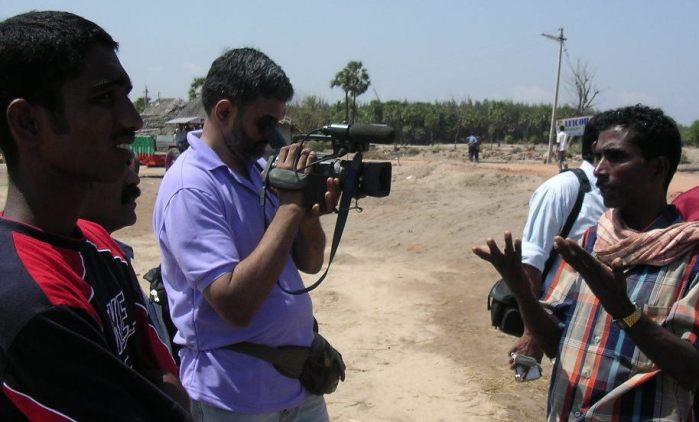
interviewing-tsunami-survivor-in-tamil-nadu-india.jpg

In my remarks, I emphasised that to discover these stories and tell them with empathy and accuracy, we as story-tellers need to recognise a few basic realities:
• The poor are not another species to be treated as if they were endangered! They are living and loving human beings as complex and nuanced as anyone in this room.
• Nor are the poor a ‘sub-human species’ with a simpler set of needs and aspirations. They have as many primary, secondary and tertiary needs – just like anyone else!
• When it comes to information, they have not only survival and practical information needs (which many development projects try to provide), but also what I call ‘information wants’ – cultural and social information – which many development projects completely ignore.
• The poor have opinions too — and are often more articulate and expressive when someone cares to listen and capture these.

So telling media stories from the Bottom of Pyramid needs the knowledge base, socio-cultural understanding and ethical framework in which to gather and process these stories. We at TVE Asia Pacific don’t claim to have got everything right, here are our basic rules of engagement:
• We treat the rich, middle class and poor alike – extending the same courtesy and respect (including obtaining personal clearances for interviews).
• We caption everyone on-screen by name and location, irrespective of their social and economic status.
• We film people – for interviews or generic footage – only with informed consent.
• Wherever possible, we take our the finished TV products back to where they were filmed and share with those who told us their stories. (We are not alone in this: I have written blog posts about Earthcare Films of India and the Brock Initiative of the UK who are also doing this.)

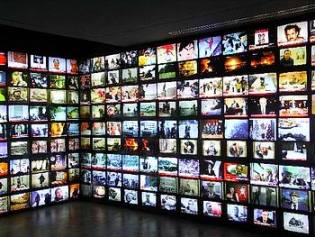
Our industry of broadcast TV is not always known for its class-less treatment of every human being with respect and dignity. In fact, the poor often become ‘Canon-fodder’ for camera crews looking for dramatic images of human suffering.

from-mediachannelorg.jpg from-mediachannelorg.jpg

The globalised media continue to use stereotyped images of the global South – captured mostly by northern photographers and camera crews. As my friend Shahidul Alam, founder of Drik Picture Library in Bangladesh, says: “Invariably, films about the plight of people in developing countries show how desperate and helpless they are…. Wide angle black and white shots, grainy, high contrast images characterise the typical third world helpless victim.”

This explained my title: “Hands up who is poor, speaks English and looks good on TV!” It’s a caricature of how some camera crews go looking for that convenient sound-bite with some doom-and-gloom visuals to match.

But it’s not just the northern media who sensationalise and oversimplify life at the bottom of the pyramid in the South. Many of our own media outlets, rooted in the cities and obsessed with middle class life styles, are also good (or bad) in this game!

And the media are not alone. When development agencies and ‘pro-poor’ activists presume – in their middle class arrogance – that the poor only need survival or sustenance related information, the latter is immediately reduced to sub-human status.

Nov 2005 op ed: Communication rights and communication wrongs


Nov 2006 op ed: Ethical news gathering: Al Jazeera’s biggest challenge

Aug 2007 blog post: Wanted: Ethical sourcing of international TV News

Moving images moving research…beyond academic circles!

Although I’ve dabbled in some media research at times, I don’t think of myself as a researcher. So when Sri Lanka’s Centre for Poverty Analysis (CEPA) invited me to speak at their 8th Annual Symposium on Poverty Research in Sri Lanka, I spoke on what I know a little bit about — communicating research using the audio-visual media.

My panel remarks, delivered on the morning of 30 November 2007, were on ‘alternative mediums of communication to influence change’. I opened with the provocative title “Hands up who is poor, speaks English – and looks good on TV!” (see separate blog post on media related aspects of my talk).

These days, so much of research in physical, biological and social sciences is justified in the name of poverty reduction. Yes, studying and understanding development problems is the essential first step of solving them. But without properly communicating this research, the results won’t help the poor — or anyone else.

We at TVE Asia Pacific are committed to covering Asia’s development issues using TV, video and web. Our small challenge is to capture the many and varied facets of how Asians are working for a better today and better tomorrow. Reducing and eventually eliminating poverty is a significant part of that process.

As Asia’s billions strive for better lives, there are millions of stories at the bottom of the income pyramid. But most mainstream media manage to miss these stories due to their ignorance, or arrogance, or both.

For us, one key source of information and analysis is researchers – people who study trends and conditions, and keep reflecting on how and why. Their knowledge and insights are invaluable for us to tell stories from and about the bottom of the pyramid.

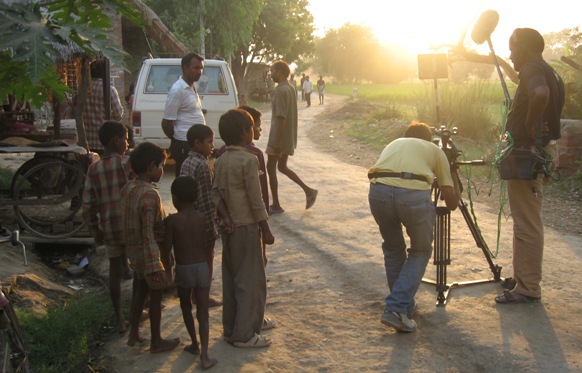
filming-living-labs-in-uttar-pradesh-india.jpg

As I told the researchers in my audience: “Part of our challenge is to know what you are studying — and then figure out the public interest and human interest angles of your work. As communicating research to those outside the scientific or research communities is more an art than a science.”

I cited three recent examples where we had produced engaging TV/video content to communicate research directly relevant or related to the poor.

Digits4Change
was our attempt to understand and document how information and communication technologies (ICTs) are changing the way Asians live, work and play. We covered technologies such as Internet, computers, mobile phones and satellite communications applied in education, healthcare and rural business development. The knowledge base for this 2006 series came from IDRC’s Pan Asia programme which supports action research that addresses specific problems.

Also in 2006, we produced The Greenbelt Reports to take a close look at the environmental lessons of the Indian Ocean tsunami. We visited a dozen locations in India, Indonesia, Sri Lanka and Thailand to find out how community and conservation interests can be balanced in relation to coral reefs, mangroves and sand dunes. In telling these stories, we worked with researchers from global agencies like IUCN the World Conservation Union and UNEP as well as national organisations like the M S Swaminathan Research Foundation in India.

The Greenbelt Reports

Living Labs is our most recent series, released in March 2007. Filmed in 9 countries in Africa, Asia, Europe and Latin America, it looked at how researchers are addressing different aspects of a major challenge in agriculture: how to grow more food with less water. We worked with a global action research project called the CGIAR Challenge Programme on Water and Food, which gave us exclusive access to their on-going field work and emerging findings in nine major river basins of the developing world.

living-labs-by-tveap.jpg

In telling these and other stories, we work within a certain framework we have defined for ourselves. Among its salient points:
• We don’t set out trying to communicate messages; we just want to tell good stories and development communication is a by-product.
• We look for under-reported/ignored development issues, or a less covered angle in a widely reported story.
• We don’t just talk to technical experts but to many other individuals involved or affected – women, men and children from all walks of life.
• We seek and accommodate different points of view, not allowing single-issue activists or one source to dominate/monopolise a story.
• Our finished products are informed by science but never immersed in science – we always keep in mind that our audience is non-specialsits.

All our stories cover real people dealing with real world issues and challenges. And since Asia has more people living in poverty than anywhere else in the world, most of the time our stories concern what’s happening at the bottom of the pyramid – or what can directly impact people living there.

And without exception, all these TV series and individuals films are available free of any license fees for broadcast, civil society and educational use. They are also available for online viewing at TVE Asia Pacific’s channel on YouTube.

Communicating research through moving images is not easy. Packing years of hard work into a few mins of engaging visuals and narration involves ruthless condensation which sometimes leaves some researcher egos bruised. When covering the work of large research organisations, we’ve also had deal with internal politics and hierarchies: for example, what to do when a junior researcher is more authentic and articulate than her supervisor?

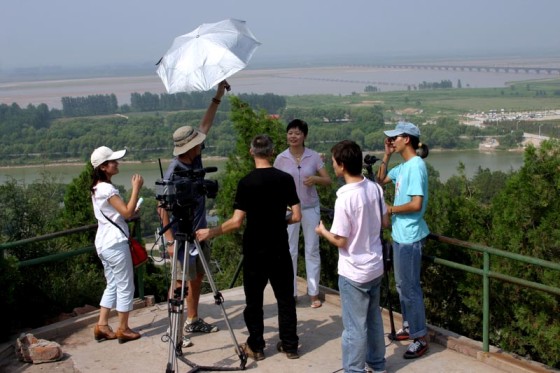
Producing Living Labs based on filming in 9 countries on 3 continents in just 5 months during 2006 was a challenge in both logistics and political negotiations. As editor-in-chief, I had to balance the public accessibility of our end product with researchers’ keenness to pack their stories with facts and figures.

living-labs-being-filmed-in-yellow-river-basin-china.jpg

We didn’t please everyone. One senior researcher told us that his multi-faceted, multi-year nad multi-million dollar was like an elephant — and we’d only glimpsed just one part of that big creature!

That’s just the point: we can never cover the whole elephant in a media product intended for non-specialists. So we choose which part of the elephant is most interesting and present it in a way that will make viewers realise — and hopefully, appreciate — that there’s a lot more that’s worth finding out.

Moving image products often act only as ‘teasers’ — communicating highlights of research, and directing those interested to online or offline sources that offer more information.

Because they act as a/v versions of executive summaries, these ‘teasers’ by themselves are a powerful way of reaching out those who are unlikely to look up the details: that includes many policy makers, government officials and business people.

Winston Churchill used to ask his staff to give him everything ‘on one page’. These days, he might have asked for everything to be summed up in a five minute video — as we often do.

Al Jazeera International: Looking hard for the promised difference

Image courtesy Al Jazeera

This is how Al Jazeera International (AJI), which started broadcasting on 15 November 2006, promoted itself.

In its own words, the 24/7 English language channel set out to ‘balance the information flow from (global) South to North, providing accurate, impartial and objective news for a global audience from a grass roots level, giving voice to different perspectives from under-reported regions around the world.’

Noble ideals, indeed — and we fervently hope they succeed. That’s what I said in my op ed, Ethical Newsgathering: Biggest Challenge for Al Jazeera, published online within days of the new channel going on the air.

I said: “In recent years, the self righteous arrogance and the not-so-subtle biases of BBC and CNN have become increasingly intolerable. But unless it’s very careful and thoughtful, AJI runs the risk of falling into the same cultural and commercial traps that its two older rivals are mired in.

“CNN can’t get out of its US-centric analysis even in its international broadcasts. And the BBC news team is like a hopelessly mixed up teenager: one moment they are deeply British or at least western European; the next moment they are more passionate about Africa than Africans themselves.

“Desperately seeking legitimacy and acceptance, these global channels have sometimes traded in their journalistic integrity for privileged access, exclusives or -– dare we say it? -– to be embedded.”

I admit that I haven’t been watching enough of AJI to come to any firm conclusions. One reason: the new channel is still not widely available in some countries that I visit and spend time in.

But going by what is on their YouTube channel, where some 1,300 video segments have been placed so far (as at 29 August 2007), I have a rough idea of AJI’s first few months of coverage.

I’m looking long and hard for the difference that they so emphatically promised. Instead, I find them a paler version of BBC World, at times trying oh-so-hard to be just like the BBC!

Take, for example, the coverage they have recently done on the bloody and protracted civil war in Sri Lanka. Being where I live and work, I take a particular interest in this topic.

In a 2-part edition of AJI’s People & Power programme, Juliana Ruhfus investigates the impact of Sri Lanka’s civil war.

People & Power: How the East was Won: Part 1 of 2

People & Power: How the East was Won: Part 2 of 2

I don’t have a problem with AJI’s analysis in this documentary, which tries hard to be balanced and fair in what I know is a very difficult subject to cover, with intolerant hardliners on both sides of the conflict.

But I have several issues with how it has been put together – the norms and ethics of their newsgathering.

* A white blond woman, so evidently a parachute journalist, is reporting and presenting the story. Why isn’t an Asian telling this story?

* She is repeatedly mispronouncing all the local names. Just like the BBC does as a matter of routine.

* She gestures, interviews and talks exactly like those know-all reporters from the BBC. At times I detect a faint condescension in her voice, but that may be my imagination.

* For part of the coverage, the intrepid AJI reporter becomes embedded with the Sri Lankan armed forces, and interviews civilians under the watchful eye of military men. This is hardly a credible way of eliciting any honest responses!

* More importantly, she shows little regard for the personal safety of some people she interviews. At one point, she asks three muslim men if the Eastern Province of Sri Lanka is now any safer than before it was ‘liberated’ by the government forces. The men are clearly uncomfortable with this question. Honest answers can cost them dearly. But why should she care? She persists, showing close-ups of these individuals.

* Even when she interviews people who had explicitly asked for concealment of their identity, she leaves tell-tale signs for those identities to be easily guessed. A woman whose teen-aged son has been coerced into joining a paramilitary group is filmed in silhouette — not a good enough cover. Real voices have not been altered through a synthesizer.

These and other observations blur the difference between BBC and AJI in my mind. With a few notable exceptions, most BBC reporters don’t care one bit about the hapless, distressed people whom they interview. All they want is to get a ‘good story’ with dramatic visuals.

AJI is desperately trying to outdo the BBC in all the latter’s wrong aspects. Otherwise why should Juliana Ruhfus try so hard to get a damning comment from an interviewee evidently ill-at-ease of being ambushed by this western woman?

I still want to have an open mind about AJI’s promised difference, and keep hoping that it will emerge sooner rather than later. But this kind of newsgathering and film-making don’t augur well.

If this is the ethical standard of journalism that AJI aspires to, we who had high hopes of their becoming a real alternative to the dominant two are going to be disappointed.

Read my earlier post: Wanted: Ethical sourcing of international TV News

Watch Al Jazeera on YouTube

AJI AJI

HIV/AIDS as a growth industry?

The 8th International Conference on AIDS in Asia and the Pacific, or ICAAP8, is currently being held in my home city Colombo, Sri Lanka, and runs from 19 to 23 August 2007.

As I wrote earlier, some of us who have a track record of communicating on HIV/AIDS have been excluded from this conference by the arrogance of its organisers. And having just read the biography of Sri Lanka’s best known HIV/AIDS activist, I now understand why.

Good books help us experience a range of emotions. A Life in the Round: Desamanya Kamalika, The Girl from Giruwa Pattuwa by Hilary Abeyaratne (WHT Publications, Colombo, 2006) made me outraged and deeply ashamed of the kind of sick society I live in.

Here are some depressing ‘lowlights’ from the book:
* Some medical professionals and para-medics simply refused to treat one of their own kind who was accidentally infected with HIV (fearing infection from casual contact!).
* A leading government hospital carelessly stocked and peddled blood contaminated with HIV. When discovered, it was quickly covered up, and the official investigation was suppressed.
* Some NGOs and charities have turned HIV activism into a self-serving, lucrative industry. There are fierce ‘turf wars’ to claim persons living with HIV as their institutional ‘property’.
* The public health system mandated to care for those living with HIV reinforces stigma and discrimination against such persons.

Image courtesy YouandAIDS Image courtesy YouandAIDS

That’s just for starters. The book packs more shocking details on mass-scale ignorance about basic facts, bureaucratic apathy and a nation in staunch denial about the human immunodeficiency virus.

And we understand why the merchants of misery detested Dr Mrs Kamalika Abeyaratne, who stood up and spoke out for the rights of those living with HIV in Sri Lanka.

She was an extraordinary Sri Lankan woman and a dedicated physician, and the book is her life’s story told by her family and friends. As the cover blurb says: “This is a sad but inspiring account of the joys, sorrows, achievements and disappointments in an all-too-brief but beautiful life, cut short by tragedy and a courageous battle with HIV.”

In 1994, Dr Kamalika was involved in a serious road accident while heading to a rural location where she was to conduct a free medical clinic. While being treated at a government hospital, she was administered HIV-contaminated blood. Media investigations later revealed how intravenous drug users had routinely sold their blood to this hospital, which had few checks in place. This created a major scandal in the public health system — ironically, the very system that she had served for many years.

Dr Kamalika (Kami to her friends) was one of the very few Sri Lankans who openly acknowledged their HIV status. She paid a dear price for this admission: she was shunned and maligned by many members of her own medical community. Undaunted, she spent the last few years of life as an activist campaigning for the rights of persons living with HIV. She waged an almost lone battle for access to anti retroviral (ARV) treatment.

As Sonam Yangchen Rana of UNDP’s Regional HIV and Devlopment Programme has noted: “As a champion for the rights of people living with HIV/AIDS, she had become an icon for PLWHA in the region. Spreading awareness about issues surrounding the epidemic had become the mission of her life. She campaigned vigorously against stigma and discrimination faced by people living with HIV/AIDS and exemplified that PLWHA can lead productive and meaningful lives. productive and meaningful lives.”

And here’s a revealing extract from her biography:
“Paediatrician turned activist, here is the story of Kami’s involvement in the HIV/AIDS campaign. A story that suggests rather wryly that it is not only about People Living with HIV/AIDS (PLWHA), but also about those who have been called People Living off HIV/AIDS (PLOHA). Kami’s own statement on this issue was that the known number of both groups was about the same, with some of the latter, representing some non-governmental organisations (NGOs) or other, living in five-star hotels, driving around in Toyota Land Cruisers, and using up sixty percent of their resources on ‘administrative costs’.”

So now we know why some organisers of ICAAP8 were so defensive and protective of ‘their’ virus: after all, it is their horn of plenty that they cannot share with anyone else. These PLOHA are the mandarins of HIV/AIDS, Incorporated.

On a personal note, I always admired Dr Kamalika but never got to meet her. Our paths almost crossed once in July 2000, when I had helped Panos South Asia to organise a media gatekeepers’ meeting on HIV which she addressed. But the night before, I was struck down by influenza, and didn’t get to participate in what had been a stimulating meeting.

Read Dr Kamalika Abeyaratne: A Profile of Courage, written by my friend Manori Wijesekera in 2003:
dr-kamalika-abeyratne-by-manori-wijesekera.pdf

Read InterPress Service profile on Dr Kamalika Abeyaratne

The Sunday Times (Sri Lanka) review of Kamalika Abeyaratne biography (March 2007)

Read The Sunday Times (Sri Lanka) tribute to Dr Kamalika Abeyaratne, 19 June 2005

Read journalistic coverage of ICAAP8 by Inter Press Service:
IPS Terraviva