Love that Bug: Spinal Beetle completes charity run across South Asia

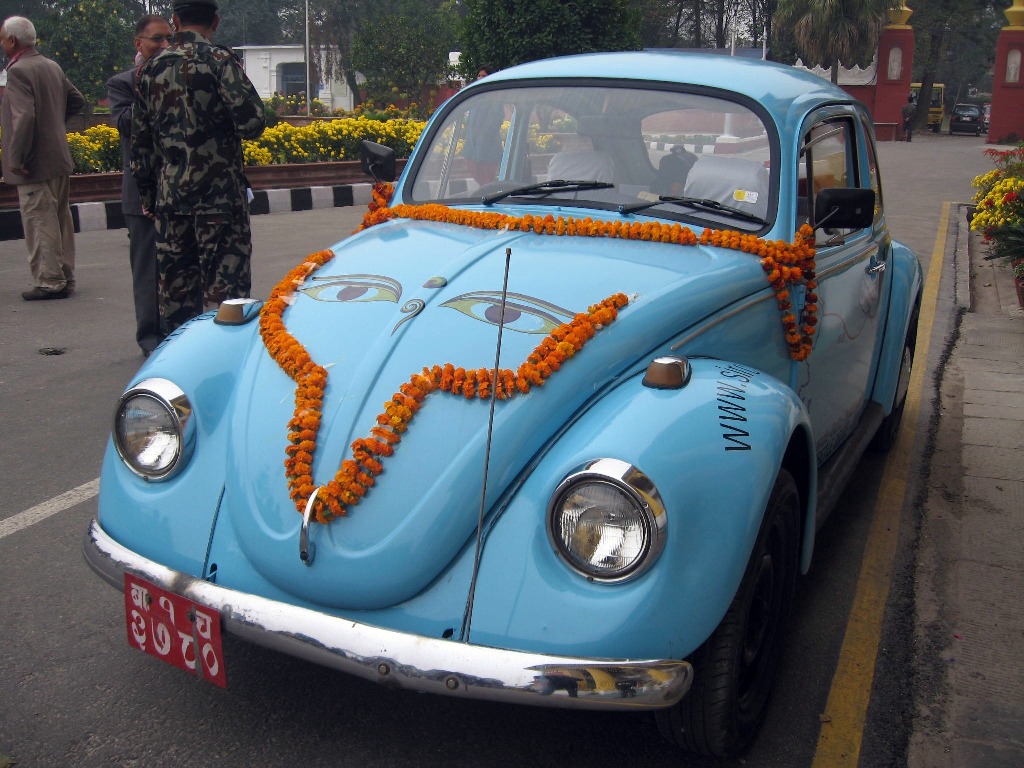
Here's looking at you, people! The Love Bug had only two eyes, but the Spinal Beetle has four. Photo by Nalaka Gunawardene

Deep down in our hearts, we are all Volkswagen Beetle fans: some of us have owned one (my first car was a red bug!), others dream of doing so. The world’s most enduringly popular car design has a particular appeal in South Asia.

And now, South Asian VW Beetle fans have a adorable new mascot. Move over, Disney’s Love Bug (thanks for tons of fun); welcome, Spinal Beetle!

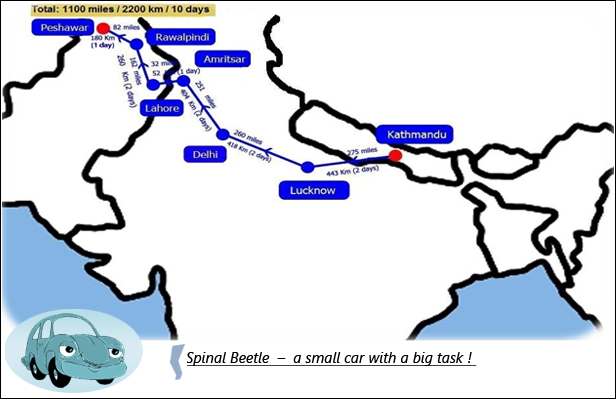
My friend – and hero – Kanak Mani Dixit and his wife Shanta have just completed a 2,200 km (1,100 mile) journey in their nearly 40-year-old Beetle that took them from Kathmandu in Nepal to Peshawar in Pakistan. It was a 12-day, 3-country drive that was to raise funds for spinal injury treatment in Nepal.

By happy coincidence, I was in Kathmandu on 4 Nov 2011 when the President of Nepal waved off Kanak and Shanta on their journey from the President’s House. It was an informal gathering of friends and well-wishers — with none of the pomposity usually associated with heads of state.

So the photos in this post are all mine. The text that follows is from Kanak and his media team:
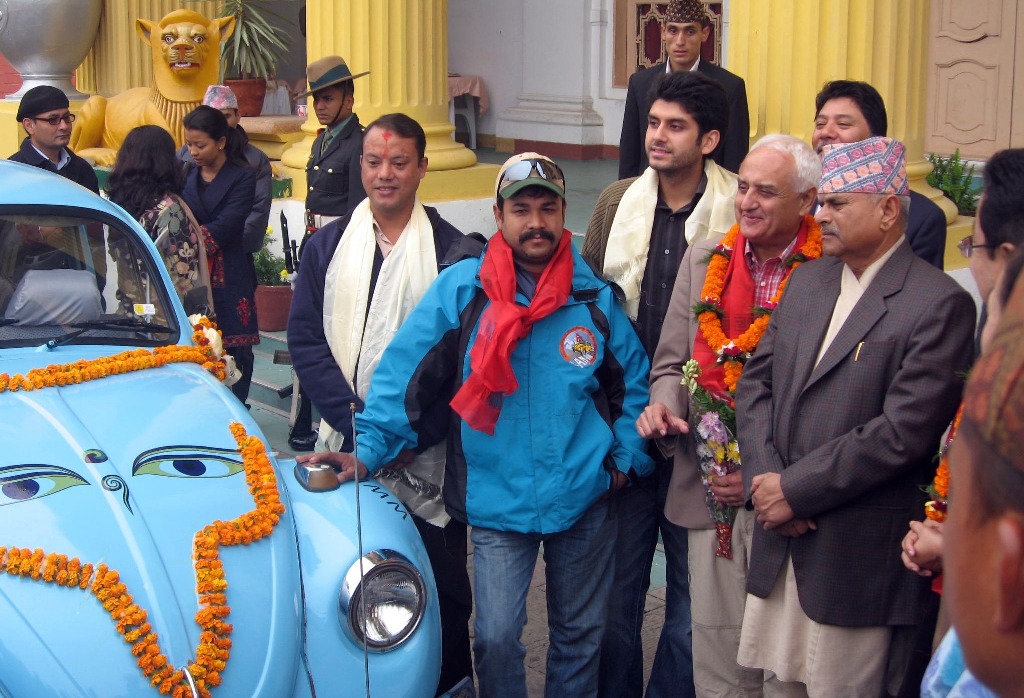
President Ram Baran Yadav about to send off Kanak Mani Dixit and Shanta Dixit on 12-day journey in Spinal Beetle - Photo by Nalaka Gunawardene

The ‘Great Nepal-India-Pakistan Spinal Beetle Drive’ arrived in Peshawar on 16 November, ending a 1100-mile odyssey that took the 1973 VW Beetle from Kathmandu through Lucknow, Agra, Delhi, Amritsar, Lahore, Islamabad and Rawalpindi.

“It was an exhilarating journey across the friendly landmass of Southasia, and I hope a pointer towards easy land-crossings for people from all our countries,” said Dixit. “Most of our journey was along the Grand Trunk Road, built originally by Sher Shah Suri in the 16th century. The 21st century demands that we open this highway for the people, commerce and ideas to flow.”

The journey of the sky-blue Beetle was conducted with three goals of promoting ‘land connectivity’ in Southasia, developing links between spinal injury institutions across the Subcontinent, and raising funds for the Spinal Injury Rehabilitation Centre in Nepal.

“The matter of land connectivity is important because airline links can never provide the mass-level contact that our people and economies deserve. One would want to see the same cacophony at the Atari-Wagah border as at the Nepal-India border of Bhairahawa-Sunauli,” said Dixit.

The trip was helpful in developing linkages between organisations such as the Spinal Centre in Nepal, the Indian Spinal Injuries Centre in Delhi (ISIC), the Mayo Hospital in Lahore, the National Institute for Rehabilitation Medicine in Islamabad, the Armed Forces Institute for Rehabilitation Medicine in Rawalpindi, and the Paraplegic Centre in Peshawar.

As for the goal of raising emergency funds for the Spinal Centre-Nepal in order to cope with sudden rise in demand for its services, Dixit said that a little over half of the USD 110,000 goal had been raised. “We hope to complete our goal through a retroactive campaign because the spinally injured of Nepal badly need support,” he said.

Dixit is a civil rights activist, writer and journalist who injured his spine in a trekking accident a decade ago. The Spinal Centre was started in 2002 and inaugurated by the late Sir Edmund Hillary.
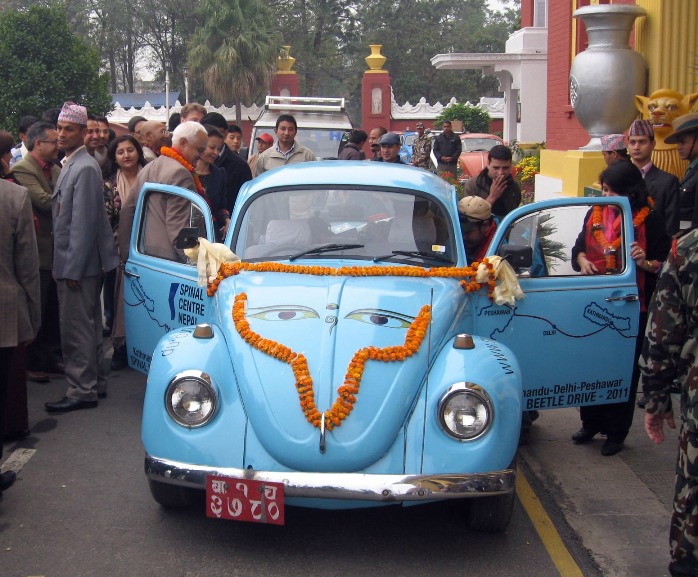
Kanak and Shanta Dixit setting off on their long journey in Spinal Beetle from Sheetal Niwas on 4 Nov 2011 morning - Photo by Nalaka Gunawardene

In the ‘Spinal Beetle’ driven by Dixit, he was accompanied by Shanta Dixit, educator and founding member of the Spinal Centre-Nepal. The back-up car, a Mahindra Bolero, included VW Beetle specialist Naresh Nakarmi, Spinal Centre staff member Suman Khadka and Eelum Dixit, doing videography and photography. Social worker Meera Jyoti is chair of the Spinal Centre-Nepal.

The Spinal Beetle drive was flagged off on 4 November by President Ram Baran Yadav of Nepal. In New Delhi, it was received by Maj. H.P.S. Ahluwalia, founder of ISIC, as well as journalist Kuldip Nayar and actor Om Puri. The physicist and peace activist A.H. Nayyar received the Spinal Beetle at the Wagah-Atari border. Throughout the Southasian drive, the team was graciously hosted by members of the Pakistan-India People’s Forum for Peace and Democracy and other organisations, such as the Indian Doctors for Peace and Development in Agra, and Asha for Education in Lucknow.

Among the many interesting aspects of the trip, from the emotional to the historical, Dixit includes the following:

• The Spinal Beetle team responded to the request of 96-year-old Barkat Singh ‘Pahalwan’ of Jalandhar (Indian Punjab) that some earth be collected from his childhood village of Fatehgarh near Sialkot (Pakistani Punjab). Taking a detour from the GT Road, the team found the place, which had now become an urban suburb of Sialkot, and collected a jarful of agricultural earth for Barkat Singh. (for a picture of Barkat Singh and other images, go to ‘Selected Photographs’ on http://www.sirc.org.np)

• The memory of Sher Shah Suri, the Afghan sultan from present-day Bihar who ruled from Agra, followed the team through much of the route, which he had regularised in the mid-16th century as an administrative and commercial artery. His memory was revived by the ‘kos’ markers along the Delhi-Chandigarh stretch, a neglected postal station outside Wazirabad, the great roadside banyans providing shade to travellers then and now, and the Rohtas Fort on the approach to Rawalpindi.
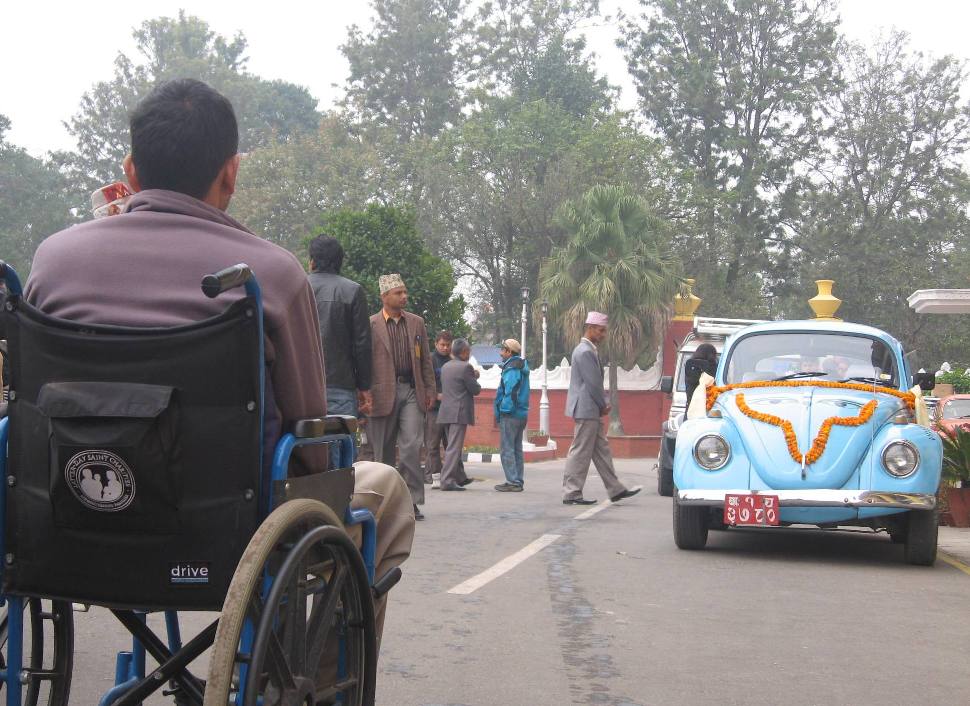
A Nepali on wheelchair watches Spinal Beetle about to depart on a long journey to raise funds for people like him - Photo by Nalaka Gunawardene

• Having started in the Lumbini region of Nepal, where the Buddha was born more than 2,500 years ago, the Spinal Beetle ended its journey in the Gandhar region around Peshawar, a vast centre for Buddhist learning, art and architecture where the Sakyamuni was first etched in human form a few centuries later. In the Potohar Plateau near Islamabad, the Spinal Beetle visited the gigantic Buddhist stupa at the village of Manikyal.

• Arriving in Agra, the Spinal Beetle visited the Taj Mahal on the day of Eid ul-Azha. It arrived in Amritsar and visited Harminder Saheb (the Golden Temple) on the Guru Nanak’s birthday. Passing Gorkha District of Nepal (named after the Gorakhnath temple situated there), the Spinal Beetle traversed Gorakhpur, the base of the Nath sect, and ended its journey in Peshawar where the team visited the Gorakhnath Temple there, opened only a month ago after 60 years of closure. The Delhi-Amritsar leg of the journey was started with a visit to the dargah of Nizamuddin Aulia.

• After watching the mock-militarist show at the Wagah-Atari border between the Indian and Pakistani goose-stepping men in khaki, that very evening the team attended a play on Bhagat Singh and his fight for independence, put on by the Ajoka Theatre of Lahore.

• The Bharatpur government hospital in Chitwan District of Nepal was the first stop of the Spinal Beetle out of Kathmandu. The Bharatpur hospital sought help for setting up a spinal injury rehabilitation unit, which is in line with the Spinal Centre’s belief in decentralising rehabilitation. As a gesture of goodwill for the Nepal-India-Pakistan drive, the hospital committee donated NRs 50,000, which was gratefully received.

• In New Delhi, Maj. H.P.S. Ahluwalia of ISIC suggested that Dixit work to set up a Southasian network for spinal injury rehabilitation, given the specificity of the need. There was an enthusiastic response to this idea throughout the rest of the trip all the way to the Paraplegic Centre in Peshawar.

• At the Mayo Hospital in Lahore, the Medical Superintendent Dr. Zahid Pervaiz and Head of Rehabilitation Medicine Dr. Waseem Iqbal provided information on spinal injury and trauma response that had been developed in Pakistan. They graciously offered four-year full fellowships for two doctors to be sent by the Spinal Centre-Nepal.
Only a Nepali team and a German Bug could get past border babus like this!

• In Islamabad, the Nepal team got specific information on the response to the 2005 earthquake which hit Kashmir and the Hazara division. The team invited Pakistani specialists to Kathmandu to share information on the medical, rescue, social work and humanitarian aspects, so that Nepal would be better able to tackle the mega-tremor that is projected to hit Kathmandu Valley and surrounding areas before long.

• In Islamabad, activist and politician Nafisa Khattak introduced the team to the Melody Theatre, which had served as a staging ground for the sudden rush of victims from the 2005 earthquake. Poignantly, this only cinema hall of the city had been set to torch by a radical mob some years earlier.

• In Agra, members of the Indian Doctors for Peace and Development reminded the team that while there were 8-9 neurosurgeons in the city, there was no rehabilitation centre.

• The Volkswagen Club of Pakistan (VCP) took the Spinal Beetle under its wings in Islamabad and made sure that the car was made ship-shape after the climb up from the Punjab plains. Discussion was started with the club members about organising a VW Beetle rally from Islamabad all the way to Dhaka through India and via Kathmandu, as an exemplary means to develop people-to-people contact in the Subcontinent. This would require cooperation between the VCP, the Association of Nepal’s Beetle Users (ANBUG), the Volkswagen Club of Bangladesh and the Volkswagen Beetle community in India.

• At a meeting organised by the Pakistan-India People’s Forum for Peace and Democracy and the Islamabad Cultural Forum, Dixit spoke on the theme of ‘land connectivity’ in Southasia. “If on an old VW Beetle can do the Kathmandu-to-Peshawar trip with ease, imagine how easy it will be for everyone else.” At this time of geopolitical rapprochement between India, Pakistan and Bangladesh, a special push must be made for land connectivity, he added. “Let a hundred thousand networks bloom across Southasia, in the spectrum from spinal injury to VW Beetles and beyond, to bring the people together.”

More on the Spinal Beetle drive: The sudden rise of the number of patients over the last year has forced the Spinal Centre-Nepal to raise its service from 39 beds to 51. We seek to raise USD 110,000 from the 1,100 mile journey of the Spinal Beetle, at the ‘rate’ of USD 100 per mile from friends and supporters worldwide. By the time the Spinal Beetle arrived at Peshawar on 16 November, a little over half that amount had been raised. The Spinal Beetle Rally is also an effort to raise awareness of spinal injury prevention, rescue, care and rehabilitation in the Subcontinent.

The Spinal Beetle has done the Kathmandu-Dhaka stretch twice, in 2002 and 2005, and touched base at the Centre for the Rehabilitation of the Paralysed (CRP) in Bangladesh. The CRP would be a key institution in the networking of spinal injury rehabilitation institutions that is proposed.
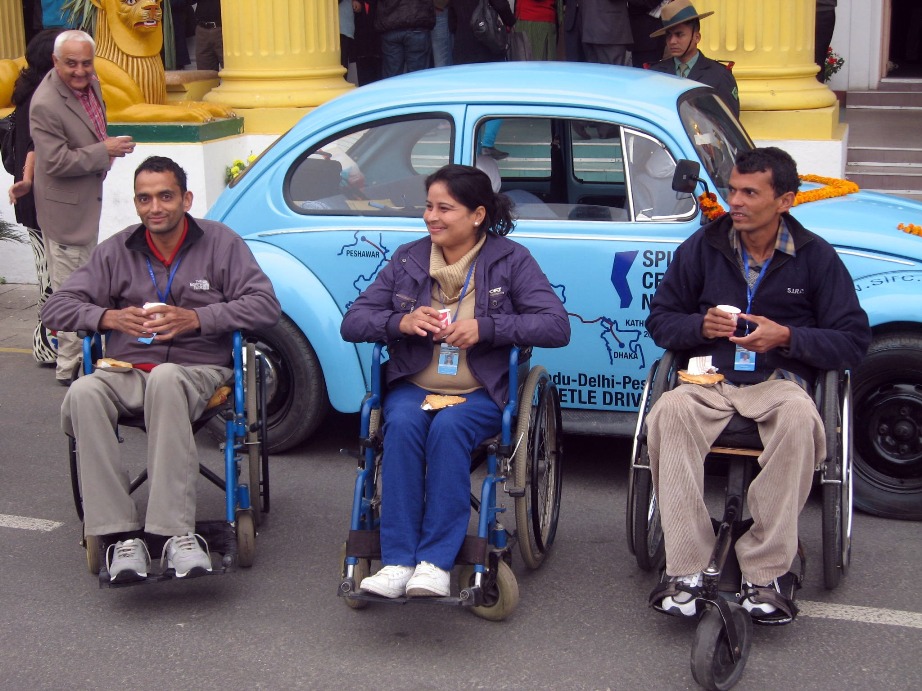
The Spinal Beetle will carry their hopes and dreams across three countries, driven by that small man standing behind - Photo by Nalaka Gunawardene

Sarvodaya Leader A T Ariyaratne at 80: Conscience of a Bruised Nation

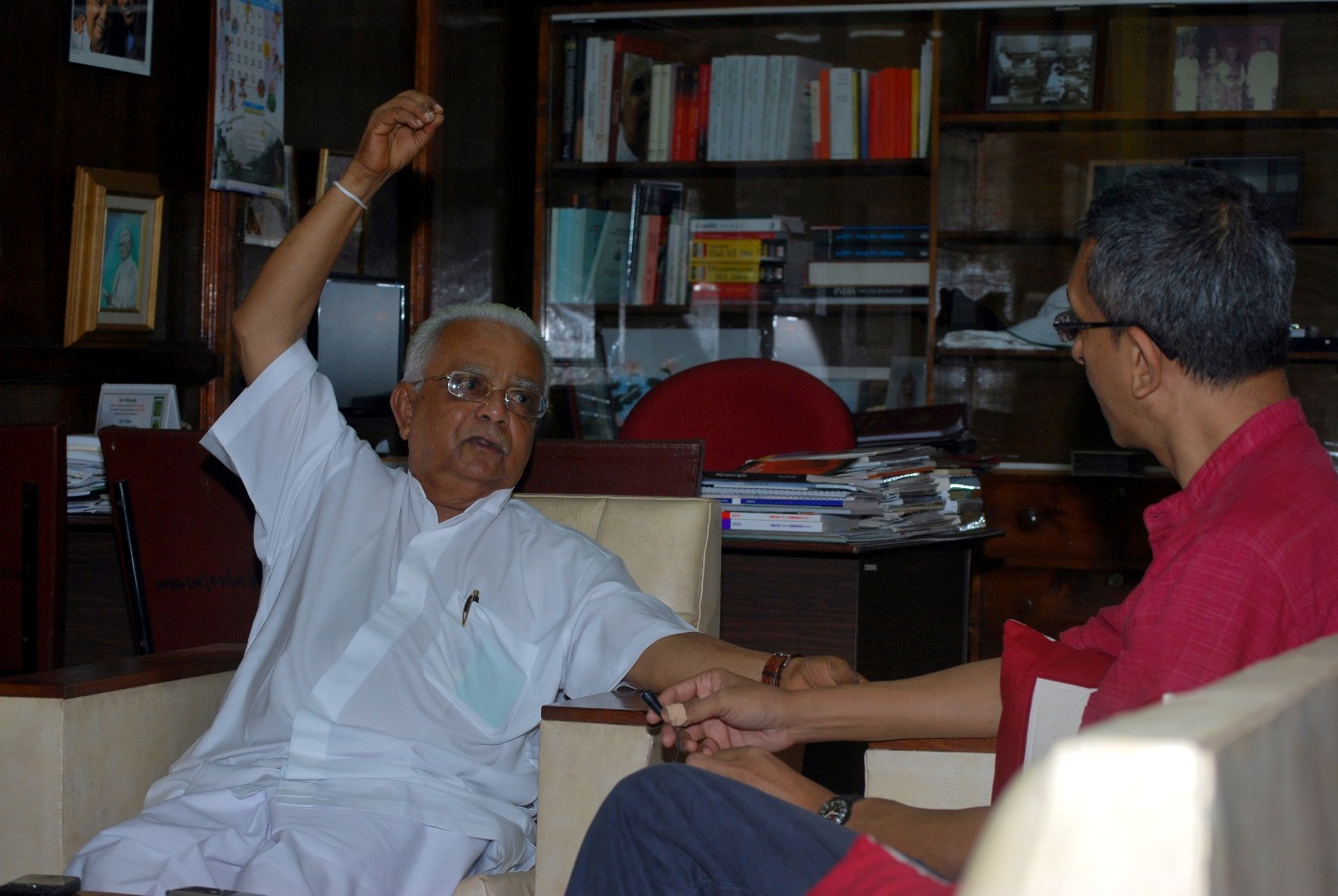
Dr A T Ariyaratne (left) in an expressive moment with Nalaka Gunawardene

When Dr A T Ariyaratne, founder and president of the Sarvodaya Shramadana Movement of Sri Lanka, turned 80 years on 5 November 2011, felicitations poured in from all over the world. This spontaneous act was an indication — if any were needed — of how much and how widely he has touched the lives of millions.

Ari is also our elder statesman of inclusive development. For over half a century, he and Sarvodaya have advocated a nuanced approach to overcoming poverty, illiteracy and various social exclusions. Unlike some die-hard activists, Ari doesn’t ask us to denounce materialism or revert to pre-industrial lifestyles. Instead, he seeks a world without extreme poverty or extreme affluence.

Suddenly, his quest for social justice and equality is resonating all over the world. In fact, Ari has been speaking out for the 99 per cent of less privileged people decades before a movement by that name emerged in the West. In a sense, those occupying Wall Street and other centres of affluence are all children of Sarvodaya.

While Ari shares their moral outrage, his own strategy has been quite different. He didn’t occupy physical spaces in his struggle; he went straight to the fount of all injustice – our minds.

* * * * *

Thus opens my personalised tribute, published on Groundviews.org as Ari of Sarvodaya: Conscience of a Bruised Nation.

In this 2,400-word essay, I salute a hero of mine who continues to speak truth to power, and makes a difference to millions of people in his land and elsewhere. For doing this, he has been ridiculed, harassed and vilified by small minds and the state. He continues undaunted, and shows no sign of slowing down after turning 80.

Here’s another excerpt:

In Ari, we find elements of Mahatma Gandhi (non-violent pursuit of the greater good); the Dalai Lama (interpreting Buddhist philosophy for the modern world); Martin Luther King, Jr. (struggling for the rights and dignity of marginalised people); Nelson Mandela (nurturing democracy and healing society); and Jimmy Carter (globalism with a humanitarian agenda).

“Yet Ari is more than the sum of these noble parts; he is his own unique visionary. And an adroit ‘remixer’ who constantly blends the best of East and West. He adapts our civilisational heritage to tackle the Twenty First Century’s anxieties and uncertainties. Thankfully, though, he doesn’t peddle simplistic solutions to today’s complex problems.

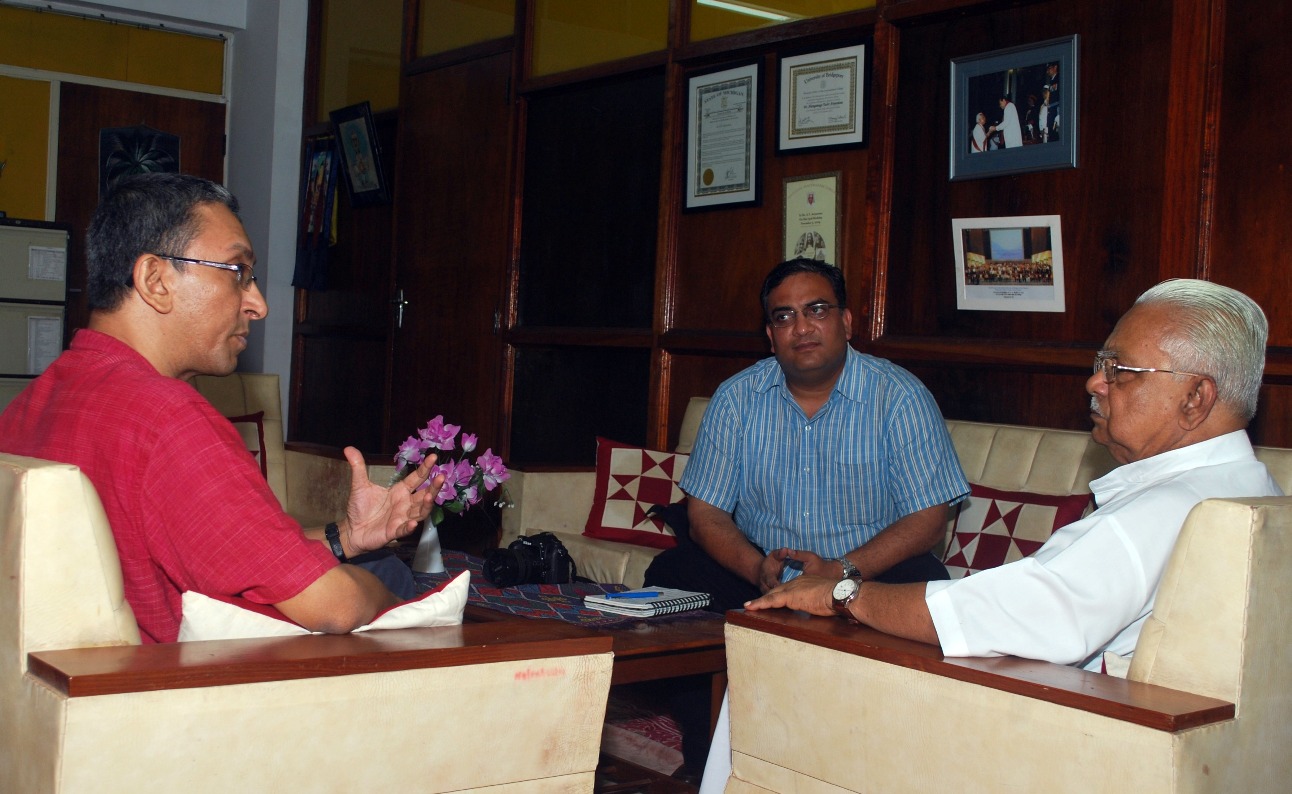
I also recall my first encounter with Ari, in early 1991, when a tyrant leader of Sri Lanka had virtually declared ‘war’ on this unarmed, non-violent small man. I have interviewed him several times since then – the most recent was in March 2011, when I accompanied my journalist friend Aditya Batra from India to talk to Ari (photo, below).

Read the full essay on Groundviews.org: Ari of Sarvodaya: Conscience of a Bruised Nation

Read a compact version of the essay on Light Millennium website (New York)

Read a compact version on Down to Earth magazine (New Delhi): Sri Lanka’s Gandhi Turns 80

L to R - Nalaka Gunawardene, Aditya Batra & Dr A T Ariyaratne of Sarvodaya, March 2011

Wangari Maathai (1940 – 2011): Tree planter, activist, visionary and mother

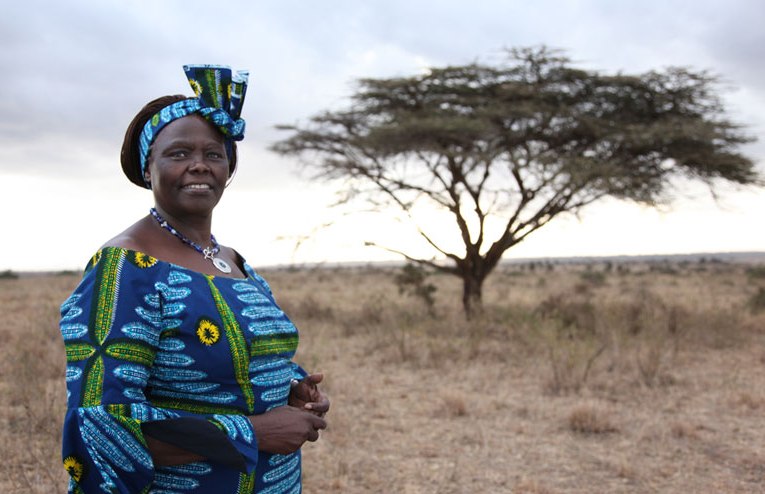
Wangari Muta Maathai (1 April 1940 – 25 September 2011)

“We are very fond of blaming the poor for destroying the environment. But often it is the powerful, including governments, that are responsible.”

That was a typical remark by Wangari Muta Maathai, the Kenyan environmental and political activist who has just died.

In the 1970s, Maathai founded the Green Belt Movement, an environmental non-governmental organisation focused on the planting of trees, environmental conservation, and women’s rights.

In 2004, she became the first African woman to receive the Nobel Peace Prize for “her contribution to sustainable development, democracy and peace.”

The Green Belt Movement in a profile about their founder counted the many roles she played: environmentalist; scientist; parliamentarian; founder of the Green Belt Movement; advocate for social justice, human rights, and democracy; elder; and Nobel Peace Laureate.

“”It is the people who must save the environment. It is the people who must make their leaders change. And we cannot be intimidated. So we must stand up for what we believe in,” Wangari Maathai kept saying.

As a tribute, I have assembled a few links to interesting online videos featuring her.

Taking Root, a long format documentary, tells the dramatic story of Wangari Maathai whose simple act of planting trees grew into a nationwide movement to safeguard the environment, protect human rights, and defend democracy—a movement for which this charismatic woman became an iconic inspiration.

TAKING ROOT: The Vision of Wangari Maathai Trailer on PBS YouTube channel:

Wangari Maathai & The Green Belt Movement, short film by StridesinDevelopment:

Riz Khan’s One on One: Wangari Maathai: Part 1
Interview with Al Jazeera English first broadcast on 19 Jan 2008

“I will be a hummingbird” – Wangari Maathai

Two more memorable quotes from her to inspire us all:

“I have always believed that, no matter how dark the cloud, there is always a thin, silver lining, and that is what we must look for.”

“We cannot tire or give up. We owe it to the present and future generations of all species to rise up and walk!”

BBC Panorama, caught faking child labour footage, returns prestigious TV award

Primark: On the Rack
Two weeks after the BBC admitted that its journalists had partly faked child labour footage in India, the public broadcaster has returned a prestigious television award won by the controversial programme.

BBC had earlier won the Current Affairs Home Prize at the Royal Television Society awards for its show Primark: On The Rack, which was first broadcast on BBC 1 channel in June 2008.

In an internal investigation, the BBC Trust – an independent body which safeguards the values of the publicly funded corporation – found that it ‘more likely than not’ that certain footage in the Panorama programme was not authentic.

The implicated retailer, Primark, criticised the BBC for taking so long to find in its favour when evidence casting doubt on some of the video material has been in the corporation’s possession since before the documentary first aired in 2008.

BBC Panorama claims to be the world’s longest running investigative TV show, and has been on the air for more than 50 years. In that time, it has done some excellent exposures on matters of vital public interest.

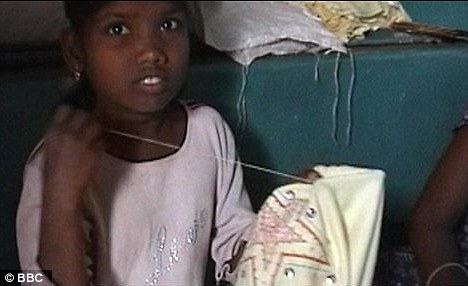
Yet hinting a decline in both editorial and ethical standards at the BBC, the reporting team was found to have taken liberties with certain visuals in this particular programme. It investigated Primark’s claims that it can deliver ‘cheap, fast fashion’ without breaking ethical guidelines, and included footage obtained in a Bangalore workshop of three boys carrying out an activity described in the programme as ‘testing the stitching’ on Primark garments.

According to the Daily Mail: “The BBC Trust’s Editorial Standards Committee examined evidence such as the unedited ‘rushes’ of the programme and emails to the production team from the freelance journalist Dan McDougall, who obtained the footage.”

BBC Trustee and Chair of the ESC Alison Hastings said after their investigations: “The BBC’s investigative journalism is rightly held in very high regard, and for more than fifty years Panorama has made a very significant contribution to that. But great investigative journalism must be based on the highest standards of accuracy, and this programme on Primark failed to meet those standards. While it’s important to recognise that the programme did find evidence elsewhere that Primark was contravening its own ethical guidelines, there were still serious failings in the making of the programme. The Trust would like to apologise on behalf of the BBC to Primark and to the audience at home for this rare lapse in quality.”

Read full report here.

Despite all these developments, the BBC Panorama official web page for this programme shows no indication of this turn of events. Accessed on at 01:30 GMT on 30 June 2011, the page says it was “last updated at 13:31 GMT, Wednesday, 18 June 2008 14:31 UK”. No apology, no correction, no link to the BBC Trust’s report.

The programme’s blurb still reads: “Panorama puts Primark’s claims that it can deliver cheap, fast fashion without breaking ethical guidelines to the test. Posing as industry buyers in India, the programme’s reporter Tom Heap and his team find some of India’s poorest people working long, gruelling hours on Primark clothes in slum workshops and refugee camps.”

So who puts the BBC Panorama to test? Are investigative journalists above the ethics of journalism because their work is hazardous, and is ultimately meant to be in the public interest?

Even Homer nods, and the best intended investigative journalists can – and do – make occasional mistakes. The important question is whether this was a bona fide error in judgement, or does it suggest a trend where the BBC’s investigative journalists and producers arrogantly believe that the end justifies the means?

Many documentaries rely on re-enactments for certain scenes, which are usually labelled as such. Does exposing child labour in supply chains give the license for do-gooding journalists to manipulate individuals and images to suit a preconceived notion of a corporation’s complicity? Could they not have resorted to other means – perhaps with less dramatic visuals, but more honest in their sourcing?

Does this rare admission of error on the part of the BBC also raise questions about the integrity of some other hard-hitting and controversial Panorama investigations over the years which have taken on some big-time targets such as the Vatican, the United Nations Peace Keepers or the CIA?

Hard questions indeed for the usually self-righteous Auntie Beeb.

Resilience 2011: Banging Heads together to make lives better

What does Livelihood Resilience mean to them?

I am at Resilience 2011: Asia Regional Conference on Building Livelihood Resilience in Changing Climate, being held in Kuala Lumpur, Malaysia, from 3 – 5 March 2011. It is jointly organised by Wetlands International-South Asia (WISA), International Development Research Center (IDRC), The Climate and Development Knowledge Network (CDKN), Cordaid and ekgaon technologies

The conference has attracted three dozen researchers, practitioners and policy makers from across the Asia Pacific region, and from different ‘domains’: Disaster Risk Reduction (DRR) and disaster management; Ecosystem services and conservation; and livelihoods and socio-economic development.

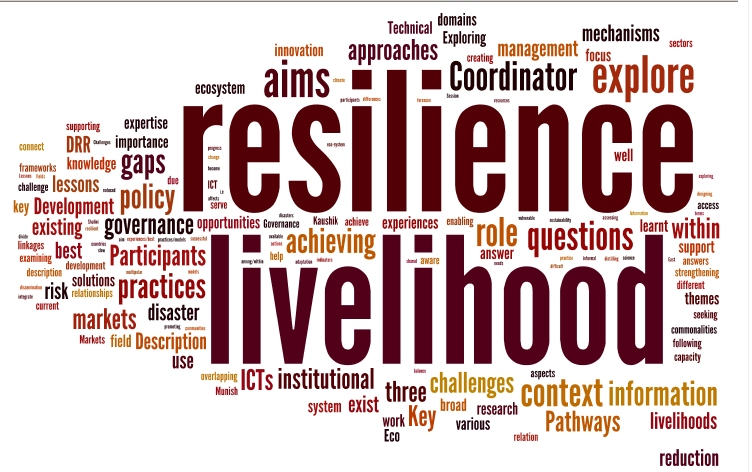
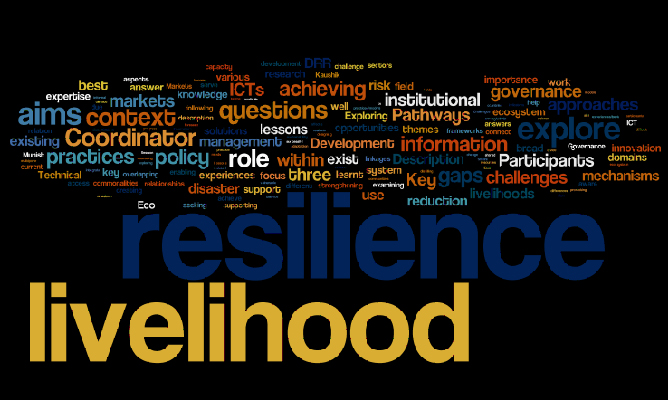
I like hobnob with researchers and activists from whom I learn much. As a science and development communicator, I sit through their often very technical discussions and find ways of relating them to the bigger realities. For a start, I created a word map of the keywords being used in the conference. That gives an idea of concerns at a glance.

I then tried to make sense of the conference introduction note, published on the event website. It looks and reads like the work of a committee, and not the easiest to read and absorb unless one is deep immersed in these areas. Since most of us aren’t, I spent an hour or two rewriting it in my own language. Here it is — my version of what Resilience 2011 conference is trying to accomplish:

Building Livelihood Resilience in Changing Climate Asia Regional Conference
Kuala Lumpur, Malaysia, 3 – 5 March 2011
A layman’s interpretation of the vision, scope and aims of the conference

Asia, home to over 60 per cent of all human beings, is the largest and most diverse geographical region in the world. It is also a region of sharp contrasts and disparities in economic and social development.

Some Asian economies have been growing faster than any other on the planet, and even the global recession has not slowed them down too much. This growth has helped push tens of millions of people out of poverty during the past three decades. Yet, Asia still has the largest number of people living in poverty and food insecurity.

In some respects, gains have been lost. For example, the UN Millennium Development Goals Report for 2010 revealed that the proportion of undernourished Asians has increased recently to levels last seen during the 1990s. Two thirds of the world’s undernourished people live in Asia. At the same time, the natural resources on which food supplies depend – land, water and biodiversity – are degrading rapidly. Food shortages and water scarcities are already being experienced, or anticipated, in many countries.

Growing number and intensity of disasters adds further pressures. According to the international disaster database EM DAT, Asia accounted for nearly half (46 per cent) of the all water related disasters in the world, and 90 per cent of all affected people during 1980 to 2006. During this period, disasters in Asia caused a total of US$ 8 billion worth of economic damage. These disasters impacted disproportionately on the poor and vulnerable sections of society.

Climate change impacts will make this situation worse for everyone, and especially for the poor who already have limited options and ability to adjust to rapid changes. It is now clear that all efforts aimed at reducing poverty and protecting the socially vulnerable groups need to factor in the additional pressures created by changing climate.

To cope with these challenges, we need better understand how livelihoods are threatened, and what strategies can be adopted to improve resilience especially at the grassroots. Researchers and practitioners in natural resource management and poverty reduction are now focusing more and more on the nexus between resources, climate changes and livelihoods.

New ways of looking at the inter-linked challenges have emerged:
• Humanitarian aid workers active on disasters now focus on disaster risk reduction, expanding the scope of risk management to include preparedness and risk reduction.
• Development practitioners working on poverty reduction emphasize on increasing access to various capitals to help address disaster risk and poverty.
• A ‘systems approach’ is being used to look at poverty in broader terms of well-being of people and ecosystem services of Nature.

In addition, researchers and activists emphasize the value of freedoms for participation, economic facilities, social opportunities, transparency guarantees, protective security and ecological security. It is only by ensuring these freedoms that the poor will have a meaningful chance to assert their rights and make their own choices in what they do, and how they do it.

The slowly but steadily warming planet challenges everyone to rethink their conceptual frameworks, and redefine or reconfigure how they work. If there is one thing certain about these uncertain and turbulent times, it is business-as-usual won’t do!

What do we seek to achieve?

Each sector has accumulated a knowledge base, set of best practices and lessons learnt exist within individual domains. Each sector’s theories, approaches and actions within various domains differ on how to make livelihoods more resilient, especially in the often harsh realities of the developing world.

They are all necessary, but not sufficient. Taken individually, no single approach or solution can help make everybody’s livelihoods resilient from the multitude of pressures and impacts. Yet, what one strand cannot withstand on its own, a bundle of strands very likely can: bringing different areas of research, advocacy and practice is the way forward to ensuring better resilience at the grassroots.

This is easier said than done. Both researchers and practitioners have long worked in their own silos or compartments, with occasional nods at each other’s work and periodic exchanges. From this, we need to evolve more integrated framework that brings in the ecologists, disaster managers, social scientists and everyone else who share an interest in making lives better at the grassroots and at the bottom of the income pyramid.

The Kuala Lumpur conference attempts to address this formidable challenge. It will provide a common platform to practitioners and researchers from various ‘domains’ related to livelihoods to work out a shared vision on livelihoods resilience by seeking answers to these questions:
• What are the existing challenges to achieving livelihood resilience?
• What are the gaps in existing livelihood frameworks in relation to disaster, climate change adaptation and conservation in addressing livelihood resilience?
• What are the challenges in scaling up pilot models of Livelihood Resilience?
• How does social adaptation occur in resilience building?

Resilience 2011: Staying Alive on a warming planet – exploring choices

Keywords of sessions at Resilience 2011 Conference: Courtesy Wordle.net

I am in Kuala Lumpur, Malaysia, attending the Resilience 2011: Asia Regional Conference on Building Livelihood Resilience in Changing Climate, being held from 3 – 5 March 2011.

The conference brings together researchers and practitioners from three fields: Disaster Risk Reduction (DRR) and disaster management community; Ecosystem services and conservation community; and the livelihoods and socio-economic development community. Although their work overlap part of the time, they don’t converge too often.

I will blog on different aspects of the conference, trying to connect the dots, and relating the micro to the macro as I often do in my own work communicating development.

There are many issues, topics and discussions under the broad theme of protecting Asian livelihoods from climate change impacts. For a start, I used Wordle to build a word map, displaying proportionate use of keywords in the conference sessions. The above and below are the word clouds it generated (same words, displayed in different modes).

The conference is organised jointly by Wetlands International-South Asia (WISA), International Development Research Center (IDRC), The Climate and Development Knowledge Network (CDKN), Cordaid and ekgaon technologies of India.

How do you measure progress? Say it in 3 min video!

How do you measure progress? Count simply the economic growth numbers? Or something more? Are people in richer countries necessarily happier? If not, what’s the key to real progress that makes people better economically, environmentally and socially?

The Organisation for Economic Co-operation and Development (OECD) wants to hear from young people about these issues through a video competition. To celebrate the OECD’s 50th Anniversary, young people worldwide are invited to create a short video describing their vision of Progress. In 3 mins, or 180 secs. The competition is open to young people (18-25 years) in every country worldwide.

Upload your video on YouTube and register online before MIDNIGHT (Paris time) on 1 March 2011. Details here. Promo video below:

Ray Wijewardene: Passionate voice for small farmers and earthworms

Ray Wijewardene on the set of 'Sri Lanka 2048' TV show, June 2008: Cautiously optimistic about the future...
The small farmers, buffaloes and earthworms all over the world lost a true friend and spokesman this week when Lankan scientist Ray Wijewardene passed away.

Ray packed multiple interests and pursuits into his 86 years of life – including engineering, building and flying light aircraft, and Olympic-level competitive sailing. But he was happiest being a farmer and mechanic, and had strong opinions on the subject. He was vocal about misguided priorities in tropical farming his native Sri Lanka – and across the developing world.

He was especially passionate when speaking about small farmers in the developing world, with whom he worked many years of his international career as an expert on tropical farming systems.

Educated at Cambridge and Harvard universities, and with impeccable technical credentials, he was no stranger to the ways of academia. But he remained a sceptic about the efficacy and benefits of agricultural research — on which hundreds of millions of development funding is invested every year.

The main problem with agricultural research, he used to say, is that those who engaged in such studies and experimentation didn’t have to rely on farming for their sustenance. There was not enough self interest. In contrast, the small farmer had to eke out a meagre existence from whatever land, water and seeds or livestock she had. In her case — and a majority of small farmers around the world today are indeed women — it’s a stark choice of innovate or perish.

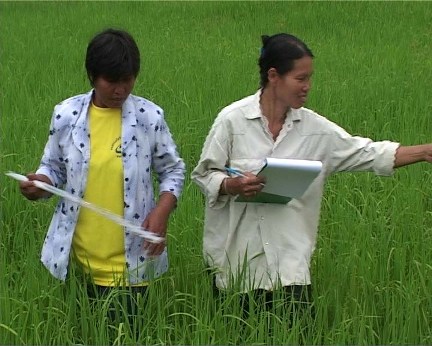
Thai researchers and farmers looking for field solutions (from Living Labs TV series)
The heroic efforts of small farmers were rarely recognised by the rest of humanity who consume their produce — and the farmers themselves are too busy planting crops or raising animals to speak on their own behalf. This is where Ray Wijewardene came in: with his education, exposure and talent, he made an outstanding spokesman for small farmers all over the tropics.

In the 1960s, as the inventor and promoter of the world’s first two-wheeled (Land Master) tractor, Ray travelled all over Asia, Africa and Latin America working with tropical farmers.

For half a century, Ray has championed the lot of the small farmer at national, regional and global levels with UN agencies, academic and research groups, corporate sector and governments. But in later years, he questioned the wisdom of trying to mechanise tropical farming, and considered that phase of his career a ‘big mistake’. He dedicated the rest of his life to researching and promoting ecologically sustainable agriculture, on which he co-wrote an authoritative book in 1984.

Ray had the rare ability to ask piercing questions without antagonizing his audiences. He was an activist in the true sense of the word, but one whose opinions were well informed and grounded in reality, not rhetoric.

This comes through very powerfully in an extensive media interview I did with Ray in 1995, which I released online this week as a tribute to Ray — who has been my mentor and friend for almost 25 years.

At the outset, Ray points out where the Green Revolutionists went astray: “All along in the Green Revolution, its promoters focused on maximizing yields through massive inputs. But they forgot that what the farmer wants is to maximize profits, not necessarily yields!”

We then talked about the particular challenges faced in tropical farming, and the mismatch of temperate farming systems promoted widely in the tropics where climatic and soil conditions are different. One of Ray’s main concerns was agriculture’s profligate use of water – more for weed control than to meet the strict biological needs of crop plants themselves!

Ray, a grandmaster in summing up complex technical issues in colourful terms, said at the time: “Water is rapidly becoming the most expensive herbicide in the world — and freshwater is increasingly scarce!” [A decade later, I would go on to script and executive produce a global TV series called Living Labs on just this issue: how to grow more food with less water, or get more crop per drop.]

Ray wasn’t fundamentally opposed to external, chemical inputs to boost soil fertility but he advocated a mix of natural and synthetic options. In our interview, he asked: “We have multinational companies supporting — directly or indirectly — the extensive use of chemical fertilizers. But who supports cow-dung? Who extols the virtues of the humble earthworm?”

He then added: “For us in Asia, these elements are far more important. Indians have recognized this, but we still haven’t. As long as our agricultural scientists are trained in the western mould of high external input agriculture, this (mindset) won’t change. Cow-dung and earthworms won’t stand a chance – until some western academic suddenly ‘re-discovers’ them…

It was Indian science writer and environmentalist Anil Agarwal who asked me, sometime in mid 1995, to interview Ray for Down to Earth, the science and environmental fortnightly magazine published by his Centre for Science and Environment. As Anil told me, “In Ray, you have not only one of the topmost agricultural experts in the developing world but one of its most original thinkers.”

By this time, I’d known Ray for almost a decade, and been exposed to several of his multiple facets. But each encounter with Ray was enriching for me, so I immediately seized the opportunity. The usually media-shy Ray already knew of and respected Anil, which helped.

Down to Earth is part of Anil Agarwal's legacy
The interview was audio taped over two long sessions, and I remember spending many hours transcribing it. I had to check some references with Ray, who cooperated wonderfully. I’ve been trained to observe the word limit set by editors, but in this instance, I sent in the full length Q&A, for it was so interesting. Down to Earth issue for 31 October 1995 carried a compact version, skillfully distilling the essence of that long exchange between Ray and myself — one of the most memorable interviews among hundreds I’ve done during 25 years of work in print and broadcast media.

How I wish the exchange was also preserved on audio tape! Indeed, it’s a small miracle that the original transcript survived for 15 years. The soft copy was lost in a hard drive crash of 1998, but fortunately I’d taken a full print-out. I’m grateful to a former colleague, Buddhini Ekanayake, for retyping the entire interview in mid 2008 when I considered releasing it in the wake of the global food crisis. That somehow didn’t work out, but the soft copy was ready at hand for me to rush to the editor of Groundviews on the day of Ray’s funeral. All I added was a new, 500-word introduction which tried to sum up the Ray Wijewardene phenomenon.

Read the full length interview with Ray Wijewardene, published for the first time, on Groundviews.org:
Who Speaks for Small Farmers, Earthworms and Cow Dung?

Celebrating Kalpana Sharma, a super-star of good journalism

My friend Kalpana Sharma just stepped down after serving on the Panos South Asia board for over a decade. The Executive Director A S Panneerselvan asked me to write a personalised piece felicitating her. Part of this was read at the annual meeting of the Board held in Dhaka last weekend. Here’s the full essay — a couple of mutual friends who read it say it isn’t too eulogistic! Now you can decide for yourself…

* * * * *

The Curious Ms Sharma of Mumbai

I knew Kalpana Sharma from her by-line long before I met her in person. Now, more than a dozen years after we became friends, she remains an inspiration and a role model.

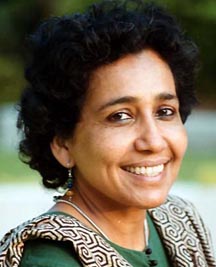
Kalpana Sharma
Kalpana has been a path-finder and trail-blazer in journalism that cares. She has set the gold standard in investigating and critiquing development in the Indian media. Today, she continues her nearly four decades of association with the Indian media as a respected columnist, journalist and writer. Her stock in trade is a mix of curiosity, sense of social justice, wanderlust and a deep passion for people and issues. She is living proof that quality journalism can be pursued even in these turbulent and uncertain times for the mainstream, corporatised media.

Kalpana has been covering the ‘other India’ that is largely ignored by the Indian media. Its denizens are some 456 million people living under the global poverty line of $1.25 per day — a third of the world’s poor. (If they declared independence, they would immediately become the world’s third most populous nation.) Kalpana’s reporting from the ‘Ground Zero’ of many disasters and conflict zones has highlighted the multiple deprivations of these people living on the margins of survival.

For many such communities, a headline-creating event is just the latest episode in their prolonged and silent suffering. The media pack that descends on them after a sudden development can’t seem very different from the assorted politicians who turn up periodically during election campaigns. For too long, the grassroots have been treated merely as a grazing ground for stories or votes.

Kalpana doesn’t hesitate to be part of the media pack when duty calls, but once in the field, she sees connections often missed by other journalists looking for a quick sound byte or dramatic image. Unlike some news hounds, she doesn’t exploit the misery of affected people (“Hands up who’s poor, speaks English – and looks good on TV!”). And she returns to the same locations months or years later to follow up.

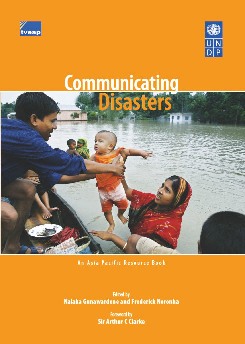
For all these reasons, Kalpana was our first choice to write the last chapter in a regional book on disasters and media that I co-edited with Indian journalist Frederick Noronha in 2007. Her 2,000-word reflective essay should be required reading for any journalist covering disasters and social disparity in South Asia.

Here is a passage that sums up her views on the subject: “Much of disaster reporting sounds and reads the same because the reporters only see what is in front of them, not what lies behind the mounds of rubble, figuratively speaking. What was this region before it became this disaster area? How were social relations between different groups? What was its history? What were its relations with the state government? Was it neglected or was it favoured? How important was it to the politics of the state?”

Kalpana has been asking such probing questions all her professional life. And it’s not just in the rural hinterland of India that Kalpana has travelled extensively listening and talking to people from all walks of life. Living in the world’s second most populous city Mumbai, she has been equally concerned with its burning issues of urban poverty, gender disparity, environmental mismanagement and governance.

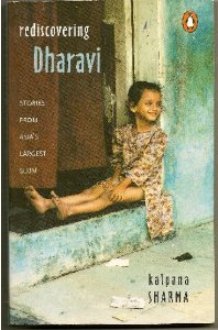
Kalpana once wrote an insightful book about the Dharavi slum in Mumbai, looking at both its social inequalities and the people’s remarkable resilience. Titled Rediscovering Dharavi: Stories from Asia’s largest slum (Penguin, 2000), it was called ‘a model of sane, human, down-to-earth writing’. All this was years before the Oscar-winning movie Slumdog Millionaire (2008) popularised the location through a dramatic tale.

In her quest for untold human stories, Kalpana has taken a particular interest in the plight of poor women. She has written many authentic and moving stories about women who struggle on the margins of the margin. A recurrent theme in her writing is how invisible ‘superwomen’ hold the social fabric together in much of India. Many communities and production systems –ranging from domestic work and child care to waste disposal and farming – would simply grind to a halt if these unseen and unsung women took even a single day off. In reality, of course, they just can’t afford such luxuries.

Kalpana’s column The Other Half, which started in The Indian Express and now appears in The Hindu, is a regular eye-opener. She takes a current topic – from politics, culture, sport or environment — and explores its gender dimensions. She does so by carefully blending facts, personal insights and opinion that makes her writing very different to the rhetorical shrill of gender activists.

Make no mistake: Kalpana is an activist in her own right, and one of the finest in modern India. It’s just that her approach is more subtle, rational and measured – and in the long run, wholly more effective. Long ago, she found how to balance public interest journalism with social activism. This is one more reason why I look up to her.

Partners in crime: Nalaka and Kalpana speaking at the Education for Sustainable Future conference in Ahmedabad, India, January 2005.

In her writing, television appearances and public speaking, Kalpana stays well within the boundaries of good, old-fashioned journalism based on its A, B and C: accuracy, balance and credibility. In my view, she enriches the mix by adding a ‘D’ and ‘E’: depth and empathy. Without these qualities, mere reporting is sterile and dispassionate.

And once we get to know her, we also discover the ‘F’ in Kalpana Sharma: she is a fun-loving, cheerful woman who doesn’t take herself too seriously. We can count on her to be adventurous, enthusiastic and endlessly curious.

Cultivating these attributes would certainly enrich any journalist. I can’t agree more when Kalpana says (in her chapter to a recent book on environmental journalism in South Asia): “Journalists are good or bad, professional or unprofessional. I am not sure if other labels, such as ‘environmental’ or ‘developmental’, ought to be tagged on to journalists.”

I hope Kalpana has no retirement plans. She has earned a break after a dozen years on the Board of Panos South Asia. But we want her to remain a guiding star – a bundle of energy that shines a light into the Darkness, and helps make sense of the tumult and frenzy that surrounds us.

Safe Bottle Lamp: Life-saving bright idea wins World Challenge 2009

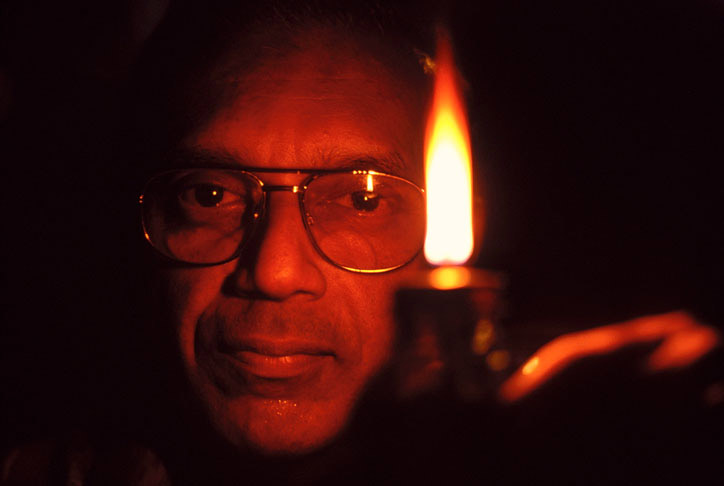
Dr Wijaya Godakumbura holding his invention - Photo courtesy Rolex Awards/Tomas Bertelsen

It’s easy to curse the darkness, and many among us regularly do. Only a few actually try to light even a small candle to fight it. Dr Wijaya Godakumbura of Sri Lanka is one of them – he literally lights lamps, thousands of them, against the darkness of ignorance and poverty.

But his lamps are different, and a great deal safer compared to normal lamps and kerosene, which can start fires risking life and property of users. The design is simple yet effective, inspired in part by the Marmite bottle known the world over: it’s small and squat, with two flat sides – equipped with a safe metal screw cap to hold the wick. It’s quite stable and hard to topple.

Surgeon turned inventor and social activist, Dr Godakumbura founded and runs the Safe Bottle Lamp Foundation which distributes safe, virtually unbreakable kerosene lamps to those who can’t afford electricity. For these untiring efforts that have saved hundreds of lives, the good doctor and his organisation have just been selected the overall global winner in the 5th annual World Challenge awards conducted jointly by BBC World News and Newsweek, together with Shell.

The Safe Bottle Lamp Foundation received a $20,000 grant from Shell to invest in the future of the project. The winner and runners-up were felicitated at an awards ceremony in the City of The Hague on 1 December 2009.

Now in its fifth year, World Challenge 2009 is a global competition aimed at finding projects or small businesses from around the world that have shown enterprise and innovation at a grass roots level. World Challenge is brought to you by BBC World News and Newsweek, in association with Shell, and is about championing and rewarding projects and business which really make a difference.

A record breaking 900 plus nominations were received this year and from these, twelve finalists were chosen by a panel of expert judges. BBC World News viewers and Newsweek readers then selected their favourite from these dozen unique and inspiring entries by casting more than 127,800 votes at http://www.theworldchallenge.co.uk.

Watch short film featuring the Safe Bottle Lamp when it emerged a finalist this year:

Dr Godakumbura and his foundation have been recognised many times before. Notable among these honours is the Rolex Award for Enterprise in 1998. Read Rolex profile about him and his continuing work.

BBC/Shell World Challenge series producer is my former colleague Robert Lamb, who has blazed many new trails in broadcast television and development communication. He specialises in telling complex environmental stories in engaging terms using moving images, and now runs his own independent film production company One Planet Pictures in the UK.

At the beginning of the World Challenge 2009 process, Robert wrote in the producer’s blog: “World Challenge is now in its fifth year. Over that time we have received thousands of nominations. Sadly, we have only been able to film a small selection. But it’s enough to know that there are millions of points of light out there. Watching the news is easy to forget that the vast majority of people go about their lives peacefully and productively.

“Our aim In World Challenge is briefly to bring stories of modest scale sustainable enterprise to the screens. Every year has thrown up big surprises. The diverse ways that ordinary people go about making a living without taxing the Earth’s resources is uplifting. This year we feature the most diverse crop of stories yet…And the really good news is that they are still going strong and proving that ‘sustainable’ is a term with a lot of meaning.”

Read Dr Wiyaya Godakumbura biography

Inventor Godakumbura promotes his safe bottle lamp