Half the sky, most of the suffering…and seeking everyone’s attention!

What’s one of the biggest reasons for suffering from violence?

Is it War? Racism? Extremism?

Or simply being born a woman?

One in 3 women is a victim of violence.

This is the powerful message in this one-minute-long public service announcement (PSA), which can be viewed here:

It was produced by the London-based advertising agency Leo Burnett for UNIFEM, the United Nations Development Fund for Women. With a striking series of images, it reveals that violence against women is one of the most common forms of violence in the world.

This PSA is part of a new global campaign on this scourge.

As UNIFEM says: “Violence against women and girls is a problem of pandemic proportions. At least one out of every three women around the world has been beaten, coerced into sex, or otherwise abused in her lifetime — with the abuser usually someone known to her. Perhaps the most pervasive human rights violation that we know today, it devastates lives, fractures communities, and stalls development.”

The campaign has elements on awareness raising as well as a call to action. The latter includes an online signature campaign that seeks to collect at least 100,000 signatures from those who oppose violence against women.

The online ‘signature book’ opened for signatures on 26 November 2007 with an appeal from actress and UNIFEM Goodwill Ambassador Nicole Kidman. She called the violence many women worldwide face “an appalling human rights violation that can be stopped”, and asked everyone to add their names to a growing number of supporters saying “NO” to violence against women at http://www.saynotoviolence.org.

She added: “The more names we collect, the stronger our case to make ending violence against women a top priority for governments everywhere.”

Watch her appeal on YouTube:

The UN Trust Fund to End Violence against Women , established in 1996, will receive US$ 100,000 from the United Nations Foundation for 100,000 signatures

I have just signed up, on this leap day 29 February 2008. Three months since the campaign was launched in New York, it has so far gathered a little over 58,500 signatures.

It’s certainly commendable – but not nearly enough, and still more than 40,000 needed to reach the modest target of 100,000.

Not that it’s just a numbers game, of course. The quality and sincerity of commitment matter a great deal. At the same time, UNIFEM and other UN agencies trying to engage the public through online interactive methods should study how successful activist groups do the same — with much better and faster results.

Avaaz.org is a leader among these. It is a new global web movement with a simple democratic mission: to close the gap between the world we have, and the world most people everywhere want. Set up in early 2007, it has quickly evolved into online community through which hundreds of thousands of concerned people are taking action together on urgent issues like climate change, poverty, human rights and the crises in the Middle East and Burma.

In October 2007, I joined Avaaz in its signature campaign to focus global attention on the political violence and gross abuse of human rights in Burma. In just four days, thousands of Avaaz members donated over $325,000 online to support the Burmese people’s efforts to peacefully promote political change and tell the world about their struggle.

The Burmese junta may not care for millions of people protesting or donating online, but the leaders of the democratic world – pondering their response to the atrocities in Burma – would find it hard to ignore this surge of public concern.

But it’s a long leap from Burma to the bed room or backyard. A major difficulty faced by those campaigning to focus on violence against women: they are countering actions that are widely distributed, pervasive and sustained over time. Much of it happens at personal and family level, necessarily beyond the public and media’s glare. Incidents flare up only occasionally to spill over to the public space to become news events or talking points.

So, as in many similar instances, out of sight often means out of mind.

The big challenge is how to raise public awareness on a wide-spread issue of violence that happens, to a large extent, in private. The facts and figures are compelling as they are alarming and depressing. The campaigners have lined up some of the biggest celebrities (like Nicole Kidman) and enlisted big guns like UN Secretary General Ban Ki-Moon.

All necessary, but not sufficient.

The campaign needs more than just star power or the UN’s clout to galvanize mass action. For a start, UN agencies need to get out of their fondness for coining and using endless acronyms. Even with my regular forays into the development community’s acronym jungle (read my post on the alphabet soup), I was recently puzzled when a film-maker colleague referred to GBV in an email without explaining it. It took me full five minutes to realise that she meant gender-based violence.

And some imaginative ways of raising the public profile would also help. Browsing on YouTube, I came across this video from Ireland. As one article described it:
“The ghosts and spirits of the millions of women who have been murdered, violated, oppressed, excluded, driven into exile, denied freedom of speech, denied participation in any decisions concerning their lives, because of war, religion, race, culture, age, disability, sexuality, poverty, bonded slavery, domestic violence or bureaucracy, glided in and out of the shoppers of Galway on 7 December 2007.”

Can Rambo take on the Burmese junta? Not quite in 90 minutes…

Hollywood’s attempts to support progressive causes in movies continue with Rambo 4, starring Sylvester Stallone.

In the fourth and latest installment of the violent adventures of John Rambo, the Vietnam veteran takes on the Burmese junta who have held the Southeast Asian country in its crushing, ruthless grip since 1962.

Inter Press Service (IPS) journalist Lynette Lee Corporal has just written an interesting article where she talked to Burmese exiles and others involved in Burma issues. Excerpts:

“In his latest caper, a bored-looking Rambo ekes out a living catching cobras in the jungles of Mae Sot in Thailand, near the border with Burma. But the arrival of a group of Christian missionaries, whose idealism and naivete literally led them to a slaughterhouse, changes Rambo’s zombie-like existence and brings back the days of gore and bloodbath.

“The film is unapologetic in its use of cliches. It’s the same tired story: Everything is black and white, good and evil, with lots of do-or-die moments thrown in for good measure.

“‘Rambo IV’ – which started showing in Asian cinemas in January and is due to open in mid-March in Thailand — is replete with stereotypes, especially when it comes to pointing out differences between the east and the west, symbolically played out in the kindness, idealism and determination of the Caucasian missionaries and the uncouth, barbaric bad guys in the form of the Burmese pirates and military.”

She says that while reports of the cruelty of the Burmese junta have been well-documented, the depiction of these stereotypes glosses over much more complex issues too deep to dig up in a 90-minute action movie.

Her article quotes freelance Burmese journalist Phyo Win Latt as saying: “The Burmese army in the movie is different from real-life. The film is filled with exaggeration and inaccuracies. Army officers, for example, don’t wear sunglasses while engaged in battle and although there are rape cases in remote ethnic villages, I’ve never heard of such things like ethnic women being forced to dance in front of the soldiers.”

Exiled Burmese appear to have given it some positive feedback. According to a report by the Norway-based Democratic Voice of Burma (DVB), about 600 Burmese who watched the film in Singapore became very emotional, chanted slogans and distributed political leaflets at the screening.

The crowd “clapped non-stop for 80 seconds to show respect to the movie audience gathered there and to show unity” in their fight for democracy, DVB reported.

Read her full article on Asia Media Forum

I’ll just take Lynette’s word for all this, because I’m not going to see this film – I can’t take a killing every few seconds.

Watch Rambo 4 official trailer on YouTube:
Caution: Extreme violence – but then, what else do you expect in Rambo?

Rambo may have discovered Burma’s long-drawn suffering only recently, but activist film-makers have been using moving images for many years to sustain international attention on Burma’s human rights and humanitarian issues.

Almost five years ago, in May 2003, TVE Asia Pacific website ran a feature titled ‘Documentaries keep Burma issues alive‘. It was written by Indian film-maker and journalist Teena Amrit Gill, who at that time was based in Chiang Mai, Thailand — where many Burma activists are concentrated.

Excerpts:

“Long drawn internal conflicts are often overlooked or completely ignored by the global media that often chase the latest stories as they unfold. It often takes a few dedicated activists and committed film-makers to sustain focus on conflicts that no longer grab headlines – but continue to affect hundreds of thousands of people.

“As Burma and the struggle of its people, especially its ethnic minorities, against four decades of military dictatorship begin to fade from international attention, a number of new television documentaries are attempting to keep the issue alive.

“Some have been made by television professionals for international broadcast. Others have used amateur or activist footage and aim at mobilising public concern and supporting campaigns to maintain pressure on the regime.”

Teena reviewed three new films that had been produced in 2001-2002 about the plight of minority groups like the Karen, Shan and Karenni who live along Burma’s borders with Thailand, China and Laos. These minorities are the target of repressive policies of the ruling military junta in Rangoon.

Read the full article, Documentaries keep Burma issues alive

Sep 2007 blog post: Kenji Nagai (1957 – 2007): Filming to the last moment

Another point of view: Entertainment the Burmese military way, by Ye Thu on DVB website

Fighting for our right to ‘shoot’: A struggle in New York…and Colombo!

Courtesy AP

Photojournalists usually bear witness to unfolding events, and then share it with the rest of us. It’s not everyday that they make the news themselves.

This photojournalist, Gemunu Amarasinghe working for Associated Press in Sri Lanka, just did. Earlier this week, he was detained, questioned and released by police — all for taking photographs near a well-known Colombo school.

According to news reports, Gemunu was apprehended by a group of parents who formed the school’s civil defence committee. They had handed him over to soldiers on duty near by, and he was briefly detained by the Narahenpita police. Sri Lanka’s Free Media Movement has already protested to the police chief on this – the latest in a series of worrying incidents.

This might seem a minor incident in the context of highly dangerous conditions in which Sri Lankan journalists operate today. It was only a few days earlier that the World Association of Newspapers ranked Sri Lanka as the third deadliest place for journalists (6 killed in 2007), behind only Iraq and Somalia.

In an op ed essay published today on the citizen journalism website Groundviews, I have discussed the far reaching implications of this latest trend – when misguided citizens turn on professional or citizen journalists simply taking photos in public places. That’s still not illegal in Sri Lanka, where many liberties have been curtailed in the name of anti-terrorism.

Read my full essay: Endangered – Our Right to ‘Shoot’ in Public

As I write: “Gemunu’s experience is highly significant for two reasons. Firstly, it is depressing that some members of the public have resorted to challenging and apprehending journalists lawfully practising their profession which responds to the public’s right to know. Battered and traumatised by a quarter century of conflict, Sri Lankan society has become paranoid. Everything seems to be ‘high S’: practically every city corner a high security place; every unknown person deemed highly suspicious; and everybody, highly strung.

Courtesy Daily Mirror - Sri Lanka Cartoon from Daily Mirror, Sri Lanka

“Secondly, far from being an isolated incident, this seems to be part of a disturbing new trend. Anyone with a still or video camera in a public place is suspected – and presumed guilty until proven otherwise. This endangers everyone’s basic right to click for personal or professional purposes.”

I mention some examples of this cameraphobia. In recent months, pedestrians who filmed public bomb attacks on their mobile phones have been confronted by the police. One citizen who passed on such footage to an independent TV channel was later vilified as a ‘traitor’. Overly suspicious (or jealous?) neighbours called the police about a friend who was running his video editing business from home in suburban Colombo.

None of these individuals had broken any known law. Yet each one had to protest their innocence.

It may not be illegal, but it sure has become difficult and hazardous to use a camera in public in Sri Lanka today. Forget political demonstrations or bomb attacks that attract media attention. Covering even the most innocuous, mundane aspects of daily life can be misconstrued as a ‘security threat’.

I stress the point that, unlike journalists working in the mainstream media, citizen journalists lack trade unions or pressure groups to safeguard their interests. The citizen journalist in Sri Lanka is very much a loner — and very vulnerable.

And it’s not just in war-torn Sri Lanka that the right to take photos or film video is under siege. I cite a recent example from what is supposed to be a more liberal democracy: in the US, where New York city officials last year proposed new regulations that could have forced tourists taking snapshots in Times Square and filmmakers capturing street scenes to obtain permits and $1 million in liability insurance. The plans were shelved only in the face of strong public protests, spearheaded by an Internet campaign that included an online petition signed by over 31,000 and a rap video that mocked the new rules. Photographers, film-makers and the New York Civil Liberties Union played a lead role in this campaign, which asked people to ‘picture New York without pictures of New York’.

Read my full essay: Endangered – Our Right to ‘Shoot’ in Public

Sep 2007 blog post: Kenji Nagai (1957 – 2007): Filming to the last moment

Dec 2007 blog post: Asian tsunami – A moving moment frozen in time

Suharto’s legacy: Mass grave Indonesia

“One death is a tragedy. A million deaths is just a statistic,” said Joseph Stalin — and he knew what he was talking about.

These words came to my mind as I followed the news coverage and commentary about the death on 27 January 2008 of Suharto, the former Indonesian military leader, and the second President of Indonesia, who was in office from 1967 to 1998.

Many western and globalised media reports touched on Suharto regime’s alleged mass-scale corruption, and the dizzy heights that crony capitalism reached under his watch.

But few talked about the genocide of unarmed, innocent civilians that took place in the years that brought him to power, 1965-67. Another blood bath took place in 1975 when Indonesian forces invaded and took over East Timor. Even those that touched on the subject used varying estimates of how many perished.

The Guardian (UK) obituary estimated the number killed in 1965-67 to be around 600,000. Others, such as BBC News, placed it at half a million, noting that “the bloodshed which accompanied his rise to power, after a mysterious coup attempt in 1965 which he blamed on Indonesia’s then-powerful Communist Party, was on a scale matched only in Cambodia in this region”.

In all probability, no one really knows the real number of Indonesians were slaughtered as the army – cheered by anti-communist west – cracked down on members and supporters of the Communist Party of Indonesia, at that time a legal political party. Genocidists don’t like to keep detailed records.

The New York Times, a long-standing cheer-leader of the ‘smiling general’, acknowledged that Suharto’s 32-year-long dictatorship was ‘one of the most brutal and corrupt of the 20th century’.

NYT added: “His rule was not without accomplishment; he led Indonesia to stability and nurtured economic growth. But these successes were ultimately overshadowed by pervasive and large-scale corruption; repressive, militarized rule; and a convulsion of mass bloodletting when he seized power in the late 1960s that took at least 500,000 lives.”

On the whole, however, the mainstream media has been far more preoccupied with the (admittedly important) issue of how much Suharto and family stole than how many people were killed extra-judicially during his regime.

In that respect, things haven’t changed all that much since Suharto was driven out of power by mass protests. American economist and media analyst Edward S Herman, who co-authored Manufacturing Consent with Noam Chomsky, wrote a commentary nearly 10 years ago titled Good and Bad Genocide: Double standards in coverage of Suharto and Pol Pot.

His opening para:
“Coverage of the fall of Suharto reveals with startling clarity the ideological biases and propaganda role of the mainstream media. Suharto was a ruthless dictator, a grand larcenist and a mass killer with as many victims as Cambodia’s Pol Pot. But he served U.S. economic and geopolitical interests, was helped into power by Washington, and his dictatorial rule was warmly supported for 32 years by the U.S. economic and political establishment. The U.S. was still training the most repressive elements of Indonesia’s security forces as Suharto’s rule was collapsing in 1998, and the Clinton administration had established especially close relations with the dictator (“our kind of guy,” according to a senior administration official quoted in the New York Times, 10/31/95).”

Suharto’s demise reminded me of a powerful short documentary I saw a few years ago. Titled Mass Grave Indonesia, it was directed by courageous young Indonesian journalist Lexy Junior Rambadeta (photos below).

Lexy Rambadeta

He works as a freelance TV journalist for international news agencies, and is a key member of the Jakarta-based media collective Off-Stream. It was started Off Stream in 2001 by journalists, filmmakers, photographers and multimedia artists “who have strong commitments and creativities on catering, promoting, covering, documenting and producing multiculturalism documentary video/film, photography and multimedia products”.

OffStream lists as its mission: To give a voice to “survivors of horror”; To tear down walls of “silence”; and To denounce “injustice” and “barbarism”.

One of their first productions was Mass Grave Indonesia, whose synopsis reads:
“Approximate between from 500 000 to 3 million of people in Indonesia have been killed by Soeharto’s regimes and buried somewhere in the wood distributed. A full and frank account of what happened in the reburial of 26 victims of horror in the 1965 mass killings. This documentary film weaves its story against the tide by presenting evidence of cruelties sponsored by the military in two regions of Central Java.”

I have just tracked down the 19-minute film on YouTube, presented in two parts:

Mass Grave – Indonesia: Part 1 of 2

Mass Grave – Indonesia: Part 2 of 2

This is no western film, filmed by visiting foreign journalists who might be accused of having one agenda or another. This is a film made by Indonesia’s own journalists who found their voice and freedom after the Suharto regime ended in 1998.

I have emailed Lexy this week asking how this film – and agitation by many human rights and democracy activists – have helped bring about belated justice to his own people. I await his reply, which will be published when received.

Sri Lanka: What killer waves united, killer humans divided again…

Today is the third anniversary of the Indian Ocean tsunami, which left a trail of destruction in many countries in South and Southeast Asia.

Today we remember those who perished and salute those who survived and endured enormous hardships.

We thank everyone everywhere who donated to help, and curse those who plundered or squandered the outcome of that generosity.

As I wrote in my only published verse, When the Waves Came, written on 28 December 2004 – when the disaster’s full impact was dawning on the world:

When the waves came
Roaring and moving mightily,
Unleashing the power of
A million bombs exploding at once,
They didn’t care
And just didn’t discern
Who or what was in their way.

My basic premise was that the killer waves had been a brutal ‘equaliser’ of all men and women. It no longer mattered on which side of law, morality, economics or social class they stood. This was particularly apt for Sri Lanka, a land divided for a quarter of a century by an armed separatist struggle that has hardened fundamentalist positions at both Sinhalese and Tamil ends of our ethnic spectrum. Towards the end of the verse, I noted:

As we in the aftermath tiptoe
Through endless depressing scenes
Of death and utter devastation
Can we tell the difference
Between Sinhala and Tamil,
Or Muslim and Burgher,
Or soldier and rebel
Or policeman and prisoner
Or rich and poor?

For a few days after the tsunami, there was a flicker of hope that the lashing from the seas might finally convince everyone of the complete futility of war. Political cartoonists in Sri Lankan newspapers were among the first to make this point. One cartoon, appearing two days after the disaster, showed a government soldier and Tiger rebel swimming together in the currents, struggling to save their lives. (Indeed, there were some reports of them helping each other in the hour of need.)

The cartoonists and other media commentators asked a common question: what happened to the land, and the dividing border that both sides had fought so hard and long for?

Alas, what Nature proposed we humans (Sri Lankans) disposed. While the tsunami helped usher in a negotiated settlement to the long-drawn armed struggle in Aceh, Indonesia, it only created a temporary lull in the Sri Lankan conflict. As soon as both sides recovered from Nature’s blow, they were back at each others’ throats again. (This contrast has been studied by various groups – see, for example, the summary of a Worldwatch Institute study Beyond Disasters: Creating Opportunities for Peace).

Looking back three years later, all I can say is that the land killer waves temporarily and forcibly united, killer human beings have managed to divide again for petty political, communal and personal gains.

theeban-survived-the-tsunami-but-not-sri-lankas-conflict.jpg

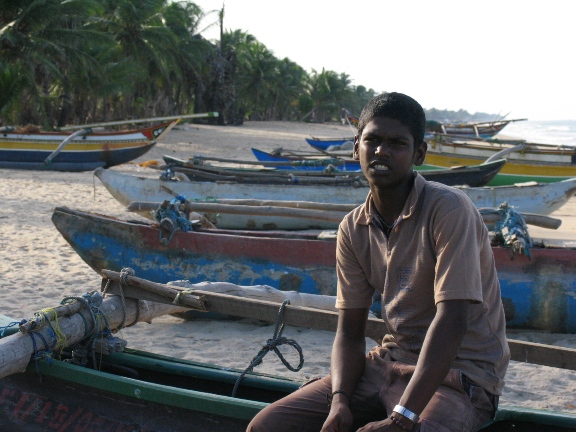
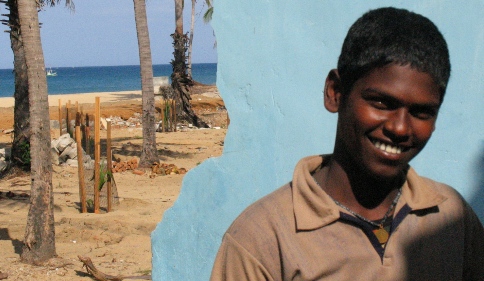
This boy, Thillainayagam Theeban, epitomizes that bigger tragedy. He survived the tsunami — but not the escalation of Sri Lanka’s ethnically driven civil war, which consumed his life in March 2007.

Theeban was one of eight surviving children – from India, Indonesia, Sri Lanka and Thailand – whose remaining families we tracked and filmed for a year in Children of Tsunami media project, a citizens’ media response to the Indian Ocean Tsunami.

Theeban was murdered by unidentified gunmen who stormed into his ‘temporary’ tsunami shelter on 3 March 2007. The death was linked to political violence that has engulfed Sri Lanka since 2006.

theeban.jpg

When the shocking news reached us three days later, our Sri Lankan camera team at Video Image and we at TVE Asia Pacific just couldn’t believe it. We were all in tears, and some of us were also angry. Theeban, who survived the killer waves 26 months earlier (but lost his mom and kid brother in the disaster) suffered many indignities in displacement. And now, he is gone.

We still don’t know who killed Theeban. He was abducted by an armed group sometime in 2006, from whom he escaped in early 2007. It is believed that Theeban was killed as a punishment for running away — and as a warning to all others.

He was 16 years at the time of his death. It is unlikely that his killers would ever face justice.

As I wrote in my personal tribute to Theeban in March 2007, published by UCLA’s Asia Media and MediaHelpingMedia, UK: “The disaster’s Sri Lankan death toll (close to 40,000 dead or missing) shocked the world when it happened within a few hours or days. Yet, at least twice as many people -– most of them unarmed and uninvolved civilians — have been killed in over a quarter century of fighting. That doesn’t always grab headlines.

“Thillainayagam Theeban has become another statistic in a ‘low-intensity conflict’ (as some researchers call it). And while this war lasts, it will continue to consume thousands of other young lives — a grim roll call of Sri Lanka’s Lost Generation.”

The third anniversary of the tsunami is a reminder – if any were needed – that man’s inhumanity to man is often worse than Nature’s fury.

March 2007 blog post: Remembering Theeban

April 2007 blog post: More memories of Theeban

Children of Tsunami: Documenting Asia’s Longest Year

Thillainayagam Theeban (1990 – 2007)

Katie Couric: Faithfully her Master’s voice?

This is an interesting video, uploaded last month on to YouTube by media activists.

In September 2007, Katie Couric, anchorwoman of CBS Evening News reported live from Baghdad. But instead of using that opportunity to ask tough questions and dig for the truth, Couric asked soft questions and repeated a number of false Bush talking points.

As activists point out, the media’s failure to ask tough questions helped America get embroiled in Iraq in the first place.

It’s hard to believe that Couric currently occupies the slot that was long adorned by the likes of Walter Cronkite, anchorman for The CBS Evening News for 19 years (1962 – 1981). During the heyday of CBS News in the 1970s and 1980s, he was often cited in viewer opinion polls as “the most trusted man in America”, because of his professional experience and avuncular demeanor.

From Wikipedia

Media watchers cannot help comparing how Cronkite covered an earlier, equally controversial conflict that left America bruised and bleeding: the Vietnam War. Following Cronkite’s editorial report during the Tet Offensive that the Vietnam War was unwinnable, President Lyndon Johnson is reported to have said, “If I’ve lost Walter Cronkite, I’ve lost Middle America.”

How times have changed. Couric is the media lap-dog that every government and military would wish to have — her recent reportage from Iraq would probably be held up by some of them as ‘an example to every journalist covering a war’.

Incidentally, Cronkite provides the voiceover introduction to Couric’s CBS Evening News, which began on 5 September 2006.

And that’s the way it is.

YouTube video courtesy Moveon.org – Democracy in Action

War Made Easy: Exposing the Spin Doctors of Death

As we mark the sixth anniversary of 9/11 terrorist attack on the World Trade Center in New York, attention is focused more and more on the role the media played in the days and months that followed.

The war in Iraq was justified as a retaliation against 9/11. The Pentagon marched on to the cheer-leading of American media, which barely asked the basic questions, let along challenge the military-political logic.

A new documentary probes how this shameless acquiescence took place in full public glare. WAR MADE EASY: How Presidents & Pundits Keep Spinning Us to Death, narrated by Sean Penn, features Normon Solomon, on whose 2005 book the film is largely based.

Here’s the trailer for the film:

And its synopsis:

War Made Easy reaches into the Orwellian memory hole to expose a 50-year pattern of government deception and media spin that has dragged the United States into one war after another from Vietnam to Iraq. Narrated by actor and activist Sean Penn, the film exhumes remarkable archival footage of official distortion and exaggeration from LBJ to George W. Bush, revealing in stunning detail how the American news media have uncritically disseminated the pro-war messages of successive presidential administrations.

War Made Easy gives special attention to parallels between the Vietnam war and the war in Iraq. Guided by media critic Norman Solomon’s meticulous research and tough-minded analysis, the film presents disturbing examples of propaganda and media complicity from the present alongside rare footage of political leaders and leading journalists from the past, including Lyndon Johnson, Richard Nixon, Defense Secretary Robert McNamara, dissident Senator Wayne Morse, and news correspondents Walter Cronkite and Morley Safer.

Norman Solomon’s work has been praised by the Los Angeles Times as “brutally persuasive” and essential “for those who would like greater context with their bitter morning coffee.” This film now offers a chance to see that context on the screen.

Approx. 72 minutes
English subtitles
Directed & Written by: Loretta Alper & Jeremy Earp
Produced by: Loretta Alper
Co-produced & Edited by: Andrew Killoy
Executive Producers: Jeremy Earp & Sut Jhally
Associate Producer: Jason Young
Sound: Peter Acker, Armadillo Media Group
Motion Graphics: Andrew Killoy & Sweet & Fizzy
Additional Music: John Van Eps & Leigh Philips
Narrated by: Sean Penn
Based on the book by Norman Solomon

Image courtesy War Made Easy website

I haven’t yet seen this film, but it’s certainly one I want to catch soon. Not the least because I live and work in a war-ravaged country – Sri Lanka – where the politicians and generals have engaged in their own (increasingly sophisticated) acts of spin doctoring. Most alarmingly, large sections of the Sri Lankan media find absolutely nothing wrong to play along, all in the name of patriotism….

Sounds familiar?

Read the full transcript of War Made Easy

Children of Men – the coming anarchy

“The Muslim community demands an end to the Army’s occupation of mosques.”

“The Homeland Security bill is ratified. After eight years, British borders will remain closed. The deportation of illegal immigrants will continue. Good morning. Our lead story…”

These and other disturbing news headlines are sprinkled throughout Children of Men, the 2006 dystopian British movie based on a 1992 novel by P D James.

It wasn’t a good idea to have watched this movie on my flight from Doha to London. I arrived to find London’s Heathrow Airport more crowded and chaotic than I’d ever seen in 15 years of arrivals. Is this a sign of things to come?

In all likelihood, it was just a routine Saturday, but the (fortunately well behaved) crowds made me think again of the coming chaos that Children of Men predicts will overwhelm Britain in just a generation.

As the movie’s official synopsis puts it:
The world’s youngest citizen has just died at 18, and humankind is facing the likelihood of its own extinction. Set in and around a dystopian London fractious with violence and warring nationalistic sects, Children of Men follows the unexpected discovery of a lone pregnant woman and the desperate journey to deliver her to safety and restore faith for a future beyond those presently on Earth.

And this is how a fan summed it up on Internet Movie Database (IMDB):

Set in 2027, when no child has been born for 18 years and science is at loss to explain the reason, African and East European societies collapse and their dwindling populations migrate to England and other wealthy nations. In a climate of nationalistic violence, a London peace activist turned bureaucrat Theo Faron, joins forces with his revolutionary ex-wife Julian in order to save mankind by protecting a woman who has mysteriously became pregnant.

When P D James wrote the original novel, she placed the story 35 years in her future. When Alfonso Cuarón directed its movie adaptation, starring Clive Owen, Sir Michael Caine, and Julianne Moore, the world had moved to just two decades within reach of 2027. And, ominously, the concerns of immigration, law and order and environmental degradation had all grown worse.

The movie portrays a dark and depressing near future for our species and the planet. This isn’t the imagination of writer and film-maker running amok: the ingredients of that dystopia are already evident, and we’re flirting with the sympoms while the trends evolve into status quo.

We have been warned.

Attacking the Messenger…again!

The Pakistani police attack on the popular, independent TV network Geo TV made international news during the weekend. Here in Washington DC, I read a half-page news features in the Washington Post, and was dismayed by this attack by law-enforcers on a reputed media organisation that operates within the law.

Geo TV, Pakistan

The Washington Post item read:

The Lahore protests on Saturday followed a clash in Islamabad on Friday in which police fired rubber bullets into crowds, detained key opposition leaders and stormed the offices of Geo TV, Pakistan’s most popular independent network.

The government has generally defended its reaction to the protests as the only way to maintain law and order. But Musharraf apologized for the raid on Geo TV in an interview with the station and indicated that the action had been executed without his approval. Prime Minister Shaukat Aziz also visited Geo TV’s studios Saturday to express his regret, and the government fired 15 officers involved in the raid.

But Hamid Mir, the station’s bureau chief in Islamabad, said that was insufficient.

“They wanted to destroy this newsroom,” Mir said Saturday afternoon, his words punctuated by frequent coughs, the result, he said, of inhaling large amounts of tear gas Friday. “They were trying to send a message to the whole media by attacking Geo TV.”

The station was broadcasting live images of the protest Friday afternoon when it was attacked. Journalists filming from the roof reported that police fired rubber bullets and tear gas in an attempt to knock out their cameras. Video footage of the raid showed police smashing in windows and doors inside the building. Broken glass lined the lobby floors Saturday.

Mir said he was encouraged that the media did not appear to be giving in to what he described as government intimidation tactics. “This is the first time the media is showing a lot of resistance,” he said.

There we go again….South Asian governments never seem to learn! We have good friends at Geo TV, and are relieved to hear from them that they are unharmed and that they continue to broadcast. Our thoughts and solidarity are with them, in the weeks and months ahead, when they stand for the public’s right to know and for the freedom of expression.

Remembering Thillainayagam Theeban (1990 – 2007)

Thillainayagam Theeban (1990 – 2007)
Since we started Children of Tsunami media project in early 2005, as a citizen media response to the Indian Ocean Tsunami, I have introduced it to dozens of audiences of many and varied kinds in different parts of the world. But presenting our documentary, Children of Tsunami: The Journey Continues to the 15th DC Environmental Film Festival at the World Bank headquarters yesterday (16 March 2007) was perhaps the most difficult of all.

No, this was not a cynical audience – far from it, they turned out to be a very appreciative one, as I describe in my other post. But this was the first public introduction I had to make after we lost Theeban, the Sri Lankan boy who was one of eight children whose recovery story we tracked and filmed for much of 2005.

Theeban was murdered by unidentified gunmen who stormed into his ‘temporary’ tsunami shelter on 3 March 2007. The death is linked to spiralling political violence that is once again sweeping across Sri Lanka.

When the shocking news reached us three days later, our Sri Lankan camera team at Video Image and we at TVE Asia Pacific just couldn’t believe it. We were all in tears, and some of us were also angry. Theeban, who survived the killer waves 26 months ago (but lost his mom and kid brother in the disaster) suffered many indignities in displacement. And now, he is gone. 

It’s now two weeks since Theeban was killed, but I still can’t speak about it without a lump in my throat.

That’s why I was nervous in introducing the film yesterday at the festival: I knew I was just seconds away from being stuck for words, and overcome with emotion.

My friends in the audience later said I had managed reasonably well. This is what I said as I ended my brief introduction:

“We ran out of funds to sustain our monthly filming beyond end 2005. By then we found that our film crews and we ourselves had become attached to our participating families, and especially the children who worked so closely with our film crews. We remain interested in their personal progress, even if we can no longer publish their stories.

Earlier this month, we received the devastatingly sad news that the Sri Lankan boy we filmed has been murdered –- by unidentified gunmen, right at the ‘temporary’ camp in Eastern Sri Lanka.

Thillainayagam Theeban survived the killer Tsunami waves and endured 26 months of extreme hardship in displacement — only to be swept away by the wave of political violence currently sweeping Sri Lanka.

We still don’t know who killed Theeban, and for what reasons. He was abducted by an armed group a few months ago, from whom he escaped earlier this year. It is believed that Theeban was killed as a punishment — and as a warning to all others.

He was 16 years at the time of his death. We don’t know if his killers would ever face justice.

I want to dedicate this screening to Theeban — and thousands of young people like him who are still languishing in temporary shelters, struggling to rebuild their futures.”

After the screening, there was some sympathy and empathy in the audience about Theeban. But on the whole this particular development didn’t inspire too many questions or remarks. The predominantly American audience seemed more intrigued by our journalistic documentation of how evangelical Christian groups rushed to tsunami-struck Asia, offering relief support coupled with religious conversion. (Find out more about this by watching the film online.)

Ah well, everyone takes away something different from a film like Children of Tsunami. It has so many facets and elements mixed together.

We set out asking lots of questions, and found only a few answers. We still have lots of questions in search of answers…and new ones emerging.

Thillainayagam Theeban (1990 – 2007)

TVE Asia Pacific official statement on Theeban’s death

My personal tribute to Theeban, published by MediaHelpingMedia, UK

My tribute to Theeban, published by UCLA Asia Media