November 4 is already here in Asia – and the day will dawn a few hours later in the United States. Today is the day Americans go to the polls to choose their next President.
Whatever the outcome of today’s election, one thing is for sure: a little campaign video by a relatively little known actress and model changed the face of Campaign 2008.
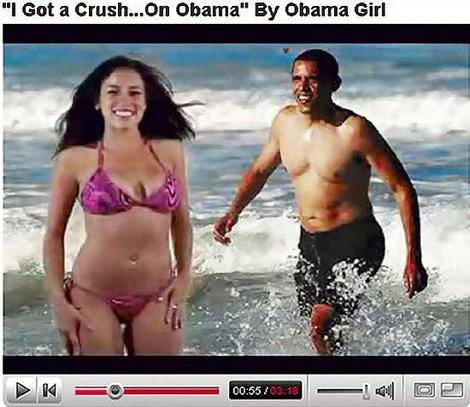
“I Got a Crush… on Obama” is an internet viral video, first posted on YouTube in June 2007 featuring a young woman seductively singing of her love for Illinois Senator and presidential candidate Barack Obama.
Produced by BarelyPolitical.com, a website for funny political videos, it featured actress and model Amber Lee Ettinger who lip-synched the song which was actually sung by Leah Kauffman (of “My Box in a Box” fame).
This video was named biggest web video of 2007 by People magazine…the AP…Newsweek…and AOL. It certainly helped to project Obama as a cool and hip candidate.
As we wait for democracy to take its course, here’s that history-making viral video, which has been watched on YouTube more than 10 million times…and counting:
These are the principal credits:
Created by: Ben Relles
Starring: Amber Lee Ettinger
Vocals: Leah Kauffman
Music Producer: Rick Friedrich
Directed by: Larry Strong and Kevin Arbouet.
And finally, if any of you feel anything at all for the incumbent who is about to be relegated to the dustbin of history, here’s a wicked video from the same creators called: Lil’ Bush Girl…Meet Obama Girl
(Caution: it’s not for the prim and proper, but then readers of this blog aren’t!).
She remains one of the most remarkable people I have met. Especially in the past year, which has been eventful and tumultuous for me, I have often thought of Anita’s long and colourful journey from working class mom to one of the most successful entrepreneurs of our time….and onward to become an outspoken and passionate activist for social justice, human rights and the environment.
As she has written, it was not an easy ride to do well in the male-dominated world of business, nor was it any easier to do good in the greed-dominated world at large. But she not only did it, but had great fun doing so.
What would Anita do? I find myself asking this question every now and then when I seem to be struggling against enormous odds (which is increasingly often). I don’t always find the answers I’m looking for, but it’s always a useful reflection.
I now find that others have been asking this question. Visiting Anita Roddick’s official website this week, I read a moving post by Brooke Shelby Biggs, who worked with Anita for 8 years. She writes: “I’ve lived most of this past year having conversations with Anita in my mind. What would she say when I told her about considering a move back to magazine journalism? How should I handle my role in the Free the Angola 3 movement? How would she get on with my new romantic interest? Should I move back to my parents’ home town to help care for my ailing mother? I’ve tried to spend this time living according to the philosophy of What Would Anita Do (WWAD?). It was a lot easier when I could ask her myself. But some part of me knows she gave me a lot of tools to figure the hard stuff out on my own. Sometimes I just wish I had her courage.”
I am an activist: website inspired by Anita Roddick
Brooke links to a website called I am an Activist that draws information and inspiration from Anita’s many and varied struggles in support of various local and global causes. Prominently displayed on the home page are Anita’s now famous words: “This is no dress rehearsal. You’ve got one life, so just lead it and try and be remarkable.”
Well, we can honestly say that she’s one person who practised what she preached.
‘I am an Activist’ is also the sub-title of a DVD that celebrates the life of Dame Anita Roddick, which is available for sale and/or download from Anita Roddick.com. It compiles footage gathered on 23 October 2007, when thousands of thinkers, artists, activists, and other heroic saboteurs of the status quo gathered to celebrate the remarkable life and legacy of Anita Roddick. According to the blurb, it features key people from groups like Amnesty International, Greenpeace, Reprieve, The Body Shop, as well as family and close friends, as they laugh and cry and ultimately take to the streets to launch.
Anita’s daughter Sam is quoted as saying in her tribute: “My mother treated life like each day was her last, and this gave her the permission for incredible bravery. … Tonight I am personally pledging that I Am An Activist, and within that, I also will have a lot of fun, and I also will be silly. I will not be polite and I will never, ever, ask for permission.”
In the weeks and months since Anita’s death, more video material featuring her public talks and interviews have been shared on YouTube by individuals and organisations. I have this week watched several of them, and felt there still isn’t sufficiently good moving images about her. In her time she must have done hundreds or thousands of interviews for broadcast television, corporate audiences as well as community groups. At least some of these must have been recorded and archived. But we still don’t see enough out there, at least in easily accessible public video platforms like YouTube.
Here are two that I did find which are interesting:
Anita speaks on the lessons she learnt from running her own home business, which she started in 1976 to augment her family income. She talks about how she had absolutely no business training, faced many odds and put up with male sarcasm:
From University of California Television comes this video of Anita delivering the Nuclear Peace Age’s third annual Frank K. Kelly Lecture on Humanity’s Future in Feb 2004.
Never underestimate the power of moving images. Al Gore tipped the balance in the long-drawn climate change debate with his Oscar-winning film, An Inconvenient Truth. The rest is recent history.
Thanks to the film – and sustained advocacy of hundreds of scientists and activists – climate change is no longer a speculative scenario; it’s widely accepted. The challenge now is to understand how it impacts different people in a myriad ways.
Called Vulnerability Exposed, the contest is open to anyone anywhere in the world who wishes to have their voice heard. The submitted films should innovatively illustrate the consequences of climate change through one of the following theme categories: conflict, migration, the urban space, rural institutions, drylands, social policy, indigenous peoples, gender, governance, forests, and/or human rights. The submission period ends on 24 October 2008.
Caroline Kende-Robb, Acting Director, Social Development Department, said, “There is a need to see climate change as an issue of global social justice. The rights, interests and needs of those affected by climate change must be acknowledged.”
Watch the Bank’s short video, where she explains further:
The contest has two award categories:
1) Social Dimensions of Climate Change Award (general category) – open to professional and amateur; and
2) Young Voices of Climate Change (youth category) – open to entries submitted by filmmakers under 24 years old.
Award winners will be chosen through a combination of public voting and a judging panel. The film with the most public votes in each theme category will receive honorable mention.
Vulnerability Exposed film competition: Judging process
This contest indicates that the World Bank is slowly but surely opening up to the currently untapped communication potential of web 2.0 – the very point I made in a recent op ed essay.
There are several noteworthy aspects in this competition, some more positive than others. I offer this critique in the spirit of improving a commendable initiative.
Three cheers to the bank for accommodating both amateurs and professionals. It’s about time those who don’t video film for a living (some of who are no less talented in the craft) had more opportunities to showcase their products.
It’s good to see the preference for shorter films, in this contest defined between 2 and 5 mins in duration. This certainly resonates with TVE Asia Pacific’s experience with Asian broadcasters, many of who now prefer shorter films. Longer films have their place, of course, but shorter ones are clear favourites of 24/7 news channels and also online.
Most film contests are judged exclusively by an all-powerful jury (I’ve been on several over the years), but here the online public have a chance to vote for their favourite entries. Let’s hope the judges will consider the story telling power of entries as the most important deciding factor. (The examples in the YouTube film given above are misleading – they all seem extracts from expensively made documentaries.)
The big challenge for many aspiring contestants would be to relate climate change to daily realities in their societies. Despite global headlines and the development community’s current frenzy about it, climate change as a phrase and concept still isn’t clearly understood in all its ramifications. If science now knows 100 facts about the murky processes of climate change, the average public knows less than 25 and understands even less. So it will be interesting to see how entries relate the big picture to their individual small pictures.
I’m a bit disappointed that the World Bank is not offering any cash prize to the winners. Instead, “the winners will receive an all expenses paid trip to Washington, DC for a screening of their film and will have the opportunity to attend a series of networking and learning events organized by…the World Bank in December 2008.” This is all useful, but video – even at the low end – is not exactly cheap, and even labour of love creations cost money to make. We are currently running a comparable the Asia Pacific Rice Film Award – which seeks entries no longer than 10 mins on any aspect of rice – and despite being a non-profit, civil society initiative we have a prize of US$ 2,000 to the winner. And we wish we could offer more.
But my biggest concern is the unequal, unfair terms of copyrights found in the small print of the competition rules. This is where the lawyers have done their usual handiwork, and with the usually lopsided results. The World Bank wants all contestants to make absolutely sure that all material used is fully owned by the contestants, or properly licensed. That’s fine. But tucked away on page 7, under section 12 titled Entrant’s permission to the organiser, is a set of conditions which will allow all affiliated institutions of the World Bank group to use the submitted material for not just promoting this contest (a standard clause in most competitions), but for ‘climate change work program of the organiser’.
What this means, in simpler terms, is that without offering a single dollar in prize money, the World Bank is quietly appropriating the unlimited user rights for any and all the submitted material. These are the core materials in the moving images industry, and nothing is more precious to their creators.
I have long advocated a more balanced, equitable and liberal approach to managing copyrights and intellectual property by both the broadcast television industry and development community — especially where public funded creations are concerned. I have nothing but contempt for lawyers and accountants who often determine the copyrights policies in large broadcast and development organisations. They set out terms that may be justified in strict legal terms, but are totally unfair, unjust and, in the end, counterproductive to the development cause and process. It seems that while our friends in the social and communication divisions were not looking, the Bank’s lawyers have done their standard hatchet job.
While this doesn’t detract from the overall value of Vulnerability Exposed, it diminishes its appeal and potential. Many professional video film-makers who value their footage – gathered with much trouble and expense – may not want to sign future user rights away for simply entering this contest. And worse, the unsuspecting enthusiasts who don’t necessarily earn their living from making films – but are entitled to the same fair treatment of their creations – would be giving away material whose industrial value they may not even fully appreciate.
It’s certainly necessary and relevant for development organisations like the World Bank and the UN system to engage web 2.0. But they must be careful not to import or impose rigid, one-sided and outdated copyright regimes of the past on this new media.
I hope the Bank would consider revising these unfair copyright terms, and treat the submitted material with greater discretion and respect. If not, all entrants risk seeing their material popping out of bluechip films produced by top-dollar production companies in North America and Europe who have ‘mining rights’ to the Bank’s video archives.
Vulnerability Exposed can have more meanings than one. We’d rather not consider some.
The world saw Lin Miaoke, right, sing at the Beijing Olympics opening ceremony - but actually heard the voice of Yang Peiyi, left.
So now it’s confirmed: the spectacular Beijing Olympics opening ceremony – watched live on television by over a billion people worldwide – had been a little more than what it seemed.
What we saw was not what we actually heard. It turns out that the little girl in a red dress, who sang “Ode to the Motherland” as China’s flag was paraded into Beijing’s National Stadium, wasn’t really singing. Clever stage management and sound mixing just made us believe she was.
Beijing games organisers have confirmed that Lin Miaoke, aged 9, whom we saw on TV, was lip-syncing to the sound of another girl, 7-year-old Yang Peiyi, who was only heard but not seen — all because she was deemed not “cute enough”. And they just forgot to tell us there were two…
To refresh memories, here’s that moment from 8 August 2008, as captured by China’s national broadcaster CCTV:
“The Chinese government has taken great pains to present the best possible image to the outside world during the Olympics, and perfection was the goal for the dazzling opening ceremonies. The filmmaker Zhang Yimou, who oversaw the production, has earned international praise for staging a performance that many considered one of the most spectacular in Olympic history.
“But to achieve the spectacular, not only did organizers fake the song, but they also have acknowledged that one early sequence of the stunning fireworks shown to television viewers actually included digitally enhanced computer graphics used for ‘theatrical effect.'”
And here’s how CNN covered the news of the fake incident on 12 August 2008:
The Olympic motto is made up of three Latin words: “Citius, Altius, Fortius”, which mean “Faster, Higher, Stronger”. At the rate things are moving — with media images taking precedence over accomplishment — we might soon find ‘cuter’ being annexed to it. (Somebody please find the right Latin word.)
But let’s face it: this is not the first time that the world’s greatest festival has been carefully stage-crafted for the benefit of broadcast television, nor will it be the last. The pressure on host nations is immense to show their best face to the world. Perhaps our Chinese friends took that literally, and opted to showcase the supposedly cuter Lin Miaoke to the billion plus audience. (Apparently, a party official deemed that the face of little Miss Yang Peiyi wasn’t good enough – both look perfectly adorable to me…)
Not for a moment do I condone the trickery that Beijing tried to get away with. At the same time, let this be seen as part of a growing, disturbing trend: the broadcast television ‘tail’ has been wagging the Olympics dog for quite some time.
Since the summer Olympics were first commercially broadcast in Rome in 1960, both television’s technology and industry have advanced leaps and bounds. Today, broadcast rights are a very significant source of income for the International Olympic Committee (IOC), and the host countries/cities.
That’s all well and good — much of competitive sport today relies so heavily on corporate sponsorships, and television rights are a key part of sports financing.
However, we must worry when so much time, effort, creativity and money is being invested in staging ever more spectacular opening (and to a lesser extent, closing) ceremonies. Yes, it’s a time for the world to celebrate the best and the brightest of the Global Family. And there’s absolutely no harm in having a gala party. But should that extend to rolling out all the tricks of showbiz and make belief? With such a massive global audience following the games not just on television but now also online, where do the IOC and hosts draw the line?
Let’s not kid ourselves: the world of broadcast television distorts reality on a daily basis. This is an industry that prefers and promotes those whom it considers more cute, pretty, good-looking and sexy. It makes no secret of choosing style over substance. And not just in pure entertainment, but in ALL areas of coverage, including news and current affairs. I have been pointing out how this also affects the coverage of issues like poverty, disasters and development. Even in such serious, factual coverage, many television producers would go with faces that they think are tele-genic, cute or at least particularly pathetic-looking…
Television audiences, by and large, have come to terms with all these ‘adjustments and improvements’ to the murky, messy and unruly real world (yes, some pockets of resistance are fighting a brave vanguard battle, but their numbers are no match for the uncritical couch potatoes).
The challenge is when the real world of Olympic sports tries to mix with the make-belief world of broadcast television to reach out to all those billions of eyeballs. Whose values, standards and rules would then apply?
While the IOC jealously guards time-cherished Olympic principles, it has been slow to modernise and keep up with the times. It must find ways to balance the Olympics integrity with media’s obsession for manufactured reality and feel-good, look-great extravaganzas. And if IOC thinks manging broadcast rights is tricky, just wait till they have to deal with the more bewildering and multitudinous online and mobile media platforms…
What happened in Beijing once again rekindles a long simmering debate. It goes much deeper than an overzealous host nation trying to picture-perfect its proud moment. It takes us right to the heart of the Olympics, and tests if the founding ideals can survive the corporate media realities of the twenty first century.
It’s finally here. The calendar shows 08.08.08 — the date the Chinese hosts selected to open the 29th Olympic Games in Beijing.
All eyes and ears will turn to the opening ceremony and subsequent events in the Chinese capital for the next two weeks. We will be looking forward to the best of us competing for the noblest of ideals in the spirit of excellence, friendship and goodwill.
The build-up to the Beijing Olympics has seen a large number of television commercials and public service announcements (PSAs) using the Olympic theme. Some of them are quite clever, bringing out the best creativity of those who create moving image treats. Today, we feature one such campaign.
For the past year, the International Olympic Committee (IOC) has been running a global promotional campaign, titled “The Best of Us”. Its aim was to communicate the key Olympic values of Excellence, Friendship and Respect to a global youth audience.
The theme of “The Best of Us” is a simple, powerful idea that transcends cultures and borders, motivating young people around the world to participate in sport by proving that sport can bring out their best.
The campaign was developed by the Voluntarily United Group of Creative Agencies (United), part of WPP. This first phase of creative development was led by Sra Rushmore/United, Madrid. The two PSAs are accompanied by a viral video as well as print and digital media items.
Here are the two PSAs:
Teens (above): The “Teens” television advert communicates that being an athlete can help teens overcome their insecurities – either real or those imposed by their peers. It aims to demonstrate how sport can play an important role in boosting young people’s confidence. The film features young athletes from across the world, including Armenia, Belgium, Brazil, China, Egypt, Germany, Ghana, India, Israel, Japan, Mexico, Russia and the United States.
Heroes (above): Legendary Olympic athletes including Roger Federer, Yao Ming, Laure Manaudou, Liu Xiang and Yelena Isinbayeva are among the stars of the International Olympic Committee’s public service announcement entitled “Heroes”. “Heroes” leverages the determination and performance of Olympic athletes to communicate the key Olympic values. The campaign also stars Kenenisa Bekele, Haile Gebrselelassie, Vanessa Ferrari and Carolina Kluft who, along with those mentioned above, star as superheroes seeking to achieve the seemingly impossible.
And finally, here are two of the seven print media posters that made up the Best of Us campaign:
Moving Images blog joins the world in wishing him many happy returns of the day — and many more birthdays to come!
To mark the occasion, we feature the song 46664 (That’s My Number) Nelson Mandela recorded some years ago to draw attention to HIV/AIDS.
This background story comes from the YouTube channel of Andrew Heath:
46664 was Nelson Mandela’s prison number when he was incarcerated on Robbin Island, Cape Town for 18 years.
In 2003 Jacqui Joseph (TV Presenter & Director of GHC Productions) was asked to host the first “live” Nelson Mandela 46664 Concert at Green Point Stadium in Cape Town with an audience of 40,000 that was broadcast globally and on the internet to 2 Billion people.
Jacqui provided her services for free and interviewed all the artists performing at the concert including Beyonce, Bono, The Edge, Peter Gabriel, Dave Stewart, Brian May, Roger Taylor, Ladysmith Black Mambazo and Angelique Kidjo and did the voice over for the official 46664 DVD.
As a result of her charity work and involvement with 46664 Jacqui and all involved in the campaign became official Ambassadors to the Nelson Mandela Foundation. Although a number of years have passed since Jacqui fronted the first big 46664 music event she now feels the time is right to re-energise and raise the public awareness and profile for the 46664 campaign.
In order to do this, Jacqui asked Max & Andy (remixer/producers) to come up with a fresh musical anthem & video for the 46664 campaign.
In 2006 Max & Andy completed the track and video and the result is: 46664 (THAT’S MY NUMBER)
46664 (That’s my Number) combines samples taken from Nelson Mandela’s inaugural 46664 speech in 2003 over dubbed onto an infectious re-mix of pop, ska and reggae classics.
The 46664 (that’s my number) video includes images sampled from the first official 46664 DVD and live concert shot in 2003 as well as original clips filmed for the GHC Productions video.
I just wrote a blog post titled Children of Heaven: Appreciating the sound of silence. Reviewing the 1997 movie by Majid Majidi, I remarked about his strategic use of silences in his soundtrack – we must never underestimate its power in the right place.
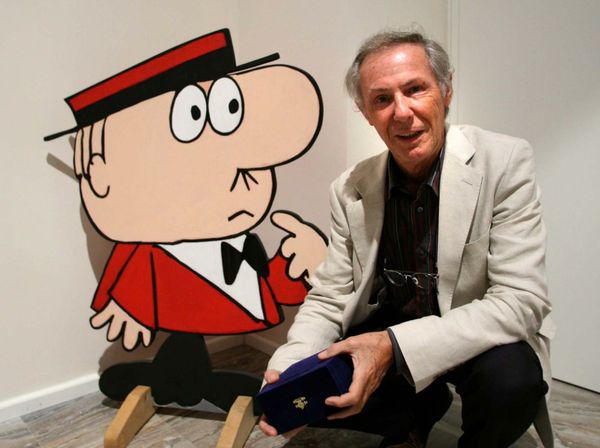
Other creators of moving images do their magic with a good sound track – but sometimes without using a word of dialog. Here’s a clever example I’ve found on YouTube – it is by Italy’s leading animator, Bruno Bozzetto (photos below, courtesy Bruno Bozzetto website).
Bruno Bozzetto
Titled Femminile & Maschile (Feminine and Masculine), this 2-D animation was made in 2004. I can’t find a synopsis online, but one website introduced it simply as follows: Some situations that show the difference of behaviour between men and women in the everyday life.
Anyone with a sense of humour can appreciate this piece – and I hope that includes die-hard feminists…
Here’s the intro from Wikipedia:
Bruno Bozzetto (born March 3, 1938 in Milan, Italy) is an Italian cartoon animator, creator of many short pieces, mainly of a political or satirical nature. He created his first animated short “Tapum! the weapons’ story” in 1958 at the age of 20. His most famous character, a hapless little man named “Signor Rossi” (Mr. Rossi), has been featured in many animated shorts as well as starring in three feature films: “Mr. Rossi Looks for Happiness” (1976), “Mr. Rossi’s Dreams” (1977), and “Mr. Rossi’s Vacation” (1977). Read the rest of his profile on Wikipedia
Earlier this week, to mark Earth Day on 22 April 2008, I took part in a half hour, live interview with Sri Lanka’s highest rated, most popular channel, Sirasa TV. I wanted to relate the global to not just the local but also to the individual and family level. To discuss how our lifestyle choices and consumer decisions affect that planet, I used a series of brilliant cartoon animations that Bruno Bozzetto had done some years ago for WWF.
Again, without having his characters utter a single word, Bozzetto gives out profound messages through images and musical sound track. This is why I keep saying that when it comes to the sheer economy of words, we writers just can’t beat cartoonists.
Sorry, I can’t locate these anywhere online (YouTube lists dozens of his other creations, but not this series — which I can’t even find on his own website.) It’s time for someone to revive this series, for their message is even more relevant for today’s climate-challenged world…
‘This is Arthur Clarke, saying goodbye from Colombo….’
This was the characteristic signing off Sir Arthur C Clarke used whenever he made a video greeting to an international meeting on some important issue somewhere on the planet.
From disarmament and new communications technologies to space exploration and conservation, he would offer the uniquely Clarkian take on the subject – in his witty, insightful and funny style.
I have worked with and for him for half my life – 21 years – as part of his personal office in Colombo, Sri Lanka (not to be confused with the government-run Arthur C Clarke Institute which he had nothing to do with). In that time, I helped film a significant number of video greetings to gatherings of the world’s movers and shakers.
Some of these were assemblies of sombre men and women in suits at the United Nations, Davos or Pentagon. Sir Arthur would deliberately poke fun at the pomposity and self-importance of these types, in a way that they could still laugh – even at their expense.
Other events were less formal, but no less important: glittering gatherings of Hollywood or Silicon Valley professionals – some of who have more ‘soft power’ worldwide than military generals or secretary generals. Again, he would challenge the boundaries of imagination of these professionals whose mega-billion industries were built largely on imagination.
In all these and more, Sir Arthur demonstrated another quality: the great economy of words. He hardly spoke for longer than ten minutes, or 600 seconds. The Grandmaster of the Soundbyte that he was, he knew just how to pack the right mix of power, fun and sense of wonder into each second.
Confined to a wheelchair in Sri Lanka – the country he adopted – in later years due to Post Polio, Sir Arthur used either satellite links or the web to connect to many important scientific, literary and entertainment gatherings in far corners of the planet.
When Sir Arthur said his Final Goodbye from Colombo in the early hours of 19 March 2008 at Colombo’s Apollo Hospital, there was no global witness. He was in the company of just five people – comprising family and staff.
Aptly, however, the news of his demise went right around the world at the speed of light thanks to the comsat and web. In less than an hour, the whole world knew.
And now its the world’s turn to say Goodbye to its most trusted ‘Man in the Future’. The world remembers, salutes and celebrates his genius, humanity and imagination.
For once, there was no specific invitation from anywhere. But for several weeks running up to his birthday, we had seen considerable media and fan interest on how he feels like completing 90 orbits around the Sun.
So in the last days of November 2007, I suggested to Sir Arthur that we should film a short video message – openly addressed to the whole world, sharing his reflections on turning 90. He liked the idea, and as has been the custom in recent years, asked me to draw up his speaking points.
I spent several days going through dozens of his essays and speeches, both published and unpublished. When I had a draft, we worked long and hard on it to get everything just right. I saw how he could still ‘Clarkise’ any piece of writing, which showed no sign of wear and tear for the 90 orbits.
This was a ‘no-budget’ production. Sir Arthur’s personal photographer Rohan de Silva had done many video greetings using a home video camera, but he and I agreed that this should be done more professionally. I mentioned the idea to our friends at Video Image (Private) Limited, the country’s top production company who had filmed with Sir Arthur for so many global TV channels and international clients. They immediately agreed to do it – for free.
We didn’t have a tele-prompter, but realised the importance of Sir Arthur looking straight at his audience. So in just a couple of days, Brian Ratnasekera of Video Image improvised a working unit.
I directed the shoot with Video Image crew on 5 December at Sir Arthur’s home. Allowing several breaks for him to catch his breath, our filming took the better part of that morning.
The filming got off to a bumpy start. First the improvised tele-prompter had some teething problems, but these were quickly sorted. Then, in a very rare moment of disagreement, Sir Arthur said he wanted to be filmed wearing his Nehru jacket (which he affectionately called ‘My Doctor No suit’).
We had already donned him in a colourful bush shirt and crew and I felt that this was the right attire for a message that was intensely personal and somewhat wistful. The shirt with large prints was far more characteristic of Arthur C Clarke than any formal suit. At that moment, I was the shoot’s director and not his long-standing spokesperson who would be more agreeable with his views and wishes.
A few tense moments passed. Then one of Sir Arthur’s valets had a brainwave. Why not use the casual NASA jacket that Sir Arthur often wore when he felt the air conditioning was getting a bit too cold?
That saved our shoot. He compromised, trading Nehru for NASA. Within seconds, he was back to his normal cheerful self. When the shoot got underway, he was at ease, speaking right to the camera and looking straight at millions of unknown viewers who would watch it for years to come.
Reading our text scrolling gently upward on the tele-prompter, he missed out just one word out of nearly 900. We only needed to do a single re-take. That was impressive for a man who’d recently had cataract operations in both eyes.
In the end, I knew we had a great piece – one where he looked back at a most remarkable career of our time, and looked forward to what lies in store for humanity.
After surveying what has, by all measures, been a highly remarkable life and the astounding rate of technological development he has witnessed, Sir Arthur listed three ‘Big Wishes’ that he wanted to see happen – ideally in his life time (alas, that was not to be).
Finally, he offered some personal views on posterity – a subject on which he’d been ambivalent at times.
This is perhaps the most consequential of his birthday reflections. In his own words: “I’m sometimes asked how I would like to be remembered. I’ve had a diverse career as a writer, underwater explorer, space promoter and science populariser. Of all these, I want to be remembered most as a writer – one who entertained readers, and, hopefully, stretched their imagination as well.”
He ended the message by quoting another English writer — who, coincidentally, also spent most of his life in the East — Rudyard Kipling: “If I have given you delight
by aught that I have done.
Let me lie quiet in that night
which shall be yours anon;
And for the little, little span
the dead are borne in mind,
seek not to question other than,
the books I leave behind.”
That’s also how he ended his 9-minute birthday video – but upon reflection, it seems to me that he used that to bid a fond farewell to his millions of fans and readers worldwide. Perhaps his famous crystal ball told him something…
He signed off: This is Arthur Clarke, saying Thank You and Goodbye from Colombo!
And this is Nalaka Gunawardene, saying Thank You and Goodbye to Sir Arthur. It was the greatest privilege of my life to have worked with you.
When I gave up eating all meat nearly 15 years ago, I had some explaining to do.
Breaking away from the pack is never that easy. Friends and colleagues wanted to know if I had suddenly gone religious (most certainly not: I practise no religion and frown upon all); or become an animal-hugger (well, not quite); or if I was too sick to eat a ‘normal diet’ anymore.
That last one was closer to the truth. I became a partial vegetarian because I wanted to stay healthy. I realised how unhygienic meat production and distribution were in my part of the world, and yes, I was also sensitive about the excessive cruelty to animals who end up on dining tables.
And it’s not just in Asia that organised meat production is increasingly hazardous to human health (not to mention the untold suffering by farm animals and the growing power of big agri-business companies). Animal rights and environmental activists have been pointing these out for years. And as powerful documentaries like Fast Food Nation(2006) documented, it is not only meat that’s crushed in the powerful mincing machine, but the whole of society.
I was delighted, therefore, to belatedly discover the innovative and insightful series called The Meatrix. Funnily, I heard about it from two sources almost at the same time. A Malaysian activist I was visiting in Georgetown, Penang, last week highly recommended it. Two days later, my colleague Manori Wijesekera returned from having screened one of our own films at the 16th Earth Vision Film Festival in Tokyo – where The Meatrix was a finalist in the children’s environmental film category.
The Meatrix is an animated spoof on The Matrix trilogy (1999 – 2003). It uses humor and thinly veiled characters and situations from the original Matrix films to educate the uninitiated about factory farms.
Evidently, it was made with the blessings of the Wachowski brothers who created the science fiction thriller series. The first animation, The Meatrix, starts when Moopheus the Cow finds Leo the Pig at a family farm and informs him that corporations are taking over the way farms used to be. By taking the blue pill, Leo can remain at ease in his current situation, or by taking the red pill, Leo can see just how far the rabbit hole goes. (Of course, the good Leo takes the red one.)
Watch the first animation on YouTube:
In this case, the Meatrix is the illusion created by big time agricultural corporations who have taken over most family-run farms in the west, and turned them into ruthless factories producing meat and dairy products. Those who take on the Meatrix – at grave risk to their life and limbs – reveal how these factory farms are pumping steroids, antibiotics and growth hormones to maximise production, exposing unsuspecting consumers to major health risks like mad cow disease and antiobiotic resistance.
There are two short sequels to the original Meatrix: The Meatrix II: Revolting, and The Meatrix II½. They all pack action, suspense and even a bit of romance….just like the Matrix films did. And all the Meatrix animations are under five minutes in duration – just right for the fast media generation!
The Meatrix is collaboration between GRACE (Global Resource Action Center for the Environment) and Free Range, a cutting-edge design company with a social conscience. It’s the mission of GRACE to eliminate factory farming and to preach the message that sustainable agriculture is both a better environmental and economic choice for rural communities.
In February of 2003, Free Range developed the Free Range Flash Activism Grant, offering the prize of a flash movie production to forward the work of a worthy nonprofit. GRACE was the first recipient, in recognition of its important work on farm reform.
When The Meatrix I launched in November 2003, the viral grassroots film broke new ground in online advocacy, creating a unique vehicle in which to educate, entertain and motivate people to create change. The Meatrix movies have been translated into more than 30 languages and are now the most successful online advocacy films ever with over 15 million viewers worldwide.
It’s time some of our development friends took a red pill to see what lies outside their charmed and illusory circles.
PS: By the way, I still eat fish and other seafood, largely because on my frequent travels in Asia I turn up in places where being a complete vegetarian is simply not realistic (try Korea, for example). I now say I eat only those creatures that swim, but none that walks on land. One of these days, I will give up temptations for all flesh…
What’s one of the biggest reasons for suffering from violence?
Is it War? Racism? Extremism?
Or simply being born a woman?
One in 3 women is a victim of violence.
This is the powerful message in this one-minute-long public service announcement (PSA), which can be viewed here:
It was produced by the London-based advertising agency Leo Burnett for UNIFEM, the United Nations Development Fund for Women. With a striking series of images, it reveals that violence against women is one of the most common forms of violence in the world.
As UNIFEM says: “Violence against women and girls is a problem of pandemic proportions. At least one out of every three women around the world has been beaten, coerced into sex, or otherwise abused in her lifetime — with the abuser usually someone known to her. Perhaps the most pervasive human rights violation that we know today, it devastates lives, fractures communities, and stalls development.”
The campaign has elements on awareness raising as well as a call to action. The latter includes an online signature campaign that seeks to collect at least 100,000 signatures from those who oppose violence against women.
The online ‘signature book’ opened for signatures on 26 November 2007 with an appeal from actress and UNIFEM Goodwill Ambassador Nicole Kidman. She called the violence many women worldwide face “an appalling human rights violation that can be stopped”, and asked everyone to add their names to a growing number of supporters saying “NO” to violence against women at http://www.saynotoviolence.org.
She added: “The more names we collect, the stronger our case to make ending violence against women a top priority for governments everywhere.”
I have just signed up, on this leap day 29 February 2008. Three months since the campaign was launched in New York, it has so far gathered a little over 58,500 signatures.
It’s certainly commendable – but not nearly enough, and still more than 40,000 needed to reach the modest target of 100,000.
Not that it’s just a numbers game, of course. The quality and sincerity of commitment matter a great deal. At the same time, UNIFEM and other UN agencies trying to engage the public through online interactive methods should study how successful activist groups do the same — with much better and faster results.
Avaaz.org is a leader among these. It is a new global web movement with a simple democratic mission: to close the gap between the world we have, and the world most people everywhere want. Set up in early 2007, it has quickly evolved into online community through which hundreds of thousands of concerned people are taking action together on urgent issues like climate change, poverty, human rights and the crises in the Middle East and Burma.
The Burmese junta may not care for millions of people protesting or donating online, but the leaders of the democratic world – pondering their response to the atrocities in Burma – would find it hard to ignore this surge of public concern.
But it’s a long leap from Burma to the bed room or backyard. A major difficulty faced by those campaigning to focus on violence against women: they are countering actions that are widely distributed, pervasive and sustained over time. Much of it happens at personal and family level, necessarily beyond the public and media’s glare. Incidents flare up only occasionally to spill over to the public space to become news events or talking points.
So, as in many similar instances, out of sight often means out of mind.
The campaign needs more than just star power or the UN’s clout to galvanize mass action. For a start, UN agencies need to get out of their fondness for coining and using endless acronyms. Even with my regular forays into the development community’s acronym jungle (read my post on the alphabet soup), I was recently puzzled when a film-maker colleague referred to GBV in an email without explaining it. It took me full five minutes to realise that she meant gender-based violence.
And some imaginative ways of raising the public profile would also help. Browsing on YouTube, I came across this video from Ireland. As one article described it:
“The ghosts and spirits of the millions of women who have been murdered, violated, oppressed, excluded, driven into exile, denied freedom of speech, denied participation in any decisions concerning their lives, because of war, religion, race, culture, age, disability, sexuality, poverty, bonded slavery, domestic violence or bureaucracy, glided in and out of the shoppers of Galway on 7 December 2007.”




 Open Minds!