‘Cheque-book development’: BBC World News editorial air time being sold to development agencies?

The BBC Trust – an independent body which safeguards the values of the publicly funded British Broadcasting Corporation – recently faulted the BBC Panorama series for faking child labour footage in India, apologised to the corporate house falsely implicated, and returned a prestigious TV award won by the 2008 programme concerned.

This was certainly a welcome move. But there is much more that the guardian of BBC values can and should investigate, among them the conduct of the BBC’s global TV broadcasting arm currently branded as BBC World News (earlier called BBC World TV). In this context, I want to draw attention to an op-ed essay I wrote in August 2007 that flagged an on-going practice where publicity-hungry development agencies were paying intermediaries who are apparently selling editorial coverage on BBC World. This is unethical and possibly illegal. I called it ‘Cheque-book development’.

The essay originally appeared in MediaChannel.org, an outspoken media-watch website produced from New York by the highly respected ‘News Dissector’ and media activist Danny Schechter. MediaChannel.org has since experienced funding difficulties and their online archive is currently not accessible. My op-ed also appeared, in full, at Asia Media Forum where it is still available.

Excerpts of the essay were featured in my blog post of 15 August 2007: ‘Cheque-book Development’: Paying public media to deliver development agency logos

I am reproducing the full text of my op-ed essay without any changes so it is more widely available. Despite expressions of dismay from fellow media watchers, there was no reaction of any kind from the BBC at the time. Let us hope the BBC Trust will now consider it worth looking into.

‘Cheque-book development’ corrupting the media?

By Nalaka Gunawardene (August 2007)

BLURB: In their ceaseless efforts to keep their organisations in the media spotlight, spin doctors of development agencies are distorting news values and corrupting the media, turning issue-based communication products into ‘logo delivery mechanisms’.

There is a new kind of ‘tout’ accosting development and humanitarian agency officials at international meetings.

These smart and well-heeled persons are not looking for a supply contract. In the age of spin, they are offering agencies ‘product placement’ – in the globalised news media.

“I can get your agency on BBC World,” is a common claim. In some quarters now, Al Jazeera International (AJI) is also being mentioned.

This is not an over-enthusiastic journalist looking for a scoop. These intermediaries are peddling the jealously-guarded access to highly visible news and current affairs TV channels.

Some are freelancers or stringers, while others are film production company executives. Their media access is hard earned: they all have track records of producing TV news features or documentaries to international broadcast standards.

There is only one problem: they are not supposed to sell this media access to the highest bidder.

But it happens more frequently than we suspect.

I have personally witnessed this kind of offer being made. Worryingly, the development community does not find anything ethically or morally wrong with this practice.

One possible reason: the competition among development and humanitarian organisations for public recognition has intensified in the past decade. Their communication officers are under tremendous pressure to raise the profile of their organisations -– and in some cases, of egotistic bosses.

So when a cash-for-media coverage opportunity comes along, it is too good to be missed.

The obvious question is hardly raised: how come access to a trusted news outlet is being marketed? Instead, many development professionals simply ask: how much?

The answer depends on how many precious seconds of air time, on which broadcast outlet and for what kind of story. But we are not talking about small change: some of these deals involve fifty or hundred thousand US dollars.

And those funds are drawn from the already tight communication budgets of development and humanitarian agencies.

At Asia Media Summit 2006 in Kuala Lumpur, the regional communication chief of a leading UN agency told me how she’d worked with such an ‘access peddler’ to get a post-tsunami story on BBC World TV. The few minutes of coverage almost drained her budget – but the agency management was highly pleased with their ‘few minutes of fame’.

I found that it was not a BBC staffer but a freelancer who was involved. Money had exchanged hands, though I didn’t find out how much, or on what kind of contractual arrangement it was done.

This is not an isolated incident. As development organisations compete more intensely for external funding, they are increasingly adopting desperate strategies to gain higher media visibility for their names, logos and bosses.

Communication officers in some leading development and humanitarian organisations have been reduced to publicists. When certain UN agency chiefs tour disaster or conflict zones, their spin doctors precede or follow them. Some top honchos now travel with their own ’embedded journalists’ – all at agency expense.

In this publicity frenzy, these agencies’ communication products are less and less on the issues they stand for or reforms they passionately advocate. Instead, the printed material, online offerings and video films have become ‘logo delivery mechanisms’.

The access peddlers know this weakness very well, and have turned it into a veritable cottage industry.

It’s not just the development sector’s vanity that fuels this process. Many 24/7 news channels are struggling to fill their hours inexpensively. Some turn a blind eye to ethical sourcing as long as they can have a steady supply of subsidised content.

Some media outlets are harder to penetrate than others. CNN International regulations prevent access peddling by its staff or intermediaries. The Public Broadcasting System (PBS) in the United States does not allow interviews with representatives of any entity sponsoring the production or broadcast of a programme.

Sadly, not every broadcaster is as careful.

This practice is wrong on two counts. One, allowing intermediaries to sell access to the airwaves is a form of corruption. Two, every time this happens, it siphons off tax-payer supported development funds intended for combating poverty and suffering in the majority world.

It is the reverse of cheque-book journalism, where some media organisations pay celebrity or other sources for exclusive access to their stories. When development agencies are paying sections of the media to get promotional or favourable stories aired, we must call it ‘cheque-book development’.

Some practitioners might argue that the end justifies the means. But beyond narcissism, the development benefit of logo-delivery media coverage is highly debatable.

Journalistic stories, whether on development, humanitarian or any other topic, must earn their place in the media on their intrinsic value. Despite greater corporatisation of the media, a good story can still stand up on its own.

Attaching cash to a development story seriously distorts those news values, making it harder for other development players to get rightful media coverage for their stories.

The origins of this unhealthy trend dates back to at least the 1970s, when the World Bank and some UN agencies started buying air time on public television networks to broadcast promotional films. Throwing money was a lot easier than working with producers to generate sustained coverage on issues of public interest. This spoilt the chances for others who were not willing or able to buy airtime but had public interest content to offer.

Paradoxically, the same development agencies take to the moral high ground on transparency and corruption in the global south. But as they broker more cash-for-media coverage deals behind the scenes, we are left gasping at the hypocrisy of it all.

Nalaka Gunawardene writes on media, development and society. The views in this essay are entirely his own. He can be reached on and he blogs at https://movingimages.wordpress.com
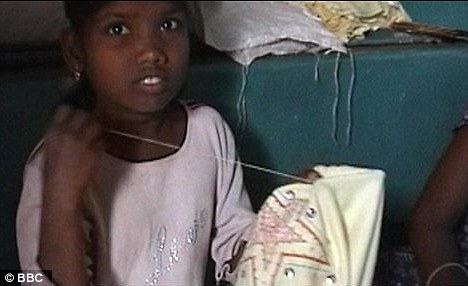
BBC Panorama, caught faking child labour footage, returns prestigious TV award

Primark: On the Rack
Two weeks after the BBC admitted that its journalists had partly faked child labour footage in India, the public broadcaster has returned a prestigious television award won by the controversial programme.

BBC had earlier won the Current Affairs Home Prize at the Royal Television Society awards for its show Primark: On The Rack, which was first broadcast on BBC 1 channel in June 2008.

In an internal investigation, the BBC Trust – an independent body which safeguards the values of the publicly funded corporation – found that it ‘more likely than not’ that certain footage in the Panorama programme was not authentic.

The implicated retailer, Primark, criticised the BBC for taking so long to find in its favour when evidence casting doubt on some of the video material has been in the corporation’s possession since before the documentary first aired in 2008.

BBC Panorama claims to be the world’s longest running investigative TV show, and has been on the air for more than 50 years. In that time, it has done some excellent exposures on matters of vital public interest.

Yet hinting a decline in both editorial and ethical standards at the BBC, the reporting team was found to have taken liberties with certain visuals in this particular programme. It investigated Primark’s claims that it can deliver ‘cheap, fast fashion’ without breaking ethical guidelines, and included footage obtained in a Bangalore workshop of three boys carrying out an activity described in the programme as ‘testing the stitching’ on Primark garments.

According to the Daily Mail: “The BBC Trust’s Editorial Standards Committee examined evidence such as the unedited ‘rushes’ of the programme and emails to the production team from the freelance journalist Dan McDougall, who obtained the footage.”

BBC Trustee and Chair of the ESC Alison Hastings said after their investigations: “The BBC’s investigative journalism is rightly held in very high regard, and for more than fifty years Panorama has made a very significant contribution to that. But great investigative journalism must be based on the highest standards of accuracy, and this programme on Primark failed to meet those standards. While it’s important to recognise that the programme did find evidence elsewhere that Primark was contravening its own ethical guidelines, there were still serious failings in the making of the programme. The Trust would like to apologise on behalf of the BBC to Primark and to the audience at home for this rare lapse in quality.”

Read full report here.

Despite all these developments, the BBC Panorama official web page for this programme shows no indication of this turn of events. Accessed on at 01:30 GMT on 30 June 2011, the page says it was “last updated at 13:31 GMT, Wednesday, 18 June 2008 14:31 UK”. No apology, no correction, no link to the BBC Trust’s report.

The programme’s blurb still reads: “Panorama puts Primark’s claims that it can deliver cheap, fast fashion without breaking ethical guidelines to the test. Posing as industry buyers in India, the programme’s reporter Tom Heap and his team find some of India’s poorest people working long, gruelling hours on Primark clothes in slum workshops and refugee camps.”

So who puts the BBC Panorama to test? Are investigative journalists above the ethics of journalism because their work is hazardous, and is ultimately meant to be in the public interest?

Even Homer nods, and the best intended investigative journalists can – and do – make occasional mistakes. The important question is whether this was a bona fide error in judgement, or does it suggest a trend where the BBC’s investigative journalists and producers arrogantly believe that the end justifies the means?

Many documentaries rely on re-enactments for certain scenes, which are usually labelled as such. Does exposing child labour in supply chains give the license for do-gooding journalists to manipulate individuals and images to suit a preconceived notion of a corporation’s complicity? Could they not have resorted to other means – perhaps with less dramatic visuals, but more honest in their sourcing?

Does this rare admission of error on the part of the BBC also raise questions about the integrity of some other hard-hitting and controversial Panorama investigations over the years which have taken on some big-time targets such as the Vatican, the United Nations Peace Keepers or the CIA?

Hard questions indeed for the usually self-righteous Auntie Beeb.

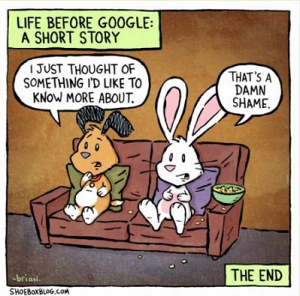
Was There Life Before Google (BG)? Sure, but try finding it!

Like many things, is Google a mixed blessing?

I now divide my life into two distinctive eras: Before Google (BG) and After Google (AG). The monumental ‘dividing event’ occurred somewhere in 1999 <em>Anno Domini (AD), when the now ubiquitous online phenomenon entered my life.

It was a good friend, photojournalist and new media activist Shahidul Alam, who first told me about this new kind of search engine with a funny-sounding name. Google. At that time, it was just a noun.

I was already weary of the simple, simplistic and yellow-page like listings offered by Yahoo, and welcomed this refreshing change. I immediately switched — and haven’t looked at another search engine in the past dozen years. And I also liked its cheerful, multi-coloured logo.

Things weren’t so slick or quick at the beginning, and even Google was learning by doing. We were still in the dial-up era, when 56 kbps Internet access speeds were still mostly an aspiration. Besides, there was far less content online, and far fewer ways to access and process it.

Where Google stood apart, from every other service, was in its better targeted search results. The research of any given quest was still in our hands, but narrowing down was helpful.

We’ve come a long way, and eons in Internet terms, since those early and murky days. With my always on, reasonably fast broadband connection, I now Google effortlessly many times day and night: I know I’m leaving a steady datastream of everything I look for, and that it can be traced, analysed and interpreted by anyone who can force Google to part with this back-end data (usually governments). But that’s the price I pay for Google’s versatile services.

I touched on this when I talked about ’21st Century Media: New Frontiers, New Barriers’ last month at Sri Lanka Press Institute on World Press Freedom Day, 3 May 2011. Here’s my PowerPoint:

A few weeks ago I tweeted “Was there life before Google?” My own tongue-in-cheek answer was: Sure, but I can’t easily locate anything from that period!

Not everyone appreciates Tweeted humour. I received a range of replies online and offline, mostly negative. Some cyber-skeptics faulted me for ‘deifying an American corporation like Google that is out take over the world’ (they haven’t heard the news!).

Others, school teachers and librarians among them, told me that Google has plenty to answer for. They lamented that many people have now forgotten the art and science of looking for a specific piece of information and imagery using well-organised information sources that combine physical and computer-based services. Professional information managers view Google as a superficial, hit-or-miss, much diluted version of their noble craft. Cyber take-away to be consumed on the run, as opposed to a gourmet meal to be partaken and enjoyed at leisure.

Sounds familiar?
I’m old enough to have used libraries diligently and regularly for several years of my working life. I still do, when I can’t easily locate something online — especially historical content that remains under-represented or non-existent on the web. For me, it’s not a question of either/or.

In fact, my frustration is that enough content from the pre-Internet period (much of history) is not yet available online in properly searchable ways. That includes my own personal archive. I’ve been producing journalistic output in the media for 25 years in print, radio and television outlets. The electronic media output is completely lost, and practically everything I wrote before 2000 AD (or Year 1 of my personal AG) is also not online. And my output in Sinhala, including my current Sunday column in the Ravaya newspaper, is not available online.

No, I don’t idolise Google as a global deity. But I thank Google a few times every day. Increasingly often, that includes times when I want to locate a specific reference to something I myself have written and published. This is what happens after writing several thousand pieces on a wide range of subjects and topics.

I envy those who can still recall precise details of their own vast bibliographies. As for me, I routinely turn to my usually reliable and well-informed friend Google. She rarely lets me down.

PS: One facility I stubbornly refuse to use is GMail. Google’s idea of a web-based email service never appealed to me, a Digital Immigrant who is not fully convinced about storing all my correspondence ‘in the cloud’. What really puts me off is how fleeting, erratic and often utterly incomprehensible GMail users are in their replies. There are a few honourable exceptions, but most GMailers I know are a confused and confusing bunch. I love you, Google, but when it comes to email, thanks but I’ll continue to operate my own accounts, branded on my own domain name.

A ‘Greek’ among Geeks and Greens…

Asking questions. Connecting the dots. Explaining matters.

These actions sum up what I have been doing in the spheres of communication and development for over 20 years. They form the cornerstone in my attempts to make sense of our globalised world and heady times.

As a journalist, I was trained to look for what’s New, True and Interesting (‘NTI Test’). Early on, I went beyond just reporting events, and probed the underlying causes and processes. With experience, I can now offer my audiences something more: perspective and seasoned opinion.

I look back (slightly) and look around (a lot) in a half-hour, in-depth TV interview with media researcher/activist and fellow citizen journalist Sanjana Hattotuwa. This was part of The Interview (third series) produced by Young Asia Television, and broadcast on two Sri Lankan TV channels, TNL and ETv on May 8 (with repeats).

Watch the full interview online: Sanjana Hattotuwa talks to Nalaka Gunawardene

Nalaka Gunawardene from Young Asia Television on Vimeo.

I have always worn multiple ‘hats’, and dabbled in multiple pursuits rather than follow narrow paths of enquiry. I see myself continuing to oscillate between the ‘geeks’ and greens, and where possible, bridging their worlds.

I sometimes feel a strange kinship with the ancient Greeks, who first asked some fundamental questions about the universe. They didn’t always get the answers right, and neither do I.

But it’s very important that we question and critique progress – I do so with an open mind, enthusiasm and optimism.

Note: I was also a guest in the first series of this show, in February 2009, which led to this blogpost.

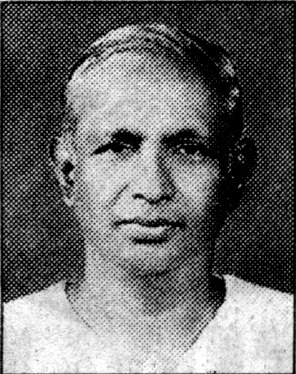
T (Tambiaiah) Sabaratnam: Fond farewell to a pathfinder science journalist

Tambiaiah Sabaratnam
I seem to be writing a few fond farewells to fellow travellers every year, becoming an obituarist of sorts in that process. I don’t go to funerals if I can help it (they’re too depressing), and instead I withdraw to a corner to write my memories. Some are published; others are privately circulated.

I’ve just published such a tribute on veteran Lankan journalist T (Tambiaiah) Sabaratnam, who died on March 5 aged 79. He was a senior colleague when I entered the world of journalism in the late 1980s. He retired (sort of) in 1997, but remained active in the world of media to the very end.

He was an outstanding journalistic story-teller. As I wrote in the tribute: “He was a pathfinder and leading light in Sri Lankan science journalism for over a generation. Throughout his long association with the English and Tamil press, he advocated the pursuit of public science: tax-payer funded scientific research for the benefit of the people and economy.”

Here’s another excerpt, more personalised:
“He was a source of inspiration and encouragement to me during my early years in science journalism. Our paths crossed often in the late 1980s and early 1990s when he and I covered many of the same scientific events. He was approachable and helpful, but I could never bring myself to call him ‘Saba’. When I knew him, he had already been in journalism for longer than I’d been alive. To me, he was always ‘Mr Sabaratnam’.

“He reached out despite our generational, media house and other divides. He was genuinely interested in my progress as a science journalist, and offered me advice on both style and substance. Occasionally, he also cautioned about on various ‘pitfalls’ in the local scientific scene — personal rivalries, exaggerated claims or oversized egos.”

Read the full tribute on Groundviews.org: Tambiaiah Sabaratnam (1932 – 2011): The Storyteller of Public Science

Read compact version in Daily News, 15 March 2011: Tambiaiah Sabaratnam (1932 – 2011): Storyteller of public science

Drowning in Media Indifference: Who cares for the backwoods?

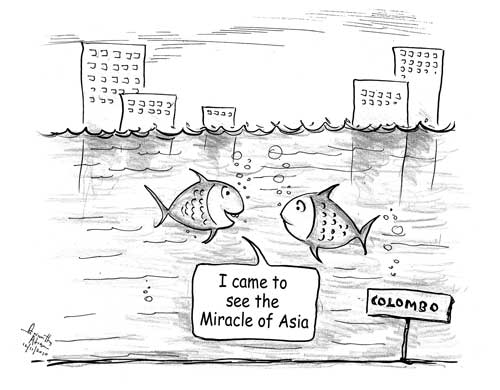
Cartoon in Daily Mirror, Sri Lanka, on 12 November 2010

Why do movie audiences in this part of the world cheer every time they see alien invaders blow up the White House? For a long time I thought it had something to do with anti-American sentiments; then I heard that many US audiences react the same way. Perhaps some among us get a kick out of seeing overbearing governments in trouble?

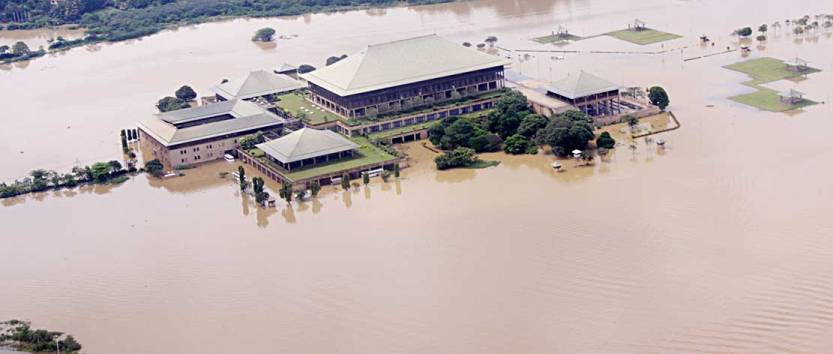
That might explain the gleeful tone with which the Colombo media reported the Sri Lankan Parliament being flooded after torrential rains in mid-November. Newspapers and television channels repeatedly showed images of the Parliamentary complex – built three decades ago on a marshland – completely marooned. The hapless people’s representatives were ferried across the expanse by the military, to take part in a brief session to extend Emergency Regulations. The symbolism was inescapable.

When the trapped rainwater engulfed many areas in and around Colombo, thousands of affected people groaned, but no one was really surprised. By now Sri Lankans know this is almost an annual routine. As I sat knee-deep in my own flooded office, I had a strong sense of déjà vu.

This is the opening of an op ed essay I’ve just written for Himal Southasian magazine, whose March issue carries a cover story on disasters in South Asia.

My essay, titled Drowning in media indifference, takes a personalised look at how the Lankan media have covered different disasters in the past two decades.

“Once again, the mainstream media in Sri Lanka has proven itself irrelevant in reporting and responding to catastrophic flooding,” says the intro — and that pretty much sums it up.

Sri Lankan Parliament flooded after torrential rains in mid-November 2010. The complex, built on a marshland, was completely marooned.

I recall how, back in 1992-93, the then media (fewer in number, with broadcasting still a state monopoly) provided saturation coverage for a major flood in the capital Colombo while under-reporting an even worse flood in the provinces a few months later.

“Fast forward to the present – and how little things have changed! During the past three months, as the fury of the formidable little girl (La Niña, the global weather anomaly) played havoc on the island, I have been struck by the similarly lop-sided coverage in the country’s mainstream print and broadcast media. Urban flooding once again received ample front-page coverage and ‘breaking news’ treatment. Everyone, from cartoonists and editorialists to talk-show hosts and radio DJs, ranted about what was taking place. Yet the much worse flooding, once again in the north, east and centre of the country, received proportionately much less attention. There were a few honourable exceptions, but by and large the 1992-93 disparity was repeated wholesale.”

I have been both an insider and outsider in this issue. I consider myself to be part of the extended mass media community in Sri Lanka for over two decades: I have worked for newspapers, magazines, radio and TV stations. At the same time, I retain the ability – and independence – to steps back and take a more critical and objective look at the media industry and community.

My interest in how disasters are covered and communicated go back to the time when my own house was flooded in mid 1992. I have since researched and commented extensively on this issue, and co-edited the 2007 book Communicating Disasters: An Asia Pacific Resource Book (TVEAP/UNDP).

In this latest essay, I reiterate an argument I’ve been making for sometime: “Media researchers have long accused the Western and globalised news media of having an implicit ‘hierarchy’ of death and destruction, in terms of how they report disasters in developing countries. But Sri Lanka’s own media’s indifference is equally appalling – the story of a quarter-million displaced people languishing in squalid conditions for weeks on end did not constitute front-page news. A starlet entering hospital after a domestic brawl excites news editors more than thousands of flood-affected provincial people starving while waiting for relief.”

Read the full essay, Drowning in media indifference, on Himal Southasian magazine’s website.

People Power beyond regime change: Now for the long haul in Egypt…

It's more than just a change at the top...

This is one of the more popular cartoons about People Power revolution in Egypt. The icon of pyramid has been irresistible for many cartoonists, but this one is especially profound: it says so much with so little!

We salute all ordinary Egyptians whose 18 days of resolve and agitation have driven out the dictator Hosni Mubarak. But as I tweeted to my Egyptian friend Nadia El-Awady on the night of 11 February soon after hearing Mubarak’s resignation: “One huge roadblock is now gone; we hope you’ll persist in your long march to democratic freedom.”

Toppling an unpopular, ruthless dictator is never easy, but the immediate aftermath is the most decisive – and dangerous – moment. This is when the ultra-nationalists and fundamentalists will compete with the democrats and liberals to fill the void. In Iran, when the Shah fell in 1979 after prolonged people power, it was a theocracy that replaced the autocracy. So people power requires constant vigilance, especially now.

People Power does not – and should not – stop at elections or revolutions in any country: regime change is only half of the struggle won. Ensuring people have a say in how their governments are run requires constant engagement by their citizens. This is a topic I have long been interested in, and written about. I also helped produce a global TV documentary on the subject in 2004. See these blog posts and web story about that film:

People Power beyond elections and revolutions: New documentary from TVE Asia Pacific profiles social accountability in practice

Blog post in August 2007: People Power: Going beyond elections and revolutions

Blog Post in August 2007: New Face of People Power: Social Accountability in Action

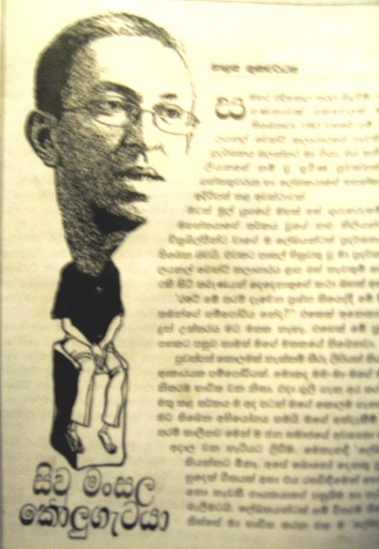
New column in Ravaya newspaper: Little Boy asking Big Questions…

Graphics identity for my new Ravaya column As a journalist, I was trained to look for what’s New, True and Interesting (‘NTI Test’). Early on, I went beyond just reporting events, and probed the underlying causes and processes. With experience, I can now offer my audiences something more: perspective and seasoned opinion. These are needed today more than ever as we wade through massive volumes of information, trying to make sense of it all.

I’ve been privileged to chronicle and comment on the closing decade of the 20th Century and the opening one of the 21st – years of unprecedented change, and considerable turmoil, in my country (Sri Lanka), region (Asia) and the world. In my chosen areas of science, technology and sustainable development, changes have happened at a dazzling and often bewildering speed.

As a science writer and development film maker, I work with researchers, activists and officials across Asia who struggle to balance ecological concerns with economic development imperatives. I call myself a ‘critical cheer-leader’ of their efforts. Through TVE Asia Pacific, SciDev.Net and my other affiliations, I seek to enhance the public understanding of complex issues and choices required in pursuing sustainable development.

I sometimes feel a strange kinship with the ancient Greeks, who first asked some fundamental questions about the universe. They didn’t always get the answers right, and neither do I. But it is very important that we question and critique progress – I do so with an open mind, enthusiasm and optimism. On some occasions, this involves asking uncomfortable questions that irk those in positions of power and authority. In that sense, I sometimes play the role of that little boy who told the Emperor had no clothes on. (Does anyone know what happened to the boy after that?).

This is the basic premise for a new weekly newspaper column I am writing from this month in the Sinhala weekend newspaper Ravaya. A few weeks ago, the executive editor of Ravaya invited me to write a regular column, which I accepted after some hesitation. My hesitation was not about them; it was about my own ability to express myself in Sinhala, a language I studied more than a quarter century ago, but have not worked in for over 20 years. But I’ve decided to take it on as a challenge, and see how far I can go and how well I can write on topics and issues that are close to my heart: science, technology, environment and development. The first column has just appeared in the Ravaya issue for 6 Feb 2011.

Ravaya: Always Open for Debate

I have been a regular reader of Ravaya in all its 25 years of publication. As I wrote in a book review last year: “It is an extraordinary publication that has, for nearly a quarter of a century, provided a platform for vibrant public discussion and debate on social and political issues. It does so while staying aloof of political party loyalties and tribal divisions. While it cannot compete directly (for circulation) with newspapers published by the state or press barons, this sober and serious broadsheet commands sufficient influence among a loyal and discerning readership.”

Published by a company owned by journalists themselves, Ravaya is almost unique among Lankan newspapers for another reason: its columnists and other contributors are allowed to take positions that are radically different from those of its formidable editor, Victor Ivan. I’m not sure how soon I will get to test this, but such pluralism is very rare in today’s mainstream media in Sri Lanka.

Saluting Journalism’s First Decade of I-Me-Mine!

My DIY as POY: Famous at last?
“All I can hear I me mine, I me mine, I me mine.
Even those tears I me mine, I me mine, I me mine.
No-one’s frightened of playing it
Ev’ryone’s saying it,
Flowing more freely than wine,
All thru’ your life I me mine…”

When George Harrison sang those words in the 1970 Beatles song ‘I-Me-Mine’, he was in two minds about expressing in the first person (or ego). He wasn’t alone: mainstream journalism has long had reservations about where ‘I’ fit in journalistic narratives.

“Never bring yourself into what you write,” we were told in journalism school 20 years ago. Journalists, as observers and chroniclers of events, write the first drafts of history – and without the luxury of time or perspective that historians and biographers take for granted. We often have to package information and provide analysis on the run. Bringing ourselves into that process would surely distort messages and confuse many, it was argued. We had to keep our feelings out of our reportage lest it affects our ‘objectivity’.

In other words, we were simply mirrors reflecting (and recording) the events happening around us. Mirrors can’t – and shouldn’t — emit light of their own.

Occasionally, if we felt the urge to express how we personally felt about such trends and events, we were allowed the luxury of an op-ed or commentary piece. Of course, as long as we ensured that it was a measured and guarded expression. And if we really wanted to bring ourselves into the narrative, we could use the archaic phrase ‘this writer…’ to refer to ourselves.

But never use I-Me-Mine! That would surely sour, taint and even contaminate good journalism – right?

Well, it used to be the ‘norm’ for decades — but mercifully, not any longer. Thanks largely to the new media revolution triggered by the Internet, writing in the I-Me-Mine mode is no longer frowned upon as egotistic or narcissistic. It sometimes is one or both these, but hey, that’s part of cultural diversity that our information society has belatedly learnt to live with…

We journalists are late arrivals to this domain. The first person narrative was always valued in other areas of creative arts such as literary fiction, poetry and the cinema. In such endeavours, their creators are encouraged to tell the world exactly how they feel and what they think.

Of course, some writers ignored orthodoxy and wrote in the first person all along. One example I know personally is the acclaimed writer of science fiction and science fact, Sir Arthur C Clarke. Shortly after I’d started working with him in 1987, Sir Arthur encouraged me to fearlessly use the first person narrative even in technical and business writing. A lot of writing ended up being too dull and dreary, he said, because their writers were afraid of speaking their minds.

Yet we had to wait for the first decade of the Twenty First Century to see I-Me-Mine being widely accepted in the world of journalism. Did the old guard finally cave in, or (as sounds more likely) did Generation Me just redefine the rules of the game?

Whatever it is, I-Me-Mine is now very much in vogue. And not a moment too soon!

Joel Stein (Photo-illustration by John Ueland for TIME)
As Time columnist Joel Stein, who often writes with his tongue firmly in his cheek, noted in a recent column: “All bloggers write in first person, spending hours each day chronicling their anger at their kids for taking away their free time. Every Facebook update and tweet is sophomoric, solipsistic, snarky and other words I’ve learned by Googling myself.”

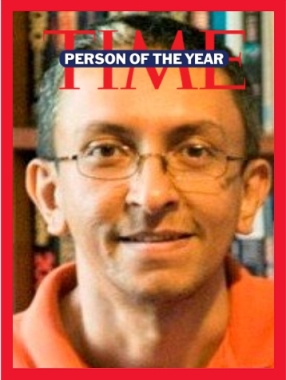
And look at what Time just tempted me to do: put myself on their cover, as the Person of the Year (POY), no less. While designating Facebook’s founder Mark Zuckerberg as its POY 2010, Time teamed up with the social media network to introduce a new application that allows anyone to become POY with just a few key strokes. Provided you have a Facebook account, of course.

Joel Stein quotes Jean M Twenge, professor of psychology at San Diego State University, as saying that we are living in the Age of Individualism, a radical philosophical shift that began with Sigmund Freud. It has exploded during the past decade with reality television, Facebook and blogging. “You’re supposed to craft your own image and have a personal brand. That was unheard of 10 years ago,” Twenge says.

What a difference a decade can make. Although trained in the pre-me era, I was never convinced as to why I had to keep myself out of what I write. However, my use of I-Me-Mine was done sparingly in the late 1980s (when I started my media work) and during the 1990s. It was only in the 2000s that I finally found both the freedom to speak my mind – and the ideal platforms for doing so: blogging and tweeting.

As my regular readers know, I blog about my family, friends, pet, travels, writing and conference speaking. I liberally sprinkle photographs of myself doing various things. I tell you more than you really want to know about my life. Ah yes, I’m self-referential too.

And not just on this blog. I’ve also been writing op ed essays for various mainstream media outlets for much of the past decade, and have never hesitated in expressing what I think, feel and even dream about. (Isn’t that what opinion pieces are meant to be?)

But the Digital Immigrant that I am, all my writing is shaped by my pre-Internet training. Even for a blog post or tweet, I still gather information, marshal my thoughts and agonise over every word, sentence and paragraph.

As my own editor and publisher on the blog, I don’t have gatekeepers who insist on any of this. My readers haven’t complained either. Yet I write the way I do for a simple reason. I may indulge in a lot of I-Me-Mine, but I don’t write just for myself. You, gentle reader, are the main reason why I strive for coherence and relevance.

(OK, if you really must know, it also ensures a joyful read when I occasionally go back and read my own writing…)

Anand Patwardhan: Film maker as perennial trouble-maker

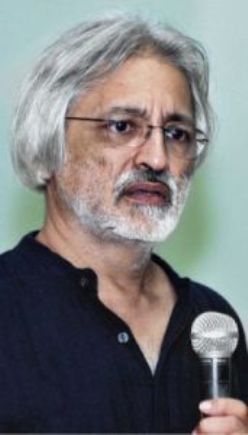
Anand Patwardhan

Anand Patwardhan is one of India’s best known and most outspoken documentary film makers. He has been making political documentaries for over three decades, pursuing diverse and controversial issues that are at the crux of social and political life in India. He epitomises the activist film maker and has inspired a generation of socially sensitive film makers.

In the world’s largest democracy that is India, and in a country with a vibrant and diverse media that is considered to be among the most free in the developing world, Anand has constantly run into problems getting his films seen on broadcast television. Many of his films were at one time or another banned by state television channels in India and became the subject of litigation by Anand, who successfully challenged the censorship rulings in court.

As his website notes, several of his films have also incurred the wrath of right wing fundamanentalists both in India and abroad. “In keeping with the uneven nature of India’s democratic institutions and its sharply divided polity, bouquets have been accompanied by brickbats.”

I came across a good interview with Anand Patwardhan in the Indian current affairs magazine Frontline, issue for 4 – 17 December 2010. Here are two questions concerning the censorship problems he has often faced:

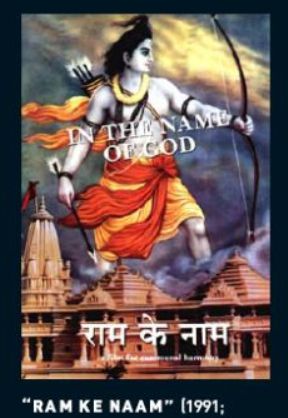
Ram Ke Naam (In the Name of God), 1991
Q: You have had problems getting clearance from the Central Board of Film Certification for almost all your films, and then later they were not allowed to be screened on Doordarshan. Your films are also not screened on private channels. How do you see this constant struggle with these forms of censorship?

A: Right from the first film, I faced censorship in some form or the other. Even the Janata Party after it came to power refused to screen Waves of Revolution though it was against the Emergency. L.K. Advani was the Information and Broadcasting Minister then. I had added an epilogue which said that the janata raj [people’s rule] that the film spoke about was not the same as [that of] the Janata Party now in power. I also drew attention to the political prisoners still being held in jail. Finally, after media pressure built up, the film was screened on Doordarshan.

Prisoners of Conscience also got into trouble with the censor board, and it took a letter from Satyajit Ray to the government saying that they must not stop a film like this to get the required clearance.

Ram Ke Naam followed the rath yatra of Advani and the violence in Ayodhya on October 30, 1990, when the Babri Mosque was attacked for the first time. It was meant to be a warning to the nation about the rise of Hindutva fundamentalism. I had trouble with the censors initially, but it finally got through in 1992 and then I had trouble with Doordarshan, which refused to show it. Finally, after the film won a national award for Best Investigative Documentary, I was able to go to court and argue that the government cannot give me a national award and yet say that I cannot show the film on Doordarshan, which it had been doing systematically. In fact, whenever any film of mine won a national award, I used it to go to court. I argued that not showing such a film on national TV was a denial of my right to freedom of expression and of the viewers’ right to information.

On these grounds I have won seven cases till now – five in the High Courts and two in the Supreme Court after the government went in appeal. Ram Ke Naam was finally shown on Doordarshan in 1997. The judge ordered that the film should be telecast at prime time.

Stills from Anand Patwardhan (courtesy his website)

Q: Why have you not approached private channels to screen your films?

A: The private media, including television, are not about giving people information. They are run by corporates more interested in providing entertainment. Their news and analysis are restricted to five and 10 second [sound] bites. Their clear mandate is commercial. They will ask, “Where are the advertisers who will endorse your product? Who is going to give the money to show this? Are we going to waste one and a half hours of TV time on issues?”

I have also discovered that even in the private domain there is political censorship. A few days before the Allahabad High Court verdict on [the] Ayodhya [title suit] was due, a private channel approached me to screen Ram Ke Naam. They paid me for three broadcasts but stopped after showing the film just once despite extremely positive feedback from viewers. On inquiring, I was told that the channel was pressured not to show the film by both the Information and Broadcasting Ministry and the TV Broadcasters’ Association. Anyone who watches Ram Ke Naam will realise that this censorship was done to protect the interests of unscrupulous politicians who had used the emotive appeal of Ram for financial and political gain.

The situation today is such that you cannot pinpoint where the censorship is coming from. During the Emergency you at least knew who the enemy was. But now what do you do when every wing of society – whether it’s the legal system, and so on – is complicit in a blanket suppression of facts.

Read the full interview in Frontline magazine, issue for 4 – 17 December 2010

Read TVE Asia Pacific profile and interview with Ananda Patwardhan in 2002