Half the sky, most of the suffering…and seeking everyone’s attention!

What’s one of the biggest reasons for suffering from violence?

Is it War? Racism? Extremism?

Or simply being born a woman?

One in 3 women is a victim of violence.

This is the powerful message in this one-minute-long public service announcement (PSA), which can be viewed here:

It was produced by the London-based advertising agency Leo Burnett for UNIFEM, the United Nations Development Fund for Women. With a striking series of images, it reveals that violence against women is one of the most common forms of violence in the world.

This PSA is part of a new global campaign on this scourge.

As UNIFEM says: “Violence against women and girls is a problem of pandemic proportions. At least one out of every three women around the world has been beaten, coerced into sex, or otherwise abused in her lifetime — with the abuser usually someone known to her. Perhaps the most pervasive human rights violation that we know today, it devastates lives, fractures communities, and stalls development.”

The campaign has elements on awareness raising as well as a call to action. The latter includes an online signature campaign that seeks to collect at least 100,000 signatures from those who oppose violence against women.

The online ‘signature book’ opened for signatures on 26 November 2007 with an appeal from actress and UNIFEM Goodwill Ambassador Nicole Kidman. She called the violence many women worldwide face “an appalling human rights violation that can be stopped”, and asked everyone to add their names to a growing number of supporters saying “NO” to violence against women at http://www.saynotoviolence.org.

She added: “The more names we collect, the stronger our case to make ending violence against women a top priority for governments everywhere.”

Watch her appeal on YouTube:

The UN Trust Fund to End Violence against Women , established in 1996, will receive US$ 100,000 from the United Nations Foundation for 100,000 signatures

I have just signed up, on this leap day 29 February 2008. Three months since the campaign was launched in New York, it has so far gathered a little over 58,500 signatures.

It’s certainly commendable – but not nearly enough, and still more than 40,000 needed to reach the modest target of 100,000.

Not that it’s just a numbers game, of course. The quality and sincerity of commitment matter a great deal. At the same time, UNIFEM and other UN agencies trying to engage the public through online interactive methods should study how successful activist groups do the same — with much better and faster results.

Avaaz.org is a leader among these. It is a new global web movement with a simple democratic mission: to close the gap between the world we have, and the world most people everywhere want. Set up in early 2007, it has quickly evolved into online community through which hundreds of thousands of concerned people are taking action together on urgent issues like climate change, poverty, human rights and the crises in the Middle East and Burma.

In October 2007, I joined Avaaz in its signature campaign to focus global attention on the political violence and gross abuse of human rights in Burma. In just four days, thousands of Avaaz members donated over $325,000 online to support the Burmese people’s efforts to peacefully promote political change and tell the world about their struggle.

The Burmese junta may not care for millions of people protesting or donating online, but the leaders of the democratic world – pondering their response to the atrocities in Burma – would find it hard to ignore this surge of public concern.

But it’s a long leap from Burma to the bed room or backyard. A major difficulty faced by those campaigning to focus on violence against women: they are countering actions that are widely distributed, pervasive and sustained over time. Much of it happens at personal and family level, necessarily beyond the public and media’s glare. Incidents flare up only occasionally to spill over to the public space to become news events or talking points.

So, as in many similar instances, out of sight often means out of mind.

The big challenge is how to raise public awareness on a wide-spread issue of violence that happens, to a large extent, in private. The facts and figures are compelling as they are alarming and depressing. The campaigners have lined up some of the biggest celebrities (like Nicole Kidman) and enlisted big guns like UN Secretary General Ban Ki-Moon.

All necessary, but not sufficient.

The campaign needs more than just star power or the UN’s clout to galvanize mass action. For a start, UN agencies need to get out of their fondness for coining and using endless acronyms. Even with my regular forays into the development community’s acronym jungle (read my post on the alphabet soup), I was recently puzzled when a film-maker colleague referred to GBV in an email without explaining it. It took me full five minutes to realise that she meant gender-based violence.

And some imaginative ways of raising the public profile would also help. Browsing on YouTube, I came across this video from Ireland. As one article described it:
“The ghosts and spirits of the millions of women who have been murdered, violated, oppressed, excluded, driven into exile, denied freedom of speech, denied participation in any decisions concerning their lives, because of war, religion, race, culture, age, disability, sexuality, poverty, bonded slavery, domestic violence or bureaucracy, glided in and out of the shoppers of Galway on 7 December 2007.”

Communicating Disasters book launched among communicators

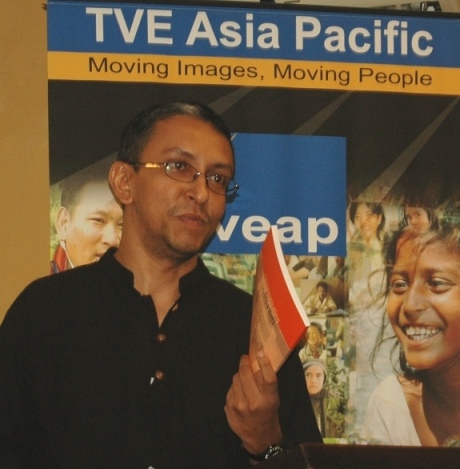
TVE Asia Pacific’s latest publication, Communicating Disasters: An Asia Pacific Resource Book, had its Sri Lankan launch on 19 February 2008.

The multi-author book focusing on how information, education and communication can help create disaster resilient communities across the Asia Pacific was released at the auditorium of Sri Lanka Press Institute (SLPI) in Colombo.

We had invited all contributing authors who are based in Sri Lanka. Six of our 21 contributors currently live in Greater Colombo, and four of them made it: Patrick Fuller, Buddhi Weerasinghe, Manori Wijesekera and myself. We missed Sanjana Hattotuwa (who is overseas) and Chanuka Wattegama.

The news story on the launch event can be read on TVEAP website.

Here are some additional photographs of the event, attended by close to 50 persons working in media, communication and humanitarian sectors.

copy-of-communicating-disaster-book-launch25.jpg

Above and below: Nalaka Gunawardene introduces the what, why and how of the new book

communicating-disaster-book-launch.jpg

copy-of-communicating-disaster-book-launch48.jpg

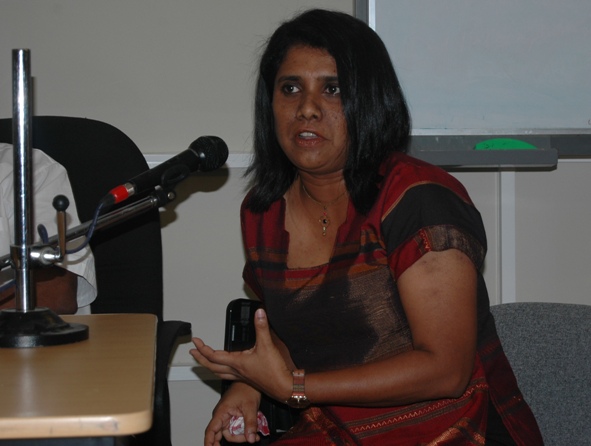
Contributing authors (L to R) Patrick Fuller, Nalaka Gunawardene, Buddhi Weerasinghe and Manori Wijesekera talk about their chapters in the book.

communicating-disaster-book-launch-buddhi-weerasinghe-speaks.jpg

Buddhi Weerasinghe responds to an audience question

manori-wijesekera.jpg

Above: Manori Wijesekera talks about Children of Tsunami

copy-of-communicating-disaster-book-launch58.jpg

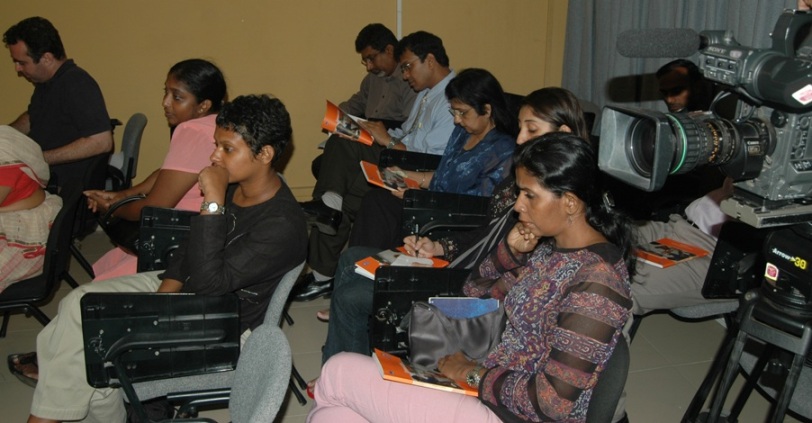
Above and below: Sections of the audience

communicating-disaster-book-launch96.jpg

Photos courtesy: Indika Wanniarachchi and Wipula Dahanayake, TVE Asia Pacific

Governments, disasters and communication: Lead, follow or get out of the way!

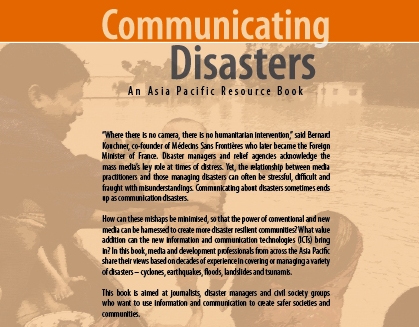
The Association for Progressive Communications (APC) has just published a good review of the book I recently co-edited titled Communicating Disasters: An Asia Pacific Resource Book.

The review is written by two academics. Dr Malathi Subramanian is Former Principal, Daulat Ram College, University of Delhi, India, while Dr. Anupama Saxena is Head, Department of Political Science, Guru Ghasidas University, Bilaspur, Chhattisgarh, India.

As they remark: “The book has articles contributed by authors who do not engage in mere theoretical discussions. They draw on their rich and varied experiences working in either preparing disaster resilient communities or responding to humanitarian emergencies triggered by specific disasters in different parts of the globe.”

They add: “The eminently readable book provides first hand information about the real life situations of disaster, richly illustrated with case studies and use of professional images….The book is written in a manner that successfully sensitises the reader to the complexity of the issue of disaster management and its various nuances. After reading the book one is sure to echo the spirit of one of the contributors, Sanjana Hattotuwa: ‘We cannot prevent or predict all disasters. However, we can plan for, react to and learn from disasters when they do occur’.

In preparation of this review, Malathi and Anupama did an email interview with me where they posed half a dozen questions on some key issues we have addressed in the book. Here is the full interview, which brings out my personal views interspersed with those of some other contributors to our multi-author book.

Question: In developing countries the governments are considered to be the nodal agencies for disaster management. In this context do you think that there is a need to advocate the integration of the National disaster management policy with the national ICT Policy to exploit the potential of ICTs before, during and after a disaster?

Yes, that certainly is the ideal, desirable scenario. But I’m not sure how soon this can become a reality, given how many of our governments think of these sectors as separate compartments – or ‘silos’ – with little or no integration. In the real world, however, these are all mixed up: people who use ICTs are affected by various disasters and the first responders – including relief workers and journalists – use various ICT tools in their work. Increasingly, we are seeing disaster affected people themselves using ICTs, especially mobile phones, to communicate with family, friends, aid officials and others from the scenes of disaster. We have documented specific instances of all this in our book and pointed out that the typical hapless, uninformed affected person is being replaced by a digitally empowered one. So the integration of disaster management and ICTs has been happening on the ground for some time, whether or not policy-makers acknowledge it!

At policy and regulatory level, governments can play an enabling role by easing the various bottlenecks that currently hold back optimum use of ICTs in disaster preparedness, early warning or response. This is so lacking and badly needed in my own country Sri Lanka. One example: amateur radio enthusiasts played a key role in establishing emergency communication with some coastal areas badly hit by the 2004 tsunami. When everything was dead, short wave was alive. Yet, barely months later, the government blocked any new amateur radio equipment being brought into the country as someone felt it was a threat to national security!

But in my view, misguided policies are worse than no policies at all. That’s when I feel like quoting Rabindranath Tagore’s words which every southern government should heed: ‘If you can lead, lead. If you cannot, follow. If you can do neither, then get out of the way’.
tveap-image-archive.jpg

Question: Participatory Modes of communications form a very important part of a comprehensive strategy aiming at creating disaster resilient communities. What type of policies and frameworks the national governments should adopt to facilitate this?

Living with disasters – or developing resilience to disasters – is fast becoming a necessary strategy of day-to-day survival. Communication plays a role in this. In our book, we have an entire chapter on this written by Chin Saik Yoon, who has been researching and documenting participatory communication processes in development. He identifies communication as one of four necessary steps towards recovery from a disaster. Survivors need to maintain communication with family, friends, and counsellors in order to share their experiences. They need to tell their stories about the disaster, and listen to others as they tell theirs. This helps survivors to collectively release their stress.

To continue in his own words: “Participatory communication processes work best here. This is where survivors assume the role of both the ‘initiator’ as well as the ‘receiver’ of communication. No expert or government official should be there to decide what is to be discussed by the survivors. They need only facilitate the process. The participatory processes ensure that communication occurs at the pace that communities are comfortable with and address issues only when survivors are ready to deal with them.”

This makes eminent sense, but it is precisely this kind of thoughtful, sensitive approach that many governments are unable or unwilling to adopt. For too long, governments have been seen as the sole decider, provider and protector – and governments do have a responsibility in all these. But in today’s world, the role of government has to be reviewed and redefined. As Chin says, government officials may facilitate, but governments must get out of the historical habit and temptation of playing Big Mama (or worse, Big Brother!) by doing such communication themselves.

For our quest for disaster resilience to succeed, we need a transformation in governmental policies, attitudes and practices. In a world experiencing a growing number and intensity of multiple hazards, no government – however powerful or well intended – can reach out and protect every citizen. That illusion was shattered forever by hurricane Katrina. There is no need for such governmental omnipresence either! The smart option is to allow, encourage and empower individuals and communities to do part of it on their own. Governments, researchers, aid agencies and charities still have to be part of this – but first they have to break free from the ‘Let’s-Do-It-All-Ourselves’ mentality.

Question: It is evident from the many case studies in the book that participatory non-media modes of communications have been quite useful in dealing with disasters. Such efforts however, need constant involvement of a wider group of people on voluntary basis over a long period of time for creating resilience for disasters. How to develop this spirit and, more important, sustain it.

Yes, participatory communication efforts have to sustain the community engagement over weeks, months and sometimes years. As one of our contributing authors, Buddhi Weerasinghe, has written in the book: “The big challenge is to sustain disaster preparedness interventions over time. This is helped by the creation of informal leadership within the community through participatory action.”

Since no two communities are alike, it’s very hard to generalise on how to develop the necessary conditions and ‘spirit’, but some generic lessons can be drawn from documented examples. The right kind of community leadership helps, as does external help that is neither over-bearing nor fleeting. Assistance from aid agencies needs to be delivered at a pace the communities can absorb, integrate and use.

Disasters are often the latest (and highly disruptive) layer over existing multiple layers in a community. Even if a shared plight and grief temporarily unite a community, that alone cannot hold people together for too long, especially if there are deep divides in that community. So community cohesion and unity become very important factors in the success of participatory communication. There is no single formula that can work for everyone.

cartoon-noahs-doubters.gif

Question: The book describes many successful interventions based on non-media participatory mode of communications for disaster management. Which of these interventions do you think can be cited for the most optimal use of non media participatory mode of communications?

In our introduction to the book, Frederick Noronha and I wrote: “Media-based communication is vitally necessary, but not sufficient, in meeting the multiple information needs of disaster risk reduction and disaster management. Other forms of participatory, non-media communications are needed to create communities that are better prepared and more disaster resilient.”

These non-media communication methods range from basic inter-personal communication and small group discussions to participatory rural appraisal techniques. The methods are not new or unique; they are being customised to meet disaster preparedness and/or response needs.

It’s more than mere talk. Some methods involve experiential learning – or learning by doing. An example is participatory hazard mapping. First, community members are divided into a few groups and asked to map their neighbourhoods – they have to capture the roads, footpaths, rivers, hillocks, houses, schools, temples and other key landmarks. Then they mark the areas that have been affected historically with different disasters such as tsunami, floods or cyclones. This helps identify relatively safer areas as well as safety routes in case a new disaster demands quick evacuation. Admittedly this is communication plus social mobilisation, but that’s what it takes in the real world – communication is only part of the solution.

As Buddhi Weerasinghe has written in his chapter, “This exercise allows informal leaderships to emerge. Encouraging this leadership and recognizing their inputs can motivate them and enable sustainability of interventions. The process of hazard mapping also imparts a sense of ownership.”

Question: To what extent is it really practicable to achieve the ‘disaster resilience’ in communities?

Disasters are all about resilience – how we pick ourselves up after a tragedy and slowly return to normalcy. And also how we take repeated battering from a multitude of disasters and still carry on with living. There is no single recipe for success in building disaster resilient communities. Everyone needs to approach this with open and flexible minds, and see what works for whom under which conditions. Disaster resilience is not a slogan like halving poverty by 2015 or writing off majority world’s debt. It’s a long-drawn, incremental process and will always remain a work in progress because both community dynamics and the nature of hazards change over time.

In many cases, the community has information and insights that help achieve resilience, but it needs to be brought out – that’s where participatory communication helps. But let’s not romanticise matters too much – some communities need external guidance, and most can benefit from external facilitation in their quest for resilience.

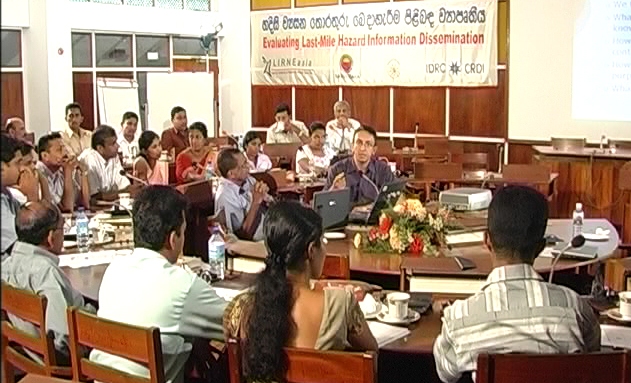
In a chapter called ‘Bridging the Long Last Mile’, I have described the experience of a community-based disaster preparedness and early warning dissemination effort undertaken by Sarvodaya, LIRNEasia and other partners in Sri Lanka. The project studied which ICTs and community mobilisation methods could work effectively in disseminating information on hazards faced by selected coastal communities all of which were battered by the Indian Ocean tsunami of December 2004.
hazinfo-project-meeting-at-sarvodaya.jpg

Sri Lanka – Last Mile Hazard Info project planning meeting: Photo courtesy Sarvodaya

I would refer you to the chapter for details, but the key lessons may be summed up as follows:
• Trusted technology: Use ICTs that are reliable in performance, accessible at the local levels and trusted by the people.
• Complementary redundancy: Always have at least two different ICTs delivering information, to minimise transmission failures.
• Credible information: Tap only the most authentic sources of information at national and international level, reducing room for misinformation and rumour.
• Right mix: Achieve the appropriate combination of technology, training and institutional arrangements at the grassroots.
• Be prepared: Raise localised awareness and provide experiential training so community know what to do when crisis occurs.
book-cover-final.jpg

Can Rambo take on the Burmese junta? Not quite in 90 minutes…

Hollywood’s attempts to support progressive causes in movies continue with Rambo 4, starring Sylvester Stallone.

In the fourth and latest installment of the violent adventures of John Rambo, the Vietnam veteran takes on the Burmese junta who have held the Southeast Asian country in its crushing, ruthless grip since 1962.

Inter Press Service (IPS) journalist Lynette Lee Corporal has just written an interesting article where she talked to Burmese exiles and others involved in Burma issues. Excerpts:

“In his latest caper, a bored-looking Rambo ekes out a living catching cobras in the jungles of Mae Sot in Thailand, near the border with Burma. But the arrival of a group of Christian missionaries, whose idealism and naivete literally led them to a slaughterhouse, changes Rambo’s zombie-like existence and brings back the days of gore and bloodbath.

“The film is unapologetic in its use of cliches. It’s the same tired story: Everything is black and white, good and evil, with lots of do-or-die moments thrown in for good measure.

“‘Rambo IV’ – which started showing in Asian cinemas in January and is due to open in mid-March in Thailand — is replete with stereotypes, especially when it comes to pointing out differences between the east and the west, symbolically played out in the kindness, idealism and determination of the Caucasian missionaries and the uncouth, barbaric bad guys in the form of the Burmese pirates and military.”

She says that while reports of the cruelty of the Burmese junta have been well-documented, the depiction of these stereotypes glosses over much more complex issues too deep to dig up in a 90-minute action movie.

Her article quotes freelance Burmese journalist Phyo Win Latt as saying: “The Burmese army in the movie is different from real-life. The film is filled with exaggeration and inaccuracies. Army officers, for example, don’t wear sunglasses while engaged in battle and although there are rape cases in remote ethnic villages, I’ve never heard of such things like ethnic women being forced to dance in front of the soldiers.”

Exiled Burmese appear to have given it some positive feedback. According to a report by the Norway-based Democratic Voice of Burma (DVB), about 600 Burmese who watched the film in Singapore became very emotional, chanted slogans and distributed political leaflets at the screening.

The crowd “clapped non-stop for 80 seconds to show respect to the movie audience gathered there and to show unity” in their fight for democracy, DVB reported.

Read her full article on Asia Media Forum

I’ll just take Lynette’s word for all this, because I’m not going to see this film – I can’t take a killing every few seconds.

Watch Rambo 4 official trailer on YouTube:
Caution: Extreme violence – but then, what else do you expect in Rambo?

Rambo may have discovered Burma’s long-drawn suffering only recently, but activist film-makers have been using moving images for many years to sustain international attention on Burma’s human rights and humanitarian issues.

Almost five years ago, in May 2003, TVE Asia Pacific website ran a feature titled ‘Documentaries keep Burma issues alive‘. It was written by Indian film-maker and journalist Teena Amrit Gill, who at that time was based in Chiang Mai, Thailand — where many Burma activists are concentrated.

Excerpts:

“Long drawn internal conflicts are often overlooked or completely ignored by the global media that often chase the latest stories as they unfold. It often takes a few dedicated activists and committed film-makers to sustain focus on conflicts that no longer grab headlines – but continue to affect hundreds of thousands of people.

“As Burma and the struggle of its people, especially its ethnic minorities, against four decades of military dictatorship begin to fade from international attention, a number of new television documentaries are attempting to keep the issue alive.

“Some have been made by television professionals for international broadcast. Others have used amateur or activist footage and aim at mobilising public concern and supporting campaigns to maintain pressure on the regime.”

Teena reviewed three new films that had been produced in 2001-2002 about the plight of minority groups like the Karen, Shan and Karenni who live along Burma’s borders with Thailand, China and Laos. These minorities are the target of repressive policies of the ruling military junta in Rangoon.

Read the full article, Documentaries keep Burma issues alive

Sep 2007 blog post: Kenji Nagai (1957 – 2007): Filming to the last moment

Another point of view: Entertainment the Burmese military way, by Ye Thu on DVB website

AlertNet for Journalists: Rough guide to disasters and ‘alms bazaar’

Journalists are among the first responders to disasters and conflicts that break out without notice. They have to gather information from ‘ground zero’, process it and disseminate as rapidly and accurately as possible.

Easier said than done – especially when there’s more than the usual level of chaos, confusion and consternation. The multitude of humanitarian workers and their agencies who rush to such situations – to provide much-needed rescue, relief and recovery support – don’t always make life easier for journalists.

Yet they need each other. They just have to find better ways to work together. This is the central theme of our just-released book, Communicating Disasters: An Asia Pacific Resource Book – the entire book is now available online for free download.

reuters-alertnet-logo.jpg

One of the appendices to the book was contributed by Emma Batha of Reuters who talked about Reuters AlertNet for Journalists.

AlertNet for Journalists is “a set of free online tools designed to help journalists cover conflicts and disasters. The resources include crisis briefings, country statistics and aid agency contacts.”

It is part of Reuters AlertNet, a non-profit humanitarian news network based around a popular website, set up in 1997 by the Reuters Foundation. It aims to keep relief professionals and the wider public up-to-date on humanitarian emergencies around the globe.

Here’s a short video that AlertNet has just placed on YouTube – their first film to be thus offered:

It’s good to see more humanitarian and disaster related organisations engaging the YouTube. I wrote in October 2007 about UN-ISDR taking the plunge, placing some of its videos on a YouTube channel.

Read Emma Batha’s contribution to Communicating Disasters: Reuters AlertNet for Journalists

Return to Paradise: Maldives on the frontline of climate change

Related blog post: 6 Jan 2008: Little voices from the waves: Maldives too young to die

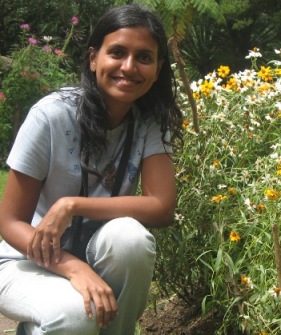
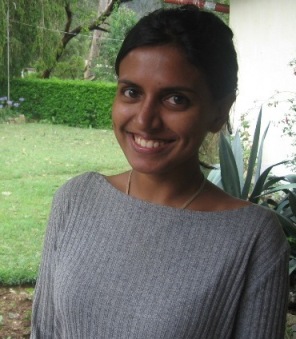
Mariyam Niuma - photo by TVEAP

All of us at TVE Asia Pacific are missing Mariyam Niuma.

This bubbly, happy-go-lucky intern returns to her native Maldives this week after working with us for over a year as a programme assistant. She plans to spend more time with her family, and explore work opportunities in the Indian Ocean archipelago nation of 370,000 people.

Niuma, in her early 20s, applied for a staff position in late 2006. Among other things, she came with skill and dexterity in graphic design, web research and English proficiency — always useful for a regional communication organisation like ourselves.

“I want to learn as much as I can how a non-profit organisation works,” she told as at the recruitment interview. She had plans of taking the knowledge and skills back to her home atoll, hoping to make life better for her people.

I hope she found what she was looking for. We found in her an energetic young person with good attitude – one who could be challenged to work on tough (and sometimes tedious) tasks on a regular basis.

“The last year has been a very challenging and fulfilling year for me, and being at TVEAP helped a lot,” she wrote in an email on her last day at work. “I will miss you all and being a part of you and will always remember the good times and everything I have learnt here both professionally and personally.”

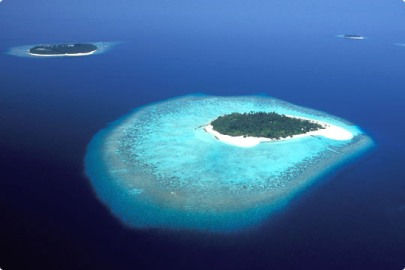
Some months into her internship, Niuma gave us a presentation on her home country, home atoll and life at home. To many outsiders, Maldives evokes images of palm-fringed sandy beaches, shallow seas of an exquisitely azure blue, high end resorts, crystal clear blue waters for diving…and plenty of sunshine all the year round. (Image shows Kurumba resort, Maldives.)

Well, all that’s true as widely advertised. But Maldives is a whole lot more – a history going back to at least 1,500 BC, distinctive island culture, and a nation that is struggling to reconcile tradition with modernity. Divehi, the Maldivian language, contributed the word “atoll” (a ring-shaped coral reef) to the English language.

The former British protectorate, which became independent in 1965 and a republic in 1968, has a pro-democracy movement sustained over the past few years. If such political turbulences create a sense of uncertainty in the minds of Maldivians about their future, it’s only one source of concern.

They also have to worry about whether their nation would have a collective future. That’s because of climate change that scientists now confirm are underway, aggravated by human action.

Most of the 1,200 islands in the Maldives are no more than 1m (3 feet) above sea level. Even a modest rise in sea levels could inundate these lands. Within 100 years the Maldives could become uninhabitable.

Time is indeed running out for Niuma and her country — as this poster produced by The Body Shop reminds us.

Time is running out...and not just for the Maldives

In 1987 and 1991 storm surges flooded a large number of islands, including one-third of the capital where one-quarter of the country’s population lives. Unusually high waves forced the international airport to be closed, causing great damage to tourism and constraining emergency relief operations. On 26 December 2004, the Asian tsunami battered the Maldives, forcing the evacuation of 13 of its 200 inhabited islands. These incidents indicate how vulnerable the islands are to wave action.

Maldives was among the first countries in the world to raise climate change as a serious issue at the United Nations. President Maumoon Abdul Gayoom raised the alarm back in 1987, when most people had not even realised the problem and scientific evidence was just beginning to come in.

The Maldives did more than raise the issue. The country played a lead role in rallying around other small island states worldwide that would be among the first to be impacted when sea levels rise due to thermal expansion and melting of polar ice.

In November 1989, the Maldives hosted the first ever small states conference on sea level rise, which was one of the first international scientific events that I covered as an eager young science journalist.

The conference issued the Malé Declaration on Global Warming and Sea Level Rise, which urged for inter-governmental action on the issue. The small island states played a key role in negotiations that led to the UN Framework Convention on Climate Change adopted in 1992. This is the precursor to Kyoto, Bali and other processes that are now very much in the news.

Just a few weeks ago, in mid November 2007, the Maldives once again hosted representatives from small island states to discuss climate change. Eighteen years after the original meeting, the subject is no longer a fringe concern; it’s now on everybody’s agenda.

Maldives from the air: tiny specs in the ocean
The meeting urged the the human dimension of global climate change to be included in the agenda of UN Climate Change Summit in Bali (December 2007), and sought the international community’s commitment “to protect people, planet and prosperity by taking urgent action to stabilize the global climate change”.

This time, the Male’ Declaration on the Human Dimension of Global Climate Change called for the UN High Commissioner for Human Rights to assess the human rights implications of climate change and “to conduct a study into the effects of climate change on the full enjoyment of human rights”. It requested the UN Human Rights Council to convene in March 2009 a debate on human rights and climate change.

I wasn’t at the November 2007 Male meeting, but was glad that the meeting stressed the need for adding a human face to the complex, nuanced challenge of climate change. This resonates very much with my own experience.

Read my April 2007 blog post: Wanted – human face of climate change

Mariyam Niuma takes me a bit closer to the realities of what climate change means to communities living on the frontline. Unlike Niuma, who is web savvy and connected with the wider world, many are blissfully unaware of the problem.

Our challenge is to bring their voices, stories and aspirations to the global news agenda and the myriad discussions now underway searching for solutions.

I hope someday we can work with Niuma again — perhaps amplifying her story in moving images.

Nov 2007 blog post: True people power needed to fight climate change

Related blog post: 6 Jan 2008: Little voices from the waves: Maldives too young to die

Photos of Mariyam Niuma courtesy Manori Wijesekera of TVEAP

Covering disasters in the globalised media: Beyond what happened…

“In a global information society where there is a constant race for who delivers the news first, such news undoubtedly fill a need — the need to know. But does reporting on disaster, conflict, international politics or other issues, throw up other questions beyond ‘what happened’? Questions like: What does this mean? How did this happen? How do other communities cope? Are the funds being put to good use? Is the kind of assistance coming in sensitive to different communities’ needs? Which communities are left out from receiving aid and why?

“These are some of the questions that beg to be delved into, and are the niche for media organisations, whose mission it is to try to look at the bigger picture and put the issues behind the events in context. This is not to say that some are always better than others. It is a way of stressing that ‘media’ are far from a homogenous crowd, and that different media organizations have different media products, stemming from different assessments of their audiences and mission.”

This is an extract from the chapter titled “The 2004 Tsunami: Unfinished Story”, by journalist Johanna Son for Communicating Disasters: An Asia Pacific Resource Book (co-edited by Nalaka Gunawardene and Frederick Noronha, and released in December 2007).

Johanna (photographed below addressing TVE Asia Pacific staff in August 2007), a journalist for two decades, is director of Inter Press Service (IPS) Asia-Pacific, the regional foundation that is part of the IPS international news agency. A Philippine national, Son was previously correspondent and editor for IPS Asia-Pacific, as well as staffer of the Manila Chronicle.

How many ways are there to report on a disaster? Johanna uses examples from IPS to ‘do a post-mortem of sorts in the spirit of sharing the challenges of covering disasters like that of the tsunami and of learning from one another.’

johanna-son-during-tveap-visit-2007-3.jpg communicating-disasters-an-asia-pacific-resource-book-by-tveap-and-undp.jpg

Here are some more extracts – the full chapter will be placed online in January 2008:

On 26 December 2004, I was in Manila, the Philippines, for the year-end holidays when the newsbar across the screens of international TV networks began flashing reports that “scores” were believed to have been killed by a tsunami in the Indian Ocean. It was, we were told, triggered by an undersea earthquake recorded at up to 9.3 magnitude on the Richter Scale. (This has since been called the second most powerful earthquake ever recorded by a seismograph.)

“In the following hours, the number kept rising – first to “hundreds” then to “thousands”. Even without much detail and description, it was clear this was quite a different disaster. News desks around the world went into action.

“The editor for my region was on holidays in Africa. So I was in touch with our regional correspondent, who was then on holidays in Sri Lanka, and also in contact with a regular contributor from Colombo, as well our correspondent in India. We agreed on a few story angles, trying to focus not on what had already been reported and added little to the avalanche of stories out there, but on how, for instance, the effects of the tsunami interplayed with the ethnic tensions in Sri Lanka.

“A look back at the coverage on the IPS wire — ipsnews.net — at that time shows two different kinds of stories in the days and weeks after December 26. Some were more obvious, predictable ones, and other more contextual ones that, regardless of where they were filed from, hew more closely to the news agency’s mission of trying to provide reporting that explains – and not only records what is happening.”

Photo courtesy TVE Asia Pacific

Asian Tsunami of December 2004: A moving moment frozen in time

An Indian woman mourns the death of a relative killed in the Asian Tsunami

An Indian woman mourns the death of a relative killed in the Asian tsunami. The picture was taken in Cuddalore, Tamil Nadu, on 28 December 2004 (REUTERS, Arko Datta)

From every disaster, conflict or tragedy emerges a single photograph that captures its essence in a way that becomes iconic. This image, showing the sheer haplessness of those who survived only just barely but lost everything they had, could well be that for the Asian tsunami of December 2004.

It was taken by Indian photojournalist Arko Datta, who won the 2004 World Press Photo Award for this image.

Indian journalist Max Martin (editor of indiadisasters.org) recently interviewed Arko Datta for a chapter in Communicating Disasters: An Asia Pacific Resource Book (co-edited by myself and Frederick Noronha, and just released). The chapter is titled ‘Stop All the Clocks! Beyond Text: Looking at the Pics’, which argues that disaster photography needs to break away from the constraints of time and space.

Excerpts from that interview:

On frames
I actually do not plan a frame. I am merely a messenger and do not try to bring in subjectivity or my priorities (in my photographs). I have to be very objective when I am covering any event. I leave the viewers to interpret the pictures according to their perspective. However, of course there are certain parameters I like to follow.

I do not like showing corpses or any (image of) morbidity unnecessarily. In natural disasters it is mostly unnecessary; however, in a war, one may need to show the victims as that may be the strongest way of making people aware of the fallout of wars.

In a natural disaster, the story is generally about the survivors — their struggle to cope with the loss of their near and dear ones, their struggle to get back to normalcy. It’s the story of their grit and determination to survive and live.

On emotions
The first viewer of my pictures is myself. When I am touched by a situation, I plan to capture it in my camera and show it to others too. So, definitely, as any other human being, I react to every situation too. However, while on work one has to control and restrain one’s emotions, as no productive work can emerge during an emotional state of mind.

Arko Datta
While covering an event, and covering several events over the years, these emotions keep getting suppressed and bottled up. One needs to know how to tackle this in the long run, or it can deeply effect one’s mind. And everyone has his or her own way of tackling it. I do so by talking to my family and very close friends about my experiences.

On interfacing with humanitarian workers
I feel, on the field, humanitarian workers have their own work to do and the press has its own. The humanitarian workers should not get concerned about the press, as definitely the victims will be their top priority. The press can surely manage on its own. In fact, the press should not come in the way of relief and rescue work.

Here’s his profile from World Press Photo:

Arko Datta started his professional photojournalistic career in an Indian dailies in Madras and Calcutta. He then worked at AFP, and joined Reuters in 2001. His awards include national photo competition prizes from the Indian government, a prize in the Canon International photo competition, a Publish Asia award in Malaysia, Best Photojournalist of the Year award from Asian Photography magazine in India, the Picture of the Year award in Bombay and awards in the General News and Daily Life categories of the Indian Express Photo Competition. His publications include “Lost Childhood”, a book on child labor sponsored by the International Labor Organization, and his pictures are featured in a coffee table book of the most memorable pictures of India in the last 100 years and in the Reuters picture book “On the Road”.

Download the full book chapter by Max Martin, titled: Stop All the Clocks! Beyond Text: Looking at the Pics

Read or download the full book’s contents at TVEAP website

Sri Lanka: What killer waves united, killer humans divided again…

Today is the third anniversary of the Indian Ocean tsunami, which left a trail of destruction in many countries in South and Southeast Asia.

Today we remember those who perished and salute those who survived and endured enormous hardships.

We thank everyone everywhere who donated to help, and curse those who plundered or squandered the outcome of that generosity.

As I wrote in my only published verse, When the Waves Came, written on 28 December 2004 – when the disaster’s full impact was dawning on the world:

When the waves came
Roaring and moving mightily,
Unleashing the power of
A million bombs exploding at once,
They didn’t care
And just didn’t discern
Who or what was in their way.

My basic premise was that the killer waves had been a brutal ‘equaliser’ of all men and women. It no longer mattered on which side of law, morality, economics or social class they stood. This was particularly apt for Sri Lanka, a land divided for a quarter of a century by an armed separatist struggle that has hardened fundamentalist positions at both Sinhalese and Tamil ends of our ethnic spectrum. Towards the end of the verse, I noted:

As we in the aftermath tiptoe
Through endless depressing scenes
Of death and utter devastation
Can we tell the difference
Between Sinhala and Tamil,
Or Muslim and Burgher,
Or soldier and rebel
Or policeman and prisoner
Or rich and poor?

For a few days after the tsunami, there was a flicker of hope that the lashing from the seas might finally convince everyone of the complete futility of war. Political cartoonists in Sri Lankan newspapers were among the first to make this point. One cartoon, appearing two days after the disaster, showed a government soldier and Tiger rebel swimming together in the currents, struggling to save their lives. (Indeed, there were some reports of them helping each other in the hour of need.)

The cartoonists and other media commentators asked a common question: what happened to the land, and the dividing border that both sides had fought so hard and long for?

Alas, what Nature proposed we humans (Sri Lankans) disposed. While the tsunami helped usher in a negotiated settlement to the long-drawn armed struggle in Aceh, Indonesia, it only created a temporary lull in the Sri Lankan conflict. As soon as both sides recovered from Nature’s blow, they were back at each others’ throats again. (This contrast has been studied by various groups – see, for example, the summary of a Worldwatch Institute study Beyond Disasters: Creating Opportunities for Peace).

Looking back three years later, all I can say is that the land killer waves temporarily and forcibly united, killer human beings have managed to divide again for petty political, communal and personal gains.

theeban-survived-the-tsunami-but-not-sri-lankas-conflict.jpg

This boy, Thillainayagam Theeban, epitomizes that bigger tragedy. He survived the tsunami — but not the escalation of Sri Lanka’s ethnically driven civil war, which consumed his life in March 2007.

Theeban was one of eight surviving children – from India, Indonesia, Sri Lanka and Thailand – whose remaining families we tracked and filmed for a year in Children of Tsunami media project, a citizens’ media response to the Indian Ocean Tsunami.

Theeban was murdered by unidentified gunmen who stormed into his ‘temporary’ tsunami shelter on 3 March 2007. The death was linked to political violence that has engulfed Sri Lanka since 2006.

theeban.jpg

When the shocking news reached us three days later, our Sri Lankan camera team at Video Image and we at TVE Asia Pacific just couldn’t believe it. We were all in tears, and some of us were also angry. Theeban, who survived the killer waves 26 months earlier (but lost his mom and kid brother in the disaster) suffered many indignities in displacement. And now, he is gone.

We still don’t know who killed Theeban. He was abducted by an armed group sometime in 2006, from whom he escaped in early 2007. It is believed that Theeban was killed as a punishment for running away — and as a warning to all others.

He was 16 years at the time of his death. It is unlikely that his killers would ever face justice.

As I wrote in my personal tribute to Theeban in March 2007, published by UCLA’s Asia Media and MediaHelpingMedia, UK: “The disaster’s Sri Lankan death toll (close to 40,000 dead or missing) shocked the world when it happened within a few hours or days. Yet, at least twice as many people -– most of them unarmed and uninvolved civilians — have been killed in over a quarter century of fighting. That doesn’t always grab headlines.

“Thillainayagam Theeban has become another statistic in a ‘low-intensity conflict’ (as some researchers call it). And while this war lasts, it will continue to consume thousands of other young lives — a grim roll call of Sri Lanka’s Lost Generation.”

The third anniversary of the tsunami is a reminder – if any were needed – that man’s inhumanity to man is often worse than Nature’s fury.

March 2007 blog post: Remembering Theeban

April 2007 blog post: More memories of Theeban

Children of Tsunami: Documenting Asia’s Longest Year

Thillainayagam Theeban (1990 – 2007)

When the Waves Came – the story behind the verse

I am a word-smith. Trained as a journalist and writer, I play with words (and occasionally make an honest living of it ) — but almost all of my published output over more than 20 years has been in prose. Not yet a creative writer (maybe someday!), I write mostly fact-based analysis or opinions.

One rare exception was when the Asian Tsunami struck three years ago in the last week of 2004. Extraordinary situations prompt extraordinary responses – and I went on to write the only verse I have so far published: When the waves came.

I was recovering from chicken pox when the mega-disaster that struck on 26 December 2004. The killer waves spared the Colombo city on the western part of coastal Sri Lanka where I live – and we were extremely lucky. But with close to 40,000 persons dead or missing (which was 1 in 500 of us), it was not a time to heave sighs of relief. We all knew people who were directly affected in one way or another: losing loved ones, suffering property damage, or seeing their jobs go up in the waves.

In the days following the disaster, the entire country was a giant funeral house. For a short while, at least, our utterly divided nation of Lanka was united — first in horror and then in grief.

creating-disaster-resilience-everywhere.jpg

I first heard about the disaster on local television – whose newscasters were struggling to make sense of what was happening. Tsunamis were not known in the Indian Ocean until then, and most people had not even heard of the term. Broadcast journalists had to improve with terms like ‘ferocious wave action’, ‘seas flooding land’ and ‘seas spilling over to coastal areas’, etc.

As the international news media started reporting the extent of devastation from all over South Asia and Southeast Asia, we realised that Sri Lanka was not alone – even though it had been battered very badly.

By Monday 27 December, the scale of the disaster was clearer, and the Sri Lankan death toll was already past 25,000 -– and counting. Search and rescue efforts were now underway, and relief agencies were continually updating their assessments of damage. The grim statistics kept rising by the hour.

The global family first watched in shock — and then started to react. Around the world, hundreds of caring people were dropping everything they had lined up for their Seasonal holidays and rushing to volunteer in Sri Lanka and other disaster hit countries. Inspired by the saturation media coverage, especially on television, caring women and men in far away corners of our planet were donating generously for disaster relief support. Children were breaking open their tills in which they’d carefully saved small change for months or years. Church congregations had special collections. Performing artistes were getting ready to have Tsunami aid concerts. Spurred and partly embarrassed by these citizen actions, governments belatedly started pledging massive volumes of aid. The worldwide response to Asia’s tragedy was deeply moving (the bickering and swindling came later).

My office (TVE Asia Pacific) was closed that week for Seasonal holidays, but I decided to go in and follow the disaster’s news coverage online (I didn’t have ADSL at home then.) Websites were often giving better coverage than TV channels, and the bloggers were rising to the challenge from many locations in impacted Asia.

I spent most of December 27 and 28 in my office. Weakened as I was by chicken pox, I didn’t rush out to help with relief efforts. I knew my limits. Instead, I was emailing regular updates to our friends and partners from many parts of the world who were concerned and anxious about our safety and well-being. Not being a blogger myself then, I was doing it on a one-to-one basis.

I slowly came to terms with a deep anguish that had built up since I first heard the dreadful news. I was badly shaken and numbed by the unfolding human tragedy and humanitarian crisis all around myself. No, I didn’t lose a loved one, or suffer personal property damage, but it was impossible not to be moved by the carnage and destruction all around. And at a scale that was unprecedented in my lifetime.

For hours on 28 December 2004, I watched the ‘doom and gloom’ television news coverage and monitored news updates online. At that stage, with little news yet emerging from Aceh, Indonesia, Sri Lanka had reported the highest death toll and the greatest damage. It was the biggest disaster in the island’s living memory.

When I finally gathered enough sense and wits, I wrote a verse ‘When the waves came’ – it was one way of coming to terms with the calamity. Its basic premise was that the killer waves had been a brutal ‘equaliser’ of all men and women. It no longer mattered on which side of law, morality, economics or social class they stood.

To drive home the point, I sprinkled the words of William Makepeace Thackeray throughout the verse:
“Good or bad, guilty or innocent —
they are all equal now.”

The verse was not meant for publication, and was only privately circulated for a few days. One friend who received it, Bircan Unver in New York, wanted to publish it on her Light Millennium website. After some persuasion, I agreed.

tsunami-survivor-children-return-to-the-sea-in-suduwella-southern-sri-lanka.jpg

I wrote this verse with tears running down both my cheeks. I kept on typing, without wiping my face, as words poured out from my grief-stricken mind. This was the least I could do, as my tribute to everyone who perished or suffered by nature’s incredible fury.

Writing this verse was cathartic for me. Three years after it happened, I can now disclose what followed my writing of this verse: I closed the laptop, sat down on the floor, and completely broke down.

I have no idea for how long I cried: it must have been 20 or 30 minutes. There was no one in the office that day so I didn’t have to subdue myself. Of course, my tears were nowhere near as abundant as those who lost their loved ones to the tsunami. But they were no less sincere.

Looking back, I suspect that during those hours of sorrowful solitude, Children of Tsunami was conceived.

But that’s another story.

Photos courtesy TVE Asia Pacific