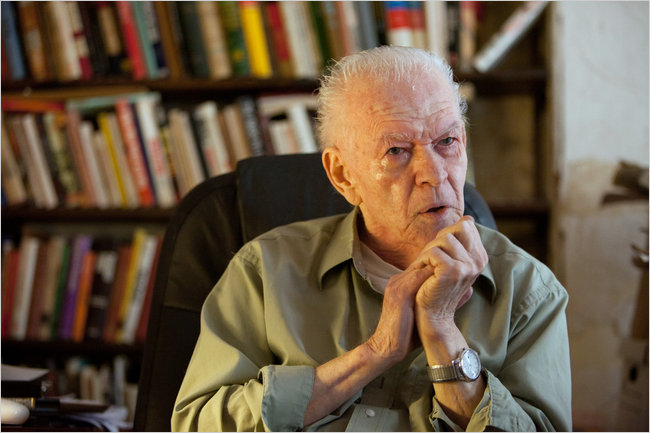
Is this man, now 82 years old, giving the world’s assorted dictators their worst nightmares?
This is Dr Gene Sharp, a Professor Emeritus of political science at the University of Massachusetts Dartmouth in the US, he is widely known for his extensive writings on nonviolent struggle, which have influenced numerous anti-government resistance movements around the world. He is now credited with the strategy behind the recent toppling of the Egyptian government of Hosni Mubarak.
The New York Times on 17 Feb 2011 profiled him with the title: “Shy U.S. Intellectual Created Playbook Used in a Revolution”. The article noted: “Few Americans have heard of Mr Sharp. But for decades, his practical writings on nonviolent revolution — most notably “From Dictatorship to Democracy,” a 93-page guide to toppling autocrats, available for download in 24 languages — have inspired dissidents around the world, including in Burma, Bosnia, Estonia and Zimbabwe, and now Tunisia and Egypt.”
“Gene Sharp is the world’s foremost expert on non-violent revolution. His work has been translated into more than 30 languages, his books slipped across borders and hidden from secret policemen all over the world,” says Ruaridh Arrow, Director of the upcoming documentary titled ‘Gene Sharp – How to Start a Revolution’.
In 2009 Arrow, a producer with Sky News in the UK, began filming a documentary following the impact of Sharp’s work from his Boston house, across four continents and eventually to Tahrir square in Cairo, “where I slept alongside protesters who read his work by torchlight in the shadow of tanks”.
Extract: “Gene Sharp is no Che Guevara but he may have had more influence than any other political theorist of his generation. His central message is that the power of dictatorships comes from the willing obedience of the people they govern – and that if the people can develop techniques of withholding their consent, a regime will crumble.”
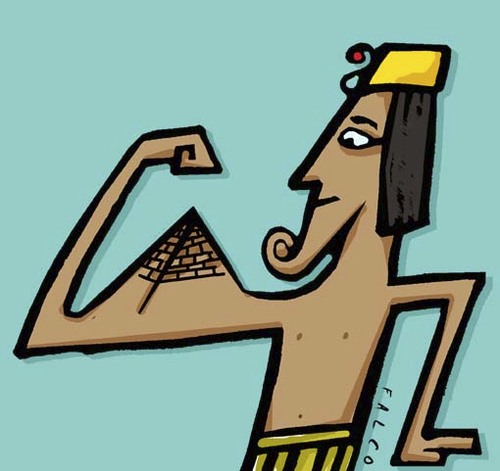
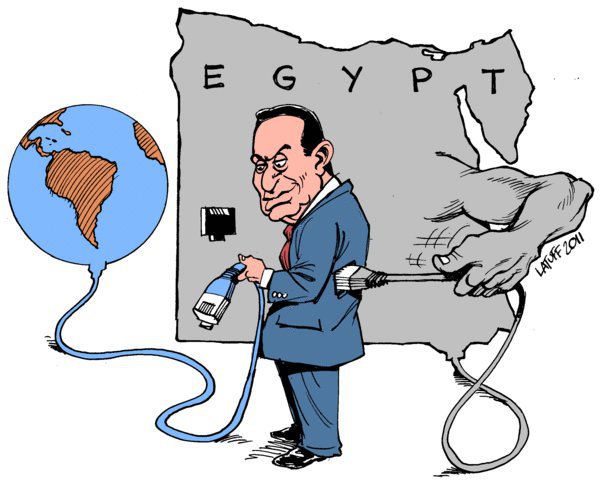
This is one of the more popular cartoons about People Power revolution in Egypt. The icon of pyramid has been irresistible for many cartoonists, but this one is especially profound: it says so much with so little!
We salute all ordinary Egyptians whose 18 days of resolve and agitation have driven out the dictator Hosni Mubarak. But as I tweeted to my Egyptian friend Nadia El-Awady on the night of 11 February soon after hearing Mubarak’s resignation: “One huge roadblock is now gone; we hope you’ll persist in your long march to democratic freedom.”
Toppling an unpopular, ruthless dictator is never easy, but the immediate aftermath is the most decisive – and dangerous – moment. This is when the ultra-nationalists and fundamentalists will compete with the democrats and liberals to fill the void. In Iran, when the Shah fell in 1979 after prolonged people power, it was a theocracy that replaced the autocracy. So people power requires constant vigilance, especially now.
People Power does not – and should not – stop at elections or revolutions in any country: regime change is only half of the struggle won. Ensuring people have a say in how their governments are run requires constant engagement by their citizens. This is a topic I have long been interested in, and written about. I also helped produce a global TV documentary on the subject in 2004. See these blog posts and web story about that film:
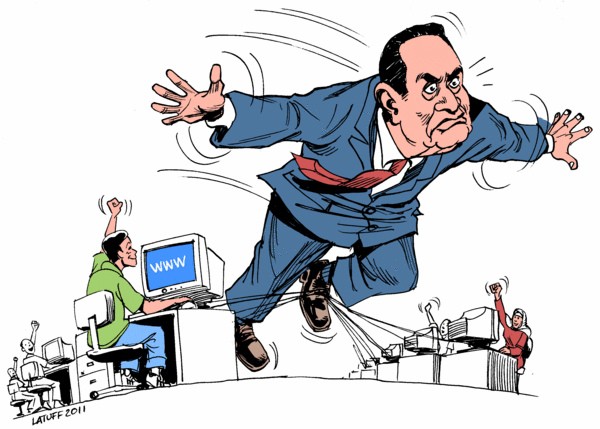
18 Days that changed Egypt: 25 Jan to 11 Feb 2011The geeky Davids bring down the mighty Goliath of Mubarak: Bravo!!!Don't meddle with a proud nation that's 5,000 years old!Mubarak unplugged Egypt from the Internet; Angry Egyptians unplugged him!
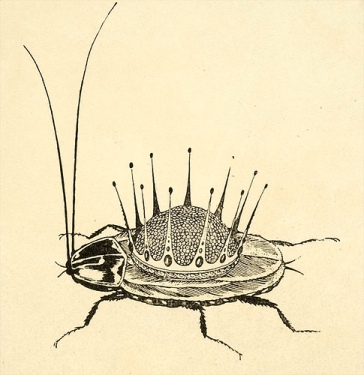
Tarankanische (The Terrible Cockroach) original book cover, 1925
Sometime ago, when I gave a talk at the Sri Lanka Rationnalists’ Association, a member of my audience asked if parents should be banned from reading fairy tales to their children. His argued that children should be raised on reality and not fantasy. I was talking about science fiction and their social relevance, and I answered: there is absolutely no harm in fairy tales as they nurture in our young minds those vital qualities of imagination and sense of wonder. I quoted C S Lewis as saying that the only people really against escapism were…jailers!
These days, not all children’s stories are fairy tales and some of them actually carry very down-to-earth messages either overtly or covertly. Members of that largest club in the world – Parenthood – keep discovering new depths and insights in some children’s stories.
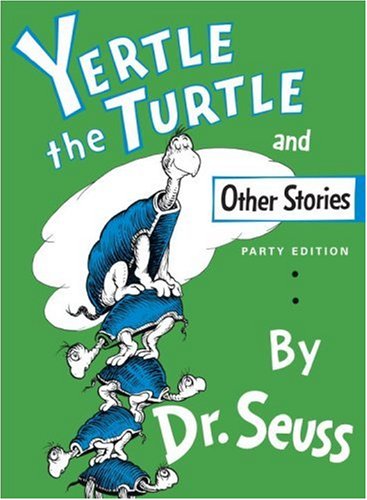
On 30 January, as people power struggles were unfolding in Tunisia and Egypt, I wrote a blog post titled Wanted: More courageous little ‘Mack’s to unsettle Yertle Kings of our times!. I related how, while following the developments on the web, I have been re-reading my Dr Seuss. In particular, the delightfully inspiring tale of Yertle the Turtle King. To me, that is the perfect example of People Power in action — cleverly disguised as children’s verse!
Turns out another parent on the opposite side of the planet had a similar insight, but from an even older children’s story written in Russia! Philip Shishkin has shared his experience in the latest issue of Newsweek.
Tarankanische, or ‘The Terrible Cockroach’ (also translated as ‘The Giant Cockroach’) is a children’s story written by the Russian author Kornei Chukovsky (1882-1969). The first edition, with illustrations by Sergeii Chekhonin, was published in (then) Leningrad 1925.
I was raised on translated Russian children’s stories (the only books of that genre we could access in the closed-economy, socialist misadventures of Sri Lanka during the early 1970s). Whatever economic realities that thrust those books on my childhood, many of them were very fine stories, always well illustrated. But I had somehow missed out on this one — so I quickly did some web searching for this story. And what a fantastic fable it is!
Tarankanische tells the nonsense tale of a threatening cockroach who is so fierce that he terrifies all the animals who are out to enjoy a picnic. Even the mighty elephants are helpless in his presence. The cockroach bullies and scares animals much larger than itself, and demands they surrender their cubs so he can eat them. He is seen as “a terrible giant: the red-haired, big-whiskered cockroach.”
Tarankanische, or The Terrible Cockroach, Sergeii Chekhonin, illustrator, 1925The little tyrant rules the whole jungle on a mix of fear, submission and misery. A laughing kangaroo points out that it’s no giant, but merely a cockroach. The hippos tell him to shut up: “You’ll make things worse for us”. Then, one day, Nature finally restores balance (as it always does): a sparrow comes along and gobbles up the Terrible Cockroach.
In his essay titled Watching the Mighty Cockroach Fall, Philip Shishkin writes: “It is hard not to read the poem as an allegory for the rise and fall of a dictatorship. Despots tend to appear invincible while they rule, and then laughably weak when they fall. Once their subjects call them out on their farce, dictators look ridiculous. Often, they react by killing and jailing people, which buys them more time in power (Iran, Belarus, and Uzbekistan come to mind). But just as often, when faced with a truly popular challenge, dictators shrink to the size of their inner cockroaches.”
Shishkin then raises an interesting question: Did Kornei Chukovsky have Joseph Stalin in mind when he wrote it? Was Stalin prominent enough when the story was first published in 1925? To find out, read the full essay.
According to his mini-bio on IMDB, Chukovsky was a praised Russian translator of Charles Dickens, Mark Twain, Walt Whitman, and other English and American authors. His writings for children are regarded as classics of the form. His best-known poems for children are “Krokodil”, “Moydodyr”, “Tarakanische”, and “Doctor Aybolit” (Doctor Ouch).
Their blurb: “Violent clashes between police and demonstrators as over ten thousand gather on the streets of Cairo. The Egyptian people have endured a tyrant’s rule for far too long, millions struggle each day to find where their next meal is coming from. January 25th, 2011 marks the day when the people rise and take back what’s rightfully there’s. This isn’t the end, but hopefully the beginning to a long awaited regime change! Send to everyone and let them know.”
Song: “Into the Fire” – Thirteen Senses
Thanks to the following news sources for their footage
Daily News Egypt
The Guardian
CNN
New York Times
Al Masry Al Youm
January 2011 has been an eventful month for democratic reform in the Middle East. As People Power successfully toppled the deeply entrenched dictator Ben Ali in Tunisia, and the ordinary Egyptians intensified their pressure on own 30-year-long regime of Hosni Mubarak, commentators around the world have been trying to make sense of the rapidly unfolding developments. One of them, David Kravets, writing in Wired linked to a blog post of mine that talked about the experience of one of the earliest successful demonstrations of people power — in the Philippines, when they toppled a long-misruling dictator in 1986.
Amidst all this, and while following the developments on the web, I have been re-reading my Dr Seuss. In particular, the delightfully inspiring tale of Yertle the Turtle King. To me, that is the perfect example of People Power in action — cleverly disguised as children’s verse!
The story was first published in April 1958, in a picture book collection by Theodor Geisel, published under his more commonly-known pseudonym, Dr. Seuss. In 2001, Publishers Weekly listed it at No 125 on a list of the best-selling children’s books of all time.
For those poor Seuss-deprived readers, here’s a helpful summary I have adapted from Wikipedia:
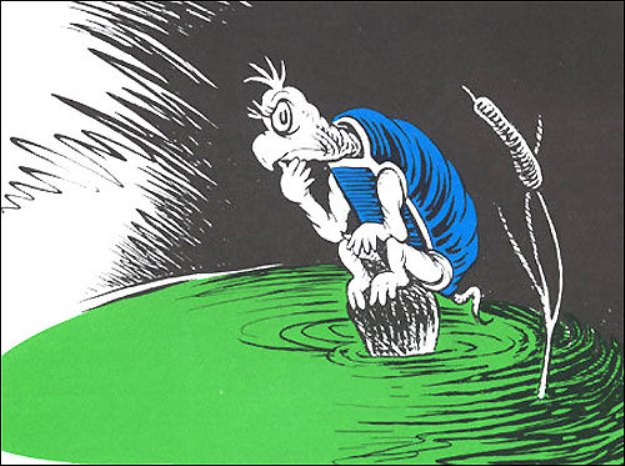
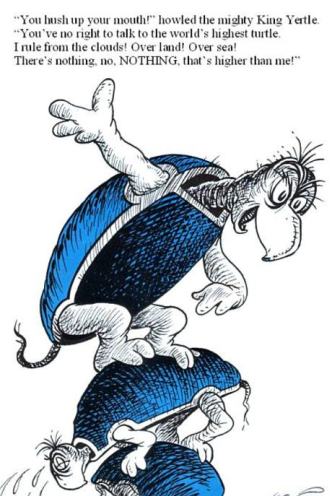
The story is about Yertle the Turtle, the king of the pond in the far-away island of Sala-ma-Sond. Unsatisfied with the stone that serves as his throne, he commands the other turtles to stack themselves beneath him so that he can see further and expand his kingdom (he considers himself the master of all he can see). However, the stacked turtles are in pain. Mack, a very ordinary little turtle at the very bottom of the pile, asks Yertle for a respite, but Yertle just tells him to shut up. Dissent is suppressed.
King Yertle is still not happy: he wants ‘to expand his kingdom’. So he commands more and more turtles to add to his throne. Mack again asks for a respite because the increased weight is now causing extreme pain to the turtles at the bottom. Again Yertle yells at Mack to shut up. At this point, little Mack decides he has had enough and decides to do something to vent his anger and frustration: he just burps. That simple action shakes up the entire stack of turtles, and the mighty king comes crashing down into the pond — and all turtles are freed at last!
Years ago, when I first read the story to my then very young daughter, I could immediately see strong parallels between the vain, merciless Yertle the turtle king and the equally egotistic megalomaniacs in the world of human politics and governance. I would later learn that Dr Seuss meant Yertle to be Adolf Hitler: the turtle’s rule of the pond and takeover of the surrounding areas signified Hitler’s regime in Germany and invasion of surrounding Europe.
The ordinary but courageous Mack epitomises long-suffering Everyman and Everywoman in all countries where autocratic or dictatorial regimes rule, piling ever more burdens on their people. Like the turtles in the stack, the people can go on for years taking a great deal of suffering and sacrifice while the despots plunder and make merry. But there comes a day when a ‘Mack’ says enough is enough…and emits a humble ‘burp’ that shakes up everyone.
As Dr Seuss wrote (and this is my favourite part!):
But, as Yertle, the Turtle King, lifted his hand
And started to order and give the command,
That plain little turtle below in the stack,
That plain little turtle whose name was just Mack,
Decided he’d taken enough. And he had.
And that plain little lad got a bit mad.
And that plain little Mack did a plain little thing.
He burped!
And his burp shook the throne of the king!
And Yertle the Turtle, the king of the trees,
The king of the air and the birds and the bees,
The king of a house and a cow and a mule…
Well, that was the end of the Turtle King’s rule!
For Yertle, the King of all Sala-ma-Sond,
Fell off his high throne and fell Plunk! in the pond!
And today the great Yertle, that Marvelous he,
Is King of the Mud. That is all he can see.
And the turtles, of course… all the turtles are free
As turtles and, maybe, all creatures should be.
I don’t mean to oversimplify or belittle the enormous courage and resolve it takes for ordinary people to take on a brutal regime, but as pop-culture metaphors go, it’s hard to find a better one than Mack and his defiant burp. That little burp by a tiny turtle brought a vain king down, and its real-world equivalent is called people power: when long-oppressed ordinary people take to the streets to protest against the accumulated excesses of their rulers, demanding reform or regime change.
Not all such ‘burps’ bring all ‘Yertles’ down in the real world. The mighty Soviet Union crumbled in the late 1980s thanks to the courage and persistence of ordinary people who stood up and stepped out. It also worked twice in the Philippines: first against an outright dictator (Marcos) in 1986, and then against a renegade elected president (Estrada) in 2001. A variation of it happened in Nepal against the brutal King Gyanendra, who was dumped into the dustbin of history with the entire monarchy in 2006. Each case had its own history, dynamics and outcomes but shared the common feat of people power.
Sounds familiar? That's because it's all too common!But elsewhere, as in Tiananmen Square of China (1989) Burma (2007) and Thailand (2010), people power failed to change regimes and led to much violence and bloodshed. What particular combination of social, political and technological factors make people power work is currently the subject of intense study and debate among scholars, diplomats and activists.
But there’s no doubt that recent history has been shaped and made by Macks who broke the silence and, figuratively speaking, burped. Some such burps were heard around the world, and some Macks went on to lead prolonged revolutions that ended with them becoming rulers themselves: Lech Walesa, Cory Aquino and Valclav Havel come to mind.
For every ‘Mack’ who succeeds, though, there are many who go unsung —or much worse. We still have no idea what happened to that much photographed and celebrated ‘Tank Man’ who stood up against the Red Army’s tanks on Tiananman Square one fateful day in June 1989. We don’t even know his name, but his defiance against such enormous odds still inspires assorted Macks all over the world.
For sure, our world is a tiny bit larger — and more complex — than that muddy pond in far away Sala-ma-Sond. And we have an abundance of Yertles, of various colours and hues, riding literally on the backs of their fellow people.
At least some of these tyrants must be following the recent developments in Tunisia and Egypt with growing anxiety. We can only hope that there will be a steady stream of courageous little ‘Macks’ in all such countries who will finally speak up and say: ‘Oi, Enough is enough!’
And then…BURP!
PS: Interesting footnote: Dr Seuss was the first to use the word “burp” in print. That apparently was cause for some concern before publication. According to him, the publishers at Random House, including the president, had to meet to decide whether or not they could use “burp” because “nobody had ever burped before on the pages of a children’s book”.
Time is ticking away...but crises also mean opportunities
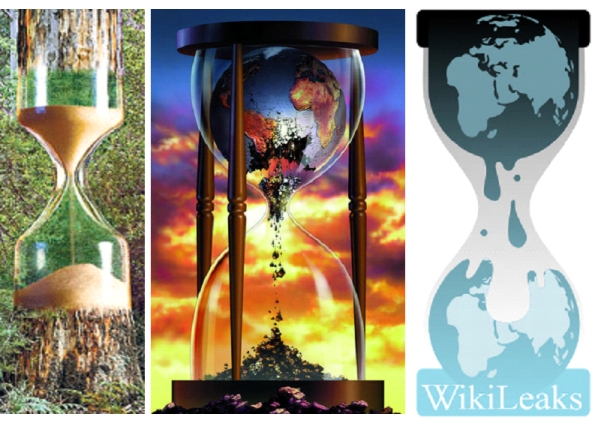
I like to think and speak in metaphors, especially visual metaphors. Sometimes I coin or design new ones. This illustration is the latest example.
Individual elements in this came from very different sources (thanks to them all). I just mixed them together to make two points during a talk I just gave at the Colombo University.
We live in a crisis-ridden world where we have to cope with multiple emergencies unfolding at the same time, impacting us on different fronts. This illustration captures three of them: crisis in biodiversity, man-made climate change, and the new reality of living in a rapidly WikiLeakable world — what I called the Global Glass House.
We don’t get to choose the timing, severity or duration of any challenge. But we do have some choice over how we respond: we can despair and grumble (blaming the Gods or karma if we believe in those); we can become really alarmist (a la Chicken Little); or we can be measured and smart in how we deal with the seemingly overwhelming situations.
Speaking at the Leaders in Environmental Advocacy Forum (LEAF) on Preserving the Past, Securing the Future on 22 January 2011 at the University of Colombo, I advocated this last option. I also pulled together a number of ideas mentioned on this blog over the past four years.
LEAF was a two-day summit held in Colombo, Sri Lanka, hosted by members of the Elon University’s Periclean Scholar Class of 2011, in partnership with the University of Colombo, the United States Embassy in Colombo, the National Science Foundation of Sri Lanka and Rainforest Rescue International.
In fact, some challenges of living on a warming planet are comparable to coping with a WikiLeakable world: both demand quick adaptation to a new reality. In both cases, governments and society have to change mindset and practices on the go — business as usual is no longer an option. Denialism, or demonising the messenger, won’t take us forward. We need more measured, sometimes even pragmatic responses.
In that process, all-or-nothing is not a viable approach. Waiting for full knowledge and understanding is not feasible either. As I once described it, responding to the planet’s climate and other ecological crisis with partial scientific understanding is akin to many pages of our planet’s ‘operations manual’ being still completely blank — and yet we have to manage the planet to the best of our knowledge, intuition and common sense.
Many of the same principles apply to living in the modern networked info society, where no secrets can be kept that way for too long. The sooner we come to terms with this new reality and adapt, the better.
I’m delighted to see others are addressing these parallels. In my talk, I mentioned a recent essay titled Could climate science become open source? by Brendan Barrett and Sulayman K. Sowe, published earlier this month on the UN University’s Our World 2.0 website.
In their perceptive piece, the authors ask whether climate science would benefit by being more firmly grounded in the principles of openness, perhaps along the lines of the free and open source software communities and open content movements. “The concept of openness behind free and open source software describes a mode of creative knowledge production and sharing in which individuals and communities freely generate and adapt or remix resources (content or software) without licensing restrictions.”
They add: “Proposing a move to a new model of climate science in no way suggests that climate change is not a real and present threat or that we cannot rely on the integrity of our contemporary climate science institutions and scientists. Rather, the argument here is that learning from the way free and open source software projects and communities work may be an important way forward in engendering more effective global, national and local responses to climate change.”
I have always worn multiple ‘hats’, and dabbled in multiple pursuits rather than follow narrow paths of enquiry. I see myself continuing to oscillate between the ‘geeks’ and greens, and where possible, bridging their worlds. It’s really encouraging to see some others straddling the two spheres.
Skip Williamson's Facebook profile photoWow, isn’t the Facebook a great place to connect people, ideas and creativity? I never thought much about it, but maybe I ought to spend more time there…
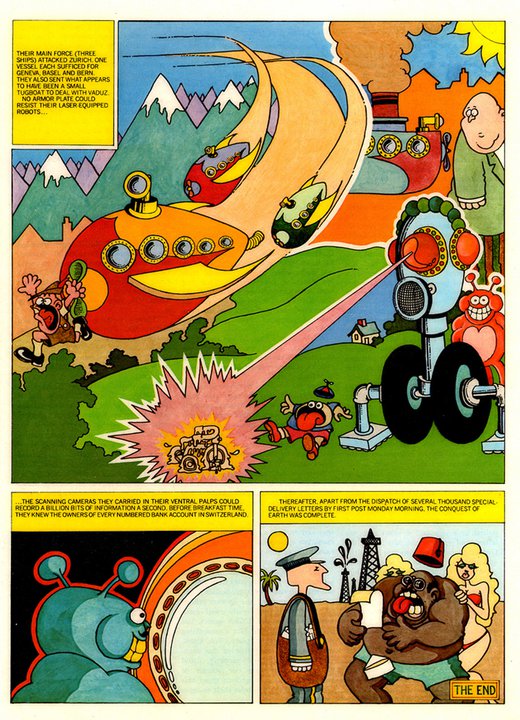
Yesterday, I published a semi-serious essay called WikiLeaks, Swiss Banks and Alien invasions, which was about an obscure short story by Arthur C Clarke describing an unlikely alien invasion of the Earth. For once, the invaders used brain and cunning rather than fire power, and against this onslaught, our planet’s rulers had no defence…
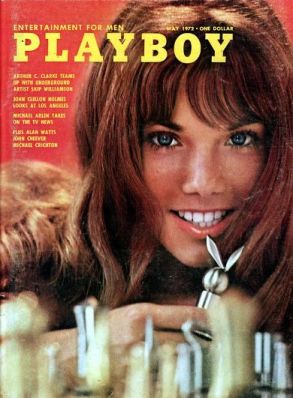
I mentioned how PLAYBOY Magazine had used that story as the basis for a psychedelic comic strip illustrated by the American underground cartoonist Skip Williamson. At the time of writing, I had not been able to locate the comic strip that was published in their issue of May 1972. I wondered: “…it’s either behind a pay-wall, or lies somewhere with little or no indexing by search engines.”
Turns out to be the latter. In less than 24 hours, there was a response from Skip Williamson himself saying the artwork is on his Facebook page, http://www.facebook.com/skip.williamson.
Many thanks to Skip Williamson for posting the link…and while at it, for all his brilliantly cheeky and subversive creations over the years! I hope he doesn’t mind my reproducing the comic strip (all of 2 pages) below:
When the Twerms Came - Comic Strip - Page 1 of 2When the Twerms Came - Comic Strip page 2 of 2
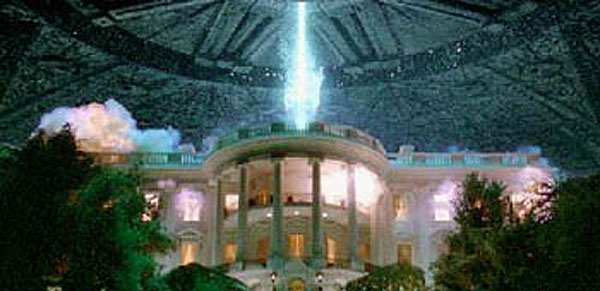
Why waste all that energy when there are smarter ways? Image courtesy movie 'Independence Day'
It’s time to come clean: I have a fascination with alien invasions of our planet.
As a kid, I was an avid listener of radio (my only electronic medium, as I grew up in a land without television, and in a time before the Internet) — and expected the regular transmissions to be interrupted any moment to break the news of an alien invasion underway. The spoilsports shattered my childhood dreams everyday.
Now slightly older, I keep looking for the perfect moments for that history-shattering event. A widely reproduced op ed essay I wrote in July 2010 opened with these words:
“If you’re an alien planning to invade the Earth, choose July 11. Chances are that our planet will offer little or no resistance. Today, most members of the Earth’s dominant species – the nearly 7 billion humans – will be preoccupied with 22 able-bodied men chasing a little hollow sphere. It’s only a game, really, but what a game: the whole world holds its breath as the ‘titans of kick’ clash in the FIFA World Cup Final…”
The careless aliens didn’t heed my advice, but I live in hope. I keep looking for the strategic moments and smart ways to take over the planet — with as little violence as possible. After all, I’m a peace-loving person (even if I’m unhappy with the planet’s current management).
I’m not alone in this noble quest. Science fiction writers have been at it for decades, and future Earth invaders are well advised to first study these useful instructions masquerading as popular literature. In an op ed essay published today, I highlight one such story by Sir Arthur C Clarke.
Click on this ONLY if you're a prude...I wrote WikiLeaks, Swiss Banks and Alien invasions with my tongue in my cheek about half the time (go figure!). I’ve been following the WikiLeaks cablegate saga for several weeks, and was intrigued to read that other critically sensitive secrets — that have nothing to do with garrulous American diplomats — were also reaching this online platform for assorted whistle-blowers.
I describe how PLAYBOY Magazine used the story as a basis for a psychedelic comic strip illustrated by the American underground cartoonist Skip Williamson. That appeared in their issue for May 1972 — and I’m still trying to locate that story. All in the interests of pop culture, of course.
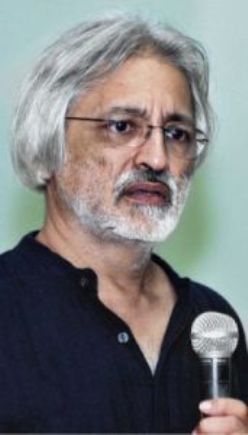
Anand Patwardhan is one of India’s best known and most outspoken documentary film makers. He has been making political documentaries for over three decades, pursuing diverse and controversial issues that are at the crux of social and political life in India. He epitomises the activist film maker and has inspired a generation of socially sensitive film makers.
In the world’s largest democracy that is India, and in a country with a vibrant and diverse media that is considered to be among the most free in the developing world, Anand has constantly run into problems getting his films seen on broadcast television. Many of his films were at one time or another banned by state television channels in India and became the subject of litigation by Anand, who successfully challenged the censorship rulings in court.
As his website notes, several of his films have also incurred the wrath of right wing fundamanentalists both in India and abroad. “In keeping with the uneven nature of India’s democratic institutions and its sharply divided polity, bouquets have been accompanied by brickbats.”
I came across a good interview with Anand Patwardhan in the Indian current affairs magazine Frontline, issue for 4 – 17 December 2010. Here are two questions concerning the censorship problems he has often faced:
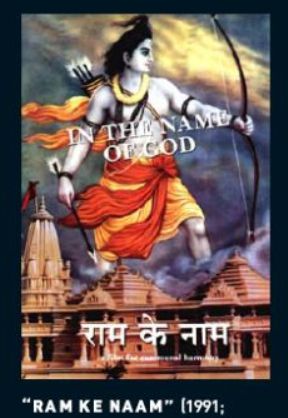
Ram Ke Naam (In the Name of God), 1991Q: You have had problems getting clearance from the Central Board of Film Certification for almost all your films, and then later they were not allowed to be screened on Doordarshan. Your films are also not screened on private channels. How do you see this constant struggle with these forms of censorship?
A: Right from the first film, I faced censorship in some form or the other. Even the Janata Party after it came to power refused to screen Waves of Revolution though it was against the Emergency. L.K. Advani was the Information and Broadcasting Minister then. I had added an epilogue which said that the janata raj [people’s rule] that the film spoke about was not the same as [that of] the Janata Party now in power. I also drew attention to the political prisoners still being held in jail. Finally, after media pressure built up, the film was screened on Doordarshan.
Prisoners of Conscience also got into trouble with the censor board, and it took a letter from Satyajit Ray to the government saying that they must not stop a film like this to get the required clearance.
Ram Ke Naam followed the rath yatra of Advani and the violence in Ayodhya on October 30, 1990, when the Babri Mosque was attacked for the first time. It was meant to be a warning to the nation about the rise of Hindutva fundamentalism. I had trouble with the censors initially, but it finally got through in 1992 and then I had trouble with Doordarshan, which refused to show it. Finally, after the film won a national award for Best Investigative Documentary, I was able to go to court and argue that the government cannot give me a national award and yet say that I cannot show the film on Doordarshan, which it had been doing systematically. In fact, whenever any film of mine won a national award, I used it to go to court. I argued that not showing such a film on national TV was a denial of my right to freedom of expression and of the viewers’ right to information.
On these grounds I have won seven cases till now – five in the High Courts and two in the Supreme Court after the government went in appeal. Ram Ke Naam was finally shown on Doordarshan in 1997. The judge ordered that the film should be telecast at prime time.
Stills from Anand Patwardhan (courtesy his website) Q: Why have you not approached private channels to screen your films?
A: The private media, including television, are not about giving people information. They are run by corporates more interested in providing entertainment. Their news and analysis are restricted to five and 10 second [sound] bites. Their clear mandate is commercial. They will ask, “Where are the advertisers who will endorse your product? Who is going to give the money to show this? Are we going to waste one and a half hours of TV time on issues?”
I have also discovered that even in the private domain there is political censorship. A few days before the Allahabad High Court verdict on [the] Ayodhya [title suit] was due, a private channel approached me to screen Ram Ke Naam. They paid me for three broadcasts but stopped after showing the film just once despite extremely positive feedback from viewers. On inquiring, I was told that the channel was pressured not to show the film by both the Information and Broadcasting Ministry and the TV Broadcasters’ Association. Anyone who watches Ram Ke Naam will realise that this censorship was done to protect the interests of unscrupulous politicians who had used the emotive appeal of Ram for financial and political gain.
The situation today is such that you cannot pinpoint where the censorship is coming from. During the Emergency you at least knew who the enemy was. But now what do you do when every wing of society – whether it’s the legal system, and so on – is complicit in a blanket suppression of facts.





 Open Minds!