No laughing matter, this...
It had to happen sooner or later: a world day dedicated to, ahem, toilets. When all sorts of public interest causes are claiming the 365 days of our year, it was only a matter of time.
19 November is World Toilet Day – a day to celebrate the humble, yet vitally important, toilet and to raise awareness of the global sanitation crisis. It was established in 2001 by the World Toilet Organization (the other WTO!), a global non- profit organization committed to improving toilet and sanitation conditions worldwide.
The World Toilet Day promotes the importance of toilet sanitation and each person’s right to a safe and hygienic sanitary environment.
Did you know, for instance:
* 2.5 billion people do not have somewhere safe, private or hygienic to go to the toilet?
* One gram of faeces can contain 10 million viruses, one million bacteria, 1,000 parasite cysts and 100 parasite eggs?
Here’s a cool viral video that WaterAid have produced to mark the event:
A third of the world’s population lacks any toilets. The rest of us who do have a toilet don’t always make the most efficient use of it – when we typically use 10 litres of water to flush away one litre of urine, that’s not very thrifty, is it?
On this day, I came across an interesting essay by Debra Shore, Commissioner, Metropolitan Water Reclamation District of Greater Chicago, in The Huffington Post. She writes: “Using freshwater in toilets is not smart and it is not sustainable. I believe the homes of the future will be designed to use “grey” water — the water from our washing machines and dishwashers, the water from our showers and from rain captured in barrels and cisterns — to flush our toilets. This kind of redesign of water use, both residential and industrial, will be one of the growth industries of coming decades.”
She adds: “So, on World Toilet Day, here is my plea: monitor your water use. Think about ways to conserve water. And consider how lucky we are.”
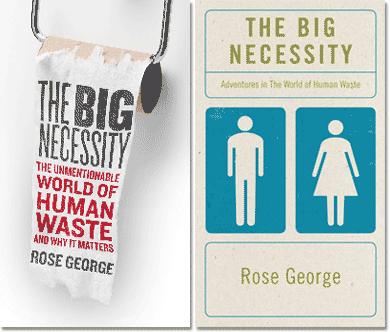
Rose George, author of The Big Necessity: The Unmentionable World of Human Waste and Why It Matters says toilets are a privilege that nearly half the world still lacks. At least 2.6 billion people around the planet have no access to a toilet — and that doesn’t just mean that they don’t have a nice, heated indoor bathroom. It means they have nothing — not a public toilet, not an outhouse, not even a bucket. They defecate in public, contaminating food and drinking water, and the disease toll due to unsanitized human waste is staggering. George notes that 80% of the world’s illnesses are caused by fecal matter.
Dilrukshi Handunnetti: Making wavesMy good friend Dilrukshi Handunnetti, a leading investigative journalist in Sri Lanka, is currently on a Jefferson Fellowship traveling in the United States. She is one of a dozen journalists from the Asia Pacific who have been competitively chosen to participate in this prestigious programme, which in 2009 is focusing on the theme, The Right Climate for Confronting Climate Change?
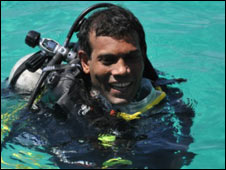
I finished my latest climate film, Small Islands – Big Impact, only the day before Dilrukshi left for Hawaii, her first stop in the multi-destination, intensive programme. Given her long standing coverage of the Maldivian political affairs as well as Asian/global environmental issues, I gave her a DVD of the film to take along.
I’m delighted to hear that she has been showing Small Islands – Big Impact in various presentations, often producing a…big impact wherever it was shared. It’s always good to have such feedback — here’s an excerpt from an email she has just sent me from Boulder, Colorado:
“I liked presenting your short film and the response it generated. The film generated a discussion on promoting the concept of (climate) adaptation as a human right – just as I felt it would be such a catch phrase here. I also had the (media coverage of) the underwater Cabinet meeting with me. So Maldives got a lot of attention despite not having a Maldivian here.
“Several wanted to know about the actual risk level of the Maldives and the possibility of the islands being submerged. They also asked about purchasing land elsewhere and whether the Maldives had the financial capability to do that. Others wanted to know about depleting fish catch President Nasheed spoke about as this was a common concern to Indonesia, Southern India and Vietnam.
President Nasheed: Stop pointing fingers, extend a helping hand...“Some queried whether President Nasheed was going to Copenhagen to state his case. Two others asked whether lobby groups were behind his thinking. Several found, including American, Chinese and Indian participants, that President Nasheed’s call to end the blame game should be heeded by all. There was collective agreement that others’ behaviour impacted on the likes of President Nasheed and vulnerable communities.
“Interestingly, everyone found his interview a STORY. Something that they would want to report on in their respective media. We continue to discuss the same on our tours and walkathons from venue to venue for various meetings. In fact, I had the American participant asking our resource persons (IPCC types, no less!) whether they were willing to acknowledge the concept of climate refugees directly in relation to the Maldives.
“I think the movie served a great purpose of awakening the minds of many to the threat level faced by some communities on low lying coastal nations – like the pacific Islands and the Maldives. A senior broadcaster from the Tonga Broadcasting Corporation personally thanked me for wanting to highlight their plight as a small island nation.”
You can watch Small Islands – Big Impact online here:
A journalist for over 17 years, Dilrukshi Handunnetti has extensively covered politics, the environment, culture, and history and gender issues. In her current role, she writes the parliamentary column for the newspaper in addition to writing and editing investigative stories carried in her publication. Dilrukshi has also covered the ethnic conflict from a non-military perspective and written extensively on issues of good governance, graft and corruption. Dilrukshi is the recipient of many national journalism awards in Sri Lanka, including: the Young Reporter of the Year 2001, Best Environment Reporter of the year 2002, Best Environment Reporter of the year 2003, Best English Journalist of the Year 2004 (Merit) Award and D B Dhanapala Award for the Best English Journalist of the Year 2005, all presented by the Editors’ Guild of Sri Lanka.
In this extract from our 2005 film Deep Divide, Dilrukshi talks about Sri Lanka’s coastal resource development challenges before and after the 2004 Asian Tsunami:
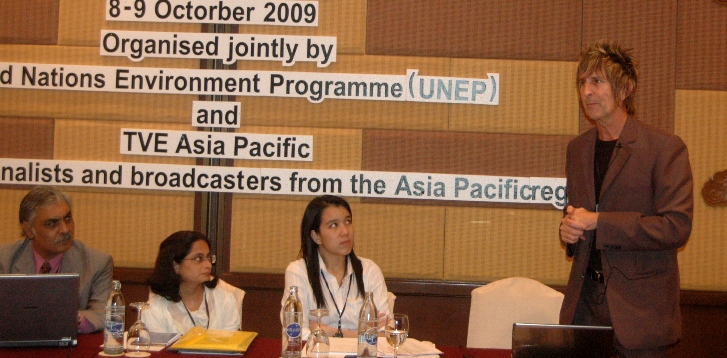
Douglas Varchol (standing, extreme right) speaking at Ozone Media Roundable, 8 Oct 2009
With his wild hair and trendy suits, Douglas J Varchol can pass for a rock star. He is actually an accomplished independent film-maker, currently operating out of Bangkok, Thailand, covering a variety of science and environmental stories in Asia.
Last week, he participated in the Ozone Media Roundtable that TVE Asia Pacific and UNEP organised in Chiang Mai, northern Thailand. After showing his latest documentary film on ozone, titled Earth Report: Perfectly Cool, which was first broadcast on BBC World News in September 2009, he talked about his experience in making the film.
Perfectly Cool is a 22 minute film looking at the challenges faced in trying to phase out a chemical called Hydrochlorofluorocarbons (HCFCs for short), a coolant gas used in air conditioners across the developing world. As chemicals go, it’s a double hazard: this ozone depleting substance also contributes to climate change by acting as a greenhouse gas.
But non-specialist viewers watch broadcast television for good stories, not science lessons. The challenge for journalists and film makers is to ‘sugarcoat’ the technicalities by wrapping it up in human interest stories. Douglas recalled how he did this: combining imagination, hard work and luck.
First, here’s the official synopsis of the film which sums up the story:
Air conditioners are damaging the environment. One widely used coolant gas, HCFC, damages the ozone layer. With booming sales of domestic ACs around the world, the problem has grown in recent years, despite vigorous international efforts to reduce ozone depleting chemicals. Under the international agreement known as the Montreal Protocol, HCFC will be phased out worldwide by 2030. An ozone-friendly replacement gas – HFC – is now used in Europe, but that gas is a potent greenhouse gas — which means it contributes to global warming. However, an answer may be at hand. Earth Report travels to China, centre of the global AC industry, to investigate the cost of cool and meets the industry representatives working on a solution – and Sa DingDing, a musician with extreme views on air conditioners.
Watch the first 4 mins of Earth Report – Perfectly Cool
Humanising science stories is hard enough, and when the subject is something people can’t see or feel, it becomes harder. As I wrote a few days ago, the Ozone Layer – located between 10 and 50 kilometres above the Earth, and invisible to the naked eye – is not something tangible like cuddly animals or endangered plants. Moving ordinary people to care for something they can’t see or touch is tough, even if all life on Earth depends critically on it (the Ozone Layer absorbs most of the Sun’s harmful ultra-violet days).
Douglas had his work cut out for him. Throw into this mix the fact that the editorially independent film was being made pooling funds from six development agencies – each with their own agenda – and that the story was filmed in China where filming permission still involve a lot of paperwork, it’s a small miracle Perfectly Cool was completed. And as we saw, Douglas tells a good story without compromising accuracy or balance.
So did he keep perfectly cool during the making of this film, I asked. He revealed that there were moments of panic and despair, although in the end everything fell into place. While the editors at BBC World were satisfied with the film, some technical specialists consulted for the script had felt it was over-simplified.
Ah, I do know that feeling! When I made a film on ozone in 2006 (Return of the Ozone Layer: Are We There Yet?) it took us 18 months to finish, and went through endless revisions. The UN system seems to just love making films by committee…
With his film, Douglas faced additional hurdles. For example, he takes us inside the Gree company‘s factory producing air conditioners. In 2004, Gree became the largest AC manufacturer in the world, but they had never before allowed television cameras inside their plant. That took lots of time and effort to set up.
Sometimes, things not going according to plans actually helps. When on location, Douglas serendipitously came across elements that were not in the original story treatment but enhanced the human interest: for example, a modern day wedding where the new couple gifted reusable chop sticks to all their guests. That was good environmental conduct – but then they headed off to choose air conditioners for their new apartment…
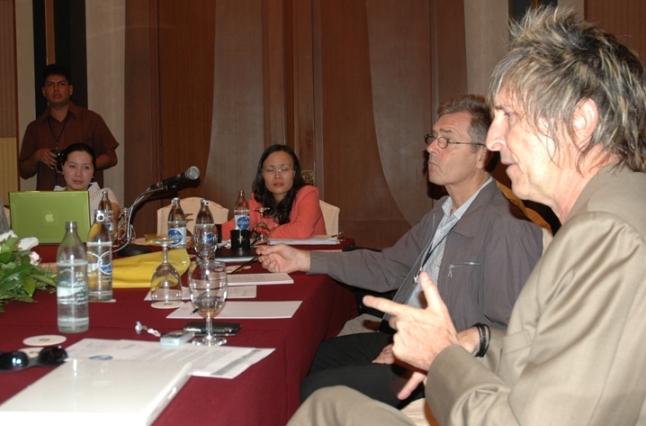
Douglas Varchol (extreme right) makes a point during Ozone Media Roundtable
Douglas paid a tribute to his Chinese researcher Lihong Shi and crew, without whose local knowledge and contacts he couldn’t have made the film.
In the end, Douglas pulls it off. Despite its seemingly esoteric and complex subject, Perfectly Cool is perfectly watchable — and not just for science buffs like myself.
Douglas, who once worked with Wired Science making science programmes for American PBS, said he set out to make a film on HCFCs that even his mom (a high school teacher) could understand. I can’t speak for her, but those of us who watched it in Chiang Mai were enthralled.
Yugratna Srivastava: Lend me your ears...This week saw the UN’s invisible man hosting mostly indifferent leaders at a Summit on one of the world’s most pressing challenges: climate change.
Nearly 100 world leaders accepted UN Secretary General Ban Ki-moon’s invitation to participate in an historic Summit on Climate Change in New York on 22 September to mobilise political will and strengthen momentum for a fair, effective and ambitious climate deal in Copenhagen this December.
The call for action at the summit did not just come from world leaders – many of who simply can’t see beyond their next election – but also from the next generation who stand the most to lose if climate talks fail.
On their behalf, Yugratna Srivastava, a 13-year-old Indian girl, spoke forcefully at the podium, sending a wake-up call to those assembled. “We received a clean and healthy planet from our ancestors and we are gifting a damaged one to our successors. What sort of justice is this?,” she said.
She added: “The Himalayas are melting, polar bears are dying, 2 of every 5 people don’t have access to clean drinking water, earth’s temperature is increasing, we are losing the untapped information and potential of plant species, Pacific’s water level has risen,Is this what we are going to hand over to our future generations? Please……no!”
She said the three billion young people in the world need them to take action now to protect the planet for future generations.
All this news coverage reminded me of another passionate young girl who similarly addressed – and challenged – the world leaders 17 years ago at the Earth Summit held in Rio de Janeiro, Brazil.
Her name was Severn Cullis-Suzuki, and she was a young Canadian environmental activist. Then 12-year-old Severn closed a Plenary Session with a powerful speech that received a standing ovation.
Raised in Vancouver and Toronto, Severn Cullis-Suzuki is the daughter of writer Tara Elizabeth Cullis and environmental activist and TV personality David Suzuki. When she was 9, she started the Environmental Children’s Organization (ECO), a small group of children committed to learning and teaching other kids about environmental issues. They were successful in many projects before 1992, when they raised enough money to go to the UN’s Earth Summit in Rio. Their aim was to remind the decision-makers of who their actions or inactions would ultimately affect.
Listen to the memorable speech at the Earth Summit by Severn Cullis-Suzuki:
Severn was every bit as sincere, concerned and passionate about the global environment as Yugratna Srivastava was this week. Seventeen years later, notwithstanding the lofty pledges at the Earth Summit and later gatherings, the environmental crises have multiplied and worsened.
Very few of the world leaders who assembled in Rio are still in office — and that underlines part of the problem. Governments have far shorter time horizons than what many of today’s global challenges demand. I am constantly reminded of what the eminent Indian scientist Dr M S Swaminathan told me in my first interview with him in 1990 (yes, even before the Earth Summit): “In democracies, rulers think in terms of the next election. In dictatorships, about the next coup d’état. Nobody is thinking in terms of the next generation!”
It was no small feat for the UN’s Invisible Man to bring 100 heads of state or heads of government together on such a long-term issue. But it’s going to take many more meetings, bickering and hard bargaining before the leaders begin to think in terms of the next generation.
I ended a recent blog post, News wrapped in laughter, with this thought: “There is another dimension to satirising the news in immature democracies as well as in outright autocracies where media freedoms are suppressed or denied. When open dissent is akin to signing your own death warrant, and investigative journalists risk their lives on a daily basis, satire and comedy becomes an important, creative – and often the only – way to comment on matters of public interest. It’s how public-spirited journalists and their courageous publishers get around draconian laws, stifling regulations and trigger-happy goon squads. This is precisely what is happening right now in countries like Kenya and Sri Lanka, and it’s certainly no laughing matter.”
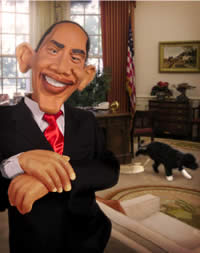
An interesting experiment in political satire on Kenyan television has just ended its first season on 9 August 2009. It’s a show called the XYZ Show, which was broadcast weekly on Kenya’s Citizen TV. Started in mid May 2009, the first season introduced Kenyan viewers to a new form of satire television, with life-sized puppets made to resemble famous persons, mostly politicians.
Gado the CreatorThe XYZ Show was inspired by famous puppet satire series like the British “Spitting Image” and the French “Les Guignols de l’Info” shows. In the XYZ Show, the puppets commented on news and current events from both Kenya and overseas.
The XYZ Show was developed by a team led by Kenyan cartoonist Godfrey Mwampembwa, alias Gado. He is the most widely syndicated cartoonist in East and Central Africa. He publishes a daily cartoon in The Nation, the largest newspaper in Kenya, and his work has been published in Le Monde (France), Washington Times (US), De Standaard (Belgium) and The Japan Times.
According to its creators, the XYZ Show challenged famous figures from Kenyan high society and politics using humour and satire. It aimed to become a new forum for social and political debate, one that provides room for open discussion.
Watch XYZ Show’s first episode trailer, produced one year ago:
Says the Prince Claus Fund of the Netherlands, which supported the show’s production: “Although freedom of the press is a constitutional right in Kenya, it is difficult for many journalists to practice their profession without interference. Gado and his team hope that the XYZ Show will contribute positively to strengthening freedom of the press and increasing political and social awareness among the people of Kenya. The show provides commentary on current social and political developments and aims to use humour and artistry to reinforce freedom of speech in Kenya.”
From what I’ve been able to watch online, on the show’s YouTube channel and elsewhere, the production values are at a high standard, comparable to such shows made in Europe and East Asia. The puppets are attractive, movements convincing and the pace quick and slick.
Who pulls his strings?The producers have also tried hard to make XYZ more than just a TV show. The website, in English, shows how the content is being adapted for the web (as webisodes) and mobile phones (as mobisodes). The show’s official blog takes us on to the set and shares with us the story behind the story, and introduces us to the artists and technical geniuses involved. Full marks for trying to engage the audience.
Then there is Barack Obama. Using his Kenyan connections, the show casts him (really, a puppet in his image) in a ‘supporting actor’ role. This has clearly inspired some interest in the show beyond Kenya.
So far, so good. But how does it work with the audience? The show is directed mainly at local audiences, and even if it’s presented in a mix of English and local language, it’s not something a complete outsider like myself can appreciate.
So I ‘crowd-sourced’ by asking a Kenyan reader of my blog, Marion N N, for her opinion. Marion is part of Sojourner, which her blog introduces as “a social enterprise that exists to promote the origination, production and distribution of African viewpoints through visual media. We are passionate about African film-making and seek its viable promotion globally”.
Marion wrote a comment in her blog after watching one episode a few weeks ago. She lives and works in Kenya, and her views are far more valid than my own.
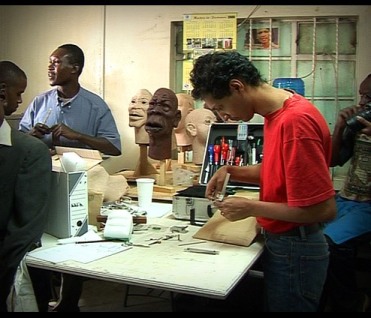
Behind the screen, creators at work...She wrote: “My first off impression was fascination about the quality of the show in terms of animation which is very new to the local TV production scene in Kenya. Once past the fascination of the animation, I found that the content failed to hold my interest, connect with me or engage me as an audience. As a socio-political spoof show, humor ideally should be the hook that captures audience but in this case, humor comes across as mindless, illogical or simply stupid action on the screen. As if in evidence to this fact, at some point my husband in between laughter remarked ‘This show is really stupid’. I would imagine this would be a compliment to the Production becuase it provoked laughter in a viewer. However beyond that moment, it seemed only natural for us to flick over to more substantial entertainment having enjoyed that brief flight of fancy that failed to arouse an appetite for more.”
Marion also wondered what the show’s intended audience was, and highlighted the many challenges in getting the levels and balances right in doing political satire: “That politicians sometimes (nay, most times) behave ridiculously is not new or fresh. But the treatment, underlying themes, ideas communicated to audiences should be. Why do I suggest this? Because political satire by its nature speaks to an audience that is fairly mature, and exposed. To use childish humor that is poorly developed will not hold the audience’s attention. Infact at some point the content may become a tad irritating to watch. Political satire needs to be treated with a peppering of fact, wit, fresh perspective or take -out: The achievement of some underlying objective and not just mindless visual gimmicks that lead to the feeling of ‘stooping to idiocy; by audiences. This seeming insult of intelligence causes us as an audience to switch off.”
In my own view, The XYZ Show had at least three major challenges. Doing any puppet show is hard enough, and these days the on-air competition is neither local nor fair: it comes from global entertainment corporations like MTV and their regional variations, usually with deep pockets. Doing political satire is even harder, especially if the political culture is intolerant or repressive. To get the look, feel and balances right in a country where such a show is being done locally for the first time is a formidable challenge by itself.
But I’ll let Marion have the last word. In spite of the various concerns, she feels that the XYZ Show has ‘room to grow and conquer the airwaves’. But, as she notes, “The production team have their work cut out for them in pre-production. It’s back to the drawing board and ask who is my audience? What appeals to them? How do I connect with them, define an objective for the show and its audiences? Research facts and opinions about national sentiment on issues then develop scripts and sequences…”
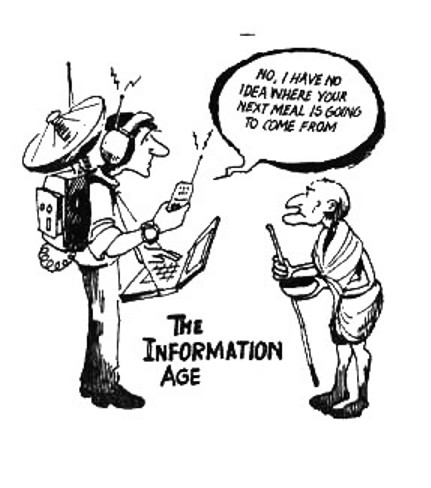
Who can crack this web 2.0 challenge? Image courtesy i4d magazineAs the 19th Century was drawing to a close, the newspaper publisher William Randolph Hearst (later immortalised in Citizen Kane) cabled a leading astronomer of the day: ‘Is there life on Mars? Please cable one thousand words’.
The scientist replied: ”Nobody knows” – written 500 times.
This would be my answer today, if a modern-day media tycoon were to ask me a different, yet equally compelling question: where are we headed with the bewildering developments in information and communication technologies, in which the mainstream media are a part?
So, with the Indian Ocean lashing gently on the rocky beach only a few feet away, and under the slightly bemused gaze of Sir Arthur, I took my audience on a quick and rough tour of the near future — the one no one about which nobody is an expert!
Here are some excerpts:
Two waves that started separately have combined to radically change how people generate, access, store and share information: the rolling out of broadband internet, and the phenomenal spread of mobile phones.
The headline figures are impressive. For the first time in history, we now have the technological means to quickly reach out to most of humanity:
• More than 4.1 billion mobile phones were in use by end 2008, a majority of them in the developing world.
• Nearly a quarter of the world population (over 1.5 billion people) has access to the web, at varying levels of bandwidth.
• Thousands of radio and TV channels saturate the airwaves – these still are the primary source of news and information for billions.
Where this growth in processing power and proliferation of devices might lead us, we can only guess — no one really knows. This can be both exhilarating for some — and very disconcerting for entities that were previously in control of the free flow of information, such as governments, academics – and dare I say it – the mainstream media!
Is that your final answer? Surely not...?They may not accept this, individual governments, and their collective known as the United Nations, don’t have full control over what is going on. But the ‘information genie’ is now firmly out of the bottle, and evolving by the day that it’s impossible to put it back inside. This is both fascinating and frightening.
If it offers any comfort, even big corporations like Microsoft, Apple or Google are all learning by doing. Everything seems to be permanently in experimental — or beta — mode…
What would emerge from the current chaos? The best brains on the planet are trying to come up with plausible answers.
There is talk about the ‘post-media age’. In the broadcast circles that I move in, they now acknowledge, quietly, that the post-broadcasting age is already dawning.
Is what we hear the death cry of the Old Order…or birth pangs of a new Information Society? Or perhaps both?
And how inclusive is that information society? As Asia Media Report 2009 reminds us, not everyone is invited to the party. Large sections of Asian society are left out.
But don’t expect such people to remain excluded for too long. Armed with mobile phones and other ICT tools, they are going to crash the party, whether we like it or not.
This multiple exposure image shows the various stages of the total solar eclipse in Baihata village, 30 kms from Guwahati, the capital city of the northeastern state of Assam on July 22, 2009. The longest solar eclipse of the 21st century cast a shadow over much of Asia, plunging hundreds of millions into darkness across the giant land masses of India and China. AFP PHOTO/ Biju BORO
This century’s longest solar eclipsed moved across Asia on 22 July 2009, wowing scientists and the public alike. Asia’s multifarious media covered the solar eclipse with great enthusiasm and from myriad locations across the vast continent.
The path of the eclipse’s totality –- where the sun was completely obscured by the Moon for a few astounding minutes –- started in northern India. It then crossed through Nepal, Bangladesh, Bhutan, Myanmar and China, before heading out to the Pacific Ocean. Those who were lucky enough to be at the right place at the right time saw one of Nature’s most spectacular phenomena. It was certainly a sight to behold, capture on film, and cherish for a lifetime.
But many along the path missed this chance as clouds obscured the Sun. It’s the rainy season in much of Asia, where the delayed monsoon is finally delivering much-needed rain.
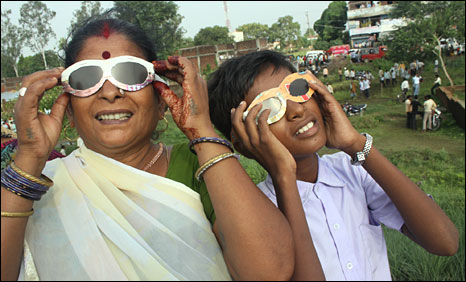
Eclipse watching in Taregna, Bihar, India - Photo: Prashant Ravi, BBC OnlineThat’s what happened in Taregna, in the eastern Indian state of Bihar. The media had dubbed it the ‘epicentre’ of the solar eclipse, and estimated totality to be visible for at least three minutes and 38 seconds. Thousands who flocked to the village were disappointed when the clouds refused to budge. Nature doesn’t follow our scripts.
That didn’t deter some affluent Indians -– if the eclipse won’t come to them, they just went after it. They chartered an airplane to fly above the rain clouds to catch the once-in-a-lifetime eclipse. Each seat cost US Dollars 1,650.
It’s rarely that totality crosses through countries with such high human numbers as China and India. This time around, millions of people and thousands of journalists took advantage.
Some travelled long distances hoping to get the best view from the 200-km wide path of totality. Others watched it one of Asia’s many and cacophonous 24/7 TV news channels. The event had all the elements of a perfect television story: mass anticipation, eager experts and enthusiasts, occasional superstitions, uncertainties of weather and, finally, a stunning display of Nature’s raw power.
‘Darkness at Dawn!’ screamed a popular headline, referring to the eclipse causing a sudden ‘nightfall’ after the day had begun. Other superlatives like ‘Spectacle of the century’ and ‘A sight never to be missed’ were also widely used.
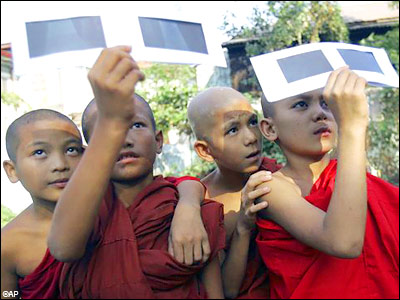
Myanmar Buddhist novices watch solar eclipse through the filters, in Yangon, MyanmarSolar eclipses are indeed a marvel of Nature, and the media’s excitement was justified. For once, it was good to see them devoting a great deal of airtime and print/web space for something that was not violent, depressing or life-threatening.
How I wish Asia’s media took as much interest in another kind of ‘eclipse’ that surrounds and engulfs us! One that does not end in minutes, but lasts for years or decades, and condemns millions to lives of misery and squalor.
Stories of poverty, social disparity and economic marginalisation are increasingly ‘eclipsed’ in Asia by stories of the region’s growing economic and geopolitical might.
The mainstream media in Asia –- as well as many outlets in the West — never seem to tire of carrying reports of Asia rising. Indeed, that is a Big Story of our times: many Asian economies have been growing for years at impressive rates. Thanks to this, over 250 million Asians have moved out of poverty during this decade alone. According to the UN’s Asian arm ESCAP, this is the fastest poverty reduction progress in history.
We see evidence of increased prosperity and higher incomes in many parts of developing Asia. Gadgets and gizmos –- from MP3 to mobile phones — sell like hot cakes. More Asians are travelling for leisure than ever before, crowding our roads, trains and skies. Lifestyle industries never had it so good. Even the current recession hasn’t fully dampened this spending spree.
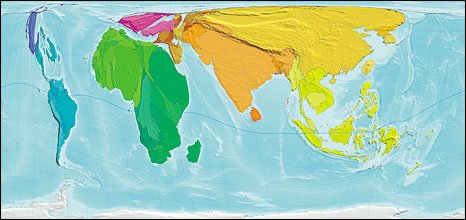
World map proportionate to number of poor people in each country/region - from Atlas of the Real World
But not everyone is invited to the party. Tens of millions of people are being left behind. Many others barely manage to keep up -– they must keep running fast just to stay in the same place.
National governments, anxious to impress their own voters and foreign investors, often gloss over these disparities. The poor don’t get more than a token nod in Davos. National statistical averages of our countries miss out on the deprivations of significant pockets of population.
On the whole, the UN cautions that the Asia Pacific region is in danger of missing out the 2015 target date for most Millennium Development Goals – the time-bound and measurable targets for socio-economic advancement that national leaders committed to in 2000.
The plight of marginalised groups is ignored or under-reported by the cheer-leading media. For the most part, these stories remain forever eclipsed. Except, that is, when frustrations accumulate and blow up as social unrest, political violence or terrorism. Even then, the media’s coverage is largely confined to reporting the symptoms rather than the underlying social maladies.
Indonesian children look up through x-ray film sheets to watch a solar eclipse in the sky in Anyer Beach, Banten province, Indonesia“Half the children in South Asia go to bed hungry every night, but the covers of our news magazines are about weight loss parlors,” says Kunda Dixit, Chief Editor of The Nepali Times.
As he noted in a recent essay: “Maternal mortality in parts of Nepal is nearly at sub-Saharan levels, but we are obsessed with politics. Hundreds of cotton farmers in India commit suicide every year because of indebtedness, but the media don’t want to cover it because depressing news puts off advertisers. Reading the region’s newspapers, you would be hard-pressed to find coverage of these slow emergencies.”
P N Vasanti, Director of the Delhi-based Centre for Media Studies which monitors the leading newspapers and news channels in India, laments how “development” issues such as health, agriculture and education are not even on the radar of popular news sources. Her conclusion is based on a content analysis of the six major Indian news channels during the run-up to the recent general election in India.
I have come across similar apathy in my travels across Asia trying to enhance television broadcasters’ coverage of development and poverty issues. As one Singaporean broadcast manager, running a news and entertainment channel in a developing country, told me: “I don’t ever want to show poor people on my channel.”
Don’t get me wrong. Trained as a science journalist, I can fully appreciate the awe and wonder of a solar eclipse. For years, I have cheered public-spirited scientists who join hands with the media to inform and educate the public on facts and fallacies surrounding these celestial events.
But there are more things in heaven and earth, than are dreamt of in our mainstream media’s breathless coverage of the march of capital. Journalists and their gate-keepers should look around harder for the many stories that stay eclipsed for too long.
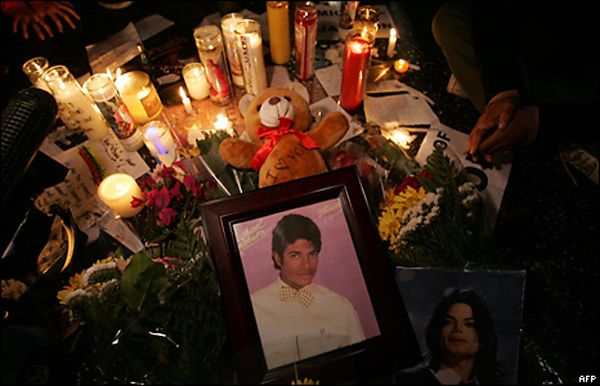
Michael Jackson, who has just died aged 50, has been called the Elvis Presley of our times. He certainly was a global cultural icon with an enormous following in the West and East, North and South. And he used this celebrity status for more than mere entertainment (which he did exceedingly well): he had a long-standing history of releasing socially conscious songs that spread public interest messages with great ease and power.
Mixing social messages with entertainment is a difficult and delicate art that only a few artistes manage to get right. Jackson was one of them — his mass appeal or sales didn’t suffer because he occasionally endorsed a worthy cause. He wasn’t overtly political like Pete Seeger, who turned 90 last month, but Jackson did it in his own unique way in songs like “We Are the World“, “Man in the Mirror” and “Heal the World“.
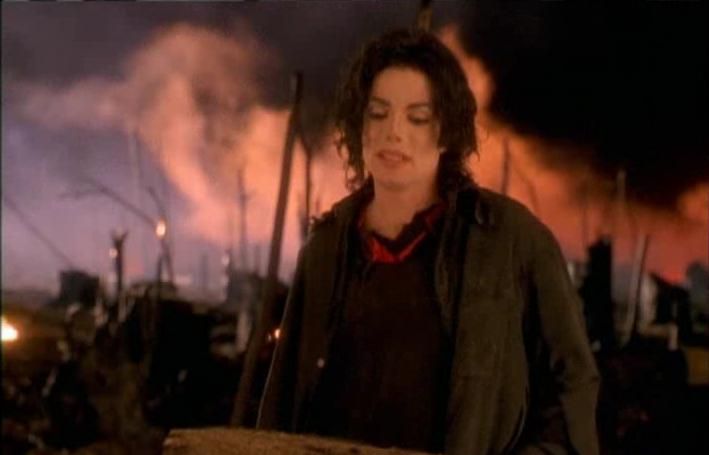
In fact, Michael Jackson’s biggest selling UK single ever was a song about the environment: Earth Song. Released in November 1995, it sold over a million copies and was at the top of the charts for six weeks.
Earth Song was the first of his songs that overtly dealt with the environment and animal welfare. Written and composed by Jackson himself, Earth Song opened with these words:
What about sunrise
What about rain
What about all the things
That you said we were to gain.. .
What about killing fields
Is there a time
What about all the things
That you said was yours and mine…
Did you ever stop to notice
All the blood we’ve shed before
Did you ever stop to notice
The crying Earth the weeping shores?
Jackson wanted to create a song that was lyrically deep yet melodically simple, so the whole world, particularly non-English-speaking fans, could sing along. He conceptualized a song that had an emotional message.
As he later recalled: “I remember writing Earth Song when I was in Austria, in a hotel. And I was feeling so much pain and so much suffering of the plight of the Planet Earth. And for me, this is Earth’s Song, because I think nature is trying so hard to compensate for man’s mismanagement of the Earth. And with the ecological unbalance going on, and a lot of the problems in the environment, I think earth feels the pain, and she has wounds, and it’s about some of the joys of the planet as well. But this is my chance to pretty much let people hear the voice of the planet. And this is ‘Earth Song’. And that’s what inspired it. And it just suddenly dropped into my lap when I was on tour in Austria.”
The video of the Earth Song was among the most expensive ever made – it was filmed in four geographic regions and involved scenes from the Amazon forest, Croatia, Tanzania and New York city, USA. It starts with a long tracking shot through a lush rain forest that then cuts to a scene showing Jackson walking through a scorched, desolate landscape. The environmental imagery then rolls on: dead elephants, evil loggers, belching smoke stacks, snared dolphins, seal clubbing, and hurricane winds. The video closes with a request for donations to Jackson’s Heal the World Foundation.
Watch Earth Song by Michael Jackson:
Although not as widely selling, ‘Will you be there‘ is my personal favourite among Jackson’s socially conscious songs. First released as a single in 1993, it was taken from the 1991 album Dangerous and also appeared on the soundtrack to Free Willy – the charming story of a boy befriending a killer whale.
The song won the MTV Movie Award for “Best Song in a Movie” in 1994. It was also included in the album All Time Greatest Movie Songs, released by Sony in 1999. Jackson also performed songs for the film’s two sequels.
Watch Michael Jackson’s ‘Will You Be There’ in Free Willy:
However, Earth Song had much wider and more lasting appeal, almost becoming an anthem for the global environmental movement in the past decade. But its real impact was not among the converted – with this song, Jackson took the green message to the heartland of the Facebook generation.
Few global figures commanded the audience he had – as the New York Times noted: “At the height of his career, he was indisputably the biggest star in the world; he has sold more than 750 million albums.”
“The song is a very rare thing: a hit record with a powerful message about our impact on the environment,” says Leo Hickman writing in The Guardian earlier today.
He adds: “What struck me today watching the video was how it is very much the product of an age before climate change had become a mainstream concern. The lyrics and imagery speak of over-fishing, deforestation, and smog. All of them are still huge and legitimate concerns, of course, but they have all now become somewhat dwarfed by climate change, the most compelling and over-arching environmental issue of our age.
“But that shouldn’t distract us from the song’s impact on its fans. Given its universal success and the repeated showing of its powerful video, it is highly likely that it was the spark that made many people – particularly young Michael Jackson fans, which, even in the mid-1990s, would have numbered many millions of people around the world – stop and think about environment for the first time.”
Experts should let film-makers produce professional films in simple terms that are more appropriate for public audiences, instead of trying to produce films that have little chance of being broadcast or distributed in other ways. There is a role for technical experts – but that’s not in the crafting and directing of films, but in providing the knowledge, clarifications and guidance to film-makers and journalists who are professionals in communicating complex issues to non-specialist publics.
Self-evident as it may be, these home truths are well worth reiterating every now and then — especially to experts and officials who keep forgetting them (sometimes with disastrous and expensive results!). So I was very glad to read that these points were emphatically made at a ‘film debate’ held in Geneva last week.
Moderated by the well known journalist, writer and producer Edward Girardet, from Media21, Geneva, it involved five panelists drawn from media/communication sector and the disaster/humanitarian sectors. Among the panelists was my colleague Robert Lamb, director of One Planet Pictures, UK, and consultant producer with dev.tv, Switzerland.
The debate’s premise was simple: So far much of the thrust of the film industry, NGOs, UN organizations and media in portraying disasters and climate change has focused on outcome – which is more visually stimulating – rather than showcasing vital prevention and adaptation solutions. This is necessary, but not sufficient. What can be done to improve the interaction between the film/news industry and leading organizations dealing with disaster risk management and climate change adaptation on a daily basis?
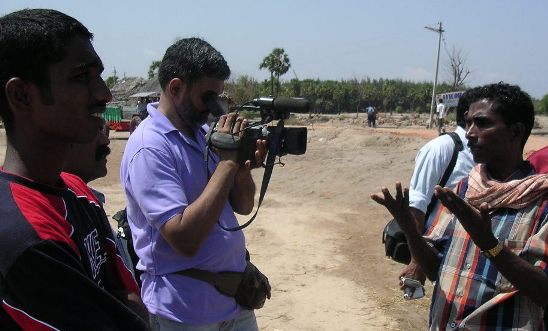
Interviewing tsunami survivor in Tamil Nadu, India - image from TVEAPThis was similar to the approach we had in TVE Asia Pacific’s Communicating Disasters project in Asia (2006-2007). We too explored the common ground for these two sectors, with their distinctive needs, and asked how the two can support each other without stepping on each others’ toes.
The same discussion continued in Geneva. I’ve limited information on what actually transpired during the debate, and am hoping someone will soon write it up. For now, here’s a summary adapted from UN-ISDR daily coverage (the official language is theirs, not mine):
“More than 150 participants attended a thought-provoking film debate. The five panelists discussed how to enhance the interaction between the film/news industry and leading organizations dealing with climate change adaptation (CCA) and disaster management to increase CCA visibility which is very limited today in film productions.
“Eight short films were presented during the session, among them a short trailer of ‘An Inconvenient Truth’ and a CCA film shot in Burkina Faso produced by Christian Aid. After identifying a number of challenges due to their formats and audiences, film-makers and experts agreed it was important to work more closely to make more films on the solutions offered by CCA.
“Film-makers suggested that experts should let them produce professional films in simple terms that are more appropriate to their audiences and focus on bringing expert knowledge to enrich the content of their current productions instead of producing films that have little chance to be broadcast or distributed.”
All this reminds me of a discussion we had around an earlier blog post where I asked: Anyone can make video film, right? So why do we need professionals?
A top European Union official recently cautioned against the concept of ‘peace journalism‘, under which journalists actively promote peace as part of their coverage of conflicts. His views resonated much with my own reservations about this particular brand of journalism.
Javier Solana, EU High Representative for the Common Foreign and Security Policy, made the remarks in a written contribution to the Deutsche Welle Global Media Forum, held in Bonn, Germany, from 3 to 5 June 2009. I wasn’t there in person, but have been reading up some of the presentations and media coverage of the event.
Javier SolanaIn his wide-ranging talk, on ‘Conflict prevention in the multi-media age – The EU’s role in the world‘, Solana asked: should we incorporate peace journalism into our conflict prevention strategies? Yes, he said, “if this means striving to give as much impartial, quality information as possible to the press and media, in all their forms”.
The Spanish physicist-turned-politician added: “We all want to promote peace, reconciliation and conflict resolution and we want the media to help us in this. The best way in which they can do this is to inform us. This is the journalist’s fundamental task.”
He then sounded a word of caution: “The reporter is there to report. We should be careful not to weigh down the media with additional responsibilities over and above their primary task of providing information. A healthy media environment is diverse and plural; it is there to explain but not take sides. The profession of journalism needs no justification and no sophisticated qualification.”
Solana also referred to the early notion of ‘development journalism’ that was promoted in the 1970s, which called upon journalists in the developing countries to always support their governments’ development efforts. Such uncritical cheer-leading, which resulted in many ‘sunshine stories’ that glossed over problems, eventually did a lot more harm than good: development journalists became mere propagandists for governments pursuing wrong development models that squandered natural resources and brought misery to millions.
In fact, after having been part of the media and communications profession for over two decades, I no longer like to box myself into any category. For some years during my first decade of working life, I proudly called myself an ‘environmental journalist’. I still cover environmental issues with the same interest and passion, but now question whether the growth of environmental journalism as a media specialisation has, inadvertently, ghettoised environmental issues within the editorial considerations of media organisations. I also feel that at one point we became too ‘green’ for our own good.
Show things as they are!This is not to argue against journalists specialising in environment or other sectors such as health, gender, peace or human rights. As issues become more complicated, journalists require a great deal of background knowledge, sustained interest and context to do their job well. But it’s poor strategy to leave sustainable development issues entirely in the hands of ‘environmental journalists’. Or coverage of conflict to ‘peace journalists’.
At best, such specialist journalists can only weave part of the much-nuanced, multi-faceted tapestry of sustainable development. To grasp that bigger picture, and to communicate it well, we need the informed and active participation of the entire media industry -– from reporters, feature writers and producers to editors, managers and media owners.
What we lack – and urgently need – is plain good journalism that covers development, conflict and other issues as an integral part of human affairs. Noble intentions of saving the planet, or making world peace, sound good at beauty pageants. But these catch-all lines don’t give anyone the license to engage in shoddy journalism that lacks accuracy, balance and credibility – the core tenets of the profession. It applies equally to mainstream and citizen journalists.
So it’s time to take a few steps back, grasp the bigger picture ourselves, and then show it as is to our audiences. We need Reporters Without Labels.
The only label worth aspiring to is a good journalist. May their tribe increase!

 She adds: “So, on World Toilet Day, here is my plea: monitor your water use. Think about ways to conserve water. And consider how lucky we are.”












 Open Minds!