BBC Panorama, caught faking child labour footage, returns prestigious TV award

Primark: On the Rack
Two weeks after the BBC admitted that its journalists had partly faked child labour footage in India, the public broadcaster has returned a prestigious television award won by the controversial programme.

BBC had earlier won the Current Affairs Home Prize at the Royal Television Society awards for its show Primark: On The Rack, which was first broadcast on BBC 1 channel in June 2008.

In an internal investigation, the BBC Trust – an independent body which safeguards the values of the publicly funded corporation – found that it ‘more likely than not’ that certain footage in the Panorama programme was not authentic.

The implicated retailer, Primark, criticised the BBC for taking so long to find in its favour when evidence casting doubt on some of the video material has been in the corporation’s possession since before the documentary first aired in 2008.

BBC Panorama claims to be the world’s longest running investigative TV show, and has been on the air for more than 50 years. In that time, it has done some excellent exposures on matters of vital public interest.

Yet hinting a decline in both editorial and ethical standards at the BBC, the reporting team was found to have taken liberties with certain visuals in this particular programme. It investigated Primark’s claims that it can deliver ‘cheap, fast fashion’ without breaking ethical guidelines, and included footage obtained in a Bangalore workshop of three boys carrying out an activity described in the programme as ‘testing the stitching’ on Primark garments.

According to the Daily Mail: “The BBC Trust’s Editorial Standards Committee examined evidence such as the unedited ‘rushes’ of the programme and emails to the production team from the freelance journalist Dan McDougall, who obtained the footage.”

BBC Trustee and Chair of the ESC Alison Hastings said after their investigations: “The BBC’s investigative journalism is rightly held in very high regard, and for more than fifty years Panorama has made a very significant contribution to that. But great investigative journalism must be based on the highest standards of accuracy, and this programme on Primark failed to meet those standards. While it’s important to recognise that the programme did find evidence elsewhere that Primark was contravening its own ethical guidelines, there were still serious failings in the making of the programme. The Trust would like to apologise on behalf of the BBC to Primark and to the audience at home for this rare lapse in quality.”

Read full report here.

Despite all these developments, the BBC Panorama official web page for this programme shows no indication of this turn of events. Accessed on at 01:30 GMT on 30 June 2011, the page says it was “last updated at 13:31 GMT, Wednesday, 18 June 2008 14:31 UK”. No apology, no correction, no link to the BBC Trust’s report.

The programme’s blurb still reads: “Panorama puts Primark’s claims that it can deliver cheap, fast fashion without breaking ethical guidelines to the test. Posing as industry buyers in India, the programme’s reporter Tom Heap and his team find some of India’s poorest people working long, gruelling hours on Primark clothes in slum workshops and refugee camps.”

So who puts the BBC Panorama to test? Are investigative journalists above the ethics of journalism because their work is hazardous, and is ultimately meant to be in the public interest?

Even Homer nods, and the best intended investigative journalists can – and do – make occasional mistakes. The important question is whether this was a bona fide error in judgement, or does it suggest a trend where the BBC’s investigative journalists and producers arrogantly believe that the end justifies the means?

Many documentaries rely on re-enactments for certain scenes, which are usually labelled as such. Does exposing child labour in supply chains give the license for do-gooding journalists to manipulate individuals and images to suit a preconceived notion of a corporation’s complicity? Could they not have resorted to other means – perhaps with less dramatic visuals, but more honest in their sourcing?

Does this rare admission of error on the part of the BBC also raise questions about the integrity of some other hard-hitting and controversial Panorama investigations over the years which have taken on some big-time targets such as the Vatican, the United Nations Peace Keepers or the CIA?

Hard questions indeed for the usually self-righteous Auntie Beeb.

‘Amazing Grace’ movie: Story of William Wilberforce, the Model Campaigner

One man, one resolve -- and history is changed!
“When people speak of great men, they think of men like Napoleon – men of violence. Rarely do they think of peaceful men. But contrast the reception they will receive when they return home from their battles. Napoleon will arrive in pomp and in power, a man who’s achieved the very summit of earthly ambition. And yet his dreams will be haunted by the oppressions of war. William Wilberforce, however, will return to his family, lay his head on his pillow and remember: the slave trade is no more.”

Those words are uttered by the character Lord Charles Fox in the British House of Commons towards the end of the 2006 movie Amazing Grace. They sum up the singular accomplishment of William Wilberforce (1759 – 1833), British politician, philanthropist and leader of the movement to abolish the slave trade.

The movie, based on his true story, is not just a well-made period drama. It also offers dramatic insights into one of the most successful – and consequential – social justice campaigns in history. It reminds us that a determined man or woman can, indeed, make a difference in our complex world.

Inspired by a recent visit to Yorkshire, where Wilberforce hailed from, I’ve just watched the movie — and am amazed to find how many such striking parallels there are to evidence-based policy change and law reform in a very different world of ours more than two centuries later.

But first, here’s the storyline from the Internet Movie Database (IMDb):

“In 1797, William Wilberforce, the great crusader for the British abolition of slavery, is taking a vacation for his health even while he is sicker at heart for his frustrated cause. However, meeting the charming Barbara Spooner, Wilberforce finds a soulmate to share the story of his struggle. With few allies such as his mentor, John Newton, a slave ship captain turned repentant priest who penned the great hymn, “Amazing Grace,” Prime William Pitt, and Olaudah Equiano, the erudite former slave turned author, Wilberforce fruitlessly fights both public indifference and moneyed opposition determined to keep their exploitation safe. Nevertheless, Wilberforce finds the inspiration in newfound love to rejuvenate the fight with new ideas that would lead to a great victory for social justice.”

A detailed plot synopsis on IMDB

Wikipedia has a good summary of how Wilberforce and his few determined friends sustained a campaign against this inhuman yet highly lucrative trade.

Wilberforce was every bit the resolute campaigner: used every trick in the book, and then some. He diligently amassed incriminating evidence about the mass-scale abuse of human rights taking place in far-away Africa and on the high seas transporting captured African slaves. He wrote and spoke extensively using facts and figures as well as appeals to human emotions. He collected eye witness testimonials, and gathered over 300,000 signatures in a petition from ordinary people calling for abolition of slavery — which countered the political argument that people didn’t care.

William Wilberforce by Karl Anton Hickel, circa 1794
Wilberforce must have been among the first to realise the power of collective consumer action. On his urging, conscientious consumers in Britain boycotted sugar grown in the Caribbean with slave labour. One of the most sucessful campaigns the Abolition Movement was responsible for was the Sugar Boycott. According to one source: “In 1791 the society distributed leaflets encouraging the public, and especially women, not to buy or use sugar produced in the West Indies by slaves. As a result about 300,000 people boycotted sugar and sales began to drop. In an effort to increase sales, some shops stocked only sugar imported from India, which had not been produced by slaves, and goods were labelled to show this.”

He also worked on and with influential religious and political connections. He surrounded himself with a few trustworthy friends who stay the course despite multiple setbacks, ridicule and character assassination. He was passionate to the point of being obsessive. Yet he also knew when to speak and when to make a tactical retreat. His timing was impeccable as were his patience and commitment.

He wasn’t successful with every social justice campaign he took up. First elected to Parliament in 1780, he campaigned unsuccessfully for penal and electoral reform. It was in 1787, at the encouragement of William Pitt the Younger — his long-long friend and Prime Minister — that he took up the cause of abolition at Westminster. But his humanitarian and ethical arguments had to meet the economic interests of those who had made vast fortunes from the slave trade or the use of slave labour. Many of his fellow Parliamentarians had deep vested interests that wanted to see the status quo continue. Others were in the pay of slave traders.

It was not until 1807 — full 20 years after Wilberforce first started his campaign — that the Abolition Bill was finally passed. Just before that, Wilberforce wrote his famous ‘Letter on the Abolition of the Slave Trade, Addressed to the Freeholders and Other Inhabitants of Yorkshire’, justifying his preoccupation with abolition against claims that he was neglecting their local interests at Westminster, and setting out all his arguments against the slave trade.

Then, as now, elected people’s representatives have to perform this difficult balancing act — between their constituency’s immediate, everyday needs and the greater good or national interest. Which is why all progressive legislators and social justice campaigners should watch Amazing Grace, and read the Wilberforce biography.

Times have indeed changed, but their challenges have not.

Wikipedia entry on Amazing Grace movie

Watch the trailer for Amazing Grace:

Elephant Walk film review: Prescient movie that forewarned about Ceylon’s crowded, troubled future?

Elephant Walk: Another century, another island - but casting its shadow on us?
How can anyone review a film made nearly six decades ago — especially if its first release took place even before I was born? Well, there is only one way to find out – by just doing it.

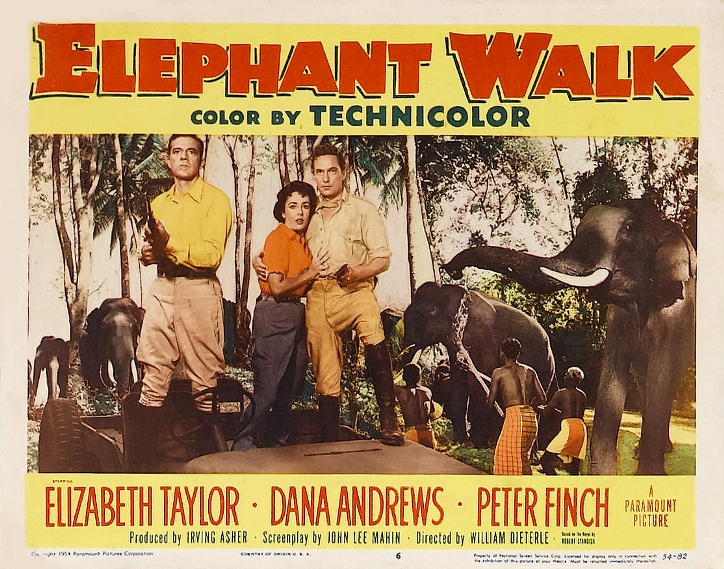
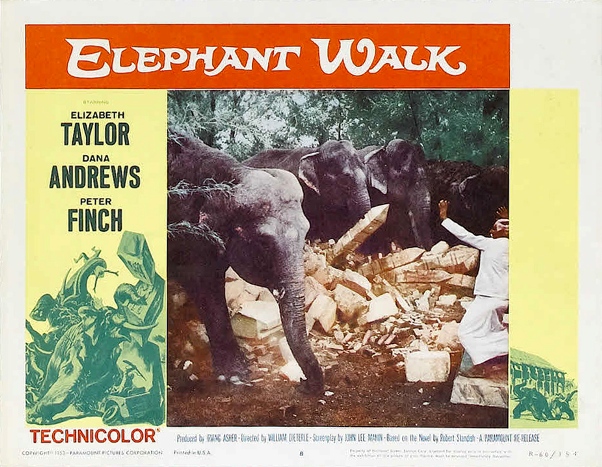
I’ve just done it with Elephant Walk (103 mins, colour), released by Paramount Pictures in April 1954 — a dozen years before I was born on the same island (then Ceylon, now Sri Lanka) where the movie was set and filmed. In fact, this was among several that were shot on location in Ceylon in the 1950s when Hollywood studios ‘discovered’ the island as an exotic, relatively inexpensive and hassle-free location. But this is the only one whose story is actually set in Ceylon.

Elephant Walk was directed by William Dieterle, and based on the 1948 novel with the same title, written by “Robert Standish” — actually the pseudonym of English novelist Digby George Gerahty (1898-1981). It starred Elizabeth Taylor, Dana Andrews, Peter Finch and Abraham Sofaer.

One benefit of reviewing a film so long after its original release is that it allows the benefit of hindsight and perspective. I have exploited this to the full in my review cum op ed essay, titled Elephant Walk revisited: Mixing Tea, Jumbos and Monsoons, just published on Groundviews.org.

Here’s an excerpt:

“The movie has been remarkably prescient on several fronts, which can only be appreciated now — in another century, and on a wholly different island. A key theme of the movie was the human-elephant conflict, but passing references to social exclusion and rampant poverty in post-independent Ceylon are also of much interest.

“I doubt if Paramount’s writers were intentionally making any social commentary. One of the studio’s co-founders, Samuel Goldwyn, had famously cautioned against it. When asked about movies with a “message” some years earlier, he had replied, “If you want to send a message, use Western Union.”

“Nevertheless, the movie (and perhaps the book on which it is based, which I haven’t read) was contrasting the British planters’ opulent lifestyle with the forced austerity in post-War Britain. Even more striking is the poverty and squalor among the hundreds of resident workers whose sweat, toil — and occasional tears — ensured that the ‘cups that cheer’ were always brimming.”

Read the full review:
Elephant Walk revisited: Mixing Tea, Jumbos and Monsoons, on Groundviews.org

Thor, Superman and Arthur C Clarke’s Third Law: Technology or Magic?

Thor: Another spectacular moving image creation from Marvel
Last evening, I wanted an escape from reality. So I walked into a local cinema with two friends and watched Thor – the latest cinematic production from Marvel Comics.

It’s another superhero spectacle, with lots of special effects and great fireworks. Not entirely plausible in the universe as we know it, but hey – we enter cinema halls willing to suspend disbelief. As C S Lewis was fond of saying, the only people really against escapism are…jailers!

Thor even has some reasonable acting and occasionally enjoyable dialogue. Half way into the story, I was pleasantly surprised to see Natalie Portman’s character quote Arthur C Clarke’s Third Law (of prediction): “Any sufficiently advanced technology is indistinguishable from magic”.

Then I realised how much the story depends on this ‘Law’ to make it plausible. Returning home, I asked my resident magician Google for some insights, and she found others have already noted this.

On Discovery magazine’s blog, Kyle Munkittrick has an interesting post titled Thor Pays Tribute to Arthur C. Clarke’s Rule About Magic and Technology. He says:

“…the Marvel universe is internally consistent… Clarke’s rule of magical tech helps create some of that consistency. I both love and loathe Clarke for that statement. Love because it strikes at the heart of what technology is: a way for humans to do things previously believed not just implausible, but impossible. Loathe because it creates an infinite caveat for lazy authors and screenwriters. It seems like anytime some preposterous technology is injected into a narrative either as a McGuffin or a deus ex machina, that damn quotation from Clarke gets trotted out as the defense.”

He adds: “Thor does not pull a George Lucas and attempt to over-science the magical elements. Thor is not superhuman because he has some Norse equivalent of midichlorians. He is superhuman because he is magical. Sure, that magic is allegedly based in technology, but technology so incredibly advanced, we can’t distinguish it from magic. That lack of distinguishability is the indicator of just how advanced the Asgardians actually are. It’s also what let’s us enjoy the movie for what it is.” Read the full post.

On the indispensable Internet Movie Database, it says: “This acknowledgement that one man’s science is another man’s magic/faith (with a hat tip to Arthur C. Clarke’s “Third Law”) is just enough to make Marvel’s comic book appropriation of mythology palatable for a mainstream Hollywood audience.”

So Clarke’s Third Law keeps popping up in popular culture, and as Kyle Munkittrick says, it’s so very convenient for script writers! The grandmaster of science fiction has given them a blanket cover to take whatever creative liberties…

And some don’t always acknowledge the source when they take cover in this quote/law. For example, the Third Law was famously uttered by Lex Luthor in Superman Returns (2006) — but without any mention of the source.

At that time, I was working with Sir Arthur as his research assistant, and remember how much the late author was intrigued by this reference. For a brief few seconds, he was (slightly) miffed that there was no attribution — and then he cheered up. He accepted that Clarke’s Three Laws are now out there in popular culture and the public imagination, having assumed a momentum and identity of their own. The product of his fertile mind was roaming free.

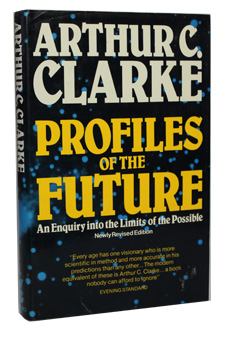
Profiles of the Future - 1982 UK edition
It’s about time too. The Three Laws have been in print for nearly half a century, in various forms. The first law was published in an essay titled “Hazards of Prophecy: The Failure of Imagination'” in the timeless Arthur C Clarke non-fiction classic Profiles of the Future: An Enquiry into the Limits of the Possible, 1962. The book itself was a collection of essays exploring the far future, written during the period 1959 – 1961, and originally published in various popular magazines — most notably Playboy, where many Clarke pieces first appeared in the 1950s and 1960s.

The First Law read: “When a distinguished but elderly scientist states that something is possible, he is almost certainly right. When he states that something is impossible, he is very probably wrong.”

In the original essay, Sir Arthur actually offered further insights on the threshold of elderly: “Perhaps the adjective ‘elderly’ requires definition. In physics, mathematics and astronautics, it means over thirty; in the other disciplines, senile decay is sometimes postponed to the forties. There are, of course, glorious exceptions; but as every researcher just out of college knows, scientists of over fifty are good for nothing except board meetings, and should at all costs be kept out of the laboratory.”

The Second Law was included as a simple observation in the same essay; its status as Clarke’s Second Law was conferred on it by others. That read: “The only way of discovering the limits of the possible is to venture a little way past them into the impossible.”

In an endnote to the ‘Hazards of Prophecy’ chapter (two) in the 1982 revised edition of the book, Sir Arthur wrote: “Originally, I had only one law, but my French editor started numbering them. The Third, which arises from material in this chapter, is perhaps the most interesting (and most widely quoted).”

In fact, this best known Third Law didn’t appear in its currently known form until the 1973 revision of Profiles of the Future. He wanted to round out the number, he said, and added: “Since three laws were sufficient for both the Isaacs — Newton and Asimov — I have decided to stop here. At least for the present…”

The first and second Laws of Clarke are known and cited among scientists and other technical experts. But it’s the Third Law that is the best known among the public: in fact, Wikipedia has compiled a collection of citations in other works.

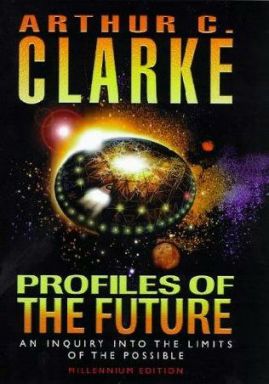
Profiles of the Future - 1999 Millennium edition
As Sir Arthur’s biographer, Neil McAleer, wrote in the 1992 biography Odyssey: “Profiles of the Future has been, and continues to be, an influential book for all those interested in science, technology and the future. Some thirty years after its original publication, it still stands out from the dozens of less important books that attempted to imitate it.”

Neil quotes Gene Roddenberry, creator of Star Trek, as saying how Profiles left a lasting impression on him. Says Roddenberry: “I read Childhood’s End, of course, and was mightily moved by it. And I should say that Profiles of the Future was the next most important Clarke work in my life because a great deal of what I did on Star Trek was guided by that.”

Star Trek: The Original Series debuted on US network television in September 1966. The publication of Profiles, four years earlier, was clearly fortuitous. Star Trek would have been made anyway, without or without Profiles — but the 23rd Century universe might well have been different…

Profiles of the Future was revised by Sir Arthur Clarke on three occasions — in 1973, 1982 and again in 1999. The last revision, where I played a part in assisting the author, came out as the Millennium Edition.

These revisions were not extensive. As the cover blurb of the first revision noted: “Since it (the book) was concerned with ultimate possibilities, and not with achievements to be expected in the near future, even the remarkable events of the last decade have dated it very little.”

The same held for the last revision. But by then, the First Law was updated for Political Correctness:
“When a distinguished but elderly scientist states that something is possible, (s)he is almost certainly right. When (s)he states that something is impossible, (s)he is very probably wrong.”

Next year, 2012, will mark the 50th anniversary of this future-shaping book’s first publication. Fans of science fiction and science fact should perhaps do something to mark the occasion — and not leave it entirely to the whim and fancy of Hollywood script writers.

Read also:
May 2009 blogpost: Star Trek: Advocating a world of equality, tolerance and compassion

‘The Futurist’ Interview with Sir Arthur C Clarke, published shortly after his death in March 2008

First Orbit: Retracing the historic journey of Yuri Gagarin, 50 years ago

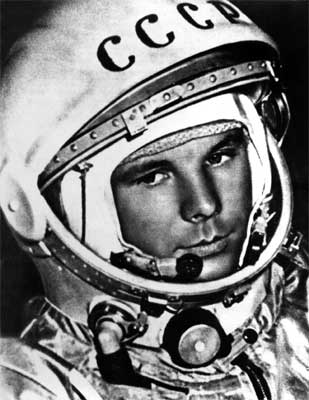
Yuri Gagarin: On 12 April 1961, he really went where no human had gone before...
It was exactly 50 years ago that a human being first traveled to outer space. Yuri Alekseyevich Gagarin was launched into Earth orbit by the former Soviet Union on 12 April 1961, creating history.

He travelled to orbit aboard the Vostok 3KA-3 (Vostok 1), which made a single orbital flight that lasted 108 minutes, or just under two hours. The maximum speed reached was 28,260 kilometers per hour – faster than any human had moved before. At its highest point, Gagarin was about 200 miles (327 kilometers) above Earth.

He paved the way for hundreds of men and women from many nations to travel to near space as well as to the Moon. Up to mid 2010, a little over 500 human beings have travelled to space from 38 nationalities.

First Orbit, a new documentary film that reconstructs Gagarin’s historic flight, has just been released for free viewing on YouTube. The making of this documentary is a remarkable story in itself.

Gagarin’s original spacecraft did not have space or capacity for filming, so there is no visual record of what he saw. But he kept in touch with his control room via radio, and gave many interviews upon return that help us imagine what he experienced.

These words by Gagarin have become famous: “Circling the Earth in the orbital spaceship, I marvelled at the beauty of our planet. People of the Earth, let us safeguard and enhance this beauty – not destroy it!”

Now, First Orbit literally takes us to space in an attempt to retrace what Gagarin saw. It is directed by Dr Christopher Riley, the British writer, broadcaster and film maker, and was made in partnership with the Russian space agency. Additional material has come from the European Space Agency (ESA) and NASA.

The new documentary has been partly filmed by Italian astronaut Paolo Nespoli, currently on a long-duration mission at the International Space Station (ISS) in Earth orbit. By matching the orbital path of ISS, as closely as possible, to that of Gagarin’s Vostok 1 spaceship and filming the same vistas of the Earth through the new giant cupola window, the film has captured a new digital high definition view of the Earth below, half a century after Gagarin first witnessed it. Read more about how the film was made

Most importantly, First Orbit is a a free film that everyone can watch online in full, and also allowed to be downloaded for free. This is in the spirit of Gagarin’s first flight which was not just for one nation, but for all mankind.

Watch the trailer for First Orbit:

Watch the full length documentary First Orbit (1 hr 39 mins):

Wiz Quiz 9: Arthur C Clarke’s HAL, are you here yet?

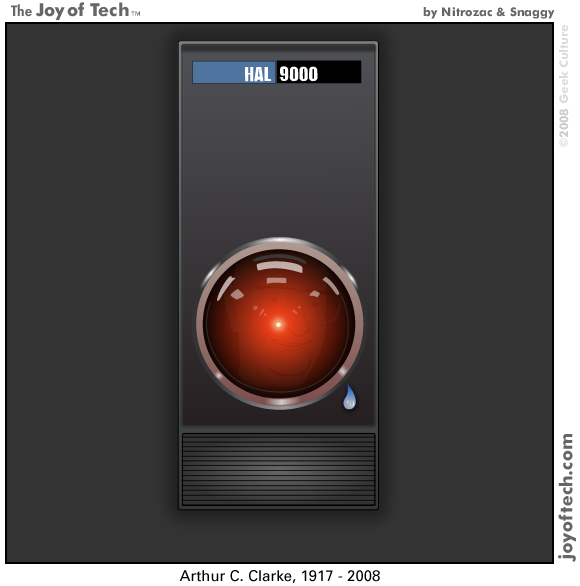
Joy of Tech tribute to Arthur C Clarke, 19 March 2008
This week marks the third death anniversary of Sir Arthur C Clarke, author and futurist.

Among the numerous tributes that poured out all over the world following his departure, I found one especially poignant. It was the ‘Joy of Tech’ cartoon above, showing the sentient computer HAL 9000 (from 2001: A Space Odyssey) shedding a single tear in his memory…

In fact, researchers in artificial intelligence (AI) are still trying to create a real-life HAL, which remains the ‘Holy Grail’ in their line of work: a machine-based intelligence that mimics the human mind in all its nuances, and not just in raw processing power.

This is proving much harder than creating chess-playing or quiz-winning computers: human beings are capable of a wide range of emotions some of which – such as intuition and sense of humour – are still not within the capabilities of advanced AI systems.

In this week’s Wiz Quiz, I pay tribute to both HAL and his creator with a few questions on the march of supercomputers. We ask the long-running question: Can computers outsmart us?

Indeed, that prospect is becoming more real every passing year. An IBM supercomputer named Deep Blue created history in May 1997 when it won a six-game match by two wins to one with three draws against the then world chess champion. A few weeks ago, another human bastion fell — and this one concerns me more as a quiz enthusiast (I never learnt the rules of chess, and don’t understand what all that fuss is about.)

On 17 February 2011, a supercomputer owned by the IBM Corporation beat two veteran quizzers to win a high profile game in the long-running US quiz show called Jeopardy. The supercomputer won with US$77,147, while its nearest rival Ken Jennings, a 74-time winner of the popular trivia quiz, came in second with US$24,000. Brad Rutter, who has in previous appearances won a total of US$3.3 million, was third with US$21,600. IBM plans to donate the computer’s winnings to charity.

What was the name of this quiz-winning supercomputer?

In HAL 9000’s name, what did the letters HAL stand for?

Which famous rocket scientist once said: “Man is the best computer we can put aboard a spacecraft…and the only one that can be mass produced with unskilled labour”?

These are among the 15 questions in this week’s Wiz Quiz. Test your brains against ours (supercomputers may not participate!).

Wiz Quiz 7: Films, canals and famous cities

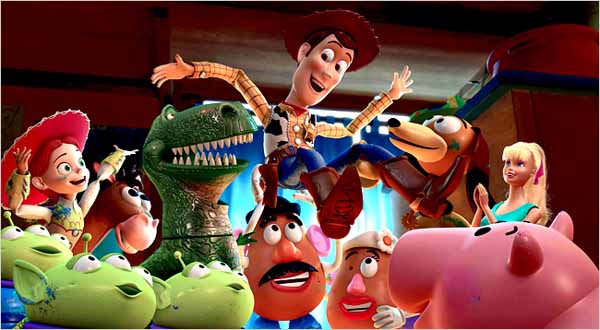
Toy Story 3: Reaching out to the child in all of us? Photo courtesy - Pixar Animation Studios/Walt Disney Pictures
Why did a 3D CGI comedy-adventure film on the abandoned toys of a upper teenager become the highest grossing feature film in the US, and also worldwide, during 2010? What does it say about our common psyche when Toy Story 3, a variation on an already twice-tested theme, earned more than a billion dollars — making it one of the top five money earners of all time?

Psycho-analysts can debate that for years to come. Toy Story series must tug on some deep emotions in many of us, for the third film was not only highly popular, but also received near universal critical acclaim.

Writing in The New York Times, movie critic A. O. Scott noted: “This film—this whole three-part, 15-year epic—about the adventures of a bunch of silly plastic junk turns out also to be a long, melancholy meditation on loss, impermanence and that noble, stubborn, foolish thing called love.”

At the 83rd Oscar Awards ceremony last weekend, Toy Story 3 won two awards — for best animated feature and best original song — out of five nominations.

Wiz Quiz this week, appearing just two days after the Oscar Awards ceremony, started off with a few questions based on some films that received nominations for the best film of 2010 (officially called the Best Picture Award). At the time we compiled the quiz, the winners were not yet announced. But we probed the 10-movie nominations list deeper to see connections not immediately apparent.

We then roam the world of ancient and modern cultures, hopping from Hindu mythology to modern day Japanese cartoons. In between, we take a look at the Suez Canal that was recently in the news, and salute Ronald Reagan.

Wiz Quiz 7: Films, canals and famous cities

Taya Diaz: Amiable tour guide to a (biological) Treasure Island

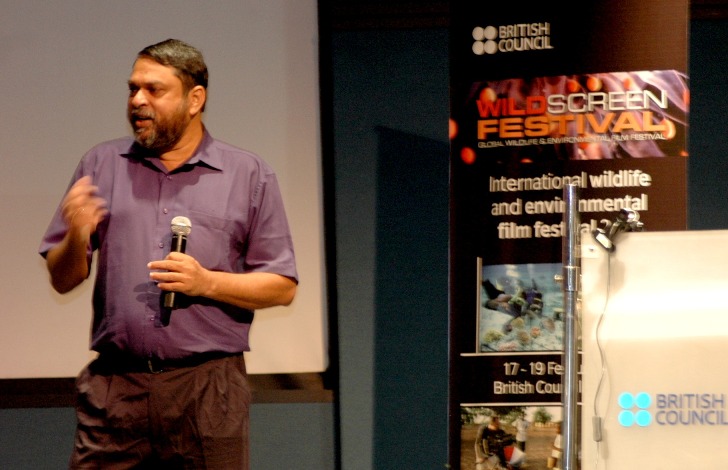
Taya Diaz conducts film making master class during Wildscreen 2011 in Colombo

“Taya Diaz has the shortest name in Sri Lanka but is a big man with a personality to match and a bushy black beard. Apart from being an excellent guide with good knowledge of all aspects of Sri Lankan Wildlife, he’s also a writer and film maker and is excellent company.”

That’s how a bird-watching website once described Taya Diaz, Sri Lankan conservationist turned wildlife film maker.

During the past two decades, Taya has collaborated in making over 20 full-length international wildlife documentaries, all showcasing Sri Lanka’s rich biological diversity and ecosystems. He has been a scientific investigator, presenter, narrator or Sinhalese scriptwriter.

One of his earliest involvements in international film making was with The Temple Troop. Made in 1997, for the BBC and Discovery Channel, it documented a year in the life of a troop of monkeys living in Sri Lanka’s ancient city of Polonnaruwa. These monkeys have been the subject of a long-running study by the Smithsonian Institution’s Primate Biology Program.

Trained as a scientist, Taya has worked in a number of field based conservation projects including the Smithsonian study of monkeys. But it’s as a wildlife and natural history that he now makes a name both in Sri Lanka and overseas.

The Urban Elephant (2000, for PBS/National Geographic), and The Last Tusker (2000, for BBC/Discovery) are two other productions that used Taya’s ground knowledge and scientific expertise. He has provided local liaison for broadcasters such as New Zealand TV, Canal+, Discovery channel, and BBC1.

Taya Diaz: Enough stories to last a lifetime!
For all these reasons, Taya was a natural choice when TVE Asia Pacific was asked to recommend a Sri Lankan film maker to present a master class when the Wildscreen traveling film festival held in Colombo from 17 to 19 February 2011. His master class, titled “Untold Stories of Sri Lanka”, looked at Sri Lanka’s as yet largely untapped potential for authentic, factual stories related to wildlife, natural history and the environment.

He explained the premise for his master class: “Sri Lanka is a pot of plenty in every aspect — the opportunities for a documentary filmmaker are astounding. But sadly, what most audiences see on the airwaves is very standard and boringly similar, touching on the same topics year in and year out.”

Taya feels that documentary films and TV programmes are also essential for educating Sri Lankans about their own natural heritage. Sri Lanka has an impressively high number of plant and animal species for its relatively small land area — which makes it one of the most biologically diverse countries in the world.

“Sri Lankan naturalists, wildlife experts and environmentalists should collaborate more closely with film makers and/or broadcasters to make more local films aimed at local audiences,” he said during a panel discussion I moderated on February 17. “This is essential for raising awareness on environment and sustainable development issues as Sri Lanka pursues rapid economic development after the war.”

Read TVEAP News story on Taya’s master class: Story telling through the local eyes vital, says Taya Diaz

Gene Sharp: Every dictator’s worst nightmare?

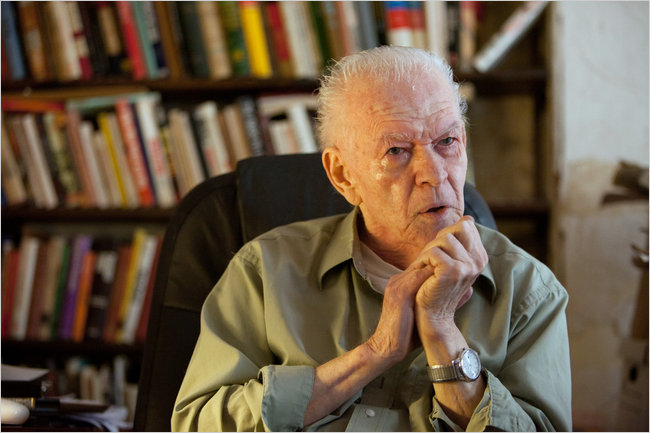
Gene Sharp - NYT Photo

Is this man, now 82 years old, giving the world’s assorted dictators their worst nightmares?

This is Dr Gene Sharp, a Professor Emeritus of political science at the University of Massachusetts Dartmouth in the US, he is widely known for his extensive writings on nonviolent struggle, which have influenced numerous anti-government resistance movements around the world. He is now credited with the strategy behind the recent toppling of the Egyptian government of Hosni Mubarak.

The New York Times on 17 Feb 2011 profiled him with the title: “Shy U.S. Intellectual Created Playbook Used in a Revolution”. The article noted: “Few Americans have heard of Mr Sharp. But for decades, his practical writings on nonviolent revolution — most notably “From Dictatorship to Democracy,” a 93-page guide to toppling autocrats, available for download in 24 languages — have inspired dissidents around the world, including in Burma, Bosnia, Estonia and Zimbabwe, and now Tunisia and Egypt.”

“Gene Sharp is the world’s foremost expert on non-violent revolution. His work has been translated into more than 30 languages, his books slipped across borders and hidden from secret policemen all over the world,” says Ruaridh Arrow, Director of the upcoming documentary titled ‘Gene Sharp – How to Start a Revolution’.

In 2009 Arrow, a producer with Sky News in the UK, began filming a documentary following the impact of Sharp’s work from his Boston house, across four continents and eventually to Tahrir square in Cairo, “where I slept alongside protesters who read his work by torchlight in the shadow of tanks”.

Arrow shares the story of the film in the making on BBC Online: Gene Sharp: Author of the nonviolent revolution rulebook

Extract: “Gene Sharp is no Che Guevara but he may have had more influence than any other political theorist of his generation. His central message is that the power of dictatorships comes from the willing obedience of the people they govern – and that if the people can develop techniques of withholding their consent, a regime will crumble.”

The film is due for release in the Spring of 2011. More info on its official website.
Director Ruaridh Arrow
Director of Photography Philip Bloom
Composer Tom Smail

Gene Sharp – How to Start a Revolution Trailer

Here’s another interesting video featuring Gene Sharp:

Gene Sharp: A Primer on YouTube:

Read “From Dicatorship to Democracy: A Conceptual Framework for Liberation” by Gene Sharp.

Wildlife and Natural History Film making: Are Darwinian Rules at play?

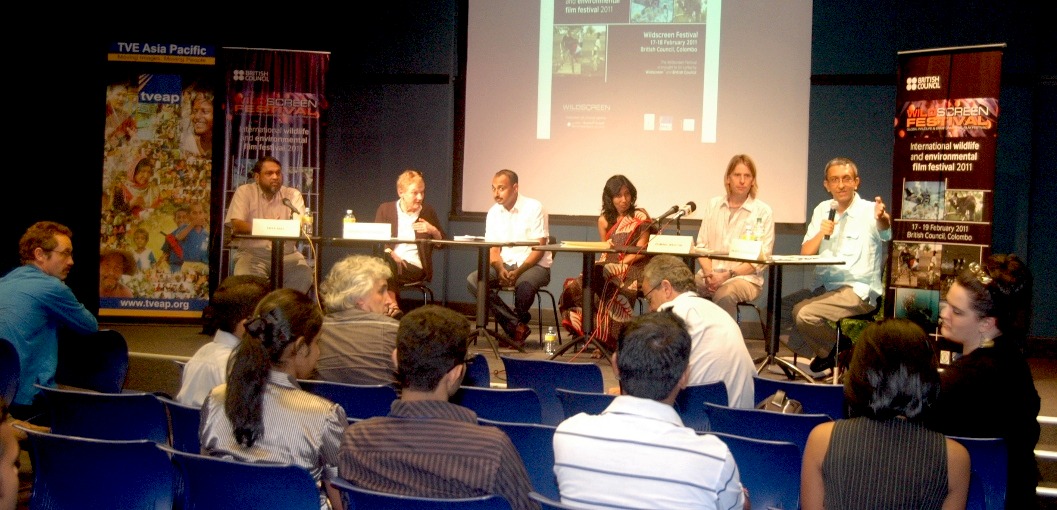
Wildscreen 2011 Colombo Panel: From L to R - Taya Diaz, Amanda Theunissen, Delon Weerasinghe, Anoma Rajakaruna, Dominic Weston and Nalaka Gunawardene

Is there an elite or ‘charmed’ circle of wildlife and natural history film makers in the world? If so, how does a new film maker break into this circle?

This is the question I posed to a group of visiting British film makers and their Sri Lankan counterparts during a panel discussion I moderated at the British Council Colombo on February 17 evening.

The panel, organised around the topic ‘Differences and mutual challenges in Asian, American and European productions/film making’, was part of the Wildscreen traveling film festival held hosted in Colombo, Sri Lanka, from 17 to 19 February 2011.

Amanda Theunissen, who has worked with the BBC Natural History Unit and National Geographic Television, gave a straight answer: yes, there is such a charmed circle.

And although she didn’t say it in so many words, it was clear from our overall discussions that the circle is jealously guarded, and it’s not easy for any newcomer to break into it. And the entry barrier becomes harder if the film maker is from the global South.

I opened the panel recalling the opening sentence of Our Common Future, the 1987 Report by the World Commission on Environment and Development: “The Earth is one but the world is not”. I said: “A similar disparity exists in wildlife and natural history film making. We are all covering the same planet Earth in all its splendour and diversity. But on this planet there are many different worlds of film making.”

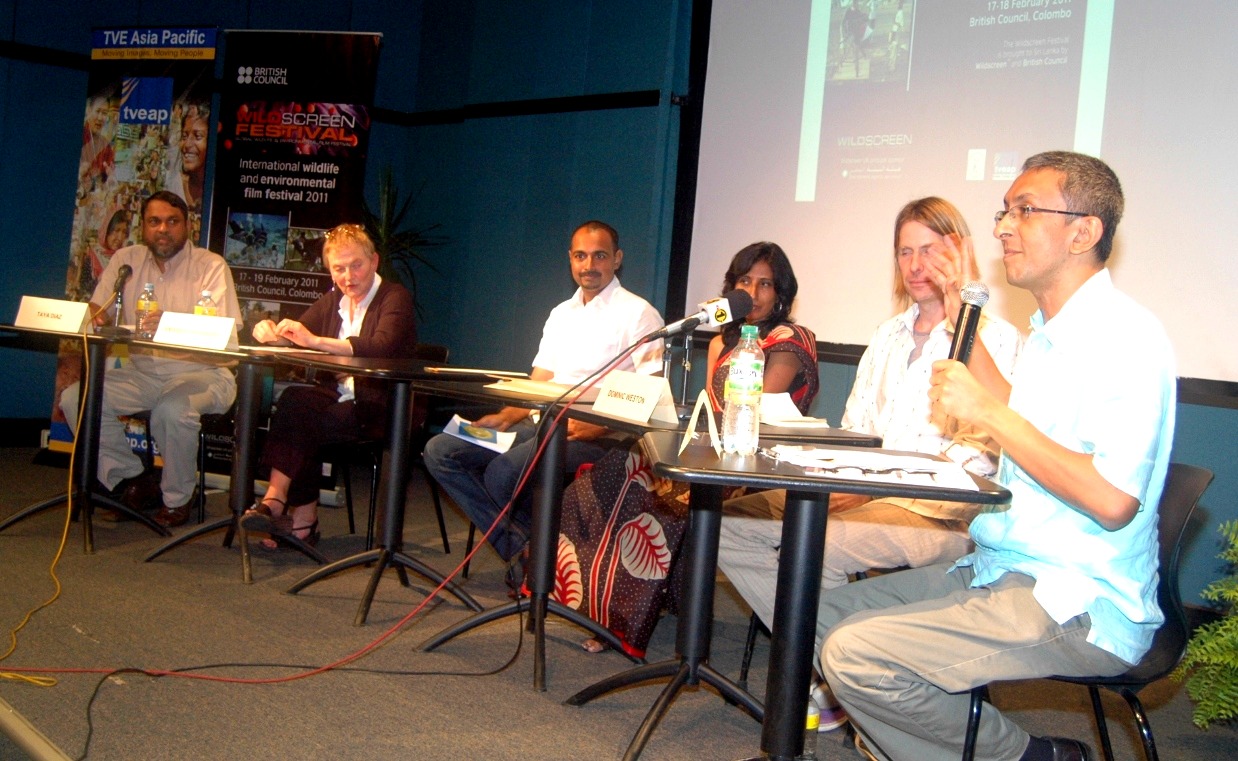
I asked my five panelists — Amanda Theunissen and Dominic Weston from the UK, and Delon Weerasinghe, Anoma Rajakaruna, and Taya Diaz from Sri Lanka — to address three key challenges faced by all wildlife and natural history film makers everywhere: the art of effective story telling; fund raising to make films; and ensuring wide distribution of the films made.

The panel discussion was lively, wide-ranging and engaged the audience which comprised mostly aspiring film makers or film students. I didn’t want our discussion to scare any of them away from a career in environment and wildlife film making. But at the same time, we wanted to acknowledge the practical realities — and disparities — that exist within and across countries in this respect.

I’ve now written up a summary of the panel discussion for TVE Asia Pacific news. Its heading comes from a provocative question I asked during the panel: does wildlife film making operate on almost Darwinian rules?

Read the full story: Wildlife and Natural History Film making: Survival of the Fittest?

Wildscreen Colombo Panel: From L to R - Taya Diaz, Amanda Theunissen, Delon Weerasinghe, Anoma Rajakaruna, Dominic Weston, Nalaka Gunawardene