We’re all familiar with the request at cinemas, theatres and concert halls for everyone to turn off their cell phones (a.k.a. mobiles) before the show starts. Not that everyone complies — there are enough deviants among us who just can’t disengage themselves from their electronic leashes even for a couple of hours.
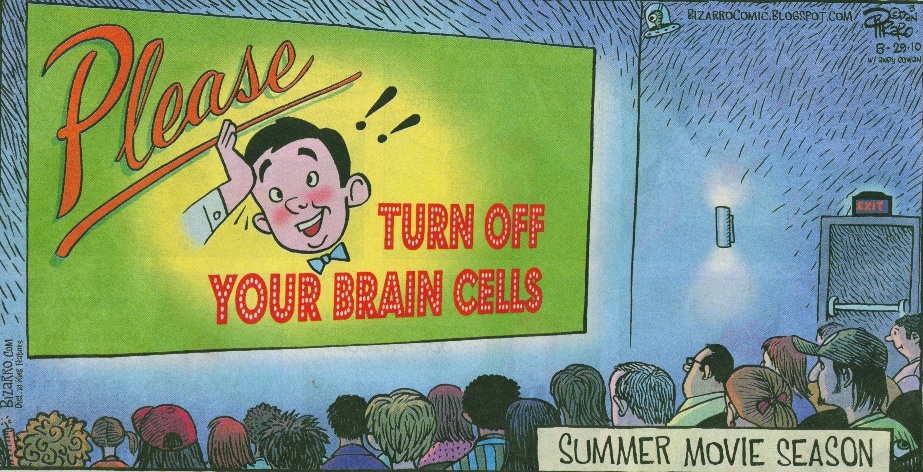
But here’s a new twist to that common (and much needed) request: I came across this in the Bizarro cartoon, which offers some fascinating insights into our topsy turvy times. There are times when I feel that every TV set should come with this line printed on top!
Everyone has a story about cell phones going off at the wrong time in the wrong place. Here’s my favourite.
Together with my TVEAP team, I was running the 2004 AIDS Film Festival in Bangkok, Thailand, during the 15th International AIDS Conference, in July 2004. The festival was held across three venues, and showcased over 50 film titles from around the world — we had nearly half the film makers turning up in person to be introduce their films.
One such film maker, an academic turned film maker, was eagerly talking about his film (an excellent one, unusual for academics) when somebody’s cell phone went off.
The film maker wasn’t amused. He told the full house: “Unless you’re a person with nuclear trigger responsibility, can everyone PLEASE turn off their cell phones?”
But the cell phone ring continued, getting louder.
It took a full minute for its owner to be found — who turned out to be our speaker himself! His own cell phone had been ringing in his trouser pocket all this time, disrupting his own talk.
Moral of the story: Turn off your cell phone at a public performance, especially if it’s your own performance!
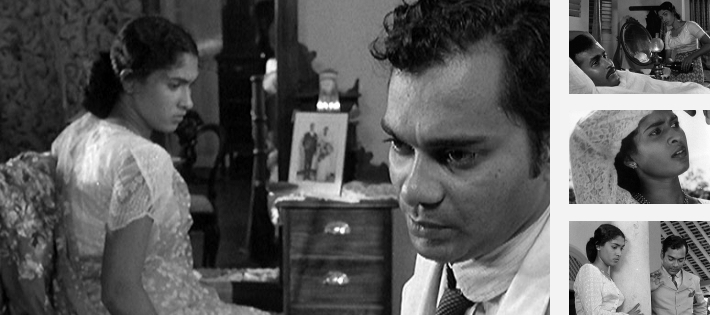
Gamperaliya (1964): A Sri Lankan film classicLast evening, at the gala opening of the European Film Festival in Colombo, I sat two rows in front of a living treasure of the Asian cinema and watched his recently restored 1964 cinematic masterpiece, a cultural treasure in its own right.
The doyen of the Lankan cinema, Lester James Peries, made Gamperaliya (Changes in the Village, 35mm, 108 minutes) based on the Sinhala novel of the same name, written by Martin Wickremasinghe, himself a leading light of Lankan literature during the 20th century.
The movie was groundbreaking in Sinhala cinema, and was shot entirely outside of a studio using one lamp and hand held lights for lighting (at a time when most films were still being made within studios). Although not an immediate commercial success, it was critically and internationally acclaimed, and won the Golden Peacock at the Grand Prix International Film Festival in India and the Golden Head of Palenque in Mexico, both in 1965. It was one of the first Lankan films to be internationally recognised.
Lester: 20 feature films in a 50-year career...Gamperaliya was the first independent film made in Sri Lanka. There was no film studio involvement, and the film maker and friends invested Lankan Rupees 170,000 to make it (roughly USD 30,000 at the time, although today the same amount of the much weaker Rupee converts to less than USD 1,500).
Critic David Chute wrote: “Gamperaliya launched a revolution, not only in the way films were made but also in content…[director] Peries sought an alternative to the Bollywood-influenced melodramas that dominated commercial cinema…With an elegant narrative style comparable to Satyajit Ray’s Apu Trilogy, [the film’s] aesthetic choices also have a moral dimension.”
Gamperaliya is two years older than myself, and although I’d watched it on television, I had never seen it in a cinema on a large screen with proper sound. It was a real treat. For nearly two hours, I was transported back to two periods of recent history: the newly independent Dominion of Ceylon (not yet renamed Sri Lanka) in the early 1960s when the film was made, and the early 20th century colonial Ceylon where the actual story takes place. To engage in such time travel in the company of the maestro film maker himself was a unique experience.
However, it was sobering to reflect how many who were involved in the creative effort to make Gamperaliya are no longer with us. Among them are screenplay writer Regi Siriwardena, actor Gamini Fonseka and co-producer Anton Wickremasinghe. It was only a few months ago that Tissa Abeysekera, who started his long and colourful association with the Lankan cinema by working as a dialogue writer and assistant director in Gamperaliya, abruptly departed.
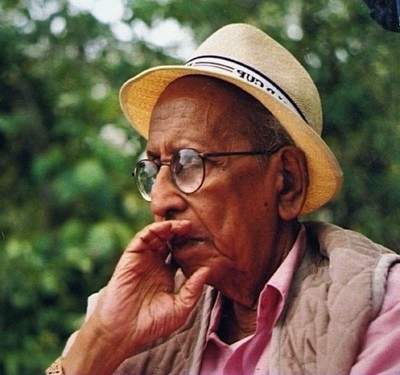
Lester, who turned 90 in April 2009, was making a rare public appearance. We were told that this is only the second time he has ventured out since he retired from film-making two years ago. He looked a bit frail, but walked up and down the isle supported by his wife Sumitra Peries, his partner both in life and cinema.
In some ways, cine film is even more prone to the decay of elements than humans. Gamperaliya was almost totally lost. Last evening’s celebrated reunion of the master and his masterpiece was the outcome of a major restoration that involved substantial efforts and investments by concerned cinephiles on both sides of the Atlantic.
Gamperaliya was rescued from the brink of disaster. A few years ago, UNESCO launched a project to collate a World Heritage of cinema and selected another film of Lester’s, Nidhanaya (Treasure, 1972) as a work of art that should be preserved for future generations. But when Lester and UNESCO representatives went to the Sarasavi studio in Dalugama, north of Colombo, where almost all the films made in Lankan cinema are kept, they found that the master Negative (the Mother Copy from which fresh copies could be made) was burnt due to vinegar syndrome – a condition when negatives start deteriorating.
“This was not due to the failure of anybody in Dalugama studio or the National Film Corporation but due to the failure of all governments that came to power since 1956. The late journalist Ajith Samaranayake and many others fought for a film archive but we were not able to persuade any government,” the disappointed film maker was quoted as saying at the time.
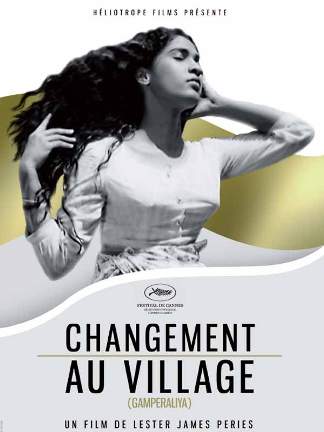
Gamperaliya French poster
This news reached Pierre Rissient, a French national and a guardian of Lankan cinema who is attached to ‘Pathe’ one of the biggest film companies in the world. He urged Lester to help restore the equally important film Gamperaliya, which was also in a state of decay but could still be salvaged.
In one email, Rissient wrote to Lester: “Dear Lester you made a great masterpiece, not only of the cinematography of your country but also universally. It is your duty to make possible this restoration; it is not for your friend Pierre, but for the world.”
So Pierre Rissient pursued this and arranged for it to be carried out at the film restoration unit of the University of California in Los Angeles (UCLA). The UCLA Film and Television Archive is the largest university-based collection of film and television materials in the world,
Some 14 sound reels and 14 picture reels of Gamperaliya, weighing 60 kilos, were couriered to UCLA in May 2007. The film was restored to the visual and audio perfection by Rob Stone and Jere Guldin. The restoration with latest digital sound and visual quality will enable the film to be shown all over the world after 45 years.
In May 2008, the restored Gamperaliya was screened at the Cannes Film Festival under the section ‘Restored Classics’.
At the time, Lester wrote to Pierre Rissient: “It is a tremendous campaign that made it possible for Gamperaliya to survive and your incredible faith in our film that made this miracle possible. We do hope and pray that there is no serious deterioration that will destroy any chances of a glorious restoration. Sumithra and I thank you and are joined by the Sri Lanka film industry for your valiant effort.”
And all of us movie lovers in Sri Lanka and across the world join them in this gratitude, for saving the cultural treasure that is Gamperaliya.
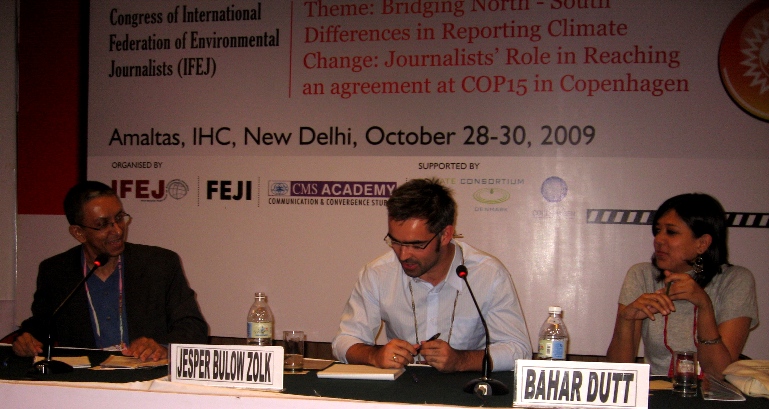
At IFEJ 2009 Congress on 28 Oct 2009: From L to R: Nalaka Gunawardene, Jesper Zolk and Bahar Dutt
I used to describe my job as one where I try to make sense of our topsy-turvy world. But I’d happily settle for the simpler description ‘connecting the dots’. This is what we as journalists covering development issues must do everyday in our work:
• link the macro with the micro; and
• find inter-relationships and inter-dependencies that aren’t always very self-evident.
This reminds of me a piece of advice given by the late Tarzie Vittachi (1921-1993), the Sri Lankan-born journalist and editor who was a pioneer in development journalism in the 1960s and 1970s. Long before climate change became an issue, he was speaking metaphorically to fellow journalists when he said: “Ordinary people live and work in the day-to -day weather. Most can’t relate to long-term climate. It’s our job, as journalists, to make those links clear.”
When Tarzie made this remark, some three decades ago, he was speaking metaphorically. Times have changed and now we are literally dealing with weather and climate issues.
Making those links is not always easy, especially if we want to avoid sensationalism, scare-mongering and other excesses that often characterize media coverage on climate change.
I made these observations when chairing a session on the North-South differences in the electronic media (television) coverage of climate change in New Delhi, India, this week. It was part of the latest international congress of the International Federation of Environmental Journalists (IFEJ), held at India Habitat Centre from 28 to 30 October 2009. Its theme was “Bridging North-South Differences in Reporting Climate Change: Journalists’ role in Reaching an Ambitious Agreement at COP15 in Copenhagen”.
Participants – over 100 journalists covering science and environmental issues, from all over the world – recognised how climate concerns have extended beyond strict environmental (or ‘green’) issues to mainstream political, business and even security coverage in the media.
Joining me on the TV panel were two experienced journalists from news and current affairs channels — Jesper Zolk, Climate Editor of TV2 News, Denmark, and Bahar Dutt, Environment Editor of CNN/IBN, India.
As it turned out, they were a great panel – they knew a lot, and being TV journalists, also knew how to say it well and concisely. This was the second time that Bahar – one of the best known faces on Indian television today – and I have been on a panel together: almost four years ago, at IFEJ Congress 2005, also in New Delhi, she joined me to discuss ‘Does TV do a better job on environmental reporting?’
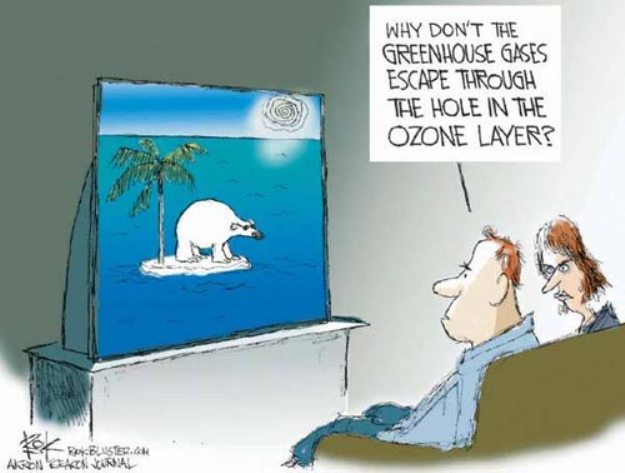
I opened my panel by showing this cartoon, one of my favourite when it comes to climate coverage in the media:
Can we blame him for the confusion?
We cannot assume much more knowledge and understanding in our average TV viewer than the confused guy in this cartoon, I said. So just how do we reach out and engage millions like him (and also the better informed viewers like his fellow viewer)? How do we tell this complex, still unfolding story within the time limits of 24/7 news television, I asked.
We didn’t find all the answers in 75 minutes of our session, but at least we clarified and agreed on a few points. Bahar Dutt’s observations were particularly relevant, especially since India now has over 500 news and current affairs TV channels broadcasting to a billion plus audience in over a dozen languages.
At a time when mainstream media elsewhere in the world are struggling to stay on in business, the Indian broadcast media remain ‘chaotic but robust’, she said. “But editorial filtering is not always very strong in some of our channels, which sees climate coverage ranging from no coverage at all to hysteria,” she added.
According to Bahar, much of the climate coverage in the Indian media overlooks the links with broader development issues. “Focus is often on climate treaty negotiations, or what individual experts or politicians say. These elements are only part of the bigger picture, and we need to look further and dig deeper.”
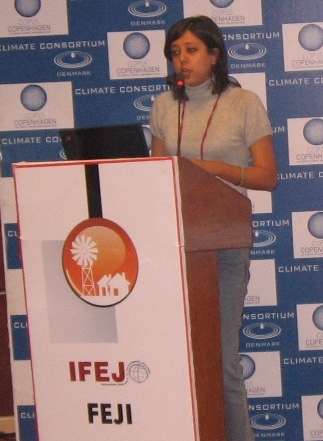
Bahar Dutt at IFEJ 2009“Environmental journalists are not green activists, and our role is to be watchdogs – keeping a sharp eye on government, industry and even civil society,” Bahar said. “But sometimes I find this watchdog role lacking in our media.”
Her advice to fellow journalists: stop seeing environment as simply a green and ‘cuddly’ sector, and move it into the political arena.
Jesper Zolk, Climate Editor of Denmark’s TV2 News, said his biggest challenge was how to get the pampered western viewers to change their lifestyles to be more climate friendly.
He urged journalists to focus not just on problems, but also on viable solutions. He expressed a concern that some journalists covering environmental issues sound more like green activists — a point that Bahar Dutt also agreed on.
She made another perceptive observation: people who have the least carbon footprint are the most keen to take action to mitigate climate change. That’s because they realise they are often the first to be impacted.
Our genial and erudite host Darryl D’Monte, chair of the Forum of Environmental Journalists of India (FEJI), had earlier asked participants to reflect on whether the media is part of the problem or the solution in the current crisis.
On the road to Copenhagen and beyond, we have our work cut out for us. As the Danish Ambassador to India, Ole Lønsmann Poulsen, quoted John F Kennedy in his opening remarks as saying: “The great enemy of the truth is very often not the lie, deliberate, contrived and dishonest, but the myth, persistent, persuasive and unrealistic.”
This award is sponsored by TVE Asia Pacific (TVEAP) and is given to “an individual for excellence in environmental reporting that contributes to public awareness and understanding of environmental issues”.
Pierre was selected “for his insightful, analytical and fact finding stories focusing on diverse issues related to environment and climate change”.
I literally dashed from the Indira Gandhi International Airport to the India Habitat Centre in New Delhi to be part of the inaugural ceremony. Despite the best efforts by Delhi’s notorious traffic, I made it just in time to join Dr Farooq Abdullah, Union Minister of New and Renewable Energy, to present the TVEAP award to Pierre Fitter.
Pierre Fitter: TVEAP Environmental Journalist of the YearAarti Dhar of The Hindu newspaper was adjudged as the Best Environment Journalist Award (Print), while my good friend Krishnendu Bose received the prestigious CMS-UNEP Prithvi Ratna Award “for his sustained and concerted efforts towards enhancing people’s understanding and spreading awareness on diverse environmental issues through films and documentaries”. This is the highest honour for wildlife and environmental film making in India.
Pierre Fitter lives in Delhi where he reports on the environment and foreign affairs. He holds a Bachelor’s degree in Socio-Legal Sciences and is studying for a Masters in Political Sciences. Pierre spent a year and a half in China and Russia, where he worked for AIESEC, an international youth leadership development organisation. While with AIESEC, he developed a deep interest in sustainable development and international relations and continues to report on these issues to this day. He has a special interest in Environment and climate change in particular.
Watch Pierre Fitter interviewing Shyam Saran, the Indian Prime Minister’s special envoy on climate change on the current state of climate change in India in early October 2009:
Selection of award winners was based on regular monitoring of Indian news and current affairs TV channels and newspapers by the CMS MediaLab.
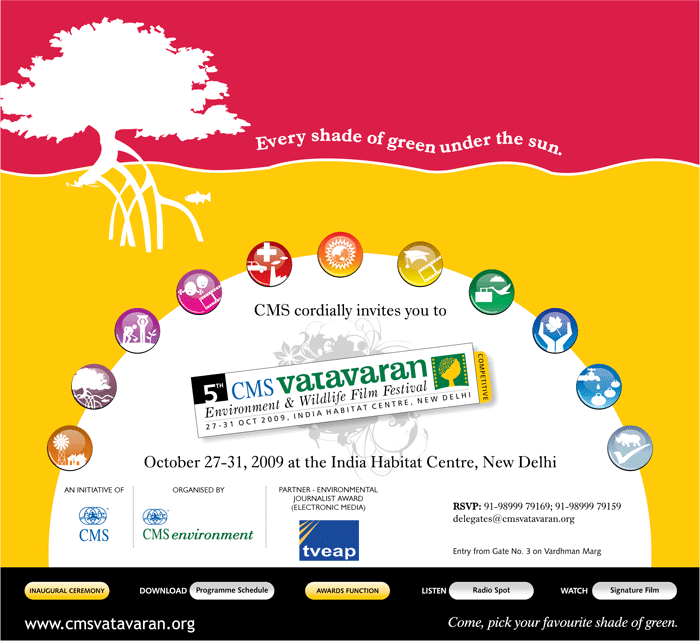
CMS VATAVARAN is India’s premier biennial competitive and traveling Environment and Wildlife Film Festival. It was initiated in 2002 towards raising awareness about environmental issues. The CMS Environment Forum and CMS VATAVARAN have ushered in a fresh green global consciousness on an extraordinary scale using environment forums and films. CMS VATAVARAN is an initiative of Centre for Media Studies.
TVE Asia Pacific (TVEAP) is once again proud to be associated with CMS VATAVARAN, India’s premier Environment and Wildlife Film festival, as a co-sponsor.
The festival runs at India Habitat Centre, New Delhi, from 27 to 31 October 2009. It will showcase the best of Indian and international films on environment and wildlife. The theme of the 2009 festival is ‘Climate Change and Sustainable Technologies’ and focus area is ‘Natural Heritage Conservation’.
I’m looking forward to a week of film watching and meeting film-makers and film lovers.
Kathmandu to Copenhagen - in three minutes?The trend to make ever shorter films has been fuelled by the growth of online video, where the dominant value seems to be: less is certainly more! This is the premise, for example, of the current competition One Minute to Save the World.
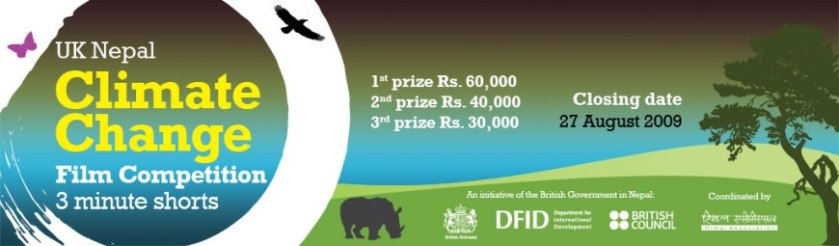
In Nepal, they were more generous — and allowed three minutes. I recently came across the winners of the UK Nepal Climate Change Film Competition, where Nepali film makers were invited to “make short, effective films of up to 3 minutes on the theme of Climate Change”. The submitted films had to be original in concept, innovative and highly motivational – no restrictions were set in terms of discipline or genre. It was organised by our friends at Himal Association, better known for sustaining Film South Asia festival for a decade.
The winning film, Act locally think globally, was directed by Santoshi Nepal and Ishu Lama:
First runner-up, Jeopardy, is an animation directed by Shiva Sharan Koirala:
Second runner-up, 3 Cs of Climate Change, directed by Binod K Dhami and Padam Raj Paneru:
The competition attracted an impressive 124 entries. Angelo D’Silva, an educationist and media critic in Kathmandu, recently reviewed the entries in Himal Southasian special issue on climate change. He wrote: “In cash-strapped times, these contests focusing on climate change prove to be a cost-effective strategy in generating content. With no funding directed to the filmmaker for production, and prize money amounting to NPR 130,000 (USD 1700) for the three winners, the climate-change film contest is a way to make a splash on the cheap.”
He added: “While the filmmakers, all of whom were Nepali, exhibited an impressive range and quality, it was a range obscured by the selection of some fairly typical public-service-announcement-type finalists. Hopefully, however, two sets among the entries will soon see the light of day: those documenting the effects of climate change on Nepali communities, and those exploring (and exploiting) anxieties and fears about the burgeoning climate crisis.”
Read full review here.
I have only seen the three winning entries that are available online, so it would be unfair to comment on other entries. But I found the three winners predictably text-bookish. For sure, simple awareness raising is always helpful, but much more is needed – and urgently so – to deal with climate change. Film can be a powerful force for changing lifestyles, and not all of them have to be feature film length in Al Gore style.
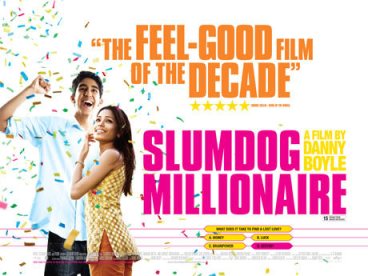
Few films in recent years have generated as much buzz as Slumdog Millionaire, the British-Indian film based in the slums of Mumbai. It has won five Critics’ Choice Awards, four Golden Globes and seven BAFTA Awards, and is nominated for ten Academy Awards, including Best Picture.
I just called to ask...Early on, film critic Ben Walters spotted this aspect. He asked in The Guardian on 9 December 2008: Is Slumdog Millionaire the first truly 21st-century film? Among his reasons: “Jamal works in a call centre decorated with London Underground paraphernalia and whose employees are kept up to date on EastEnders plotlines to improve their chances of successful small talk with their customers. Aptly enough, the customers are mobile phone users – another emblem of 21st-century connectivity – and a mobile plays a crucial part in the story’s climax.”
And now it turns out that a real life ICT experiment triggered the idea of the Slumdog story.
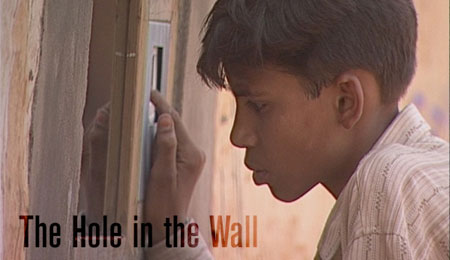
Indian author Vikas Swarup, on whose 2005 novel Q&A the movie is based, has recently revealed how he was inspired by the hole-in-the-wall project. This was an initiative by Dr. Sugata Mitra, chief scientist at NIIT, a leading computer software and training company in New Delhi. Mitra embedded a high-speed computer in a wall separating his firm’s headquarters from an adjacent slum, he discovered that slum children quickly taught themselves how to surf the net, read the news and download games and music. He then replicated the experiment in other locations. Each time the results were similar: within hours, and without instruction, the children began browsing the Internet.
Swarup told Indian Express in January 2009: “That got me fascinated and I realised that there’s an innate ability in everyone to do something extraordinary, provided they are given an opportunity. How else do you explain children with no education at all being able to learn to use the Internet. This shows knowledge is not just the preserve of the elite.”
Discover your world...Dr Mitra’s project was the subject of a 2002 documentary film, called Hole in the Wall, made by the New York based production company GlobalVision.
The film was introduced as follows: A revolution in information technology is redefining poverty, as how much you know is becoming just as important as how much you own. “The Hole in the Wall” examines one possible solution to the growing technological gap between rich and poor — the so-called ‘digital divide’ — that threatens to consign millions to an “information underclass.”
The film was made by Rory O’Connor and Gil Rossellini. An 8-min version was broadcast by PBS in October 2002 in their program Frontline/World. A 60-min version was screened at the United Nations in New York City in December 2002. The film has been widely screened, and won several awards.
Initiator of the Hole in the Wall project carries on his mission to adapt ICTs to serve the unmet needs of India’s poor. Watch Dr Sugata Mitra talk about his work in this TED Video:
What happens when a small and culturally diverse group is flown in from different parts of the world, put up in a comfortable hotel, fed well — and mandated to watch two or three dozen excellent films and asked to come up with a selection of ‘the best of the best’?
That pretty much sums up the experience of the final jury process of international film festivals that have a competitive element. The festival secretariat lines up the logistics but entrusts all the rankings and selections of entries to an independent jury – which typically serves without pay, and works long and hard.
Hosting the Wildscreen Film Festival in Colombo, Sri Lanka, which ended last evening, brought back memories from eight years ago, when I served on the global jury of Wildscreen festival in Bristol in October 2000. It wasn’t just the turn of the millennium that made the festival especially remarkable that year. In some ways, Wildscreen 2000 marked a significant change in how wildlife and natural history films are assessed and honoured.
I’ve done this a few times before and since 2000 — among them Earth Vision (Tokyo) in 1993 and Japan Wildlife Festival (Toyama) in 2003. But being on Wildscreen jury was special, for it’s considered to be the world’s largest and most prestigious wildlife and environmental film festival — the ‘green’ equivalent of the Oscars.
Serving on film festival juries can be both tedious and highly rewarding. On the plus side, I get to watch the best of contemporary factual film making on these subjects from all over the world, and then discuss their relative merits with some of the best professionals in the industry. The downside is that no jury can ever satisfy all film makers who enter their work, nor come up with a selection that is universally accepted: after every festival, there are those who feel their creations didn’t receive the recognition they deserved.
While all the film juries I have served on managed to reach consensus decisions, it often wasn’t easy. Much depends on the jury chair’s ability to find common ground among jury members who hold diverse – sometimes even opposite – views. Wildscreen 2000 jury was very ably chaired by Peter Goodchild, who came from a background of science film making, and was once editor of BBC’s Horizon science series (He was called in on short notice when the chair designate Christopher Parsons, co-founder of Wildscreen, fell ill.)
Endless golden sunsets...Among my fellow jurors were conservationist Dr Lee Durrell and Canadian film-maker and co-inventor of Imax Roman Kroitor. Jane Krish, then Executive Director of Wildscreen, kept us going and made sure there wasn’t too much blood on the expensively carpeted floors of the Bristol Marriot hotel where we were holed up.
Details of what happened during that week is now buried too deep beneath sediments of memory. I remember watching and discussing some great films in great company and racing against time to reach our decisions for the awards night. Parallel to this, the festival’s multiple events were taking place in nearby venues but we couldn’t join them – except some social events in the evenings.
I’m only sorry that I haven’t got a single photograph of that occasion in my personal collection – it was a year or two later that I started the routine of taking my camera on all my travels. But I’ve just located, from the digital archives two laptops ago, the opening remarks that Peter Goodchild made at the awards ceremony, which he’d typed out on my machine. That neatly sums up our extraordinary experience:
“In the past week my jury and I have, in effect, left the human race. During our four days’ viewing we have seen no less than 54 films. And in that time we have tramped over billions of tons of sand, swum in every ocean of the world with trillions of fish, experienced 80 full moons, watched the production of 30 tons of elephant droppings, around 120 copulations (not ourselves), 15 rapes (not ourselves), 210 killings including 30 infanticides, several thousand insect bites, and we have done all this in temperatures of 50 degrees Fahrenheit below and temperatures of 50 degrees Centigrade above.
“In those aforementioned copulations we were privy to the sight of a pair of 1 ton testicles accompanied by what looked like 3 meters of stout garden hose, but was referred, very tastefully, by the narrator as a ‘flexible friend’.
“And so it goes on, 73 assorted prehistoric animals, 18 symphony orchestras, around half a dozen heavenly choirs and — we have refrained from killing each other and we learned that Nature is prolific, but merciless, that humankind has screwed things up quite a bit, and still is, but we are beginning to try to remedy our ignorance and mistakes. And now we return to you here with the results of our deliberations amongst what is, with one or two exceptions, an embarrassment of riches…”
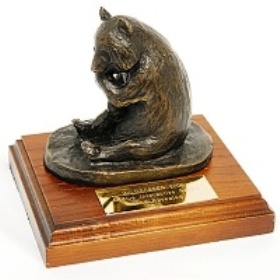
Panda Award, a.k.a. 'Green Oscar'From then on, each member of the jury took turns in announcing winners in various categories, some technical and others more editorial. Each winner received the coveted Panda Award, affectionately (and unofficially) known as the ‘Green Oscar’. Wildlife film-makers from Australia, Britain, France, India, the Netherlands, Norway, South Africa and the United States shared the honours that evening.
Each Panda award was introduced with a brief citation. I presented two: the Conservation/Environment Award and the award for the best film entry from a country that did not have a long tradition of making natural history films.
When presenting the latter, I noted: “It is tempting to draw parallels between the natural world and the world of natural history film making. There are enormous inequalities and disparities in both. Film makers everywhere find it increasingly difficult to raise adequate budgets, but this has always been a stark fact of life for film makers in those parts of the world that lack a long tradition of producing natural history films. In these harsh conditions, the resourcefulness and ingenuity of film makers are tested on many fronts.
“This festival received relatively few entries from such parts of the world and from such film makers, but we understand that it is better than last time. This indicates the presence of talented professionals working against many odds, and trying to exploit the medium to raise public understanding of the environment. The finalists we saw bear testimony to the resolve and commitment of their film makers — who clearly know the art of story telling on television in ways that best engage their audiences. And we need to remember that some of them reach out to hundreds of millions of viewers. These people can make a difference for the planet.”
The award went to Indian film maker Mike Pandey, for his film Shores of Silence: Whale Sharks in India. The 25-minute film, made in early 2000, was the first ever revelation of the killing of whale sharks on the Indian coastline. It so stirred the collective conscience of the authorities, that the government banned the hunting of these endangered marine creatures seven months later.
Every jury’s selection sends out signals, and this is especially so when it concerns the natural history film industry’s most coveted awards. Beyond selecting the winners, our jury also recommended the expansion of the festival’s scope in two ways.
Firstly, we pointed out that simply documenting animal and plant behaviour and their habitats was no longer adequate in a world facing a multitude of environmental crises. There was an urgent need, we said, to mainstream films that looked at the nexus between the natural environment and human society – both conflict and harmony between the two.
Secondly, we recognised the rapid changes taking place in the worlds of broadcasting and web, which challenges film makers to try out new formats or genres, including some that used much shorter durations than those used in wildlife and natural history films until recently. Reviewing eligible film formats was necessary, we said, in an industry that was embracing multimedia to retain or attract eyeballs.
As Peter Goodchild noted in his remarks: “There’s little doubt that there will be increasing demands for personality led programmes, for cheaper format programmes and, because a valuable award – a panda on the mantelpiece – is one potent way of moderating any feared slides into banality, it seemed to us that the Festival needed to create an award rooted in entertainment, where good work in this kind of programming would be recognised.”
It’s heartening to note that Wildscreen festival took note of these recommendations, as evidenced by changes in subsequent editions of the festival. But Peter’s words still hold true: “What is needed, in our view, is to keep testing alternative forms and approaches, expanding the range of programming and avoiding the dangers of a rut based on a past successes.”
For me, it was more than a fascinating journey to far corners of our endangered planet in the company of the world’s best known broadcaster, and Britain’s most trusted public figure. I recalled how in this very venue, as an eager teenager growing up in the simpler, pre-web days of the 1980s, I watched his pioneering series Life on Earth (1979) and The Living Planet (1984). These path-breaking series redefined how natural history documentaries were made, and inspired a whole new generation of film-makers and nature lovers. A quarter century later, I’m still hooked.
Over the last 25 years, Attenborough has established himself as the world’s leading natural history programme maker with more landmark series: The Trials of Life (1990), The Private Life of Plants (1995), The Life of Birds (1998), The Life of Mammals (2002) and Life in the Undergrowth (2005). The final chapter in the ‘Life’ series is Life in Cold Blood (2008).
As fellow broadcaster Jeremy Paxman noted in a Time magazine tribute to Attenborough: “Life After Death is almost the only natural-history series yet to be made by Attenborough. In a career that has taken him to every corner of the world, he has explored life in all its richness — from mammals and birds to plants and reptiles. No living person has done more to make the people of Planet Earth aware of the world around them.”
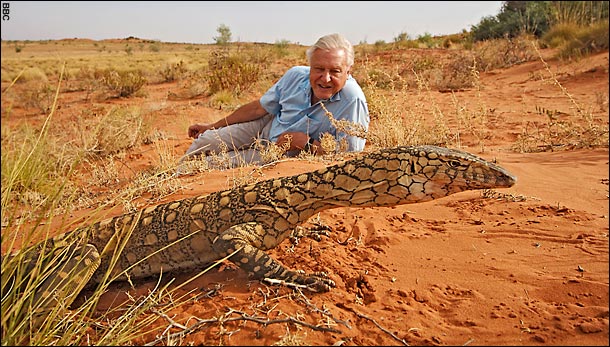
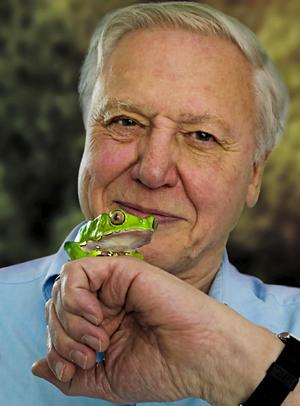
Close encounters?But as I wrote in May 2007, “like all creatures big and small in the great Circle of Life that Sir David has so avidly told us about, he too is mortal. At 81, it’s time for the world to look for the next David Attenborough.”
In his Time tribute, Paxman noted that what distinguishes Attenborough is “that boundless, schoolboyish enthusiasm, the infectious joy of discovering the infinite variety of life”. Yet as the popular song goes, dragons live forever, but not so little boys – so the quest for the next Attenborough has quietly preoccupied the minds of many practising or following the world of natural history and environmental film making.
I’m not obsessed with this question (and I wish Sir David many more years of life on Earth and life on the airwaves), but I today popped it to Jeremy Bristow, a producer of environmental programmes at BBC Television, at the end of his fascinating master class on The role of films in Environmental Conservation. Jeremy’s most recent project has been two films hard-hitting films on Climate Change with Sir David Attenborough for BBC1 and the Discovery Channel.
The bad news is that despite searching far and wide – even some competitions – the David Attenborough has yet to be discovered.
“There are many talented, passionate natural history film makers and some of them also have good screen presence — but none to match Sir David,” said Jeremy Bristow. “I know many in the natural history film world have kept their eyes open for a potential successor.”
Perhaps Sir David is a unique product of his time and circumstances, Jeremy speculated. Certainly, there weren’t too many getting into this business in the early days of television broadcasting. The first major programme series to feature Sir David was BBC’s Zooquest, which ran from 1954 to 1963. And then, one thing led to another…and more than 50 years later, he’s still in the business.
To me, it’s the voice – authoritative without at all being pompous or pontificating – that gives Sir David enduring and endearing appeal. Time called it ‘the voice of the environment’.
Now is the time when that voice of reason, moderation and passion is needed more than ever. A time when the natural world is under siege from human-induced accelerated climate change even as the world of science takes daily beatings from assorted fundamentalist forces.
At 82, Sir David still remains not just our most versatile ambassador to the natural world, but also one of the best spokespersons for the rigors of science and intellectual curiosity.
Here’s a recent example of Sir David – taking us on a quick, animated guide to evolution of life on Earth, in a 2009 documentary called Charles Darwin and the Tree of Lifeto mark 150 years since Charles Darwin published his famous Origin of the Species:
The keynote address was delivered by Sri Lankan minister of environment and natural resources. The British Council asked me to speak a few words at the opening as TVE Asia Pacific is a local partner for this event.
Here’s what I said, which sums up why we are in this business:
We are delighted to be partners in hosting Wildscreen film festival in Sri Lanka. We thank our friends at the British Council and Wildscreen festival for this opportunity to join hands.
May I say a brief word about ourselves. We’re Television for Education Asia Pacific — trading as TVE Asia Pacific. We’re a regionally operating media foundation anchored in Colombo and engaging developing countries of Asia. We were set up in 1996 by a group of Asian and European filmmakers and TV professionals to cover the full range of development issues using broadcast television, narrowcast video and now, the web.
We are driven by a belief that what is happening in the world’s largest and most populous region has far-reaching implications not just for our region — but also for the entire planet.
When introducing our work, I like to recall the words of Mahatma Gandhi. Once, when asked by a visiting foreign journalist for his views on wildlife in India, he said: “Sadly, wildlife is declining in our jungles, but wild – life is increasing in our cities.”
It is precisely this wild–life that interests us more. In our work we keep asking: when life itself is going wild, what hope and prospects are there for wildlife, Nature and environment?
For example, we’ve literally just finished a short film looking at environmental restoration of Afghanistan. This will be screened to the environmental minister from around the world who will gather shortly for the UN Environment Programme’s Governing Council meeting in Nairobi.
We can't just walk into a glorious sunset and forget real world challenges - Photo by Niroshan Fernando, TVEAP
Capturing wild-life is now the focus and concern of wildlife and environmental film makers everywhere. There was a time, not too long ago, when films used to simply capture the beauty of Nature and the diversity or behaviour of plants and animals. Such documentation is still very necessary and useful — but it’s no longer sufficient.
In the past couple of decades, all film makers have been challenged to look at how our own ‘wild’ ways of living affects:
– each other in our own human species;
– the rest of Nature and other species; and
– also, the future of life on Earth.
We see this transformation reflected in the content of films entering Wildscreen and other film festivals. I saw early signs of this when I served as a juror at Wildscreen 2000 festival. This process has gathered momentum since.
To remain relevant and topical, films can no longer just cover ‘green’ subjects — they have to acknowledge the ‘brown’ issues as well as the harsh black-and-white, life-or-death concerns such as climate change.
At the same time, we have seen a rapid diversification of formats or genres — especially with the emergence of online and mobile platforms. These now compete with broadcast television to engage audiences. This is both good news and bad news for us engaged in film making and film outreach. Yes, we now have more ways of reaching people than ever before. But engaging audiences is harder: people have more choice — and more distractions!
Of course, we can’t just give up the good struggle and walk away into those beautiful sunsets. At TVE Asia Pacific, we believe that making good films is only half the job done. Distributing them far and wide is just as important. This is why the slogan of our own organisation is: Moving images, moving people!
In that process, film festivals such as this one play a key role. We’re very happy to add an extra day of screenings to this event. On Saturday in this auditorium, we’ll be showing a number of films on climate change and sustainable development drawn from our own catalogue of films we distribute to broadcast, civil society and educational users across Asia.
These are small efforts in a big world. I can only hope all these help us in winning history’s greatest race – which, according to H G Wells, is one between education and catastrophe!


 I’ve done this a few times before and since 2000 — among them


 Open Minds!