In the environment and development circles, all the roads these days seem to lead to Copenhagen.
That’s because the Danish capital will be hosting the 15th conference of parties (COP15) of the UN Framework Convention on Climate Change, or UN-FCCC from 7 to 18 December 2009.
All sorts of campaigns are underway to raise awareness and build up consensus — a tough call when nations of the world are bickering endlessly as the planet warms up.
Now, CNN and YouTube have created Raise Your Voice campaign: it allows your voice to be amplified to the world leaders at COP15 – the most important climate change conference in a decade.
Here’s the blurb: As nations seek an agreement to protect the world we want your views from across the spectrum.
What needs to be done?
How do the issues affect you?
Do you agree there needs to be action?
There is a breathtaking short video now on YouTube supporting this call:
Click here to send a video with your views, opinions and questions. The best contributions will be aired during the COP15 CNN/YouTube TV debate on December 15.
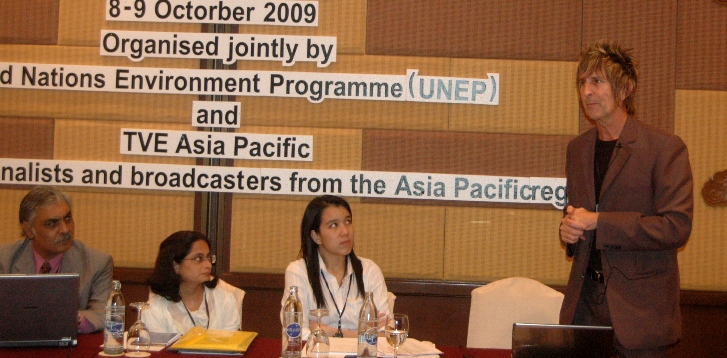
Douglas Varchol (standing, extreme right) speaking at Ozone Media Roundable, 8 Oct 2009
With his wild hair and trendy suits, Douglas J Varchol can pass for a rock star. He is actually an accomplished independent film-maker, currently operating out of Bangkok, Thailand, covering a variety of science and environmental stories in Asia.
Last week, he participated in the Ozone Media Roundtable that TVE Asia Pacific and UNEP organised in Chiang Mai, northern Thailand. After showing his latest documentary film on ozone, titled Earth Report: Perfectly Cool, which was first broadcast on BBC World News in September 2009, he talked about his experience in making the film.
Perfectly Cool is a 22 minute film looking at the challenges faced in trying to phase out a chemical called Hydrochlorofluorocarbons (HCFCs for short), a coolant gas used in air conditioners across the developing world. As chemicals go, it’s a double hazard: this ozone depleting substance also contributes to climate change by acting as a greenhouse gas.
But non-specialist viewers watch broadcast television for good stories, not science lessons. The challenge for journalists and film makers is to ‘sugarcoat’ the technicalities by wrapping it up in human interest stories. Douglas recalled how he did this: combining imagination, hard work and luck.
First, here’s the official synopsis of the film which sums up the story:
Air conditioners are damaging the environment. One widely used coolant gas, HCFC, damages the ozone layer. With booming sales of domestic ACs around the world, the problem has grown in recent years, despite vigorous international efforts to reduce ozone depleting chemicals. Under the international agreement known as the Montreal Protocol, HCFC will be phased out worldwide by 2030. An ozone-friendly replacement gas – HFC – is now used in Europe, but that gas is a potent greenhouse gas — which means it contributes to global warming. However, an answer may be at hand. Earth Report travels to China, centre of the global AC industry, to investigate the cost of cool and meets the industry representatives working on a solution – and Sa DingDing, a musician with extreme views on air conditioners.
Watch the first 4 mins of Earth Report – Perfectly Cool
Humanising science stories is hard enough, and when the subject is something people can’t see or feel, it becomes harder. As I wrote a few days ago, the Ozone Layer – located between 10 and 50 kilometres above the Earth, and invisible to the naked eye – is not something tangible like cuddly animals or endangered plants. Moving ordinary people to care for something they can’t see or touch is tough, even if all life on Earth depends critically on it (the Ozone Layer absorbs most of the Sun’s harmful ultra-violet days).
Douglas had his work cut out for him. Throw into this mix the fact that the editorially independent film was being made pooling funds from six development agencies – each with their own agenda – and that the story was filmed in China where filming permission still involve a lot of paperwork, it’s a small miracle Perfectly Cool was completed. And as we saw, Douglas tells a good story without compromising accuracy or balance.
So did he keep perfectly cool during the making of this film, I asked. He revealed that there were moments of panic and despair, although in the end everything fell into place. While the editors at BBC World were satisfied with the film, some technical specialists consulted for the script had felt it was over-simplified.
Ah, I do know that feeling! When I made a film on ozone in 2006 (Return of the Ozone Layer: Are We There Yet?) it took us 18 months to finish, and went through endless revisions. The UN system seems to just love making films by committee…
With his film, Douglas faced additional hurdles. For example, he takes us inside the Gree company‘s factory producing air conditioners. In 2004, Gree became the largest AC manufacturer in the world, but they had never before allowed television cameras inside their plant. That took lots of time and effort to set up.
Sometimes, things not going according to plans actually helps. When on location, Douglas serendipitously came across elements that were not in the original story treatment but enhanced the human interest: for example, a modern day wedding where the new couple gifted reusable chop sticks to all their guests. That was good environmental conduct – but then they headed off to choose air conditioners for their new apartment…
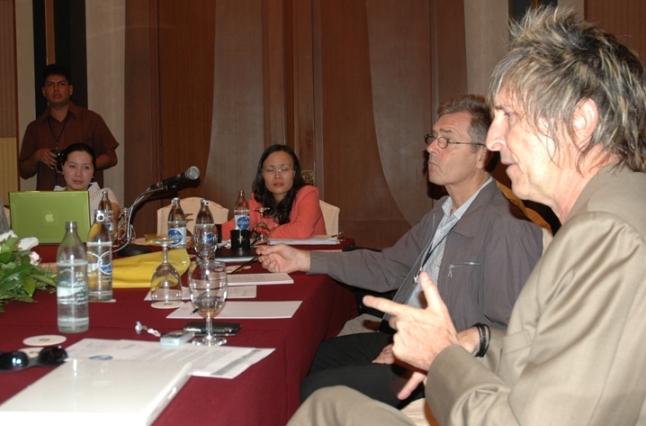
Douglas Varchol (extreme right) makes a point during Ozone Media Roundtable
Douglas paid a tribute to his Chinese researcher Lihong Shi and crew, without whose local knowledge and contacts he couldn’t have made the film.
In the end, Douglas pulls it off. Despite its seemingly esoteric and complex subject, Perfectly Cool is perfectly watchable — and not just for science buffs like myself.
Douglas, who once worked with Wired Science making science programmes for American PBS, said he set out to make a film on HCFCs that even his mom (a high school teacher) could understand. I can’t speak for her, but those of us who watched it in Chiang Mai were enthralled.
Tata Young, 28, is a Thai-American singer, model and actress who is one of the best known performers in Thailand, with a growing following across Southeast Asia. Last week, she was among the performers at the “What on Earth!” concert in Bangkok, part of the EU Green Days event to coincide with the latest round of negotiations of the UN Framework Convention on Climate Change, UN-FCCC.
Tata is the latest Asian entertainment celebrity to join the climate bandwagon. Inside the UN Convention Centre in Bangkok, the climate negotiations were making slow progress. Environmental activists and campaigners were trying every trick in their books to speed things up — but governments bickered over selfish interests even as the planet heated up.
Tata’s newest album, Ready for Love, has its cover printed on recycled paper and sports a sticker that says “Protect the Ozone Layer”. Her interest in campaigning for ozone was sparked when she donated her time filming an ozone related public service announcement for UNEP last year.
The PSA is one of four that UNEP’s ozone team in Asia produced in 2008 as part of their public awareness campaign. They all draw attention to an important date that is drawing close: by or before 1 January 2010, all consumption and production of chlorofluorocarbons, or CFCs, one of the main destroyers of the ozone layer would be phased out in all countries of the world. That is a significant achievement under the Montreal Protocol that nations of the world adopted in 1987 to save the endangered ozone layer.
The PSAs started screening in movie theatres in the Philippines earlier this year, to be followed by Thailand and other countries in the region.
Watch Tata Young’s ozone PSA for UNEP:
In June this year, talking to journalist Nirmal Ghosh, Tata Young said: “It’s important that people are aware of the little things you can do to protect our world, are aware (of ozone) and know what’s going on, especially because unlike garbage and other types of pollution, you can’t see the ozone layer.”
Tata is now singing and speaking for the ozone layer on her own steam. Unlike some other UN agencies, UNEP does not have a formal goodwill ambassador programme. But she has de facto become one.
Full credit to her for this choice. After all, the Ozone Layer – located between 10 and 50 kilometres above the Earth, and invisible to the naked eye – is not something tangible like cuddly animals or endangered plants. Moving ordinary people to care for something they can’t see or touch is that much harder, even if all life on Earth depends critically on it (the Ozone Layer absorbs most of the Sun’s harmful ultra-violet days).
Tata used to hit the headlines in Thailand for some songs which were considered a little too ‘hot’ for the conservative guardians of culture. But looking at the less-than-glacial pace kept by climate change talks in Bangkok, perhaps activists should roll out Tata Young to turn on the heat…
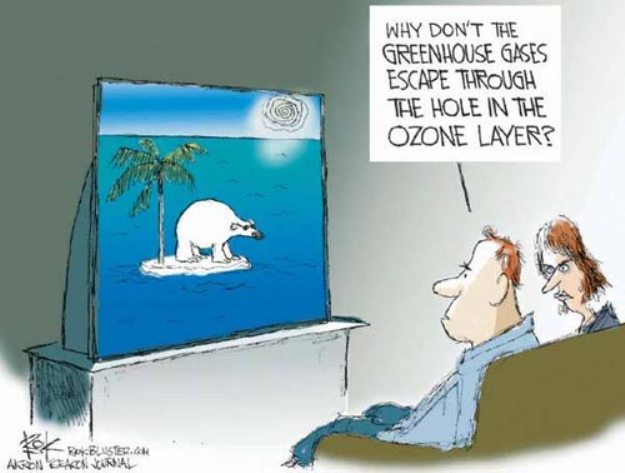
Don’t laugh. The perception of the TV viewer in this cartoon (which first appeared a couple of years ago in the Akron Beacon Journal in Ohio, United States) is more common that you’d think. In recent years, as climate change rose up in the media’s news agenda and the public’s list of concerns, I have met a number of people – from across educational and cultural spectra – who harbour similar confusion about the two issues.
I showed this cartoon, and referred to the wide-spread confusion, in my opening remarks to the Ozone Media Roundtable, an event to engage Asian media professionals on the nexus between ozone depletion and climate change. The meeting, held in Chiang Mai, Thailand, on 8 – 9 October 2009, was organised jointly by the United Nations Environment Programme (UNEP) and TVE Asia Pacific for invited senior journalists and broadcasters from the Asia Pacific region.
Ozone layer depletion and climate change are linked in a number of ways, but ozone depletion is not a direct or major cause of climate change.
In fact, the relationship between ozone and climate is both complex and nuanced, which has prompted some experts to call it a ‘Tango in the Atmosphere’. Ozone affects climate, and climate affects ozone. The authoritative UNEP GRID Arendal website says: “Ozone depletion and climate change are two distinct problems but as they both modify global cycles, they cannot be totally separated. There are still many uncertainties concerning the relations between the two processes.”
In recent years, research has outlined that global efforts to protect the ozone layer has also delivered climate benefits as many of the chemicals that damage the ozone layer – such as chloroflurocarbons or CFCs – also cause global warming.
In 2007 a scientific paper calculated the climate mitigation benefits of the ozone treaty as totalling an equivalent of 135 billion tonnes of C02 since 1990 or a delay in global warming of seven to 12 years. That same year countries meeting in Canada, under the Montreal Protocol, agreed to an accelerated freeze and phase-out of Hydrochloroflurocarbons (HCFCs)—chemicals designed to replace the old, more ozone-damaging CFCs – in the main for the climate benefits.
If an alien spaceship were to randomly descend to the one third of our planet that is not covered by ocean, chances are high that it would land on a rice field.
So I was told a few years ago, when spending time with some rice researchers. Rice is the most widely cultivated food crop in the world. It is also the most important staple food for a large part of the world’s human population, especially in East Asia, South Asia, Southeast Asia, Latin America and the West Indies. From risotto to sushi to paella, food-savvy consumers are using rice as the main ingredient in recipes from around the world. Rice lends substance and texture to many dishes.
Despite all this, rice is under some pressures both economically and culturally. For one thing, it has been taken for granted by many of those who regularly have a ‘rice day’ and think nothing further about it.
How effective do you think this award will be?
When we set out on this joint effort, we posed two big questions: What feeds 3 billion people? And what is slowly but surely disappearing without anyone noticing it? The answer to both questions is Rice! We wanted this film award to draw attention to the central role that rice plays in Asian and Pacific cultures and economies. The measure of our success will be a long term one, and will depend on how many take part in this competition and how far and wide we will be able to distribute their creative efforts.
Why do you think Asia is in need for a wake up call on the subject of rice?
Rice one of our most revered treasures in the Asia Pacific, and many of us take it for granted. It is central to the Asian way of life — its cultural heritage and diversity, spirituality and traditions. This precious rice heritage is under threat from corporate or industrialized agriculture, neo-liberal globalization, private control of the rice seeds, and genetic engineering of the rice genome. Rice lands are also being torn away from small rice farming communities in the name of “development” projects such as special economic zones, cash cropping, and agro-fuel plantations.
Pesticide Action Network Asia Pacific (PAN-AP) has for the last two decades championed the food sovereignty of the grassroots, namely, farmers, agricultural workers, indigenous people and consumers. In 2003, PAN-AP launched the SAVE OUR RICE CAMPAIGN. It is founded on Five Pillars of Rice Wisdom: Rice Culture, Community Wisdom, Biodiversity based Ecological Agriculture, Safe Food and Food Sovereignty. Last year, PAN-AP joined TVE Asia Pacific and Public Media Agency to organise this film competition as part of the on-going campaign. We all share the ideals of promoting rice in Asia and the Pacific.
APRFA co-organisersWhat would you be looking out for in the short films?
The Asia Pacific Rice Film Award will be presented to creators of short innovative television, video or cinematic films that effectively educate the public on the role of rice in Asian cultures, economies and communities/societies. The films should use the ‘Five Pillars of Rice Wisdom’ as guiding principles. They should enhance appreciation of the rice heritage of Asia; raise public awareness of the issues on and threats to rice; highlight the role of small farmers, women in rice; strengthen the people’s resolve and action to save rice; and encourage a stronger role for youth in rice.
Any tips for the participants?
We are looking for short films that are innovative, imaginative and ultimately effective in raising public awareness. Rice may be a pervasive topic in Asia, but the threats to rice are not yet widely appreciated. How do we take this message to the three billion rice growers and eaters of Asia using moving images? How do we engage the YouTube generation – predominantly youthful populations of Asia – with films that open eyes and provoke minds to think further? What would work best — factual reportage, drama, humour, performing arts or other formats? These questions are worth pondering. As organisers, we are open to all formats. We want to be surprised!
After all this, what would be the next step/project?
As I said, this is an on-going campaign, so the winning and commended entries will become new tools and resources for that campaign. Making films and ranking them is only the first half of our shared challenge. We then have to get these films distributed far and wide, using broadcast, narrowcast, webcast and mobile platforms. Three billion people means six billion eye balls that need to be reached! That should keep all of us busy for a while…
A tale of two iconic images...
I am in Chiang Mai, northern Thailand, conducting the Ozone Media Roundtable, a high level event to engage Asian media professionals on the nexus between ozone depletion and climate change. The meeting, held on 8 – 9 October 2009, is organised jointly by the United Nations Environment Programme (UNEP) and TVE Asia Pacific for invited senior journalists and broadcasters from the Asia Pacific region.
TVE Asia Pacific and UNEP convened the roundtable meeting in Chiang Mai to explore the ozone/climate nexus from a communications perspective. We brought together a small group of senior journalists and broadcasters who have been covering ozone and/or climate issues. We also invited a few ozone and climate technical experts to discuss the close links between ozone layer protection and climate change mitigation.
I work with moving images, but I also know the power of still images — especially when they are highly symbolic. Looking for a good visual link between ozone depletion and climate change, I came up with two images of our planet, seen in different ways that represent the two global environmental challenges.
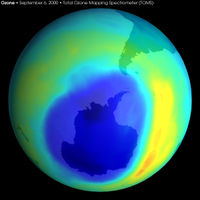
Largest ever Ozone hole, Sept 2000The first image is better known, and is a colour enhanced satellite image of the Ozone Hole that was discovered in 1985 by British scientists Joesph Farman, Brian Gardiner and Jonathan Shanklin of the British Antarctic Survey. The ozone “hole” is really a reduction in concentrations of ozone high above the earth in the stratosphere. It is defined geographically as the area wherein the total ozone amount is less than 220 Dobson Units.
This discover was largely responsible for galvanising international attention and response to the threat of ozone depletion. After a series of inter-governmental meetings and negotiations, the Montreal Protocol on Substances that Deplete the Ozone Layer was finally agreed upon on 16 September 1987 at the headquarters of the International Civil Aviation Organization in Montreal.
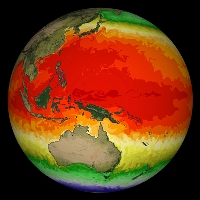
Temperature projection for Year 2100The second image is not as widely known, but represents an even greater environmental calamity that is currently unfolding: global warming and rapid changes in climate it has triggered. The image is a colour enhanced image of the Earth’s temperatures in 2100 AD (less than a century from now), as projected by the Earth Simulator — one of the world’s most powerful supercomputers — which Japanese scientists use to project the climatic disasters in next 100 years.
The system was developed in 1997 for running global climate models to evaluate the effects of global warming and problems in solid earth geophysics. It has been able to run holistic simulations of global climate in both the atmosphere and the oceans — down to a resolution of 10 km.
Between these two images, we are looking at two of the biggest environmental challenges of our times. How the climate crisis can learn valuable lessons from the ozone crisis is what we discussed at the Ozone Media Roundtable.
How much can you pack in to one minute, or 60 seconds? That’s a lot of air time, as broadcasters and advertisers know very well.
‘One Minute to Midnight‘ has been a favourite metaphor of dooms-dayers – and is the title of a 2008 book. It was widely used in relation to the world drawing closer to nuclear war during the second half of the 20th century.
Now, as global climate change surpasses fears of global nuclear war, we are given just one minute to save the world.
One Minute to Save the World is an international short film competition to raise awareness of climate change. Entries are currently being sought from professionals and amateurs, with 31 October 2009 as the deadline. There is also a category for under 18s and for entries shot on mobile phones.
The idea is to enable anyone, anywhere, to deliver a short but powerful message to the world on climate change. The winning films will be sent around the world in November as an online campaign to raise awareness of the Copenhagen Climate Conference in December 2009.
Good planets are hard to find...British TV presenter and adventurer Bruce Parry, a founder of the competition, says: “Together we will be looking for films that convey a powerful message about how climate change affects you and those around you. Were you a flood victim? Have you seen a change in the plants and wildlife in your garden? How has your world been affected and how can we address it?
He adds: “So, we hope you’ll all get thinking and shooting – whether you’re a seasoned pro or just someone who cares. Your planet needs you and your talents. One minute might not seem like a long time but it’s actually longer than many advertisers spend hundreds of thousands of pounds on. It’s also an easy length of time to hold people’s attention. And that is one of the things we urgently need to do if we’re going to turn things around for our planet before it’s too late.”
The winning entries will be judged by an international panel that includes Parry himself, award-winning director and climate change activist Shekhar Kapur; Franny Armstrong, director of Age of Stupid and The Guardian‘s environment editor John Vidal.
The website will become an online film festival which requires no travel or celebrity status to attend – all you need is access to a computer. “And as everyone knows, the power of the net can make the most unexpected video attract the attention of millions globally,” says Bruce Parry.
Whatever we might think about the artistic and technical merits of his climate film An Inconvenient Truth, it has settled with a resounding ‘yes’ one question: can a single film make a difference in tipping public opinion about a matter of global importance?
But the climate crisis that confronts us is so formidable that we need many more Al Gores to come up with as many moving images creations as they can.
Their call out for all climate films says: “This December thousands of delegates, decision makers, stakeholders and activists will converge on Copenhagen. To be part of this EngageMedia is putting together a compilation of Asia-Pacific climate films to be screened and distributed at the event and around the world. Submit your film to EngageMedia and be part of the action. Global action is urgent and essential – the time for debate is over.”
TVE Asia Pacific, already a partner on EngageMedia platform, is submitting all its recently produced climate change films.
Celebrating Heroes
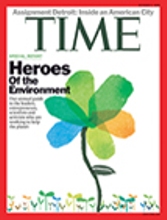
Asian environmental leaders, activists and visionaries feature prominently in TIME Magazine’s Heroes of the Environment 2009 list, published in its issue dated 5 October 2009.
This isn’t surprising, since the Asia Pacific accounts for nearly two thirds of humanity. As I’ve been saying for some years, the quest for sustainable development will be won – or lost – in Asia.
By happy coincidence, I have met three of the two dozen remarkable men and women in this year’s Heroes list — and count two of them among my extended network of friends across Asia.
One friend is the Indian film-maker Mike Pandey, who has been making environment and wildlife films for over 30 years in India, where he is one of the most respected names in conservation circles.
The other is Sheri Liao, Founder of the Global Village of Beijing (GVB), one of the earliest non-governmental organisations addressing environmental issues in China. She is an indefatigable Chinese activist and campaigner whom I first met on my first visit to Beijing in 1996. Our paths have crossed a couple of times since then, and I have always admired her zeal and single-minded pursuit of ‘greening’ China. Added on 17 Oct 2009: Blog post on Sheri Liao and greening the airwaves in China
The third ‘hero’ is the amiable and technocratic Mohamed Nasheed, President of the Maldives. I filmed an exclusive TV interview with him a few weeks ago, which I am currently editing into a short documentary on climate change. His country, the smallest independent state in Asia (by both land area and population), is on the frontlines of impact from rising sea levels and extreme weather events triggered by global warming.
“From saving wild mountain rivers in China to measuring the Arctic’s icy expanse, our green heroes are informed by this simple notion: We can all make a difference,” Time editors wrote in introducing this year’s list.
And I have already blogged about another TIME Hero well ahead of their selection: environmental lawyer Syeda Rizwana Hasan, a determined environmental activist who keeps dozens of ships from coming to die on the beaches of her native Bangladesh.
In the coming days and weeks, I plan to write separate posts on these other heroes whose selection is both timely and inspiring to all of us working in the broader development sector.
Prince Mostapha Zaher (left) with Rohit Gandhi in Kabul
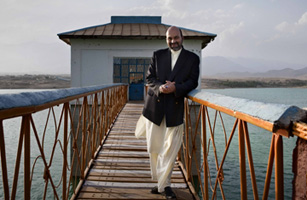
I haven’t yet met Prince Mostapha Zaher in person, but feel almost as if I have. That’s because he features prominently in a short documentary film we released earlier this year on the environmental problems in Kabul, the capital of Afghanistan — where he is now the environmental chief, and where his grandfather was Afghanistan’s last king, Mohammed Zahir Shah (1914-2007).
In January 2009, I was watching a rough edit of the film (Breathing Life into Kabul) in Delhi, where Indian film-maker Rohit Gandhi was putting it together. In the interview, Mostapha Zaher came across as authoritative and resolute.
And does he have formidable challenges to deal with! Since the Taliban regime fell in 2001, people have been returning to Afghanistan after years in neighbouring countries. This massive influx is exerting pressure on the resources and infrastructure of the capital Kabul. Among the effects are high levels of air and water pollution, massive shortages of electricity and mounting problems waste.
Addressing these and other environmental issues is made that much more difficult because Afghanistan is one of the poorest countries in Asia, where large parts of the country are still engulfed in a prolonged conflict with extremists and the Taliban.
Says TIME: “Since then he has worked to rewrite the nation’s environmental laws, enshrining in the constitution an act that declares it the responsibility of every Afghan citizen to “protect the environment, conserve the environment and to hand it over to the next generation in the most pristine condition possible.” In a country ravaged by 25 years of war, it was an extraordinary feat.”







 “From saving wild mountain rivers in China to measuring the Arctic’s icy expanse, our green heroes are informed by this simple notion: We can all make a difference,”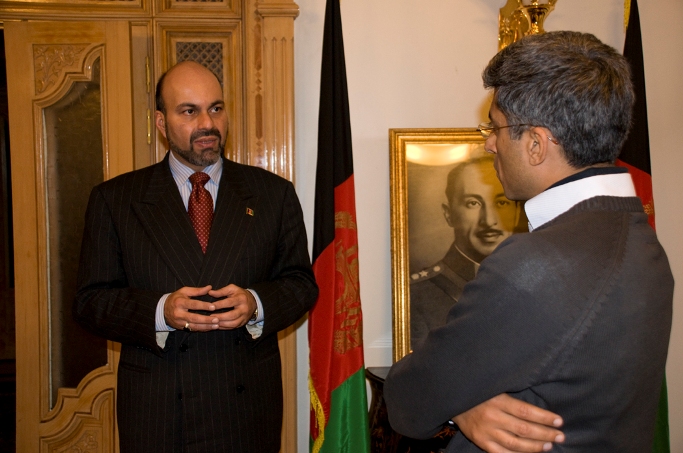
 Open Minds!