This Blogger has gone in search of answers. Back...whenever
“The long run is a misleading guide to current affairs. In the long run we are all dead.” – John Maynard Keynes
I’m taking a break from blogging and other forms of public engagement. When I come up for fresh air, I might occasionally tweet – see the twitter feed on the right hand column for such output, but again, don’t bank on it. I have to sort out some Big Ideas in my mind, and seek answers to compelling questions.
Every blogger needs a break. This is mine. We’ll be back as soon as….inspiration permits.
Meanwhile, read this essay that asks – and answers – the Big Question: Is Life Worth Living?
I haven’t been blogging much during April. One reason is that I’ve been travelling across space — and time.
I was in London for 10 days, and with its lovely Spring weather, I had every reason to be offline. I’ve also been spending a good deal of time back in 1966-67, and having a great deal of fun doing so. (The 1960s had a charm of their own that’s never been repeated…)
Let me explain. I’ve been watching the digitally remastered original Star Trek episodes, which had their first broadcast in that now far-away year — the same year I was born. And what an exhilerating experience to go back to these superbly crafted stories: they offer me both timeless mental stimulation and a sentimental journey to my own childhood/boyhood.
I’d heard of the digitally remastered DVDs’ release a couple of years ago, and was delighted when I found the last copy of Season 2 in a DVD store in Amsterdam in late March. The remastered episodes look and sound crisp, thanks to digitally restored imagery and audio. But the more daring work involved updating the shows’ visual effects with CGI to bring them more in line with the look and quality of later Trek efforts. That’s proving to be a real treasure – well worth waiting for…
As the promotional blurb reads on Amazon.com: “Star Trek, the NBC series that premiered on 6 September 1966, has become a touchstone of international popular culture. It struggled through three seasons that included cancellation and last-minute revival, and turned its creator, Gene Roddenberry, into the progenitor of an intergalactic phenomenon. Eventually expanding to encompass five separate TV series, an ongoing slate of feature films, and a fan base larger than the population of many third-world countries, the Star Trek universe began not with a Big Bang but with a cautious experiment in network TV programming. Even before its premiere episode (“The Man Trap”) was aired, Star Trek had struggled to attain warp-drive velocity, barely making it into the fall ’66 NBC lineup.”
To boldly go where no man has gone before...
As I’ve said before, I’m as old as Star Trek: we were born a few months apart in 1966 (I’m older by seven months). But because we grew up on opposite sides of planet Earth in the pre-Internet era, our worlds didn’t collide until we were both well into our teens.
I have vivid memories of that delightful first encounter, which changed the course of my life forever. In mid or late 1982, Sri Lanka’s newly launched national TV channel Rupavahini started airing a space adventure series called Star Trek. Although I was already familiar with Star Wars movies (of which two had been made by then), I’d not heard about Star Trek until the publicity accompanying the local broadcast.
Star Trek (the original series, now abbreviated as TOS) aired on my local TV – we had just two channels back then – on Wednesdays from 7 to 8 pm, which was prime time just before the evening news at 8. I remember the series ran for at least a year, during which time around 50 episodes were broadcast. I managed to watch most of them.
That wasn’t as easy as it sounds. Our household didn’t yet have a television set, so I had to go across to my aunt’s house next door to watch Star Trek. My school teacher parents took a long time to warm up to the new medium – we didn’t acquire a TV set until early 1983, almost four years after TV was introduced to Sri Lanka in April 1979. And because they placed such emphasis on studies, I was allowed only an hour of television per week. I have absolutely no regrets that while it lasted, I devoted my entire weekly TV quota for Star Trek.
So every week at the appointed time, the United Star Ship Enterprise and its intrepid crew took my young mind roaming around the universe, providing me a welcome escape from the dull and monotonous routine of my teenhood. Even today, hundreds of movies and many thousands of TV hours later, I can just close my eyes and instantly replay in my mind the evocative theme narration and music of Star Trek TOS:
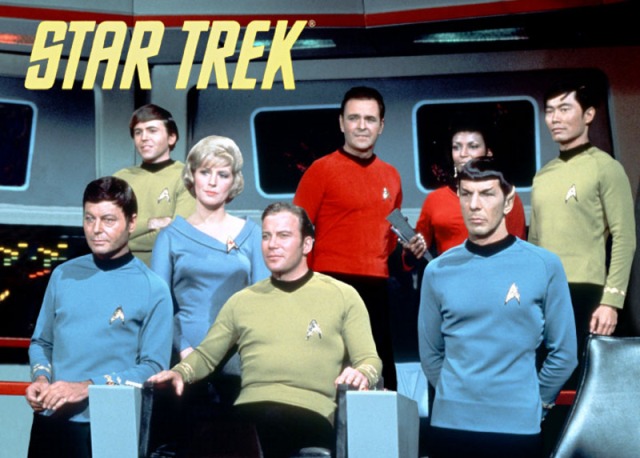
I sat awestruck by the adventures of Captain James T Kirk (played by William Shatner), First Officer Spock (Leonard Nimoy), chief engineer Lieutenant Commander Montgomery Scott (James Doohan), Dr. Leonard “Bones” McCoy (DeForest Kelley), Communications Officer Uhura (Nichelle Nichols) and others. The stories appealed to me as much for insights into the infinite possibilities (and combinations) of life, technology and power at a cosmic scale, as for the glimpses of the near-Utopian human society in the 23rd century.
The series was already 15 years old, and it was showing signs of age. It had the faded Technicolor look and feel of films and TV programmes made in the 1960s and 1970s. The sets were basic and special effects appeared simple — computer-generated images (CGI) was not yet invented. On such technical merits, Star Trek TOS appears elementary when compared to the original Star Wars movie that would roll out just a decade later, in 1977. (A decade is a very long time in the entertainment industry.)
But what the series lacked in looks, the show more than made up in its brilliant story lines and rich imagination. Inadequacies in production values didn’t really matter to me — or to millions of other ‘Trekkies‘ scattered across the planet. The storylines were entertaining and mind-stretching, frequently carrying concepts distilled from the finest in science fiction literature (in fact, some of the genre’s accomplished writers were involved in writing stories for the series, e.g. Robert Bloch, Normal Spinrad, Harlan Ellison and Theodore Sturgeon). The characters were strong, diverse and played by actors who soon developed global fan clubs of their own.
And now, I can relive those journeys again — this time at my leisure, packing as many, or as few, into my private screening schedule. No broadcaster or parent holds me captive any more.
Here’s how the digitally remastered version of the same series opens (aficionados, please spot the differences):
And here are a couple of comparisons between the old and remastered versions that fans have done and released on YouTube:
Of course, remastering a series held in such awe and regard by millions of fans worldwide was a calculated risk.
As Wired noted in a December 2008 story: When Star Trek designer Mike Okuda began remastering the original Star Trek episodes for a series of DVD releases, there was a chance that the show’s more devoted fans would want him beamed to a Klingon prison planet for altering the 1960s classic. To guard against this, Okuda insisted that the new effects would have to be closely based on the originals to retain the visual spirit of the ’60s series.
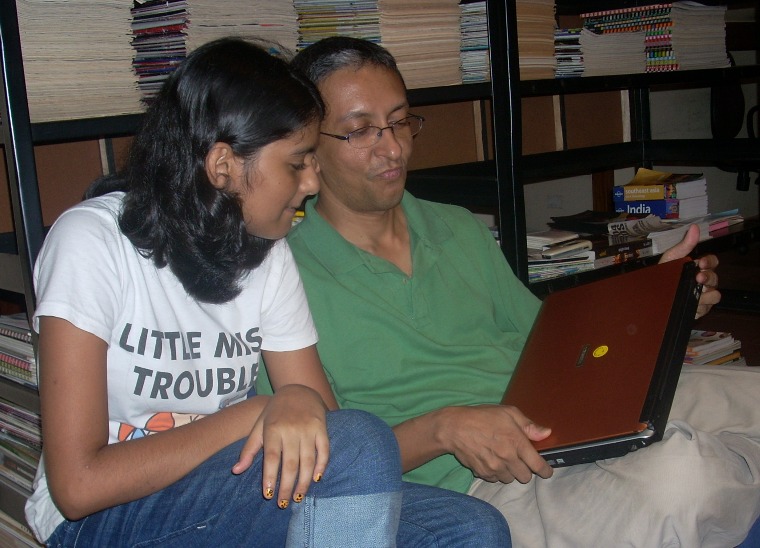
“Good parents are sooo hard to find these days!” exclaimed my teen-aged daughter Dhara recently. She was talking with her tongue firmly in her cheek — I hope!
In recent days, she’s been re-reading our collection of Calvin and Hobbes books, where the world’s most cheeky six-year-old keeps making wisecracks about his own mom and dad (‘Your approval ratings among household six-year-olds are way down’, ‘When are you standing for re-election, dad?’, etc.).
But Dhara’s light comment rang true, generally speaking. As every parent discovers sooner or later, parenting is a 24/7 job that lasts for two decades or longer. There’s no help desk or emergency number we can call. It’s more an art than a science, for which there is no comprehensive, fail-proof guide — even though plenty of advice is available on TV and online (some of it better than others).
Generic advice is helpful but not sufficient. Every parent-child situation is unique, and every parent has to find what works for him or her…ideally, the two parents working in tandem.
Does parenting come naturally? If only it did! I don’t believe in this grandma-knew-best kinda romanticising. For sure, some in our grandparents’ generation got it right, but there were also many who never did.
For something so consequential for the future of our species, there’s no minimum age or entry level or qualification. (As Dhara occasionally asks me, “You didn’t have to take any exam for this job, did you, dad?”. Come to think of it, I didn’t — although, in my case, I did give it a lot of thought first. Honest!)
Dhara with her dad-for-life, Jan 2010Geeks express it a bit differently. “A human being is the best computer available to place in a spacecraft. . . It is also the only one that can be mass produced with unskilled labour,” said the German-American rocket scientist Wernher von Braun, the brains behind the Apollo project that landed men on the Moon.
Although I can’t vouch for its authenticity, a similar quote from the mid 1960s is attributed to the US space agency NASA: “Man is the lowest-cost, 150-pound, nonlinear, all-purpose computer system which can be mass-produced by unskilled labour.”
I don’t like their cynical analysis of something far more nuanced than their usual hardware and software. But they got a point there. Biomedical sciences have advanced much since the Moon landings, and today some medi-geeks are trying to ‘play God’ in creating life in a lab. I’d like to see how they can get a machine to mimic the 20+ year parenting process…
Making babies may be accomplished by unskilled humans in the right age, but raising babies is most decidedly a high skill, high intensity and highly demanding job. Especially in this day and age, when many kids are more tech savvy than their parents: the Digital Natives can easily run virtual rings around their Digital Immigrant parents.
We have to watch out, though, to listen carefully to what our children are saying to us — and also about us!
By the way, as one of my favourite authors, Roald Dahl, reminded us, “To children, all grown ups are like giants — who tell them what to do all the blooming time!”. (The worst parents in my mind are also created by Roald Dahl’s imagination: Mr and Mrs Wormwood, in his 1988 novel Matilda, which was adapted into a movie in 1996. In the movie, Papa Wormwood tells the precocious little Matilda: “Listen, you little wiseacre: I’m smart, you’re dumb; I’m big, you’re little; I’m right, you’re wrong; and there’s nothing you can do about it!”).
The bottomline: am I a good parent? It’s not for me to judge — but I try hard being one. It isn’t an easy act for anyone, and especially for a single parent that I now am.
Someday, I hope, the one-woman jury won’t be too harsh on me…and may she never need to advertise for a replacement.
Nalaka Gunawardene (L) with cartoonist Camillus Perera - photo by Malaka Rodrigo
In January 2009, writing a tearful farewell to the slain newspaper editor and investigative journalist Lasantha Wickrematunga, I invoked the memory of Siribiris. I wrote: Goodbye, Lasantha – and long live Siribiris!
Last weekend, I finally met the ‘father of Siribiris’ and was delighted to salute him in public.
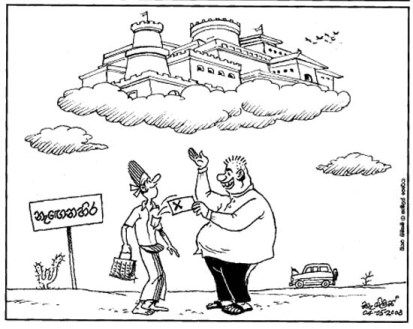
Let me explain. Siribiris is an iconic cartoon character well known to two generations of Lankan newspaper readers. He is a creation of Camillus Perera, a veteran Lankan political cartoonist who has been in this uncommon profession for nearly 45 years.
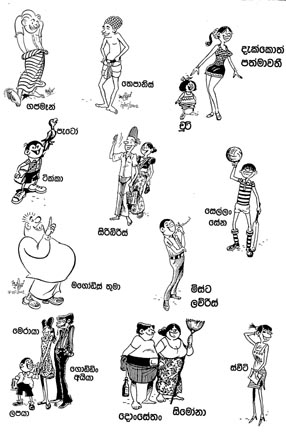
Camillus started drawing cartoons in newspapers in 1966 with the Observer newspaper and the film magazine of the same publishing group, Lake House (then privately owned and under state control since 1973). He draws pocket cartoons, political cartoons as well as satirical comic strips. His most enduring accomplishment has been the creation of a set of regular characters who have developed a loyal following over the years. Among them are the wily Siribiris, prankster Gajaman, fashionable young lady Dekkoth Pathmawathie, smart alec kid Tikka and sporty Sellan Sena.
These and other characters are very ordinary and very real, and they inhabit an undefined yet familiar place in the cartoon universe that most Lankan newspaper readers can easily relate to — it’s a bit like R K Narayan’s fictitious village of Malgudi.
Siribiris (left): puncturing egos for 40 yearsMy own favourite, Siribiris, is really Everyman personified: long-suffering, taken for granted by politicians, exploited by businessmen, hoodwinked by corrupt officials, and always struggling to simply stay alive. He is down but not yet out. The only way that poor, unempowered Siribiris can get back at all those who take advantage of him is to puncture their inflated egos and ridicule them at every turn. And boy, does he excel in that!
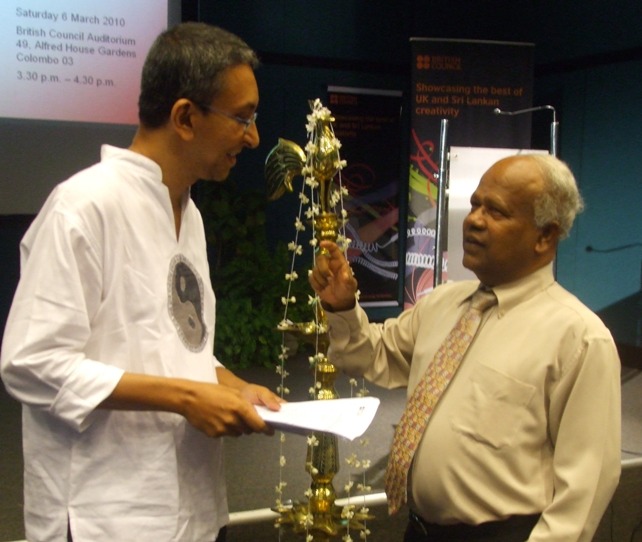
I grew up enjoying Camillus cartoons in various newspapers meant for children, youth and general readers. I had occasionally seen him being interviewed on TV. But I’d never seen or met him in person — until now. It happened when the British Council Sri Lanka invited Camillus as chief guest at their awards ceremony in the climate change cartoon contest they organised, which I helped judge with three others.
As the master of ceremonies, I announced: “It’s a great pleasure and honour for me to introduce Camillus Perera, the senior-most cartoonist in Sri Lanka who is still professionally active. Indeed, he has been drawing cartoons for as long as I have been alive — for he started his long innings in the same year I was born!”
Cartoon universe of Camillus PereraCamillus, a small made and pleasant man, spoke briefly and thoughtfully. (As I keep saying, we writers just can’t beat cartoonists in the economy of words!). He recalled how he’d used the British Council Library for visual references for years before the web made it much easier to search. He congratulated all those who won prizes or commendations in the contest.
Many years ago, I privileged to count senior cartoonist W R Wijesoma as a senior colleague when we both worked for The Island newspaper. Now I have finally met Camillus Perera, another hero of mine still practising his craft and drawing regularly for Rivira Sunday newspaper, as well as The Catholic Messenger and Gnanartha Pradeepaya. My only regret is that I don’t follow any of these newspapers on a regular basis, even though I try hard to keep up with Siribiris on the web…
There is a bit more than childhood idol worship involved here. Satire is one of the last domains we are left with when freedom of expression comes under siege.
As I wrote in July 2009in a blog post on news wrapped up in laughter: “There is another dimension to satirising the news in immature democracies as well as in outright autocracies where media freedoms are suppressed or denied. When open dissent is akin to signing your own death warrant, and investigative journalists risk their lives on a daily basis, satire and comedy becomes an important, creative – and often the only – way to comment on matters of public interest. It’s how public-spirited journalists and their courageous publishers get around draconian laws, stifling regulations and trigger-happy goon squads. This is precisely what is happening right now in countries like Kenya and Sri Lanka, and it’s certainly no laughing matter.“
Taken in that light, Camillus Perera is not just a popular and entertaining cartoonist adorning Sri Lanka’s newspaper industry. He is a gentle giant in the world of journalism — a man of few words whose sharp wit and keystrokes are more piercing than any number of words that we writers and journalists can churn out. He is a living cultural treasure.
So long live both Siribiris — and Camillus Perera!
Two years ago, in a moment of panic, I rushed my young daughter to Colombo’s only children’s hospital. To be honest, I don’t normally turn to our overcrowded government hospitals for healthcare. But a doctor friend had recommended the Lady Ridgeway Hospital as the best place for administering the anti-rabies vaccine.
As with all government hospitals, they first wanted to record the patient’s basic bio data. Fair enough. I provided the child’s name, age and street address. For some reason, the form also asked for the patient’s religion. Before I could say anything, the nurse in charge wrote ‘Buddhist’.
Now, this was both incorrect and highly presumptuous. But when I objected, it sparked off an argument. The formidable woman insisted that with a ‘good Sinhalese surname’ like ours, we simply had to be Buddhists!
When I said her assumption was wrong, she asked me with some disdain: are you then a Christian? No again. Now she was beginning to be get really irritated: who is this man who speaks fluent Sinhala, but is neither Buddhist nor Christian?
I was not about to declare in public a matter I consider to be intensely private: my religious faith. With the fellow public behind me becoming impatient, and the public servant in front of me taking a dogged stand, I retreated with a heavy heart. (I later paid a few thousand rupees for the same course of vaccines at a private clinic, where my religious faith or ethnicity was never questioned.)
I thought this was an isolated incident, and didn’t think further. But a few months later, I ran into a similar situation at my area police station. I’d gone to make a formal complaint about a serious matter concerning personal safety, and once again, the process started with my bio data. When it came to fixing labels, the woman constable recording my statement categorised me as ‘Sinhalese Buddhist’ — without even raising her head from the big book of complaints.
In case you are wondering, I bear absolutely no tell-tale signs of belonging any faith: I don’t wear a religious symbol as jewellery, or wrap pirith nool (pieces of thread blessed by monks) on my wrist. I also carefully avoid sprinkling my everyday speech with any religious phrases. Even my occasional swearing is devoid of religious references. (An observant friend once likened my colloquial speech to that of my favourite cartoon charter Tintin’s: no harsh swear words, and only secular references.)
Must biology be destiny in the 21st Century? Blind chance of birth placed me in a family of ethnic Sinhala parents who also happened to be Buddhists. But these cosmic accidents don’t make me a Buddhist any more than, say, I become a believing and practising Aquarian simply because I was born in February. My brand loyalty to the randomly assigned religion and star sign are about the same: zero.
Just so that I put all my cards on the table, I have not practised any religion or belonged to any religious faith (with their trappings of scripture, priests and places of worship) from my teen years. That’s 30 years of uninterrupted secular humanism.
Indeed, ‘secular humanist’ is the only label that I proudly wear in both public and private. But in the Sinhala Buddhist Republic of Sri Lanka that my land of birth is turning into, various public agencies find this ‘aberration’ either unsettling or unacceptable. My self-exclusion on matters of faith makes me an instant misfit in many state procedures. And yet, we are supposedly an open and democratic society……and in theory at least, not a religious state.
But that matters little in practice. For example, I recently gave evidence under oath in a court of law in a civil case. All along, my lawyer advised me to just ‘pretend’ to be a Buddhist for that solemn occasion. Apparently the system can’t handle ‘spiritually neutral’ — my preferred (and very honest) answer when asked about my faith.
I don’t see how and why a citizen’s religious affiliation – or its complete absence – should matter in the least when dispensing vaccines or justice in the modern world. Is this not a residual habit from colonial times that no longer serves a purpose? Actually, I find it worse than redundant; it’s plain insulting.
Religion is not the only private matter that our governments love to poke its clumsy and unwelcome noses into. Also falling into this category: everyone’s sanitary habits, and sexual relations between consenting adults.
For sure, what private individuals do in the privacy of their homes can have some implications for the community, economy and national statistics. In today’s highly inter-dependent and interlinked world, no man or woman or nation is an island.
Despite this, there are at least three aspects of modern living where choices must remain strictly and entirely personal: what we do in our bed rooms, wash rooms and (metaphorical) shrine rooms. I, for one, will resist all arms of the state and government, as well as self-appointed guardians of our morals and values, from intruding into any of these hallowed spaces of my free will and choice.
Especially when it comes to matters of faith – or its complete avoidance – the Jackboot of government means absolutely nothing.
Explanation for non-Lankan readers:
The ethnic mix and religious mix in Sri Lanka don’t coincide, making it (at least for me!) a delightfully chaotic melting pot. While some Sinhalese are Buddhist and some Tamils are Hindu in their choice of faith, that is not to be assumed. Indeed, there are statistically significant numbers of both Sinhalese and Tamils who are Christians (of various denominations). While all our muslim friends are Islamic, there are also some ethnic Sinhalese and Tamils who have converted to Islam. So one has to be very careful in making generalisations, and it’s altogether better to avoid them….
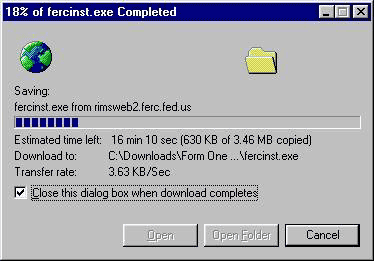
I sometimes wish Life came with its own progress bar. [tweetmeme]
You know, that now familiar indicator on computer screens that shows how much of a task is done, and estimates what more remains — and for how long.
Wouldn’t it be interesting to know how much of our life is still left?
I’m not alone in this wish. In fact, whole cottage industries – such as astrology and palmistry – thrive on this universal curiosity to know what’s next, and what’s round the corner for ourselves.
Yet there is no known system of knowledge, or a proven technology, that can give us a customised, accurate answer. Everything that claims to do this is nothing better than a clever guess. Often, it’s not even that and only a complete rip-off…
The Undiscovered Country...Then again, do we really want to know when we’re going to reach the end of the line (whether or not the mission is accomplished)?
Years ago, I watched a Star Trek episode that involved a world where everyone died at the same age. So all living persons knew how much time they had left, allowing them to sort their lives before it was too late.
I don’t think I’d want to live there. Not knowing how much of my life is left, and what’s in store for me in that remainder, makes living more interesting. Besides, I doubt if the chaos theory and randomness of the universe will ever allow such precise advance knowledge of anyone’s future…
As I turn 44 years today, I Googled for ‘progress bar + life’. Just for the heck and kick of it. I didn’t really expect to find an exact match, but I did. That’s the wonder of the web…
Always in a hurry?Perhaps the inspiration came from Top Geek Steve Jobs, who is quoted on this website as saying: “Remembering that I’ll be dead soon is the most important tool I’ve ever encountered to help me make the big choices in life”
Still in the realm of marginally useful web apps, I also discovered timeanddate.com some weeks ago: it allows counting down or counting between any two dates. The result can be in days, hours, minutes or – for those who prefer such precision in their lives – even in seconds.
They tell me that I am exactly 16,071 days old today. Not a neat round figure as being 44 years, but there we are. (I somehow thought I’d lived for more days than that, but a quick manual calculation showed they are right.)
These counts are all very abstract anyway: our days and years are peculiar to the Earth — these measurements have no meaning beyond our home planet. Planetary rotation defines a day, while its revolution around the local star (in our case, the Sun) defines a ‘year’.
Another website, maintained by San Francisco’s excellent Exploratorium, allows me to calculate how old I would be if I lived on other planets of the Solar System where the rotation and revolution are different.
According to them, if I were to travel to the two planets closest to ours, I would be aged: 71.5 Venusian years on Venus; and 23.3 Martian years on Mars.
And if I want to melt my years away, I have to travel further to the outer planets: on Jupiter, I will be 3.7 Jovian years, and I’ll not even be 2 in Saturnian years! Wow…
On second thoughts, I think I’ll just stay on here.
Dhara and Nalaka with their old faithful Toshiba, 24 Dec 2009 - Photo by Niroshan Fernando
For many of us, computers have become essential silicon extensions of our carbon selves — and we can’t imagine how we managed our work and leisure before their arriva. In my case, the attachment to my laptop goes beyond professional: it’s also my constant companion and travel partner.
So it’s akin to a death in the family when the old faithful finally goes the way of…all silicon. In 20 years of laptop use, I have mourned six: the average productive lifespan seems to be between three and four years. (Confession time: I have a cabinet full of very tired and fully expired laptops, mostly Toshiba.)
The latest calamity happened in early December, pushing me into a few days of digital turbulence just when I was trying to tie up various loose ends in what has been another hectic year. Fortunately, no data were lost, and I eventually managed a fairly orderly transfer.
It didn’t come entirely as a surprise. My Toshiba Satellite Pro (model A100) had been showing signs of wear and tear for a few months. The laptop screen is usually the first to develop problems of old age, but switching to a new machine is such a chore (and expense) that I was willing to live with an occasionally misbehaving display. But when bigger and deeper problems manifested – which our IT Manager Indika found were due to a malfunctioning motherboard – it was time to let go…
When I bought my latest Toshiba in mid 2006, I didn’t immediately like its metallic orange colour. I’d been using laptops with silver or electric blue coloured exteriors, and this was a clear departure from that range. But my female colleagues thought orange was rather ‘cool’. I didn’t easily warm up to this colour shift — until I realised the potential for some harmless fun.
Every few weeks, someone would ask me – inevitably, in the ICT circles that I move — whether I used Apple (the geekdom’s ultimate standard). For the past three and a half years, my honest yet confounding answer has been: ‘No, I’m perfectly happy with my Orange!’
Of course, my affection for the laptop was a lot more than skin deep. It has been an integral part of much of what I did professionally and personally in the past three and half years, both online and offline. My substantial volume of published output (op ed essays, book chapters, reviews and film scripts, etc.) took shape within it before flowing out in many and varied directions. I also generated a good deal of unpublished material, all of which is safely stored but not yet ready to see the light of day…
It has travelled the world with me, going through hundreds of airports and keeping me much needed company in endless hotel rooms, conferences and meetings.
It has been my confidante in times of crisis – and the past 1,300 days have been among the most tumultuous in my personal and professional lives. While I’m not a social recluse, and cherish the company of my few close (human) friends, it’s sometimes nice to just pour my heart out to someone who listens, doesn’t judge and never resorts to wisecracks or amateur psychology…
Assigning a gender isn’t that simple when I wasn’t the only regular user of the recently departed Toshiba. That is also another good reason why I was more attached to the last laptop than any of its predecessors: it’s the first machine that connected my Digital Native daughter Dhara to the internet. It arrived within days of her 10th birthday, and I finally ran out of excuses why she shouldn’t go online and get a digital life. (As I reported a few weeks ago, she has since made rapid progress.)
So it was rather apt that Dhara should come up with the perfect epitaph for our beloved, sorely missed silicon companion. It isn’t quite original, but sums up our shared sentiments very well: RIP: Rust In Peace…
PS: Rust in Peace is also the title of an interesting collection that New York magazine recently published of everyday stuff rendered obsolete in the first decade of this century. Among the 17 items listed are the fax machine, audio cassette, answering machine, cathode ray tube TV and incandescent bulb…
Memory is a curious phenomenon. Sometimes memories of our personal past are evoked in the most unexpected manner, reviving nostalgia for days that are forever lost in the sands of time.
I have never visited Poland, but it’s been on my mind in recent days. 1 September 2009 marked the 70th anniversary of the beginning of the Second World War – which was sparked off by Nazi Germany’s invasion of Poland.
That’s also the day when the Anglo-American poet W H Auden wrote his deeply evocative poem, September 1, 1939. He wrote it sitting in a New York bar and distraught by the clouds of hatred gathering over Europe. I’ve been reading and re-reading it this year as the war Sri Lanka – which lasted almost five times longer – officially ended in May 2009.
As I wrote at the time: “Almost 70 years later, at the end of my own 30-year-long war, I have been reading and re-reading September 1, 1939. I’m trying to make sense of what is happening around me. The near hysterical mass euphoria on one side, and bewildered dejection on the other.”
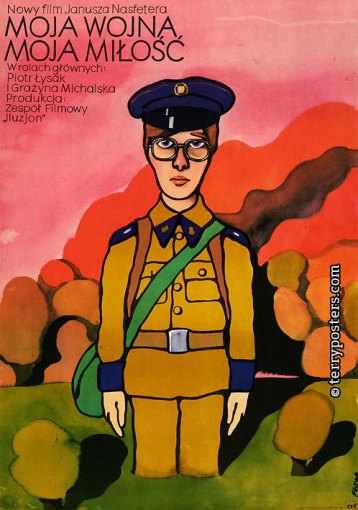
I have only just remembered that Poland in September 1939 holds another significance for me. It has to do with the Polish film Moja Wojna – Moja Milosc (My War-My Love, 1975), which I saw in the summer of 1979 at a Colombo cinema as a 13-year-old school boy.
Not only did I see the film, but I also wrote an essay reviewing it and entered it into a competition organised by the Embassy of Poland. Growing up in a country that didn’t have broadcast television until that very year, I had only seen a handful of movies up to that time. I was no movie critic, but my views on the film and its resonance with my own times must have struck a chord with the judges. For I won the second prize in the Sinhala essay competition.
Being runner-up was no big deal by itself, but this was the first time that my writing was competitively judged and ranked by anyone outside my immediate circles. My prize included a fountain pen, white polyester cloth for school uniforms, and an LP record of Polish music (yes, LPs were still in use, but on their way out at the time!).
From My War - My LoveI would go on to win many essay competitions during my teens, and one day earn an honest living as a wordsmith. But that movie review – long since lost in the mists of time – was my first success. My career in literary crime was thus forged…thanks to a Polish movie!
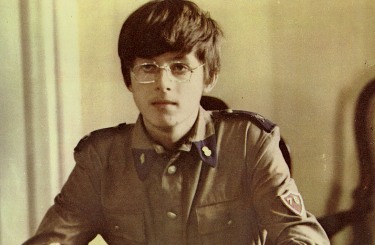
From the little that I can still remember, 30 summers later, My War-My Love wasn’t a pretty film. It is set during the week of the Nazi invasion of Poland in 1939. Daring 17-year-old schoolboy Marek (Piotry Lyjak), inspired by the example of the Sobieski cadets during 1831 insurrection, vows to take on Germans single-handedly. He devotes most of his energy to protecting a young girl who lost her mother during the invasion.
As one reviewer wrote, “My War-My Love could not, by its very nature, end altogether happily, but the film can be regarded as life-affirming.”
War has no place for innocence - then or now...That film was my first visual introduction to the horrors of war, a topic that was to dominate my own future for the next 30 years to come. In that Sri Lankan war, child soldiers several years younger than the film’s character Marek would play a prominent role.
At a far more personal level, I had never been in love when I saw My War-My Love. In the three decades to follow, I would fall in love three times — and lose out every time, though for very different reasons (none of which involved ‘my’ war). I must now carry the pain of these lost loves for the rest of my time. But that is another story…
Thanks to the wonders of Google, I’ve been able to track down some specifics about the film. It was directed by Janusz Nasfeter (1920 – 1998), a versatile Polish film maker whose career in writing and directing films spanned from the late 1940s to the early 1980s. He was 19 when the Germans came marching in.
It was one of many films that have used the Second World War as its backdrop. There have been several other Polish films that looked back on the Polish resistance, Poland Holocaust and Warsaw uprising of 1944 and other key events that left an indelible mark on the country. In fact, as this listing in Wikipedia shows, when Janusz Nasfeter made My War-My Love, the theme was pretty much covered by different Polish film makers in numerous ways.
I haven’t seen any of these other Polish films, and even My War-My Love is now only a distant memory. But as a moving image creation that moved my life in a certain direction, it would always have a special place in my heart.
I explained: I keep asking more questions than I can answer. The ancient Greeks did the same – they were the first to ask many fundamental questions in philosophy and science. They didn’t always get the answers right, but started quests that lasted for millennia…
As Ed Johnson recently wrote: “We have so many things to thank the Greeks for, from philosophy to democracy. They were the ones who established the first civilization, governed by free citizens. Individual liberty has been the basis of civilization ever since.”
It so happens that I recently completed 40 years in this business of playing the Greek. As I recalled a few weeks ago on the 40th anniversary of the first Moon landing, I had an early start in asking difficult, sometimes irritating, questions.
I’m fortunate to be welcomed among media practitioners as well as media researchers. I’m not a card-carrying member of either group, but I have great fun hobnobbing with both. This is what Irish journalist-cum-academic Conor Cruise O’Brien once called ‘having a foot in both graves’!
And I’m also grateful for being allowed into the community of geeks, especially of the IT, ICT and gadget-wielding kind.






 Open Minds!