“HIV is our virus; go find one of your own!”

“HIV is our virus; go find one of your own!”

Well, the nice lady on the phone didn’t actually say that. But that message was heard loud and clear.

And she is one at the forefront of fighting HIV/AIDS in my native Sri Lanka. My organisation had gone with an offer of help, in our own small way, to augment their good fight. But for reasons best known to her, she chose to brush us off.

It happens in the context of the 8th International Conference on AIDS in Asia and the Pacific, or ICAAP8. The year’s most important regional event on HIV is scheduled to be held in Colombo, Sri Lanka, from 19 to 23 August 2007. Several hundred members of our region’s HIV community — from activists and researchers to development aid officials and persons living with HIV — are expected to turn up.

HIV virus

TVE Asia Pacific has been involved in communicating about HIV for a few years. One highlight was when, at the invitation of the International AIDS Society and the Thai Ministry of Public Health, we organised the 2004 AIDS Film Festival in Bangkok. That was part of the XV International AIDS Conference.

We also distribute across Asia some outstanding factual films on HIV/AIDS produced in different parts of the world. Among them is the highly acclaimed Scenarios from Africa.

With these and other credentials, we had hoped that we could share our experience in using audio-visual media for communicating the HIV message in all its nuances and complexity.

Earlier this year, we responded to a call for skills building activities appearing on the Conference website. We didn’t know anyone involved, but we submitted a proposal to the website, outlining our offer to conduct a ‘Skills Building Workshop on Strategic use of moving images for HIV/AIDS Advocacy’. We didn’t ask for any money – our offer was to do it entirely at our cost. We planned to involve some Asian communicators who are regional leaders in this area.

A few weeks later we had a phone and email exchange with a Sri Lankan member of the secretariat
about our proposal. We don’t know this lady at all, but relating to her was not a pleasant experience. In fact, she was very dismissive and almost rude. She found fault with us for submitting our proposal late, when in fact we’d done so well within deadline!

We felt rebuffed and put off by her attitude. Although she said she was going to get back to us, it never happened. Evidently, our offer had touched on somebody’s raw nerve.

We still don’t know what irked this lady — it’s possible that my outspoken public views on HIV/AIDS in Sri Lanka may have been taken personally by a small mind. This is the problem with some people: they take evidence-based criticism personally.

Whatever was responsible, we won’t be at ICAAP8. Our friends who are part of the media team at the conference belatedly tried to involve us. But by then, our spirits were shattered.

A missed opportunity. And there’s some irony that while the Thai Ministry of Health invited us to run an entire film festival in their capital, the Sri Lankan Health Ministry (organisers of ICAAP8) would actually keep us out of this event!

Such are the politics of HIV, which I’m only just beginning to understand. And I thought we needed to unite against the common, invisible enemy…

Read my other blog posts on HIV:

HIV: Stigma a bigger killer than the virus?

Three Amigos: Funny condoms with a serious mission

Beware of Vatican condoms!

50? In South African terms, you’re probably dead!

Ratomate’s best cup of tea

A girl named Nan-nan

Earthcare Outreach: taking moving images to the grassroots

On 19 July 2007, I wrote about the need for natural history and environment film-makers to take their films back to the locations and communities where they filmed.

I cited the specific example of the Brock Initiative, started by ex BBC Natural History producer Richard Brock, which is supporting projects in several countries in Africa and Asia.

In today’s mail, I received the DVD of Tiger – the death chronicles, the latest documentary by the award-winning Indian film-maker Krishnendu Bose. I’m going to watch and write about it separately, but this reminded me of the outreach work he and his company, Earthcare Films, have been doing for years.

After working for a dozen years with factual film-makers from across Asia, my experience is that not many are really interested in any outreach besides a high profile broadcast. For sure, broadcasts help draw attention to a film and its creator/s. But as we have discussed in recent blog posts, broadcast television is not an ideal platform to get a discussion going on issues and concerns. In fact, many film makers are finding it harder to get their serious films broadcast at times with better audience ratings.

Still, surprisingly few film-makers have time or patience for serious narrowcast outreach. Yes, it is a time consuming, tedious process. The logistics can be demanding and expensive. And there is not much glamour (or ‘arty and intellectual feel’) in going to a small town or remote village and playing back your film to a few dozen people living on the edge of survival.

Image courtesy Earthcare Films website

But as exceptional film-makers like Krishnendu (in photo above, taken from Earthcare Films website) know well, it can be an enormously enriching and satisfying experience for a film-maker. People like him watch the audience while they watch the film.

Films are a greatly underused communication form. Serious communication usually is at most limited to awareness building,” says Earthcare Films website in its section on outreach.

That’s why EarthCare Outreach wants to explore beyond. “Films could be tools for social change and empowerment. Participatory film-making by sharing skills and capacities could take the ‘use’ of films to a different level. Not that it has not been tried and practised, but we want to take it forward and try and push the boundaries.

Krishnendu and colleagues have set up the EarthCare Outreach Trust specifically for this purpose. The objective is “to create ownership and stake in the process and the product of a documentary film of the people whose lives we document. In the process we strive to empower young people and rural communities to make them stakeholders in decision-making and in planning for natural resource management.”

For the past several years, Earthcare Outreach has been active on these fronts, organising mobile film screenings or traveling film festivals in rural and urban areas in different parts of India. The website talks about how they have held community and citizenry exchanges between selected locations, evolving film-making skill-share across these groups.

Read more about Earthcare Outreach activities.

Contact Earthcare Films for more information and involvement

On a personal note, I’m trying to recall when I first met Krishnendu. It must be at least a decade ago — I had seen some of his work before I met the man behind them. We were together as guests of the Earth Vision Tokyo Global Environmental Film Festival in 2001 — where his film, Harvesting Hunger, (image below shows it being filmed) won a special jury award.

Image courtesy Earthcare Films

Arthur Clarke’s climate friendly advice: Don’t commute; communicate!

This week I’m working from home, as I nurse a cold that came from nowhere and knocked me down.

I have to take plenty of rest as my body battles the virus. So I alternate between bed and desk, keeping up with at least some of my work.

And that’s not as difficult as it once was, thanks to my home ADSL connection. (For sure, its day-time speeds make it more like ‘fraudband’ and not the broadband that it’s marketed as, but hey, at least I’m connected to the world.)

So this week I have practised a slogan that Sir Arthur C Clarke — inventor of the communications satellite and inspiration for the World Wide Web — suggested over some four decades ago: Don’t commute; communicate!

Well, that’s old hat — probably older than myself. But that assumes a new significance with the current concerns about climate change and how we may adapt our lifestyles to be more climate friendly, i.e. emit less carbon dioxide and other gases that trap the sun’s heat and warm up the planet.

sir-arthur-clarke-by-shahidul-alam.jpg

Trust Sir Arthur to make that link ahead of many others. In a short essay written for the UK’s Climate Group in 2005, included as part of a global exhibit on climate issues, he noted:

In 1973, when OPEC started to multiply oil prices, I rashly predicted: ‘The age of cheap power is over – the age of free power is still 50 years ahead.’

Three decades on, there are promising signs that we may soon get close to that ideal. There is a real possibility that the most important event of the early 21st century will be the advent of unlimited amounts of clean energy. Does it really matter whether hydrogen or nuclear fusion or another technology will finally liberate us from our current addiction to fossil fuels? Meanwhile, other technologies enable us to adjust our work and lifestyles. For example, mobile phones and the Internet have already cut down a lot of unnecessary travel – and this is only the beginning. We should revive a slogan I coined in the 1960s: ‘Don’t commute – communicate!’”

Self evident as this might seem, it’s not a point that is appreciated widely enough.

On 30 October 2006, the UK government published a 579-page report on the economics of climate change by Sir Nicholas Stern, a former chief economist at the World Bank. Despite the massive size, scope and authority of the report, the Stern Report had no reference to the role that the ICT sector could play in helping to reduce energy demand, mitigate CO2 emissions and help to save the planet.

Fortunately, others are taking note. Among them is the European Telecommunications Network Operators’ Association (ETNO), which issued a report — incidentally, in the same month as the Stern Report — titled Saving the climate @ the speed of light: ICT for CO2 reductions.

It was a joint publication with the World Wide Fund for Nature, WWF. Its introduction read: “A wider usage of ICT-based solutions can play an important role in reducing CO2 emissions. This joint WWF-ETNO road map proposes a concrete way forward for a better consideration and inclusion of ICT’s in EU and national strategies to combat climate change.

Read the full report here.

Image courtesy ETNO and WWF

And guess what, there is already a movement: ICT for carbon dioxide reduction, inevitably abbreviated as ICT4CO2R!

Read Sir Arthur Clarke’s full essay: Hydrocarbon Anonymous

Sir Arthur Clarke photo by Shahidul Alam, taken in January 2007

PS: I must admit that my carbon emission savings by working from home are pretty modest. I live about a kilometre from my office, so my personal commuting to and from work does not entail much of fossil fuel burning. On a good day, I can walk to work…

Faecal Attraction: There’s no such thing as a convenient flush…

Out of sight is out of mind.

That’s how it works for most of us. Especially when the subject is what we do in the privacy of our toilets and then just flush away.

But there is no such thing as a Convenient Flush — it’s all linked to how waste, including sewage, is disposed of. Or not.

And what goes around, even out of our sight, comes around — turning up in the least expected ways! Like faecal matter in our drinking water.

A new film produced by the New Delhi-based research and advocacy organisation Centre for Science and Environment (CSE) probes the link between sewage disposal and river water pollution in India — specifically, the River Yamuna, part of the massive Indo-Gangetic river system.

The film by Pradip Saha is titled Faecal Attraction: Political Economy of Defecation. It is accompanied CSE’s latest publication Sewage Canal: How to Clean the Yamuna.

The book and the film expose the political economy of defecation, where the rich are subsidised to defecate in convenience and the poor pay for pollution with their ill health because of dirty water.

It begins by asking two simple questions: Where does your water come from? What do you do with your shit?

Watch the answers – some amusing, others absurd – in this 3-min trailer on YouTube:

Backed by scientific data, CSE shows how India’s 14 major rivers, as well as 55 minor and many small rivers have all been reduced to sewers. They receive millions of litres of sewage, industrial residue and agricultural waste from the cities and towns through which they flow.

Delhi and Agra together account for 90 per cent of the pollution in the River Yamuna, a major tributary of the Ganges. Yamuna is one of the most polluted rivers in the world, especially around New Delhi, the capital of India, which dumps about 57% of its waste into the river.

When Yamuna flows by Delhi, the city extracts gallons of fresh water for drinking and irrigation. What is given in return to the river is only excreta – sewage, and industrial and agricultural waste. This sewage is (supposed to be) collected, transported, and assembled for treatment (cleaning), and then flown back to the river. In reality, what goes back is far from clean… The irony is that the city has 40 per cent of the entire sewage treatment infrastructure in the country with only five per cent of the country’s population! And still, Yamuna is unclean.

Cartoon courtesy CSE India

Though numerous attempts have been made to clean it, the efforts have proven to be futile. Although the government of India has spent nearly $500 million to clean up the river, the river continues to be polluted with garbage while most sewage treatment facilities are underfunded or malfunctioning.

“As these rivers die a slow death, the sole blame for their pathetic condition lies with human beings who have always treated these water bodies as their personal dumping zones,” says CSE.

Anil Agarwal, founder director of CSE, believed that a “society is known by the water it keeps”. “The health of a river…reflects the very health of the human society, its ability to live harmoniously with its environment,”, he said.

In that sense, things are very seriously wrong with not just the Yamuna, but river systems across India.

Read CSE Director Sunita Narain’s presentation on the River Yamuna pollution and clean up options

Read CSE Press release on river pollution

A Silent Emergency: More television sets than toilets!

Read a later blog post: Faecal Attraction: There’s no such thing as a convenient flush…

It was September 2004. My daughter Dhara, eight years at the time (or ‘eight plus’ as she insisted on saying), had a complaint.

The toilets in her school were not clean enough. She was finding it squeamish to use them. So she was doing her best to avoid going to the loo: she’d drink less, and try to ‘hold back’ until she could rush home.

Like many sheltered middle class kids, she was still coming to terms with the wider world outside her home. And she attends a well endowed private school where, I am told, toilets are cleaned regularly by janitors engaged by the school.

Now we cut to eleven-year-old Susheela, a girl growing up in neighbouring India. I’ve never met her in person, but this sentence summed up her tragic story:
“I was always first in the class. I am very much interested in studies. I want to become a lawyer. But my mother stopped me from going to school after Class V as the middle school I was attending, 5 km from my house, had no toilet. Can someone help me?”

This was the opening of an article on water and sanitation written by Indian journalist Dr Asha Krishnakumar and published in the news magazine Frontline (part of The Hindu group) at the end of 2003. It was titled: A Silent Emergency.

dr-asha-krishnakumar.jpg Image courtesy WSSCC

It was several months later that I actually read Asha’s article. By coincidence, my daughter was having her own ‘toilet issue’ at the time — and the contrast was striking.

Asha’s article continued:
Susheela’s anguish is shared by a large number of girls in India who drop out of school for what sounds like an absurd reason: want of a toilet in school. “Sanitation is closely linked to female literacy in India,” says a United Nations Children’s Fund (UNICEF) study. According to V. Balakrishnan, convener of the Tamil Nadu Primary Schools Improvement Campaign, the lack of proper toilet facilities in schools has a definite and significant bearing on the drop-out rate of girls, particularly around the time they reach Class VIII. In 2000, barely 10 per cent of Tamil Nadu’s 40,000 government schools had usable toilets; the figure is much lower for the country as a whole.

I’d been covering development issues in the media for over 15 years, but this stark reality had not occurred to me. In some developing countries, girls face a greater struggle in enrolling in school and staying on. There are cultural, social and economic factors working against educating girls.

And as Asha’s article revealed, there are other, less known factors adding to this burden.

I shouldn’t have been surprised. Indian census data had revealed in 2001 that, some parts of the country had more television sets than toilets.

Asha’s was one of three dozen excellent media articles on water and sanitation that I read that month as a judge in an international award scheme to recognise the best media reporting on the issue. Organised by the Water Supply and Sanitation Collaborative Council (WSSCC), it was meant to to encourage broader media coverage of water supply, sanitation and hygiene (WASH) issues in the developing world.

The initiative, first launched in 2002, is open to journalists from developing countries, who write or broadcast original investigative reports on WASH issues. The Collaborative Council seeks to use the WASH Media Awards as part of the broader goals of fostering sustainable relations with journalists in developing nations, and increasing media coverage of WASH issues.

WASH has recently announced the next media awards, covering print and broadcast media coverage from 1 July 2007 to 30 April 2008. This time around, it also involves the Stockholm International Water Institute (SIWI).

Winning entries will be presented at the World Water Week in Stockholm , Sweden in August 2008. Deadline for the submission of entries is on or before May 15, 2008. Read the announcement

In 2004, the recipient of the first WASH Media Award was Nadia El-Awady from Egypt for her outstanding article “The Nile and its People”. It illustrated the impacts of industrial pollution, sewage and solid waste management on people’s health and dignity along the River Nile.

We evaluated a large number of high quality entries and decided to give special recognition and Certificates of Appreciation to several other journalists. Asha was one of them.

A few months later, it was my privilege to meet Asha in person at a workshop on media and sustainable development that TVE Asia Pacific organised as part of the Education for a Sustainable Future conference in Ahmedabad, India, in January 2005. The photo shows Asha addressing our workshop while Darryl D’Monte, fellow judge in WASH media awards looks on.

l-to-r-darryl-dmonte-asha-krishnakumar-and-nadia-el-awady.jpg

By another coincidence, the lady on the right is Nadia El-Awady who was overall winner of the WASH media award. At the time she was the Health and Science Page Editor of IslamOnline.net. She has since been promoted.

Either the world is smaller than we think, or our networks are larger than we imagine.

But I will always be grateful to Asha for opening my eyes on a silent emergency. One that I have since explained to my daughter. She no longer complains.

Read the WASH press release on 2004 media award winners

Read the publication on WASH Media Awards 2004

Read WASH media guide on The Biggest Scandal of the last 50 Years

Photos by Janaka Sri Jayalath, TVE Asia Pacific

Love Thy Mangrove: A Greenbelt Report from Pra Thong island, Thailand

jureerat-pechsai-deun.jpg

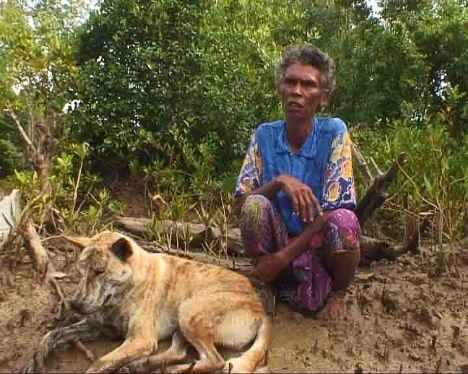
This is Jureerat Pechsai, nicknamed Deun.

She is a member of the Moken community – indigenous people living on the coast and islands on Thailand’s southern coast. Their nomadic lifestyle has earned them the name Sea Gypsies. In Thai, they are called Chao Ley — or people of the sea.

They traditionally live on small boats and move from place to place. When the Monsoon rains make the seas rough, they set up temporary huts on islands – such as Pra Thong Island, where Deun lives.

Pra Thong is an hour’s boat ride from the mainland city of Phuket — some conservationists call it one of the “Jewels of the Andaman” for its biodiversity. It is also an important nesting beach for turtles.

It was on this island that my colleagues from TVE Asia Pacific met and filmed with her in late 2006 for our Asian TV series, The Greenbelt Reports.

The Asian Tsunami of December 2004 devastated the Moken way of life. Their temporary huts were destroyed, and many families lost loved ones. The losses would have been greater if not for the mangrove forest close to the Moken village.

“Moken loves the water, the forest and everything. And we love the mangrove forest the most. The mangrove forest is like a living creature that has helped the Moken people for years. It’s our most beloved place on the island,” says Khiab Pansuwan, an older woman who is a leader in Deun’s community.

After the Tsunami, some Moken felt that they could not return to their nomadic lives. They have chosen to live on the mainland where they feel safe from the waves. Others who remained on their island had new, permanent houses built for them. But the Moken are quick to abandon these whenever they hear rumours of more Tsunamis.

Watch The Greenbelt Reports: Love Thy Mangrove on YouTube:

The mangrove replanting work on Pra Thong island is led by two women, Khiab and Deun.

Deun has been a volunteer with conservation organisations. She learnt about ecosystems and how to protect mangroves and endangered species like sea turtles. She can see many changes in her environment after the tsunami.

“After the tsunami, there are a lot of changes. We didn’t have much grass before, but now weeds are everywhere. The weeds are now more than grass,” says Deun. “In the past, we used to have more and more beach every year. But now the sea has come so close…”

khiab-pansuwan.jpg

The Tsunami’s impact is not the only factor affecting the mangroves here. Dynamite fishing, oil from boats, foam from fish and oyster nets are all damaging this life-saving greenbelt. Some people also cut down mangrove trees.

But Khiab and Deun are determined to rally everyone around to replant and regenerate their mangroves.

Says Khiab: “The community forest is part of the Moken people. We don’t want to cut the trees or clear it. We want to replant the trees so the forest is like before. We don’t want anyone to cut down trees because the mangrove forest saved many Moken lives.”

The two women are determined to rally everyone around to replant and regenerate their mangroves.

Replanted mangroves will ensure not only protection from the waves, but also a continued supply of shell fish and crabs – the main source of income and food for the Moken.

The Moken have traditionally managed the mangroves sustainably. They fish in different areas of the forest during the year, giving time for fish stocks to regenerate. Logging for firewood is done only in moderation, in designated areas.

But these mangroves are now under threat from outsiders who see it as a source of firewood and shell fish. Only a few Moken are left in the village to protect the forest from these intrusions.

Khiab and Deun have much work to do.

NOTE: We are now looking for more stories like this to be featured in the second Asian TV series of The Greenbelt Reports. See TVEAP website news story calling for story ideas.

All images and video courtesy TVE Asia Pacific

How short is short today? Packaging Nature for today’s television viewers

On 15 July 2007, I wrote about the award-winning natural history film-maker Neil Curry, based in South Africa, whom I last met during the Japan Wildlife Film Festival in Toyama in the summer of 2005.

Most recently, Neil made The Elephant, the Emperor and the Butterfly Tree, which has won several of the industry’s top awards.

I’ve since heard from him, and want to share some of his views on how best to package Nature and wildlife for today’s easily-distracted, attention-challenged audiences. He is responding to my post on 13 July 2007 titled Mine is shorter than yours, yipee!

neil-curry.jpg

He says:

‘Mine is shorter than yours….’ is one of the issues I’ve been going on about for years and I’m delighted that Friends of the Earth has now come up with a competition for one-minute films. This ridiculous thing of the ‘standard’ broadcast slot for bluechip wildlife programmes being 52-minute is, in my opinion, one of the main reasons why the public’s view of Nature has become so ‘warped’.

You can’t sustain a 52-minute wildlife film without drama – so we end up with this on-going emphasis on killing, sex, things that are supposedly deadly to humans (everything from snakes and great white sharks to mosquitoes), and dramatic confrontations between macho men – and women – and animals. By insisting on these long films, television itself has actually ‘created’ the audience for wildlife violence – and I’ve been told by more than one commissioning editor that audiences aren’t interested in “place” and “habitat” films any more, they want to see big animals doing exciting things.

In short, Dallas with animals – wildlife “reality-TV”.

Based on my own experience, that’s rubbish. Yes, audiences want a well-told story but they can be equally fascinated by quite prosaic things in the complex inter-relationships of nature, provided the story is told properly. They don’t need all this ‘red in tooth and claw’ stuff. The superb, The Queen of Trees that is currently doing the rounds is a good example – as is the on-going popularity of Attenborough and some of the BBC’s mega-series.

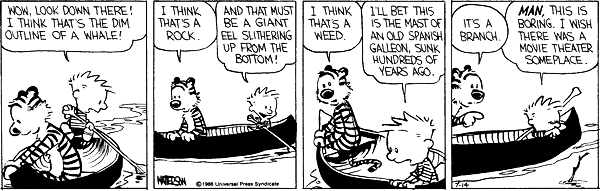
In fact, the over-dramatised programmes often give a quite distorted view of what wildlife is really like. Most creatures don’t spend all their time fighting and killing one another, or looking for human beings to threaten and attack. But if film makers, no matter how serious they are about telling the truth, want to eat, have somewhere to live, educate their kids and so on, they simply have to comply with what the programmers want – and thus, the cycle continues. Of course, it sometimes backfires. Some years ago – unfortunately I can’t remember the exact details now – research in the UK found that school children on field trips into the countryside were bored, because “nothing was happening”. Wildlife programmes on television had led them to expect nature to be full of continuous action and excitement. If children find real nature and the countryside “boring”, imagine how that will influence them when they grow up and find themselves in positions of authority where they may have to make decisions about siting roads, factories, quarries and so on in otherwise unspoilt but “boring” countryside.

nature-is-boring-have-a-movie.gif

If television would just take some of their hour-long wildlife slots and break of them into shorter segments of 30 or even 15 minutes, they would open up the screens to hundreds, perhaps even thousands of fascinating stories about some of the wonders of nature that are astonishing and intriguing, and that would grab audience attention – without any of the drama that is needed to sustain 52 minutes. In my own files I have dozens of stories like that – and so probably, do most other wildlife film makers – but we just never get the chance to tell them because there’s almost no market for short wildlife films on television.

Lord Reith, father of the BBC, said the job of broadcasting was to inform, educate and entertain – but nowadays unfortunately, much of wildlife programming seems to have got itself stuck solely in the entertainment category. It’s a pity because it means a lot of stuff that could give audiences a better understanding of the other life we share this planet with, is largely kept off our screens.

In the circumstances, it’s a miracle that The Elephant, the Emperor and the Butterfly Tree ever got made. It says a lot for the courage and acumen of Mike Gunton, who was commissioning editor on The Natural World at the time, that he was prepared to buck the trend and take it on. There’s no sex, no killing, no violent confrontations – just a boring old tree and a lot of small-scale interactions going on around it, plus a few examples of the dreaded Homo sapiens (who doesn’t even exist in Nature if lots of the wildlife TV programmes are to be believed).

Himal – 20 years of celebrating South Asian diversity

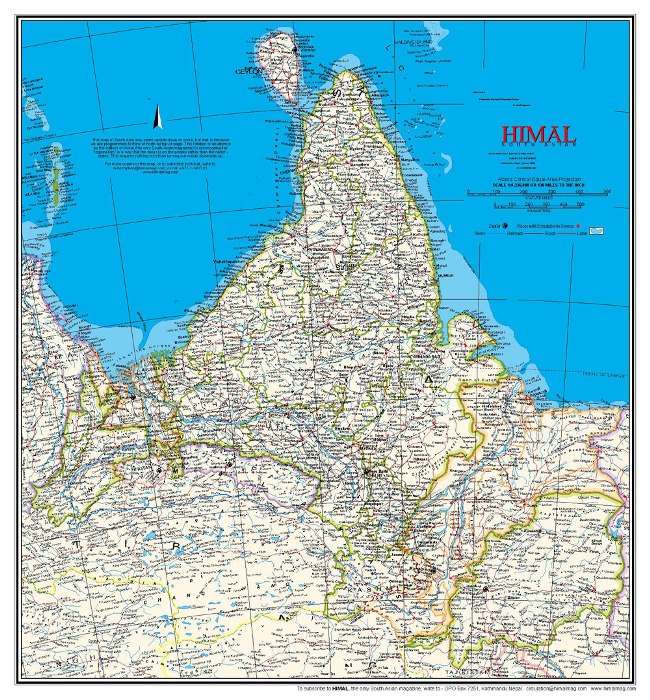
copy-2-of-southasian-map-by-himal.jpg

This is a map of South Asia, the sub-region where I live — along with over 1.5 billion other people, a quarter of humanity.

For sure it’s different: things look as if they have been turned upside down. But are they?

This map was published by Himal Southasian, our region’s one and only publication that really thinks and acts in genuinely South Asian terms.

Himal is celebrating 20 years of publication this month, and I join its many friends worldwide in congratulating and saluting this courageous, persistent citizen effort to evolve a regional mentality and identity for the currently divided and fragmented South Asia.

A note on their website reads:
“A friend just told us we had turned twenty. And so we counted the years and indeed it has been two decades since Himal began in 1987. That was the start of our Himalayan phase, and it has been ten years since Himal went Southasian. During the period, some of us have gone from black to grey, others grey to silver.”

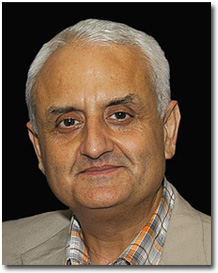
That sounds characteristic of Himal’s founder, editor in chief and publisher, Kanak Mani Dixit — one of the most senior journalists in South Asia. He and his journalist brother Kunda Dixit have kept Himal going for two decades.

Kanak Mani Dixit

As with the map, Himal has offered a different, sometimes defiant, perspective on issues of public and topical interest. Staying within the basic principles of journalism, it has challenged assorted tyrants and monopolies; questioned middle class complacency and lampooned South Asian idiosyncrasies.

Except for a short period when its soul was (temporarily) possessed by crusty intellectuals (my favourite definition: people educated beyond their intelligence), Himal has remained readable, passionate and credible — virtues that are not that common in a region that has an abundance of periodicals in English and many other local languages.

Before I get carried away, let me declare that:
1. I’m privileged to count Kanak and Kunda among my friends
2. I occasionally contribute articles to Himal that they are kind enough to print. In that respect, I’m part of the ‘Himal mafia’ and my praise is anything but objective!

But hey, who wants to peddle that cold and clinically detached objectivity that journalism schools continue to advocate? Himal is living proof that one can take a stand, vehemently if needed, and still do good journalism.

As Himal comes of age, I hope it will continue to kick ass, puncture inflated egos and remain outside the ‘mainstream’ for a long time to come. Never give up, guys — too much is at stake!

PS: On the ‘right side map’ itself, Himal explained:
This map of South Asia may seem upside down to some, but that is because we are programmed to think of north as top of page. This rotation is an attempt by the editors of Himal (the only South Asian magazine) to reconceptualise ‘regionalism’ in a way that the focus is on the people rather than the nation-states. This requires nothing less than turning our minds downside-up.

Read greetings to Himal from friends and fans all over the world!

Channel South Asia? Yes and No!

I wrote a few days ago about Ujala TV, a fledgling and entirely private, modest effort to operate a satellite TV channel carrying education and information for South Asian audiences — a quarter of the world’s total population.

This reminds me of discussions that have been around for years about setting up a South Asian TV network.

It’s one of those good ideas too dangerous to be mentioned frequently in public — in case our South Asian governments actually take it up! And that, as all South Asians know, will be the death of another good idea.

Two years ago, Himal Southasian, the only publication that truly thinks and acts at South Asian level (even if they spell it as one word: Southasian!) ran an interesting analysis on the prospects for a South Asian channel. It was written by Indian journalist Aman Malik.

The article’s premise was this:
Isn’t it time for a regional television network that ‘thinks Southasian’ and broadcasts via satellite and cable throughout the region? While Latin America’s incipient Telesur and West Asia’s energetic Al Jazeera might provide models, it is clear that we will have to go our own way.

Read Channel Southasia by Aman Malik in Himal Southasian, Nov – Dec 2005

Himal Southasian Cartoon courtesy Himal Southasian

It looked at the experience of Al Jazeera Arabic channel in the Middle East (launched in 1996), and the more recent initiative of Telesur, the pan Latin American television network founded by the Chavez administration of Venezuela in 2005.

Aman’s article was based on this premise:
“Regionalism in Southasia, which got a boost with the official sanction of the establishment of SAARC two decades ago, has been an increasingly important theme for civil society in each of the region’s countries. Over time, such groups have felt the need for print and electronic media that cover the region as a whole; the overwhelming presence of western satellite news has made analysts call for native channels. The spread of Indian channels, in particular the satellite footprints of Hindi and English broadcasts emanating from India, has again led people in other countries to call for a satellite channel that is uniquely Southasian, without allegiance to any national sensibility.”

Map courtesy www.safeer.info copy-of-southasian-map-by-himal.jpg

He also analysed the prevailing media mix accurately when he wrote:
Coverage of the Southasian neighbourhood is hampered by the fact that no television channels, beyond the few big Indian channels, keep correspondents (or even stringers) in the neighbouring countries. As a result, the news that is used is filtered through the medium of Western wire services and television channels. A region the size of the Subcontinent generates an enormous volume of news, but you would not know that ‘there is a region out there’ if you watched television in any of the countries of Southasia. The Indian channels that are able do so send camera units parachuting into nearby countries – if there is a bombing spree in Dhaka, for instance, a state of emergency in Kathmandu, or a tsunami disaster in Colombo. But they themselves have neither the wherewithal nor the interest to stay with a story to do follow-up.”

He then summed up the divided opinion on the timing for such a channel:
“Some believe that now is the perfect time for a Southasian channel; they tend to be the idealists who hanker for ‘soft borders’, Southasian camaraderie, peace and the prosperity that comes from peace. There are others who believe that the time is not right for such a channel; they tend to be the realists who point out, first, that the audiences are currently not present for a channel that tries to be all things to all audiences across seven nation states. They also point to the enormous costs of running a satellite channel in Southasia. Such an investment would be unlikely to be backed by bankers and investors – at least, not until the movement for Southasian regionalism evolves into a revolution.”

Among the key issues such a venture will have to address is language. There is no one South Asian language spoken and understood by all people — between Hindu and Urdu, a few hundred million may be covered but it still leaves out a sizeable number who don’t understand these. English, for the time being, is the language that cuts across political borders, even if it has its own cultural barriers: only a numerical minority speaks English, even if they are among the more influential in societies.

Other challenges for a Channel South Asia include:
* Given the enormous diversity among South Asian peoples, societies and economies, how would audience be defined for such a channel (no channel can be all things to all people).
* How to rise above the interests and perspective of a single country
* How to recruit and nurture staff who can think beyond and above their own nationalities
* Where in geographical terms can such a broadcaster be anchored, and yet stay beyond the crushing bureaucracy and political pressures of the physical location?
* Where to find the investors with deep enough pockets yet honourable enough not to meddle with the editorial aspects of such an operation

I agree fully with Aman when he writes:
The governments of Southasia clearly cannot be expected to back a Southasian television channel — neither by themselves, nor due to their lack of trust in each other. Such a channel would be an expensive project, from the hardware and satellite hook-ups, to region-wide networks of correspondence and marketing reach. But if not the government, then who would have the required cash to promote it? While a sense of regionalism may be developing, it is still incipient as far as the marketplace is concerned; investors are hardly going to come up at this time with the multimillion dollars that the project would need.

I, for one, am relieved that South Asian governments are unlikely to come together in such a venture – we’ve suffered long enough and hard enough with our state-owned, government-controlled, ruling party mouthpieces (both radio and TV) that pollute our airwaves (a public commons) every day and night. Euphemistically called ‘national television’, these conduits of governmental propaganda have progressively lost audience share — and influence — since private channels started operating in the early 1990s. They are today reduced to vanity channels for vane politicians and bureaucrats. The mass audience has long ago abandoned them.

I’d rather take chances with a South Asian Murdoch, than with our unaccountable, selfish governments.

Read the full article on Channel Southasia in Himal Southasian, Nov-Dec 2005
Enriching South Asian airwaves: Ujala TV is one year old – and counting

Satellites and South Asia: An overview by David Page and William Crawley published in Himal South Asian magazone, August 2000

Arthur C Clarke on ‘Satellites and Saris – 25 years later’ in Frontline Magazine, 28 April – 11 May 2001

Bill Moyers and the Yes Men: The ultimate media merger?

On 20 July 2007, the Bill Moyers Journal on PBS opened with these words by the inimitable Bill Moyers:

“Here with me now are two partners of Triglyceride Investments, a private equity fund that recently announced its intention of combining the assets of all the hedge funds on Wall Street in order to bring under a single canopy of ownership every media outlet in America. Their prospectus contends that the handful of big media companies that control most of what you see, hear, and read cannot possibly produce maximum return on investment as long as each has to field its own army of lobbyists in Washington.

“If only one holding company instead of four or five controlled all the country’s radio and television stations and all of its cable, newspaper, and Internet outlets, eliminating the need for the competitive purchase of politicians, the savings on campaign contributions alone would increase the bottom line tenfold.

“Not the least of their argument is that since our present media system and Washington so closely mirror each others’ interests, it could even be possible to close down the government altogether and have the country run by Wall Street, saving huge sums of money now spent on perpetuating an impression to the contrary. Joining me are Andy Bichlbaum, the chairman of Triglyceride Investments, and his partner, Mike Bonanno, chief executive of their offshore subsidiary, Tsetse Media Inc., with headquarters in the Marianas Islands.

Bill talks with the two ‘money men’ very seriously for a couple of minutes — before letting on that it’s all a big joke. The two men are not from Wall Street – they’re the ‘Yes Men’ and “they serve up satirical humor laced with lunacy to call the media’s attention to serious issues”.

Read the full transcript of the 21-minute interview

Watch the full interview on PBS Online

The Yes Men are Andy Bichlbaum and Mike Bonanno, two impersonators who use satire to bring media attention to issues that otherwise might be overlooked.

Their premise, from their website, is:
Small-time criminals impersonate honest people in order to steal their money. Targets are ordinary folks whose ID numbers fell into the wrong hands. Honest people impersonate big-time criminals in order to publicly humiliate them. Targets are leaders and big corporations who put profits ahead of everything else.

It all started some years ago when they set up a parody of the World Trade Organization’s website. Somebody mistook it for the real thing and they got a serious invitation to speak as experts at an international conference in Austria.

“We actually see this as a form of journalism. Or perhaps more precisely, the form of collaboration of journalists,” explains Bichlbaum in his interview with Bill Moyers.

“A lot of the issues that we address journalists want to cover. But…in many situations, editorial control won’t let them unless there’s a good little hook behind it. And so, we’ve found a way to create funny spectacles that give journalists the excuse to cover issues.”

To me, their best prank was when they managed to fool BBC World TV in front of a global audience. In December 2004, on the 20th anniversary of the Bhopal gas disaster, “Dow representative” “Jude Finisterra” went on BBC World TV to announce that the company was finally going to compensate the victims with US$ 12 billion, and clean up the mess in Bhopal. The story shot around the world, much to the chagrin of Dow, who briefly disavowed any responsibility. And the BBC was left with egg all over its smug face.

Watch how the mighty news giant fell for a prank by two determined men:

After this, would you ever trust BBC World when it claims to give us the bigger picture?

And here’s the UK Channel Four’s gleeful documentation of how the BBC and other news media fell for the Yes Men:

The Yes Men have also impersonated representatives from Halliburton, Exxon and others, giving public presentations aimed at exposing what they believe to be discrepancies between how these groups want to be seen and how they really act. They call this process, “identity correction.”

While some criticize them for deception and call their hijinx unethical, they argue “these kinds of [corporate and political] wrongdoings are at such a scale – they’re so vast compared to our white lies that we think it’s ethical.”

Take the PBS Online Poll: Do you think the Yes Men’s methods are an acceptable form of social activism?

Mike and Andy released their first film in 2004 entitled, “The Yes Men,” as well as a book, The Yes Men: The True Story of the End of the World Trade Organisation. They are planning on releasing a new film shortly.

If I ever meet them, I’ll have just one question: just how do you suppress the giggles as you fool the gullible?