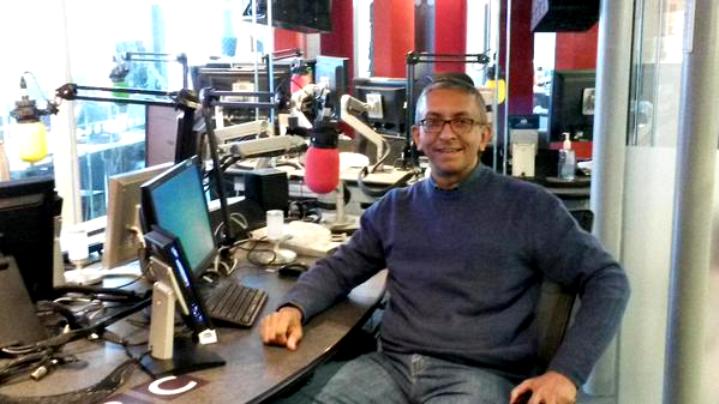
On 13 Feb 2015, while briefly in London, I visited BBC’s new Media Centre and recorded brief interviews with BBC Sinhala and BBC Tamil services (radio) on the role of social media during the Sri Lanka Presidential Election 2015 – the topic of my talk at University of London the previous day.
BBC Sinhala published the story online on 22 Feb 2015, along with an edited down audio track.
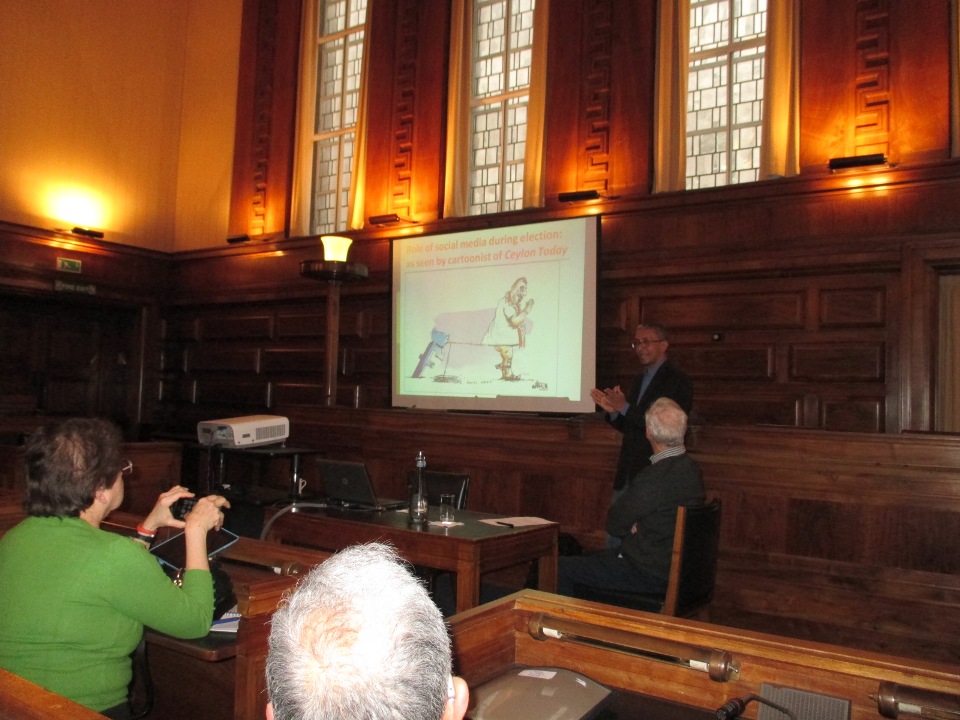
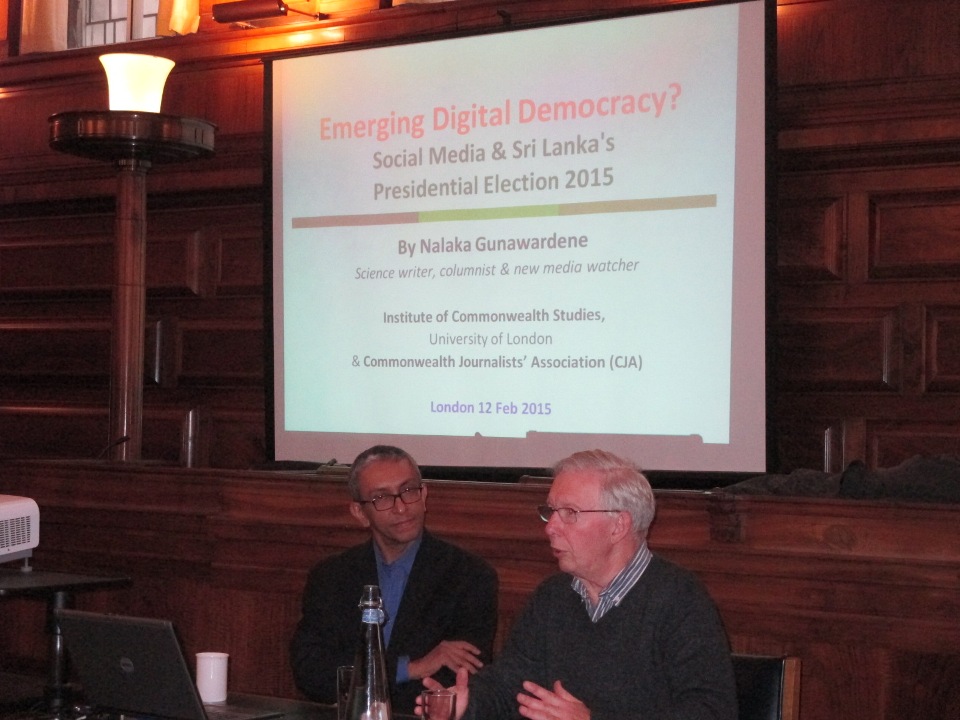
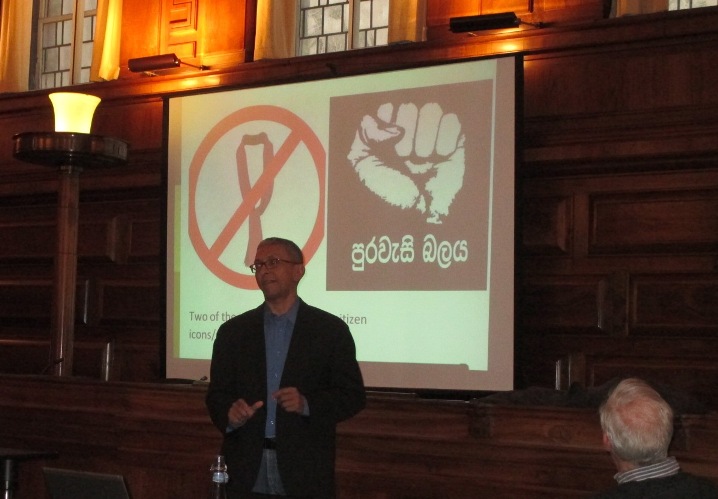
Nalaka Gunawardene talking at London University on 12 Feb 2015 on “Social Media and Sri Lanka’s Presidential Election 2015” Photo by Prasanna Ratnayake
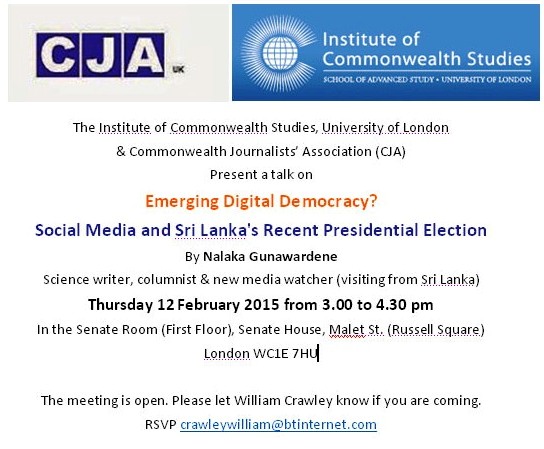
Emerging Digital Democracy? Social Media and Sri Lanka’s Presidential Election 2015
This was the topic of a public talk I gave at the University of London on 12 Feb 2015.
It was organised and hosted by the Institute of Commonwealth Studies, University of London in collaboration with the Commonwealth Journalists’ Association (CJA).
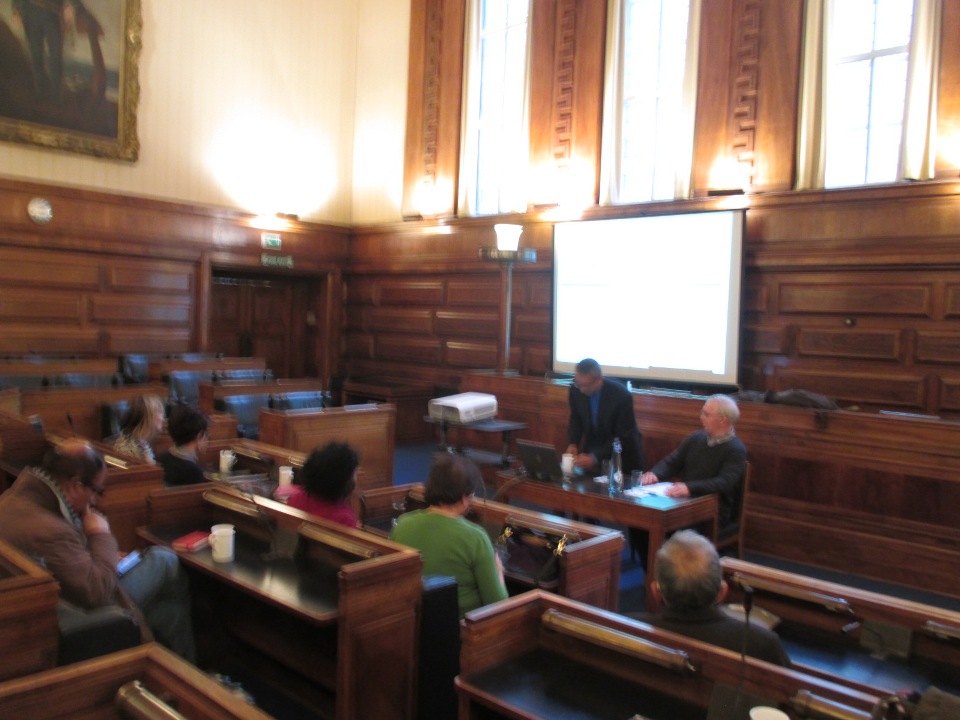
They lined up the University’s Senate Room for the talk, which was attended by a South Asian audience who engaged me in a lively discussion.
Emerging Digital Democracy? Social Media and Sri Lanka’s Presidential Election 2015
Synopsis of the talk:
A record 81.5% of registered voters took part in Sri Lanka’s presidential election on 8 January 2015 in which incumbent Mahinda Rajapaksa was defeated by his former health minister Maithripala Sirisena. The peaceful regime change has been widely acclaimed as a triumph of democracy and a mandate for political reform, improved governance and national reconciliation.
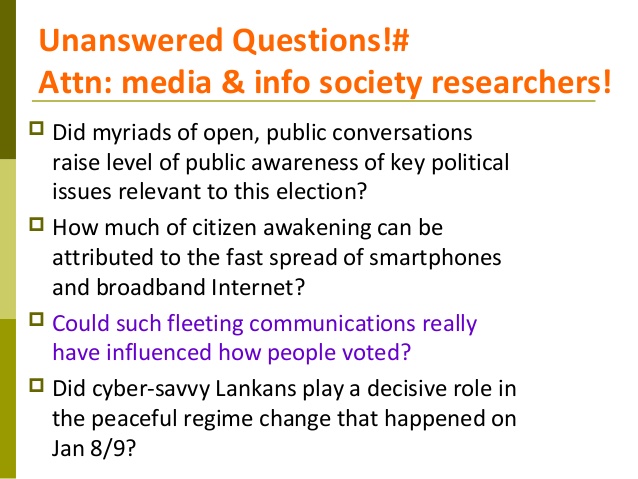
The election saw unprecedented use of social media by both candidates as well as by politically charged yet unaffiliated youth. How much of this citizen awakening can be attributed to the fast spread of smartphones and broadband? Did it really influence how people voted? What does this mean for future politics and governance in Sri Lanka?
In this illustrated talk, science journalist and new media watcher (and practitioner) Nalaka Gunawardene shares his insights and views.
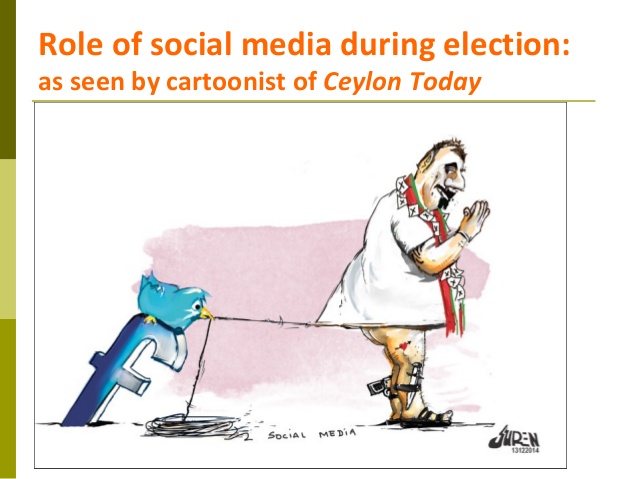
Who’s afraid of social media? Many Lankan politicians, for sure…
My PowerPoint slides:
Key questions that need more research to answer:
This is why we need better research on new media and society in Sri Lanka!
Photos by Prasanna Ratnayake
William Crawley (right), Fellow of the Institute of Commonwealth Studies, introduces Nalaka GunawardeneNalaka Gunawardene on Social Media and Sri Lanka’s Presidential Election 2015 at University of London, 12 Feb 2015A section of the audience at Senate Room, University of London, listening to Nalaka Gunawardene: 12 Feb 2015
Text of my news feature published in Ceylon Today newspaper on 21 June 2012
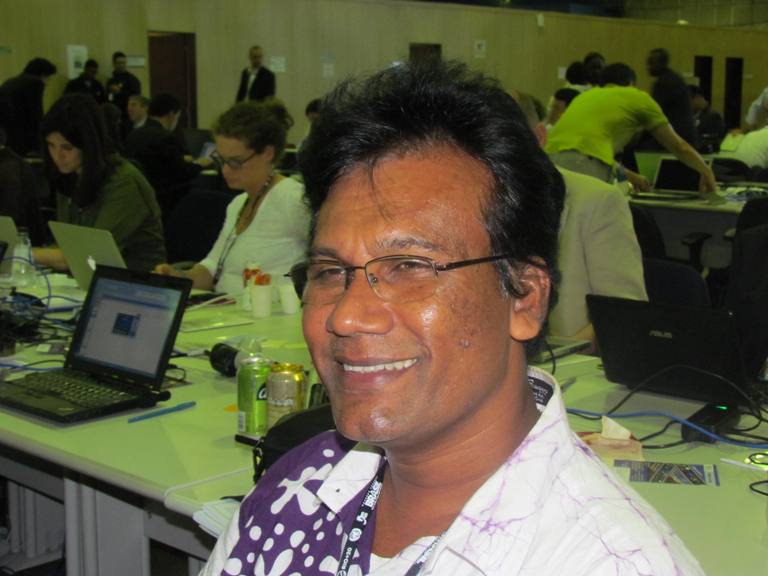
Hemantha Withanage in Rio de Janeiro
Ensure Good Governance and People’s Rights for a Sustainable Sri Lanka, urge civil society in Rio
By Nalaka Gunawardene in Rio de Janeiro, Brazil
As world leaders gather in Rio de Janeiro for the United Nations Conference on Sustainable Development, 50 Lankan civil society organisations (CSOs) have issued a joint statement calling for good governance and respect for people’s rights in Sri Lanka.
Mere economic growth – by raising per capita Gross National Product (GNP) — can be a highly misleading indicator of development, the statement said.
“Better governance is a must for a sustainable society. Better environmental governance and environmental justice should be ensured for sustainable living,” it added.
The 15-page document is signed by 50 people’s organisations working on environment, development and human rights issues at the grassroots level. It urged the government of Sri Lanka to “follow the middle path in development as we proposed in 2002 for the World Summit on Sustainable Development (WSSD)”.
The statement has been released on the web and is being distributed to over 40,000 participants attending the major UN conference, also known as Rio+20. (Full text at: http://tiny.cc/SLRio20)
The government of Sri Lanka was also due to release its official report for the conference, but copies of it were not available. There was also no mention of it anywhere on the Ministry’s official website.
CSOs underlined the need to respect the basic rights of people while ensuring environmental safeguards and maintaining a slow growth. It emphasized that sustainable development and good governance were inseparable.
The statement called for greater media freedom, right to freedom of expression and right to dissent as articulated in Article 14 of the Universal Declaration of Human Rights, and in Agenda 21, an action plan for sustainable development that countries adopted at the original Earth Summit in Rio in June 1992. Sri Lanka has committed itself to both.
“It is very well known that without access to information, public participation, accountability, rule of law and predictability — which are the basic pillars of good governance — you cannot achieve sustainable development,” said Hemantha Withanage, the statement’s principal author in an exclusive interview.
“The sustainable development principles agreed at the Earth Summit in 1992 had environment, social and economical pillars. But today, we know that without a political pillar, sustainable development cannot be achieved,” added Withanage, Executive Director of the Centre for Environmental Justice in Sri Lanka.
“The space for CSOs and recognition of their role in development is vital,” the statement noted, calling for greater civil society involvement in policy formulation in all areas of development.
The statement mentions a wide array of issues and concerns raised by ordinary Lankans who were consulted during its preparation. These range from local and national to global, and cover sectors such as agriculture, water, livelihoods, energy, public health, disaster management and biodiversity conservation.
“The world needs to move towards a simultaneous action at local, national, regional and international level to confront the social, economic and ecological crises which the present development model has caused,” it notes. “What we need instead is to defend our commons and total transformation towards sustainable consumption and production patterns.”
It explicitly called “to stop all kinds of corporate control, capture and monopolisation of natural resources.”
“Our demands are not only for Rio+20. After all, this is just another meeting of the world nations under the UN flag. We should not treat this as an end of everything. It is an on-going process,” Withanage said.
He recalled being involved in the ‘Citizens Report on Environment and Development’ that Sri Lanka civil society organisations collectively prepared for the Earth Summit in 1992. Many of its aspirations were never met, he lamented.
“Meanwhile, we have seen more deterioration of the social and environmental rights over the past two decades,” he said.
CSOs also called for an assessment of environmental and social costs of Sri Lanka’s prolonged civil conflict that ended in 2009. Its impact on natural resources remains little understood even as economic development projects are being rolled out in conflict affected areas, the statement said.
The CSO statement was produced at the end of Sri Lanka Civil Society Dialogue on Rio+20 held in Negombo on 17 – 18 May 2012. It was convened by the Centre for Environmental Justice/Friends of the Earth Sri Lanka, National Fisheries Solidarity Movement (NAFSO) and the Sri Lanka Nature Group.

 Open Minds!