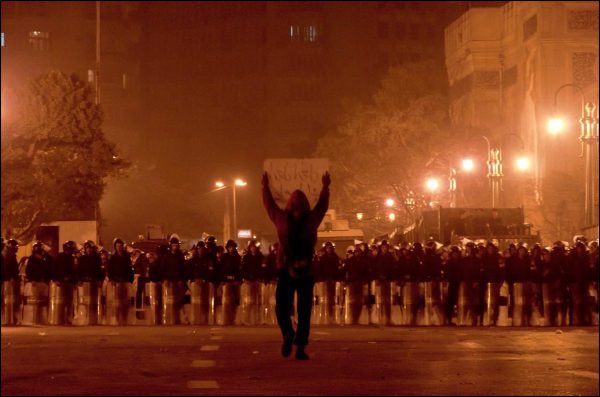
Their blurb: “Violent clashes between police and demonstrators as over ten thousand gather on the streets of Cairo. The Egyptian people have endured a tyrant’s rule for far too long, millions struggle each day to find where their next meal is coming from. January 25th, 2011 marks the day when the people rise and take back what’s rightfully there’s. This isn’t the end, but hopefully the beginning to a long awaited regime change! Send to everyone and let them know.”
Song: “Into the Fire” – Thirteen Senses
Thanks to the following news sources for their footage
Daily News Egypt
The Guardian
CNN
New York Times
Al Masry Al Youm
How do you measure progress? Count simply the economic growth numbers? Or something more? Are people in richer countries necessarily happier? If not, what’s the key to real progress that makes people better economically, environmentally and socially?
The Organisation for Economic Co-operation and Development (OECD) wants to hear from young people about these issues through a video competition. To celebrate the OECD’s 50th Anniversary, young people worldwide are invited to create a short video describing their vision of Progress. In 3 mins, or 180 secs. The competition is open to young people (18-25 years) in every country worldwide.
Upload your video on YouTube and register online before MIDNIGHT (Paris time) on 1 March 2011. Details here. Promo video below:
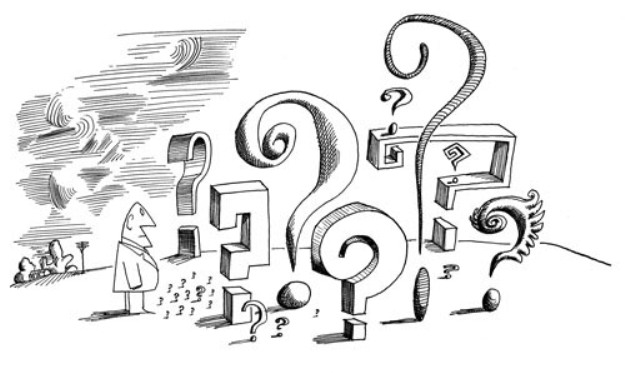
By Saul Steinberg (1914-1999), American cartoonist and illustrator
Question: Who said: “All the world is a quiz, and all the men and women merely players”?
Answer: The late Magnús Magnússon, iconic host of BBC television’s long-running quiz Mastermind.
I am fond of quoting these words, which sum up what quizzing is all about. I’ve been involved in quizzing most of my life, now for over 30 years. I was an avid ‘quiz kid’ in my time and later became a quiz compiler and quizmaster – I’ve been hosting long-running quizzes on radio and television in both in English and Sinhala.
The latest venture in that quiz career was launched today, with a new weekly quiz column in Daily News, Sri Lanka. It’s called Wiz Quiz. The first installment is found here, a quick look at 2011.
Every week, we will present a new set of 15 questions, and publish the answers to the previous week’s questions. The newspaper is arranging for prizes for those who get all the answers right.
I am partnering on this with my friend and long-standing quiz enthusiast (and film buff) Vindana Ariyawansa. Vindana too started quizzing as a school boy aged 13, and was later a member of University of Kentucky quiz team for three years. In 2008, he published a Quiz Book in English containing 1,000 questions and answers on general knowledge.
As we say in today’s intro: “We don’t want to ask questions that elicit esoteric answers that nobody knows. Instead of such trivial pursuits, we want to keep this quiz focused on interesting insights and factoids related to our island and the wider world outside.”
And while on the subject, here’s a great new quizzing website I’ve just discovered: Quizzing.in
What do you think of higher education in Sri Lanka, a young documentary film maker asked me a few weeks ago.
That would be a good idea, I replied. I wasn’t trying to be too cynical, but that’s the stark reality.
Sri Lanka’s 20 million population is served by 15 public universities. Between them, these had a total of 65,588 students (not counting those enrolled with the Open University) and 4,738 faculty members in 2009.
None of these universities come anywhere near the top 1,000 (or even top 2,000) of the world’s universities as independently ranked using measurable criteria. Some say we have universities in name only, which of course those inside the system protest and deny vehemently.
University World News, an online global higher education publication focusing on international higher education news and analysis, recently asked me for a comment article on the crisis in Sri Lanka’s higher education sector. When I said I was a complete outsider to the system, they replied that’s precisely why they wanted my view.
So I wrote a 1,100 words which has just been published. My original title was ‘Squabbling while our future burns’ but some editors like to understate (their prerogative). I’m glad the rest of my text has largely survived their considerate editing.
Here are the opening paras:
“Sri Lanka’s university system is overburdened, outdated, and badly in need of reform. But politicians, academics and students just can’t agree on how to do it. So they fight.
“The recent wave of student protests have focused on one element of a wider package of proposed reforms: inviting private universities into a country where publically -funded universities currently dominate.
“In Sri Lanka’s heavily polarised political culture, the much-needed reforms have become the latest source of bickering. Yes, we need public discussion and debate to make the best policy choices. But what progress can be achieved when rhetoric replaces reason?
“As a concerned citizen and anxious parent, I call this reckless squabbling while our children’s future burns…”
The essay ends with the brief author bio, part of which reads: “Nalaka Gunawardene sometimes calls himself a ‘higher education refugee'”. My regular readers know how and why.
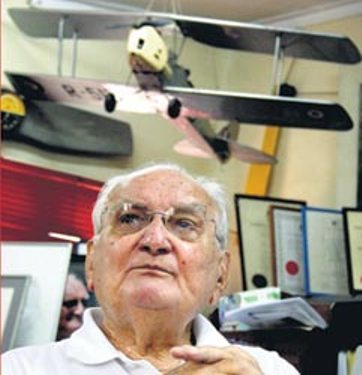
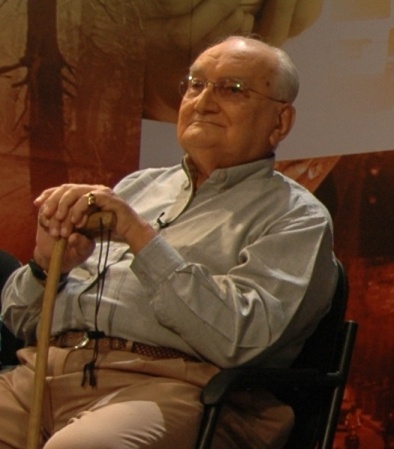
Ray Wijewardene: Freed from gravity, at last!I went straight from a paddy field, where I was filming much of the morning, to the funeral of my mentor and friend Ray Wijewardene early afternoon at the General Cemetery Colombo.
Ray would have approved: despite being a high flyer in every sense of that phrase, he had his feet firmly on the ground — and sometimes in the mud. He was fond of saying, “Agriculture is my bread and butter, while aviation is the jam on top of it”.
Dr Philip Revatha (Ray) Wijewardene, who passed away on August 18 aged 86, was an accomplished engineer, aviator, inventor, Olympian and a public intellectual of the highest calibre. He was also one of the most practical and down to earth people I’ve known.
He preferred to introduce himself as a farmer and mechanic ‘who still got his hands dirty’. Perhaps that’s how he wanted to be remembered — but each one of us will carry our own vivid memories of this colourful, jovial and altogether remarkable human being.
I’ve already written a quick introduction about Ray for Groundviews.org, which has published a long interview I did with Ray 15 years ago, originally for an Indian science magazine. That exchange is a reminder of the imaginative thinker, life-long experimenter and outspoken scientist that Ray always was.
I’ll be writing more about Ray Wijewardene in the coming weeks, exploring his many different facets. I’ve known and walked alongside him for almost a quarter century. For now, I’ll remember him for one facet that I didn’t share despite many offers and invitations: flying.
per ardua ad astra...Ray just loved to fly. Most humans share this age old dream, but Ray wasn’t contented just being flown around on commercial jets — which to him were merely large, sealed up cylinders. He far preferred the small, propeller-driven aircraft – single or twin seaters that gave their passengers a true sense flying and a real taste of the sky.
Looking back, it was quite apt that I first met Ray at the Ratmalana Airport, just south of Colombo, from where he took off and landed hundreds of times over the decades. One sunny morning in mid 1986, he took time off from his flying to talk to a group of high school leavers who were participating in the first Science for Youth programme. It exposed us to various (then) modern technologies over six consecutive weekends. Much of the knowledge we gained has long been obsolete, but its inspirational value was timeless….and continues to propel me forward.
Much of that inspiration came from Ray Wijewardene, who talked to us – with lots of practical demonstrations – about problem solving and innovations in three areas close to his heart: energy, agriculture and transport. I remember how he was experimenting with improvements to the humble bicycle at the time, so that riders could optimise performance with modest efforts.
He also talked about growing our food and energy. But it was his flying experience that most fascinated us starry-eyed youngsters. As a pilot, Ray was licensed to fly three kinds of flying machines: fixed-wing aircraft, helicopters and autogyros. But this pilot was flying not only factory-fitted, mass-manufactured units. He also experimented with building and flying his own ultra-light aircraft and helicopters – he was particularly interested in building amphibious small planes that could land on, and take off from, Sri Lanka’s numerous inland lakes and reservoirs.
All this and more made Ray a journalist’s dream, but as I soon found out, he wasn’t an easy subject to cover! In 1988, The Island newspaper asked me to interview Ray and write an article about the dream and reality of flying. He happily talked with me for two hours — yet, in the end, didn’t want his name mentioned in print. For all his accomplishments and outspoken views, Ray was completely publicity shy. He didn’t mind his views being reported, but with little or no mention of the source.
It’s the song that matters, not the singer, he said — and I heartily disagreed. I pointed out that we journalists needed to attribute wherever possible for greater credibility of what we write (I didn’t tell him that we also love good news-makers: the more informed and opinionated they are, the better!). This became a running argument that Ray and I had for two decades. Within a few years, he trusted me enough to talk to me on the record. But what he said off the record was always more interesting…
When he was approaching 75, Ray told me how nervous he was when he had to go for renewals of his pilot’s license. In the end, it wasn’t age that ended his flying career: along with everyone else, he was ‘grounded’ when private flying was first restricted and then banned during the latter years of Sri Lanka’s long-drawn war.
During the 1990s, Ray had repeatedly invited me to share a flight on one of his home-built light planes. He assured me they were perfectly safe — among satisfied customers was Prof Cyril Ponnamperuma, one time science advisor to the President of Sri Lanka and an internationally renowned biochemist. (Ray did acknowledge that he’d crash landed his various planes thrice — and each time, he lived to tell the tale. He believed that test flying one’s own aircraft designs quickly eliminated bad designers!)
I kept deferring my own tryst with the open skies and was too preoccupied with earthly matters — and suddenly, it was too late. By the time Sri Lanka’s war ended in May 2009, Ray’s flying days were over (and our skies are not yet fully free for private domestic aviation).
Gravity, bureaucracy and age may have conspired to keep Ray confined to the ground in the last few years of his life — but only just. His spirit soared even when the body wasn’t allowed to: in all my years and encounters with him, I’ve never seen him ‘down’ (concerned and reflective, yes; depressed, no).
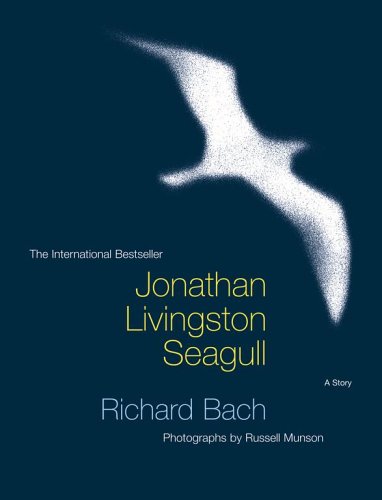
A lone spirit, on a long journey....That passion, enthusiasm and spirit of adventure characterised Ray and influenced everything he did, on the ground and in the air. Born in the 1920s and raised as part of the first generation of humans for whom private flying was available, he was infected with the ‘flying bug’ in the same way that American author and aviator Richard Bach was. In fact, Ray knew Bach and was a devoted fan of the latter’s books, especially Jonathan Livingston Seagull.
Perhaps Ray saw himself in Jonathan: a seagull tired of the monotonous life in his clan. He rather experiments with new – always more daring – flying techniques…which means he must fly solo most of the time, and confront the travails of life on his own.
Ray wasn’t a loner (to the contrary, he was very much a team player in everything he did). But sometimes he was racing ahead of us – or just flying at a higher altitude. Although I’ve never heard him say it, perhaps this unattributed quote partly explains the phenomenon: “When once you have tasted flight, you will forever walk the earth with your eyes turned skyward, for there you have been, and there you will always long to return.”
What Ray did quote, frequently, were these words of Robert Browning: “Ah, but a man’s reach should exceed his grasp, or what’s a heaven for?”
It was entirely fitting that a grand daughter would recite the poem ‘High Flight’ by John Gillespie Magee, Jr., a favourite verse among aviators and, more recently, astronauts.
High Flight
by John Gillespie Magee, Jr.
Oh! I have slipped the surly bonds of Earth
And danced the skies on laughter-silvered wings;
Sunward I’ve climbed, and joined the tumbling mirth
of sun-split clouds, — and done a hundred things
You have not dreamed of—wheeled and soared and swung
High in the sunlit silence. Hov’ring there,
I’ve chased the shouting wind along, and flung
My eager craft through footless halls of air….
Up, up the long, delirious, burning blue
I’ve topped the wind-swept heights with easy grace
Where never lark nor even eagle flew—
And, while with silent lifting mind I’ve trod
The high untrespassed sanctity of space,
Put out my hand, and touched the face of God.
On returning from the simple yet moving funeral, I tweeted: No longer a prisoner of gravity: sky-lover, pilot & light aircraft builder Ray Wijewardene blasted off heavenwards. Farewell, high flyer!
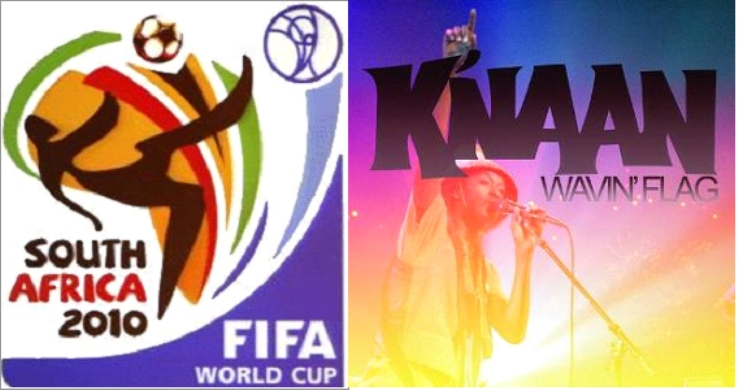
FIFA World Cup Football enters its final few days this week, culminating a month of international football at the highest level.
Played across 10 venues in South Africa, this is much more than a sporting tournament. It’s the ultimate celebration of the world’s most popular sport, held once every four years. More popular than the Olympics, it demonstrates the sheer power of sports and media to bring together – momentarily, at least – the usually fragmented and squabbling humanity.
And one upbeat song has characterised this World Cup more than any other: the FIFA World Cup Anthem, “Wavin’ Flag” (The Celebration Mix). Sung by K’naan (born Keinan Abdi Warsame) a Somali-Canadian poet, rapper, singer, songwriter, and instrumentalist.
It opens with these now famous words:
…Singing forever young, singing songs underneath that sun
Lets rejoice in the beautiful game,
And together at the end of the day.
We all say
When I get older I will be stronger
They’ll call me freedom, just like a wavin’ flag…
“Wavin’ Flag” is the third official single (eighth single overall) from K’naan’s Troubadour album. He specially recorded a version of the song for the tournament, hosted by South Africa. The remix of “Wavin’ Flag” is part of Coca-Cola’s global integrated marketing campaign “inspired by the joyous dance celebrations familiar to Africa.”
The song is popping up and pouring out from billions of radio and TV sets, mobile phones, websites and other devices. So much so that I wonder if it might as well be our planetary anthem — an idea that some social activists and artistes have dreamed about for decades?
Last year, shortly after Michael Jackson’s sudden death, I wrote a blog post that looked back at his songs that celebrated social and environmental themes. Referring to one, I said: “…the Earth Song had much wider and more lasting appeal, almost becoming an anthem for the global environmental movement in the past decade. But its real impact was not among the converted – with this song, Jackson took the green message to the heartland of the Facebook generation.”
We can argue about that (please do!). For now, here’s the celebrated song, currently the most popular on the planet:
FIFA Wold Cup Anthem “Wavin’ Flag” (The Celebration Mix) by K’naan
Wavin’ Flag lyrics (Celebration Mix) by K’naan
Ooooooh Wooooooh Ooooooh Wooooooh
Give me freedom, give me fire, give me reason, take me higher
See the champions, take the field now, unify us, make us feel proud
In the streets are, hands are liftin’, as we lose our inhibition
Celebration, its around us, every nations, all around us
Singin’ forever young, singin’ songs underneath that sun
Lets rejoice in the beautiful game
And together at the end of the day
WE ALL SAY
When I get older, I will be stronger
They’ll call me freedom
Just like a wavin’ flag
And then it goes back…And then it goes back…
And then it goes back…And then it goes…
When I get older, I will be stronger
They’ll call me freedom
Just like a wavin’ flag
And then it goes back…And then it goes back…
And then it goes back…And then it goes…
Ooooooh Wooooooh Ooooooh Wooooooh
Give you freedom, give you fire, give you reason, take you higher
See the champions, take the field now, unify us, make us feel proud
In the streets are, hands are lifting, every loser inhibition
Celebration, its around us, every nations, all around us
Singin’ forever young, singin’ songs underneath that sun
Lets rejoice in the beautiful game
And together at the end of the day
WE ALL SAY
When I get older, I will be stronger
They’ll call me freedom
Just like a wavin’ flag
And then it goes back…And then it goes back…
And then it goes back…And then it goes…
When I get older, I will be stronger
They’ll call me freedom
Just like a wavin’ flag
And then it goes back…And then it goes back…
And then it goes back…And then it goes….
Ooooooh Wooooooh Ooooooh Wooooooh
WE ALL SAY
When I get older, I will be stronger
They’ll call me freedom
Just like a wavin’ flag
And then it goes back…And then it goes back…
And then it goes back…And then it goes…
When I get older, I will be stronger
They’ll call me freedom
Just like a wavin’ flag
And then it goes back…And then it goes back…
And then it goes back…And then it goes…
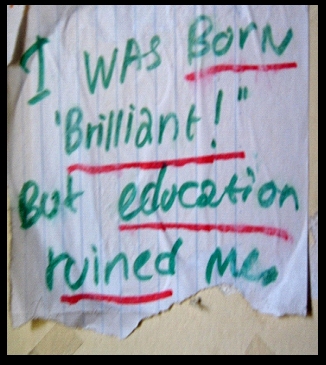
Look what education is doing to me!A few days ago, while cleaning the spare room in our home, I came across a piece of paper stuck on to the wall. These words were scribbled on it: “I was born brilliant – but education ruined me!” (see photo).
My daughter Dhara, 14, admitted authorship without any hesitation. It’s not her original line, of course — but a clear reflection of how she feels about schooling and formal education. When we think about it, these few innocent words become a severe indictment of a mass-scale system in which families, societies and countries invest so much money, time and hope.
She’s certainly not alone in her misgivings about the value of institutionalised education. As George Bernard Shaw once declared, “The only time I interrupted my education was in school.”
Although I had a happy school life, I can well appreciate how and why many people feel like this about school. Don’t take my word for it – do a quick, random sampling of those around you. How many of them will admit to having happy memories of their school days?
Let’s face it: the whole concept of a school is flawed. Education may be a great leveller among human beings, but schooling in most parts of the world operates at the lowest common denominator level. How can you group together 30 or 40 children at random, expose them to the same curriculum, imparted at the same pace, and expect all to thrive? Some will keep up; others will lag behind; and a few will be completely bored out of their minds – like I was, for a good part of my primary and secondary schooling.
Yet there is not much that even the most dedicated teacher could do under such trying circumstances. Oddly enough, no one in any self-respecting healthcare system would want to prescribe the same medicine for patients with very different ailments. Yet the one-size-fits-all approach is never questioned when it comes to education. Why?
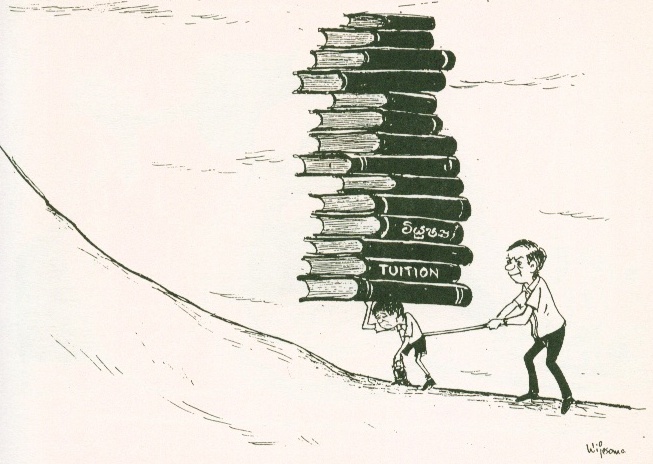
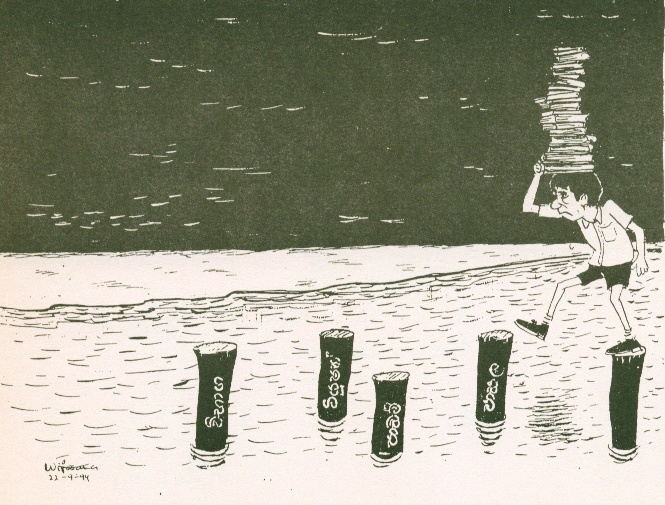
A hapless school kid being primed for the Great Rat Race - cartoon by W R Wijesoma, 1994
One reason why this abuse has thrived is because no one listens to the most important voice in this debate: the average schoolgirl and schoolboy. The learner’s perspective is largely missing in most educational policies and plans. There is so much emphasis on teaching, infrastructure, performance and resources. The handful of men and women who decide what should be taught in our schools hardly ever pause to think how their decisions affect the last link in the chain: the hapless, overburdened, over-driven student. Over 4 million of them — like the one in the cartoon above.
Must things remain like this forever? Is there any hope that our much-tinkered (and much-maligned) education system could one day be more student friendly, more learning oriented and more responsive to the different needs of different students? Will those in charge of the system begin to treat students and teachers as something more than movable statistics? And most importantly, can we restore the joy of learning, the sense of wonder and fun of schooling?
I don’t have easy answers to these – nobody does. But these are worth asking, even if they are uncomfortable and unpopular questions to pose. For too long, the formal education sector has carried on with its business-as-usual with the typical self-righteousness and arrogance of a matronly school principal.
It’s time for us to storm the citadels of learning and make them more caring, accommodating and sensitive to the needs of the most important people in the system: the learners.
Nothing less than our children’s individual and collective futures are at stake.
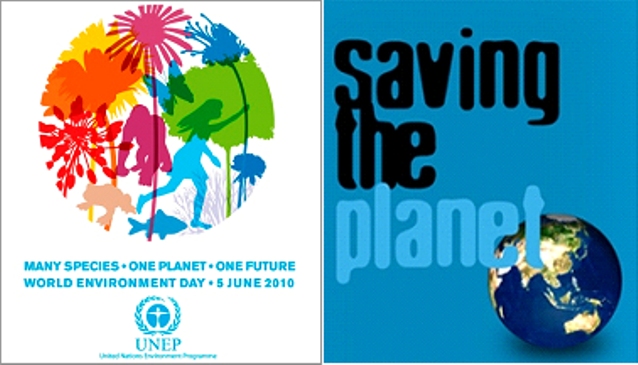
Today was World Environment Day (WED), and this year’s theme was biodiversity. The slogan read: Many Species, One Planet, One Future.
Different people observed the day in many and varied ways. Each one is valid, useful and purposeful.
I don’t believe in tokenistic tree planting. In fact, I’ve never planted more than a tree or two all my life – and honesty, I don’t know what happened to those hapless saplings after I deposited them gently and eagerly into a little hole in the ground…
Instead, I’m committed to a longer term effort: raising a single child as a single parent, trying to make her more caring for the planet, its limited natural resources and its people. I’m hoping that this would prove to be a lot more planet-friendly and worthwhile than a whole lot of trees planted and then abandoned…
As David Suzuki, the Canadian environmentalist and my favourite broadcaster, has said: “Our personal consumer choices have ecological, social, and spiritual consequences. It is time to re-examine some of our deeply held notions that underlie our lifestyles.”
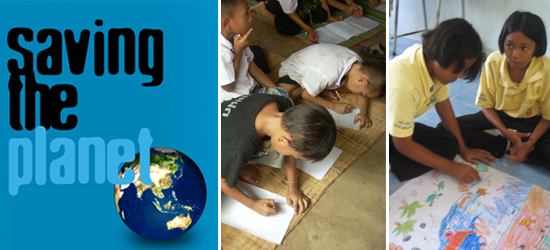
This is precisely the premise of Saving the Planet, the six-part, pan-Asian TV series we at TVE Asia Pacific produced and released in late 2009. It was among the compilation of environmental films that we screened at the British Council Colombo today to mark WED.
Filmed in six countries in South and Southeast Asia, Saving the Planet profiles groups working quietly and relentlessly to spread knowledge, understanding and attitudes that inspire action that will help humans to live in harmony with the planet.
Here are two stories that have a particular focus on biodiversity – all others have also been featured on this blog over the past few months (just run a search for ‘Saving the Planet’).
The people of Prek Toal have always known how closely their lives and jobs are linked to the ebb and flow of the Tonlé Sap lake, the largest in Cambodia and linked to the Mekong River. Now, the conservation group Osmose is showing how they can benefit from the lake’s fish and other natural resources without killing off the very ecosystem that sustains them. One strategy that works: to reach out to grown-ups through their children.
Tourists are astounded by the richness and diversity of Thailand’s natural heritage. But many Thai children and youth are not connected with Nature – they are not familiar with plants and animals even in their own backyard. Concerned, the Thai Education Foundation launched a programme that links schools with their local community to learn about Nature through exposure and experience. We travel to Phang Nga province in southern Thailand to find out this works.
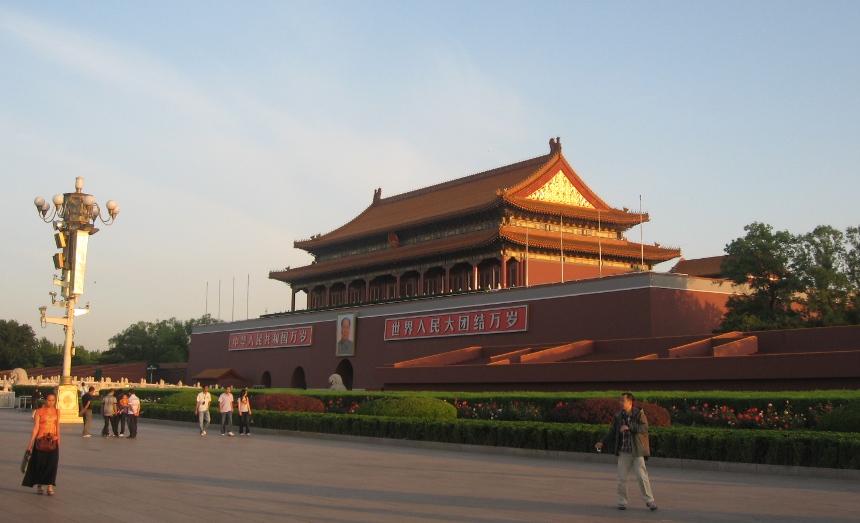
Tiananmen literally means Gate of Heavenly Peace...hmmm
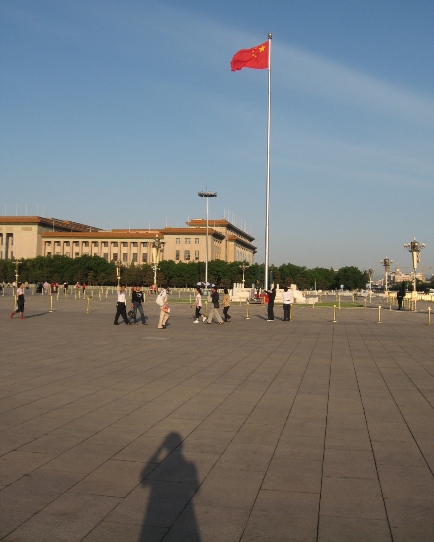
I spent several hours at the Tian’anmen Square in Beijing, China, this week, while attending a media conference. I was returning to this landmark, now a key tourist attraction in modernised and assertive China, after nearly a decade. And much has changed…
Measuring 880 metres by 500 metres, and covering a total area of 440,000 square metres, the Tiananmen Square is the largest city square in the world. But mere superlatives don’t impress me. It’s what goes on behind the claims, labels and stereotypes that interest me.
I’ve been to the square on a couple of previous Beijing visits. The first was in October 1996, during my very first visit to China. I was also taken in a group tour on a later visit. If I remember right, my last sighting of the Square was in 2002 – just before I acquired my first digital camera. (That makes a difference, because Before Digital, my analog photographs on travel were sparingly taken…and my own memory is not a very reliable storage medium.)
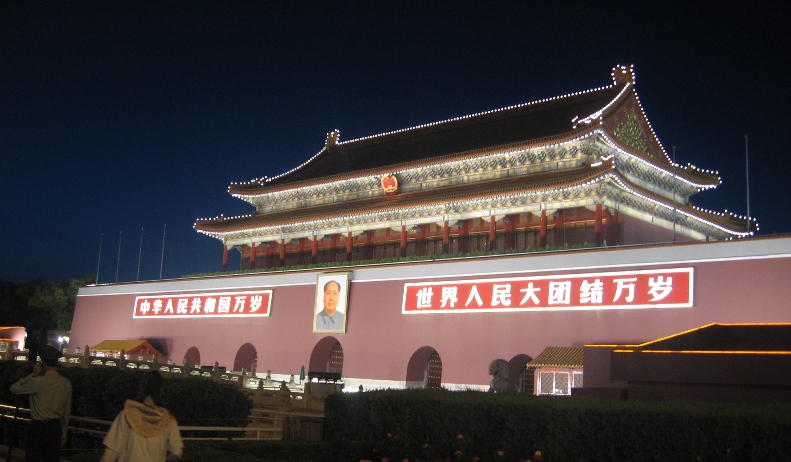
Day or night, he keeps vigil over Tiananmen Square...and 1.3 billion people
This time, I was armed with my digital camera and ample digital memory — and, it seemed, so were most other visitors! There were the obviously foreign tourists (including the loud and uninformed Americans), but it seemed most people thronging to the square were Chinese…many from out of town. For some, a visit to this centre of power is a rare occasion to be cherished and recorded.
I was impressed by just how many people were clicking away, using either digital cameras or mobile phone cameras. I shouldn’t be surprised by this, for China is the country with the largest number of mobile phones in use: by March 2010, there were some 780 million mobile subscribers, accounting for 58.5 per cent of all people in China.
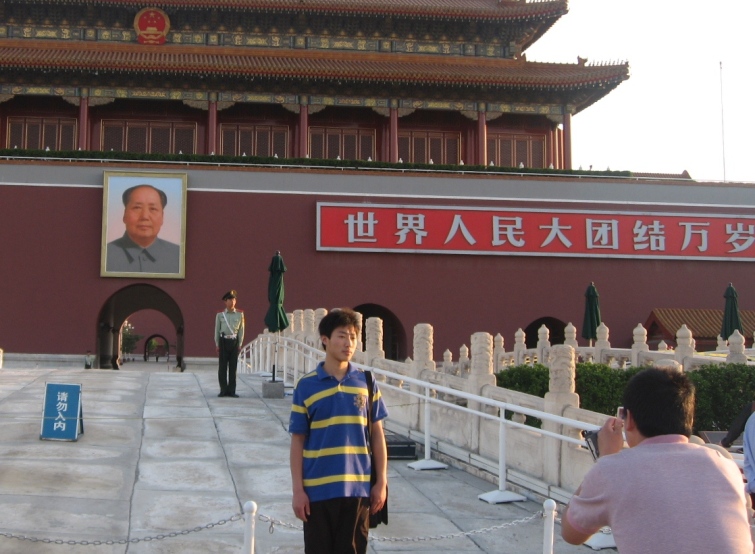
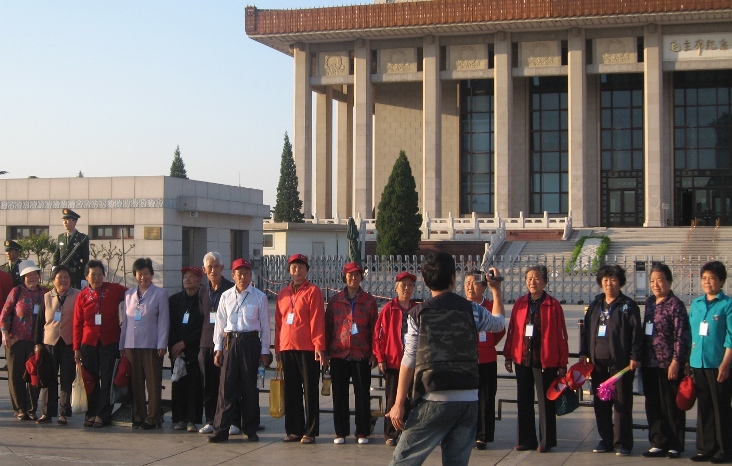
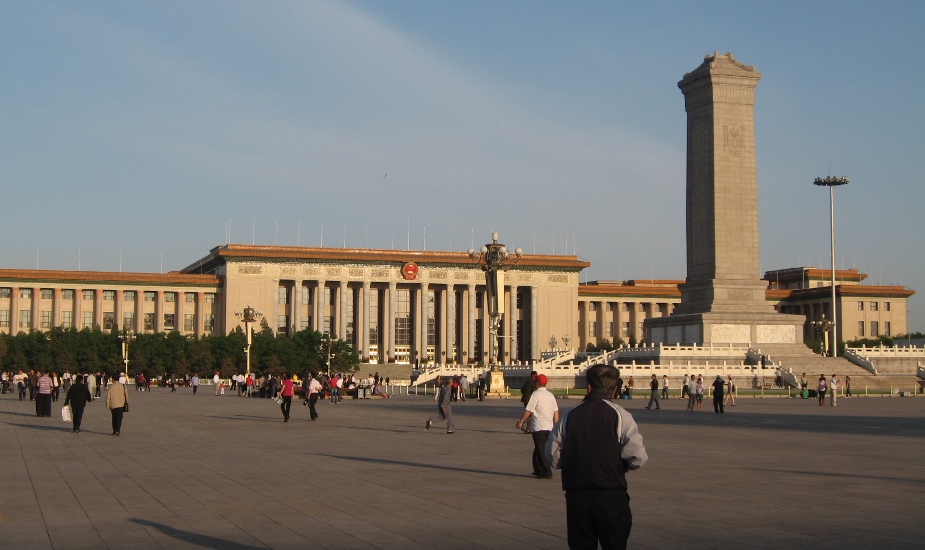
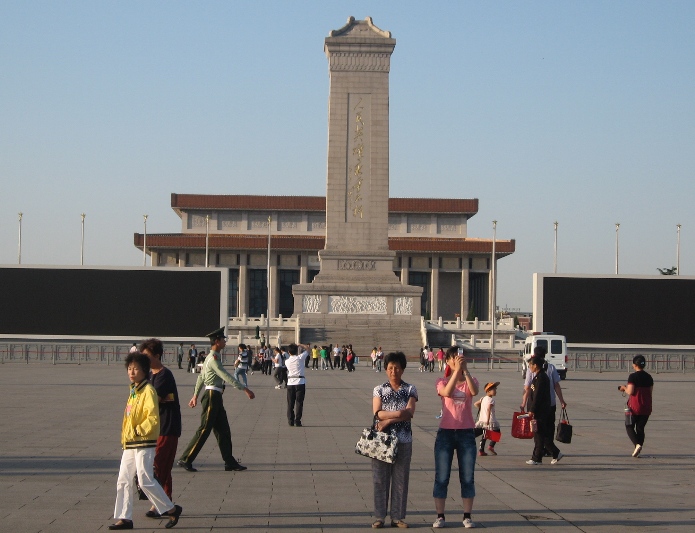
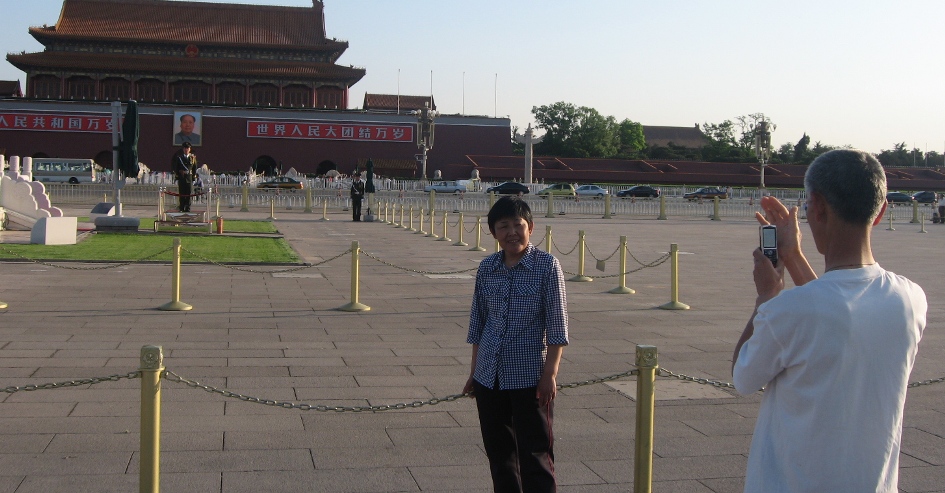
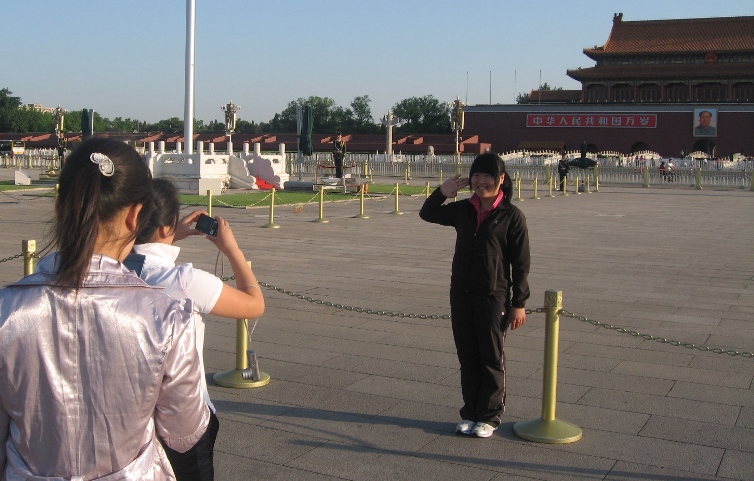
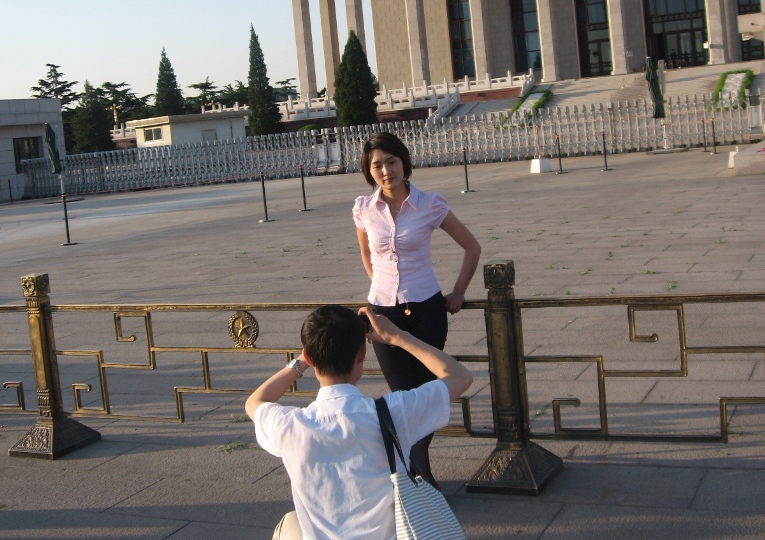
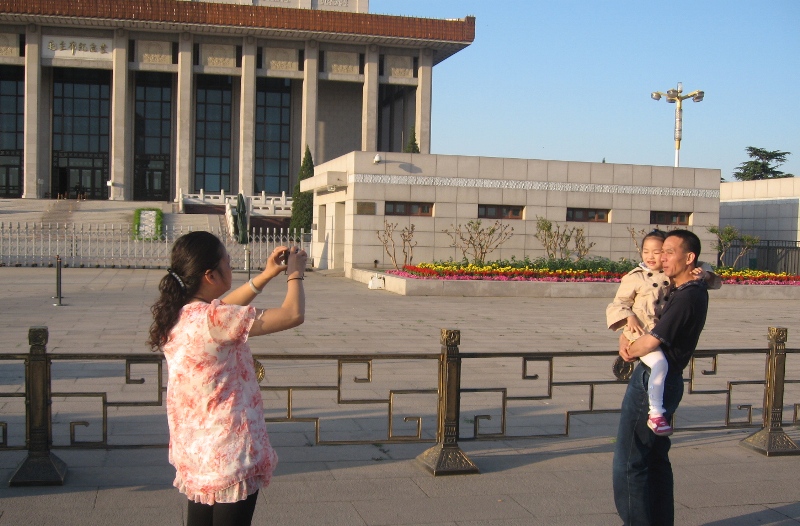
Keen to capture different scenes under varying kinds of daylight and night lights, I made three visits to the Square – including one at 5.30 in the morning to catch daybreak at the Gate of Heavenly Peace (literal meaning of Tiananmen). So here’s a sampling of my several dozen photos – this selection has a bias on people shooting each other, digitally speaking (a far cry from the kind of shooting that took place here 20 years ago).
Look serious, man - he's watching!Now bring out your best smiles, all!People milling about with Great Hall of the People in the backgroundClicking away at Monument to the People's Heroes
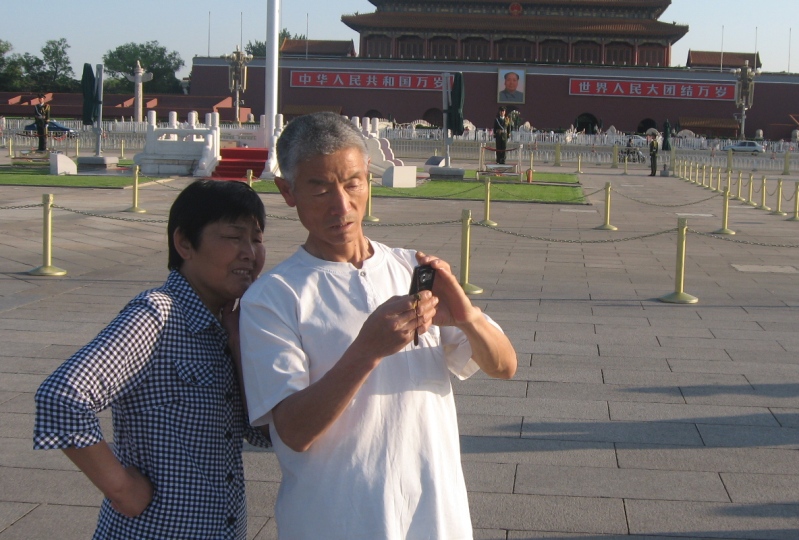
One of the most striking moments I captured was of this elderly couple, very dignified and sprightly in their outlook, as they were taking a stroll on the square early morning and capturing memories on their mobile phone. They are old enough to have known another reality, but this was now and here…
This Square, and we, have seen and heard much in our time...Did we get it alright?
I also noticed how the younger visitors were clearly at ease with digital technologies, just like their fellow Digital Natives elsewhere in the world. There is also a discernible easing up (not only among unknown people in public places, but also noticeable among older and younger Chinese friends I have): maybe it’s the exuberance of youth, but the NextGen Chinese don’t seem to be as somber and serious as their parents.
Or perhaps the younger people in China today just have more things to smile about?
Would Chairman Mao approve this pose, eh?Heaven is in the eye of the beholder...Digital Natives capturing memories for the Next Gen
It was a rushed visit of four nights and three days, so all my impressions are fleeting. They don’t begin to do justice to the nuanced complexity that is modern China. But they tell me one thing: even in a land with a proud history of over 5,000 years, ten years can still make a difference.
Bye for now: I take only photos, and leave only shadows behind...
Note: All photos were taken touristically for my own memory and personal archives, with no other intention.


 Open Minds!