In a new op ed essay — titled ‘Open Moment’, Closed Minds! — just published on Groundviews.org, I look back and ask some hard questions.
Here’s an excerpt:
“We all knew the hard-won peace had to be nurtured and consolidated. We also realised just how formidable the challenges of healing and rebuilding were. But could anyone have imagined the dramatic turn of political events since?
“Who would have thought that the victors of the war would soon be engaged in a nasty battle for personal glory and power? Who expected the historical feud between ‘lions’ and ‘tigers’ to be replaced so swiftly by a showdown between self-proclaimed ‘patriots’ and ‘traitors’?”
I raise these questions in the context of a fiercely contested presidential election scheduled for 26 January 2010. I note: “The two main contenders both claim to hold a mutually exclusive key to a better future for our land and people. Their dizzy campaigns bombard us with lofty claims and counter-claims 24/7 delivered through broadcast, broadband, mobile and other media.”
I ask whether either of the leading candidates has the open mind needed to seize the historic ‘open moment’ since the war ended. I recall how we completely missed the last such open moment created by the tsunami of December 2004.
I write: “Having missed the tsunami’s open moment, we cannot afford to bungle again. Rebuilding a nation of lasting peace, pluralism and prosperity will require many sections of society to change their mindset. This is especially and urgently needed in our media, much of which has become uncritical cheerleaders for patriotism and tribalism in recent years.”
Despite the many disappointments of the past 250 days, I still remain cautiously optimistic. But for how long?
“Another year grew old and weary
And gave way to one new and young.
Another orbit we’ve completed
Around our local star, the Sun.
We’ve been here before,
And return here we shall.
Dare I say it, among celebrations: This too shall pass…”
That was part of my own verse with which I wrote the first blog post of 2009. And do it did, just as I predicted — what powers of prescience I possess!
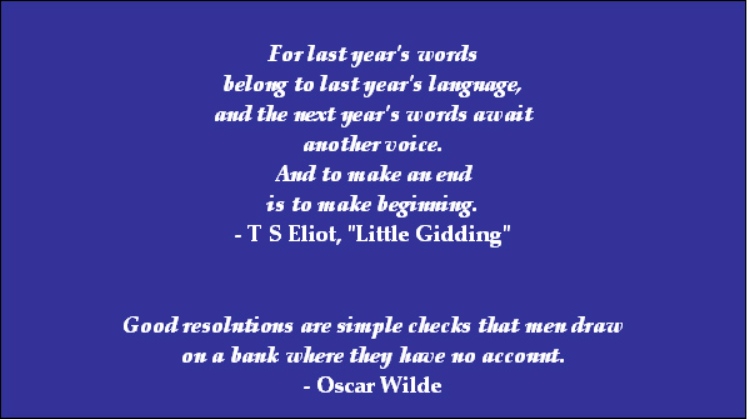
And I was inspired by these witty and perceptive words from two of the finest wordsmiths of yesteryear, which a dear friend circulated hours before the old year ran out.
After clocking dozens of orbits, these words haven't worn out...
Memory is a curious phenomenon. Sometimes memories of our personal past are evoked in the most unexpected manner, reviving nostalgia for days that are forever lost in the sands of time.
I have never visited Poland, but it’s been on my mind in recent days. 1 September 2009 marked the 70th anniversary of the beginning of the Second World War – which was sparked off by Nazi Germany’s invasion of Poland.
That’s also the day when the Anglo-American poet W H Auden wrote his deeply evocative poem, September 1, 1939. He wrote it sitting in a New York bar and distraught by the clouds of hatred gathering over Europe. I’ve been reading and re-reading it this year as the war Sri Lanka – which lasted almost five times longer – officially ended in May 2009.
As I wrote at the time: “Almost 70 years later, at the end of my own 30-year-long war, I have been reading and re-reading September 1, 1939. I’m trying to make sense of what is happening around me. The near hysterical mass euphoria on one side, and bewildered dejection on the other.”
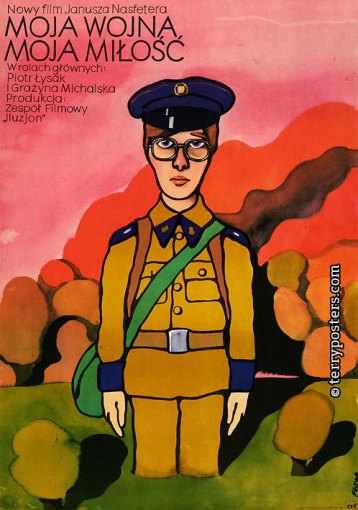
I have only just remembered that Poland in September 1939 holds another significance for me. It has to do with the Polish film Moja Wojna – Moja Milosc (My War-My Love, 1975), which I saw in the summer of 1979 at a Colombo cinema as a 13-year-old school boy.
Not only did I see the film, but I also wrote an essay reviewing it and entered it into a competition organised by the Embassy of Poland. Growing up in a country that didn’t have broadcast television until that very year, I had only seen a handful of movies up to that time. I was no movie critic, but my views on the film and its resonance with my own times must have struck a chord with the judges. For I won the second prize in the Sinhala essay competition.
Being runner-up was no big deal by itself, but this was the first time that my writing was competitively judged and ranked by anyone outside my immediate circles. My prize included a fountain pen, white polyester cloth for school uniforms, and an LP record of Polish music (yes, LPs were still in use, but on their way out at the time!).
From My War - My LoveI would go on to win many essay competitions during my teens, and one day earn an honest living as a wordsmith. But that movie review – long since lost in the mists of time – was my first success. My career in literary crime was thus forged…thanks to a Polish movie!
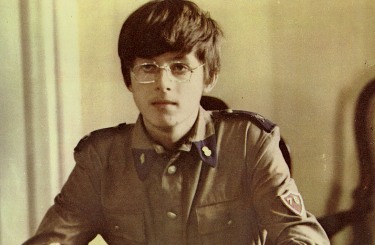
From the little that I can still remember, 30 summers later, My War-My Love wasn’t a pretty film. It is set during the week of the Nazi invasion of Poland in 1939. Daring 17-year-old schoolboy Marek (Piotry Lyjak), inspired by the example of the Sobieski cadets during 1831 insurrection, vows to take on Germans single-handedly. He devotes most of his energy to protecting a young girl who lost her mother during the invasion.
As one reviewer wrote, “My War-My Love could not, by its very nature, end altogether happily, but the film can be regarded as life-affirming.”
War has no place for innocence - then or now...That film was my first visual introduction to the horrors of war, a topic that was to dominate my own future for the next 30 years to come. In that Sri Lankan war, child soldiers several years younger than the film’s character Marek would play a prominent role.
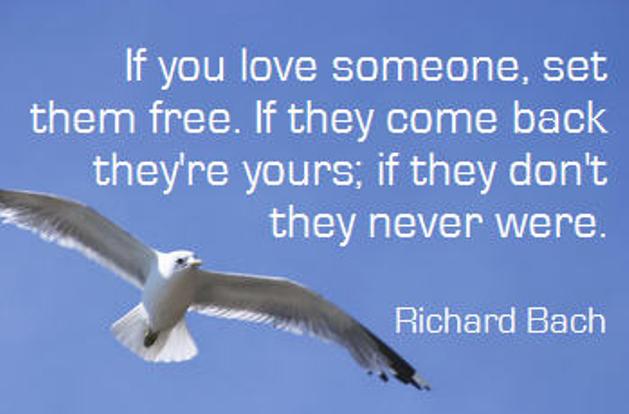
At a far more personal level, I had never been in love when I saw My War-My Love. In the three decades to follow, I would fall in love three times — and lose out every time, though for very different reasons (none of which involved ‘my’ war). I must now carry the pain of these lost loves for the rest of my time. But that is another story…
Thanks to the wonders of Google, I’ve been able to track down some specifics about the film. It was directed by Janusz Nasfeter (1920 – 1998), a versatile Polish film maker whose career in writing and directing films spanned from the late 1940s to the early 1980s. He was 19 when the Germans came marching in.
It was one of many films that have used the Second World War as its backdrop. There have been several other Polish films that looked back on the Polish resistance, Poland Holocaust and Warsaw uprising of 1944 and other key events that left an indelible mark on the country. In fact, as this listing in Wikipedia shows, when Janusz Nasfeter made My War-My Love, the theme was pretty much covered by different Polish film makers in numerous ways.
I haven’t seen any of these other Polish films, and even My War-My Love is now only a distant memory. But as a moving image creation that moved my life in a certain direction, it would always have a special place in my heart.
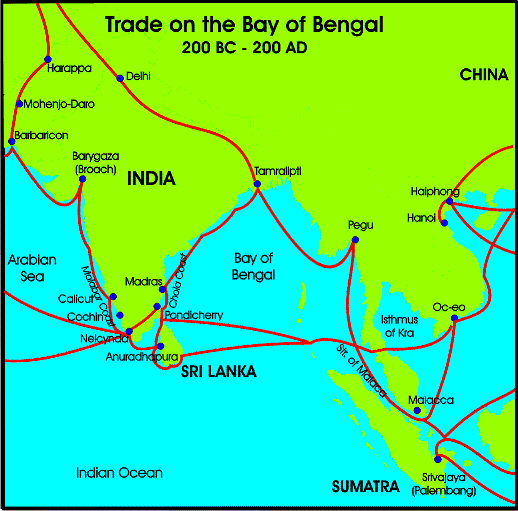
Ancient Lanka: Open and engaged with the world - image courtesy http://nabataea.net
I am neither a historian nor chef, but have a healthy interest in the subject areas of both. The two rarely come together, except when one goes in search of culinary history. I have just written an essay titled ‘Sri Lanka: Spice Island or Bland Nation?’ which blends the two in a social commentary highlighting a challenge we face as we rebuild our island nation after the war.
“Located strategically in the Indian Ocean, Sri Lanka was a hub in the maritime silk and spice routes for millennia. It drew traders from the east and west for both business and pleasure. Notable among the attractions were spices, whose many aromas and flavours formed an integral part of the tropical paradise experience.
“The traditional Lankan curry contained up to 13 spices and herbs. Most plants were not native – cardamom came from South India, cloves from Indonesia and chilli all the way from the Americas. Cinnamon was Sri Lanka’s unique contribution to this delightful mix. The origins didn’t really matter: the islanders knew just how to mix the native and the foreign to achieve legendary results.
“As Sri Lanka embarks on national integration after three decades of highly divisive war, it is worth recalling these aspects of its heritage. For the war not only devastated our economy and blighted the prospects of a generation; it also nurtured high levels of insecurity, insularity and mutual suspicion. In recent years, democratic dissent has become ‘unpatriotic’. Everything foreign is suspect – especially if from the west.
“Suddenly, the spice island is in danger of turning into a ‘bland’ nation with xenophobia the only condiment in use.”
Both versions of the essay end with an ardent plea for a return to pluralistic, cacophonic society we have been for much of our long and well-chronicled history.
“Throughout history, the spice island nurtured plurality without losing its identity or integrity. It withstood numerous invasions, colonialism and tsunamis. Sri Lanka is more resilient than many of its citizens think — and more vibrant and diverse than it appears at first glance. That’s the legacy of good geography and open frontiers.
“Let genes, ideas and spices flow freely again! We have nothing to lose – except our temporary blandness.”
Sri Lanka: Island of suspended dreams has a second chance...
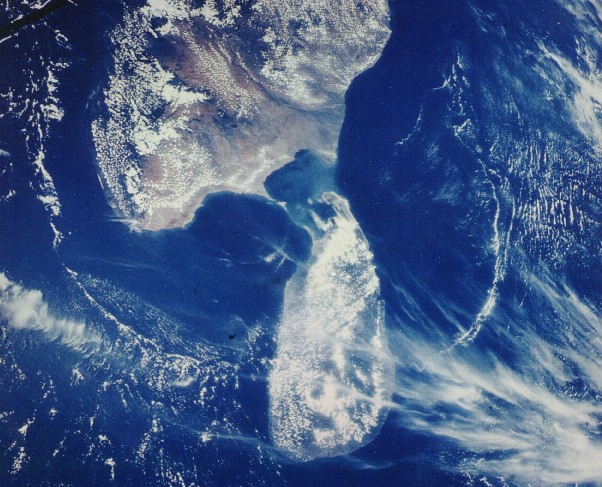
This is one of my favourite images. Showing southern part of India and my native Sri Lanka, it was captured by one of the early US space missions, nearly four decades ago.
Much has happened on the tear-drop shaped island since this image was taken: among other things, we’ve been through a civil war that lasted a generation, and robbed the dreams of at least two generations. That war officially ended on 18 May 2009.
The Day After, on 19 May 2009, I wrote a 1,500-word essay titled Memories of War, Dreams of Peace. The editor of Groundviews, Sri Lanka’s leading citizen journalism website, published it in full, and within minutes of my emailing the text to him.
I look back briefly on the brutal and tragic war – not in anger, but in great sadness. I then look forward in a wistful, dreamy mode. My premise was: “Now that the war is officially over, will this mark the beginning of real peace? I want to believe so. I want to audaciously dream of peace. The alternative is too dreadful to consider.”
This is not exactly what I’ve been trained to do. As a science writer and film-maker, I gather and analyse information, which I try to present in logical, coherent and accessible ways. In recent years, I’ve also been writing op ed essays in areas where I have some competence and experience. In writing this essay, I consciously departed from all that. I’m neither political scientist nor activist to engage in ideological or technocratic discussions, which others have already started in earnest. I wrote this at an emotional level, looking back and looking forward.
But my training did come in handy in framing the timely and necessary questions. My chosen ‘author intro’ for this essay thus reads: “Writer Nalaka Gunawardene has been a dreamer for all his 43 years. He asks more questions than he can answer.”
We've doused the flames of war, but much more needs to be done...If my views come across as naive or idealistic, I shall plead guilty as charged. My emotions this week are best described as cautiously optimistic, but as some readers on Groundviews pointed out in their comments, our high hopes have been betrayed before. But can we afford not to dream privately and publicly at this juncture? I don’t think so. We have suspended our dreams for too long, and it’s time to start dreaming again.
There are as many kinds of dreamers as there are dreams. One of my favourite quotes comes from the British soldier and writer T E Lawrence (of Lawrence of Arabia fame): “All men dream, but not equally…the dreamers of the day are dangerous men, for they may act their dream with open eyes, to make it possible.”
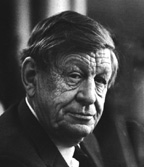
W H Auden (1907 - 1973) It begins in a bar, and ends with a prayer. It was written in another century by a poet on the opposite side of the planet on the day the deadliest war in history broke out.
Almost 70 years later, at the end of my own 30-year-long war, I have been reading and re-reading September 1, 1939. I’m trying to make sense of what is happening around me. The near hysterical mass euphoria on one side, and bewildered dejection on the other.
I was just six when the poet W H Auden died, and only 13 when this bloody, protracted war started. As I wrote in an essay published on the day after the war ended, I have lived all my adult years with this war providing a constantly grim, sometimes highly disruptive backdrop.
I survived the war in its various phases, including uneasy lulls when guns were temporarily silent. I watched most of my own friends join the exodus of genes and talent from a land where they saw no hope or future. I chose to stay on, but questioned the wisdom of it each time a major atrocity took place. I went through six jobs and one marriage, and raised a child who would soon be the same age as I was when the war started.
Are we at the end of the long, dark tunnel? Is the promised land of peace and prosperity now at hand? Have we seen the last of multi-barrel guns, grenade launchers, helicopter gunships, claymore mines and the deadly suicide bombers? Or will national security and anti-terrorism continue to dictate what we can or cannot do as citizens in a free, democratic and finally peaceful country?
I honestly don’t know. Probably it’s too early to tell. But I’m uneasy with celebrations when so much healing and rebuilding need to be done. I’m worried about continuing the simplistic division of people into patriots and traitors. As I wrote earlier this week, this perception of Us and Them is our first landmine on the long road to peace. I don’t know why we as a people continue to insist on everything being in black and white. What happened to the myriad shades of grey?
For some months now, I’ve been turning to classical and modern poems for solace and comfort. When prose fails, verse must take over. Auden himself disliked this poem, but few words in English move me as his line: “We must love one another or die.”
So here it is, the full and original words of September 1, 1939 – for whatever resonance it may offer us across the gulf of seven decades straddling two centuries:
September 1, 1939
I sit in one of the dives
On Fifty-second Street
Uncertain and afraid
As the clever hopes expire
Of a low dishonest decade:
Waves of anger and fear
Circulate over the bright
And darkened lands of the earth,
Obsessing our private lives;
The unmentionable odour of death
Offends the September night.
Accurate scholarship can
Unearth the whole offence
From Luther until now
That has driven a culture mad,
Find what occurred at Linz,
What huge imago made
A psychopathic god:
I and the public know
What all schoolchildren learn,
Those to whom evil is done
Do evil in return.
Exiled Thucydides knew
All that a speech can say
About Democracy,
And what dictators do,
The elderly rubbish they talk
To an apathetic grave;
Analysed all in his book,
The enlightenment driven away,
The habit-forming pain,
Mismanagement and grief:
We must suffer them all again.
Into this neutral air
Where blind skyscrapers use
Their full height to proclaim
The strength of Collective Man,
Each language pours its vain
Competitive excuse:
But who can live for long
In an euphoric dream;
Out of the mirror they stare,
Imperialism’s face
And the international wrong.
Faces along the bar
Cling to their average day:
The lights must never go out,
The music must always play,
All the conventions conspire
To make this fort assume
The furniture of home;
Lest we should see where we are,
Lost in a haunted wood,
Children afraid of the night
Who have never been happy or good.
The windiest militant trash
Important Persons shout
Is not so crude as our wish:
What mad Nijinsky wrote
About Diaghilev
Is true of the normal heart;
For the error bred in the bone
Of each woman and each man
Craves what it cannot have,
Not universal love
But to be loved alone.
From the conservative dark
Into the ethical life
The dense commuters come,
Repeating their morning vow;
“I will be true to the wife,
I’ll concentrate more on my work,”
And helpless governors wake
To resume their compulsory game:
Who can release them now,
Who can reach the deaf,
Who can speak for the dumb?
All I have is a voice
To undo the folded lie,
The romantic lie in the brain
Of the sensual man-in-the-street
And the lie of Authority
Whose buildings grope the sky:
There is no such thing as the State
And no one exists alone;
Hunger allows no choice
To the citizen or the police;
We must love one another or die.
Defenceless under the night
Our world in stupor lies;
Yet, dotted everywhere,
Ironic points of light
Flash out wherever the Just
Exchange their messages:
May I, composed like them
Of Eros and of dust,
Beleaguered by the same
Negation and despair,
Show an affirming flame.
Today, 3 May, is once again World Press Freedom Day. It is recognised by the UN, and observed by media professionals and media activists worldwide to ‘draw attention to the role of independent news and information in society, and how it is under attack’.
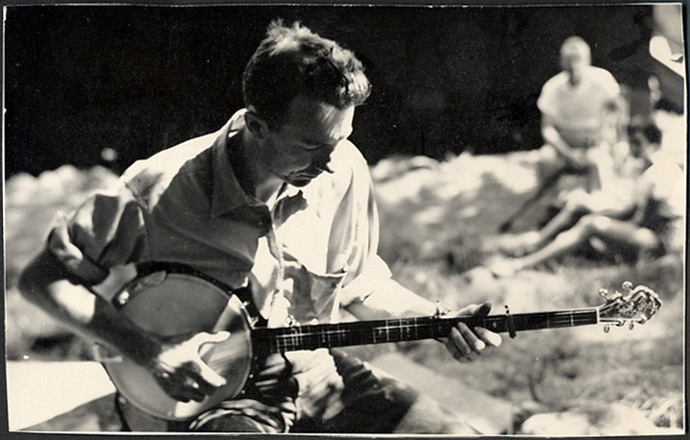
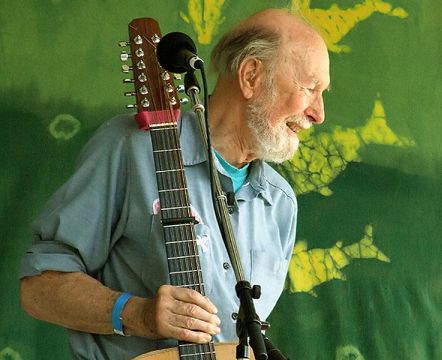
By happy coincidence, today also marks the 90th birthday of Pete Seeger, American folk singer and a pioneer of protest music. Since media freedom is inseparable from the democratic rights to dissent and protest, I will devote this blog post to salute Pete and his many decades of music for worthy causes — ranging from the American civil rights movement and opposing the Vietnam war to saving the environment and nuclear disarmament.
Pete is a hero for at least three generations of music lovers and freedom lovers around the world who believe in human rights, human dignity and democratic freedoms. Armed with nothing more than his banjo and melodious voice, and driven by the courage of his conviction, this small, gentle man has stood up to mighty leaders, generals and officials.
Never underestimate the power of one determined man...Pete is celebrated as much for his artistic and cultural achievements as for standing resolutely for his political beliefs and for lending his voice and music in support of causes be believed in. In 1955, he was called before the now infamous House Un-American Activities Committee, but refused to name personal and political associations on the grounds that this would violate his First Amendment rights. He said: “”I am not going to answer any questions as to my association, my philosophical or religious beliefs or my political beliefs, or how I voted in any election, or any of these private affairs. I think these are very improper questions for any American to be asked, especially under such compulsion as this.”
This defiance resulted in sustained harassment, persecution and professional isolation. As his recent PBS biography noted, “Standing strong for deeply-held beliefs, Seeger went from the top of the pop charts to the top of the blacklist and was banned from American commercial television for more than 17 years. This determined singer/songwriter made his voice heard and encouraged the people of the world to sing out along with him.”
‘If you love your country, you’ll find ways to somehow to speak out, to do what you think is right,” Pete says in this powerful documentary looking back at over half a century of activist singing and music.
Watch opening segment of PBS AMERICAN MASTERS series: Pete Seeger: The Power of Song, directed by Jim Brown and first aired in February 2008
Having pleaded under the First Amendment during the communist witch days of the 1950s, Pete repeatedly paid tribute to the far-sighted American pioneers who introduced the First Amendment guaranteeing the freedom of speech.
“As some judge said, if there is any fixed star in our firmament, that is the First Amendment,” he says in a talk-cum-performance at the Ford Hall Forum. In this audio-only piece, he talks the privilege of living under the First Amendment. He recalls his experience being questioned by the House Unamerican Activities Committee, encounters with censorship, and his relationship with fellow singer Woody Guthrie. It runs for nearly an hour, but is worth every second.
For someone like Pete Seeger who sang alongside Dr Martin Luther King, Jr., and other civil rights movement leaders and activists, it must have been deeply moving to be able to sing at the concert to mark President Barack Obama’s inauguration on 20 January 2009 at the Lincoln Memorial.
Watch Bruce Springsteen sing along with Pete Seeger on Woody Guthrie’s “This Land Is Your Land”. As he often does, Pete invites the euphoric audience to sing along!
One of my favourite Pete Seeger songs is “Turn! Turn! Turn! (to Everything There is a Season)”, often abbreviated to “Turn! Turn! Turn!”. It’s a song adapted entirely from the the Book of Ecclesiastes in the Bible (with the exception of the last line) and composed to music by Pete Seeger in 1959. Seeger waited until 1962 to record it,
Pete Seeger tells how he came to write “Turn Turn Turn.”
I have always believed that we have to get creative and resourceful when the basic freedoms of conscience and freedom of expression are under siege from despotic rulers and fanatical extremists. When we are not allowed to express in factual prose, we must turn to creative prose. And when prose fails, we still have verse, lyrics, satire and drama — the possibilities are only limited by our imagination. This is why I celebrate activist artistes like Pete Seeger, and invoke the memory of activist-poets like Adrian Mitchell and Ken Saro-wiwa. When the barbarians are at our gates and we feel surrounded by the unrelenting forces of hatred, intolerance and tribalism, they remind us that Another World is Possible — but we have to believe in it, stay the course and find ways to sing, dance and laugh our way out of gloom.
And here’s Pete singing another one of my personal favourites, a song that powered the civil rights movement and has since inspired and sustained struggles for social justice around the world: We Shall Overcome.
The power of three...to do good!Just imagine…
You do a favour that really helps someone, and tell him/her not to pay it back…
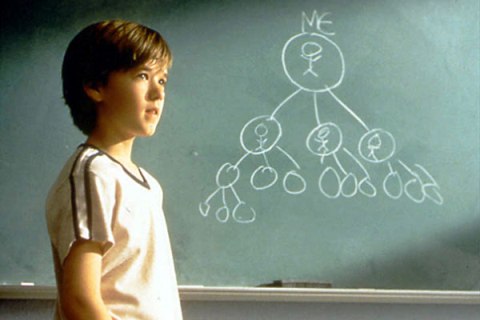
Instead, you ask that it be paid FORWARD to three other people who, in turn, must each pay it forward to three more…and so on.
Impossible? Well, not quite – if you believe (as I do) in the essential goodness of human beings, no matter what their class, race and other divisive factors are.
This idea is known as ‘Pay it forward’. It is really simple: it asks that a good turn be ‘repaid’ by having it done to others instead. Paying it forward has been around as a concept for more than two millennia, from the time of ancient Greece. It was rediscovered in modern times by Benjamin Franklin and later, by Ralph Waldo Emerson, one of my favourite essayists.
In his 1841 essay titled ‘Compensation’, Emerson wrote: “In the order of nature we cannot render benefits to those from whom we receive them, or only seldom. But the benefit we receive must be rendered again, line for line, deed for deed, cent for cent, to somebody.”
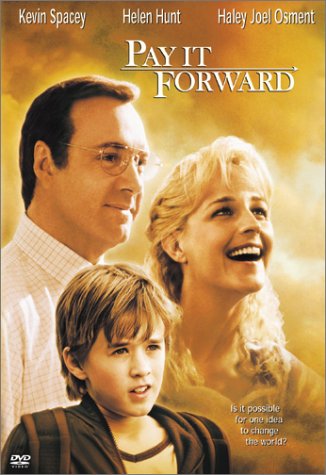
During the Twentieth Century, science fiction author Robert A Heinlein popularised the concept in his book Between Planets (1951). It formed the central theme of Pay It Forward (2000), a novel by Catherine Ryan Hyde, which was soon turned into a movie by the same name.
In that story, a thoughtful teacher challenges his seventh grade students with ‘an assignment to save the world’. One perceptive student devices a scheme where one has to carry out three good deeds for others as repayment of a good deed received. Such good deeds should be things that the beneficiaries cannot accomplish on their own.
It was through Pay It Forward the movie, made in 2000 and directed by Mimi Leder, that I first came cross the idea. It’s one of those simple and elegant ideas that packs so much power to change people and the world. Its implementation requires trust, honour and imagination, which most human beings can muster in sufficient quantity when challenged.
Then I realised that, without a conscious plan and not labelling it as such, I was already ‘paying it forward’ myself — and not just to three new people, but many. That was the least I could do for the many breaks, blessings and opportunities I had received in my professional life.
More about that in a minute. First, take a look at the official trailer for Pay it Forward:
And this is how it all started in the movie, with one thoughtful class teacher challenging his seventh grade pupils with ‘an assignment to save the world’:
Here’s an extended, unofficial trailer remixed by a fan using the official trailer, some scenes from the movie and a few interviews with the key stars:
Journalism – especially the industrialised, mainstream version of it – is by definition a highly collaborative business: newspapers, magazines, as well as TV/radio broadcasts are produced by several or many people working together, each playing a specified part.
And because the media are a mirror on our society and our times, the stories we journalists produce just won’t be possible unless our sources share their information, experiences and insights. This is why Bill Moyers, one of the most respected and credible voices in American broadcasting (a land where such professionals are endangered), says: “We journalists are simply beachcombers on the shores of other people’s knowledge, other people’s experience, and other people’s wisdom. We tell their stories.”
During the early years of my career as a science writer and journalist, I was enormously lucky in both respects. I had kind, indulgent, nurturing senior colleagues who showed me the ropes, expecting nothing in return except good stories. And I benefited much from the kindness and thoughtfulness of many accomplished men and women – mostly in the worlds of science, environment and development – who took the time and trouble to talk to me, clarify even basics to a rookie like myself, and allow me to attribute information or quotes them. I was a complete stranger to many of them, yet they cared enough in spite of busy schedules (there were also a few didn’t, but that’s only to be expected).
Then there were opportunities, some competitively earned, others bestowed on me. In those formative years, the opportunities for training, mentoring and other influences sharpened my skills and shaped my worldview. It was easy to grow up angry with the world and seeing conspiracies everywhere; it was much harder to acquire a balanced view of the world and to become a skeptical enquirer without turning into an incurable cynic.
Among those early influences were:
• Working with the Centre for Science and Environment (CSE) in India, under the late Anil Agarwal and his worthy successor Sunita Narain
• Regional and international training programmes, organised by various UN agencies and other entities such as the Abdus Salam International Centre for Theoretical Physics in Trieste, Italy
• Invaluable support from the International Science Writing Association (ISWA), which leverages far more benefits than its modest resources would indicate at first glance (again, the power of networking!)
• Editorial training and global syndication from Panos, which provided my first outlet to publish internationally through Panos Features (sadly, no more).
Then there was my mentor Sir Arthur C Clarke, who gave me the rare privilege of spending 21 years as his research assistant — a long and unique apprenticeship that enriched me so much.
These and others helped fill gaps in my formal training in science journalism. And such exposure was worth so much more in the days before commercial internet connectivity. There was no Google or YouTube, and early versions of email were just beginning to roll out.
Just do it, and hope others will keep doing it too...And now it’s my turn to ‘pay it forward’. It’s plain and simple; there’s no grand pledge or plan. No one asked me to sign up to any binding agreement. There is no spiritual or intellectual compulsion. I just do it, because that’s a good thing to do.
This is also why I spent a good part of my recent Easter/New Year holidays putting together a detailed response to a young script writer who is passionately promoting a film project related to climate change. I have never met him in person, and until a few weeks ago, I’d never heard of him. A cynical British colleague used to caution me that any crazy nut sitting under a banyan tree can write a letter (or more likely an email these days) claiming to be anything he wasn’t. There’s always that risk. But I’m taking my chances.
Years ago I stopped counting the favours I paid forward, and I no longer even keep track of the people that I give little nudges along the way. Being a secular rationalist with no absolutely religious belief of any kind, I don’t collect brownie points for any ‘next world account’. I just do these little good deeds to make this world a little better place.
If further justification were needed, I cannot say it better than Steven Grellet, a prominent French Quaker missionary who once said (and I quote him for its secular essence): “I expect to pass through this world but once; any good thing therefore that I can do, or any kindness that I can show to any fellow creature, let me do it now; let me not defer or neglect it, for I shall not pass this way again.”
I was run over by the truth one day.
Ever since the accident I’ve walked this way
So stick my legs in plaster
Tell me lies about Vietnam…
With these lines opened the bitterly sarcastic reaction to the televised horrors of the Vietnam War by British poet, playwright and performer Adrian Mitchell.
He first read his best-known poem, called To Whom It May Concern (also known as Tell Me Lies), to thousands of anti-war protesters who flocked into London’s Trafalgar Square on the afternoon of Easter Monday 1964. As Mitchell delivered his lines from the pavement above in front of the National Gallery, angry demonstrators in the square below scuffled with police.
Adrian Mitchell (1932 - 2008)Mitchell, who died on 20 December 2008 aged 76, occasionally updated the poem to take into account the subsequent wars and resulting tragedies in places as far apart as Iraq, Burma, Afghanistan and Israel/Palestine.
“It is about Vietnam, But it is still relevant,” Mitchell said in 2001. “It’s about sitting faithfully in England while thousands of miles away terrible atrocities are being committed in our name.”
As Michael Kustow wrote in an obituary in The Guardian: “Mitchell’s original plays and stage adaptations, performed on mainstream national stages and fringe venues, on boats and in nature, add up to a musical, epic and comic form of theatre, a poet’s drama worthy of Aristophanes and Lorca. Across the spectrum of his prolific output, through wars, oppressions and deceptive victories, he remained a beacon of hope in darkening times. He was a natural pacifist, a playful, deeply serious peacemonger and an instinctive democrat.”
The one time journalist and television critic was fired by The Sunday Times (UK) for reviewing Peter Watkins’ 1965 anti-nuclear TV film The War Game. Its depiction of the impact of Soviet nuclear attack on Britain had caused such dismay within the BBC and British government that the public broadcaster cancelled its scheduled transmission on 6 August 1966 (the 21 anniversary of the Hiroshima attack). It was finally broadcast in 1985, with the corporation stating that “the effect of the film has been judged by the BBC to be too horrifying for the medium of broadcasting”.
But Auntie Beeb and the rest of the Establishment couldn’t stop Mitchell, whose satirical poems continued to demolish myths emanating from the propaganda mills of the military-industrial complex and their allies in the mainstream media.
As Kustow recalled: “To Whom It May Concern, a riveting poem against bombs and cenotaphs and the Vietnam war, with which he stirred a capacity audience in Mike Horovitz’s pioneering Poetry Olympics at the Albert Hall in 1965, has lasted through the too many wars since: a durable counting-rhyme to a rhythm and blues beat.”
Watch Adrian Mitchell recite/sing his poem in 1965 (black and white film):
As Jan Woolf wrote in another tribute: “To watch Adrian Mitchell…prepare his body for a performance of To Whom It May Concern – chin cupped in hand, eyes focused, back tense, ‘I got run over by the truth one day…’ – was to see a great poet steadying himself with all the focus and tension of a warrior. When those blue suede shoes got moving, the poem came alive. He breathed it, lived it, became it. It was as if he were dancing with language to get at the truth.”
Woolf recalls that Mitchell’s reading of Tell Me Lies at a City Hall benefit just before the 2003 invasion of Iraq was electrifying. “Of course, he couldn’t stop that war, but he performed as if he could.”
The 21st century re-mix ends with these words:
“You put your bombers in, you put your conscience out
You take the human being, and you twist it all about
So scrub my skin with women
So chain my tongue with whisky
Stuff my nose with garlic
Coat my eyes with butter
Fill my ears with silver
Stick my legs in plaster
Tell me lies about –
Iraq
Burma
Afghanistan
BAE Systems
Israel
Iran
Tell me lies Mr Bush
Tell me lies Mr Blairbrowncameron
Tell me lies about Vietnam”
For some strange reason that has nothing to do with Adrian Mitchell’s recent departure, these words and the whole poem keep turning in my mind over and over again.




 Open Minds!