NHK: A public broadcaster that cares for its public

NHK is Japan's sole public broadcaster

My regular readers know the disdain with which I hold the so-called public broadcasters in my part of the world. In developing Asia, which lacks sufficient checks and balances to ensure independence of state broadcasters, the only thing ‘public’ about such channels is that they are often a drain on public money collected through taxes. Their service and loyalties are entirely to whichever political party, coalition or military dictator heading the government in office. A few months ago, I described Burmese TV as a good example.

I was delighted, therefore, to visit the headquarters of Japan’s sole public broadcaster NHK this week and find out how exceptional they are in being a public broadcaster that really cares for its funding and viewing public.

Nippon Hōsō Kyōkai has always identified itself to its audiences by the English pronunciation of its initials, NHK. Started as a radio service in 1926, it added television in 1953. Today, NHK runs two terrestrial TV channels, three satellite channels and three radio services – and has started offering more content online and for mobile devices as well. It also has international offerings in TV, radio and web through NHK World.

This massive broadcast operation is financed primarily by a license fee (called ‘receiving fee’ in Japan) paid by each Japanese household that owns a television set. Its TV channels don’t carry any advertising, although the corporation exploits its massive archive and often repurposes its products for commercial gain.

As NHK’s website says, “This (license) system enables the Corporation to maintain independence from any governmental and private organisation, and ensures that the opinions of viewers and listeners are assigned top priority.”

NHK’s license fee system is not unanimously endorsed by the Japanese public, and I later found out that growing numbers of households are declining to pay what currently works out to around US$30 per month (or a dollar a day). This debate has been sustained for several years, with public calls for administrative reform at NHK.

NHK Studio Park entrance

But NHK’s eagerness to engage the public is clearly evident, even to a visitor like myself who spent only an afternoon at NHK’s Studio Park in Shibuya. This is where the corporation’s production facilities are opened to the public every week day from 10 am to 5.30 pm.

NHK Studio Park is a living exhibit – the corporation’s executives and technical staff carry on with their real work amidst (mostly Japanese public) visitors who get to see how TV content is made. Part of the attraction is a museum of TV 55 years of TV broadcasting in Japan.
You're in our bigger picture!
Welcome to NHK: You're in our bigger picture!

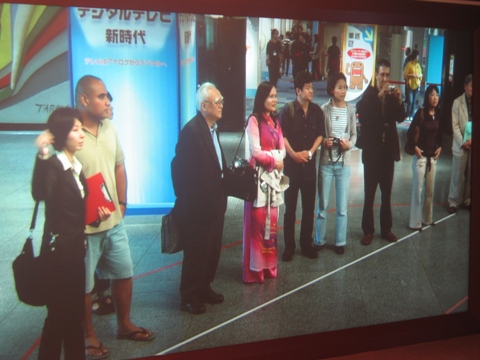
Every visitor is welcomed by being captured by a TV camera with the image being projected live on to a giant screen at the reception. The camera zoomed in on each one in our tour party of ten – and gave us our 10 seconds of fame!

From then on, it offers various displays and interactive opportunities to find out how TV broadcasting has evolved, where it is today – and glimpses of where it is headed. NHK has been an industry leader in technological innovation. It launched digital satellite TV broadcasting in December 2000 and introduced digital terrestrial broadcasts in December 2003. The core technology is Hi-Vision (HDTV), which delivers clear, vivid pictures and CD-quality sound. More than 90% of the programming on NHK is now produced and aired in Hi-Vision.
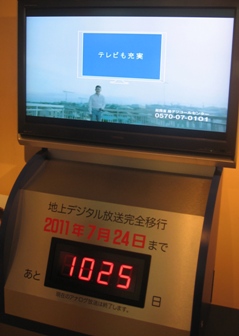
Japan's countdown to analog switch-off

In fact, Japan will be fully switching on to digital and switching off all analog TV transmissions on 24 July 2011. The countdown has already started and on the day I visited NHK (2 October 2008), it was 1,025 days away.

Studio Park makes good use of corridor space for varied displays of photos and archival videos on memorable moments in Japanese and world broadcasting history. Highlights of NHK’s most enduring productions in news, current affairs, culture programming and sports are also shared.

Some of NHK’s cultural and entertainment programmes have been exported successfully to other parts of Asia, offering some counterbalance to the western TV content. One that I recognised was Oshin, a serial drama of 297 episodes made in the early 1980s that has since been aired in close to 60 countries.

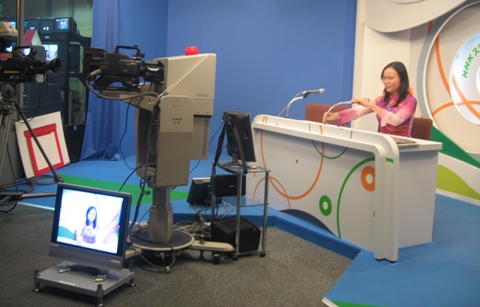
One of Studio Park’s star attractions offers to make a star of any visitor for a few minutes. It’s a newscasting studio where the visitor may sit and face the live camera and read a few lines suggested by the teleprompter – the device that enables news readers to look at their audience while sticking to a flowing text. The teleprompter text is available in Japanese and several other Asian languages.
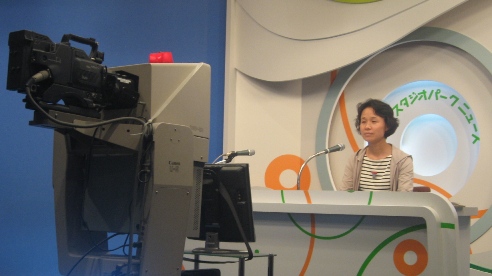
Hu Jincao of China faces NHK camera
Pham Thuy Trang from Vietnam reads NHK news

Two members of our tour party took this news challenge (photos above), and being broadcast professionals, they performed admirably! While it was fun and games for us who are familiar with the medium’s inner working, I can imagine the educational and public relations value of this for people who only consume what television delivers every day and night.

We were also treated to a screening of what was called the world’s first 3D television without special glasses. It was a breathtaking film of about 10 minutes showing underwater scenes. In the dimly lit theatre, the screen felt more like a fish tank – the 3D effect was very real. Not being a techie, I don’t know how to verify the claim of this being a world first, but when this catches on, watching television will never be the same again…

As visitors move in and out of these interesting offerings, it was another day at work for NHK’s staff who carried on with their real productions in studios we passed by. We were allowed to photograph everything except across the viewing glass inside a studio when a recording was underway (lest the camera flashlights disturb it). The freedom to explore and experience, helped by the eternally courteous tour guides, was refreshing.

And what a contrast to many so-called public broadcast stations elsewhere in Asia which are more like battle fortresses with armed guards firmly keeping the public out (I suppose they expect their irate public to attack the stations because of the truly dreadful content they carry?).

Well, at least NHK seems to know who their masters are – the paying public. And as this image in one exhibit shows, NHK is aware of that little gadget in every viewer’s hand that can instantly nullify all the irinvestment, technology and creativity. If wielded for long enough by sufficient numbers, this can put mighty broadcasters out of business.

It’s a message that Asia’s other broadcasters – public and private – would do well to remember.
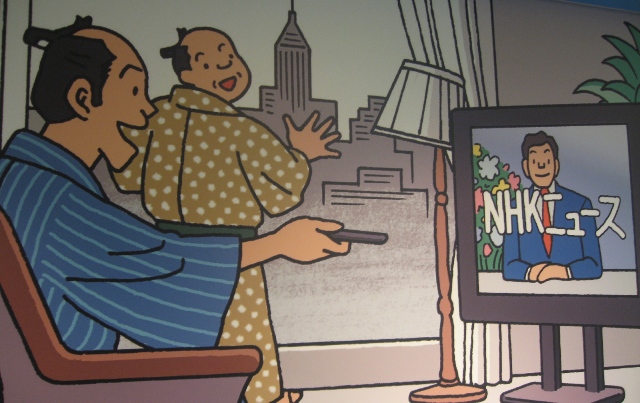
NHK knows who its bosses are...

Note: My visit to Tokyo did not involve NHK funding in any manner. I was the guest of our partner TVE Japan, who paid for our admission tickets to enter NHK Studio Park.

Explore 50 years of NHK Television online

Do you believe everything you see on TV? Some do!

It's easy to be lulled by TV...

“I invested Rs. 2 million (US$ 18,550) of my money after seeing him on TV. I basically believe what I see on the TV and so was misled.”

I read this remark, by a hapless woman victim of an investment scam, in a Sri Lankan newspaper report last week. It got me thinking: where is our media literacy?

Sakvithi Ranasinghe, a populist tutor of English turned millionaire businessman, had just fled the country after duping thousands of unsuspecting people to deposit their life’s savings in his investment firm. Media reports have variously placed the number of victims between 1,500 and 4,000 — and some estimates place the total worth of his loot to be a whopping Rs. Nine billion (over USD 83.5 million).

This local scam may seem insignificant in the current global context when established and well respected banks and financial houses are collapsing one after the other in capitalism’s biggest crisis in decades. But for the several thousand victims, the effects are devastating.

The woman quoted in the news report is not an isolated case. Too many people, it seems, were mesmerised into parting with their money due to a deviously persuasive media campaign. For several years, Sakvithi ran English teaching programmes on Sri Lanka’s national television and other channels. On the guise of teaching English (which he didn’t do very well), Sakvithi manufactured a larger than life image for himself. He also ran regular newspaper advertisements in the highest circulating weekend newspapers. Some were in full colour, occupying an entire broadsheet page. These too reinforced his image as a benevolent, enterprising young Sinhala businessman doing social good.

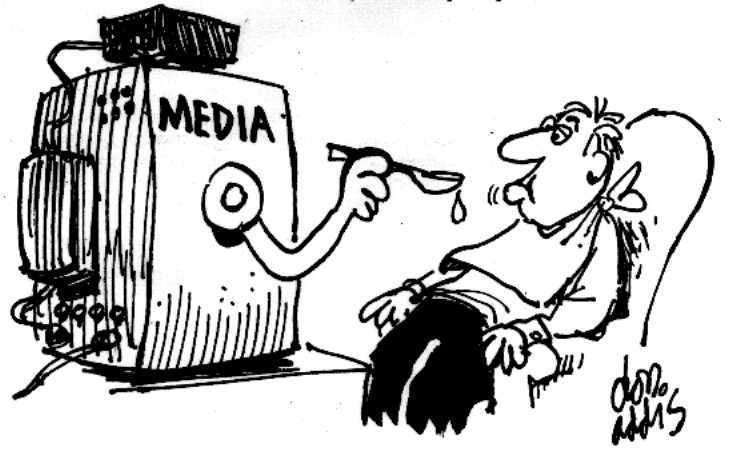
Not everyone, it seems, heeds the common sense advice, ‘Don’t believe everything you read/hear in the media’. Indeed, the Sakvithi scandal once again brings into sharp focus the media’s — especially television’s — perceived role as the great authenticator of our times.

I have just written an op ed essay for the citizen journalism website Groundviews, where I suggest that the mainstream media outlets that repeatedly sold airtime or newspaper space to this man must now share part of the blame for misleading the public. I also argue that besides timely regulatory action and proper law enforcement, we also need greater vigilance by the media, and higher levels of media literacy in everyone to safeguard society from this kind of media manipulation.

Media illiteracy creates this!

Here’s an extract:

“I find it more than a tad ironic that the same media outlets are now peddling the tales of woe of the thousands of men and women tricked by their former, big-time customer. Knowingly or otherwise, these media have amplified the mesmerising tune of this pied piper of Nugegoda who lulled thousands into parting with their money.

“Their journalists would no doubt protest innocence, reminding us of the divide between editorial and advertising operations. And they are right: media practitioners and editorial gatekeepers don’t have much (or any) control over what fills up the commercially sold advertising space. But how many of their readers or viewers can distinguish the difference?

“Most people experience media products as a whole, and lack even the basic media literacy to separate news, commentary and paid commercials. Besides, with the rise of ‘advertorials’ — product promotions neatly dressed up as editorial content — it’s becoming harder to discern which is which.

Read the full essay on Groundviews.

Financial Meltdown: Putting pieces together of a gigantic whodunnit

this says it all...
My cartoon of the year: this says it all...

This cartoon by Pulitzer prize winning Tom Toles first appeared in the Washington Post in 2007 – it brilliantly anticipated the global financial meltdown that we’re now experiencing. Coming in the wake of confirmed global warming, it is a double whammy.

America has been hit hard by the sub-prime crisis. The social and human cost of financial failure has been enormous. An epidemic of home repossessions has left thousands of houses abandoned and boarded-up: whole suburbs are falling into disrepair and dereliction.

Financial institutions in America and in Britain had poured billions into investments backed by these mortgages. As more and more people have defaulted on their mortgage repayments, financial markets have collapsed, causing a crisis that has rippled across the Atlantic, sending the City of London into turmoil and pulling the plug on one now infamous British bank.

Some call it a financial tsunami not been seen since the Great Depression in the 1930s….a crisis that has forced the US government to step in and save the financial system after trillions were wiped off global stock markets and once revered institutions were swept off the face of Wall Street. Is the US intervention too little, too late to save the economy?

In fact, just a few days ago, the People’s Daily of China warned that a “financial tsunami” was approaching, which recalled the Great Depression in the US. It said: “As the contemporary economy has been integrated globally, American consumption and currency exchange rates will directly influence countries dependent on the US as the main export destination for economic growth and employment”.

The Chinese Communist Party organ complained that the US had unleashed financial “weapons of mass destruction” on the world economy in the form of subprime debts and related financial derivatives.

The world’s media have been scrambling to cover these rapidly unfolding events. In fact, many have been caught napping, or worse, been uncritical cheerleaders of the march of capital and credit. Most of them – even the respected financial journals – just didn’t see the crisis building up…or ignored the tell-tale signs that constituted an inconvenient truth.

Danny Schechter - wasnt crying wolf!
Danny Schechter - wasn't crying wolf!
“This didn’t just happen in the course of a usual business cycle,” insists the American investigative journalist and media analyst Danny Schechter, who has been tracking this issues for many months on his influential News Dissector blog and the MediaChannel that watches and critiques the media.

In his new book, aptly titled Plunder, Danny offers an in-depth investigation into the decline of the economy that’s causing millions to lose jobs and face foreclosures and across-the-board price hikes.

He says: “You wouldn’t know it by relying on our media, but the subprime scandal masks massing looting by Wall Street firms using carefully calculated predatory lending schemes enabled by regulators who don’t regulate and a media that looked the other way. We have lost trillions and dislocated millions with no relief in sight. Every American is paying for the greed of our financiers in the grocery store, gas pump and unemployment line. Bank robberies are not new — but banks doing the robbing is.”

Read the introduction to Danny Schechter’s Plunder.

In 2007, his film IN DEBT WE TRUST was the first to expose Wall Street’s connection to subprime loans, predicting the economic crisis that this book investigates.

I have been watching various news media analysis of the current crisis and want to share two that stood out from the rest: Inside Story by Al Jazeera English, and Dispatches by UK’s Channel 4.

In a special show from New York, Inside Story looks at the financial turbulence that rocked the US last week. Will the emergency measures by the US government be enough to stabilise the markets or has the financial system in the US been changed forever? The introductory report from AJE’s Washington correspondent Reynolds is particularly illuminating – he also writes the story for their website.

Inside Story – The US financial crisis – 21 Sep 2008 – Part 1

Inside Story – The US financial crisis – 21 Sep 2008 – Part 2

From the other side of the Atlantic comes a more investigative, one-hour special that was produced and broadcast in March 2008, when the early signs of the banking crisis were beginning to show – for anybody who cared to notice.

As Channel 4 introduces it: “This is a story about the destructive power of finance: what happens when banks are driven by short-termism; when bankers are rewarded with vast bonuses, free to operate under inadequate regulatory supervision, and with the complicity of a government too in awe of big business to step in.”

Dispatches: How The Banks Bet Your Money UK & US – part 1

In this edition of Dispatches, private equity financier Jon Moulton delivers a stinging rebuke to the banks for causing this financial meltdown and explains why the British taxpayer will now pay the price.

Dispatches: How The Banks Bet Your Money UK & US – part 2

Dispatches: How The Banks Bet Your Money UK & US – part 3

Dispatches: How The Banks Bet Your Money UK & US – part 4

Dispatches: How The Banks Bet Your Money UK & US – part 5

Thailand’s people power gets a boost from satellite TV

Street protests in Bangkok - image from DayLife

Thailand, which had built up a reputation as a relatively stable country, has been under siege for much of this year. Confrontations between the coalition government, elected in December 2007, and the anti-government People’s Alliance for Democracy (PAD) have affected civil administration, law enforcement and economy, especially tourism.

On 10 September 2008, Thai prime minister Samak Sundaravej was forced to step down when a court found him guilty of accepting money from a TV station to host a popular cooking show. Bizarre as this reason was for his ouster, it has only added to the confusion that currently dominates Thai life.

Although I have been visiting Thailand regularly for the past 20 years, I don’t claim to understand the murky world of Thai politics. But until recently, Thais had somehow managed to keep their politics and business separate, allowing the latter to continue largely unaffected.


Pro-democracy struggles are not new to Thai people. But this time around, there is a new player involved: Asia Satellite Television (ASTV) a relatively new entrant into Thailand’s TV world which is dominated by commercial TV stations that offer a staple of light talk shows, soap operas and gossip programmes.

ASTV’s programmes, since May 2008, has consisted of speeches beamed from a stage set up at the site of a Bangkok protest rally, led by the PAD.

In early September 2008, around 200 PAD supporters banded together to guard the ASTV station and Manager newspaper offices on Phra Athit road amid rumours Prime Minister Samak Sundaravej was going to take the cable TV channel off the air.

In an interesting news analysis filed from Bangkok, Inter Press Service (IPS) noted on 5 September: “ASTV makes little effort to hide its political mission as the principle broadcaster of the PAD. After all, its founder, Sondhi Limthongkul, a fiery speaker, is one of the PAD’s leaders. His sustained attacks on the government and Thai democracy — that the prevailing elections system does not work, and the country needs a largely appointed parliament — have resonated with the thousands drawn to the PAD rallies after first hearing them on ASTV.”

Much of the PAD’s mass mobilisation has been possible due to ASTV’s reach, which is currently estimated at 20 million viewers. ‘’Our audience has doubled since 2006, when we had 10 million viewers, because we present the political side of the news that is not available on national TV,” the article quoted Chadaporn Lin, managing editor of the station’s English-language channel, as saying.

The Manager owns ASTV
Viewers who cannot access the station through a satellite dish or a provincial cable company turn to the website of ‘Manager,’ the newspaper produced by ASTV’s parent company. The site has seen the number of regular visitors rise and is now placed third among the top 10 Thai-language websites.

Read the full IPS article: THAILAND: Satellite TV Boosts Anti-Gov’t Protests By Marwaan Macan-Markar

To make sense of what’s going on, I turned to Pipope Panitchpakdi, a Thai friend who has worked in the broadcast media industry for many years:

Pipope Panitchpakdi, independent Thai journalist

He says: “It’s just too bad that the ideology behind the ASTV movement is identified by many as right-winged and nationalistic. For me, the movement itself is quite progressive in its post-modernistic use of everything that works to topple the existing government. In a way, it’s going back to the muckraking days of partisan journalism, which may be in need when mainstream media are no longer functioning during Thaksin/Samuk’s administration (with his equally keen media strategist team).”

Pipope adds: “Few mentioned that ASTV is self sponsoring through viewers’ subscriptions. That’s, to me, says a lot about the station. In my opinion what is unacceptable is when NBT (National Broadcasting Television) starts to give air time to government politician to bash the ASTV and to report heavily distorted news on the anti-government movement. They said it is the counter measure to what the ASTV is doing.”

He continues: “NBT, which is a free to air TV, funded by tax money and has a nation wide coverage, now becomes the state propaganda in the true sense of the word and by being such, there is no telling what kind of political fervor the NBT can stir.”

The argument of using NBT to project government view is a familiar one in other fragile or immature democracies across Asia. To understand it, we need to recall how rapidly broadcasting has changed in the past two decades.

In 1990, most Asian viewers had access to an average of 2.4 TV channels, all of them state owned. This has changed dramatically — first with the advent of satellite television over Asia in 1991, and then through the gradual (albeit partial) broadcast liberalisation during the 1990s. Asian audiences, at last freed from the unimaginative, propaganda-laden state channels, exercised their new-found choice and quickly migrated to privately owned, commercially operated channels. Soon, state owned TVs and radios found themselves with ever-shrinking audiences and declining revenue. For the past decade, most have survived only because governments infused them with massive amounts of tax payer money. Their public service remit is long forgotten.

In recent years, some governments have taken the view that since a growing number of private channels provide an outlet to political opposition and other dissenting views, the state channels are justified in peddling the ruling party (or ruling military junta) view – often exclusively. This convenient argument overlooks the fact that Pipope points out: state channels are funded mostly or wholly by tax payer money (as many lack the entrepreneurial skill to compete in a market environment). They have a moral and legal obligation to serve the public interest — and that does not coincide with the ruling party’s or junta’s self interest.

There are some who accuse ASTV of Thailand, and its equivalents such as courageous Geo TV of Pakistan (which stood up to the once mighty, now fallen general Musharaf), of being partisan. Perhaps they are, and in ASTV’s case it unashamedly and openly is. But in my view, they offer a much-needed counter balance to the disgusting excesses of state TV that prostitute the airwaves.

Supinya Klangnarong
Supinya Klangnarong

Supinya Klangnarong, deputy head of the Campaign for Popular Media Reform (CPMR), an independent local group lobbying for media rights, told IPS: “ASTV is offering knowledge and political information and new ideas that have never been seen on Thai TV. They have opened a new space for TV. There is 100 percent media freedom. You can say anything against the elected government and get away.’’

But she warned that while such a media agenda has tapped into an older audience that has felt left out by the dominant trends on the existing commercial stations, where youth is the focus, it is also creating a following that could become increasingly intolerant. “They are creating a culture of hate by the one-sided opinions being broadcast. They are promoting very conservative and very nationalistic ideas.’’

She added: “And if it attracts more people, ASTV may take over the role that has always been played by Thai newspapers of setting the political agenda for the country. That will be a win for those who say that Thailand has become too liberal, open and globalised… like my mother’s generation.’’

PAD protests hold Thai capital under siege - image from DayLife

Vulnerability Exposed: Micro films on how climate change affects YOU!

Vulnerability Exposed!

Never underestimate the power of moving images. Al Gore tipped the balance in the long-drawn climate change debate with his Oscar-winning film, An Inconvenient Truth. The rest is recent history.

Thanks to the film – and sustained advocacy of hundreds of scientists and activists – climate change is no longer a speculative scenario; it’s widely accepted. The challenge now is to understand how it impacts different people in a myriad ways.

Now the World Bank wants people to use their video cameras to capture how climate change may already be affecting their ways of living and working. The Bank’s Social Development Department has just announced the launch of a worldwide documentary competition that will highlight the social aspects of climate change as experienced and/or observed by the film-maker(s).

Called Vulnerability Exposed, the contest is open to anyone anywhere in the world who wishes to have their voice heard. The submitted films should innovatively illustrate the consequences of climate change through one of the following theme categories: conflict, migration, the urban space, rural institutions, drylands, social policy, indigenous peoples, gender, governance, forests, and/or human rights. The submission period ends on 24 October 2008.

Caroline Kende-Robb, Acting Director, Social Development Department, said, “There is a need to see climate change as an issue of global social justice. The rights, interests and needs of those affected by climate change must be acknowledged.”

Watch the Bank’s short video, where she explains further:

The contest has two award categories:
1) Social Dimensions of Climate Change Award (general category) – open to professional and amateur; and
2) Young Voices of Climate Change (youth category) – open to entries submitted by filmmakers under 24 years old.

Award winners will be chosen through a combination of public voting and a judging panel. The film with the most public votes in each theme category will receive honorable mention.

Judging process
Vulnerability Exposed film competition: Judging process

This contest indicates that the World Bank is slowly but surely opening up to the currently untapped communication potential of web 2.0 – the very point I made in a recent op ed essay.

There are several noteworthy aspects in this competition, some more positive than others. I offer this critique in the spirit of improving a commendable initiative.

Three cheers to the bank for accommodating both amateurs and professionals. It’s about time those who don’t video film for a living (some of who are no less talented in the craft) had more opportunities to showcase their products.

It’s good to see the preference for shorter films, in this contest defined between 2 and 5 mins in duration. This certainly resonates with TVE Asia Pacific’s experience with Asian broadcasters, many of who now prefer shorter films. Longer films have their place, of course, but shorter ones are clear favourites of 24/7 news channels and also online.

Most film contests are judged exclusively by an all-powerful jury (I’ve been on several over the years), but here the online public have a chance to vote for their favourite entries. Let’s hope the judges will consider the story telling power of entries as the most important deciding factor. (The examples in the YouTube film given above are misleading – they all seem extracts from expensively made documentaries.)

The big challenge for many aspiring contestants would be to relate climate change to daily realities in their societies. Despite global headlines and the development community’s current frenzy about it, climate change as a phrase and concept still isn’t clearly understood in all its ramifications. If science now knows 100 facts about the murky processes of climate change, the average public knows less than 25 and understands even less. So it will be interesting to see how entries relate the big picture to their individual small pictures.

I’m a bit disappointed that the World Bank is not offering any cash prize to the winners. Instead, “the winners will receive an all expenses paid trip to Washington, DC for a screening of their film and will have the opportunity to attend a series of networking and learning events organized by…the World Bank in December 2008.” This is all useful, but video – even at the low end – is not exactly cheap, and even labour of love creations cost money to make. We are currently running a comparable the Asia Pacific Rice Film Award – which seeks entries no longer than 10 mins on any aspect of rice – and despite being a non-profit, civil society initiative we have a prize of US$ 2,000 to the winner. And we wish we could offer more.

But my biggest concern is the unequal, unfair terms of copyrights found in the small print of the competition rules. This is where the lawyers have done their usual handiwork, and with the usually lopsided results. The World Bank wants all contestants to make absolutely sure that all material used is fully owned by the contestants, or properly licensed. That’s fine. But tucked away on page 7, under section 12 titled Entrant’s permission to the organiser, is a set of conditions which will allow all affiliated institutions of the World Bank group to use the submitted material for not just promoting this contest (a standard clause in most competitions), but for ‘climate change work program of the organiser’.

What this means, in simpler terms, is that without offering a single dollar in prize money, the World Bank is quietly appropriating the unlimited user rights for any and all the submitted material. These are the core materials in the moving images industry, and nothing is more precious to their creators.

I have long advocated a more balanced, equitable and liberal approach to managing copyrights and intellectual property by both the broadcast television industry and development community — especially where public funded creations are concerned. I have nothing but contempt for lawyers and accountants who often determine the copyrights policies in large broadcast and development organisations. They set out terms that may be justified in strict legal terms, but are totally unfair, unjust and, in the end, counterproductive to the development cause and process. It seems that while our friends in the social and communication divisions were not looking, the Bank’s lawyers have done their standard hatchet job.

While this doesn’t detract from the overall value of Vulnerability Exposed, it diminishes its appeal and potential. Many professional video film-makers who value their footage – gathered with much trouble and expense – may not want to sign future user rights away for simply entering this contest. And worse, the unsuspecting enthusiasts who don’t necessarily earn their living from making films – but are entitled to the same fair treatment of their creations – would be giving away material whose industrial value they may not even fully appreciate.

It’s certainly necessary and relevant for development organisations like the World Bank and the UN system to engage web 2.0. But they must be careful not to import or impose rigid, one-sided and outdated copyright regimes of the past on this new media.

I hope the Bank would consider revising these unfair copyright terms, and treat the submitted material with greater discretion and respect. If not, all entrants risk seeing their material popping out of bluechip films produced by top-dollar production companies in North America and Europe who have ‘mining rights’ to the Bank’s video archives.

Vulnerability Exposed can have more meanings than one. We’d rather not consider some.

Olympics on TV: How the World is One

When Lopez Lomong led the US team into the opening ceremony of Beijing 2008 Olympics as its flag-bearer, he was completing a journey that started eight years earlier, on another continent. And under very different circumstances.

In September 2000, as a Sudanese refugee, he walked eight kilometers from a refugee camp in Kenya, and paid five Kenyan shillings, to watch the Sydney Olympics on a black and white television. There, he saw Michael Johnson win the gold medal in the 400 meters, and that gave him a dream.

Until then, he’d not even heard of the Olympics. From then onwards, he wanted to be an Olympic runner. In Beijing, he is competing as a 1,500-meter track runner. Just as important, he is a leading member of Team Darfur, an international coalition of athletes committed to raising awareness about and bringing an end to the genocide in Darfur, Sudan.

According to his website, at age 6 he was abducted from a Sudanese church by a militia faction that wanted to turn young boys into child soldiers. He eventually escaped the militia camp through a hole in a fence with three older boys who carried them on their backs as they walked for three days until they reached Kenya, where police arrested them and sent them to a refugee camp. He spent 10 years in the camp, living on one meal a day.

Read Lopez Lomong biography on his website

Read New York Times profile of Lopez Lomong, 2 July 2008

Through a combination of persistence, determination and luck, Lopez came to the United States through the help of Christian charities. There, he could pursue his dream – he became a naturalised citizen only about a year before the Beijing Olympics.

“I come here to inspire kids who are out there watching this Olympics, as I did watching the Sydney Olympics,” Lopez told the media in Beijing. “All the countries and all the nations are out there watching. I’m very honored to be here and I am very honored to lead the American team into the opening ceremony.”

Indeed, the summer Olympics have become one of the most widely watched events in the world. An estimated four billion people worldwide watched the Beijing Olympics opening ceremony on 8 August 2008. (Even if two complete spoilsports – Russia and Georgia – started a little war that very day, many news media outlets didn’t pay them much attention until the Beijing opening ceremony was over.)

And for the first time, that viewing was not confined to television alone: a small but growing number followed the event online, heralding the arrival of another distribution medium for this global event.

Olympic broadcasts go back to nearly half a century, when the 1960 Rome games became the first to be covered live on television. Olympic games have enjoyed a mutually beneficial relationship with television, with the medium popularizing the event to the point that the global audience is now counted in billions of viewers.

As I have commented in another blog post, this close relationship between the Olympics and television does have its downside. The medium’s showbiz driven demands for style over substance can and do sometimes distort reality and even threaten the integrity of the Olympics movement as a sporting event.

The International Olympics Committee (IOC) tries hard to strike a balance between revenue optimisation and safeguarding the Olympics ideals. This is why, for example, the IOC has often declined higher fee offers for broadcast on a pay-per-view basis or because a broadcaster could reach only a limited part of the population, as this is against Olympic Broadcast Policy.

As the IOC explains on its website: “This fundamental IOC Policy, set forth in the Olympic Charter, ensures the maximum presentation of the Olympic Games by broadcasters around the world to everyone who has access to television. Rights are only sold to broadcasters who can guarantee the broadest coverage throughout their respective countries.”

This is extremely important. It’s impossible to put a dollor or Euro figure to the inspirational value of television (and now online) coverage of the Olympics. For the couple of weeks that the summer Olympics are held, moving images from the host city captivate the world’s eyeballs in a way that few other events can.

Among the Beijing 2008’s billions of viewers might well be the next Lopez Lomong. We have no way of knowing that yet…but if not for the worldwide broadcasts and webcasts, the global event in Beijing will not be shared by most members of the Global Family.

Read more about Olympics and television

Blog post on 13 Aug 2008: Beijing 2008: So what’s a little fake for a cuter Olympics?

Blog post on 8 Aug 2008: Olympics 2008 Campaign: The Best of Us

Beijing 2008: So what’s a little fake for a cuter Olympics?

The world saw Lin Miaoke, right, sing at the Beijing Olympics opening ceremony - but actually heard the voice of Yang Peiyi, left.

So now it’s confirmed: the spectacular Beijing Olympics opening ceremony – watched live on television by over a billion people worldwide – had been a little more than what it seemed.

What we saw was not what we actually heard. It turns out that the little girl in a red dress, who sang “Ode to the Motherland” as China’s flag was paraded into Beijing’s National Stadium, wasn’t really singing. Clever stage management and sound mixing just made us believe she was.

Beijing games organisers have confirmed that Lin Miaoke, aged 9, whom we saw on TV, was lip-syncing to the sound of another girl, 7-year-old Yang Peiyi, who was only heard but not seen — all because she was deemed not “cute enough”. And they just forgot to tell us there were two…

To refresh memories, here’s that moment from 8 August 2008, as captured by China’s national broadcaster CCTV:

Since the story broke a couple of days later, it has been covered very widely in print, broadcast and online media. There has been particularly good coverage in the New York Times.

An extract from that story:

“The Chinese government has taken great pains to present the best possible image to the outside world during the Olympics, and perfection was the goal for the dazzling opening ceremonies. The filmmaker Zhang Yimou, who oversaw the production, has earned international praise for staging a performance that many considered one of the most spectacular in Olympic history.

“But to achieve the spectacular, not only did organizers fake the song, but they also have acknowledged that one early sequence of the stunning fireworks shown to television viewers actually included digitally enhanced computer graphics used for ‘theatrical effect.'”

And here’s how CNN covered the news of the fake incident on 12 August 2008:

The blogosphere is teeming with discussions on this — and not just in English. It sure raises a number of concerns.

The Olympic motto is made up of three Latin words: “Citius, Altius, Fortius”, which mean “Faster, Higher, Stronger”. At the rate things are moving — with media images taking precedence over accomplishment — we might soon find ‘cuter’ being annexed to it. (Somebody please find the right Latin word.)

But let’s face it: this is not the first time that the world’s greatest festival has been carefully stage-crafted for the benefit of broadcast television, nor will it be the last. The pressure on host nations is immense to show their best face to the world. Perhaps our Chinese friends took that literally, and opted to showcase the supposedly cuter Lin Miaoke to the billion plus audience. (Apparently, a party official deemed that the face of little Miss Yang Peiyi wasn’t good enough – both look perfectly adorable to me…)

Not for a moment do I condone the trickery that Beijing tried to get away with. At the same time, let this be seen as part of a growing, disturbing trend: the broadcast television ‘tail’ has been wagging the Olympics dog for quite some time.

Since the summer Olympics were first commercially broadcast in Rome in 1960, both television’s technology and industry have advanced leaps and bounds. Today, broadcast rights are a very significant source of income for the International Olympic Committee (IOC), and the host countries/cities.

As the IOC official website says: “Increases in broadcast revenue over the past two decades have provided the Olympic Movement and sport with an unprecedented financial base.” And according to the most recent data available, theat revenue accounts for a little over half of all the income that Olympic marketing generates.

That’s all well and good — much of competitive sport today relies so heavily on corporate sponsorships, and television rights are a key part of sports financing.

However, we must worry when so much time, effort, creativity and money is being invested in staging ever more spectacular opening (and to a lesser extent, closing) ceremonies. Yes, it’s a time for the world to celebrate the best and the brightest of the Global Family. And there’s absolutely no harm in having a gala party. But should that extend to rolling out all the tricks of showbiz and make belief? With such a massive global audience following the games not just on television but now also online, where do the IOC and hosts draw the line?

As the world becomes more and more media saturated, these pressures are only set to increase. This year, for the first time, the IOC also allowed online video platform YouTube (owned by Google) to carry about three hours a day of exclusive content — summaries and highlights — from Olympic Broadcasting Services on a dedicated channel.

Let’s not kid ourselves: the world of broadcast television distorts reality on a daily basis. This is an industry that prefers and promotes those whom it considers more cute, pretty, good-looking and sexy. It makes no secret of choosing style over substance. And not just in pure entertainment, but in ALL areas of coverage, including news and current affairs. I have been pointing out how this also affects the coverage of issues like poverty, disasters and development. Even in such serious, factual coverage, many television producers would go with faces that they think are tele-genic, cute or at least particularly pathetic-looking…

Television audiences, by and large, have come to terms with all these ‘adjustments and improvements’ to the murky, messy and unruly real world (yes, some pockets of resistance are fighting a brave vanguard battle, but their numbers are no match for the uncritical couch potatoes).

The challenge is when the real world of Olympic sports tries to mix with the make-belief world of broadcast television to reach out to all those billions of eyeballs. Whose values, standards and rules would then apply?

While the IOC jealously guards time-cherished Olympic principles, it has been slow to modernise and keep up with the times. It must find ways to balance the Olympics integrity with media’s obsession for manufactured reality and feel-good, look-great extravaganzas. And if IOC thinks manging broadcast rights is tricky, just wait till they have to deal with the more bewildering and multitudinous online and mobile media platforms…

What happened in Beijing once again rekindles a long simmering debate. It goes much deeper than an overzealous host nation trying to picture-perfect its proud moment. It takes us right to the heart of the Olympics, and tests if the founding ideals can survive the corporate media realities of the twenty first century.

Olympics 2008 campaign: The Best of Us

It’s finally here. The calendar shows 08.08.08 — the date the Chinese hosts selected to open the 29th Olympic Games in Beijing.

All eyes and ears will turn to the opening ceremony and subsequent events in the Chinese capital for the next two weeks. We will be looking forward to the best of us competing for the noblest of ideals in the spirit of excellence, friendship and goodwill.

The build-up to the Beijing Olympics has seen a large number of television commercials and public service announcements (PSAs) using the Olympic theme. Some of them are quite clever, bringing out the best creativity of those who create moving image treats. Today, we feature one such campaign.

For the past year, the International Olympic Committee (IOC) has been running a global promotional campaign, titled “The Best of Us”. Its aim was to communicate the key Olympic values of Excellence, Friendship and Respect to a global youth audience.

The theme of “The Best of Us” is a simple, powerful idea that transcends cultures and borders, motivating young people around the world to participate in sport by proving that sport can bring out their best.

The campaign was developed by the Voluntarily United Group of Creative Agencies (United), part of WPP. This first phase of creative development was led by Sra Rushmore/United, Madrid. The two PSAs are accompanied by a viral video as well as print and digital media items.

Here are the two PSAs:

Teens (above): The “Teens” television advert communicates that being an athlete can help teens overcome their insecurities – either real or those imposed by their peers. It aims to demonstrate how sport can play an important role in boosting young people’s confidence. The film features young athletes from across the world, including Armenia, Belgium, Brazil, China, Egypt, Germany, Ghana, India, Israel, Japan, Mexico, Russia and the United States.

Heroes (above): Legendary Olympic athletes including Roger Federer, Yao Ming, Laure Manaudou, Liu Xiang and Yelena Isinbayeva are among the stars of the International Olympic Committee’s public service announcement entitled “Heroes”. “Heroes” leverages the determination and performance of Olympic athletes to communicate the key Olympic values. The campaign also stars Kenenisa Bekele, Haile Gebrselelassie, Vanessa Ferrari and Carolina Kluft who, along with those mentioned above, star as superheroes seeking to achieve the seemingly impossible.

And finally, here are two of the seven print media posters that made up the Best of Us campaign:

More about the Best of Us campaign on IOC website

Beyond Babu SAARC: Liberating airwaves for South Asians

“Watching the current SAARC jamboree unfold over television news, my young daughter asked why none of the officials were smiling. The SAARC Secretary General, Dr. Sheel Khant Sharma, was always scowling. Others didn’t have smiles on their faces either, even insincere ones. They all looked stressed out, wearing glum, miserable faces.

“I could only hazard a guess. Perhaps the assorted babus have too much to worry about, as they get through their very serious and grim business of fostering regional cooperation. On the other hand, after all these years of endless meetings and declarations, they might have forgotten the simple joys of smiling and enjoying each other’s company.”

With these words I open my latest op ed essay, just published on the Sri Lankan citizen journalism website Groundviews.

Anti-people, Pro-Babu SAARC in Colombo

The essay is my personal response to the meetings of the South Asian Association for Regional Cooperation or SAARC, taking place in my home city of Colombo this week. Assorted babus (a derogatory South Asian term for pompous officials) from all over South Asia have invaded the city, displacing its people and severely disrupting normal life and work.

And all for what? So that the unsmiling babus can congratulate each other on how little they have accomplished since the last such gathering in New Delhi in April 2007!

As I note in my essay: Make no mistake: SAARC is a good idea hijacked by unimaginative and pompous, unsmiling babus of South Asia and run to the ground. The self-congratulatory rhetoric of the inter-governmental merry-go-round is once again deafening us as the 15th SAARC takes place in Colombo. In reality, SAARC at 23 has the mental development of a 3-year-old (if that). There isn’t, in fact, much to smile about.

The SAARC Sec Gen is always scowling, with never a smile on his face...

I go on to note:
The proof of the SAARC pudding is not in over-hyped Summits or crusty declarations, but in the free flow of people, ideas, creativity and culture across the political boundaries jealously guarded by governments and their militaries. Most SAARC initiatives miserably fail this test. Typical of this arrested development is the SAARC Audio-Visual Exchange, SAVE.

The rest of my essay is a critique of SAVE, and how it has failed to foster greater regional understanding among the people of South Asia through the airwaves. This is because SAVE brought together only the state-owned radio and television stations of South Asia which are no more than propaganda organs for ruling parties and/or militaries that are running our countries.

I go on to cheer the recent initiative called TV South Asia, a collaboration involving 5 private TV broadcasters in South Asia. Without any of the pomposity of SAVE or SAARC, TV South Asia is quietly doing what SAVE has failed for nearly a quarter of a century.

The essay builds on my 6 July 2008 blog post TV South Asia: Nothing official about it, yipee!

Read my full op ed essay on Groundviews

More unsmiling SAARC babus - they certainly dont speak for me!
More unsmiling SAARC babus - they certainly don't speak for me!
Never a smile on their faces!
Foreign secretaries of SAARC: Never a smile on their faces!

All images courtesy Daily News, Sri Lanka

Calling Hydrocarbons Anonymous: Admitting my oil addiction…

Living with climate change
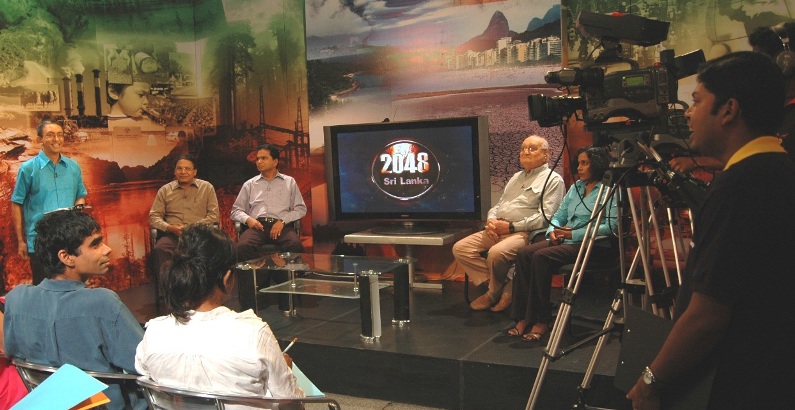
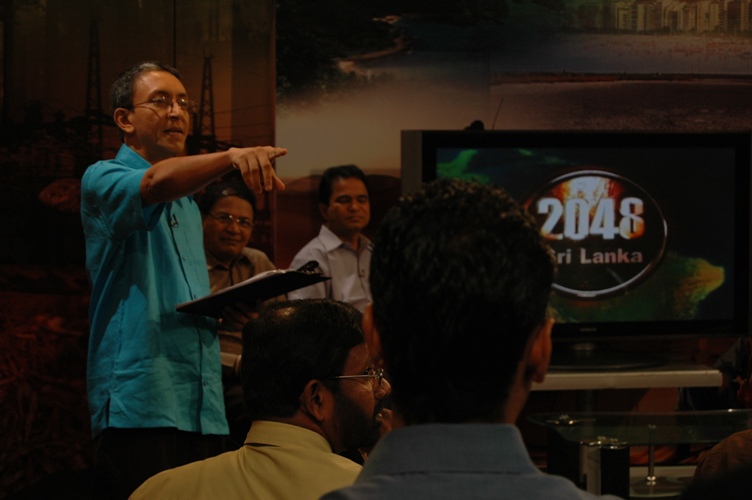
On the set of Sri Lanka 2048: Living with climate change

I have finally done it…and not a moment too soon!

There I was, moderating an hour-long TV debate on Saturday evening prime time television on Sri Lanka’s premier English language Channel One MTV. Our topic for this edition of Sri Lanka 2048 was living with climate change. After exploring its many facets, I was beginning to wind up.

But not before underlining the need for us to take personal responsibility for changing our lifestyles whose cumulative impact on the planet is significant.

The philosophical and political debates over climate change will continue for a long time, I said. Meanwhile, we have to live with climate change impacts that are already happening…and change how we use energy and resources so that we don’t make matters any worse.

This means we must consume less, share more, live simply and pursue smart solutions through green technologies. Of course, at the basis of all this is finding meaningful, practical ways of kicking our addiction to oil.

That’s when I put my hand up and admitted, on air, my own substance addiction: I am hooked on hydrocarbons, a.k.a. petroleum. I’m struggling to break free from it, but it’s not easy.

Of course, my individual addiction pales into insignificance when we look at how entire industries, sectors and countries are addicted to oil and stubbornly insist on continuing the status quo. But we must be the change we seek, so it’s never too late for me to work on my oil problem. When enough of us individuals do, countries and economies will follow.

But people with addictions often need expert guidance, as well as to keep the company of fellow addicts who are similarly trying to kick the habit. That’s why those having drinking problems find help in Alcoholics Anonymous.

We oil addicts could do with some organised help — environmental activist groups, please note. And Sir Arthur C Clarke has already suggested the perfect name for such a movement: Hydrocarbons Anonymous. Read his 2004 essay on Hydrocarbons Anonymous.

* * * * *

Race Against Time
Nalaka Gunawardene moderates Sri Lanka 2048: Race Against Time

Here’s what the promotional blurb for last weekend’s show said:

Sri Lanka 2048 looks at living with climate change: how challenges can become opportunities

Climate change is no longer a theory; it’s already happening. What awaits Sri Lanka – and how best can we adapt to live with extreme weather events, disrupted rainfall, sea level rise and other projected impacts? How can Sri Lanka play a meaningful role in mitigating further damage to the world’s climate?

These and related questions will be raised in this week’s Sri Lanka 2048, the series of TV debates exploring Sri Lanka’s prospects for a sustainable future in the Twenty First Century. The one-hour debate, in English, will be shown on Channel One MTV from 8 to 9 pm on Saturday, 26 July 2008.

Titled Race Against Time, this week’s debate brings together concerned Sri Lankans from academic, corporate, civil society and government backgrounds to discuss the many challenges of living with climate change. The debate looks at aspects such as promoting renewable energy to reduce our carbon emissions, and emerging opportunities for individuals, communities and businesses to adopt low carbon lifestyles and practices.

This week’s panel comprises: Dr. W. L. Sumathipala Director, National Ozone Unit, Ministry of Environment & Natural Resources; Dr. Suren Batagoda, CEO, Sri Lanka Carbon Fund; Dr Ray Wijewardene, Eminent engineer and specialist in renewable energies; and Darshani de Silva, Environmental Specialist, World Bank Office in Colombo. The debate is moderated by TVE Asia Pacific’s Director Nalaka Gunawardene.

The debate also seeks answers to questions such as: What niche can Sri Lanka occupy in the fast-growing global carbon market? How much money can we make from this market? What is the role of the recently established Sri Lanka Carbon Fund? Is the Clean Development Mechanism the right way forward?

The debate concludes with the recognition that climate Change is not just an environmental concern, but also has economic, social, political and security implications. While the philosophical and political debates over climate change will continue for a long time, everyone has to learn fast to live with it. This calls for consuming less, sharing more, living simply and pursuing smart solutions that reduce carbon emissions without compromising the quality of living.

Sri Lanka 2048 debates are co-produced by TVE Asia Pacific, an educational media foundation, and IUCN, the International Union for Conservation of Nature, in partnership with MTV Channel (Private) Limited. This editorially independent TV series is supported under the Raising Environmental Consciousness in Society (RECS) project, sponsored by the Government of the Netherlands.

Sri Lanka 2048
Sri Lanka 2048

Photos by Amal Samaraweera, TVE Asia Pacific