The irony of the Climate Nobel: With love from oil-rich Norway…

The announcement from Oslo on 12 October held few surprises: the Nobel Peace Prize 2007 has been awarded to climate champion Al Gore and the UN’s IPCC, headed by Indian scientist Dr Rajendra Pachauri.

The selection committee, appointed by the Norwegian Parliament acting on the will of the late Alfred Nobel, said it wanted to bring into sharper focus the “increased danger of violent conflicts and wars, within and between states” posed by climate change.

Mr Gore, 59, was praised as “probably the single individual who has done most to create greater worldwide understanding of the measures that need to be adopted”, through his lectures, films and books.

The UN-IPCC (Intergovernmental Panel on Climate Change), established in 1988, is tasked with providing policymakers with neutral summaries of the latest expertise on climate change. The organisation involves hundreds of scientists working to collate and evaluate the work of thousands more.

In recent years, the usually secretive and conservative Nobel Peace Committee has been increasingly in tune with the changing realities of our world. Recent prizes to environmental activist Wangari Mathaai and microcredit champion Muhammad Yunus indicate that their traditional definition of peace and security – confined for nearly a century to peace-makers and humanitarian agencies – is being widened.

But the irony of the climate Nobel won’t be lost on the long-time champions of climate change action. Here we have oil-rich Norway, sometimes called the Kuwait of Europe, presenting the world’s best known award to an individual and organisation calling for the planet to kick its addiction to oil (and coal, too).

Notwithstanding all that, we join everyone in saluting Al Gore, Pachauri and everyone associated with the IPCC for their years of hard work in bringing climate change to the fore.

The real hard work is only just beginning.

Watch Al Gore press conference following the Nobel announcement:

Read blog post on Oct 21: Al and Pachy Show: Climate Change gains public momentum

Oz challenge to Japanese whaling – on YouTube!

Who said YouTube is only for activists and video enthusiasts to share their content?

The above appeal is by Australia’s Environment Minister Malcolm Turnbull, who’s using the popular new media platform to reach out to children and young adults in Japan in a campaign aimed at stopping Japan’s stubborn insistence on whaling.

The Australian Department of Environment has taken out a YouTube channel where this and several other videos are on offer.

This is very encouraging – to see a government putting aside diplomatic niceties and taking a campaign right to the heart of a society that is still culturally attached to whale meat. For sure, Australia is also active in inter-governmental negotiations to sustain the global ban on whaling, but addressing the issue from the demand side and future generation angle can make the anti-whaling positions stronger.

Here’s how Reuters reported the story this week:

CANBERRA, Oct 9 (Reuters) – Australia has taken its battle against Japanese whaling in the Antarctic to the Internet, with a new YouTube campaign unveiled on Tuesday that targets Japanese children.

“Can you imagine what life on Earth would be like without these magnificent creatures? Hundreds of years of whaling have nearly wiped them out,” Australia’s Environment Minister Malcolm Turnbull says in the video, subtitled in Japanese.

Japan plans for the first time to hunt 50 humpback whales in the Antarctic over the coming summer, with the endangered animals currently migrating south along the Australian coast. Japan also plans to hunt 935 minke whales for scientific research.

The Japanese whaling fleet, hampered by a fire on the factory processing ship Nisshin Maru last February which killed one crewman, was recently bolstered by the addition of a new chaser vessel.

Australia’s government, facing re-election in weeks, has dismissed as futile the opposition’s calls for legal action over Japanese whaling in Australia’s Antarctic Whale Sanctuary, which is not recognised by other nations.

Japan’s fisheries agency, confident its whaling rights will be confirmed, has challenged any country to take it to the International Court of Justice in The Hague

Turnbull said Canberra would fight in the court of public opinion.

Read the full story on Reuters AlertNet

Greenpeace anti-whaling website

Here’s an animated anti-whaling TV commercial I came across on YouTube that takes a different look at the same issue. It was produced by Saachi & Saachi Poland:

Taking it personally: Anita Roddick’s Arabian Nights

“I am overwhelmed by the potential of the web to link like-minded people and move them to mass-action,” the late Anita Roddick once wrote. “We are excited to experiment in other media too — perhaps subversive billboards, or a television program, or other print projects. As someone once said, we are only limited by our imaginations.”

In my personal tribute to Anita, written shortly after her untimely death on 10 September 2007, I touched on her extraordinary skills as an activist-communicator. It was in connection with a global television series that I last met Anita in person.

In the summer of 2003, I was invited to join a small group of people at Anita’s country home, Highfield House, in Arundel, Somerset, England. It was a one-day brainstorming on the future of Hands On, a global TV series that she’d been hosting for three years.

Hands On stood out as a beacon of hope amidst so much doom and gloom on television -– it featured environmentally-friendly technologies, business ideas and processes that have been tried out by someone, somewhere on the planet.

It covered a broad range of topics, from renewable energies, waste management and information technology to food processing and transport. The aim was to showcase good news and best practices so they could inspire others — entrepreneurs, communities or even governments — to try these out.

The series was first broadcast on BBC World and was redistributed to dozens of TV channels worldwide through my own organisation, TVE Asia Pacific, and others. It was backed by the reputed development agency Intermediate Technology (now called Practical Action).

Watch a typical Anita introduction of Hands On and a sample story in capsule form:

Anita brought her usual passion and dynamism to our discussion, energising the development and communications professionals enjoying her hospitality. Covering good news was already going against the media’s grain, but it was harder to keep at it year after year, especially when the media landscape was changing rapidly. It was a challenge to stay engaged and relevant to viewers across Africa, Asia Pacific, Latin America and Europe.

During the meeting, Anita asked me to sum up the World Summit on the Information Society (WSIS) which was coming up in a few months. Putting aside all the ‘developmentspeak’ of UN agencies, I described it as an attempt to put new information and communication technologies (ICTs) to work for the poor and disadvantaged of our world. Or get the geek tools to work for the meek. (I still think my phrase ‘Geek2Meek’ sounds better than the official ICT4D, where D stands for development.)

We agreed that civil society had to seize the opportunities offered by these new media tools. (A few months later, Anita presented two Hands On editions called ‘Communicating for Change’ on BBC World that profiled some initiatives doing just this.)

Always fond of analogies, I likened Hands On to Arabian Nights, which, according to legend, a young woman had spun from her rich imagination for 1,001 nights to save her life from an evil king. In Hands On, I suggested, we are telling stories to save not one life, but all life on Earth.

Read my July 2007 post: Telling stories to save ourselves…and the planet

Anita quite liked my analogy. She was always a good story teller, and had so many good stories to tell (A favourite opening line from her biography, Body and Soul: “There I was, with my panty down to my knees.” You’ll never guess why until you read that story…)

She challenged everyone at that meeting to make Hands On more interesting to younger viewers in different cultures. We recognised that offering one media product to a global audience was a tough sell: most people prefer a home-made, local story.

But then, she’d built the entire Body Shop chain with a largely common product offering, even if raw materials were sourced from different parts of the globe. She never imposed the Body Shop experience on our meeting, but it was sometimes instructive to look at how a globally available product could still be localised.

hands-on-in-asia.jpg hands-on-in-asia.jpg

This is just what we did in the months and years following the Arundel brainstorming. We rolled out the ‘Localising Hands On in Asia’ project, which saw several dozen Hands On stories being versioned into local languages and distributed through broadcast and narrowcast means in Cambodia, India, Laos and Nepal. The two-year project, generously supported by Toyota, was hugely successful in delivering the Hands On stories to millions of people who would never have been exposed to it in original English.

We were thrilled when our localising work inspired similar local TV shows in three countries (Cambodia, Nepal and Laos). Yet it was the narrowcast outreach that was more rewarding.

Read about one narrowcast experience in my April 2007 blog post: Anita Roddick, Angkor Wat and the development pill

Coming soon: Who killed Hands On, one of the most successful multimedia initiatives in recent years to communicate development?

Shimu: Bangladesh’s real life ‘Meena’ enthralls millions on TV

Meena’s uncle has arranged for his daughter Rita to marry Babu, a shopkeeper’s son. But Rita is only 15 and has not yet finished school. With Meena’s help, it comes to light that Babu, who is studying to be a doctor, does not want to get married yet, especially since he knows it is unsafe for young girls to become mothers. To everyone’s satisfaction, the marriage is postponed until Rita is 18 and has completed her education.

That’s the storyline in Meena: Too Young to Marry, which is part of the hugely successful cartoon animation series Meena, which Unicef produced with leading animation houses in South Asia during the 1990s. It was part of the Meena Communication Initiative.

Its central character is Meena: a spirited, nine-year-old girl, living in a typical South Asian village, facing all the usual challenges of growing up — whether in her efforts to go to school, or having enough to eat, or in fighting the stigma surrounding HIV/AIDS in her village. In a sub-region where many families still favour boys over girls, life is not easy for Meena, but she finds ways to not just cope but flourish.

Now comes the news of a real life Meena in Bangladesh.

Shimu - photo courtesy Washington Post

Alo Amar Alo is the name of a live action television drama series that promotes girls’ education in Bangladesh. Launched in July 2007, it is currently running on Bangladesh Television, BTV.

Alo Amar Alo (“Light My Light”) centers around a girl named ‘Alo’ who stops going to school when she completes Class V. Throughout 26 episodes, the story follows Alo as she struggles to overcome life’s challenges through the support and friendship of a renowned actress.

Playing the role of Alo is 13-year-old Shimu, who suddenly finds herself the star of the country’s most popular television series.

In an article profiling her, The Washington Post wrote on 14 September 2007: “Shimu, a youthful Bangladeshi version of Winona Ryder, is recognized across the country for her moving role as the spunky 11-year-old heroine Alo. On Wednesday nights, more than 10 million viewers tune in after the 8 p.m. news to see her character put through the gantlet of family entanglements and financial strains that afflict many of the young girls in this desperately poor, densely populated South Asian nation. Alo must fight to stay in the fifth grade while her uncle demands that she work in a garment factory and other family members urge her to marry so they will have one less mouth to feed.”

“Teachers say that Shimu’s photograph hangs in classrooms across the country on posters advertising the show and that her story has become a symbol of the struggle to keep girls in school.”

Elsewhere, the article notes:
“As in Latin America’s telenovelas and many African and South Asian TV dramas, story lines in Bangladeshi programs are often infused with messages decrying social ills such as child labor, domestic violence and early marriage. Many of the shows are low-budget productions funded by nonprofit organizations or the government. Shimu’s show…is funded by the Education Ministry and UNICEF; actors receive modest stipends.

Being a TV star has not changed Shimu’s life, says Washington Post writer Emily Wax. Even though Shimu is on television, her family does not own a TV set. She and her friends watch the show at the theater group’s center.

Her grandfather, Mohamed Siddiq, 61, is quoted saying he wants Shimu to stay in school but is worried that she may end up marrying or working, since their family is being evicted in a month and has no savings.

“We are illiterate. I really want Shimu to stay in classes,” Siddiq said. “It’s just so hard to survive here.”

Read the full article about Shimu in The Washington Post online

The Alo Amar Alo series is funded by Unicef and the Ministry of Education in Bangladesh. It’s part of a communication strategy which includes interactive popular theatre shows, folksong performances, wall paintings and Meena Communication Initiatives.

“These have been extremely effective in raising awareness on the value of education as well as reaching the remote corners of the country through the mass media. Parents have shown more willingness to send girls to school. The increase in the enrollment of girls has also been the impact of multiple awareness raising campaigns,” says Unicef Bangladesh.

But big challenges remain. The Washington Post article draws parallels between the character Alo and child actor Shimu.

“Sometimes I feel she should support me,” Shimu’s grandmother, Ayesha, 49, who was herself married at 12, is quoted as saying. “Boys want to marry her. They are always harassing her. Even though she is known for her acting, it’s very hard to make a living here. If she were married, we wouldn’t have to worry about feeding her.”

To which Shimu says, simply: “It’s better to stay in learning for the future. I want to try.”

One concern is I have why Unicef is exploiting a child actor without adequate pay. The article refers to actors receiving ‘modest stipends’. If Shimu was paid better for her natural talent as well as considerable time she doubtless spends on acting in Alo Amar Alo, surely that can make a difference in one child’s life? Or is that not statistically significant for Unicef?

Photo of Shimu courtesy The Washington Post

Meena image courtesy Unicef

Ozzy Ozone: The Little Molecule on a Big Mission

This is Ozzy Ozone. He is an energetic, cheerful little ozone molecule – part of the ozone layer in the upper atmosphere that prevents the Sun’s harmful ultra-violet rays from coming through.

Today, 16 September 2007, is a day to celebrate Ozzy Ozone. Because it’s the 20th anniversary since the nations of the world adopted the Montreal Protocol to phase out chemicals that harm the ozone layer.

It was a landmark international environmental treaty — one which has galvanized governments, industry and society into sustained action for two decades to give using close to a hundred chemicals, all of which – when released into the air – go up to damage the ozone layer.

Ozzy Ozone has been part of the many-faceted public education programme mounted by the UN Environment Programme (UNEP) to tell everyone how harmful UV rays are to our health, and how Ozzy and his fellow ozone molecules are literally protecting life on earth from being zapped out.

In this video, Ozzy Ozone and Alberta the Albatross take a voyage of discovery to find out exactly who and what is attacking the ozone layer and how children can play an important role in making a difference.

Watch Ozzy Ozone online:

Order Ozzy Ozone on video tape or DVD from TVE Asia Pacific

Ozzy himself is now 10 years old. He was created by a graphic artist in Barbados, as part of a government-supported campaign to raise public awareness on ozone layer thinning. This cartoon character served as a “mascot” and was very effective in raising awareness in Barbados. The cartoon series has been printed in the local newspapers on several occasions. Additionally, promotional items produced for local public awareness and education campaigns using the Ozzy graphic include posters, key rings, rulers, erasers, refrigerator magnets, mouse pads, pens, pencils, stickers, and envelopes.

The character was enduring and popular that UNEP struck a deal with Barbados to ‘globalize’ Ozzy. An animated video was produced, along with a dedicated website, comic strips and other media adaptations.

Read more about the origins of Ozzy Ozone

Ozzy Ozone website

Running the planet without a user-guide

There is a best-selling small book titled Everything Men Know About Women. It’s authored by Cindy Cashman, writing under the pseudonym Dr. Alan Francis.

The book is revealing as it’s simple: every page is completely blank.

I was reminded of this little book while listening to some of the world’s leading environmental scientists and conservationists speak this week during the 4th IUCN Asia Conservation Forum, held in the Nepali capital of Kathmandu, 10 – 13 September 2007.

Expert after expert admitted how limited our understanding still was of the planet’s intricate and inter-linked natural systems. Some processes — such as how climate change would impact different geographical regions, natural cycles and ecosystems — are only just beginning to be understood. We know more about the surface of the Moon than about the bottom of the oceans on our planet. We have only had a few recent glimpses into the large and complex world of micro organisms.

In short, many pages of our planet’s ‘operations manual’ or user guide are still completely blank!

Read related post: Talking Big Foot in YetiLand – Got a spare planet, mate?

Yet the ecological threats are real, and they are here. The pressures we humans exert on our environment is increasing by the day. Deferring action until we have better knowledge and understanding is no longer an option.

Instead, we now have to use a combination of the best current knowledge, common sense and intuition to address a multitude of formidable environmental issues including the growing piles of our waste, intensification of disasters, march of desertification, changing climate as well as the poisoning of our freshwater, seas and the air. Some of these degradation factors feed on each other, producing more damage – and rude shocks – than each one could on their own.

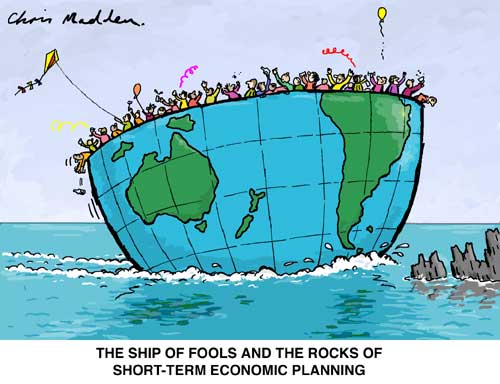
ship-of-fools.jpg

In this scenario, the conservation community — in Asia and elsewhere — faces three major challenges:

First, they just have to doggedly persist in gathering new knowledge, and deriving understanding and insights on how our planet works. This is not research for its own sake, or mere academic theorising. It’s now a pre-requisite for survival.

Second, they have to find smart and strategic ways to fill up the ‘blank pages’ in our planet’s user-guide. In the 1970s, they used to say we have been handed over a planet without that manual and it seemed we had time to figure things out. The truth is, time is running out and we have to write that manual as we go along.

Third, it’s vital that the user-guide is widely shared using every available advocacy and dissemination method, tool and medium. Staying within comfort zones and talking to each other in technical jargon is not enough. This is the point I personally stressed at the meeting: use modern ICT tools to discuss, debate and engage everyone in changing their ways where needed.

The current conservation imperative reminds me of what H G Wells said: History is a race between education and catastrophe. Right now, it seems, we are just staying ahead to avoid disaster.

Thanks to initiatives like the Millennium Ecosystem Assessment, those blank pages in the Earth’s user guide are filling up.

Strange as it sounds, the book’s already filled pages have to be be peddled far and wide even as the other pages are being written.

Talk about a race between education and catastrophe!

Crossing the other Digital Divide: Challenge to conservation community

Digital Divide refers to the gap between those who have regular, easy access to modern information and communication technologies (ICTs) and those who don’t. In the past decade, the IT industry and development community have launched various initiatives to bridge this divide. The One Laptop Per Child project is among the better known examples.

As digital technologies and media gain momentum and wider coverage than ever before, another kind of digital divide has emerged. This week in Kathmandu, during the Fourth Asian Conservation Forum, some of us have been talking about this new divide — between the Digital Natives and Digital Immigrants.

This latter divide is mainly a product of age, not socio-economics. Market research and sociological studies now confirm that today’s younger people – raised on a diet of mobile phones, video games and mp3 (music) players – have radically different ways of accessing, receiving and coping with information.

Recognising this new Digital Divide is vital for communication and advocacy work of conservation groups, such as IUCN – The World Conservation Union, conveners of the Kathmandu forum.

For nearly 60 years, IUCN has been an effective platform for knowledge-based advocacy. Using scientific evidence and reasoning, it has influenced conservation policies, laws and practices at country and global levels. The world would be a worse place to live in if not for this sustained advocacy work by thousands of experts and activists who were mobilised by IUCN.

Much of that work has been accomplished through the classical advocacy tools: scientific papers, books, conferences and, in recent years, ‘policy dialogues’ — meetings where experts and activists would sit down and talk things through with those who make policy in governments and industry.

IUCN continues to pursue all these methods, with creditable impact. IUCN’s Red List of Threatened Species, whose latest edition is being released today (12 September 2007), is among the best known examples of how the Union’s work informs and inspires urgent action for saving the world’s animals and plants driven to the edge by human activity.

To remain similarly effective in the coming years, IUCN — and the rest of the conservation community — need to evolve and adapt to changing realities in human society. One such reality is the proliferation of ICTs in the past two decades.

The International Telecommunications Union (ITU) announced recently that the world’s telephone connections had passed four billion. Largely thanks to the explosion of mobile phones in the majority world, the total number of telephones (fixed and mobile) had quadrupled in the past decade.

While exact figures are hard to come by, it is estimated that around 1.17 billion people (almost 1 in 6 persons) have access to the Internet, even though varying levels of quality.

These are the more widely quoted figures, but the media mix keeps diversifying even as the size of the overall ‘ICT pie’ keeps increasing. For example, the 1990s saw a channel explosion in both FM radio and television across much of Africa, Asia Pacific and Latin America, hugely increasing viewers’ choice and enhancing the outreach of broadcasting. The popularity of video games (and now, online games) has spawned trans-boundary subcultures that were inconceivable even a decade ago.

It is this bewilderingly media-enriched world that IUCN’s members and experts are trying to engage, hoping to persuade everyone — from governments and industry to communities and individuals — to live and work as if the planet mattered.

In Kathmandu this week, I argued that scientific merit and rational (and often very articulate) reasoning alone won’t win them enough new converts to achieve significant changes in lifestyles, attitudes and practices. To be heard and heeded in the real world outside the charmed development and conservation circles, we need to employ a multitude of platforms, media and ICT tools. And we have to talk in the language of popular culture.

We have come a long way since the 1980s, with the new ICTs evolving parallel to our own understanding of sustainability.

When we were involved in processes leading up to the Earth Summit in Rio de Janeiro, back in 1992, most of us were still using fax and snailmail to exchange information. Email was confined to academic circles and the web was not even conceived.

By the time Johannesburg Summit was held a decade later, email had come into wide use and static websites were being used to disseminate information and opinions. E-commerce and music file sharing were gaining momentum.

Just five years on, the rapidly evolving web 2.0 offers us more tools and platforms to not just engage in one-way dissemination, but to truly communicate with a two-way flow. Wikis allow participatory document drafting. Web logs or blogs enable faster, easier expression and discussion. YouTube and other platforms have suddenly made sharing of moving images much simpler (assuming we have sufficient bandwidth).

In fact, connectivity is improving in many parts of the world, though there still are many gaps, frustrations and cost issues to be resolved. Young people, under 25 years, are leading the charge in entering and ‘colonising’ the new media. Social networking platforms such as MySpace and FaceBook are only the tip of this cyber iceberg. And virtual worlds — such as Second Life, with over 8 million online members — are moving in from the periphery to occupy a clear niche in our new digital world.

800px-web_20_mapsvg.png

Every indication is that these trends will continue. IUCN and other conservationists, with their rigorous scientific analysis expressed in technical papers, print publications and the occasional op ed article in a broadsheet newspaper, have to navigate in this whirlpool — and it’s not easy. But their choice is between engagement and marginalisation. The planet cannot afford the latter.

I’m not suggesting that conservation scientists and organisations must drop their traditional advocacy methods and rush to embrace the new ICT tools. But they need to survey the new media landscape with an open mind and identify opportunities to join the myriad global conversations.

A good part of that is what intellectuals might see as chatter, or tabloid culture. It’s precisely this mass tabloid audience that needs to be engaged for conservation.

There are inspiring examples of how other sections of the development spectrum are seizing new media opportunities:

* Some humanitarian groups now use Google Earth online satellite maps for their information management and advocacy work, for example in Darfur, Sudan, and the Central African Republic.

* In an attempt to name and shame offenders, human rights activists are using YouTube to post incriminating video evidence of human rights abuses worldwide. The influential Foreign Affairs journal recently called this the YouTube Effect.

Fortunately, at least a few Asian conservation leaders already appreciate this enormous new media potential. In Kathmandu, Surendra Shrestha, UNEP’s regional director for Asia Pacific, echoed my views.

“My young kids spend several hours each weekend in virtual worlds. We need to get in there and engage them with our content,” he said. “To do that, we have to get inside their minds, and speak their language.”

Shrestha mentioned how UNEP in Asia is attempting this with ICT-based projects for youth, such as e-generation which, according to him, has involved half a million young people.

Such initiatives are beginning to happen, thanks to a few conservationists who are pragmatic enough to exploit the inevitable. But much more needs to be done to make conservation ‘cool’ and hip for Asia’s youthful population, half of them under 35, and many of them Digital Natives.

For sustainability measures to have a chance of success, these upwardly mobile, spend-happy youth have to be reached, touched and persuaded. If it takes tabloid tactics to achieve this, so be it.

And given Asia’s growing economic clout and ecological impact – with China and India leading the way – the fate of the planet will be decided by what is done, or not done, in our region.

While they debate the finer points of conservation strategies and activities in Kathmandu, Bangkok and other cities across our massive region, Asia’s conservation community must quickly cross the new Digital Divide that currently separates them from Digital Natives.

Declaration of interest: I was part of IUCN Sri Lanka Secretariat (1992-1994), where I started its communication division, and have been a member of IUCN Commission on Education and Communication since 1991.

Read my April 2007 post: Do ICTs make a difference?

Anita Roddick: We shall always remember you

Image courtesy Treehugger

“Remember me!”

That’s how Anita Roddick, who died on 10 September of brain haemorrhage, autographed for me a copy of her book Taking It Personally: How to make Conscious Choices to Change the World.

You’re hard to forget, I told her at the time. And suddenly, memories are all we are left with. And what vivid ones!

Dame Anita Roddick (1942 – 2007), founder of The Body Shop, is one of the most unforgettable persons I have met. And now that she has moved on, far too soon, her memory challenges us to persist with the social, humanitarian and environmental causes that she so passionately championed.

Media obituaries described her as the ‘Queen of Green’, but Anita was much more than just green. She stood for justice, fairness and equality in both business practices and her campaigns. From ethical sourcing of raw materials for her beauty products to agitating for human rights and humane globalization, she was one activist who walked the talk.

“I came out of the womb as an activist. I’m part of the 1960s; it’s in my DNA,” she wrote in Newsweek earlier this year. “So the idea of dying with loads of money doesn’t appeal to me at all.”

She added: “I want to use the last years I have to get my hands dirty working for civil change. I want to be able to see the positive difference that money can make by giving away what I have.”

It’s not immediately clear if she made much headway with that, but the recently set up Roddick Foundation is the latest of a long line of campaigns, social projects and charities that she founded, energised or supported.

Her business acumen and commitment to global justice have been eulogised for years. She was equally adept in using the media and communications to draw attention to a cause, issue or incident.

Without going to any business school, Anita built up a global business that had over 2,200 stores in 55 countries by the time she let go of the company in 2004. And without attending any communication school, she became one of the best communicators of our troubled times – speaking eloquently for her company’s ideals and various charitable causes.

It all came from the heart, and it was passion –- not cold facts or even colder logic -– that drove her to be a phenomenally successful communicator.

Anita loved to say: “The job of a citizen is to keep his mouth open.” And her advice to activists was: Get Informed. Get Inspired. Get Outraged. Get Active.

Never underestimate the power of one, she said. As she liked to put it:
If many little people
In many little places
Did many little deeds
They can change the face of the Earth

And like the Energizer bunny, but with lot more purpose, she kept going, going and going. She loved the Dorothy Sayers quote: “A woman in advancing old age is unstoppable by any earthly force”.

It was on one of her many world travels that our paths first crossed. In the summer of 1991, I was invited to give a workshop at Youthquake, a Canadian environmental conference building up momentum for the Earth Summit scheduled for the following year. It was here that I met two of my all-time favourite activists: geneticist-turned-TV presenter David Suzuki, and Anita Roddick. The celebrity guest was Mutang Tu’o, a representative from the Penan indigenous tribe from Sarawak, Malaysia, whose jungles were in imminent danger of being logged.

Youthquake was part conference, part youth jamboree and altogether a great deal of fun. Anita turned up with her youngest daughter Sam, and spent hours just telling real life stories in her inimitable way – full of laughter and making fun of power and pomposity. After all these years, I can’t remember anything about what I myself spoke, but I know Anita’s remarks had a lasting influence.

In those heady days before the Earth Summit, email and the global Internet, activists had an easier and simpler choice of adversaries — Uncle Sam and World Bank usually came up among the top five. When economic globalization gathered pace, things became more complex and nuanced. Ah, for the good old days!

Anita marched fearlessly into this new world where corporate fortunes are being made at the speed of light, governments are waging wars to the tune of media-entertainment industries, and certain development agencies have turned poverty reduction and HIV/AIDS into cottage industries.

Marshall all facts, get analysis right, take your firing positions and never give up the good struggle, she seemed to suggest: there’s a war out there, and it wasn’t just in Iraq and Afghanistan.

In fact, Taking It Personally was her rough guide on how to tame run-away globalization. For it, Anita invited the top thinkers in the struggle for humanitarian trade policies to weigh in on the problem, and to give citizens the tools and inspiration to do work for constructive solutions. Among its contributors were Vandana Shiva, Paul Hawken (Natural Capitalism), Naomi Klein (No Logo), and Ralph Nader.

When she autographed a copy for me, she added with a mischievous grin that the book’s US distributors had been coerced to withdraw it. She showed a possible reason: that famous photo of President George W Bush reading a book with a young child — while holding it upside down!

It’s this topsy turvy, cruel world that Anita Roddick tried to make slightly better in a thousand different ways. We fellow travellers will sorely miss her, but there is ‘no bloody alternative’ but to just slog on.

— Nalaka Gunawardene; Kathmandu 12 September 2007

Read my earlier post: Anita Roddick, Angkor Wat and the ‘Development Pill’

BBC Online: Dame Anita Roddick dies at 64

Look, no Kleenex: Way to blow our noses without blowing our planet

In the Fall of 2004, I was on a Cathay Pacific flight from Hong Kong to Toronto. The flight across the vast Pacific was 13 hours long, and half way into the flight my nose started playing up.

Being in cold placed for many hours sometimes triggers my catarrh, but I was prepared. I always carry one or more handkerchiefs with me, especially on flights. And also some anti-sneeze pills from my homeopathy doctor.

Blowing my nose and popping the small, sugary pills hardly ever draws anyone’s attention, but on this occasion it did. Our friendly flight stewardess was quite amused to see me using a hanky.

“Oh, Sir, you’re such a gentleman!” she exclaimed.

It took me a few seconds to figure out what she meant. Then she added, helpfully: “You still use a handkerchief. That’s so charming. No one uses them anymore…”

There wasn’t the faintest tone of sarcasm in her voice. She was genuinely impressed that I carried a hanky.

Image courtesy Boeing Co

I was reminded of this incident when reading Time magazine’s recent reflective essay on ten years after Princess Diana’s death.

At one point, it quotes Dickie Arbiter, a former press secretary to the Queen, Charles and Diana who was responsible for the media arrangements for Diana’s funeral: “The Queen was always going to pay tribute to Diana….There was a furor because she was at [the Scottish castle] Balmoral and not down with the sniveling mobs in London. [But] William and Harry needed her more than hundreds and thousands of people keeping Kleenex in business.”

Indeed, Kleenex and other tissue paper manufacturers must have done very nicely that week. A few days later, the death of Mother Teresa in Kolkata (formerly Calcutta) would have profited the Indian peddlers of the flimsy paper that more and more people seem to find indispensable.

Tissue paper vs. Handkerchiefs is an on-going debate that’s far from resolved. Both items have pros and cons; they also have their defenders and promoters. Some of them air their views on the Bottledguy blog

I have always been a handkerchief user, so I’m naturally biased in their favour. Yes, I have to be careful in using and storing them; yes, I have to wash, dry and keep track of them. And no, I don’t mind these chores at all.

And everything I read tells me it is more environmentally friendly to use hankies.

Here’s an interesting story from Pittsburgh Post-Gazette (3 Sep 2007): Can Australian sisters bring back hanky’s heyday?

It’s about two sisters in Australia, one in Sydney and the other in Brisbane (that I passed through only a few days ago) trying to revive the use of handkerchiefs.

They market them as “both useful accessories and as markers of the bonds between people.”

Image courtesy Hanky Schmanky

Their company is named Hanky Schmanky. I don’t know them, but applaud their initiative. They are trying to make hanky use ‘cool’ again.

We need many more people like Jennifer Moran and Angela Galgut – co-founders of this small company – to help us blow our noses without blowing the planet.

Hankymania page from Hanky Schmanky website


Nothing to Sneeze at: Umbrak Fisk gives environmental advice to all nose blowers at Grist.org

New Face of People Power: Social Accountability in action

In an earlier post, I wrote about how citizen groups are increasingly empowering themselves with information to demand greater accountability from their elected representatives in local, provincial and central governments.

This is collectively called Social Accountability – and it represents a significantly higher level of citizen engagement than merely changing governments at elections or taking to the streets for popular revolt (‘people power’).

In 2004, TVE Asia Pacific produced a half-hour international TV documentary titled People Power that profiled four Social Accountability projects in Africa (Malawi), Asia (India), Europe (Ireland) and Latin American (Brazil).

Watch the Brazil story on TVEAP’s YouTube channel:

The experiment with participatory budgeting in the municipality of Porto Alegre in Brazil is a long-running example that we filmed. This is one of the largest cities in Brazil, one of the most important cultural, political and economic centers of Southern Brazil.

The city is well known as the birth place of the World Social Forum. The first WSF was held there in January 2001.

Participatory budgeting goes back to a decade earlier. It was started in 1989 by the newly elected “Worker Party” (PT) to involve people in democratic resource management in an effort to provide greater levels of spending to poorer citizens and neighborhoods. It has since spread to over 80 municipalities and five states in Brazil.

Porto Alegre’s challenge was how to include the poorer people in this success. Housing was a major problem as rural people migrate to the city looking for work. In the past, people built temporary houses on whatever land they could find, and the city council kept on demolishing these unauthorised structures.

from-people-power-porto-allegre-story-2.jpg

As Brazil moved from a totalitarian to democratic form of government in the late 1980s, the newly elected city government adopted a program where the people participate in prioritising the City Budget.

The city is divided into sixteen regions and during each year, local neighbourhoods send representatives to people’s assemblies. In these assemblies, the neighbourhood representatives discuss priorities for the allocation of the city budget. They then elect their representatives from each region to form a budget council.

Over a year, from neighbourhood associations to people’s assemblies, up to 20,000 people have a direct say on how the city budget should be allocated.

This participation ensures democratic accountability and fairer distribution of tax revenue. It allows the poorest and the richest regions to have equal weight in the decision process.

After the introduction of participatory budgeting, an influential business journal nominated Porto Alegre as the Brazilian city with the ‘best quality in life’ for the 4th consecutive times. Statistics show that there has been significant improvement in quality of roads, access to water services, coverage of sewerage system, school enrollment and tax revenue collection.

from-people-power-porto-allegre-story.jpg

We interviewed Joao Verle (wearing pink shirt in photo above), the then Mayor of Porto Allegre, who said: “I believe in this project since i was one of those responsible for starting it fifteen years ago. The participatory budget is now part of the organic life of this city – people can change it any time they please. And this makes it more adaptive to the people’s needs.”

First broadcast on BBC World in February 2004, People Power documentary has since been widely distributed to broadcast, civil society and educational users in the global South. It is still available from TVEAP on DVD and VHS video.

Photos are all captured from People Power video film. Courtesy TVE Asia Pacific

Read my post about social accountability in the world’s largest democracy, India