BigShot: Inspiration with every click?“Build a better mousetrap, and the world will beat a path to your door.” This remark is attributed to one of my favourite essayists and philosophers, Ralph Waldo Emerson.
That was probably true for the 19th century in which he lived and died, but it takes a bit more than a mousetrap to generate a buzz these days. But simple and elegant inventions are still the best. BigShot is one of these.
It’s still in testing stage, but already being hailed as “a camera that could improve the way children learn about science and one another”.
BigShot is an innovation by Indian-born Shree K. Nayar, now the T. C. Chang Professor of Computer Science at Columbia University in New York, USA.
As his university’s newspaper reports: “He came up with a prototype as sleek as an iPod and as tactile as a Lego set: the Bigshot digital camera. It comes as a kit, allowing children as young as eight to assemble a device as sophisticated as the kind grown-ups use—complete with a flash and standard, 3-D and panoramic lenses—only cooler. Its color palette is inspired by M&Ms, a hand crank provides power even when there are no batteries and a transparent back panel shows the camera’s inner workings.”
With the BigShot, Nayar wants to not only empower children and encourage their creative vision, but also get them excited about science. Each building block of the camera is designed to teach a basic concept of physics: why light bends when it passes through a transparent object, how mechanical energy is converted into electrical energy, how a gear train works.
Watch Professor Shree Nayar talk about the purpose and development of the Bigshot camera project.
Nayar would like to roll out the camera, now in prototype form, along the lines of the One Laptop Per Child campaign: For each one sold at the full price of around $100, several would be donated to underprivileged schools in the United States and abroad. He will soon begin looking for a partner—a company or nonprofit—to help put Bigshot into production.
Life inspires innovation...Wired magazine wrote in a recent review: “(It) is a super-simple digicam from the Computer Vision Lab at Columbia University. It comes in parts, ready to be assembled (by kids, but I can’t wait to get my hands on one), and teaches you along the way how these things work. It’s not quite the transparent view you get from making an old analog camera, where you can see how everything works, but it’s as close as you can get from a machine that uses circuit boards.”
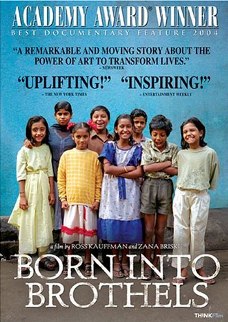
Interestingly, the initial inspiration for BigShot came from a documentary: Born into Brothels (85 mins, 2004), a film about the children of prostitutes in Sonagachi, Kolkata’s red light district. The widely acclaimed film, written and directed by Zana Briski and Ross Kauffman, won a string of accolades including the Academy Award for Documentary Feature made in 2004.
I saw that film during the AIDS Film Festival I helped organise in Bangkok in July 2004. In this film, the film maker, British photographer Zana Briski, gave 35 mm film cameras to eight children and watched as those cameras transformed their lives.
“The film reaffirmed something I’ve believed for a long time, which is that the camera, as a piece of technology, has a very special place in society,” says Nayar. “It allows us to express ourselves and to communicate with each other in a very powerful way.”
Watch an overview of Born into Brothels, featuring the film makers:
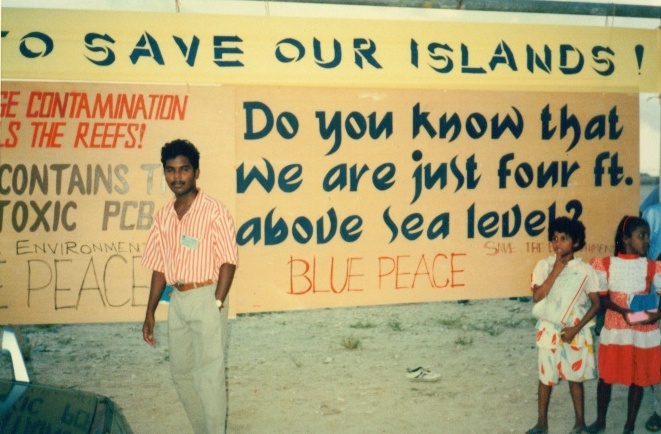
Bluepeace was vocal, even at 2 months. Photo by Nalaka Gunawardene: Male, November 1989
I’m not a professional photographer, but as a journalist I often carry a camera and take photos of what interests me. So I’m very glad to have captured that historic bill board as a journalist covering the conference. Bluepeace still uses it in their records, always with acknowledgement.
Ali Rilwan, Bluepeace co-founder whom I photographed as a young man, says: “Twenty years later, we need not ask the same question, as the world is well-aware of the dangers Maldives faces. However, we face the urgent need to talk and work with the rest of the world to find solutions.”
Now, Bluepeace is actively using photographs as part of their climate advocacy.
Images from the frontlines of climate impact...
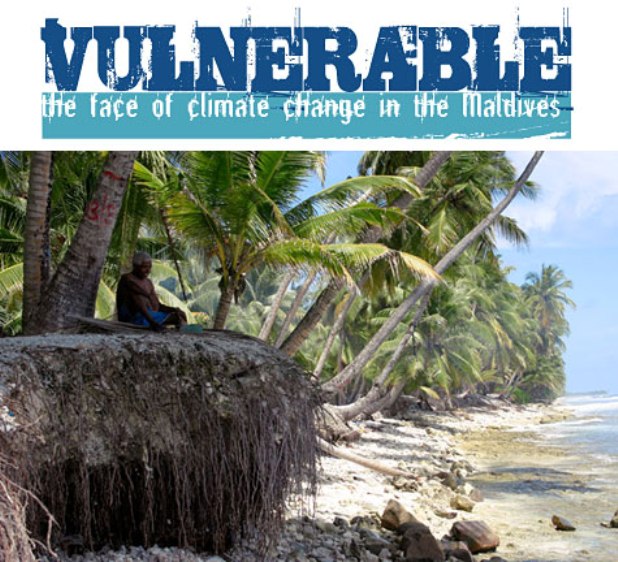
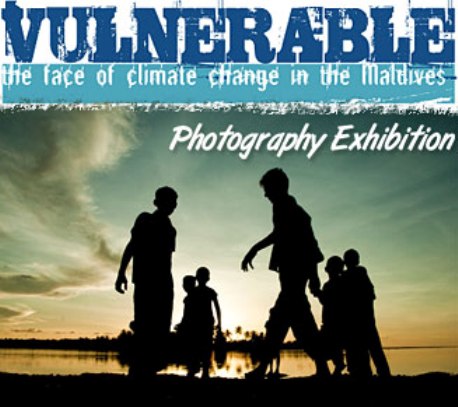
VULNERABLE is a photo exhibition organised by Bluepeace. To celebrate the 20th anniversary of Bluepeace, and to join the global environmental movement bringing attention to the dangers of climate change in the run up to United Nations Conference on Climate Change (COP15), Bluepeace presents VULNERABLE, which showcases the face of climate change in the Maldives. The exhibition documents the vulnerability of the fragile coral islands of the Maldives to climate change, through pictures from talented Maldivian photographers. It depicts a nation under threat, as it tries to safeguard an age-old culture and lifestyle that could be erased with rising seas and climate change.
VULNERABLE was launched online on October 24, the International Day of Climate Action organised by 350.org, which calls for a reduction of global carbon emissions below 350 parts per million.
In the coming weeks and months the exhibition will move to different locations in the Maldives and other countries, including Copenhagen in December 2009, where it will be hosted by Klimaforum09, an alternate climate summit with participation from global environmental movements and civil society organisations.
I can’t wait to see the exhibit in a physical display, which is more powerful than viewing it online. For now, here are some glimpses…
One man vs. the mighty Red Army - photo by Jeff Widener for Associated Press
This is of the most famous photos of modern times. The official caption, given by Associated Press, reads: “An anti-government protester stands in front of artillery tanks in Beijing’s Tiananmen Square on June 5, 1989, at the height of the pro-democracy protests.”
It’s a moment deeply etched in the consciousness of our media-saturated world. The solitary, unarmed man was standing up against not just a brute of a tank, but the might of the entire Chinese Red Army, which had just cracked down ruthlessly on pro-democracy student protests.
It was on the morning of June 5 that the Tank Man appeared from nowhere. A line of 18 tanks were pulling out of Tiananmen Square and driving east along the Avenue of Eternal Peace. The previous day, the square had been cleared of students and much blood had been spilled. The streets were now empty except for soldiers.
Suddenly a man in a white shirt and black trousers, with a shopping bag in each hand, steps out on to the road and stands waiting as the tanks approach. The lead vehicle halts, assessing its options.
It moves right to go around him. The man waves the shopping bag in his right hand then dances a few steps to the left to block the tank again. The tank swerves back left to avoid him. The man waves the bag again and stepps to the right. Then both stop. The tank even turned off its engine.
Then more things happened.
Watch a video montage of this breathtaking standoff, captured by western journalists filming from a safe distance:
Watch first few minutes of the 2006 PBS documentary on the Tank Man incident and aftermath:
Twenty years on, the identify of the Tank Man remains a mystery. There are conflicting reports on who he was, and what happened to him after that single, defining act of defiance. Practically all we know is that he wasn’t run down by the tanks, and was instead arrested a few minutes later by the Chinese authorities. Naturally, there are few official comments on the incident or the Tank Man.
But during those few minutes, when individual soldiers hesitated and refrained from running him over, the Unknown Rebel secured his worldwide fame. He probably wasn’t doing it for any notion of posterity – in all likelihood, he was horrified bystander who’d seen the carnage in the preceding days and felt, as we do from time to time, that enough was enough.
And unlike most of us, he decided to risk his life to register his protest. In April 1998, Time magazine included the “Unknown Rebel” in its feature entitled Time 100: The Most Important People of the Century.
Charlie Cole, a Newsweek photographer who captured the moment, says: “Personally I think the government most likely executed him. It would have been in the government’s interest to produce him to silence the outcry from most of the world. But, they never could. People were executed at that time for far less than what he did.”
In early June 2009, a fifth photographer shared his own image of the incident – disclosing photos that had never before been circulated. Associated Press reporter Terril Jones revealed a photo he took showing the Tank Man from ground level, a different angle than all of the other known photos. (Tank Man is the second from left, in the background.) Jones initially didn’t realise what he had captured until a month later when printing his photos from that momentous week.
As we celebrate the memory of the Tank Man – and his defiance of brutal, oppressive use of state power to crush dissent – we must also salute the courage and resourcefulness of photojournalists and TV reporters who risked their own lives to capture this moment for posterity. Tank Man became iconic only because his act was frozen in time by those bearing witness. All too often, states – from Burma to Zimbabwe, and others in between – ensure that there is no one to bear such witness when they unleash the full force of police, armies and weapons on their own people.
There can be no doubt that Tank Man was not the first of his kind, nor would he be the last. Other ordinary men and women have found uncommon courage to stand up against injustice and state brutality wielded in the name of national security, law and order or anti-terrorist crackdown. But in the absence of witnesses – whether professional journalists or citizen journalists – the rest of the world will never know.
As I have explained elsewhere: “I’m strongly committed to promoting media freedom, but have never been the placard-carrying, slogan-shouting type. Street activism is necessary — but not sufficient. I’ve been more interested in studying trends and conditions, trying to anticipate what the next big threats, challenges and opportunities are, and how best we can respond to them.”
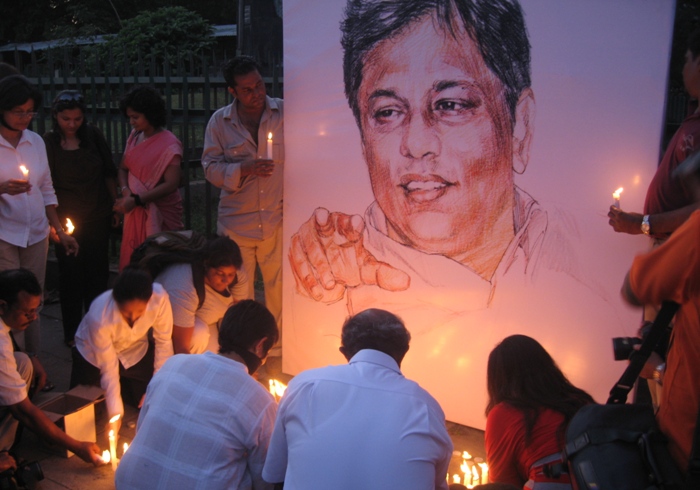
So I went to the vigil more for Lasantha the person and less for any organised effort. The invitation I received by SMS and email from several sources asked us to gather outside Colombo’s Vihara Maha Devi (formerly Victoria) Park at 5.15 pm. It was going to be a ‘joint civil society protest’ against Lasantha’s killing and the erosion of media freedom, democracy and human rights.
It turned out to be a well-intended but poorly-planned event lacking in vision and dynamism, perhaps a bit like our (very) civil society entities themselves. The couple of hundred people who joined it came mainly from Colombo’s high society, the ones who faithfully lapped up every word that Lasantha churned out week after week for nearly 15 years. Ironically, Lasantha and his newspaper were only loosely associated with this kind of (very) civil society – fellow companions on a shared journey, but not necessarily agreeing on priorities or strategies.
I remembered the battered face of an old lady who sat through the entire funeral service – and then left quietly, without even lining up with the rest of the crowd to take one last look at Lasantha as he lay amidst flowers. I remembered the handful of men and women dressed in bright coloured clothes – standing out amidst the sea of white or black clad people – who I later found out came from the Kotahena area and were part of Lasantha’s home town church.
Lighting candles was good. Keeping the flame alive is harder...
No one had sent SMS or emails asking them to turn up. Some of them might not have been readers of English newspapers, which circulate among a numerically small but socially and economically influential section of Lankan society. They came because they felt the fallen man had stood up and spoken out for them.
In comparison, the candlelight vigil was decidedly upmarket. Nothing wrong in that, for the chattering class is very much part of our society and have the same rights to dissent and protest. In some countries, the upper middle class even provides vision, articulation and leadership to mass struggles. Ours, sadly, is more characterised by part-time activists who move more in the cocktail circuits grumbling about everything yet doing precious little to change the status quo. Indeed, some of them in their day jobs benefit personally from the prevailing corruption and nepotism, no matter which political party is in office.
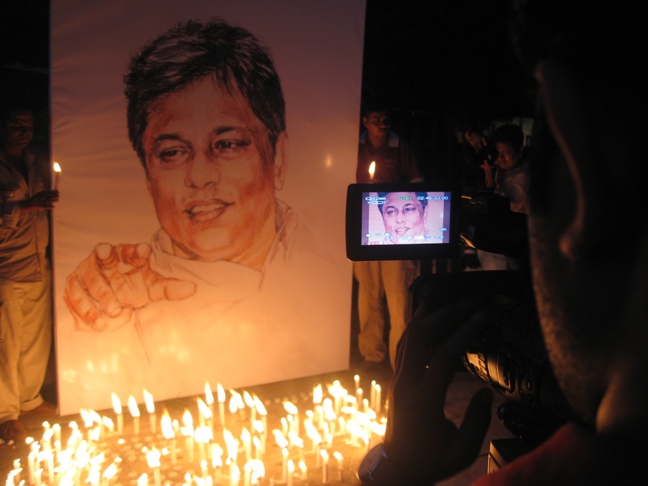
The vigil’s organisers – it wasn’t clear who exactly they were – had painstakingly got the material ready: a large painting of Lasantha, black cloth bands and, of course, candles. But they hadn’t given enough thought to the location. We initially gathered and spent over half an hour on a stretch of road (Green Path) where only motorists passed by, but absolutely no pedestrians. Then someone thought of moving to the nearby roundabout which was a more visible, strategic location.
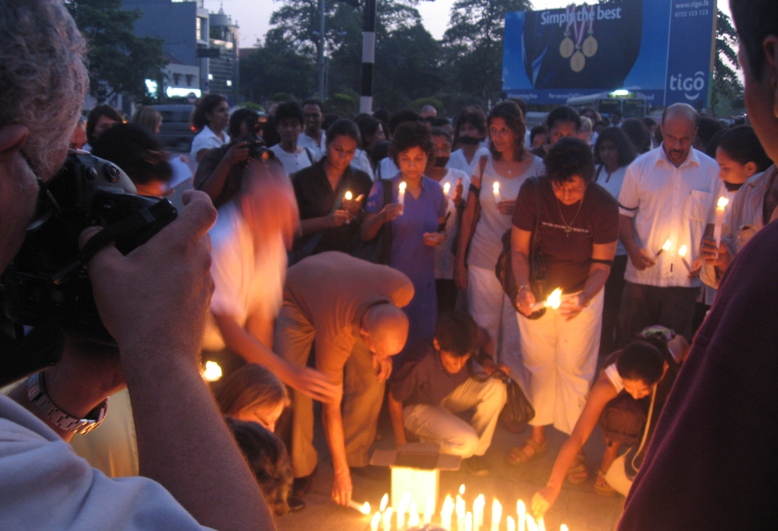
Not perfect, but better. By then, dusk was beginning to fall. We moved unhurriedly, chatting among ourselves, and slowly converged on a wide pavement. There, one by one, we started planting our candles on the ground in front of Lasantha’s picture. It was a moving moment captured in many still cameras and a handful of video cameras.
There we lingered for another hour or more, chatting with each other — and not necessarily about the lofty or somber matters. I was glad to catch up with several friends or associates active in artistic, journalistic or intellectual circles. I saw everybody else doing the same.
One of them, a human rights activist now turned peacenik, asked me many eager questions about blogging. A columnist for an English daily, he isn’t active online and his organisation is notably inept when it comes to mobilising the web for their cause. In his early 50s, he evidently hasn’t crossed what I call the Other Digital Divide. And he typifies the face of our organised civil society – a motley collection of do-gooders who are liberal, mostly secular, passionate yet largely ineffective in their advocacy for reform and change. They just can’t mobilise people power.
Candles burn out, but the image captured will live for longer...
Admittedly, it’s a quantum leap from the one-way street in op ed pages of mainstream print newspapers to the far less orderly, sometimes near-anarchic and often unpredictable world of the blogosphere. This might explain why a majority of Lankan civil society groups stay within their comfort zone and don’t engage the world of web 2.0
On the other hand, the younger, digitally-empowered activists who engage the web with technical savvy and passion are often too impatient or inexperienced (or both) with the necessarily tedious processes of institutional development – such as legal registration, financial management and putting in place mechanisms for the very ideals they advocate in governments and corporations: proper governance and accountability.
Fortunately, this offline/online divide is blurring, even if only slowly. Groups like Beyond Borders, which originated and found their feet in the new media world, are becoming more institutionalised. If they sustain themselves (and don’t lose their sharp edge), they can bridge the online world with the offline realities and needs.
Meanwhile, as some doggedly persistent citizen journalists and new media activists have shown in the days following Lasantha’s killing, it is now possible to stir up public discussion and debate on issues of rights, freedoms and democracy using dynamic websites, blogs, online video and other tools of web 2.0. See, for example, this reflection by the Editor of Groundviews.
Whether they are active online or offline, committed activists in Sri Lanka have their work cut out for them. If the candlelight vigil for Lasantha is an indication, far more work needs to be done in strategy, unity, networking and technology choices. The old order needs to pause, reflect and change their ways. If they can’t or won’t, at a minimum they must get out of the way. (Remember what happened to those dinosaur species that were vegetarian and harmless? They too went the way of T rex…)
Earlier on in the evening, as we were heading to the roundabout with burning candles in our hands, the wind suddenly picked up. Many of us struggled to keep the flame burning, sometimes shielding it with one palm. It wasn’t quite easy to do this while walking forward, watching our step. Amidst all this, we lost sense of where we were heading. We just followed those immediately in front of us, unsure who – if anyone – was leading. Not smart or strategic.
As I drove home, I realised how symbolic that candle-in-the-wind moment had been. Keeping the flames of truth, justice and fairness alive is hard enough. It becomes that much harder when winds of tribalism threaten to snuff it out. And in the thickening darkness, how do we make sure we are headed in the right direction?
The night is young and storm clouds are still gathering. We have miles to go before we can sleep.
In the wake of Cyclone Nargis that wreaked havoc in Burma, the world has once again realised the brutality and ruthlessness of the military regime that runs the country.
And as the United Nations and aid agencies struggle with the incredibly uncaring Burmese bureaucracy to get much needed emergency relief for the affected Burmese people, the media outside Burma are having great difficulty accessing authentic information and images.
Despite the massive disaster and resulting tragedy, Burma remains closed to foreign journalists, especially the visual media. No doubt the memories of the monk-led pro-democracy protests of late 2007 are still fresh in the minds of the ruling junta and their propagandists. The few courageous foreign reporters who managed to get in at the time ran enormous personal risks, and Japanese photojournalist Kenji Nagai was shot dead by a Burmese soldier while filming demonstrations.
Unable to report from the multiple scenes of disaster, and lacking a wide choice of reliable local sources willing to go on the record, international news agencies and broadcasters have been forced to quote the government-owned Burmese television station, MRTV.
Global news leaders like Al Jazeera, BBC and CNN have all used MRTV visuals to illustrate their news and current affairs reportage. A recent example from Al Jazeera, posted on 8 May 2008:
The image monopoly by MRTV wouldn’t have mattered so much if they at least provided an accurate account of the unfolding events in its own country. But that seems far too much to expect of this mouthpiece of the Rangoon regime. In Burma’s darkest hour in recent memory, MRTV would much rather peddle the official propaganda – never mind the millions made homeless by the recent disaster.
Here’s an insight from the Inter Press Service, the majority world’s own news agency, reporting from their Asia Pacific headquarters in Bangkok, Thailand:
Worse, there is evidence emerging that the military authorities had ample warning of a storm brewing in the Bay of Bengal but chose to ignore, or even suppress, it.
The Indian Meteorological Department (IMD) which keeps a close track of geo-climatic events in the Bay of Bengal and releases warnings not only to provinces on the Indian east coast but also to vulnerable littoral countries said it warned Burmese authorities of Cyclone Nargis’ formation and possible approach as early as on Apr. 26.
“We continuously updated authorities in Myanmar (as Burma is officially called) and on Apr. 30 we even provided them a details of the likely route, speed and locations of landfall,’’ IMD director B.P. Yadav told IPS correspondent in New Delhi, Ranjit Devraj.
Burma’s meteorology department did post a warning on its official website on Apr. 27 but no effort was made to disseminate information to the people, much less to carry out evacuations along the coastline or from the islands on the Irrawaddy Delta.
By the time state-run media, which has been continuously spewing propaganda and exhorting the public to vote ‘yes’ to Saturday’s constitution referendum, issued its first cyclone alert on Friday afternoon it was too late for the hapless residents of Rangoon.
Elsewhere in the report, IPS says:
Pictures of soldiers removing fallen trees and clearing roads in Rangoon on the state-run television have further infuriated many in the city. “This is pure propaganda and it’s far from the truth,” e-mailed a Burmese journalist, asking not to be identified for fear of the consequences. “Why do foreign broadcasters show them too –Burmese government propaganda is a disgrace enough to journalism,” he fumed.
“I saw some soldiers getting onto a truck yesterday,” said a 50-year-old resident. “They had no sweat on their shirts, despite what was shown on TV!”
“My wife saw three truckloads of soldiers parked in front of a fallen tree, none of them got down to remove it,” he added.
“Burma is shut off from foreign journalists (unless they are invited in by the military regime to cover specific showpiece events). Western news channels have had to rely on state run television for their moving images.
“So while the death toll is now officially 22,000 (unofficially up to 50,000), with 40,000 people missing and a million homeless; and while the regime is coming in for bitter criticism for its foot-dragging over opening up to international aid and the utter incompetence of its own relief effort so far (which has reached only a tiny fraction of the people affected), we are watching on our television screens soldiers handing over food parcels. We can see nothing of the grief or rage of the people going hungry and thirsty (many water sources are too contaminated to use). They do not talk on camera. Instead they sit obediently in the state TV images, taking what’s given to them. And we watch them, while listening to the numbers and being told of the heightening crisis.”
Appalling as these revelations are, they don’t surprise us. Indeed, MRTV is not alone in this kind of shameless abuse and prostitution of the airwaves, a common property resource. A vast majority of the so-called ‘public’ broadcasters in Asia behave in exactly the same callous manner. This is why I don’t use the term ‘public broadcaster’ to describe these government propaganda channels – because, whatever lofty ideals their founding documents might have, most of them are not serving the public interest any more (if they ever did).
As I commented in Feb 2008: “In developing Asia, which lacks sufficient checks and balances to ensure independence of state broadcasters, the only thing public about such channels is that they are often a drain on public money collected through taxes. Their service and loyalties are entirely to whichever political party, coalition or military dictator in government. When the divide between governments and the public interest is growing, most ‘public’ channels find themselves on the wrong side. No wonder, then, that discerning views have abandoned them.”
I don’t hold a grudge against the hapless staff of MRTV, who simply must remain their Masters’ Voice at all times to stay alive. Those working for government channels in countries with greater levels of democratic freedom can’t take refuge in this excuse. They must be held accountable for their continuing propagandising and the disgusting pollution of the airwaves.
And the incredibly naive and sycophantic UN agencies – especially UNESCO – also share the blame for their feeble yet persistent defence of the so-called public broadcasters. Years ago, I stopped attending meetings discussing public service broadcasting (PSB) in Asia, which these agencies equate with what the government channels are doing. I see yet another of these exercises in futility being lined up as part of the Asia Media Summit 2008 coming up in a few days in Kuala Lumpor.
As I wrote in February, if these development agencies are seriously interested in broadcasting that serves the public interest, they must engage the privately-owned, commercially operated TV channels, which are the market leaders in much of Asia.
Except, that is, in tightly controlled, closed societies like Burma, where government channels are the only terrestrial TV available for the local people.
Images courtesy AP and Reuters, as published by The New York Times online
Today, May 3, is World Press Freedom Day. Proclaimed by the UN General Assembly in 1993, the day is celebrated each year on May 3 — the anniversary of the Declaration of Windhoek, a statement of free press principles put together by African newspaper journalists in 1991.
I’m holed up in a hotel in Singapore this whole weekend, attending the annual Board meeting of Panos South Asia, which works to promote greater public discussion and debate on development issues through the media. Our Board is drawn from Bangladesh, India, Nepal, Pakistan and Sri Lanka and includes leading journalists, publishers and social activists.
I’ve been busy preparing for and attending the intensive Board meeting that I’ve not had the time to do an original blog post on this important day. So like any resourceful journalist, I’m doing the second best thing – ‘recycling’ some material that I was recently associated with in producing.
First, here’s an extract from a chapter that I invited Sri Lankan ICT activist Sanjana Hattotuwa to write for Communicating Disasters: An Asia Pacific Resource Bookthat I edited last year. Sanjana traces the growing role played by digitally empowered citizens while disasters unfold as well as after disasters have struck. He then turns attention to the wider and more generic challenges faced by citizen journalists everywhere, especially in countries where democracy is under siege:
Who’s Afraid of Citizen Journalists?
But is it all good and positive? Put another way, merely because we now have access to a hundred times more content on a disaster than before does not mean that we get any closer to understanding it or responding to it.
Information overload is a real problem, as is the subjectivity of citizens, who only capture what they feel is important and often ignore aspects to a disaster beyond their own comfort zone and prejudices. There is still no widely accepted standard for citizen journalists, though organizations such as the Centre for Citizen Media are actively working towards such standards .
There are other challenges associated with citizen journalism, especially in a context of violent conflict. This author receives vicious hate mail, suffers public insults, is branded a ‘terrorist’ and even receives the occasional death threat – all because of the content he promotes on the citizen journalism websites he edits.
Not all citizens, even when they can do so and have access to digital devices, record disasters or human rights abuses – especially when their own security could be compromised for having done so. Governments can also clamp down hard on citizen journalism. The French Constitutional Council approved a law in early 2007 that criminalizes the filming or broadcasting of acts of violence by people other than professional journalists. The law could lead to the imprisonment of eyewitnesses who film acts of police violence, or operators of Web sites publishing the images. Sri Lanka unofficially banned a pro-Tamil nationalist website in 2007 and regularly cuts off mobile phone and Internet services in the North and East of the country.
Scared by the potential for embarrassment, political debacles and popular uprisings, countries such as Egypt, Iran, Cuba, North Korea and China vigorously censor and monitor content on blogs and exchanges through SMS, prompting Julien Pain, head of the Internet freedom desk at Reporters Without Borders (RSF) to note: “… all authoritarian regimes are now working to censor the Web, even countries in sub-Saharan Africa. The Ethiopian regime of Prime Minister Meles Zenawi has blocked openly critical Web sites and blogs since May 2006, and President Robert Mugabe of Zimbabwe is considering a law allowing security forces to intercept online messages without reference to the courts. One of the first moves by Thailand’s military rulers after their September (2006) coup was to censor news Web sites, even foreign ones, that criticized the takeover.”
The second extract is from my own recent essay under the above title, which was published by the Asia Media website managed by the University of California Los Angeles (UCLA). In this piece, written only a few weeks ago, I comment on a disturbing new threat to media freedom in my native Sri Lanka: misguided citizen vigilantes suspecting and attacking professional journalists engaging in their legitimate news and/or image gathering work in public places. When accredited journalists are affected by this paranoia, I point out how much more difficult it is for citizen journalists who lack the institutionalised media behind them.
Public interest blogging in Sri Lanka has been growing slowly but steadily since the Indian Ocean tsunami of December 2004, which marked a turning point for citizen journalism. According to researcher and new media activist Sanjana Hattotuwa, citizen journalists are increasingly playing a major role in meaningfully reporting deaths, the humanitarian fallout and hidden social costs of violent conflict that are often glossed over or sensationalised by the mainstream media.
Hattotuwa acknowledges, however, that the ready availability of information and communication technologies (ICTs) does not guarantee public-spirited citizen journalism.
“In Sri Lanka, the significant deterioration of democracy in 2006-2007 has resulted in a country where anxiety and fear overwhelm a sense of civic duty to bear witness to so much of what is wrong. No amount of mobile phones and PCs is going to magically erase this deep rooted fear of harm for speaking one’s mind out,” says Hattotuwa.
This makes the courage and persistence of the few citizen journalists even more remarkable. Unlike mainstream journalists, they lack official accreditation, trade unions and pressure groups to safeguard their interests. The state does not recognize bloggers as journalists; despite their growing influence online, most local news websites don’t enjoy any formal status either.
For now, the citizen journalist in Sri Lanka is very much a loner — and very vulnerable.
A wounded Japanese photographer, Kenji Nagai, lay before a Burmese soldier yesterday in Yangon, Myanmar, as troops attacked protesters. Mr. Nagai later died. Published 28 September 2007 (Adrees Latif, Reuters)
This dramatic photograph, one of the harrowing and yet enduring images of 2007, has just won its photographer a Pulitzer Prize, announced in New York on 7 April 2008.
Ironically, the last defiant act of one courageous photojournalist has landed one of journalism’s most prestigious awards for another of his kind. Adrees Latif, a Pakistan-born American, had concealed his identity by blending in with the crowd in Rangoon/Yangon, and captured Nagai’s killing on film.
For a distinguished example of breaking news photography in black and white or color, which may consist of a photograph or photographs, a sequence or an album, in print or online or both, Ten thousand dollars ($10,000).
Awarded to Adrees Latif of Reuters for his dramatic photograph of a Japanese videographer, sprawled on the pavement, fatally wounded during a street demonstration in Myanmar.
Born in Lahore, Pakistan on July 21, 1973, Adrees Latif lived in Saudi Arabia before immigrating with his family to Texas in 1980. Latif worked as a staff photographer for The Houston Post from 1993 to 1996 before joining Reuters. Latif graduated from the University of Houston in 1999 with a Bachelor of Arts in Journalism. Latif has worked for Reuters in Houston, Los Angeles before moving to Bangkok in 2003 where he covers news across Asia.
Latif’s collection of photos from his days in Burma, “Myanmar Marooned,” recently won an award given by the prestigious Japanese photographic magazine Days Japan.
Dith, who died on March 30 in New Jersey, USA, had both the talent and tenacity for his chosen profession. His experience as an interpreter for The New York Times, for which he later worked as a photographer after migrating to the US, and his ordeal surviving the Khmer Rouge became the basis of the Hollywood movie The Killing Fields (1984).
Watch the trailer for The Killing Fields here:
Here’s Dith’s story as summed up in his Wikipedia entry:
In 1975, Pran and New York Times reporter Sydney Schanberg stayed behind in Cambodia to cover the fall of the capital Phnom Penh to the communist Khmer Rouge forces. Schanberg and other foreign reporters were allowed to leave, but Pran was not permitted to leave the country. When Cambodians were forced to work in forced labor camps, Pran had to endure four years of starvation and torture before finally escaping to Thailand in 1979. He coined the phrase “killing fields” to refer to the clusters of corpses and skeletal remains of victims he encountered during his 40-mile escape. His three brothers were killed back in Cambodia.
“I’m a very lucky man to have had Pran as my reporting partner and even luckier that we came to call each other brother,” Schanberg was quoted in the New York Times tribute to Dith Pran. “His mission with me in Cambodia was to tell the world what suffering his people were going through in a war that was never necessary. It became my mission too. My reporting could not have been done without him.”
In another tribute to Dith, the executive editor of the New York Times, Bill Keller, said: “To all of us who have worked as foreign reporters in frightening places, Pran reminds us of a special category of journalistic heroism — the local partner, the stringer, the interpreter, the driver, the fixer, who knows the ropes, who makes your work possible, who often becomes your friend, who may save your life, who shares little of the glory, and who risks so much more than you do.”
This is a highly significant statement, coming from a major media house of the western world. Acknowledging – let alone celebrating – the contributions of unsung local counterparts is not yet a routine practice among many western media professionals covering the global South. More often then not, the fixers are used, paid and dismissed. They are lucky to get proper credit. And if things go wrong, the western media companies would bring in top lawyers and diplomatic pressures to get their own out of trouble; never mind what happens to the locals who are part of that same team.
Even after being released, Saleem Samad was hounded and harassed in his native country that he went into exile in Canada. Read his profile here, and connect to his blog.
This scenario keeps repeating with different names and in different southern locations all the time. In such a harsh, selfish world, Dith Pran was certainly fortunate to have worked with Sydney Schanberg who stood by and for his local colleague. When Schanberg returned to the US and was awarded a Pulitzer Prize for his reporting from Cambodia, he accepted it on behalf of Dith as well.
Schanberg continued to search for, and write about Dith in newspaper articles – one was in The New York Times Magazine, in a 1980 cover article titled “The Death and Life of Dith Pran., which later became a book by the same title in 1985. Dith’s story became the basis of The Killing Fields.
Haing Ngor, the Cambodian-American doctor who played Dith Pran in the movie, worked with Dith in real life to promote human rights in their native Cambodia and to prevent genocide everywhere. Ngor was shot dead in 1996 in Los Angeles.
As the New York Times noted, Dith’s greatest hope was to see leaders of the Khmer Rouge tried for war crimes against his native country; preparations for these trials are finally under way.
A 1974 photo by Mr. Dith of the wife and mother of a government soldier as they learned of the soldier’s death in combat southwest of Phnom Penh. (Photo: Dith Pran/The New York Times)
In 1979, Mr. Dith escaped over the Thai border. He returned to Cambodia in the summer of 1989, at the invitation of Prime Minister Hun Sen. At left, Mr. Dith visited an old army outpost in Siem Riep where skulls of Khmer Rouge victims were kept. (Photo: Steve McCurry/Magnum)
Mr. Dith joined The Times in 1980 as a staff photographer. He photographed people rallying in Newark in support of the rights of immigrants on Sept. 4, 2006. (Photo: Michael Nagle/Getty Images)
It’s titled: When citizens turn on journalists Nalaka Gunawardene describes the disturbing trend of vigilantism against professional and citizen journalists
Once again I talk about the multiple pressures and risks faced by mainstream and citizen journalists alike when they try to cover matters of public interest in my native Sri Lanka. This is particularly so for photojournalists and videographers who simply must go out with tools of their profession.
Here are the few opening paras:
Friday, February 29, 2008
Colombo — For over two decades, Sri Lanka’s state-owned radio and television stations — located next to each other in residential Colombo — have been heavily guarded by police and army. This fortress-like arrangement is due to their being high on the list of targets for Tamil Tigers engaged in a bitter separatist war for a quarter century.
The joke is that the stations are just as likely to be attacked by outraged listeners or viewers. Considering the endless state propaganda they dish out day and night, that’s not as far-fetched as it sounds.
But shooting the messenger never solves any problem, as Sri Lanka’s deeply divided combatants — and their die hard supporters — need to be constantly reminded. Attacks on journalists and media organisations have increased several fold in the past two years, and the World Association of Newspapers ranked Sri Lanka as the third deadliest place for journalists (six killed in 2007) — behind only Iraq and Somalia.
As if this was not depressing enough, we have seen another disturbing trend emerge: authorities and citizens alike turning on reporters and photojournalists in public places, suspecting them to be agents of mayhem and terror.
Photojournalists usually bear witness to unfolding events, and then share it with the rest of us. It’s not everyday that they make the news themselves.
This photojournalist, Gemunu Amarasinghe working for Associated Press in Sri Lanka, just did. Earlier this week, he was detained, questioned and released by police — all for taking photographs near a well-known Colombo school.
According to news reports, Gemunu was apprehended by a group of parents who formed the school’s civil defence committee. They had handed him over to soldiers on duty near by, and he was briefly detained by the Narahenpita police. Sri Lanka’s Free Media Movement has already protested to the police chief on this – the latest in a series of worrying incidents.
In an op ed essay published today on the citizen journalism website Groundviews, I have discussed the far reaching implications of this latest trend – when misguided citizens turn on professional or citizen journalists simply taking photos in public places. That’s still not illegal in Sri Lanka, where many liberties have been curtailed in the name of anti-terrorism.
As I write: “Gemunu’s experience is highly significant for two reasons. Firstly, it is depressing that some members of the public have resorted to challenging and apprehending journalists lawfully practising their profession which responds to the public’s right to know. Battered and traumatised by a quarter century of conflict, Sri Lankan society has become paranoid. Everything seems to be ‘high S’: practically every city corner a high security place; every unknown person deemed highly suspicious; and everybody, highly strung.
Cartoon from Daily Mirror, Sri Lanka
“Secondly, far from being an isolated incident, this seems to be part of a disturbing new trend. Anyone with a still or video camera in a public place is suspected – and presumed guilty until proven otherwise. This endangers everyone’s basic right to click for personal or professional purposes.”
I mention some examples of this cameraphobia. In recent months, pedestrians who filmed public bomb attacks on their mobile phones have been confronted by the police. One citizen who passed on such footage to an independent TV channel was later vilified as a ‘traitor’. Overly suspicious (or jealous?) neighbours called the police about a friend who was running his video editing business from home in suburban Colombo.
None of these individuals had broken any known law. Yet each one had to protest their innocence.
It may not be illegal, but it sure has become difficult and hazardous to use a camera in public in Sri Lanka today. Forget political demonstrations or bomb attacks that attract media attention. Covering even the most innocuous, mundane aspects of daily life can be misconstrued as a ‘security threat’.
I stress the point that, unlike journalists working in the mainstream media, citizen journalists lack trade unions or pressure groups to safeguard their interests. The citizen journalist in Sri Lanka is very much a loner — and very vulnerable.
And it’s not just in war-torn Sri Lanka that the right to take photos or film video is under siege. I cite a recent example from what is supposed to be a more liberal democracy: in the US, where New York city officials last year proposed new regulations that could have forced tourists taking snapshots in Times Square and filmmakers capturing street scenes to obtain permits and $1 million in liability insurance. The plans were shelved only in the face of strong public protests, spearheaded by an Internet campaign that included an online petition signed by over 31,000 and a rap video that mocked the new rules. Photographers, film-makers and the New York Civil Liberties Union played a lead role in this campaign, which asked people to ‘picture New York without pictures of New York’.








 Cartoon from Daily Mirror, Sri Lanka
 Open Minds!
