Iodised Salt: How to make the world smarter, faster?

A miracle powder?
A miracle substance to get smarter?
One of the earliest video films I helped distribute at TVE Asia Pacific, soon after it was set up in 1996, was called Ending Hidden Hunger.

This 20 minute film, made in 1992 by Bedford Films of UK and narrated by Sir Peter Ustinov, described how the UN children’s agency UNICEF was working toward eliminating micronutrient deficiencies from iron, vitamin A and iodine in different parts of the developing world. Examples are taken from Africa and Asia to both illustrate the extent of the problem as well as steps being taken to reduce these deficiencies that cause mass-scale disability and death.

The main premise of the film was simple: those lacking micro-nutrients in their regular diet often don’t show immediate signs of starvation. This deprivation builds up over time and causes slow – sometimes irreparable – damage.

Nicholas Kristof
Nicholas Kristof
I was reminded of this film — and its still very relevant message — when reading an excellent essay by Nicholas Kristof in International Herald Tribune a few days ago. He is a columnist for the New York Times who travels the world reporting from the various frontlines of survival and struggle.

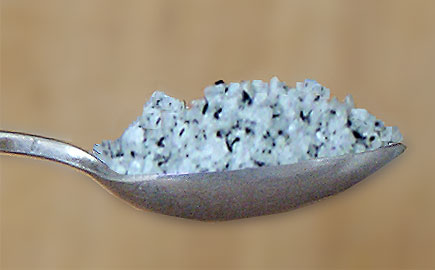
In Raising the World’s I.Q., dispatched from Rawalpindi, Pakistan, Kristof was talking about ‘a miracle substance that is cheap and actually makes people smarter’: iodised salt.

Here’s the context, as he put it:

“Almost one-third of the world’s people don’t get enough iodine from food and water. The result in extreme cases is large goiters that swell their necks, or other obvious impairments such as dwarfism or cretinism. But far more common is mental slowness.

“When a pregnant woman doesn’t have enough iodine in her body, her child may suffer irreversible brain damage and could have an I.Q. that is 10 to 15 points lower than it would otherwise be. An educated guess is that iodine deficiency results in a needless loss of more than 1 billion I.Q. points around the world.”

In nearly all countries, the best strategy to control iodine deficiency is iodisation of salt — one of the most cost-effective ways to contribute to economic and social development. Especially in these hard times, development professionals are looking for smart ways to get the biggest bang for their limited (and still shrinking) bucks. Investing in micronutrients – such as iodine – can provide some of the biggest bangs possible.
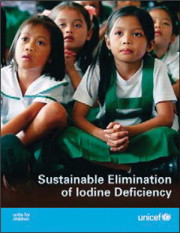
UNICEF Report 2008
UNICEF Report 2008
In June 2008, UNICEF published Sustainable elimination of iodine deficiency, a new report on progress since 1990 when the world’s governments set the target to eliminate iodine-deficiency disorders worldwide.

In October 2008, The Lancet, one of the world’s leading medical journals, published a report that noted: “Iodine deficiency is the most common cause of preventable mental impairment worldwide.”

The medical, public health and development communities have known and talked about iodine and other micronutrients for over 30 years. Significant progress has been made – for example, UNICEF says by 2006, more than 120 countries were implementing salt iodisation programmes, and 34 countries had managed to get rid of iodine deficiency among their people through this smart strategy.

But there still are major gaps — which continue to cause preventable damage to tens of millions of people including children.

Nicholas Kristof navigates through the heavy, jargon-ridden developmentspeak and churns out an eminently readable, accessible piece. It’s written in first person narrative from a part of the world where illiteracy, superstition – and their erstwhile companion, religious fanaticism – are trying to prevent people at risk from using iodised salt. This is science writing at its finest: anecdotal, personalised and purposeful.

And he’s absolutely right when he says iodised salt lacks glamour, doesn’t have too many stars or starlets singing its praise and (almost) no one writing about it despite its potential to improve lives for so many people.

I should know: one of the earliest topics I tackled as a young science reporter – getting started in the late 1980s – was salt iodisation. I struggled to put together a readable, engaging piece — which I then had to push through jaded editors who wondered what all this fuss was about.

I have only one (minor) bone to pick with Kristof. He pokes fun at Canada for hosting and supporting the Micronutrient Initiative, “an independent, not-for-profit organization committed to promoting simple cost-effective solutions for hidden hunger and developing innovative new solutions where needed.”

He calls Canada “earnest and dull, just like micronutrients themselves”. It’s a personal view – perhaps expressed with his tongue firmly in his cheek. Having travelled a fair amount in North America, and having good friends in both countries, I think that the nation north of the US-Canada border is a tad more civilised, certainly more caring and better engaged with the rest of the world.

But then, that too is a personal view. I’m darn lucky that I get enough iodine in my diet so that I can think for myself, keep asking lots of annoying questions…and occasionally even get some answers right.

Two billion people – almost a third of humanity – aren’t so lucky.

Read Raising the world’s I.Q. by Nicholas Kristof

Salt iodisation is not universally hailed. Read an alternative point of view that appeared in India’s Frontline magazine in 2006: Imposing iodine

TV Southasia: Nothing official about this, yipee!

TV South Asia

Nearly one year ago, I wrote a blog post titled: Channel South Asia? Yes and No!

My closing words at the time were:
“I, for one, am relieved that South Asian governments are unlikely to come together in such a venture – we’ve suffered long enough and hard enough with our state-owned, government-controlled, ruling party mouthpieces (both radio and TV) that pollute our airwaves (a public commons) every day and night. Euphemistically called ‘national television’, these conduits of governmental propaganda have progressively lost audience share — and influence — since private channels started operating in the early 1990s. They are today reduced to vanity channels for vane politicians and bureaucrats. The mass audience has long ago abandoned them. I’d rather take chances with a South Asian Murdoch, than with our unaccountable, selfish governments.”

Chevaan Daniel, head of Sri Lanka’s enterprising Channel One MTV, posted a comment soon afterwards, on 27 July 2007, saying: “Maharaja Channels have pioneered this for Sri Lanka, by joining together in an initiative involving media companies from India, Pakistan, Nepal and Bangladesh to launch ‘The SouthAsian’. This collaboration includes a weekly programme produced in Calcutta, aired at the same time in the region. The next step is indeed a SouthAsian Channel, which we are working towards.

Well, I’m delighted to find that over the past 12 months, they have indeed been investing time, creative effort and money in this venture. TV Southasia is now a reality!

It’s a collaborative venture of commercial broadcasters in five countries of South Asia, who have joined hands to produce and share content across their national borders. Mercifully, no governments are involved and certainly none of the state-owned broadcasters (Babu TVs) whose lack of vision and creativity is only matched by their depleting audiences these days.

TV Southasia

Indeed, there’s nothing official about TV Southasia (TVSA), and that’s to be celebrated on its own merit. And if they get it right, TVSA founders — Rtv of Bangladesh, TARANEWS of India, Image Channel of Nepal, Aaj TV of Pakistan and News 1st of Sri Lanka — can tap into an enviably large audience. Between them, their countries have more than 1.5 billion people, most of who have access to television.

TVSA founders are taking one step at a time, perhaps knowing very well that cross-border ventures in South Asia need to be nursed slowly and incrementally, while dealing with assorted historical hang-ups and tonnes of red tape (or these days the colour could well be saffron or khaki, depending on where you live!).

It all started when a group of broadcasters and activists from across South Asia came together in Kolkata in December 2006 and agreed to forge the Southasian initiative. They swapped content to start producing a half-hour magazine programme (containing news analysis, music, features and interviews) from April 2007. Called Southasian, it was produced by Taranewz drawing on content from the participating channels, who then broadcast it weekly and also made it available online.

Taking the next logical step, the five broadcasters decided in August 2007 to form a channel, branded as TV Southasia. It started being previewed on 19 April 2008.
Read more about TV Southasia on its own website

The channel is being distributed by Thailand’s ThaiCom5 satellite, and would be available through cable operators across South Asia. It’s an English language channel, based on the reality that English is the only link language shared and understood by all countries of South Asia.

TVSA says it’s concentrating on talk shows, interviews, lifestyle, music, short films, sports, cuisine and quiz — most of this content is already available through many national channels and occasionally from global channels too. But TVSA can bring in a trans-boundary, pan South Asian outlook which is largely missing in these channels. In fact, it would be refreshing to see a TV channel covering South Asia as a whole, without giving into the frequent pressures or temptations of national tribalism and geopolitical posturing that we see all the time on both BabuTVs and many commercial channels.

Click here for programme lineup on TV Southasia

I have so far only caught glimpses of their offering, when Channel One MTV shows the Southasian magazine show. Going by this limited exposure, I can confirm that the products of this collaboration are superior to what BabuTVs have been struggling to do for two decades through the very official (read: officious and unimaginative) framework of SAARC Audio-Visual Exchange, or SAVE.

Started in 1987, just two years after the South Asian governments formed the regional grouping called South Asian Association for Regional Cooperation or SAARC, SAVE brought together the so-called national broadcasters in radio and TV. Trapped in inter-governmental bureaucracies, they tried to share and carry each other’s broadcast content. The officially sanctioned programmes, often made by committees, completely failed to capture the diversity and vibrancy of what’s going on in each South Asian country that interests the rest of the sub-region. I have no idea if SAVE still exists, because I don’t watch BabuTV anymore (does anybody?). Even in its formative days, I could tell that SAVE was beyond saving…

TV Southasia

Enter TV Southasia – and not a moment too soon. As its website says: “It is for the first time in history that the private electronic media channels have come together and have formed a collaborative channel sharing the same view points on diversity, heritage, bondage and possibilities.”

Unlike many broadcast ventures, TVSA declares its agenda – and it’s a lofty one. It wants to promote highly desirable values like liberalism, scientific temperament, education, heritage and cultural diversity. Rather courageously, it also declares what it is explicitly opposed to, which includes superstition, fundamentalism, corruption, violence, cultural hegemony and communalism — the long and depressing list of evils that keeps hundreds of millions of South Asians in misery, fear and trapped at the bottom of the development ladder. Read TVSA’s vision, mission and ideals

This agenda resonates with the equally passionate, secular idealism of Ujala TV, another satellite broadcast venture aimed at beaming to South Asia since mid 2006. I have been cheering them from the beginning, while my organisation TVE Asia Pacific has been a regular supplier of factual programming for them. Read my July 2007 blog post on Ujala TV – Enriching South Asian airwaves

Well, we need as many idealists as we can find in South Asia. Encouragingly, TV Southasia has already involved Himal Southasian founder and editor Kanak Mani Dixit, a great champion of people-to-people collaboration in South Asia. Perhaps it’s due to Kanak’s influence that the brave new channel is spelling Southasia as one word, as Himal Southasian has been doing for some years now. It might seem an aberration in spelling to some, but in fact, it separates these entirely unofficial, people’s ventures from the many committees and initiatives of the official SAARC, which are endlessly meeting yet constantly failing to forge regional trust, cooperation and cohesion.

The official, officious and unproductive SAARC will be on parade once again at the next Summit due in late July 2008. My SAARCasm is shared by many journalists, intellectuals and activists across South Asia who have tracked the origins and evolution of this grouping since its founding in Dhaka in 1985. To put it charitably, at 23 years of age, SAARC has the mental development of a 3-year-old (if that). We only need to take a look at the People’s SAARC Declaration, adopted in Kathmandu in March 2007, to realise how much the official SAARC has failed to accomplish.

That’s in spite of its frequent and highly expensive meetings. Alas, this time they have chosen to meet in my city of Colombo, which means – after footing a massive Summit bill of LKR 2.8 billion (over USD 27 million) – we ordinary citizens will very likely be kept under virtual house arrest for its duration. All in the name of security, of course.

I hope I can catch a bit more of TV Southasia when the visiting SAARC-babus drive us off our own streets.

Photos and images all courtesy TV Southasia

Below – photos from TV Southasia launch

Arthur C Clarke: Of Nukes and ‘Impotent Nations’

The past few days have been particularly hectic for me as I was Sir Arthur Clarke’s spokesman for the past decade, and remain so for the time being. While handling literally dozens of media queries and requests from all over the world, I somehow managed to find the time to write an op ed essay on Sir Arthur’s life-long crusade against nuclear weapons.

This essay is based on a feature I wrote in 2002 for the now defunct (and sorely missed) Gemini News and Feature Service, but I rewrote it completely before sending it off to my newspaper editor and senior journalist friends across South Asia. It has so far appeared in full in:
Daily News (Sri Lanka), 22 March 2008
New Age (Bangladesh), 23 March 2008
The Hindu (India), on 30 March 2008
The News (Pakistan), 30 March 2008
Excerpts have been carried on the website of Himal Southasian (Kathmandu).

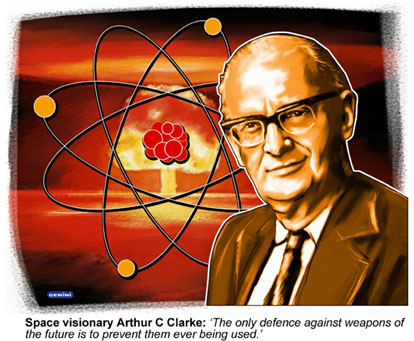
Here’s the 900-word essay in full with the Gemini illustration that accompanied my original article.

Arthur C Clarke: Of Nukes and Impotent Nations
by Nalaka Gunawardene
Colombo, Sri Lanka: 22 March 2008

arthur-c-clarke-and-nuclear-weapons-pix-by-gemini-news-2002.jpg

“Do you know about the only man to light a cigarette from a nuclear explosion?” Sir Arthur C Clarke was fond of asking his visitors a few years ago.

Clarke, the celebrated science fiction writer and space visionary who died on March 19 aged 90, loved to ask such baffling questions.

In this instance, the answer was Theodore (Ted) Taylor, a leading American nuclear scientist who designed atomic weapons in the 1950s and 1960s. Apparently he just held up a small parabolic mirror during a nuclear test — the giant fireball was 12 miles away – and turned light into heat.

“The moment I heard this, I wrote to Taylor, saying ‘Don’t you know smoking is bad for your health?'” Clarke added with a chuckle.

In fact, he took an extremely dim view of both smoking and nuclear weapons, and wanted to see them outlawed. But he was aware that both tobacco and nukes formed strong addictions that individuals and nations found hard to kick.

Years ago, Clarke had coined the slogan ‘Guns are the crutches of the impotent’. In later years, he added a corollary: “High tech weapons are the crutches of impotent nations; nukes are just the decorative chromium plating.”

Living in the Sri Lankan capital Colombo, the author of 2001: A Space Odyssey was acutely aware of tensions between neighbouring India and Pakistan – both nuclear weapon states.

British-born and calling himself an “ethnic human”, Clarke offered a unique perspective on nuclear disarmament. His interest in the subject could be traced back to his youth, when he served in the Royal Air Force during Second World War. As a radar officer, he was never engaged in combat, but had a ringside view of Allied action in Europe.

Shortly after the nuclear bombs in Hiroshima and Nagasaki ended the War, he wrote an essay “The Rocket and the Future of Warfare”. In that essay, first published in the RAF Journal in 1946, he said: “The only defence against the weapons of the future is to prevent them ever being used. In other words, the problem is political and not military at all. A country’s armed forces can no longer defend it; the most they can promise is the destruction of the attacker….”

Arthur Clarke’s continued his advocacy against the weapons of mass destruction to the very end. The lure and folly of nuke addiction is a key theme in his last science fiction novel, The Last Theorem, to be published later this year. He completed working on the manuscript, co-written with the American author Frederik Pohl, only three days before his demise.

From his island home for over half a century, Clarke was a keen observer of the subcontinent’s advances in science and technology. He personally knew some of the region’s top scientists – among them Indian space pioneers Vikram Sarabhai and Yash Pal, and Pakistan’s Nobel Laureate Abdus Salam.

When India carried out nuclear weapons test in May 1998, Clarke issued a brief statement saying: “Hindustan should be proud of its scientists – but ashamed of its politicians.”

He chided the mass euphoria that seemed, for a while at least, to sweep across parts of the subcontinent. He signed the statement as “Arthur C Clarke, Vikram Sarabhai Professor, 1980”.

That was a reference to three months he spent at the Physical Research Laboratory (PRL) in Ahmedabd, in western India, lecturing about peaceful uses of outer space. It was the only time he held the title ‘professor’.

Clarke’s direct associations with India went back further. In the early 1970s, he advised the Indian Space Research Organisation on the world’s first use of communications satellites for direct television broadcasting to rural audiences. Preparations for the Satellite Instructional Television Experiment (SITE) Project were underway when India carried out its first “peaceful explosion” of an atom bomb in 1974.

“I can still remember Vikram telling me how Indian politicians pleaded with him to ‘build a teeny weeny (nuclear) bomb’,” Clarke recalled in an interview in 2002.

india-pakistan-nuclear-rivalry-as-seen-by-himal-magazine.jpg
Cartoon: Indo-Pak nuclear and missile rivalry as seen by Himal Southasian

He returned to the subject when delivering the 13th Nehru Memorial Address in New Delhi in November 1986, which he titled ‘Star Wars and Star Peace’. He critiqued the Strategic Defence Initiative (which President Reagan called ‘Star Wars’) – a nuclear ‘umbrella’ over the United States against missile attacks. Clarke argued that SDI was conceptually and technologically flawed, and that its pursuit could hurt America’s lead in other areas of space exploration.

Prime Minister Rajiv Gandhi rejoined from the chair: “Forty years ago, Dr Clarke said that the only defence against the weapons of the future is to prevent them from being used…. Perhaps we could add to that, we should prevent them from being built. It’s time that we all heed his warning….I just hope people in other world capitals also are listening…”

While campaigning against nuclear weapons, Clarke was equally concerned about all offensive weapons. “Let’s not forget the conventional weapons, which have been perfected over the years to inflict maximum collateral damage,” he said in a video address to the 50th anniversary celebrations of the Pugwash Movement in October 2007. “If you are at the receiving end, it doesn’t matter if such weapons are ‘smart’ or stupid…”

As tributes to Arthur C Clarke from all corners of the planet confirm, he commanded the world’s attention and respect. His rational yet passionate arguments against warfare were heard, though not always heeded in the corridors of power and geopolitics.

For such people, he had the perfect last words from his own hero, H G Wells: “You damn fools – I told you so!”

Pugwash Movement on the death of Sir Arthur C Clarke

India and Pakistan: Still struggling to grow up at 60!

See 23 March 2008 related story: Arthur C Clarke – Of Nukes and Impotent Nations (commentary on nuclear arms race in South Asia)

Today, 15 August 2007, India marked its 60th anniversary of political independence from the British. Pakistan, which was created by the British partitioning of India at the time of independence, marked their 60th birthday yesterday.

So here’s wishing the Indo-Pak combine a meaningful 60th.

For human beings, 60 is a landmark age. In some cultures, it marks the beginning of senior citizen stage. Wisdom, maturity and exemplary conduct are assumed and expected of those reaching 60.

When it comes to nation states, however, things don’t quite work that way. India and Pakistan at 60 are a good example.

Yes, they have made significant advances on many fronts in the past six decades. But before that progress can be celebrated, we have to take note of the political and socio-economic turmoil that these two nations — harbouring close to 1.5 billion human beings between them — find themselves in.

Those tensions are exacerbated by the bitter nuclear arms race between these two still-impoverished nations.

When it comes to geopolitics of nuclear weapons, India and Pakistan behave worse than two sill school boys. This is how my friends at Himal Southasian magazine summed it up brilliantly:

india-pakistan-nuclear-rivalry-as-seen-by-himal-magazine.jpg

And here’s another Himal cartoon which punctures the juvenile male obsession with weapons of mass destruction:

Image courtesy Himal Southasian

So let’s hope that the 60-year-olds will finally begin to act their age at least now!

Remembering Saneeya Hussain

20 April 2007: It’s exactly two years ago that Saneeya Hussain left us.

Saneeya was a journalist who took a special interest in environment and human rights issues. All her working life, she campaigned tirelessly for a cleaner, safer and more equitable society for everyone — not just in her native Pakistan, but everywhere.

Ironically, it was the urban nightmare that we have collectively created that finally snatched her away at the prime of her career. She was 51.

saneeya-hussain.jpg

I first met Saneeya when we both worked for the same global organisation – IUCN, The World Conservation Union. She headed IUCN Pakistan’s Communication Division while I started a similar division for IUCN in Sri Lanka in the early 1990s. In fact, the trails she and her team had blazed in Pakistan was a model and inspiration for us.

In 1998, Saneeya moved to Cape Town in South Africa to work with the World Commission on Dams, an independent group of experts that had a tough mandate: consult widely to resolve the controversial issues associated with large dams. When the Commission held its South Asia consultations in Colombo, Sri Lanka, Saneeya approached us at TVE Asia Pacific to handle all the media relations.

It was while working in Cape Town that Saneeya met Luis Ferraz, a Brazilian geographer, whom she married later.

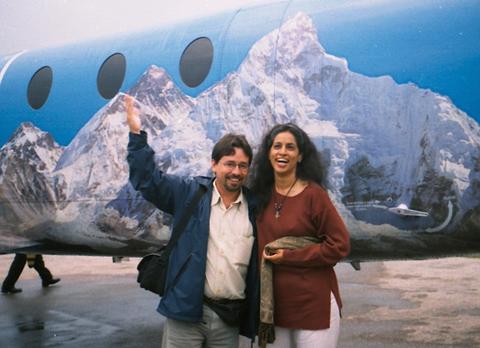
saneeya-and-luis-taking-an-everest-flight.jpg

In 2002, Saneeya became the Executive Director of Panos South Asia, a regional media organisation with its headquarters in Kathmandu, Nepal. As a Board member of Panos, I worked closely with Saneeya in a number of projects and activities.

Although everyone at Panos and in Kathmandu liked her, Saneeya’s stay there was cut short by what her successor at Panos, A S Panneerselvan, called her Siamese twin: asthma.

It was asthma that forced Saneeya to leave Nepal – and the Panos director’s job – as she just couldn’t cope with Kathmandu’s polluted air. As a fellow asthmatic, I fully empathised with her. She moved to Sao Paulo, where she set up what was to be her final home.

What happened in April 2005 has been written and discussed widely by Saneeya’s far-flung network of friends in the past two years. I can only reproduce the last few paras of a tribute I wrote in May 2005, which was privately circulated at the time:

When Saneeya suffered an acute attack of asthma in Sao Paulo on April 7, her husband Luis rushed her to hospital in his car. It was rush hour at 6.30 in the evening, and it took him 20 minutes to drive to the hospital only 2 kilometres away. Saneeya — who had walked to the car — stopped breathing five minutes into the journey. Luis drove as fast as the traffic would allow him, but as it turned out, not nearly fast enough.

Her brain suffered too much damage due to oxygen deprivation, and she never recovered.

As Luis was to remark later, it was not asthma but the traffic that killed Saneeya.

Similar tragic scenarios unfold on South Asia’s mean streets every day. Heart and stroke patients fail to reach help in time. Ambulences and fire engines, with their sirens blaring, only manage to proceed at a snail’s pace. It’s not uncommon for expectant mothers in labour to give birth on their way to hospitals. Then there is the slow, insidious poisoning that goes on 24/7.

So let us be forewarned. If the air pollution doesn’t get us, the traffic jams will. And if we survive both, our road accidents will wait for us. It’s only a matter of time.

Not one but several serial killers are out there.

And we unleashed them all.

beena-sarwar-left-and-saneeya-hussain-photo-courtesy-b-sarwar.jpg

Our mutual friend Beena Sarwar (in the photo above, with Saneeya) has made a 14-minute documentary called Celebrating Saneeya. It was screened at the 5th Karachi International Film Festival in December 2005.

See also my essay ‘Grappling with Asia’s Tsunami of the Air’ (December 2006).

All photos from Saneeya Yahoo Group that links her friends around the world.