He was recognised ‘for his provocative cartoons that rely on originality, humor and detailed artistry’. This is his second Pulitzer, having earlier won the same award in 1994 for his work published in Commercial Appeal, Memphis, Tennessee, USA.
This morning, I spent a couple of enjoyable hours browsing through the archive of his political cartoons for the past one year. He doesn’t conceal his right wing political loyalties, but despite this, I could appreciate the satire and originality of his cartoons.
As I’ve said before, when it comes to the economy of words, political cartoonists are the most efficient commentators in journalism.
Here are a few of his cartoons that touched on the state of media and publishing over the past few months:
Ramirez is a Lincoln Fellow and has won several awards during his career, including the 1994 Pulitzer Prize, the UCI Medal from the University of California, Irvine and the Sigma Delta Chi Awards in 1995 and 1997. He has been the editorial cartoonist of the Los Angeles Times, the Commercial Appeal and USA Today, and is nationally syndicated in over 450 newspapers around the world.
A wounded Japanese photographer, Kenji Nagai, lay before a Burmese soldier yesterday in Yangon, Myanmar, as troops attacked protesters. Mr. Nagai later died. Published 28 September 2007 (Adrees Latif, Reuters)
This dramatic photograph, one of the harrowing and yet enduring images of 2007, has just won its photographer a Pulitzer Prize, announced in New York on 7 April 2008.
Ironically, the last defiant act of one courageous photojournalist has landed one of journalism’s most prestigious awards for another of his kind. Adrees Latif, a Pakistan-born American, had concealed his identity by blending in with the crowd in Rangoon/Yangon, and captured Nagai’s killing on film.
For a distinguished example of breaking news photography in black and white or color, which may consist of a photograph or photographs, a sequence or an album, in print or online or both, Ten thousand dollars ($10,000).
Awarded to Adrees Latif of Reuters for his dramatic photograph of a Japanese videographer, sprawled on the pavement, fatally wounded during a street demonstration in Myanmar.
Born in Lahore, Pakistan on July 21, 1973, Adrees Latif lived in Saudi Arabia before immigrating with his family to Texas in 1980. Latif worked as a staff photographer for The Houston Post from 1993 to 1996 before joining Reuters. Latif graduated from the University of Houston in 1999 with a Bachelor of Arts in Journalism. Latif has worked for Reuters in Houston, Los Angeles before moving to Bangkok in 2003 where he covers news across Asia.
Latif’s collection of photos from his days in Burma, “Myanmar Marooned,” recently won an award given by the prestigious Japanese photographic magazine Days Japan.
I seem to be writing many obituaries and tributes these days. Following the several I wrote on Sir Arthur C Clarke and the blog post I did on Cambidian photojournalist Dith Pran, I want to share this tribute I wrote today on a senior Sri Lankan journalist who embarked on her final voyage this weekend.
Mallika Wanigasundara:
Trail-blazer in issue-based journalism
Mallika Wanigasundara, who passed away on 4 April 2008 aged 81, was a talented and sensitive Sri Lankan journalist who went in search of causes and process that shape the everyday news headlines. In doing so, she blazed new trails in issue-based journalism, covering topics ranging from health and environment to children, women and social justice.
It was only last year that the Editors Guild of Sri Lanka and the Sri Lanka Press Institute presented her the Lifetime Achievement Gold Medal for Excellence in Journalism.
Mallika was associated with the Sri Lankan media in one capacity or another for over half a century. Starting her professional career in 1956 with the Sinhala evening daily Janatha, she later moved on to English language journalism at Lake House where she worked first in The Observer and then at Daily News. It was as Features Editor of this oldest English daily that she played a key role in practising and nurturing development journalism. She helped evolve the genre to new levels of professionalism, liberating it from the typecast of politically motivated, sometimes fabricated ‘sunshine’ stories that had been forced on the state-owned Lake House newspapers during the 1970s.
Mallika also helped put Sri Lanka on the world map of development journalism. Beginning in the early 1980s, she contributed Sri Lankan stories to Depthnews, published by the Press Foundation of Asia based in Manila, and to Panos Features, syndicated globally by the Panos Institute in London. In those pre-web days, these services – when printed in newspapers and magazines – were among the most dependable sources for ground level reporting from far corners of the world. (Alas, both services have since gone the way of the Dodo – not to mention Asiaweek, South and Gemini.)
Although I grew up in the 1980s reading her writing in Daily News, my own contacts with Mallika were few and far between. The first was indirect and happened in the late 1980s, when as an eager young reporter I started contributing to Panos Features, syndicated from London to several hundred newspapers around the world. Mallika remained the Panos Sri Lanka correspondent and I was merely a stringer. Donatus de Silva, then head of programmes at Panos London, somehow found a clear niche for both of us. At the time, Mallika and I exchanged occasional communications.
As a novice, I studied Mallika’s approach and style, and emulated them both. Hers was an easy, reader-friendly prose: it brought in both expert views and grassroots insights, but with none of the technicality or pomposity – and very little editorialising. Although she was fully supportive of the various social and environmental causes, she didn’t allow activist rhetoric to dominate her journalism. She also ventured beyond the predictable ‘green’ issues to cover many ‘brown’ issues. Two decades after the Brundtland Commission on Environment and Development (1987) that thrust sustainable development into the global agenda, it’s precisely this kind of journalism that’s needed to make sense of our fast-moving, slowly-baking, topsy-turvy world.
Mallika continued to be an active freelancer after she retired from Lake House. She seemed more prolific in retirement – she continued to chronicle the rise of the environmental movement in Sri Lanka, which emerged from citizen campaigns to save the Sinharaja rain forest from state-sponsored logging and evolved through crises and protests in the 1980s and beyond.
In 1990, she was selected by the United Nations Environment Programme for the Global 500 award that recognised environmental achievements of individuals and organisations. She was the first Sri Lankan journalist to be thus honoured, and one of only four Sri Lankans to be inducted into this global roll of honour that eventually included over 600 persons or entities worldwide.
At the time, I was hosting a weekly TV quiz show on Rupavahini (national TV) and decided to set one of my questions on Mallika receiving the Global 500. I phoned her to offer my congratulations and asked for a photo that we may use on the TV show. She was happy to be the basis of a question, but declined giving a photo, saying: ‘I don’t look good in photos or on TV’.
It was characteristic of many accomplished journalists of her generation that they remained mostly in the background, shaping news coverage and analysis. Some even didn’t nurture a personal by-line, writing under pseudonyms or simply not signing their names on their work. What a contrast with the image-conscious, in-your-face radio and TV journalism of today, where even respected newspaper editors eagerly pursue parallel careers as talk show hosts or TV pundits.
Dith, who died on March 30 in New Jersey, USA, had both the talent and tenacity for his chosen profession. His experience as an interpreter for The New York Times, for which he later worked as a photographer after migrating to the US, and his ordeal surviving the Khmer Rouge became the basis of the Hollywood movie The Killing Fields (1984).
Watch the trailer for The Killing Fields here:
Here’s Dith’s story as summed up in his Wikipedia entry:
In 1975, Pran and New York Times reporter Sydney Schanberg stayed behind in Cambodia to cover the fall of the capital Phnom Penh to the communist Khmer Rouge forces. Schanberg and other foreign reporters were allowed to leave, but Pran was not permitted to leave the country. When Cambodians were forced to work in forced labor camps, Pran had to endure four years of starvation and torture before finally escaping to Thailand in 1979. He coined the phrase “killing fields” to refer to the clusters of corpses and skeletal remains of victims he encountered during his 40-mile escape. His three brothers were killed back in Cambodia.
“I’m a very lucky man to have had Pran as my reporting partner and even luckier that we came to call each other brother,” Schanberg was quoted in the New York Times tribute to Dith Pran. “His mission with me in Cambodia was to tell the world what suffering his people were going through in a war that was never necessary. It became my mission too. My reporting could not have been done without him.”
In another tribute to Dith, the executive editor of the New York Times, Bill Keller, said: “To all of us who have worked as foreign reporters in frightening places, Pran reminds us of a special category of journalistic heroism — the local partner, the stringer, the interpreter, the driver, the fixer, who knows the ropes, who makes your work possible, who often becomes your friend, who may save your life, who shares little of the glory, and who risks so much more than you do.”
This is a highly significant statement, coming from a major media house of the western world. Acknowledging – let alone celebrating – the contributions of unsung local counterparts is not yet a routine practice among many western media professionals covering the global South. More often then not, the fixers are used, paid and dismissed. They are lucky to get proper credit. And if things go wrong, the western media companies would bring in top lawyers and diplomatic pressures to get their own out of trouble; never mind what happens to the locals who are part of that same team.
Even after being released, Saleem Samad was hounded and harassed in his native country that he went into exile in Canada. Read his profile here, and connect to his blog.
This scenario keeps repeating with different names and in different southern locations all the time. In such a harsh, selfish world, Dith Pran was certainly fortunate to have worked with Sydney Schanberg who stood by and for his local colleague. When Schanberg returned to the US and was awarded a Pulitzer Prize for his reporting from Cambodia, he accepted it on behalf of Dith as well.
Schanberg continued to search for, and write about Dith in newspaper articles – one was in The New York Times Magazine, in a 1980 cover article titled “The Death and Life of Dith Pran., which later became a book by the same title in 1985. Dith’s story became the basis of The Killing Fields.
Haing Ngor, the Cambodian-American doctor who played Dith Pran in the movie, worked with Dith in real life to promote human rights in their native Cambodia and to prevent genocide everywhere. Ngor was shot dead in 1996 in Los Angeles.
As the New York Times noted, Dith’s greatest hope was to see leaders of the Khmer Rouge tried for war crimes against his native country; preparations for these trials are finally under way.
A 1974 photo by Mr. Dith of the wife and mother of a government soldier as they learned of the soldier’s death in combat southwest of Phnom Penh. (Photo: Dith Pran/The New York Times)
In 1979, Mr. Dith escaped over the Thai border. He returned to Cambodia in the summer of 1989, at the invitation of Prime Minister Hun Sen. At left, Mr. Dith visited an old army outpost in Siem Riep where skulls of Khmer Rouge victims were kept. (Photo: Steve McCurry/Magnum)
Mr. Dith joined The Times in 1980 as a staff photographer. He photographed people rallying in Newark in support of the rights of immigrants on Sept. 4, 2006. (Photo: Michael Nagle/Getty Images)
It’s titled: When citizens turn on journalists Nalaka Gunawardene describes the disturbing trend of vigilantism against professional and citizen journalists
Once again I talk about the multiple pressures and risks faced by mainstream and citizen journalists alike when they try to cover matters of public interest in my native Sri Lanka. This is particularly so for photojournalists and videographers who simply must go out with tools of their profession.
Here are the few opening paras:
Friday, February 29, 2008
Colombo — For over two decades, Sri Lanka’s state-owned radio and television stations — located next to each other in residential Colombo — have been heavily guarded by police and army. This fortress-like arrangement is due to their being high on the list of targets for Tamil Tigers engaged in a bitter separatist war for a quarter century.
The joke is that the stations are just as likely to be attacked by outraged listeners or viewers. Considering the endless state propaganda they dish out day and night, that’s not as far-fetched as it sounds.
But shooting the messenger never solves any problem, as Sri Lanka’s deeply divided combatants — and their die hard supporters — need to be constantly reminded. Attacks on journalists and media organisations have increased several fold in the past two years, and the World Association of Newspapers ranked Sri Lanka as the third deadliest place for journalists (six killed in 2007) — behind only Iraq and Somalia.
As if this was not depressing enough, we have seen another disturbing trend emerge: authorities and citizens alike turning on reporters and photojournalists in public places, suspecting them to be agents of mayhem and terror.
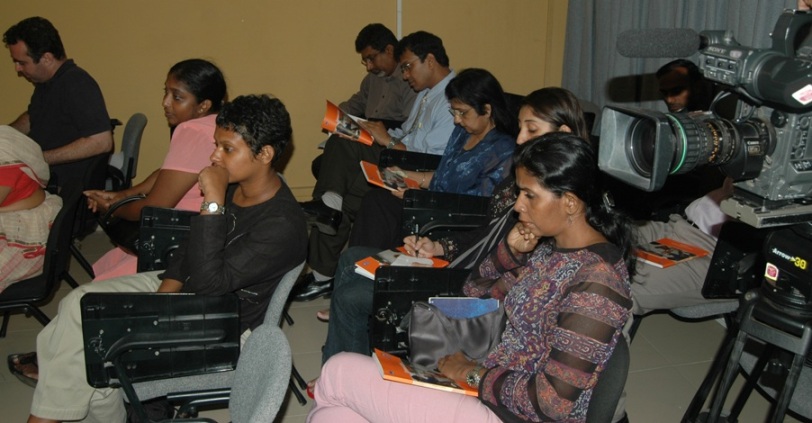
The multi-author book focusing on how information, education and communication can help create disaster resilient communities across the Asia Pacific was released at the auditorium of Sri Lanka Press Institute (SLPI) in Colombo.
We had invited all contributing authors who are based in Sri Lanka. Six of our 21 contributors currently live in Greater Colombo, and four of them made it: Patrick Fuller, Buddhi Weerasinghe, Manori Wijesekera and myself. We missed Sanjana Hattotuwa (who is overseas) and Chanuka Wattegama.
Photojournalists usually bear witness to unfolding events, and then share it with the rest of us. It’s not everyday that they make the news themselves.
This photojournalist, Gemunu Amarasinghe working for Associated Press in Sri Lanka, just did. Earlier this week, he was detained, questioned and released by police — all for taking photographs near a well-known Colombo school.
According to news reports, Gemunu was apprehended by a group of parents who formed the school’s civil defence committee. They had handed him over to soldiers on duty near by, and he was briefly detained by the Narahenpita police. Sri Lanka’s Free Media Movement has already protested to the police chief on this – the latest in a series of worrying incidents.
In an op ed essay published today on the citizen journalism website Groundviews, I have discussed the far reaching implications of this latest trend – when misguided citizens turn on professional or citizen journalists simply taking photos in public places. That’s still not illegal in Sri Lanka, where many liberties have been curtailed in the name of anti-terrorism.
As I write: “Gemunu’s experience is highly significant for two reasons. Firstly, it is depressing that some members of the public have resorted to challenging and apprehending journalists lawfully practising their profession which responds to the public’s right to know. Battered and traumatised by a quarter century of conflict, Sri Lankan society has become paranoid. Everything seems to be ‘high S’: practically every city corner a high security place; every unknown person deemed highly suspicious; and everybody, highly strung.
Cartoon from Daily Mirror, Sri Lanka
“Secondly, far from being an isolated incident, this seems to be part of a disturbing new trend. Anyone with a still or video camera in a public place is suspected – and presumed guilty until proven otherwise. This endangers everyone’s basic right to click for personal or professional purposes.”
I mention some examples of this cameraphobia. In recent months, pedestrians who filmed public bomb attacks on their mobile phones have been confronted by the police. One citizen who passed on such footage to an independent TV channel was later vilified as a ‘traitor’. Overly suspicious (or jealous?) neighbours called the police about a friend who was running his video editing business from home in suburban Colombo.
None of these individuals had broken any known law. Yet each one had to protest their innocence.
It may not be illegal, but it sure has become difficult and hazardous to use a camera in public in Sri Lanka today. Forget political demonstrations or bomb attacks that attract media attention. Covering even the most innocuous, mundane aspects of daily life can be misconstrued as a ‘security threat’.
I stress the point that, unlike journalists working in the mainstream media, citizen journalists lack trade unions or pressure groups to safeguard their interests. The citizen journalist in Sri Lanka is very much a loner — and very vulnerable.
And it’s not just in war-torn Sri Lanka that the right to take photos or film video is under siege. I cite a recent example from what is supposed to be a more liberal democracy: in the US, where New York city officials last year proposed new regulations that could have forced tourists taking snapshots in Times Square and filmmakers capturing street scenes to obtain permits and $1 million in liability insurance. The plans were shelved only in the face of strong public protests, spearheaded by an Internet campaign that included an online petition signed by over 31,000 and a rap video that mocked the new rules. Photographers, film-makers and the New York Civil Liberties Union played a lead role in this campaign, which asked people to ‘picture New York without pictures of New York’.
“One death is a tragedy. A million deaths is just a statistic,” said Joseph Stalin — and he knew what he was talking about.
These words came to my mind as I followed the news coverage and commentary about the death on 27 January 2008 of Suharto, the former Indonesian military leader, and the second President of Indonesia, who was in office from 1967 to 1998.
Many western and globalised media reports touched on Suharto regime’s alleged mass-scale corruption, and the dizzy heights that crony capitalism reached under his watch.
But few talked about the genocide of unarmed, innocent civilians that took place in the years that brought him to power, 1965-67. Another blood bath took place in 1975 when Indonesian forces invaded and took over East Timor. Even those that touched on the subject used varying estimates of how many perished.
In all probability, no one really knows the real number of Indonesians were slaughtered as the army – cheered by anti-communist west – cracked down on members and supporters of the Communist Party of Indonesia, at that time a legal political party. Genocidists don’t like to keep detailed records.
NYT added: “His rule was not without accomplishment; he led Indonesia to stability and nurtured economic growth. But these successes were ultimately overshadowed by pervasive and large-scale corruption; repressive, militarized rule; and a convulsion of mass bloodletting when he seized power in the late 1960s that took at least 500,000 lives.”
On the whole, however, the mainstream media has been far more preoccupied with the (admittedly important) issue of how much Suharto and family stole than how many people were killed extra-judicially during his regime.
His opening para: “Coverage of the fall of Suharto reveals with startling clarity the ideological biases and propaganda role of the mainstream media. Suharto was a ruthless dictator, a grand larcenist and a mass killer with as many victims as Cambodia’s Pol Pot. But he served U.S. economic and geopolitical interests, was helped into power by Washington, and his dictatorial rule was warmly supported for 32 years by the U.S. economic and political establishment. The U.S. was still training the most repressive elements of Indonesia’s security forces as Suharto’s rule was collapsing in 1998, and the Clinton administration had established especially close relations with the dictator (“our kind of guy,” according to a senior administration official quoted in the New York Times, 10/31/95).”
Suharto’s demise reminded me of a powerful short documentary I saw a few years ago. Titled Mass Grave Indonesia, it was directed by courageous young Indonesian journalist Lexy Junior Rambadeta (photos below).
He works as a freelance TV journalist for international news agencies, and is a key member of the Jakarta-based media collective Off-Stream. It was started Off Stream in 2001 by journalists, filmmakers, photographers and multimedia artists “who have strong commitments and creativities on catering, promoting, covering, documenting and producing multiculturalism documentary video/film, photography and multimedia products”.
OffStream lists as its mission: To give a voice to “survivors of horror”; To tear down walls of “silence”; and To denounce “injustice” and “barbarism”.
One of their first productions was Mass Grave Indonesia, whose synopsis reads:
“Approximate between from 500 000 to 3 million of people in Indonesia have been killed by Soeharto’s regimes and buried somewhere in the wood distributed. A full and frank account of what happened in the reburial of 26 victims of horror in the 1965 mass killings. This documentary film weaves its story against the tide by presenting evidence of cruelties sponsored by the military in two regions of Central Java.”
I have just tracked down the 19-minute film on YouTube, presented in two parts:
Mass Grave – Indonesia: Part 1 of 2
Mass Grave – Indonesia: Part 2 of 2
This is no western film, filmed by visiting foreign journalists who might be accused of having one agenda or another. This is a film made by Indonesia’s own journalists who found their voice and freedom after the Suharto regime ended in 1998.
I have emailed Lexy this week asking how this film – and agitation by many human rights and democracy activists – have helped bring about belated justice to his own people. I await his reply, which will be published when received.
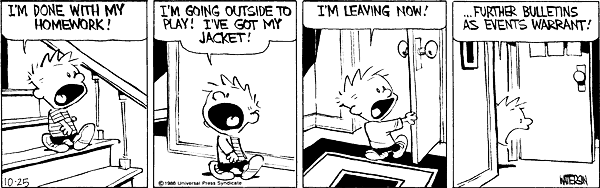
This came in a few days ago – as part of my daily diet of emailed Calvin and Hobbes comic strips sent free by Go Comics.
It reminded me of our South Asian governments and many 24/7 news channels who sound just like Calvin.
Governments – at least in popularity-conscious democracies – are constantly trying to create news, even when there is nothing new, true or interesting (the triple test for news). There’s a lot more rhetoric, plans and claims than actual accomplishments.
TV news channels, having to fill 24 hours of the day, cover news needlessly and in endless repetitions and detail. (By the way, covering news needlessly is an irreverent expansion of the abbreviation CNN!).
Actually, I shouldn’t compare either entity with the smart six-year-old Calvin. He is a great deal more interesting on an on-going basis than most of our governments and much of our news media.
I’m a long-standing fan of the comic – and followed it while Bill Watterson was still drawing them from 1985 to 1995. It was a sad day indeed when he decided on 31 December 1995 not to draw any more Calvin and Hobbes.
“In a global information society where there is a constant race for who delivers the news first, such news undoubtedly fill a need — the need to know. But does reporting on disaster, conflict, international politics or other issues, throw up other questions beyond ‘what happened’? Questions like: What does this mean? How did this happen? How do other communities cope? Are the funds being put to good use? Is the kind of assistance coming in sensitive to different communities’ needs? Which communities are left out from receiving aid and why?
“These are some of the questions that beg to be delved into, and are the niche for media organisations, whose mission it is to try to look at the bigger picture and put the issues behind the events in context. This is not to say that some are always better than others. It is a way of stressing that ‘media’ are far from a homogenous crowd, and that different media organizations have different media products, stemming from different assessments of their audiences and mission.”
This is an extract from the chapter titled “The 2004 Tsunami: Unfinished Story”, by journalist Johanna Son for Communicating Disasters: An Asia Pacific Resource Book (co-edited by Nalaka Gunawardene and Frederick Noronha, and released in December 2007).
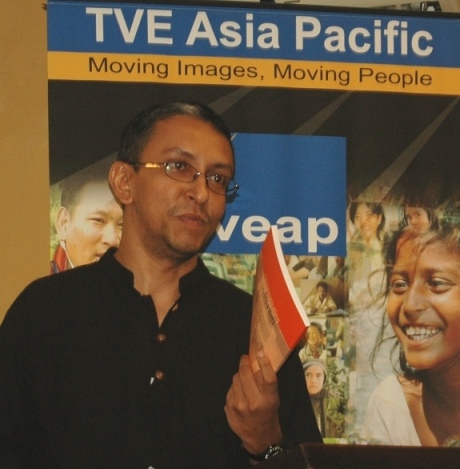
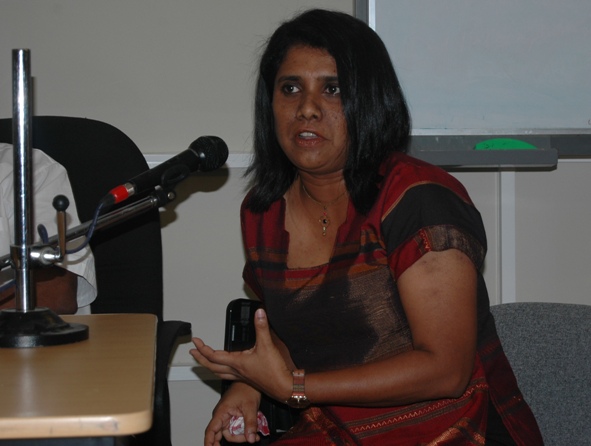
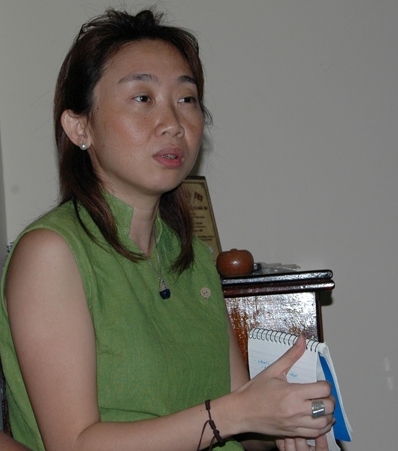
Johanna (photographed below addressing TVE Asia Pacific staff in August 2007), a journalist for two decades, is director of Inter Press Service (IPS) Asia-Pacific, the regional foundation that is part of the IPS international news agency. A Philippine national, Son was previously correspondent and editor for IPS Asia-Pacific, as well as staffer of the Manila Chronicle.
How many ways are there to report on a disaster? Johanna uses examples from IPS to ‘do a post-mortem of sorts in the spirit of sharing the challenges of covering disasters like that of the tsunami and of learning from one another.’
Here are some more extracts – the full chapter will be placed online in January 2008:
“On 26 December 2004, I was in Manila, the Philippines, for the year-end holidays when the newsbar across the screens of international TV networks began flashing reports that “scores” were believed to have been killed by a tsunami in the Indian Ocean. It was, we were told, triggered by an undersea earthquake recorded at up to 9.3 magnitude on the Richter Scale. (This has since been called the second most powerful earthquake ever recorded by a seismograph.)
“In the following hours, the number kept rising – first to “hundreds” then to “thousands”. Even without much detail and description, it was clear this was quite a different disaster. News desks around the world went into action.
“The editor for my region was on holidays in Africa. So I was in touch with our regional correspondent, who was then on holidays in Sri Lanka, and also in contact with a regular contributor from Colombo, as well our correspondent in India. We agreed on a few story angles, trying to focus not on what had already been reported and added little to the avalanche of stories out there, but on how, for instance, the effects of the tsunami interplayed with the ethnic tensions in Sri Lanka.
“A look back at the coverage on the IPS wire — ipsnews.net — at that time shows two different kinds of stories in the days and weeks after December 26. Some were more obvious, predictable ones, and other more contextual ones that, regardless of where they were filed from, hew more closely to the news agency’s mission of trying to provide reporting that explains – and not only records what is happening.”






 Cartoon from Daily Mirror, Sri Lanka




 Open Minds!