Arthur C Clarke Institute in Sri Lanka: Time to ask some tough questions!

Read also: 4 Oct 2011: A Tale of Three Telescopes and a Blind News Media
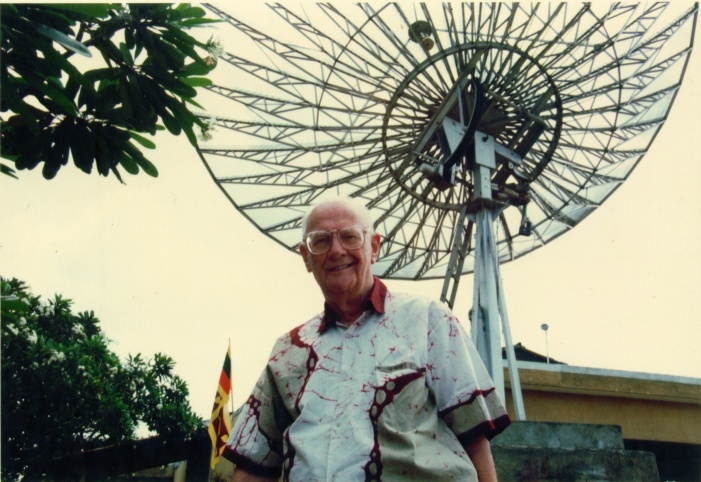
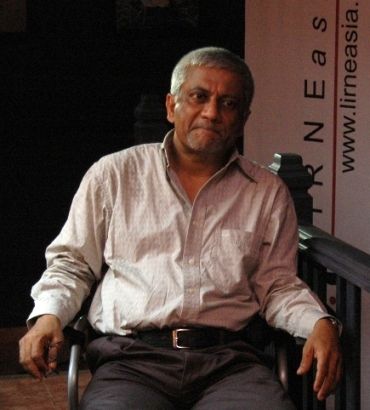
Sir Arthur C Clarke at the ACCIMT in better times

For many years, I’ve been explaining and clarifying to everyone that I worked with the late Sir Arthur C Clarke in his personal office in Colombo, which was completely separate from a government entity named the Arthur C Clarke Institute for Modern Technologies in Moratuwa, Sri Lanka. This is not just an institutional demarcation; the latter body set up by the government of Sri Lanka in 1984 and sustained since then with public funding has completely under-served its founding ideals and remains mediocre and unproductive after a quarter century. I have no wish to be associated, even mistakenly, with such an entity.

I remained quiet about this for as long as Sir Arthur was alive, as it was not tactful for me – as part of his team – to criticise a state entity named in his honour. A year after his death, I broke that silence and wrote a media article which was published in the current affairs magazine Montage in April 2009.

That elicited some strange ‘reader comments’ on the magazine’s website — several of which alleged that I was a ‘traitor’ who was out to discredit the hard-working (‘Sinhala Buddhist’) engineers and managers of this institute! I could not fathom how and why the staff’s ethnicity or religious faith was relevant.

Beyond such vitriol, these pseudonymous ‘readers’ never once responded to my specific questions about the public-funded institute’s scientific productivity and public accountability.

Unfortunately, Montage went out of publication and its website, which was located at http://www.montagelanka.com, is also no longer available online. So in the public interest, I’m reproducing my article below, unedited as it appeared in print in April 2009. Alas, I never saved the online comments so those are probably lost forever…

As always, this blog is open to a rational discussion of the core issues raised below, as all the concerns still remain valid. And there are no ‘sacred cows’ in my book!

* * * * *

Published in Montage magazine, Sri Lanka; April 2009 issue (print issue and
originally online at: http://www.montagelanka.com/?p=1476)

Monument for Sir Arthur C Clarke: Time to ask some tough questions

By Nalaka Gunawardene

As the first death anniversary of Sir Arthur C Clarke approaches, Lankans are still debating how best to cherish the memory of the celebrated author and visionary who called the island his home for more than half a century.

Ours is a land where private individuals — and governments –- just love to put up ostentatious and often superfluous structures to honour the departed. We typically don’t assess their cost-effectiveness or utility. Neither do we pause to ask how the person being honoured would have felt about it.

The Telecommunications Regulatory Commission of Sri Lanka (TRCSL) recently announced plans to launch the country’s first satellite, which is to be named after Sir Arthur. According to news reports, it will be launched into low earth orbit (LEO) at an estimated cost around US$ 20 million.

Would naming Sri Lanka’s first satellite be a fitting tribute to Sir Arthur, universally acclaimed as inventor of the communications satellite (comsat)? Or should a monument to this ‘one man cheering squad for Sri Lanka’ be more rooted in the Lankan soil, where people can see and feel its presence everyday? And, by the way, what about the state technical institute in Moratuwa that already bears the Arthur Clarke name?

Sir Arthur, with whom I worked closely for 21 years as an aide and a decade as spokesman, would surely have wanted an open and frank debate on this matter. He opted for rational, evidence-based decisions based on cost-benefit analysis. He frowned upon grandiose plans made for their own sake, whether their implementation was going be paid for by public or private funds.

Besides, he already had an asteroid, dinosaur species and a geostationary comsat named after him during his lifetime. Topping that without going over the top would be a challenge indeed.

A living legacy

The tussle for the Clarke legacy started within hours of his death on 19 March 2008. He had left clear written instructions for his funeral to be held on a strictly secular and austere basis. He didn’t want any decorations, and explicitly disallowed official involvement by British or Lankan governments.

As this news spread, it fell on me to explain to government officials why offers of a state funeral and other types of state patronage could not be accommodated. This raised some eyebrows and dashed hopes of some who wanted to turn the sombre event into a carnival. In the end, the state appealed for a symbolic radio silence of two minutes to coincide with the funeral.

In the weeks and months that followed, many have asked me what kind of monument was being planned in Sir Arthur’s memory. The answer, as far as the Arthur Clarke Estate is concerned, is none –- and this seems to surprise many.

Yet it is entirely consistent with Sir Arthur’s personality and vision: he never sought personal edifices in his honour or memory. When a journalist once asked him about a monument, he said: “Go to any well-stocked library, and look around…”

That evokes memories of the well known epitaph for Sir Christopher Wren, one of the greatest architects of all time, who significantly changed London’s skyline: “Lector, Si Monumentum Requiris Circumspice”(“Reader, if you seek his monument, look around”). It also begs the question why Sir Arthur chose not to make any mention of the physical entity that already bore his name: the Arthur C Clarke Institute for Modern Technologies (ACCIMT).

Indeed, the ACCIMT is today a perfect example of a good idea gone astray, becoming a disgrace to the very man it was meant to honour. How did things go wrong to the point where Sir Arthur Clarke distanced himself from the Arthur Clarke Institute in the last few years of his life? These thorny questions need to be asked now that we are discussing matters of legacy.

The world was very different, and aspirations were very high, when ACCIMT was established in 1984 by an Act of Parliament to help transfer and adopt modern technologies in five areas: computers, telecommunications, energy, robotics and space technology. The Institute, initially called the Arthur Clarke Centre, was to undertake research and development as well as train technical professionals in ways that would accelerate economic development and advance the quality of life.

Several leading Lankan professionals were associated with its creation. Among them were civil servant (later Minister) Dr Sarath Amunugama and diplomat (now academic) Dr Naren Chitty. In 1985, President J R Jayewardene appointed the eminent biochemist (and his science advisor) Professor Cyril Ponnamperuma as its founder director.

As patron, Sir Arthur had no executive functions or responsibilities, but generously provided advice, guidance and some funding to the fledgling institute. He donated US$ 35,000 received for the 1982 Marconi Fellowship. Just as importantly, he mobilised his far-flung network of international contacts in scientific, technological and engineering circles. The Arthur Clarke ‘fan club’ stretched far and wide -– from the White House to the Kremlin, and from elite academia to geeky Silicon Valley. Carrying this unique calling card, ACCIMT had access to a global reservoir of goodwill, partnerships and external funding.

Tragically, despite this head start and advantages, the Institute reaped little benefit. While it did show some early promise, it has failed to consolidate itself as a credible and productive technical institute. Its founding aim of becoming a centre of excellence for the developing world also flopped. When assessed using universally accepted measures of scientific productivity -– such as research publications in refereed international journals, peer citations and patents for innovation — it shows a dismally poor track record.

For sure, it has been dabbling with a few everyday technologies such as traffic lights, telephone locks and domestic gas leak alarms. Useful as these applications are in specific situations, they cannot justify 25 years of substantial investment of Lankan tax payer money as well as international donor funds.

March of ICTs

Perhaps an institute with this kind of lofty mandate could have been more influential at the apex policy level. The past 25 years have seen Sri Lanka adopting many new information and communication technologies or ICTs (e.g. mobile telephony in 1989, commercial internet connectivity in 1995). There has been an unprecedented and phenomenal growth in the coverage of telecom services. These developments have thrown up many policy and regulatory challenges for the state and private sector players.

Alas, ACCIMT has not kept up with the rapid evolution of information society, and failed to carve out a clear niche for itself even as Sri Lanka engages the Global Village through a multitude of ICTs. Its voice is neither heard nor heeded in key debates on bridging the digital divide, and on how best to prepare our youth to ‘exploit the inevitable’ in a globalised marketplace. These concerns were very dear to Sir Arthur, who continued to talk and write perceptively about them to the very end of his life. But ACCIMT is still stuck in the obsolete analog concerns of the 1980s.

Peer acceptance and recognition are indicators of any technical institute’s standing. ACCIMT would struggle to demonstrate its worth on these criteria. It is routinely bypassed by state policy making mechanisms and agencies. It is curious how the telecom industry regulator is spearheading the government’s newly announced satellite project. Why is ACCIMT, with a statutory mandate in this subject, not playing a more prominent role in such plans and discussions?

When the rest of government ignores the institute, it’s not surprising that technology-based industries don’t turn to it for advice either. The institute’s principal activity these days is conducting training courses in electronics — useful, no doubt, but for which purpose there already are several dedicated vocational training centres.

For much of its 25 years, the Arthur Clarke institute has taken cover behind its famous patron to avoid adequate public scrutiny. Large sections of society, including many in the media, harboured a misconception that Sir Arthur Clarke was personally involved in its management and research; in practice, he had none.

Early sparks

Things didn’t always look this bleak. For a while, it seemed as if the institute would live up to its founders’ expectations. For example, it was the first to downlink and relay CNN broadcasts in Sri Lanka. CNN founder Ted Turner‘s respect for Sir Arthur made this possible. The institute was also involved designing low-cost dish antennae for households to directly capture satellite TV transmissions in the 1980s when only two terrestrial channels were available. March of technology and commerce later made these services redundant.

One far-sighted activity that Professor Ponnamperuma started was the Science for Youth programme. On a national and competitive basis, 25 of the brightest high school leavers were selected and introduced to modern technologies over six consecutive weekends. Out of that exercise eventually emerged the Young Astronomers’ Association and Computer Society of Sri Lanka, the latter now a professional body.

As part of the 1986 batch, I can personally vouch for the insights and inspiration Science for Youth gave me in those pre-Internet days. I was especially fascinated by the outspoken views of inventor and aviator Ray Wijewardene. The friendship I formed with him has lasted for over two decades and enriched me enormously. Later, as a young science journalist, I used to cover the institute’s public events hosting of visiting tech pioneers and Russian cosmonauts. For a while, ACCIMT was a ‘happening place’.

Then, sometime in the 1990s, the institute abandoned most of its public engagement and outreach activities. This inward looking attitude didn’t change even after the government decided to locate the country’s largest optical telescope (donated by Japan) at the institute. I remember how exasperated Sir Arthur was to hear schools being told that they may visit and look at the telescope during the working hours from 9 am to 5 pm!

But by then, he was not going to intervene. After he turned 80 in 1997, Sir Arthur adopted a policy of ‘benign neglect’ towards the institute on which he had pinned such high hopes only years earlier. Ever conscious of his ‘resident guest’ status, he chose not to criticise the institute in public, although he shared his dismay and disappointment in private.

As we debate how best to preserve Sir Arthur’s illustrious legacy, we cannot afford to continue such ‘benign neglect’ on the publicly-funded Arthur Clarke Institute. A good starting point would be to belatedly ask tough questions and engage in some serious introspection.

Sir Arthur would have expected nothing less.

About the writer: Science writer Nalaka Gunawardene worked for Sir Arthur Clarke’s personal office, which was totally separate from the Arthur Clarke Institute. The views in this article are entirely those of the author.

Photographs courtesy Rohan de Silva, Arthur C Clarke Estate.

Read also these other critiques of the governmental Clarke Institute in Sri Lanka:

16 June 2010: Sri Lanka’s Sacred Cows and Orbital Dreams: Asking difficult questions

4 Oct 2011: A Tale of Three Telescopes and a Blind News Media

9 Oct 2011: සිවුමංසල කොලූගැටයා #35: දුර දැක්මක් නැති දූපතක දුරදක්නවල ඉරණම

FINALLY, SOME HOPE OF SALVAGING ARTHUR C CLARKE’S LEGACY — ON THE OTHER SIDE OF THE PLANET!

24 May 2013: New Arthur C Clarke Centre to study Human Imagination
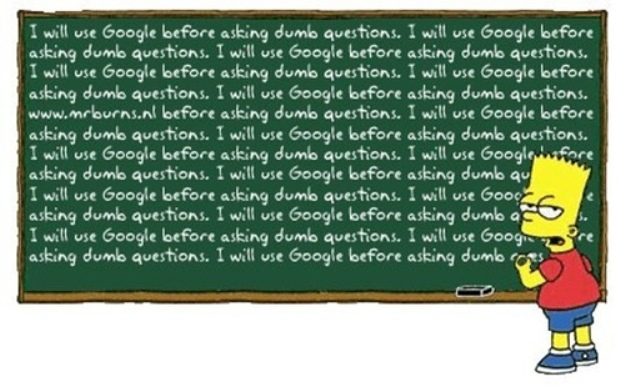
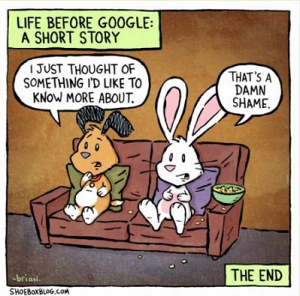
Was There Life Before Google (BG)? Sure, but try finding it!

Like many things, is Google a mixed blessing?

I now divide my life into two distinctive eras: Before Google (BG) and After Google (AG). The monumental ‘dividing event’ occurred somewhere in 1999 <em>Anno Domini (AD), when the now ubiquitous online phenomenon entered my life.

It was a good friend, photojournalist and new media activist Shahidul Alam, who first told me about this new kind of search engine with a funny-sounding name. Google. At that time, it was just a noun.

I was already weary of the simple, simplistic and yellow-page like listings offered by Yahoo, and welcomed this refreshing change. I immediately switched — and haven’t looked at another search engine in the past dozen years. And I also liked its cheerful, multi-coloured logo.

Things weren’t so slick or quick at the beginning, and even Google was learning by doing. We were still in the dial-up era, when 56 kbps Internet access speeds were still mostly an aspiration. Besides, there was far less content online, and far fewer ways to access and process it.

Where Google stood apart, from every other service, was in its better targeted search results. The research of any given quest was still in our hands, but narrowing down was helpful.

We’ve come a long way, and eons in Internet terms, since those early and murky days. With my always on, reasonably fast broadband connection, I now Google effortlessly many times day and night: I know I’m leaving a steady datastream of everything I look for, and that it can be traced, analysed and interpreted by anyone who can force Google to part with this back-end data (usually governments). But that’s the price I pay for Google’s versatile services.

I touched on this when I talked about ’21st Century Media: New Frontiers, New Barriers’ last month at Sri Lanka Press Institute on World Press Freedom Day, 3 May 2011. Here’s my PowerPoint:

A few weeks ago I tweeted “Was there life before Google?” My own tongue-in-cheek answer was: Sure, but I can’t easily locate anything from that period!

Not everyone appreciates Tweeted humour. I received a range of replies online and offline, mostly negative. Some cyber-skeptics faulted me for ‘deifying an American corporation like Google that is out take over the world’ (they haven’t heard the news!).

Others, school teachers and librarians among them, told me that Google has plenty to answer for. They lamented that many people have now forgotten the art and science of looking for a specific piece of information and imagery using well-organised information sources that combine physical and computer-based services. Professional information managers view Google as a superficial, hit-or-miss, much diluted version of their noble craft. Cyber take-away to be consumed on the run, as opposed to a gourmet meal to be partaken and enjoyed at leisure.

Sounds familiar?
I’m old enough to have used libraries diligently and regularly for several years of my working life. I still do, when I can’t easily locate something online — especially historical content that remains under-represented or non-existent on the web. For me, it’s not a question of either/or.

In fact, my frustration is that enough content from the pre-Internet period (much of history) is not yet available online in properly searchable ways. That includes my own personal archive. I’ve been producing journalistic output in the media for 25 years in print, radio and television outlets. The electronic media output is completely lost, and practically everything I wrote before 2000 AD (or Year 1 of my personal AG) is also not online. And my output in Sinhala, including my current Sunday column in the Ravaya newspaper, is not available online.

No, I don’t idolise Google as a global deity. But I thank Google a few times every day. Increasingly often, that includes times when I want to locate a specific reference to something I myself have written and published. This is what happens after writing several thousand pieces on a wide range of subjects and topics.

I envy those who can still recall precise details of their own vast bibliographies. As for me, I routinely turn to my usually reliable and well-informed friend Google. She rarely lets me down.

PS: One facility I stubbornly refuse to use is GMail. Google’s idea of a web-based email service never appealed to me, a Digital Immigrant who is not fully convinced about storing all my correspondence ‘in the cloud’. What really puts me off is how fleeting, erratic and often utterly incomprehensible GMail users are in their replies. There are a few honourable exceptions, but most GMailers I know are a confused and confusing bunch. I love you, Google, but when it comes to email, thanks but I’ll continue to operate my own accounts, branded on my own domain name.

A ‘Greek’ among Geeks and Greens…

Asking questions. Connecting the dots. Explaining matters.

These actions sum up what I have been doing in the spheres of communication and development for over 20 years. They form the cornerstone in my attempts to make sense of our globalised world and heady times.

As a journalist, I was trained to look for what’s New, True and Interesting (‘NTI Test’). Early on, I went beyond just reporting events, and probed the underlying causes and processes. With experience, I can now offer my audiences something more: perspective and seasoned opinion.

I look back (slightly) and look around (a lot) in a half-hour, in-depth TV interview with media researcher/activist and fellow citizen journalist Sanjana Hattotuwa. This was part of The Interview (third series) produced by Young Asia Television, and broadcast on two Sri Lankan TV channels, TNL and ETv on May 8 (with repeats).

Watch the full interview online: Sanjana Hattotuwa talks to Nalaka Gunawardene

Nalaka Gunawardene from Young Asia Television on Vimeo.

I have always worn multiple ‘hats’, and dabbled in multiple pursuits rather than follow narrow paths of enquiry. I see myself continuing to oscillate between the ‘geeks’ and greens, and where possible, bridging their worlds.

I sometimes feel a strange kinship with the ancient Greeks, who first asked some fundamental questions about the universe. They didn’t always get the answers right, and neither do I.

But it’s very important that we question and critique progress – I do so with an open mind, enthusiasm and optimism.

Note: I was also a guest in the first series of this show, in February 2009, which led to this blogpost.

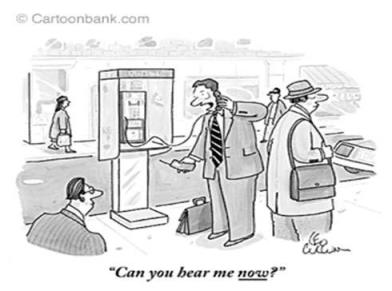
Can you hear me now? Why people yell into mobile phones…

Louder, please?
Why do people – especially middle aged men – yell into their mobile phones?

This is one of those widely asked questions in relation to communications technologies that have become part of our daily lives. Mobile phone etiquette hasn’t evolved as fast as phone coverage, so this behaviour remains a regular source of irritation at hotels, restaurants, airports and other public places.

So why do people with normal speaking volumes yell into their cell phones? I came across an interesting explanation, which also suggests that it’s a trait more common among Digital Immigrants.

Here’s an extract: “Household telephones, or landlines, have a microphone in the receiver that amplifies your voice into the ear piece. When you talk into a landline, your voice is captured and replayed through the ear piece, so you hear your own voice loud and clear….With cell phones, your own voice is not amplified into the earpiece, so the only sound you hear is from your mouth. Seem like this wouldn’t be a huge difference, but the volume level of words coming from your mouth through the air and into your ear is a pretty big difference from sounds coming from a phone speaker that’s pressed directly against your ear.”

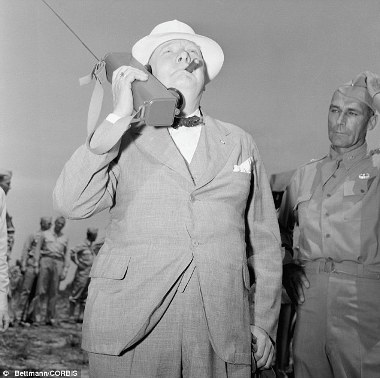
No, Sir Winston is not using an early mobile phone - it's a field radio receiver!
Hmm. So there’s hope that the trait will become less common in the coming years.

Of course, the habit goes a long way back to the days when phone lines rarely offered good audio quality. There is the true story of how Sir Winston Churchill had to suffer a Cabinet colleague who was a loud phone talker. During the Second World War, they were sharing crammed war cabins.

One day the Minister was once again talking very loudly on the phone. Churchill asked his secretary to go over and tell Mr Brown not to talk at the top of his voice. The secretary returned and told the PM: ‘Sir, the Minister is talking to Scotland.’

Without batting an eyelid, Churchill replied: ‘Yes, I’m sure he is. But tell him to use the phone!’

Fraudband or Broadband? Find out for yourself! New film tells how…

The user is willing, but the network is not...?

I once saw a sports car on the narrow streets of Malé, capital of the Maldives (total population 350,000). Nothing unusual about it — except that the whole of Malé is about two square km: we can WALK the length and breadth of the crowded capital in 10 or 15 minutes. The other 1,200 islands that make up the Indian Ocean archipelago are even smaller.

That reality didn’t stop an optimistic Maldivian from investing in a fast vehicle – after all, a car (especially a sports model) is more just a means of transport.

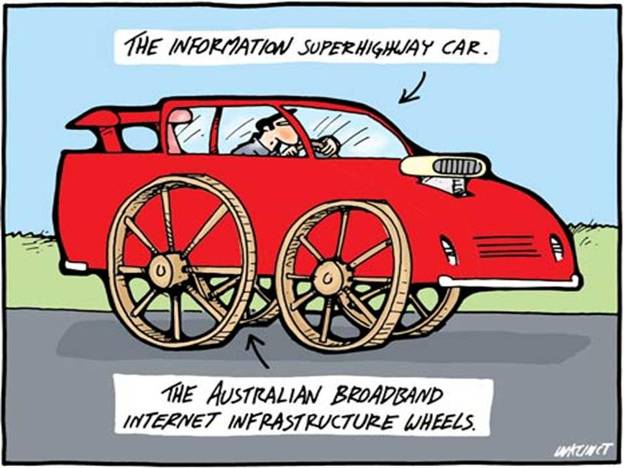
Something akin to this plays out in the virtual world everyday in many parts of developing Asia. Many Internet users have state of the art access devices — ranging from the latest laptops and high-speed desk tops to ipads and internet-enabled mobile phones. But most of the time the users and devices are held up by poor quality internet connections. I mean patchy, uneven, really S-L-O-W ones.

So part of the time — how often and how long depends on where you are, and who your internet service provider or ISP is — we are all like that Maldivian sports car owner. Dressed up and rearing to go, but not really going very far. Because our network is overloaded.

What can you do when your broadband internet connectivity slows down, making some web applications tedious or impossible? How can you measure and compare the quality of broadband service within the same telecom network or across different service providers?

As consumers, we have limited options. We can grin and bear, and be grateful that we are among the 2 billion (and counting) human beings who regularly access the Internet. We can grumble and rant, and even complain to our ISP. But chances are that they’ll plead it was a system fluke, an exception to the norm.

Now there’s another option. The Ashoka-Tissa method, a simple and free software developed by LIRNEasia and IIT Madras, enables just that: with it, you can gather evidence before taking it up with telecom operators.

Rohan Samarajiva: Fraudband-buster?
At TVE Asia Pacific , we have just produced a short video in which LIRNEasia — a regional ICT policy and regulation think tank active across the Asia Pacific — sums up their experience in developing a user-friendly method to measure broadband quality of service experience. It also shows how they engaged telecom operators and regulators in South and Southeast Asia from 2007 t0 2010.

“256 kbps up and down is the minimum definition (of broadband),” says Dr Rohan Samarajiva, LIRNEasia’s Chair and CEO. “There are various people debating about it: whether it should be 2Mbps and so on, but I will give an acceptable minimum definition…Our research shows that, in fact, many broadband products that say they are giving 2Mbps don’t even meet this minimum rate.”

The former Sri Lankan telecom regulator adds: “Then of course there is this whole story of companies promising all kinds of things. 2Mbps up, 2Mbps down and various other things being promised and giving not even 256kbps. So there is almost like a dishonesty factor here. As one of my friends says, this is not broadband; this is fraudband!”

Watch Fraudband or Broadband?

More information at: BroadbandAsia.info

PS: While writing this blog post, I was frustrated by the poor quality of my own supposedly high-speed broadband connection, provided by Sri Lanka’s oldest telecom operator.

What’s the universal icon for the Internet? Is there one?

Would 2 billion recognise this?
What’s the first image that comes to your mind when you hear the word ‘Internet’?

If you’re a techie or geek, you’ll probably come up with a detailed answer that is technically accurate or precise. But most of the 2 billion plus people who use the Internet worldwide are not techies. They don’t know – or care – about the back-end technicalities.

A good icon is simple, language-neutral, and can be understood across different cultures and by people with very different educational backgrounds. For example, telephones – both fixed and mobile – have established symbols or icons. Sure, the devices have evolved beyond the well known imagery, but everybody recognises these.

So what’s the equivalent for the Internet, never mind its multitudinous applications and delivery methods?

We’re currently editing a short video on LIRNEasia’s broadband quality of service experience (QoSE) in emerging Asian economies. We play with images to tell complex stories in non-technical terms. We wanted to use an icon for the Internet (broadband or otherwise) — and couldn’t immediately think of one visual that everybody knows and recognises unambiguously as representing the global Internet.

So we searched. Our usually reliable friend Google wasn’t of much help. Google image search for ‘internet icon’ brought up hundreds of results — but none that is a universally accepted or recognised. But the search itself was interesting and revealing.

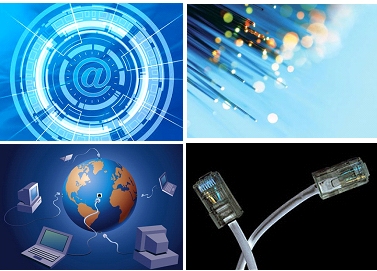
Some images, like Microsoft’s Internet Explorer browser’s famous ‘e’, are well known but are branded to one product and company.

Others, like the ethernet cable’s plug pin, are widely used — but how many non-techies will recognise it? Besides, when broadband access is increasingly going wireless, do the cables matter as much as they used to?

The same goes for those colourful images of fibre optic cables — dazzling points of light, but how many Digital Immigrants (or even Digital Natives) will know what they are?

At least wireless Internet seems to have settled its iconography — or has it? The little antenna transmitting omni-directionally seems to pop up everywhere these days, at least where such coverage is available. But there too, we have more than one icon — even if their main visual symbols are similar.

Then there’s the ubiquitous @ sign — originally introduced for, and still an integral part of, email addresses. But hey, Internet is a lot more than emails!

Are we settled on this?
We asked around IT industry friends and IT-watchers, but none could give us a definitive answer. The most that they could agree on was that the 3-letter formulation www (signifying the World Wide Web) comes close to a universally recognised sign for the Internet.

Hmm, that’s far from being a visually elegant design. And it’s decidedly biased to the roman alphabet too (ok, that’s the language of science).

But is there a better icon for the whole Internet, irrespective of delivery method and language-neutral? If not, isn’t it about time we agreed on one?

Designers, geeks and others with spare creative capacity, please take this up.

Wiz Quiz 9: Arthur C Clarke’s HAL, are you here yet?

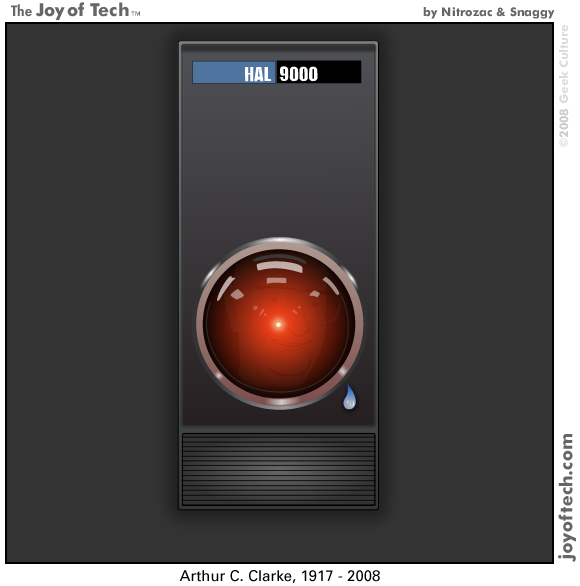
Joy of Tech tribute to Arthur C Clarke, 19 March 2008
This week marks the third death anniversary of Sir Arthur C Clarke, author and futurist.

Among the numerous tributes that poured out all over the world following his departure, I found one especially poignant. It was the ‘Joy of Tech’ cartoon above, showing the sentient computer HAL 9000 (from 2001: A Space Odyssey) shedding a single tear in his memory…

In fact, researchers in artificial intelligence (AI) are still trying to create a real-life HAL, which remains the ‘Holy Grail’ in their line of work: a machine-based intelligence that mimics the human mind in all its nuances, and not just in raw processing power.

This is proving much harder than creating chess-playing or quiz-winning computers: human beings are capable of a wide range of emotions some of which – such as intuition and sense of humour – are still not within the capabilities of advanced AI systems.

In this week’s Wiz Quiz, I pay tribute to both HAL and his creator with a few questions on the march of supercomputers. We ask the long-running question: Can computers outsmart us?

Indeed, that prospect is becoming more real every passing year. An IBM supercomputer named Deep Blue created history in May 1997 when it won a six-game match by two wins to one with three draws against the then world chess champion. A few weeks ago, another human bastion fell — and this one concerns me more as a quiz enthusiast (I never learnt the rules of chess, and don’t understand what all that fuss is about.)

On 17 February 2011, a supercomputer owned by the IBM Corporation beat two veteran quizzers to win a high profile game in the long-running US quiz show called Jeopardy. The supercomputer won with US$77,147, while its nearest rival Ken Jennings, a 74-time winner of the popular trivia quiz, came in second with US$24,000. Brad Rutter, who has in previous appearances won a total of US$3.3 million, was third with US$21,600. IBM plans to donate the computer’s winnings to charity.

What was the name of this quiz-winning supercomputer?

In HAL 9000’s name, what did the letters HAL stand for?

Which famous rocket scientist once said: “Man is the best computer we can put aboard a spacecraft…and the only one that can be mass produced with unskilled labour”?

These are among the 15 questions in this week’s Wiz Quiz. Test your brains against ours (supercomputers may not participate!).

Resilience 2011: Banging Heads together to make lives better

What does Livelihood Resilience mean to them?

I am at Resilience 2011: Asia Regional Conference on Building Livelihood Resilience in Changing Climate, being held in Kuala Lumpur, Malaysia, from 3 – 5 March 2011. It is jointly organised by Wetlands International-South Asia (WISA), International Development Research Center (IDRC), The Climate and Development Knowledge Network (CDKN), Cordaid and ekgaon technologies

The conference has attracted three dozen researchers, practitioners and policy makers from across the Asia Pacific region, and from different ‘domains’: Disaster Risk Reduction (DRR) and disaster management; Ecosystem services and conservation; and livelihoods and socio-economic development.

I like hobnob with researchers and activists from whom I learn much. As a science and development communicator, I sit through their often very technical discussions and find ways of relating them to the bigger realities. For a start, I created a word map of the keywords being used in the conference. That gives an idea of concerns at a glance.

I then tried to make sense of the conference introduction note, published on the event website. It looks and reads like the work of a committee, and not the easiest to read and absorb unless one is deep immersed in these areas. Since most of us aren’t, I spent an hour or two rewriting it in my own language. Here it is — my version of what Resilience 2011 conference is trying to accomplish:

Building Livelihood Resilience in Changing Climate Asia Regional Conference
Kuala Lumpur, Malaysia, 3 – 5 March 2011
A layman’s interpretation of the vision, scope and aims of the conference

Asia, home to over 60 per cent of all human beings, is the largest and most diverse geographical region in the world. It is also a region of sharp contrasts and disparities in economic and social development.

Some Asian economies have been growing faster than any other on the planet, and even the global recession has not slowed them down too much. This growth has helped push tens of millions of people out of poverty during the past three decades. Yet, Asia still has the largest number of people living in poverty and food insecurity.

In some respects, gains have been lost. For example, the UN Millennium Development Goals Report for 2010 revealed that the proportion of undernourished Asians has increased recently to levels last seen during the 1990s. Two thirds of the world’s undernourished people live in Asia. At the same time, the natural resources on which food supplies depend – land, water and biodiversity – are degrading rapidly. Food shortages and water scarcities are already being experienced, or anticipated, in many countries.

Growing number and intensity of disasters adds further pressures. According to the international disaster database EM DAT, Asia accounted for nearly half (46 per cent) of the all water related disasters in the world, and 90 per cent of all affected people during 1980 to 2006. During this period, disasters in Asia caused a total of US$ 8 billion worth of economic damage. These disasters impacted disproportionately on the poor and vulnerable sections of society.

Climate change impacts will make this situation worse for everyone, and especially for the poor who already have limited options and ability to adjust to rapid changes. It is now clear that all efforts aimed at reducing poverty and protecting the socially vulnerable groups need to factor in the additional pressures created by changing climate.

To cope with these challenges, we need better understand how livelihoods are threatened, and what strategies can be adopted to improve resilience especially at the grassroots. Researchers and practitioners in natural resource management and poverty reduction are now focusing more and more on the nexus between resources, climate changes and livelihoods.

New ways of looking at the inter-linked challenges have emerged:
• Humanitarian aid workers active on disasters now focus on disaster risk reduction, expanding the scope of risk management to include preparedness and risk reduction.
• Development practitioners working on poverty reduction emphasize on increasing access to various capitals to help address disaster risk and poverty.
• A ‘systems approach’ is being used to look at poverty in broader terms of well-being of people and ecosystem services of Nature.

In addition, researchers and activists emphasize the value of freedoms for participation, economic facilities, social opportunities, transparency guarantees, protective security and ecological security. It is only by ensuring these freedoms that the poor will have a meaningful chance to assert their rights and make their own choices in what they do, and how they do it.

The slowly but steadily warming planet challenges everyone to rethink their conceptual frameworks, and redefine or reconfigure how they work. If there is one thing certain about these uncertain and turbulent times, it is business-as-usual won’t do!

What do we seek to achieve?

Each sector has accumulated a knowledge base, set of best practices and lessons learnt exist within individual domains. Each sector’s theories, approaches and actions within various domains differ on how to make livelihoods more resilient, especially in the often harsh realities of the developing world.

They are all necessary, but not sufficient. Taken individually, no single approach or solution can help make everybody’s livelihoods resilient from the multitude of pressures and impacts. Yet, what one strand cannot withstand on its own, a bundle of strands very likely can: bringing different areas of research, advocacy and practice is the way forward to ensuring better resilience at the grassroots.

This is easier said than done. Both researchers and practitioners have long worked in their own silos or compartments, with occasional nods at each other’s work and periodic exchanges. From this, we need to evolve more integrated framework that brings in the ecologists, disaster managers, social scientists and everyone else who share an interest in making lives better at the grassroots and at the bottom of the income pyramid.

The Kuala Lumpur conference attempts to address this formidable challenge. It will provide a common platform to practitioners and researchers from various ‘domains’ related to livelihoods to work out a shared vision on livelihoods resilience by seeking answers to these questions:
• What are the existing challenges to achieving livelihood resilience?
• What are the gaps in existing livelihood frameworks in relation to disaster, climate change adaptation and conservation in addressing livelihood resilience?
• What are the challenges in scaling up pilot models of Livelihood Resilience?
• How does social adaptation occur in resilience building?

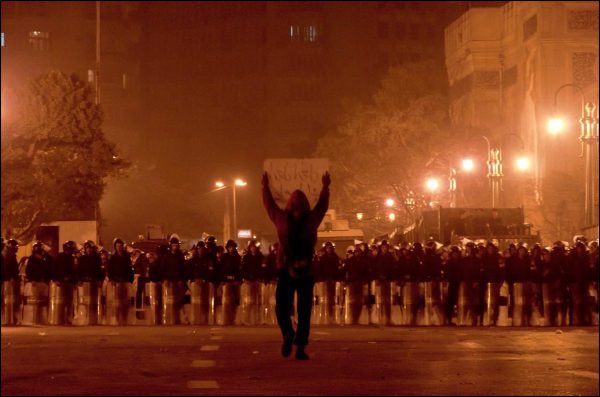
Revolution at the Bottom of the Pyramid: Egyptians want freedom – video

This short video is currently a high favourite online. Created by Tamer Shaaban. Another Egyptian who’s had enough.

Their blurb: “Violent clashes between police and demonstrators as over ten thousand gather on the streets of Cairo. The Egyptian people have endured a tyrant’s rule for far too long, millions struggle each day to find where their next meal is coming from. January 25th, 2011 marks the day when the people rise and take back what’s rightfully there’s. This isn’t the end, but hopefully the beginning to a long awaited regime change! Send to everyone and let them know.”

Song: “Into the Fire” – Thirteen Senses

Thanks to the following news sources for their footage
Daily News Egypt
The Guardian
CNN
New York Times
Al Masry Al Youm

The video was posted on reddit and has gained momentum!

#Facebook Link: Egypt’s Peaceful Revolution

Related blog post: Wanted: More courageous little ‘Mack’s to unsettle Yertle Kings of our times!

Revolution in the making...at the bottom of the pyramid

Coping with a warming planet and WikiLeakable world: Common challenges

Time is ticking away...but crises also mean opportunities

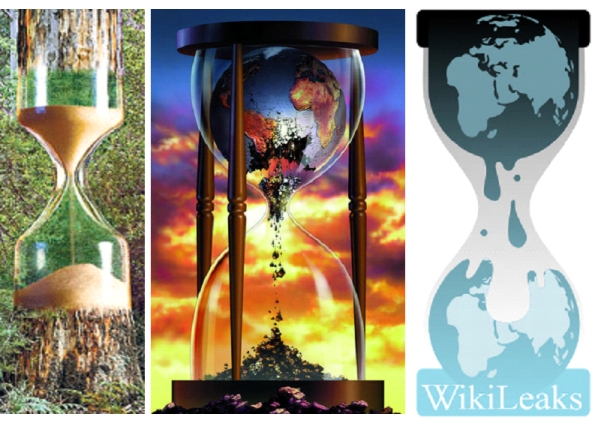
I like to think and speak in metaphors, especially visual metaphors. Sometimes I coin or design new ones. This illustration is the latest example.

Individual elements in this came from very different sources (thanks to them all). I just mixed them together to make two points during a talk I just gave at the Colombo University.

We live in a crisis-ridden world where we have to cope with multiple emergencies unfolding at the same time, impacting us on different fronts. This illustration captures three of them: crisis in biodiversity, man-made climate change, and the new reality of living in a rapidly WikiLeakable world — what I called the Global Glass House.

We don’t get to choose the timing, severity or duration of any challenge. But we do have some choice over how we respond: we can despair and grumble (blaming the Gods or karma if we believe in those); we can become really alarmist (a la Chicken Little); or we can be measured and smart in how we deal with the seemingly overwhelming situations.

Speaking at the Leaders in Environmental Advocacy Forum (LEAF) on Preserving the Past, Securing the Future on 22 January 2011 at the University of Colombo, I advocated this last option. I also pulled together a number of ideas mentioned on this blog over the past four years.

LEAF was a two-day summit held in Colombo, Sri Lanka, hosted by members of the Elon University’s Periclean Scholar Class of 2011, in partnership with the University of Colombo, the United States Embassy in Colombo, the National Science Foundation of Sri Lanka and Rainforest Rescue International.

My illustrated talk was titled “Telling Stories to Save Ourselves: Communicating on a Warming Planet” — I revisited an idea originally featured on this blog in mid 2007 (about Arabian Nights and their modern day relevance) and coupled that with a more recent proposal of mine: consider education and communication the third track of plank in humanity’s response to climate change (alongside climate mitigation and adaptation).

In fact, some challenges of living on a warming planet are comparable to coping with a WikiLeakable world: both demand quick adaptation to a new reality. In both cases, governments and society have to change mindset and practices on the go — business as usual is no longer an option. Denialism, or demonising the messenger, won’t take us forward. We need more measured, sometimes even pragmatic responses.

In that process, all-or-nothing is not a viable approach. Waiting for full knowledge and understanding is not feasible either. As I once described it, responding to the planet’s climate and other ecological crisis with partial scientific understanding is akin to many pages of our planet’s ‘operations manual’ being still completely blank — and yet we have to manage the planet to the best of our knowledge, intuition and common sense.

Many of the same principles apply to living in the modern networked info society, where no secrets can be kept that way for too long. The sooner we come to terms with this new reality and adapt, the better.

I’m delighted to see others are addressing these parallels. In my talk, I mentioned a recent essay titled Could climate science become open source? by Brendan Barrett and Sulayman K. Sowe, published earlier this month on the UN University’s Our World 2.0 website.

In their perceptive piece, the authors ask whether climate science would benefit by being more firmly grounded in the principles of openness, perhaps along the lines of the free and open source software communities and open content movements. “The concept of openness behind free and open source software describes a mode of creative knowledge production and sharing in which individuals and communities freely generate and adapt or remix resources (content or software) without licensing restrictions.”

They add: “Proposing a move to a new model of climate science in no way suggests that climate change is not a real and present threat or that we cannot rely on the integrity of our contemporary climate science institutions and scientists. Rather, the argument here is that learning from the way free and open source software projects and communities work may be an important way forward in engendering more effective global, national and local responses to climate change.”

I have always worn multiple ‘hats’, and dabbled in multiple pursuits rather than follow narrow paths of enquiry. I see myself continuing to oscillate between the ‘geeks’ and greens, and where possible, bridging their worlds. It’s really encouraging to see some others straddling the two spheres.