Marginal comments on media, science & development – NOTHING official about this!
Author: Nalaka Gunawardene
A science writer by training, I've worked as a journalist and communication specialist across Asia for 30+ years. During this time, I have variously been a news reporter, feature writer, radio presenter, TV quizmaster, documentary film producer, foreign correspondent and journalist trainer. I continue to juggle some of these roles, while also blogging and tweeting and column writing.
This is an amusing and clever video I’ve just come across on YouTube: Internet People. As its creators say “it’s an animated tribute to the internet people of the world, wherever you may be.”
It celebrates those ordinary people who found expression — and sometimes, fame — on YouTube before political campaign managers and corporate spin doctors realised its potential.
Animated by Dan Meth, with music by Dan Meth and Micah Frank, Internet People captures and celebrates our shared Internet experiences over the last half-decade with cartoon caricatures that are somehow funnier than the original footage.
“I dare you to watch it just once—or to get all the references after even three viewings,” says animator Meth.
In the Fall of 2004, I was on a Cathay Pacific flight from Hong Kong to Toronto. The flight across the vast Pacific was 13 hours long, and half way into the flight my nose started playing up.
Being in cold placed for many hours sometimes triggers my catarrh, but I was prepared. I always carry one or more handkerchiefs with me, especially on flights. And also some anti-sneeze pills from my homeopathy doctor.
Blowing my nose and popping the small, sugary pills hardly ever draws anyone’s attention, but on this occasion it did. Our friendly flight stewardess was quite amused to see me using a hanky.
“Oh, Sir, you’re such a gentleman!” she exclaimed.
It took me a few seconds to figure out what she meant. Then she added, helpfully: “You still use a handkerchief. That’s so charming. No one uses them anymore…”
There wasn’t the faintest tone of sarcasm in her voice. She was genuinely impressed that I carried a hanky.
At one point, it quotes Dickie Arbiter, a former press secretary to the Queen, Charles and Diana who was responsible for the media arrangements for Diana’s funeral: “The Queen was always going to pay tribute to Diana….There was a furor because she was at [the Scottish castle] Balmoral and not down with the sniveling mobs in London. [But] William and Harry needed her more than hundreds and thousands of people keeping Kleenex in business.”
Indeed, Kleenex and other tissue paper manufacturers must have done very nicely that week. A few days later, the death of Mother Teresa in Kolkata (formerly Calcutta) would have profited the Indian peddlers of the flimsy paper that more and more people seem to find indispensable.
Tissue paper vs. Handkerchiefs is an on-going debate that’s far from resolved. Both items have pros and cons; they also have their defenders and promoters. Some of them air their views on the Bottledguy blog
I have always been a handkerchief user, so I’m naturally biased in their favour. Yes, I have to be careful in using and storing them; yes, I have to wash, dry and keep track of them. And no, I don’t mind these chores at all.
And everything I read tells me it is more environmentally friendly to use hankies.
It’s about two sisters in Australia, one in Sydney and the other in Brisbane (that I passed through only a few days ago) trying to revive the use of handkerchiefs.
They market them as “both useful accessories and as markers of the bonds between people.”
Their company is named Hanky Schmanky. I don’t know them, but applaud their initiative. They are trying to make hanky use ‘cool’ again.
“Can you help us to film a child’s leg being broken?”
This question, posed by a visiting Canadian TV crew in the 1970s, startled my good friend Darryl D’Monte, one of the most senior journalists in India and former editor of the Times of India.
Darryl was having a chat with the crew, giving them some insights on the extent of poverty in his home city of Bombay, since renamed as Mumbai. It is routine for visiting journalists to have such chats with their local counterparts to get context and advice.
It was when the conversation turned to beggars, that this western TV crew asked if they could film the intentional breaking of a poor child’s leg — a brutal practice that was believed to exist so that maimed children could be employed as beggars. A disabled child would evoke more sympathy, and consequently, more alms.
The articulate Darryl must have expressed his exasperation in strong terms. But even he couldn’t have anticipated the response.
“It’s going to happen anyway,” was how the film crew rationalised their bizarre request.
So why not be there, capture it on film, and get a great story out of it — which can be packaged as the brutal side of India’s poverty! This must have been the crew’s line of reasoning. Maybe their editors had exerted pressure to come back with something out of the ordinary.
I quoted this incident in my essay, Ethical newsgathering challenge for Al Jazeera International, published in November 2006. It was a plea for the newest entrant to international TV newsgathering to play by a different, and more ethical, set of rules.
These and worse practices are certainly not confined to India, or to TV crews originating from any single country. And sadly, these have not been abandoned after the 1970s. In fact, the emergence of 24/7 satellite news channels since the 1980s has inspired much more competition in the TV newsgathering industry, creating an alarming race to the bottom.
Such journalists’ only operating guideline seems to be: get the story, no matter what — or who gets hurt in that process.
In filming wildlife documentaries, film-makers sometimes have to make a choice: do they interfere in the processes of Nature, such as a predator setting on a hapless prey? There is an unwritten rule that things must be allowed to happen, with humans only capturing actuality on film.
But when it comes to filming wild life of our species in our cities and villages, the ethical dilemmas are not so easily resolved. This is why all journalists and film-makers, especially those in newsgathering, need a strong ethical framework for their work.
Journalists represent the public’s right to know, which is extremely important. Media coverage and exposes can trigger much needed aid, reform or public outcry on certain issues. But that is not a justification for getting the story by any means.
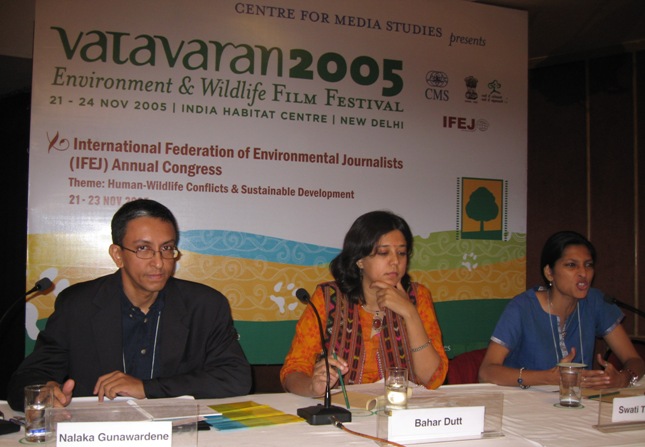
I was reminded of this story because the 4th CMS Vatavaran film festival is round the corner: it will be in New Delhi from 12 to 16 September 2007. I won’t be there in person; my colleague Manori Wijesekera is representing TVEAP this time.
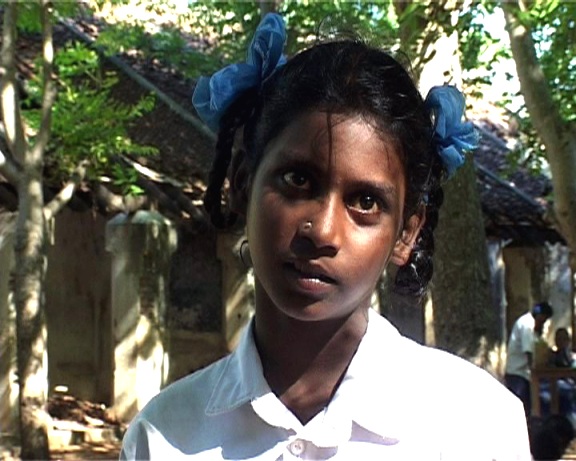
Meet Mala. She lives in in Kottaikkadu village in Kancheepuram District in India’s southern Tamil Nadu state.
She was 11 years old when, in December 2004, the Asian Tsunami crashed into village without warning. This made her very poor family desperate and destitute.
The disaster didn’t kill anyone in her village, but caused considerable property damage. In her case, the waves that rolled in spared their small hut, but her fisherman father was nearly drowned: he survived with some injuries.
But the family’s fishing boat and gear were gone. That was a mighty blow.
After the waves had retreated, they returned to their house and started rebuilding their lives. They thought the world’s generosity in responding to the Asian Tsunami will somehow bring some help.
They were wrong.
When the Tsunami triggered massive aid donations, all affected countries pledged to distribute it in a fair, equitable and transparent manner. But as the aid trickled down layers of government and charities, various biases and distortions crept in.
What happened in Mala’s village was an example. We came across the situation when tracking Mala’s family for a whole year (2005) after the Tsunami, documenting their long road to recovery as part of our Children of Tsunami media project.
We tracked two affected families each in India, Indonesia, Sri Lanka and Thailand, filming their progress — or the lack of it — every month and producing video reports that were uploaded to a dedicated website.
The most striking example of aid disparity came from India. Even months after the disaster, Mala’s family — or anyone else in her village — received absolutely no relief or recovery assistance.
Officially, it was because ‘no one was killed’ in her village. But everybody in Kottaikkadu village knew the real reason: in the Indian social hierarchy, they occupy the lowest level, known as ‘Dalits’.
Apparently, that was why both government agencies and charities stayed clear of the village.
Our India production team, led by senior journalist and film-maker Satya Sivaraman (with video camera in the photo, below), investigated further. They compared Kottaikadu with its adjoining village of Alambara. Both had suffered similar damage during the Tsunami: people lost their boats and nets, but there were no deaths.
Yet the people of Alambara – who belong to a supposedly higher caste of fishermen — received food items, boats and fishing nets from various outside sources.
In fact, they felt quite sorry for their neighbours in Kottaikkadu. “On the day of the tsunami we ran over 15 kilometers,” said Kuppuraj, a resident of Alambara. “Kottaikadu villagers, who live just 600 meters away…ran with us — but nobody has helped them to recover.”
There was another incident that showed up the caste-based discrimination, which my colleague Manori Wijesekera, production manager of Children of Tsunami, has just reminded me.
In March 2005, our India film crew found Mala’s father seriously ill with a lung infection (triggered by his near-drowning during the Tsunami) and his family so helpless that they were unable to even seek medical attention.
So the crew put their filming gear aside, and became good Samaritans: they rushed the sick man to a nearby government-run hospital. But once there, doctors refused to admit or treat him — all due to the patient’s supposedly low caste!
It was only when Satya and crew threatened to film the entire sorry episode, and have it broadcast on television later that day, that medical attention was finally provided. Discarding their production plans, our crew stayed with Mala’s family at the hospital through the night and next day to ensure the doctors gave her father the correct medical attention. The family believes that the production team saved her father’s life that day.
Read more about what happened at Children of Tsunami website
While their father was recovering, Mala’s mother toiled as a labourer to keep the home fires burning. Mala has one younger sister and two younger brothers.
Children of Tsunami: Rebuilding the Future was TVE Asia Pacific’s response to largely superficial media coverage of the Indian Ocean Tsunami of December 2004. It tracked on TV, video and web the personal recovery stories of eight affected families in India, Indonesia, Sri Lanka and Thailand for a year after the disaster. Its many media products — distributed on broadcast, narrowcast and online platforms -– inspired public discussion on aid management and optimum rehabilitation choices.
Today, 31 August 2007, is the tenth anniversary of Princess Diana’s tragic death in a road accident in Paris.
A decade on, I can still remember exactly where and how I first heard the news. This experience is widely shared: to many in my generation — born in the 1960s and raised through 1970s and 1980s (just like Diana was) — this was an unforgettable moment. Perhaps just like the assassination of John F Kennedy was to a previous generation.
The analogy between Di and JFK goes further. Both had charismatic personalities that appealed far beyond their home country. Both epitomised the vibrancy of youth and the potential for change in the institutions they joined (Diana the British Royal family, and JFK the American government). Both lives were snuffed out before they could fulfill that promise, but they left enduring legacies — and thriving cottage industries of conspiracy theories (‘Who killed JFK?’ has now been joined by ‘Who killed Diana?’).
Here’s another similarity: JFK and Diana were both iconic images of the era of television.
If JFK turned up just in time to charm the first generation of American TV viewers, Diana’s arrival on world stage coincided neatly with the worldwide roll out of satellite television, especially the all-news channels. And thanks to the advances in global broadcasting, Diana commanded a far bigger global audience than JFK did (though the comparisons must end there).
I would like to remember Diana as the first Princess of Television of our media-rich age.
Looking back, we can see how satellite television started and evolved almost in parallel to Diana’s own life. Diana had just celebrated her first birthday, when the world’s first trans-Atlantic satellite television signal was relayed from Europe to the Telstar satellite over North America on 23 July 1962. (By coincidence, JFK was to have participated in the event, but could not owing to a technical delay.)
Over the next two decades, as Diana grew up and matured into a young lady who would soon capture the world’s imagination, satellite TV’s technology, outreach and mass following evolved to cover more channels, territories and eyeballs.
A turning point came when the US entrepreneur Ted Turner took a daring step for that time by launching the Cable News Network (CNN), the world’s first 24 hour news channel. CNN went on the air on 1 June 1980 amidst many skeptics asking: who would possibly want to watch news all the time?
Who indeed! Until then, conventional wisdom had confined news to a regular evening slot, anchored by larger-than-life newscasters. The routine was broken only when there was some earth-shattering development.
Turner’s CNN, ridiculed in the early days as the ‘chicken noodle network’, changed all that, and paved the way for dozens of 24/7 news channels.
As it turned out, CNN arrived just in time. The engagement between Diana and Charles, the Prince of Wales, was announced a few months later, in February 1981.
The rest is recent history. Television newsgatherers could never have enough of Diana — apparently their audiences kept asking for more. That may be a debatable point, but Diana was quick to learn the art of exploiting the inevitable: when she realised it was a stark fact of life, she started using it to her personal advantage.
Diana used television as much as television used Diana. Her famous BBC Panorama interview with Martin Bashir was one among many instances when she lived her personal life under the glare of public television (photo below).
But Diana’s clever use of television was not just for advancing her personal agenda. When she became a big time charity supporter in the 1990s, she used the power of moving images to demystify and humanise global issues from caring for people living with HIV/AIDS to banishing the scourge of landmines. These ensured that Diana became the People’s Princess in the last years of her life.
Early on in her marriage to Charles, a leading newsman told Diana: when you married him, we came as part of the package deal. If she was initially stressed by that revelation, she later made the best use of that inevitable trapping of her celebrity.
Diana’s funeral on 6 September 1997 had a larger global satellite TV audience than did her wedding. Of course, by then there were more people and more television sets on this planet.
Elton John sings a special version of ‘Candle in the Wind’ at Princess Diana’s funeral:
So we salute the legacy of the world’s first Princess of Television. One who moved our hearts with moving images of her personal life and those of the worthy causes she championed. One who showed how moving images can move people.
PS: There was a time when the unforgettable television moments were gone after their broadcasts (unless recorded on tape). But now we have YouTube, where the world’s visual memory lives on. All news and current affairs coverage I have linked to in this post were found on YouTube by simply searching for Princess Diana. There is much more where these came from.
Read BBC Online’s timeline of the life of Princess Diana
Last April in Melbourne, I listened avidly to the doyen of Australian science journalists Robyn Williams compare science journalists to whales as he opened the Fifth World Conference of Science Journalists.
As I paraphrased Robyn in my blog post on 18 April 2007:
They both respond to lots of free drinks and eats. In fact, they like to drink vast amounts (though not necessarily the same liquids!). There is evidence to suggest they are both intelligent species. They are both endangered too – there are some nasty people out to get them. Both are free spirits – don’t like being trapped or hounded.
Back in Australia on a short private visit, I finally manged to catch up with these marvelous creatures that I have admired, written and spoken about for a quarter of a century. Today, I went whale watching in Hervey Bay, north of Brisbane in Queensland.
It was an awe inspiring experience. Here are some photographic highlights. I’ll write more about it when I have caught my breath again.
A humpback whale leaps in joy, having sighted me at last:
Is this the world’s largest tail? Oh boy, what a tale to tell!
Who is watching whom? Take a closer look at these strange creatures who come on noisy vessels:
Your mouse-clicks at work: thanks to the steady income from this blog, I’ve got my own yacht at last (just kidding!):
In its own words, the 24/7 English language channel set out to ‘balance the information flow from (global) South to North, providing accurate, impartial and objective news for a global audience from a grass roots level, giving voice to different perspectives from under-reported regions around the world.’
I said: “In recent years, the self righteous arrogance and the not-so-subtle biases of BBC and CNN have become increasingly intolerable. But unless it’s very careful and thoughtful, AJI runs the risk of falling into the same cultural and commercial traps that its two older rivals are mired in.
“CNN can’t get out of its US-centric analysis even in its international broadcasts. And the BBC news team is like a hopelessly mixed up teenager: one moment they are deeply British or at least western European; the next moment they are more passionate about Africa than Africans themselves.
“Desperately seeking legitimacy and acceptance, these global channels have sometimes traded in their journalistic integrity for privileged access, exclusives or -– dare we say it? -– to be embedded.”
I admit that I haven’t been watching enough of AJI to come to any firm conclusions. One reason: the new channel is still not widely available in some countries that I visit and spend time in.
But going by what is on their YouTube channel, where some 1,300 video segments have been placed so far (as at 29 August 2007), I have a rough idea of AJI’s first few months of coverage.
I’m looking long and hard for the difference that they so emphatically promised. Instead, I find them a paler version of BBC World, at times trying oh-so-hard to be just like the BBC!
Take, for example, the coverage they have recently done on the bloody and protracted civil war in Sri Lanka. Being where I live and work, I take a particular interest in this topic.
In a 2-part edition of AJI’s People & Power programme, Juliana Ruhfus investigates the impact of Sri Lanka’s civil war.
People & Power: How the East was Won: Part 1 of 2
People & Power: How the East was Won: Part 2 of 2
I don’t have a problem with AJI’s analysis in this documentary, which tries hard to be balanced and fair in what I know is a very difficult subject to cover, with intolerant hardliners on both sides of the conflict.
But I have several issues with how it has been put together – the norms and ethics of their newsgathering.
* A white blond woman, so evidently a parachute journalist, is reporting and presenting the story. Why isn’t an Asian telling this story?
* She is repeatedly mispronouncing all the local names. Just like the BBC does as a matter of routine.
* She gestures, interviews and talks exactly like those know-all reporters from the BBC. At times I detect a faint condescension in her voice, but that may be my imagination.
* For part of the coverage, the intrepid AJI reporter becomes embedded with the Sri Lankan armed forces, and interviews civilians under the watchful eye of military men. This is hardly a credible way of eliciting any honest responses!
* More importantly, she shows little regard for the personal safety of some people she interviews. At one point, she asks three muslim men if the Eastern Province of Sri Lanka is now any safer than before it was ‘liberated’ by the government forces. The men are clearly uncomfortable with this question. Honest answers can cost them dearly. But why should she care? She persists, showing close-ups of these individuals.
* Even when she interviews people who had explicitly asked for concealment of their identity, she leaves tell-tale signs for those identities to be easily guessed. A woman whose teen-aged son has been coerced into joining a paramilitary group is filmed in silhouette — not a good enough cover. Real voices have not been altered through a synthesizer.
These and other observations blur the difference between BBC and AJI in my mind. With a few notable exceptions, most BBC reporters don’t care one bit about the hapless, distressed people whom they interview. All they want is to get a ‘good story’ with dramatic visuals.
AJI is desperately trying to outdo the BBC in all the latter’s wrong aspects. Otherwise why should Juliana Ruhfus try so hard to get a damning comment from an interviewee evidently ill-at-ease of being ambushed by this western woman?
I still want to have an open mind about AJI’s promised difference, and keep hoping that it will emerge sooner rather than later. But this kind of newsgathering and film-making don’t augur well.
If this is the ethical standard of journalism that AJI aspires to, we who had high hopes of their becoming a real alternative to the dominant two are going to be disappointed.
This is collectively called Social Accountability – and it represents a significantly higher level of citizen engagement than merely changing governments at elections or taking to the streets for popular revolt (‘people power’).
In 2004, TVE Asia Pacific produced a half-hour international TV documentary titled People Power that profiled four Social Accountability projects in Africa (Malawi), Asia (India), Europe (Ireland) and Latin American (Brazil).
Watch the Brazil story on TVEAP’s YouTube channel:
The experiment with participatory budgeting in the municipality of Porto Alegre in Brazil is a long-running example that we filmed. This is one of the largest cities in Brazil, one of the most important cultural, political and economic centers of Southern Brazil.
The city is well known as the birth place of the World Social Forum. The first WSF was held there in January 2001.
Participatory budgeting goes back to a decade earlier. It was started in 1989 by the newly elected “Worker Party” (PT) to involve people in democratic resource management in an effort to provide greater levels of spending to poorer citizens and neighborhoods. It has since spread to over 80 municipalities and five states in Brazil.
Porto Alegre’s challenge was how to include the poorer people in this success. Housing was a major problem as rural people migrate to the city looking for work. In the past, people built temporary houses on whatever land they could find, and the city council kept on demolishing these unauthorised structures.
As Brazil moved from a totalitarian to democratic form of government in the late 1980s, the newly elected city government adopted a program where the people participate in prioritising the City Budget.
The city is divided into sixteen regions and during each year, local neighbourhoods send representatives to people’s assemblies. In these assemblies, the neighbourhood representatives discuss priorities for the allocation of the city budget. They then elect their representatives from each region to form a budget council.
Over a year, from neighbourhood associations to people’s assemblies, up to 20,000 people have a direct say on how the city budget should be allocated.
This participation ensures democratic accountability and fairer distribution of tax revenue. It allows the poorest and the richest regions to have equal weight in the decision process.
After the introduction of participatory budgeting, an influential business journal nominated Porto Alegre as the Brazilian city with the ‘best quality in life’ for the 4th consecutive times. Statistics show that there has been significant improvement in quality of roads, access to water services, coverage of sewerage system, school enrollment and tax revenue collection.
We interviewed Joao Verle (wearing pink shirt in photo above), the then Mayor of Porto Allegre, who said: “I believe in this project since i was one of those responsible for starting it fifteen years ago. The participatory budget is now part of the organic life of this city – people can change it any time they please. And this makes it more adaptive to the people’s needs.”
That’s the original title given to an essay that I co-wrote with Sir Arthur C Clarke nearly two years ago, at the invitation of the Indian news magazineOutlook.
The editors of Outlook changed it to Arise, Citizen Journalist! — which was fine, though perhaps not as poignant.
Of course, our original title would make sense only if you know what Citizen Kane means. That’s the name of the famous 1941 movie directed by Orson Welles, based on the life and career of American newspaper publisher Charles Foster Kane. The Wikipedia describes Kane as ‘a man whose career in the publishing world was born of idealistic social service, but gradually evolved into a ruthless pursuit of power and ego at any cost.’
Many consider Citizen Kane to be one of the finest movies ever made — some rank it as the best ever.
In the essay, written within months of the Asian Tsunami of December 2004, we looked at the rise and rise of citizen journalists — taking both a historical perspective and a futuristic scenarios.
On the road thus far, we wrote: “Historically, organised and commercialised mass media have existed only in the past five centuries, since the first newspapers — as we know them — emerged in Europe. Before the printing press was invented, all news was local and there were few gatekeepers controlling its flow. Having evolved highly centralised systems of media for half a millennium, we are now returning to a second era of mass media — in the true sense of that term. Blogs, wikis and citizen journalism are all signs of things to come.”
After exploring the corporatisation of the mass media, and its implications for free flow of information and opinions, we ask the question: can the citizen journalist fill the many voids in today’s mainstream media?
The essay quotes John Naughton, a noted British chronicler of the new media, who has watched and commented on the rise of blogging and its impact on the rest of the media. We also refer to researches Shayne Bowman and Chris Willis who have defined citizen journalism as the act of citizens “playing an active role in the process of collecting, reporting, analysing and disseminating news and information”
We raise the all-important question: “Will citizen journalism survive and thrive in the harsh marketplace? The answer to that question lies in our hands—let us not underestimate the power of the discerning media consumer to set new trends (and not forget how mass indifference kills many innovations).”
The essay suggests that we should not write off the mainstream media — it has survived and adapted to many changes in both technology and the marketplace.
But our conclusion is definitive: “Yet one thing is clear: the age of passive media consumption is fast drawing to an end. There will be no turning back on the road from Citizen Kane to citizen journalist.”
“At the bottom of all the tributes paid to democracy is the little man, walking into the little booth, with a little pencil, making a little cross on a little bit of paper.”
That’s how Sir Winston Churchill summed up democracy at work. Elections – at national and local levels – give ordinary people the chance to decide who would run their affairs for the next few years. At least in theory.
In the modern world, however, elections alone cannot ensure that people’s wishes prevail. Better models of engagement are needed…and are being developed across the globe.
Historically, people responded to bad governance by rejecting governments at elections, and occasionally by overthrowing corrupt and despotic regimes through mass agitation. In the past decade, this “people power” has toppled rulers in the Philippines, Nepal and Ukraine among others, and sent a strong signal to autocratic governments elsewhere.
Yet such people power has its own limits: in country after country where one political party – or indeed political system – was replaced with another through popular vote or revolt, people have been disappointed or dismayed at how quickly the new brooms lose their bristles. The solution must, therefore, lie in not just participating in elections or revolutions, but in constantly engaging governments and keeping the pressure on them to govern well – or else.
So what is to be done, as Lenin famously asked? One challenge is to find new approaches to promoting good governance.
Photo: An election awareness public rally in Rajastan, India (late 2003)
An example is Social Accountability practices – individuals or civil society groups getting together to demand accountability from different levels of government. This represents a significantly higher level of citizen engagement than merely changing governments at elections or taking to the streets.
It involves the careful gathering of data, their systematic analysis and knowledge-based engagement and negotiation with elected and other public officials. Crucial to this process is accessing and using critical information – about budgets, expenditures, excesses, corruption, performance, etc.
The new breed of citizen voice is about using information in a way that lead to positive change in government and society. People use knowledge as a pivotal tool to improve governance, better use of common property resources, and management of public funds collected through taxation or borrowed from international finance institutions.
The media can play multiple roles in such social accountability processes. At a basic level, media’s coverage of these processes adds momentum to citizen movements. At a higher level, some citizen groups are use media as an information tool or campaigning platform or both, optimising each other’s strengths.
Here’s an example from my own experience. In 2004, TVE Asia Pacific produced a half-hour international TV documentary titled People Power that profiled four Social Accountability projects in Africa (Malawi), Asia (India), Europe (Ireland) and Latin American (Brazil).
We interviewed the Peruvian economist Hernando de Soto (photo, above) of the Institute for Liberty and Democracy in Lima, Peru, who said: “Supposedly in a democracy, if the majority of people are poor, then they set the criteria of what is right. Yet all those mechanisms that allow [society] to decide where the money goes — and that it is appropriately allocated — are not in place throughout the Third World. We take turns electing authoritarian governments. The country, therefore, is left to the [whims] of big-time interests, and whoever funded the elections or parties. We have no right of review or oversight. We have no way for the people’s voice to be heard — except for eight hours on election day.”
When the India story was being filmed, in late 2003, by coincidence several states were holding elections for the state legislatures. Our crew followed the election process in the northern Indian state of Rajastan to see how a citizen group was forcing social accountability for all standing for election.
Mazdoor Kisan Shakti Sangathan (MKSS) invited the people of Beawar, Rajastan, to a public meeting where the affidavits on the local candidates were made available to everyone. This process of social accountability and transparency extends beyond the political process to the village level where the MKSS has successfully lobbied for the right to information legislation to overcome the systemic corruption in the political and bureaucratic organisations.
MKSS’s struggles has led to laws to ensure people’s right to information across India.
“India is the largest functioning democracy in the world and it has significant strengths (but) it also has weaknesses,” says Dr Bela Bhatix (photographed wearing red saree), Associate Fellow of the Centre for the Study of Developing Societies, interviewed on our film. “Among the strengths is that we have been able to sustain our democracy…It’s no small matter to have regular elections and we usually have something like 60 per cent turnout — around 600 million people, or twice the size of America. But at the same time there are some very important weaknesses of our democracy which we really need to think about.”
Social activist Aruna Roy, coordinator of MKSS (photographed below), says: “In 1996, the MKSS sat in a 40-day sit-in at Beawar and we were demanding the right to access records of the Panchayat, the smallest elected body in India. We involved the entire city and made it a people’s campaign. We involved people from all over India, and the national campaign for people’s right to information was born.”
Watch India story from People Power on TVEAP’s YouTube channel:
All photos captured from People Power documentary, courtesy TVE Asia Pacific.





 Open Minds!