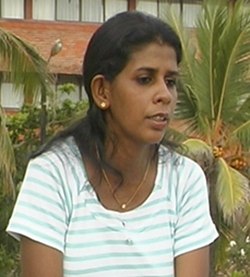
Dilrukshi Handunnetti in Deep Divide filmContrary to a popular belief, journalists don’t enjoy being able to say ‘I told you so!’. They much rather prefer if their investigative or analytical work in the public interest are heeded in time.
A few months before the Indian Ocean tsunami of December 2004, my friend and journalist Dilrukshi Handunnetti wrote an investigative story on how coastal zone management laws and regulations were openly flouted by developers. She cautioned that it was a ‘disaster waiting to happen’
She had no idea how forcefully her point will be driven home before that year ended.
“Little did anyone realise the price coastal communities would have to pay for the greed of a few dozen developers,” she said after the tsunami, interviewed for Deep Divide, a South Asian documentary on environmental justice that TVE Asia Pacific produced in 2005.
Sri Lanka’s economic activities are concentrated in coastal areas: 80 per cent of the tourist related activities are found there, along with one third of the population. Seeking to accelerate economic growth, the Sri Lankan government took measures to develop the island’s coastal regions. Shrimp and prawn farming was encouraged, while many incentives were provided for developing tourist resorts along the island’s scenic beaches.
As the shrimp exports grew and tourist arrivals increased, there was a ‘cost’ that only local residents and a few environmentalists cared about: mangrove forests were cleared, coral reefs were blasted, and the coastal environment was irreversibly changed.
Shrimp farming damaged mangroves, aggravated tsunami impactCoastal zone management regulations and guidelines were openly flouted by developers. Local communities were the last to benefit from this development boom — they watched silently as their fish catch dwindled and their coastal environment was pillaged. But little did anyone realise the price coastal communities would have to pay for the greed of a few dozen developers.
When the tsunami struck, there were very few natural barriers to minimise its impact. More than 40,000 people died or went missing, while hundreds of thousands lost their homes and livelihoods. It was the biggest single disaster in the island’s history.
Dilrukshi reflects: “Post-tsunami, people realised that the mangroves have protected these little, you know, landmass. And where you find a little bit of protected mangroves, you also find the landmass protected.”
She adds: “I think we have committed lot of excesses and we have been made to answer for those sins. Hereafter, we cannot afford to not do it right.”
Filmed on location in India, Nepal and Sri Lanka, Deep Divide explores the reality of environmental justice in South Asia — home to 500 million people living in absolute poverty, or 40 per cent of the world’s total poor. Everywhere, it finds environmental injustice. This investigative film builds on the work by three local journalists, who act as our guides to understanding the complexities and nuances of development amidst poverty and social disparities.
The origins of Deep Divide go back to 2002. Panos South Asia, a regionally operating non-profit organization analyzing development issues, awarded media fellowships to selected journalists from five South Asian countries to explore specific cases of environmental injustice in their countries. They were to investigate issues as varied as land degradation, food and water insecurity, rising pollution, and mismanaged development.
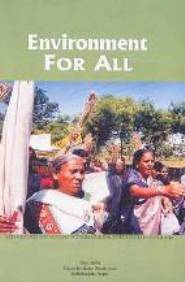
Their findings were initially published in the local media – in the newspapers or magazines they worked for. In 2004, Panos South Asia compiled the articles in a book titled Environment for All. Three stories from this book were adapted into the documentary, directed by Indian film maker Moji Riba.
Some films, like certain books, are in the making for years or decades. My latest film, Small Islands, Big Impact, just released online by TVE Asia Pacific, is quite short: slightly under 6 minutes long. But it has been forming in my mind for the past 20 years.
As a science journalist, I have been covering its story since 1989: how the Indian Ocean archipelago of the Maldives – Asia’s smallest country by area and population – is on the ‘frontline’ of climate change impact.
The Maldives packs 325,000 people into a combined land area just under 300 square kilometres spread over 1,192 islands and islets. With an average ground level of 1.5 metres (5 feet) above sea level, it is also the lowest country on the planet. When I first visited the Maldives in late 1988, they were still recovering from a massive storm surge in 1987. Although the damage was limited, the experience showed how vulnerable the Maldives can be to even a small rise in sea levels – this prompted the then President Maumoon Abdul Gayoom to take up the issue internationally. (It was President Gayoom who took up climate crusading at statesman level, well before Al Gore turned up on the scene.)
Interestingly, my first encounter with President Gayoom had nothing to do with climate – it concerned a celestial phenomenon: the Maldives was witnessing an annual solar eclipse and the President wanted to observe it in the company of amateur astronomers from their nearest neighbour, Sri Lanka. So he invited a couple of us over (I was active in the Young Astronomers’ Association of Sri Lanka at the time.)
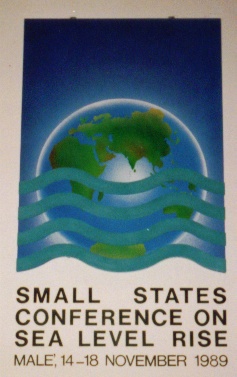
I returned to the Maldives in November 1989, that time as a member of the international media covering the first ever small states conference on sea level rise. Held at the Kurumba island resort, it was one of the earliest international gatherings on climate impacts on low lying states, a topic that was to gain public interest and momentum in the years to come. Among the participants were delegates from practically all the small states in different parts of the world (defined as those with less than 1 million population), and scientists from disciplines such as oceanography, climatology, meteorology and geology.
This was one of the first international scientific events that I covered as an eager young science journalist. I was a foreign correspondent for Asia Technology, a monthly magazine on Asian science and technology published from Hong Kong (now defunct), and freelancing for The Island daily newspaper in Sri Lanka. (There’s nothing online from that coverage as it was in the pre-web era!)
The conference had technical sessions where experts debated scenarios and implications, and a political segment where delegations made their official statements. In the end, they issued the Malé Declaration on Global Warming and Sea Level Rise, which urged for inter-governmental action on the issue.
Our Maldivian hosts knew that scientists and officials alone couldn’t send out a powerful message to the world on what climate change meant for low lying islands of the world – many of them mere specks on the world map, barely registering in media’s radar. So on the last day of the conference, we were taken to the Maldivian capital of Malé, where a demonstration and public rally were held by school children and ordinary people.
That turned out to be the most striking moment of the whole week. I had been listening to experts and officials talk about impacts, scenarios and mitigation measures for several days, on which I’d filed several stories. But unless I go back to my personal archives, I can no longer remember those details. My lingering memories of this event are in a few photos I took, showing school children telling delegates – and the world – what it means to be living on the front lines of climate change impact.
After 1989, I visited the Maldives on a couple of occasions for professional purposes during the 1990s. After I started working with TVE Asia Pacific in 1996, I was keen to return to the story of the Maldives and climate change – this time, in moving images – but I never had the chance until this year.
But I was covering the bigger story of climate change and its impact on the Asia Pacific from other locations. For example, in 2002, I commissioned and executive produced Voices from the Waves, the first-ever documentary on climate change in the South Pacific made by a native Pacific islander. Directed by Fijian film-maker Bernadette Masianini, the story revolved around two teenagers growing up on Fiji and Kiribati, each facing an uncertain future because of climate change.
In November 2007, the Maldives once again hosted representatives from small island states to discuss climate change. Eighteen years after the original meeting, the subject was no longer a fringe concern; it was now on everybody’s agenda. The meeting urged the the human dimension of global climate change to be included in the agenda of UN Climate Change Summit in Bali (December 2007), and sought the international community’s commitment “to protect people, planet and prosperity by taking urgent action to stabilize the global climate change”.
This time, the Male’ Declaration on the Human Dimension of Global Climate Change called for the UN High Commissioner for Human Rights to assess the human rights implications of climate change and “to conduct a study into the effects of climate change on the full enjoyment of human rights”. It also requested the UN Human Rights Council to convene a debate on human rights and climate change.
I wasn’t present at the 2007 meeting, but followed the process online. While climate change emerged as a major global concern, political change and reforms were underway in the Maldives. The country moved to a multi-party democracy, and in November 2008, the Maldivian Democratic Party‘s candidate Mohamed Nasheed won the presidential election.
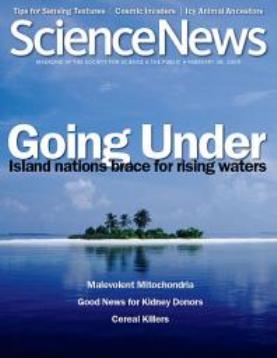
Science News cover - 28 Feb 2009President Nasheed continues the climate advocacy that President Gayoom had sustained for nearly a quarter of a century. President Nasheed has emerged as an outspoken and pragmatic voice speaking on behalf of his and other small island states, grouped under the Alliance of Small Island States (AOSIS).
In early 2009, President Nasheed announced that the Maldives would become the world’s first fully carbon-neutral nation within a decade. To accomplish this, they would vigorously pursue renewable energies and green energy sources to replace current dependence on fossil fuels.
The final inspiration for Small Islands, Big Impact came in February 2009, when Science News magazine in the United States carried a cover feature on the challenges faced by Kiribati and the Maldives because of climate change. Written by senior science writer Cristine Russell, the article noted: “The Maldives and Kiribati highlight a hidden challenge for coping with climate change. It’s not just about slowing the emissions of greenhouse gases. It’s also about figuring out what to do for localities threatened with the possibility of extinction from rising ocean waters.”
My original plan was to film interviews with President Anote Tong of Kiribati, and President Nasheed. While sharing the same overall concerns, the two leaders (and their governments) have adopted somewhat different responses to the challenges posed by climate change. Unfortunately, the interview with President Tong did not come through in time, even though I had a Kiribati TV crew standing by to film it. So I decided to go ahead with the film focusing solely on the Maldives.
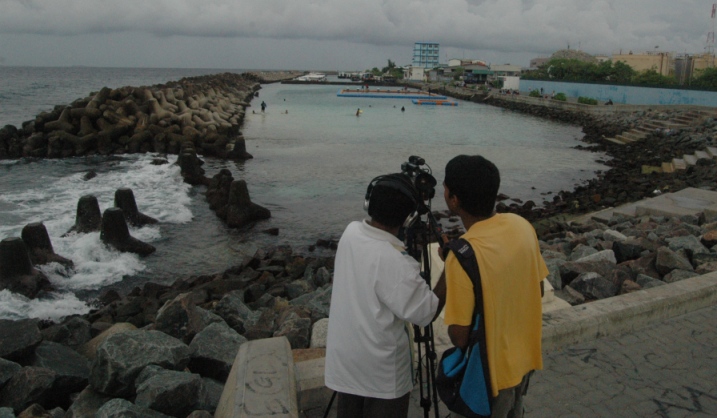
Location filming in Male - Hussein Makzoom (left) and Ibrahim Yasir As with all TVEAP films, I was keen to make it with a local crew. Mariam Niuma, an engaging young Maldivian woman who had worked for nearly two years with us as an intern, helped me find a very capable crew in Ibrahim Yasir and his colleague Hussein Makzoom.
Niuma had been urging us to make a film about her country and was delighted that we were finally able to take it up. She helped us in numerous ways with local knowledge, introductions and advice. She also took time off her work with a local charity to show me around the Male’ island – which I was returning after a dozen years, in which time it had changed almost beyond recognition. (Male’ is one of the most crowded places on Earth – every one in four Maldivians lives on the tiny capital island.)
Small Islands, Big Impact was filmed on location over a few days in late August in Male’ and the nearby island of Vilingili. Our tiny production budget didn’t allow us to spend longer or venture further into the more remote islands and atolls (coral island formations, 26 of which make up the Maldives).
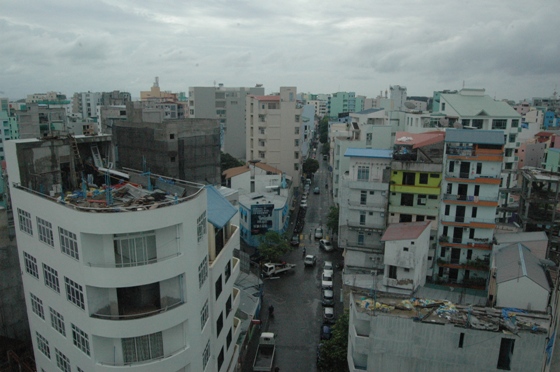
Overcrowded Malé, capital of the MaldivesThe timing wasn’t ideal either – the Monsoon was still active, and rain often interrupted our filming. There was some irony that a climate film was being shot in inclement weather. Sometimes we filmed in spite of the rain – one ferry ride we took from Male’ to Vilingili island had to cross very choppy seas that made me (a land lubber!) quite nervous. For our Maldivian crew, however, it was all in a day’s work…
President Nasheed’s media team had been quick and supportive in accommodating our interview request, but when actually filming it, we faced an unexpected challenge which I’ve described in an earlier blog post. (Clue: In addition to inclement weather, we had to deal with a nasty influenza virus). With the month-long Ramadan fast period about to begin, which would significantly affect the pace of work in the 100% islamic Maldives, we had no choice but to persist with our filming, improvising as we went along.
I returned to Colombo with five camera tapes rich in footage, one of which contained a 15-minute interview with the amiable and technocratic President Nasheed. Over the next few weeks, I worked with our editor Umesha Fernando in distilling this material into a short, compact film less than six minutes. It took a good deal of time and effort — especially since I chose not to have any narration and to let President Nasheed tell the story in his own voice, interspersed with text-supported transitions.
Because of this style, soundtrack mattered a great deal, and we agonised over custom-composing the music. As I put everything this together, I kept recalling the wise words of senior Australian film-maker Bruce Moir: “Film is a lousy medium to communicate information. It works best at the emotional level.”
I can’t judge my own film, but I have tried hard to strike a balance between its intellectual and emotional appeal. My team and I set out to tell a compelling story about a country on the frontlines of climate impact. No less a person than its dynamic head of state stars in our modest effort, made on an incredibly tiny budget.
Note: Small Islands, Big Impact was produced on an editorially independent basis by TVE Asia Pacific in collaboration with COM+ Alliance of Communicators for Sustainable Development. As with all other TVEAP productions, this series comes without license fees, where only copying and dispatch costs are payable. To order broadcast master tapes, please contact:
It may also be ordered in high resolution on DVD (without regional coding) from TVEAP’s e-shop.
News by definition looks for the exception. What goes right, and according to plan, is hardly news. Deviations, aberrations and accidents hit the news.
It’s the same with disasters. Reducing a hazard or averting a disaster does not make the news; when that hazard turns into a disaster, that typically tops the news. Yet, as we discussed during a session at the 6th World Conference of Science Journalists held in London from June 30 – July 2, 2009, both aspects are important — and both present many challenges to journalists and the media.
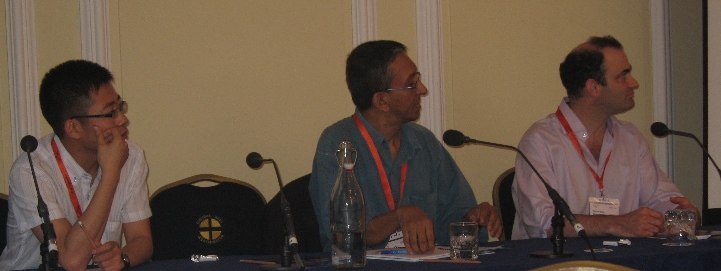
The session, titled Covering a disaster from Sichuan to Sri Lanka, saw three science journalists share their own experiences and insights in covering two major disasters in Asia. Richard Stone (Asia News Editor, Science) and Hujun Li (senior science writer with Caijing magazine, China) both spoke about covering the Sichuan earthquake that occurred on 12 May 2008. I spoke on my experiences in covering the Indian Ocean tsunami of 26 December 2004. The session was chaired by the veteran (and affable) British journalist Tim Radford, who has been The Guardian‘s arts editor, literary editor and science editor.
Covering a disaster from Sichuan to Sri Lanka: L to R: Hujun Li, Nalaka Gunawardene and Richard StoneI recalled the post-tsunami media coverage in two phases — breaking news phase (first 7 – 10 days) and the aftermath, which lasted for months. When the news broke on a lazy Sunday morning, ‘Tsunami’ was a completely alien term for most media professionals in Sri Lanka. In newspaper offices, as well as radio and TV studios, journalists suddenly had to explain to their audiences what had happened, where and how. This required journalists to quickly educate themselves, and track down geologists and oceanographers to obtain expert interpretation of the unfolding events. We than had to distill it in non-technical terms for our audiences.
My involvement in this phase was as a regular ‘TV pundit’ and commentator on live TV broadcasts of MTV Channels, Sri Lanka’s largest and most popular broadcast network. Night after night on live TV, we talked about the basics of tsunami and earthquakes, and summed up the latest information on what had taken place. We also acknowledged the limits of science -– for example, despite advances in science and technology, there still was no way of predicting earthquakes in advance.
One question we simply couldn’t answer was frequently raised by thousands of people who lost their loved ones or homes: why did it happen now, here — and to us? Was it an act of God? Was it mass scale karma? As science journalists, we didn’t want to get into these debates — we had to be sensitive when public emotions were running high.
There were enough topics during the breaking news phase that had a scientific angle. Clinically cold as it sounded, the mass deaths required the safe, proper and fast burial of bodies with identities established. The survivors had to be provided shelter, food, safe drinking water and counselling. And when rumours were spreading on the possibility of further tsunamis, both officials and public needed credible information from trusted, competent sources.
Tsunami waves lashing Kalutara beach on western Sri Lanka on 26 December 2004: satellite image courtesy DigitalGlobe Quickbird satellite, http://www.digitalglobe.com
After the breaking news phase passed, we had more time to pursue specific stories and angles related to the tsunami. As an environmentally sensitive journalist, I was naturally interested in how the killer waves had impacted coastal ecosystems. Then I heard some interesting news reports – on how some elements of Nature had buffered certain locations from Nature’s own fury.
Within days, such news emerged from almost all Tsunami-affected countries. They talked about how coral reefs, mangroves and sand dunes had helped protect some communities or resorts by acting as ‘natural barriers’ against the Tsunami waves. These had not only saved many lives but, in some cases, also reduced property damage. Scientists already knew about this phenomenon, called the ‘greenbelt effect’. Mangroves, coral reefs and sand dunes may not fully block out tsunamis or cyclones, but they can often reduce their impact.
Researching this led to the production of TVE Asia Pacific‘s regional TV series called The Greenbelt Reports, which was filmed at a dozen tsunami impacted locations in South and Southeast Asia. By the time we released the series in December 2006, sufficient time had passed for the affected countries to derive environmental lessons of the tsunami.
The other big story I closely followed was on early warnings for rapid on-set disasters like tsunamis. Some believed that the tsunami caught Indian Ocean rim countries entirely by surprise, but that wasn’t quite true. While the countries of South and Southeast Asia were largely unprepared to act on the tsunami, the Pacific Tsunami Warning Centre (PTWC) in Hawaii, who had detected the extraordinary seismic activity, did issued a tsunami warning one hour after the undersea quake off western Sumatra. This was received at Sri Lanka’s government-run seismological centre in good time, but went unheeded: no one reacted with the swiftness such information warranted. Had a local warning been issued, timely coastal evacuation could have saved thousands.
All this shows the many and varied science or development stories that journalists can find in the aftermath of disasters. Some of these are obvious and widely covered. Others need to be unearthed and researched involving months of hard work and considerable resources. Revisiting the scenes of disasters, and talking to the affected people weeks or months after the event, often brings up new dimensions and insights.
My own advice to science journalists was that they should leave the strictly political stories to general news reporters, and instead concentrate on the more technical or less self-evident facets in a disaster. During discussion, senior journalist Daniel Nelson suggested that all disaster stories are inherently political as they deal with social disparities and inequalities. I fully agreed that a strict separation of such social issues and science stories wasn’t possible or desirable. However, science journalists are well equipped to sniff out stories that aren’t obviously covered by all members of the media pack that descends on Ground Zero. Someone needs to go beyond body counts and aid appeals to ask the hard questions.
As Hujun Li said recalling the post-Sichuan quake experience, “Politics and science are like twins – we can’t separate the two. What we as science journalists can do is to gather scientific evidence and opinion before we critique official policies or practices.”
Another question we were asked was how journalists can deal with emotions when they are surrounded by so much death and destruction in disaster scenes. Reference was made to trauma that some reporters experience in such situations.
I said: “We are human beings first and journalists next, so it’s entirely normal for us to be affected by what is happening all around us. On more than one occasion in the days following the tsunami, I spoke on live television with a lump in my throat; I know of presenters who broke down on the air when emotions overwhelmed them.”
And now...the sequelsSumming up, Tim Radford emphasized the need for the media to take more interest in Disaster Risk Reduction (DRR), which basically means preventing disasters or minimising the effects of disasters.
“DRR is perhaps less ‘sexy’ for the media, as it involves lots of policies and practices sustained over time,” he said. “But the potential to do public good through these interventions is enormous.”
As Tim reminded us, disasters already exact a terrible and enduring toll on the poorest countries. This is set to get worse as human numbers increase and climate change causes extreme weather and creates other adverse impacts. Living with climate change would require sustained investments in DRR at every level.
The stories are out there to be captured, analysed and communicated. In the coming years, the best stories may well turn out to be on disasters averted or minimised
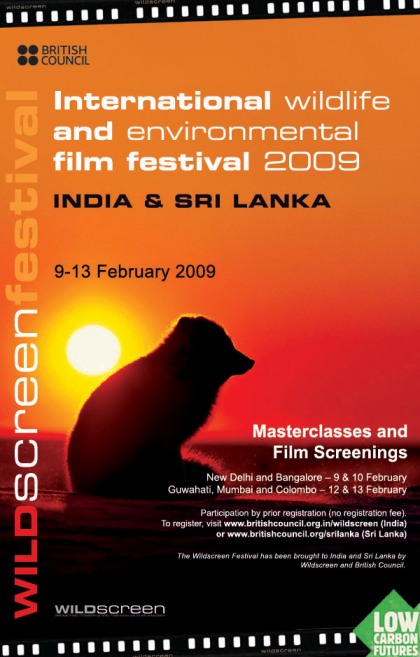
Wildscreen comes to ColomboWildscreen, the world’s largest and most prestigious wildlife and environmental film festival, will be touring India and Sri Lanka in February 2009.
Nine wildlife or environmental filmmakers from the UK will be coming to India and Sri Lanka as part of this event, organized by the British Council. The festival will also see screenings of wildlife and environmental films from across the world, some of them winners of the Wildscreen festival’s Panda Awards, the environmental equivalent of the Oscars.
The Wildscreen Festival was founded by Sir Peter Scott in 1982. It has been organised every alternate year for the past 25 years, and is now considered to be the world’s largest and most prestigious wildlife and environmental film festival. Held in Bristol, UK, it attracts hundreds of delegates from around the globe who work in film, television and new media, as well as those involved in environmental conservation.
The Festival is coming to Sri Lanka for the first time. The programme, held at the British Council Colombo on 12 – 13 February 2009, will screen several award winning films on climate change and wildlife, showcasing the best of current environmental film making worldwide. On 14 February 2009, TVE Asia Pacific will present a selection of films on environment and sustainable development drawn from their global catalogue, which includes some Sri Lankan and South Asian titles.
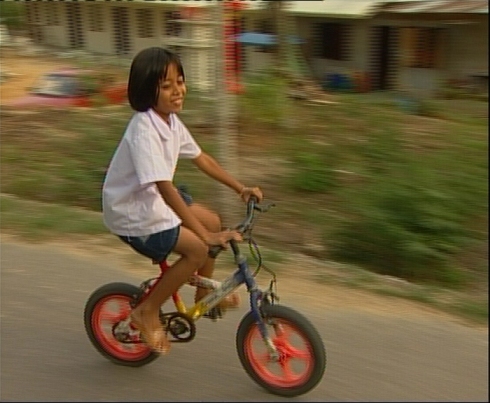
Jantakarn Thep-Chuay, known as Beam
For many weeks, Jantakarn Thep-Chuay — nicknamed Beam -– did not understand why her father was not coming home. The eight-year-old girl, in Takuapa in Thailand’s southern district of Phang Nga, had last seen him go to work on the morning of 26 December 2004.
“On that Sunday, the day there was a wave, my dad wore his tennis shoes,” she recalls as she gets into his pair of sandals. “My dad didn’t have to do much work — he just walked around looking after workers.”
Beam’s father Sukaroak –- a construction supervisor at a new beach resort in Khao Lak –- was one of thousands of Thais and foreign tourists killed when the Asian Tsunami hit without warning. His body was never found.
For months, Beam would draw pictures of her family. These, and family photos of happier times, helped her to slowly come to terms with what happened.
The first year was long and hard for the family Sukaroak left behind: Beam, her two-year-old brother Boom, and mother Sumontha, 28. The determined young widow struggled to keep home fires burning -– and to keep her troublesome in-laws at bay.
As if that were not enough, she also had to engage assorted bureaucracies: even obtaining an official death certificate for her late husband entailed much effort.
Just a few weeks after the disaster, the local authorities approached Sumontha suggesting that she gives away one or both her children for adoption. Apparently a foreigner was interested. She said a firm ‘No’.
“Her dad wanted Beam to become an architect. He was hoping for a day when he could build something she draws,” says Sumontha. “If I am still alive, I want to raise my own children. I am their mother. For better or worse, I want to raise them myself.”
The Tsunami destroyed Beam’s school, but she continued to attend a temporary school set up with local and foreign help. Before the year ended, she moved to a brand new ‘Tsunami School’ that the King of Thailand built to guarantee education for all children affected by the disaster.
Sumontha, Beam and Boom are three ordinary Asians who have shown extraordinary courage, resilience and resourcefulness as they coped with multiple challenges of rebuilding their lives after the Tsunami. Theirs is one of eight families that we followed throughout 2005, under our empathetic communication initiative called Children of Tsunami: Rebuilding the Future.
It was a multi-country, multi-media project that tracked how ordinary Asians rebuilt their lives, livelihoods and futures after one of the biggest disasters in recent years. We at TVE Asia Pacific documented on TV, video and web the personal recovery stories of eight affected families in India, Indonesia, Sri Lanka and Thailand for a year after the disaster. Our many media products — distributed on broadcast, narrowcast and online platforms -– inspired wide ranging public discussion on disaster relief, recovery and rehabilitation. In that process, we were also able to demonstrate that a more engaged, respectful kind of journalism was possible when covering post-disaster situations.
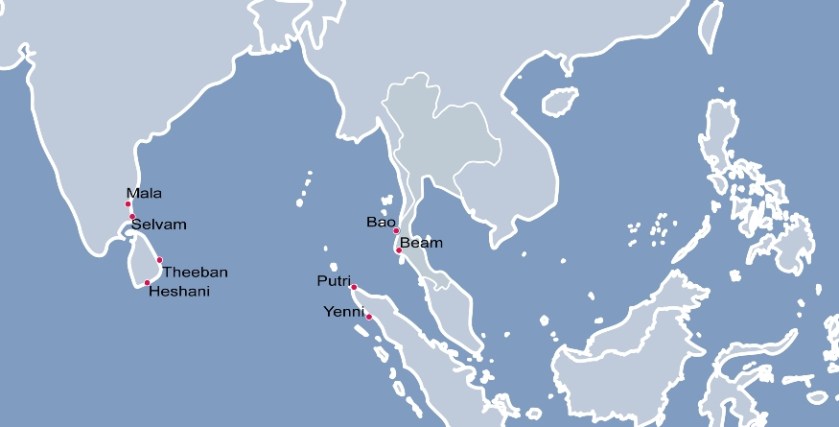
Four countries, eight locations: where Children of Tsunami stories were filmed for much of 2005
Meet the Children of Tsunami…
They have never met each other. Yet they were united first in grief, then in survival. Five girls and three boys, between 8 to 16 years of age, living in eight coastal locations in four countries. Their families were impacted by the Asian Tsunami in different ways. Some lost one or both parents -– or other family members. Some had their homes or schools destroyed. Others found their parents thrown out of a job. During the year, these families faced many hardships and challenges in rebuilding their futures.
Filming with Theeban in eastern Sri Lanka...now only a memory
As I recalled in early 2007, when we tragically lost one of eight survivor children – Theeban – to Sri Lanka’s civil war: “As journalists, we have been trained not to get too attached to the people or subjects we cover, lest they affect our judgment and dilute our objectivity. The four production teams involved in Children of Tsunami initially agreed to follow this norm when we met in Bangkok in early 2005 for our first (and only) planning meeting. We also resolved not to reward our participating families in cash or kind, as they were all participating voluntarily with informed consent.
“But the ground reality was different. 2005, Asia’s longest year, wore on. As survivors slowly patched their lives together again, our film teams found themselves becoming friends of families or playing Good Samaritan. Sometimes our teams would find a survivor family close to starvation and — acting purely as human beings, not journalists — they would buy dry rations or a cooked meal. At other times, finding the children restless or aimless, they would buy them a football, kite or some other inexpensive toy that would produce hours of joy and cheer.
“As commissioners and publishers of Children of Tsunami stories, we didn’t object to these acts of kindness. Journalism with empathy was far preferable to the cold detachment that textbooks recommend.”
Children of Tsunami: No More Tears (25 mins) was the shorter version of the end-of-year film that captured the highlights and ‘lowlights’ of our families’ first year following the disaster. We co-produced it with the Singapore-based regional broadcaster Channel News Asia.
When our Sri Lanka 2048 TV debate series started a few weeks ago, I had no idea that I’d be hosting some programmes. But through an interesting turn of events, I’ve ended up doing just that.
The series, which TVE Asia Pacific is co-producing with IUCN and MTV Channel (Pvt) Limited — Sri Lanka’s ratings leading TV broadcaster — has been going out once every week from 22 May 2008. As I wrote at the time the series started, most programmes (8 out of 10) were hosted by Sirasa TV’s versatile and dynamic presenter Kingsly Rathnayaka.
Our plan was to do two shows in English, exploring the topics living with climate change and the nexus between business and the environment. We were still searching for a presenter for these two even as we produced and aired the Sinhala programmes.
In the end, the channel management as well as our production team all suggested for me to take it on. I’ve been hosting quiz shows on TV since 1990, and have been a regular ‘TV pundit’ on a broad range of development, science and technology issues for at least a decade. I’ve also been doing a fair amount of moderating sessions and panels at international conferences. Hosting Sri Lanka 2048 challenged me to combine all these skills — and to be informed, interested and curious about our topics under discussion.
I enjoyed being the ‘skeptical inquirer’, a role I’ve had fun playing for long years as a development journalist. Our viewers can judge how well I fared. My aim was to keep the panel and audience focused, engaged and moving ahead. My style is slower and more reflective than Kingsly’s fast-paced, chatty one. Direct comparisons would be unfair and unrealistic since we are very different personalities.
But I’m enormously grateful to the younger, more experienced Kingsly for his advice and guidance in preparing for my new role. The TV camera is ruthless in capturing and sometimes magnifying even minor idiosyncrasies in presenters. It has as much to do with style as with substance. Hope I made the grade…
Sri Lanka 2048 series branding
Here’s the promotional blurb for this weekend’s show, titled Business As Unusual (yes, I borrowed the apt title from our sorely missed inspiration Anita Roddick). It was broadcast on Channel One MTV, the English language channel of Sri Lanka’s Maharaja broadcasting group.
Sri Lanka 2048 looks at Business As Unusual: How can companies do well while doing good?
The private sector is acknowledged as the engine of our economic growth. But how long can this ‘engine’ keep running without addressing its many impacts on society and the natural environment? With public concerns rising everywhere for a cleaner and safer environment, how best can businesses respond to the environmental challenges — and find new opportunities to grow and innovate?
These and related questions will be raised in this week’s Sri Lanka 2048, the series of TV debates exploring Sri Lanka’s prospects for a sustainable future in the Twenty First Century. The one-hour debate, this time in English, will be shown on Channel One MTV from 8 to 9 pm on Saturday, 19 July 2008.
Titled Business As Unusual, this week’s debate brings together concerned Sri Lankans from academic, corporate, civil society and government backgrounds to discuss what choices, decisions and tradeoffs need to be made for businesses to become environmentally responsible — and still remain profitable. Increasingly, there are examples of smart companies achieving this balance.
Sri Lanka 2048 panel on business and environment broadcast on 19 July 2008
The wide ranging discussion — looking at both domestic and international markets, and covering a range of industries — notes that many companies already address not just financial but also social and environmental bottomlines. Adopting cleaner production practices have helped increase profits through being thrifty with resources and careful with waste.
The debate also looks at the findings of a survey that IUCN and the Ceylon Chamber of Commerce carried out last year of 45 companies on their corporate social responsibility (CSR) policies and practices. It revealed that a significant number of companies are actively applying CSR principles, with slightly over half (53%) already having environmental components in their CSR (known as CSER). The survey also found that local companies were stronger on CSR/CSER than the local operations of multinational companies.
As some panelists and audience members argue, embracing sound environmental practices goes well beyond CSR. With rising consumer awareness and greater scrutiny of how companies source materials and energy, ‘going green’ has become an integral part of responsible corporate citizens.
Sri Lanka 2048 debates are co-produced by TVE Asia Pacific, an educational media foundation, and IUCN, the International Union for Conservation of Nature, in partnership with MTV Channel (Private) Limited. This editorially independent TV series is supported under the Raising Environmental Consciousness in Society (RECS) project, sponsored by the Government of the Netherlands.
Sri Lanka 2048 - Nalaka briefing audience just before recording starts...
Wherever you are, Anita, I hope you were watching our show tonight — and hopefully nodding… When you insisted that businesses must care for community and the environment, you were so ahead of the pack. We’re still struggling to catch up.
On the set of Sri Lanka 2048: Nalaka with panelist Jeevani Siriwardena
 The origins of Deep Divide go back to 2002. Panos South Asia, a regionally operating non-profit organization analyzing development issues, awarded media fellowships to selected journalists from five South Asian countries to explore specific cases of environmental injustice in their countries. They were to investigate issues as varied as land degradation, food and water insecurity, rising pollution, and mismanaged development.
 I returned to the Maldives in November 1989, that time as a member of the international media covering the first ever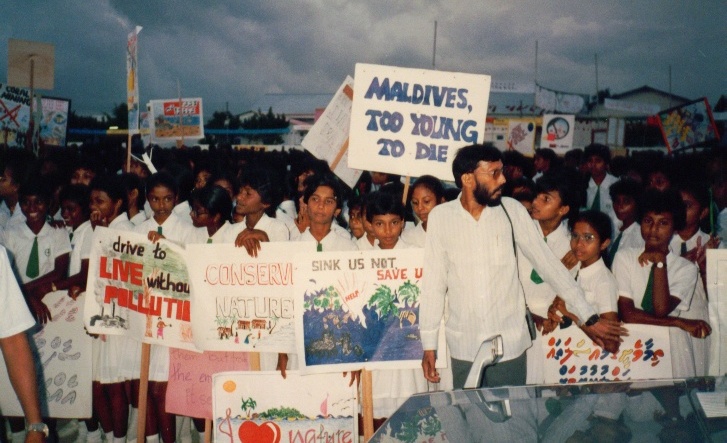




 Open Minds!