I just killed a few dozen ‘girls’ before breakfast. It wasn’t always easy or pleasant, and after a while there was blood all over the place. But I feel good about getting them – and I saved an innocent baby in the process, and even helped a researcher doing good work!
Now online: a game we have played over millennia against 'em blood suckers...
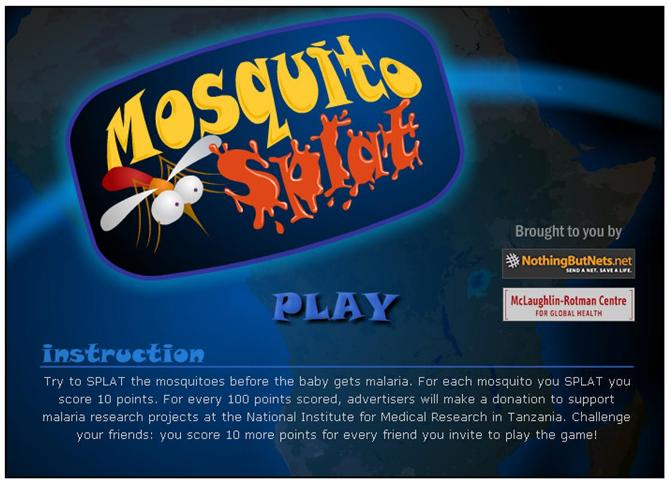
The aim of the game is to use the fly squatter to SPLAT mosquitoes before the baby gets malaria. For each mosquito you SPLAT, you score 10 points. For every 100 points scored, advertisers will make a donation to support malaria research projects at the National Institute for Medical Research in Tanzania. We also score 10 points for everyone we invite to play the game – plus there’s a link taking us to an online donation page in case we want to support the research directly.
“It’s quick, easy and fun, and a great way to do your part for one of the most serious global health problems in the developing world,” say the game’s promoters.
Indeed. Nearly 500 million cases of malaria occur each year, resulting in over one to three million deaths (figures online vary enormously on this). Malaria is particularly devastating in Africa where it is a leading killer of children. Every 30 seconds a child in Africa dies from malaria.
The fact is, malaria deaths are entirely preventable with modest investment and spread of knowledge that mosquitoes spread malaria (not everyone knows this, and as I wrote in another blog post, that’s a challenge that educators and broadcasters are now working on).
McLaughlin-Rotman Center for Global Health: Taking anti-malaria campaign onlineBut more needs to be done to engage the Digital Natives in this global public health challenge. It’s not just the exposed people in malaria-prevalent parts of Africa, Asia and Latin America who are at risk. As development economist Jeffrey Sachs has been reminding us eloquently, malaria reduces productivity, increases poverty, weakens people’s bodies and makes them vulnerable to other diseases. In a globalised world, such massive suffering in some parts of the world would quickly manifest in different ways all over the planet.
Little biology lesson: Usually, people get malaria by being bitten by an infective female Anopheles mosquito. Only Anopheles mosquitoes can transmit malaria, and they must have been infected through a previous blood meal taken on an infected person. When a mosquito bites an infected person, a small amount of blood is taken, which contains microscopic malaria parasites. About one week later, when the mosquito takes its next blood meal, these parasites mix with the mosquito’s saliva and are injected into the person being bitten.
A film to reveal what the old media didn't show...When Barack Obama and his running made Joe Biden won the US Presidential Election held on 4 November 2008, they not only beat the Republican duo McCain-Palin but also a host of other also-rans. It’s too soon to tell, but that date might also mark the beginning of the end for the old media, also called the mediasaurus, who have been dominating the public’s access to news, information and commentary for over a century.
But how did it all happen? Who can tell us the real story as it happened, and why, without filters and biases so rampant among the mediasaurus?
On this blog, we have watched with deep interest and some fascination the rise of Barack Obama from relative obscurity to become the President of the United States. On 6 November 2008, soon after the election results were confirmed, we noted how Obama had just been elected ‘President of the New Media world’. I explained: “Obama’s rise has epitomised change in many ways. Among other things, he is the first elected leader of a major democracy who shows understanding and mastery over the New Media World, which is radically different from the old media order.”
On 20 January 2009, when he was inaugurated, we wrote: “For four or eight years, Obama’s every move, word and gesture will be captured, dissected and debated to exhaustion by admirers and detractors alike. And his administration will be under scrutiny by thousands of citizen journalists who don’t share much except the digital platforms and social networks on which they post their impressions. Welcome to the New Media Presidency. The hard work – and real fun – begin now!”
And now, one of the world’s leading new media activists, Danny Schechter, is about to release a new documentary on how the Obama campaign rode the new media wave to the White House — and more importantly, how the same new media can help the American public to keep Obama Administration accountable.
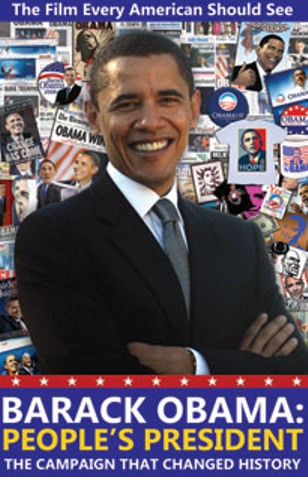
The film “Barack Obama, People’s President”, (slated for DVD release later this month by ChoiceMedia.net), documents the online and on the ground techniques that were used to win the highest office in the land.
As the film’s advance promo blurb says: The one story that most TV outlets didn’t tell in the 2008 election was the most important one -how did a young and relatively unknown candidate become President? If you voted for Barack Obama or not, this is a story you will want to know because it shows how the face of presidential politics changed forever. Barack Obama used techniques never seen before in a nationwide election — his grassroots mobilization and use of the internet was unprecedented, inspiring and effective. You have seen the rest of the coverage — now see the real story.
The film goes inside the official and unofficial campaign to show how Barack Obama was turned into a political brand to appeal to young first time voters. It shows how social networking on the internet — blogs, Facebook, texting and other techniques — were used carry the message to the masses and to raise tens of millions of dollars for the campaign. Popular online videos such as “Obama Girl”, along with those created by regular yet passionate supporters to engage their own communities, became one of the most important tools in the campaign’s success.
Watch the trailer of “Barack Obama, People’s President” directed by Danny Schechter:
Emmy award winning film-maker Danny Schechter, who is also blogger-in-chief at MediaChannel.org that keeps a critical eye on the media, just wrote this explaining why he made this film:
“It is hard to remember that two years earlier Obama was barely known, registering on the radar screen for just 10% of voters. He was also hardly a brand name as a first term Senator who spent more time in state politics in Illinois than on the national stage. Moreover, he was young and a man of color — not qualities that usually prevail in a presidential arena which tends to draw far older, far whiter, and far more centrist candidates. The thought that he would beat frontrunner Hillary Clinton in the primaries was, quite frankly, unthinkable to most of the elite.
“And yet he prevailed, as he used a phrase appropriated from labor organizer and Latino legend Caesar Chavez. Obama turned the farm workers Spanish language slogan “Si Se Puede” into “Yes We Can.” Rather than focus on specific political issues, he built a campaign on the promise of “Hope.” Rather than just rely on traditional fundraising — although by the end, he was plush with it — he reached out over the internet for smaller donations from millions of donors.
Perils of the New Media Generation...“Few in the major media gave him a chance, but he was not discouraged because he had created his own grassroots media operation using sophisticated organizing and social networking techniques to build a bottom-up movement, not the usual top-down apparatus. While his campaign ran the show, he encouraged independent initiatives including citizen-generated media, music videos, personalized websites, twittering and texting, etc..
“This is the new direction our politics has taken. It is a story that may be somewhat threatening to old media – and older activists – who prefer a one to many approach to communication, as opposed to forging a more interactive empowering platform. There is no question that young people — especially those mobilized by Obama — prefer online media and that choice is making it harder and harder for traditional outlets to sustain their influence and, in some cases, even their organizations. Old media may be on the way out.
“This is why our film is, in my mind, so important, not just as a record of how Obama won and what happened in 2008, but in what will happen, can happen, and is happening in the future. This is why I believe its critical for Americans to see it — and others in the world as well — to recognize how Obama represents more than just another politician, but a whole new approach to politics. That old adage is worth remembering: “It’s not the ship that makes the wave, it’s the motion of the ocean.”
“Obama, for all his shortcomings, which are becoming more obvious by the day, has pioneered the way change must be won — not by people on the top, but by all of us. It remains for “us” to hold him accountable. We live in a culture of amnesia – it is important to learn the lessons of the recent past.”
Read the full comment: New Film Tells Unreported Story of Obama’s Election on MediaChannel.org
 Open Minds!