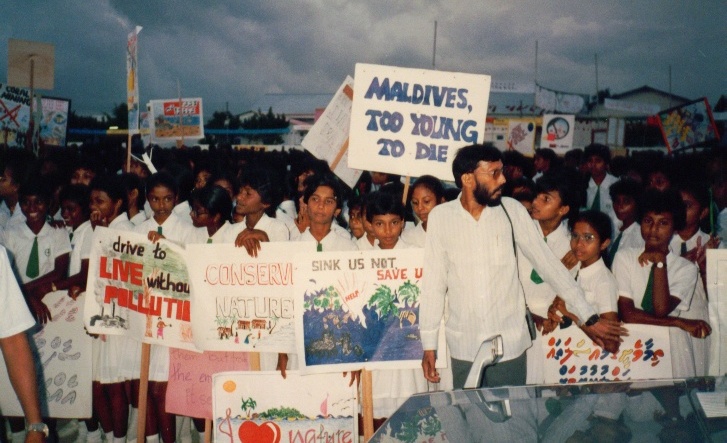
Little voices from the waves: Maldives too young to die!

maldives-too-young-to-die-say-school-children-nov-1989.jpg

My post last week on the Maldives on the frontline of climate change reminds me that I have been covering this story for the better part of 20 years. I have just located this photo from the depths of my personal image collection.

I first visited the Maldives in 1988, which was within months of the Indian Ocean archipelago nation suffering from a massive storm surge in 1987. Although the damage was minimal, the experience was a forceful reminder of how vulnerable the Maldives can be to even a small rise in sea levels – this is what prompted the low lying nation to take up the issue internationally.

In November 1989, the Maldives hosted the first ever small states conference on sea level rise, held at the Kurumba island resort.

It was also one of the earliest international gatherings on this issue, which was to gain public interest and momentum in the years that followed. Among the participants were delegates from practically all the small states in different parts of the world (defined as those with less than 1 million population), and scientists from disciplines such as oceanography, climatology, meteorology and geology.

This was one of the first international scientific events that I covered as an eager young science journalist. I was then a roving South Asian correspondent for Asia Technology, a popular monthly on Asian science and technology published from Hong Kong (which, alas, folded up in 1991) – there’s nothing online as it was in the pre-web era!

The conference had technical sessions where experts debated scenarios and implications, and a political segment where delegations made their official statements. In the end, they issued the Malé Declaration on Global Warming and Sea Level Rise, which urged for inter-governmental action on the issue.
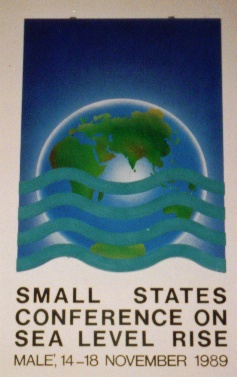
small-states-conference-on-sea-level-rise-logo.jpg small-states-conference-on-sea-level-rise-logo.jpg

Some 18 years later, I’m still eager but not so young – and I’ve covered more than my share of international environmental conferences to know that they can’t save the world. At least not on their own.

But many serve a useful function in rallying around concerned parties, helping them to agree on advocacy positions. Progress at inter-governmental level can be painfully slow and incremental. Sustaining public and media interest is one way to keep pressure on the endlessly bickering governments.

Following the November 1989 conference, small island states played a key role in negotiations that led to the UN Framework Convention on Climate Change adopted in 1992. This is the precursor to Kyoto, Bali and other processes that are now very much in the news.

The Maldivian hosts knew that scientists and officials alone could not send out a powerful message to the world on what climate change means to low lying islands of the world – many of them no more than a few feet above sea level.

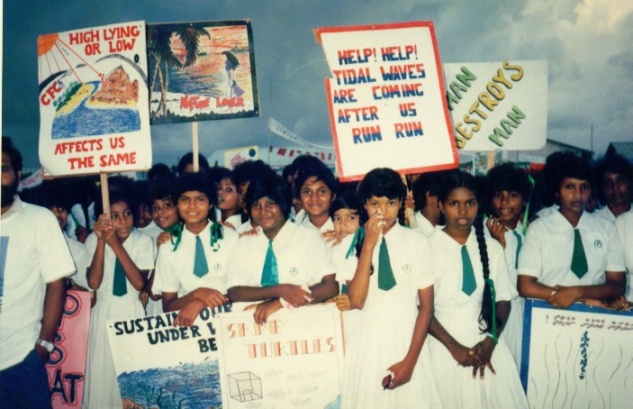
So on the last day evening, we were all taken to the Maldivian capital of Male, where we saw a demonstration and meeting held by the school children and ordinary people. To me, at least, this was the most striking moment of the whole week.

Leading up to this, I had been listening to competent experts and concerned officials talk about impacts, scenarios and mitigation measures for several days. Based on my notes and interviews, I filed several stories that captured highlights.

But unless I go back to my personal archives and look up those stories, I can no longer remember what I wrote. My lingering memories of this event are in these images, showing school children telling delegates – and the world – what it means to be living on the front lines of climate change impact.
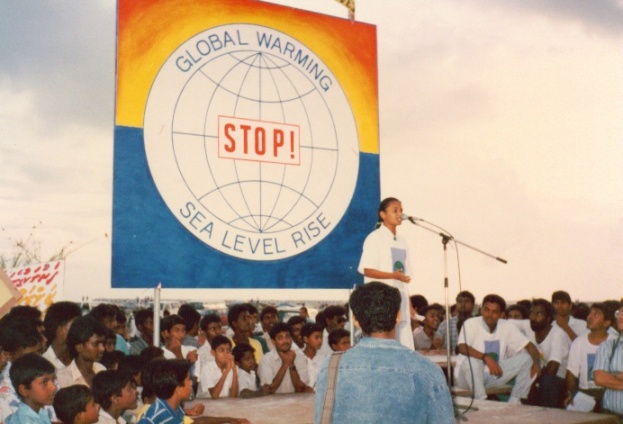
listen-to-our-voice-from-the-waves-maldives-nov-1989.jpg

maldivian-school-children-worried-about-sea-level-rise-nov-1989.jpg

Then newly formed Maldivian environmental organisation Bluepeace was also part of the demonstration:
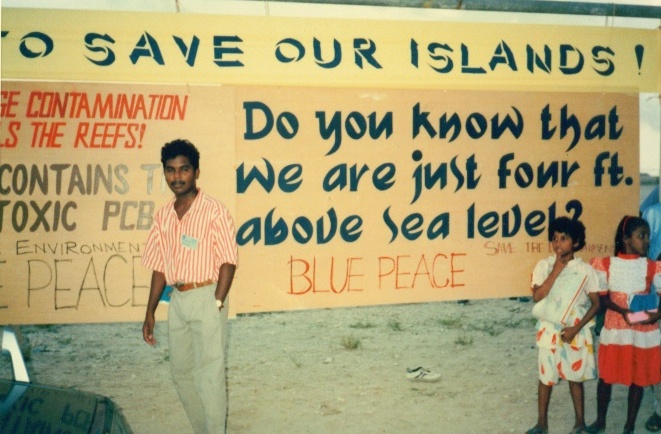
bluepeace-calls-for-global-attention.jpg

I worked for several years as a science and technology reporter. I was trained to gather, process and present facts and, preferably, expert opinion. But over the years I have realised that while hard facts and expert opinions are necessary, these tell only one part of complex stories we cover.

We need to bring in the human face of our stories — how ordinary children, women and men feel about issues and how they react to situations. This is why I now argue that we should not allow the human face of climate change to be lost in our well-meaning technical and economic discussions about climate change mitigation and adaptation.

We can cover carbon neutrality, zero emissions and common but differentiated responsibilities for all we like, but if we don’t pause to listen to these little voices from the waves – from the frontlines that are already feeling the heat – we will miss the bigger picture of what climate change is all about.

Dec 2007: Road to Bali – Beware of ‘Bad Weather Friends’

Photos by Nalaka Gunawardene, Male island, November 1989
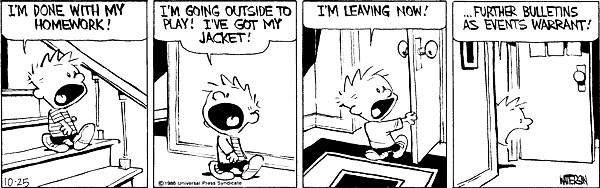
Creating news needlessly – or covering news needlessly?

covering-news-needlessly.gif

This came in a few days ago – as part of my daily diet of emailed Calvin and Hobbes comic strips sent free by Go Comics.

It reminded me of our South Asian governments and many 24/7 news channels who sound just like Calvin.

Governments – at least in popularity-conscious democracies – are constantly trying to create news, even when there is nothing new, true or interesting (the triple test for news). There’s a lot more rhetoric, plans and claims than actual accomplishments.

TV news channels, having to fill 24 hours of the day, cover news needlessly and in endless repetitions and detail. (By the way, covering news needlessly is an irreverent expansion of the abbreviation CNN!).

Actually, I shouldn’t compare either entity with the smart six-year-old Calvin. He is a great deal more interesting on an on-going basis than most of our governments and much of our news media.

I’m a long-standing fan of the comic – and followed it while Bill Watterson was still drawing them from 1985 to 1995. It was a sad day indeed when he decided on 31 December 1995 not to draw any more Calvin and Hobbes.

calvin-hobbes.png

AlertNet for Journalists: Rough guide to disasters and ‘alms bazaar’

Journalists are among the first responders to disasters and conflicts that break out without notice. They have to gather information from ‘ground zero’, process it and disseminate as rapidly and accurately as possible.

Easier said than done – especially when there’s more than the usual level of chaos, confusion and consternation. The multitude of humanitarian workers and their agencies who rush to such situations – to provide much-needed rescue, relief and recovery support – don’t always make life easier for journalists.

Yet they need each other. They just have to find better ways to work together. This is the central theme of our just-released book, Communicating Disasters: An Asia Pacific Resource Book – the entire book is now available online for free download.

reuters-alertnet-logo.jpg

One of the appendices to the book was contributed by Emma Batha of Reuters who talked about Reuters AlertNet for Journalists.

AlertNet for Journalists is “a set of free online tools designed to help journalists cover conflicts and disasters. The resources include crisis briefings, country statistics and aid agency contacts.”

It is part of Reuters AlertNet, a non-profit humanitarian news network based around a popular website, set up in 1997 by the Reuters Foundation. It aims to keep relief professionals and the wider public up-to-date on humanitarian emergencies around the globe.

Here’s a short video that AlertNet has just placed on YouTube – their first film to be thus offered:

It’s good to see more humanitarian and disaster related organisations engaging the YouTube. I wrote in October 2007 about UN-ISDR taking the plunge, placing some of its videos on a YouTube channel.

Read Emma Batha’s contribution to Communicating Disasters: Reuters AlertNet for Journalists

Return to Paradise: Maldives on the frontline of climate change

Related blog post: 6 Jan 2008: Little voices from the waves: Maldives too young to die

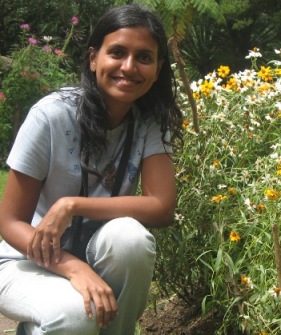
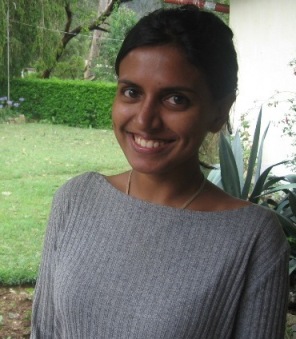
Mariyam Niuma - photo by TVEAP

All of us at TVE Asia Pacific are missing Mariyam Niuma.

This bubbly, happy-go-lucky intern returns to her native Maldives this week after working with us for over a year as a programme assistant. She plans to spend more time with her family, and explore work opportunities in the Indian Ocean archipelago nation of 370,000 people.

Niuma, in her early 20s, applied for a staff position in late 2006. Among other things, she came with skill and dexterity in graphic design, web research and English proficiency — always useful for a regional communication organisation like ourselves.

“I want to learn as much as I can how a non-profit organisation works,” she told as at the recruitment interview. She had plans of taking the knowledge and skills back to her home atoll, hoping to make life better for her people.

I hope she found what she was looking for. We found in her an energetic young person with good attitude – one who could be challenged to work on tough (and sometimes tedious) tasks on a regular basis.

“The last year has been a very challenging and fulfilling year for me, and being at TVEAP helped a lot,” she wrote in an email on her last day at work. “I will miss you all and being a part of you and will always remember the good times and everything I have learnt here both professionally and personally.”

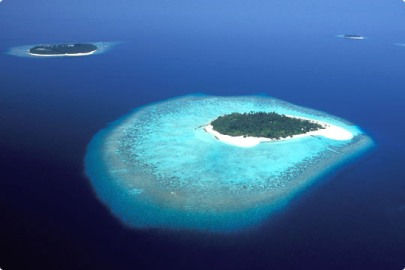
Some months into her internship, Niuma gave us a presentation on her home country, home atoll and life at home. To many outsiders, Maldives evokes images of palm-fringed sandy beaches, shallow seas of an exquisitely azure blue, high end resorts, crystal clear blue waters for diving…and plenty of sunshine all the year round. (Image shows Kurumba resort, Maldives.)

Well, all that’s true as widely advertised. But Maldives is a whole lot more – a history going back to at least 1,500 BC, distinctive island culture, and a nation that is struggling to reconcile tradition with modernity. Divehi, the Maldivian language, contributed the word “atoll” (a ring-shaped coral reef) to the English language.

The former British protectorate, which became independent in 1965 and a republic in 1968, has a pro-democracy movement sustained over the past few years. If such political turbulences create a sense of uncertainty in the minds of Maldivians about their future, it’s only one source of concern.

They also have to worry about whether their nation would have a collective future. That’s because of climate change that scientists now confirm are underway, aggravated by human action.

Most of the 1,200 islands in the Maldives are no more than 1m (3 feet) above sea level. Even a modest rise in sea levels could inundate these lands. Within 100 years the Maldives could become uninhabitable.

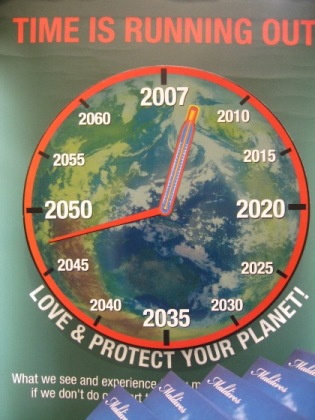
Time is indeed running out for Niuma and her country — as this poster produced by The Body Shop reminds us.

Time is running out...and not just for the Maldives

In 1987 and 1991 storm surges flooded a large number of islands, including one-third of the capital where one-quarter of the country’s population lives. Unusually high waves forced the international airport to be closed, causing great damage to tourism and constraining emergency relief operations. On 26 December 2004, the Asian tsunami battered the Maldives, forcing the evacuation of 13 of its 200 inhabited islands. These incidents indicate how vulnerable the islands are to wave action.

Maldives was among the first countries in the world to raise climate change as a serious issue at the United Nations. President Maumoon Abdul Gayoom raised the alarm back in 1987, when most people had not even realised the problem and scientific evidence was just beginning to come in.

The Maldives did more than raise the issue. The country played a lead role in rallying around other small island states worldwide that would be among the first to be impacted when sea levels rise due to thermal expansion and melting of polar ice.

In November 1989, the Maldives hosted the first ever small states conference on sea level rise, which was one of the first international scientific events that I covered as an eager young science journalist.

The conference issued the Malé Declaration on Global Warming and Sea Level Rise, which urged for inter-governmental action on the issue. The small island states played a key role in negotiations that led to the UN Framework Convention on Climate Change adopted in 1992. This is the precursor to Kyoto, Bali and other processes that are now very much in the news.

Just a few weeks ago, in mid November 2007, the Maldives once again hosted representatives from small island states to discuss climate change. Eighteen years after the original meeting, the subject is no longer a fringe concern; it’s now on everybody’s agenda.

Maldives from the air: tiny specs in the ocean
The meeting urged the the human dimension of global climate change to be included in the agenda of UN Climate Change Summit in Bali (December 2007), and sought the international community’s commitment “to protect people, planet and prosperity by taking urgent action to stabilize the global climate change”.

This time, the Male’ Declaration on the Human Dimension of Global Climate Change called for the UN High Commissioner for Human Rights to assess the human rights implications of climate change and “to conduct a study into the effects of climate change on the full enjoyment of human rights”. It requested the UN Human Rights Council to convene in March 2009 a debate on human rights and climate change.

I wasn’t at the November 2007 Male meeting, but was glad that the meeting stressed the need for adding a human face to the complex, nuanced challenge of climate change. This resonates very much with my own experience.

Read my April 2007 blog post: Wanted – human face of climate change

Mariyam Niuma takes me a bit closer to the realities of what climate change means to communities living on the frontline. Unlike Niuma, who is web savvy and connected with the wider world, many are blissfully unaware of the problem.

Our challenge is to bring their voices, stories and aspirations to the global news agenda and the myriad discussions now underway searching for solutions.

I hope someday we can work with Niuma again — perhaps amplifying her story in moving images.

Nov 2007 blog post: True people power needed to fight climate change

Related blog post: 6 Jan 2008: Little voices from the waves: Maldives too young to die

Photos of Mariyam Niuma courtesy Manori Wijesekera of TVEAP

Covering disasters in the globalised media: Beyond what happened…

“In a global information society where there is a constant race for who delivers the news first, such news undoubtedly fill a need — the need to know. But does reporting on disaster, conflict, international politics or other issues, throw up other questions beyond ‘what happened’? Questions like: What does this mean? How did this happen? How do other communities cope? Are the funds being put to good use? Is the kind of assistance coming in sensitive to different communities’ needs? Which communities are left out from receiving aid and why?

“These are some of the questions that beg to be delved into, and are the niche for media organisations, whose mission it is to try to look at the bigger picture and put the issues behind the events in context. This is not to say that some are always better than others. It is a way of stressing that ‘media’ are far from a homogenous crowd, and that different media organizations have different media products, stemming from different assessments of their audiences and mission.”

This is an extract from the chapter titled “The 2004 Tsunami: Unfinished Story”, by journalist Johanna Son for Communicating Disasters: An Asia Pacific Resource Book (co-edited by Nalaka Gunawardene and Frederick Noronha, and released in December 2007).

Johanna (photographed below addressing TVE Asia Pacific staff in August 2007), a journalist for two decades, is director of Inter Press Service (IPS) Asia-Pacific, the regional foundation that is part of the IPS international news agency. A Philippine national, Son was previously correspondent and editor for IPS Asia-Pacific, as well as staffer of the Manila Chronicle.

How many ways are there to report on a disaster? Johanna uses examples from IPS to ‘do a post-mortem of sorts in the spirit of sharing the challenges of covering disasters like that of the tsunami and of learning from one another.’

johanna-son-during-tveap-visit-2007-3.jpg communicating-disasters-an-asia-pacific-resource-book-by-tveap-and-undp.jpg

Here are some more extracts – the full chapter will be placed online in January 2008:

On 26 December 2004, I was in Manila, the Philippines, for the year-end holidays when the newsbar across the screens of international TV networks began flashing reports that “scores” were believed to have been killed by a tsunami in the Indian Ocean. It was, we were told, triggered by an undersea earthquake recorded at up to 9.3 magnitude on the Richter Scale. (This has since been called the second most powerful earthquake ever recorded by a seismograph.)

“In the following hours, the number kept rising – first to “hundreds” then to “thousands”. Even without much detail and description, it was clear this was quite a different disaster. News desks around the world went into action.

“The editor for my region was on holidays in Africa. So I was in touch with our regional correspondent, who was then on holidays in Sri Lanka, and also in contact with a regular contributor from Colombo, as well our correspondent in India. We agreed on a few story angles, trying to focus not on what had already been reported and added little to the avalanche of stories out there, but on how, for instance, the effects of the tsunami interplayed with the ethnic tensions in Sri Lanka.

“A look back at the coverage on the IPS wire — ipsnews.net — at that time shows two different kinds of stories in the days and weeks after December 26. Some were more obvious, predictable ones, and other more contextual ones that, regardless of where they were filed from, hew more closely to the news agency’s mission of trying to provide reporting that explains – and not only records what is happening.”

Photo courtesy TVE Asia Pacific

Asian Tsunami of December 2004: A moving moment frozen in time

An Indian woman mourns the death of a relative killed in the Asian Tsunami

An Indian woman mourns the death of a relative killed in the Asian tsunami. The picture was taken in Cuddalore, Tamil Nadu, on 28 December 2004 (REUTERS, Arko Datta)

From every disaster, conflict or tragedy emerges a single photograph that captures its essence in a way that becomes iconic. This image, showing the sheer haplessness of those who survived only just barely but lost everything they had, could well be that for the Asian tsunami of December 2004.

It was taken by Indian photojournalist Arko Datta, who won the 2004 World Press Photo Award for this image.

Indian journalist Max Martin (editor of indiadisasters.org) recently interviewed Arko Datta for a chapter in Communicating Disasters: An Asia Pacific Resource Book (co-edited by myself and Frederick Noronha, and just released). The chapter is titled ‘Stop All the Clocks! Beyond Text: Looking at the Pics’, which argues that disaster photography needs to break away from the constraints of time and space.

Excerpts from that interview:

On frames
I actually do not plan a frame. I am merely a messenger and do not try to bring in subjectivity or my priorities (in my photographs). I have to be very objective when I am covering any event. I leave the viewers to interpret the pictures according to their perspective. However, of course there are certain parameters I like to follow.

I do not like showing corpses or any (image of) morbidity unnecessarily. In natural disasters it is mostly unnecessary; however, in a war, one may need to show the victims as that may be the strongest way of making people aware of the fallout of wars.

In a natural disaster, the story is generally about the survivors — their struggle to cope with the loss of their near and dear ones, their struggle to get back to normalcy. It’s the story of their grit and determination to survive and live.

On emotions
The first viewer of my pictures is myself. When I am touched by a situation, I plan to capture it in my camera and show it to others too. So, definitely, as any other human being, I react to every situation too. However, while on work one has to control and restrain one’s emotions, as no productive work can emerge during an emotional state of mind.

Arko Datta
While covering an event, and covering several events over the years, these emotions keep getting suppressed and bottled up. One needs to know how to tackle this in the long run, or it can deeply effect one’s mind. And everyone has his or her own way of tackling it. I do so by talking to my family and very close friends about my experiences.

On interfacing with humanitarian workers
I feel, on the field, humanitarian workers have their own work to do and the press has its own. The humanitarian workers should not get concerned about the press, as definitely the victims will be their top priority. The press can surely manage on its own. In fact, the press should not come in the way of relief and rescue work.

Here’s his profile from World Press Photo:

Arko Datta started his professional photojournalistic career in an Indian dailies in Madras and Calcutta. He then worked at AFP, and joined Reuters in 2001. His awards include national photo competition prizes from the Indian government, a prize in the Canon International photo competition, a Publish Asia award in Malaysia, Best Photojournalist of the Year award from Asian Photography magazine in India, the Picture of the Year award in Bombay and awards in the General News and Daily Life categories of the Indian Express Photo Competition. His publications include “Lost Childhood”, a book on child labor sponsored by the International Labor Organization, and his pictures are featured in a coffee table book of the most memorable pictures of India in the last 100 years and in the Reuters picture book “On the Road”.

Download the full book chapter by Max Martin, titled: Stop All the Clocks! Beyond Text: Looking at the Pics

Read or download the full book’s contents at TVEAP website

Sri Lanka: What killer waves united, killer humans divided again…

Today is the third anniversary of the Indian Ocean tsunami, which left a trail of destruction in many countries in South and Southeast Asia.

Today we remember those who perished and salute those who survived and endured enormous hardships.

We thank everyone everywhere who donated to help, and curse those who plundered or squandered the outcome of that generosity.

As I wrote in my only published verse, When the Waves Came, written on 28 December 2004 – when the disaster’s full impact was dawning on the world:

When the waves came
Roaring and moving mightily,
Unleashing the power of
A million bombs exploding at once,
They didn’t care
And just didn’t discern
Who or what was in their way.

My basic premise was that the killer waves had been a brutal ‘equaliser’ of all men and women. It no longer mattered on which side of law, morality, economics or social class they stood. This was particularly apt for Sri Lanka, a land divided for a quarter of a century by an armed separatist struggle that has hardened fundamentalist positions at both Sinhalese and Tamil ends of our ethnic spectrum. Towards the end of the verse, I noted:

As we in the aftermath tiptoe
Through endless depressing scenes
Of death and utter devastation
Can we tell the difference
Between Sinhala and Tamil,
Or Muslim and Burgher,
Or soldier and rebel
Or policeman and prisoner
Or rich and poor?

For a few days after the tsunami, there was a flicker of hope that the lashing from the seas might finally convince everyone of the complete futility of war. Political cartoonists in Sri Lankan newspapers were among the first to make this point. One cartoon, appearing two days after the disaster, showed a government soldier and Tiger rebel swimming together in the currents, struggling to save their lives. (Indeed, there were some reports of them helping each other in the hour of need.)

The cartoonists and other media commentators asked a common question: what happened to the land, and the dividing border that both sides had fought so hard and long for?

Alas, what Nature proposed we humans (Sri Lankans) disposed. While the tsunami helped usher in a negotiated settlement to the long-drawn armed struggle in Aceh, Indonesia, it only created a temporary lull in the Sri Lankan conflict. As soon as both sides recovered from Nature’s blow, they were back at each others’ throats again. (This contrast has been studied by various groups – see, for example, the summary of a Worldwatch Institute study Beyond Disasters: Creating Opportunities for Peace).

Looking back three years later, all I can say is that the land killer waves temporarily and forcibly united, killer human beings have managed to divide again for petty political, communal and personal gains.

theeban-survived-the-tsunami-but-not-sri-lankas-conflict.jpg

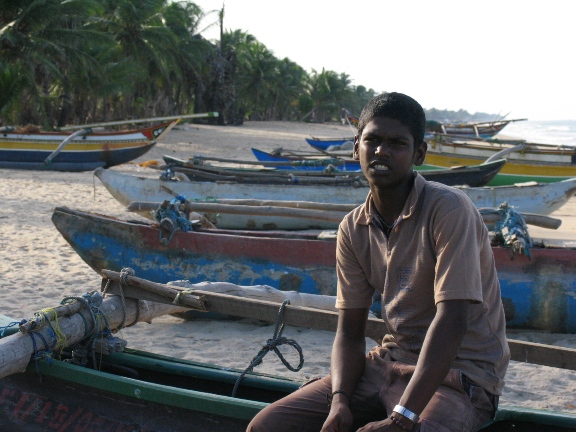
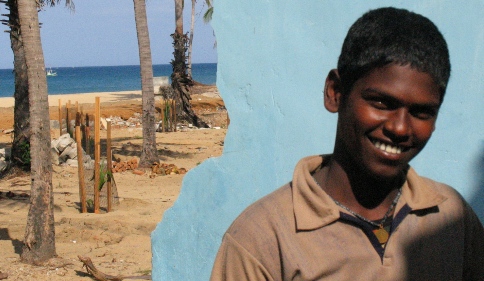
This boy, Thillainayagam Theeban, epitomizes that bigger tragedy. He survived the tsunami — but not the escalation of Sri Lanka’s ethnically driven civil war, which consumed his life in March 2007.

Theeban was one of eight surviving children – from India, Indonesia, Sri Lanka and Thailand – whose remaining families we tracked and filmed for a year in Children of Tsunami media project, a citizens’ media response to the Indian Ocean Tsunami.

Theeban was murdered by unidentified gunmen who stormed into his ‘temporary’ tsunami shelter on 3 March 2007. The death was linked to political violence that has engulfed Sri Lanka since 2006.

theeban.jpg

When the shocking news reached us three days later, our Sri Lankan camera team at Video Image and we at TVE Asia Pacific just couldn’t believe it. We were all in tears, and some of us were also angry. Theeban, who survived the killer waves 26 months earlier (but lost his mom and kid brother in the disaster) suffered many indignities in displacement. And now, he is gone.

We still don’t know who killed Theeban. He was abducted by an armed group sometime in 2006, from whom he escaped in early 2007. It is believed that Theeban was killed as a punishment for running away — and as a warning to all others.

He was 16 years at the time of his death. It is unlikely that his killers would ever face justice.

As I wrote in my personal tribute to Theeban in March 2007, published by UCLA’s Asia Media and MediaHelpingMedia, UK: “The disaster’s Sri Lankan death toll (close to 40,000 dead or missing) shocked the world when it happened within a few hours or days. Yet, at least twice as many people -– most of them unarmed and uninvolved civilians — have been killed in over a quarter century of fighting. That doesn’t always grab headlines.

“Thillainayagam Theeban has become another statistic in a ‘low-intensity conflict’ (as some researchers call it). And while this war lasts, it will continue to consume thousands of other young lives — a grim roll call of Sri Lanka’s Lost Generation.”

The third anniversary of the tsunami is a reminder – if any were needed – that man’s inhumanity to man is often worse than Nature’s fury.

March 2007 blog post: Remembering Theeban

April 2007 blog post: More memories of Theeban

Children of Tsunami: Documenting Asia’s Longest Year

Thillainayagam Theeban (1990 – 2007)

When the Waves Came – the story behind the verse

I am a word-smith. Trained as a journalist and writer, I play with words (and occasionally make an honest living of it ) — but almost all of my published output over more than 20 years has been in prose. Not yet a creative writer (maybe someday!), I write mostly fact-based analysis or opinions.

One rare exception was when the Asian Tsunami struck three years ago in the last week of 2004. Extraordinary situations prompt extraordinary responses – and I went on to write the only verse I have so far published: When the waves came.

I was recovering from chicken pox when the mega-disaster that struck on 26 December 2004. The killer waves spared the Colombo city on the western part of coastal Sri Lanka where I live – and we were extremely lucky. But with close to 40,000 persons dead or missing (which was 1 in 500 of us), it was not a time to heave sighs of relief. We all knew people who were directly affected in one way or another: losing loved ones, suffering property damage, or seeing their jobs go up in the waves.

In the days following the disaster, the entire country was a giant funeral house. For a short while, at least, our utterly divided nation of Lanka was united — first in horror and then in grief.

creating-disaster-resilience-everywhere.jpg

I first heard about the disaster on local television – whose newscasters were struggling to make sense of what was happening. Tsunamis were not known in the Indian Ocean until then, and most people had not even heard of the term. Broadcast journalists had to improve with terms like ‘ferocious wave action’, ‘seas flooding land’ and ‘seas spilling over to coastal areas’, etc.

As the international news media started reporting the extent of devastation from all over South Asia and Southeast Asia, we realised that Sri Lanka was not alone – even though it had been battered very badly.

By Monday 27 December, the scale of the disaster was clearer, and the Sri Lankan death toll was already past 25,000 -– and counting. Search and rescue efforts were now underway, and relief agencies were continually updating their assessments of damage. The grim statistics kept rising by the hour.

The global family first watched in shock — and then started to react. Around the world, hundreds of caring people were dropping everything they had lined up for their Seasonal holidays and rushing to volunteer in Sri Lanka and other disaster hit countries. Inspired by the saturation media coverage, especially on television, caring women and men in far away corners of our planet were donating generously for disaster relief support. Children were breaking open their tills in which they’d carefully saved small change for months or years. Church congregations had special collections. Performing artistes were getting ready to have Tsunami aid concerts. Spurred and partly embarrassed by these citizen actions, governments belatedly started pledging massive volumes of aid. The worldwide response to Asia’s tragedy was deeply moving (the bickering and swindling came later).

My office (TVE Asia Pacific) was closed that week for Seasonal holidays, but I decided to go in and follow the disaster’s news coverage online (I didn’t have ADSL at home then.) Websites were often giving better coverage than TV channels, and the bloggers were rising to the challenge from many locations in impacted Asia.

I spent most of December 27 and 28 in my office. Weakened as I was by chicken pox, I didn’t rush out to help with relief efforts. I knew my limits. Instead, I was emailing regular updates to our friends and partners from many parts of the world who were concerned and anxious about our safety and well-being. Not being a blogger myself then, I was doing it on a one-to-one basis.

I slowly came to terms with a deep anguish that had built up since I first heard the dreadful news. I was badly shaken and numbed by the unfolding human tragedy and humanitarian crisis all around myself. No, I didn’t lose a loved one, or suffer personal property damage, but it was impossible not to be moved by the carnage and destruction all around. And at a scale that was unprecedented in my lifetime.

For hours on 28 December 2004, I watched the ‘doom and gloom’ television news coverage and monitored news updates online. At that stage, with little news yet emerging from Aceh, Indonesia, Sri Lanka had reported the highest death toll and the greatest damage. It was the biggest disaster in the island’s living memory.

When I finally gathered enough sense and wits, I wrote a verse ‘When the waves came’ – it was one way of coming to terms with the calamity. Its basic premise was that the killer waves had been a brutal ‘equaliser’ of all men and women. It no longer mattered on which side of law, morality, economics or social class they stood.

To drive home the point, I sprinkled the words of William Makepeace Thackeray throughout the verse:
“Good or bad, guilty or innocent —
they are all equal now.”

The verse was not meant for publication, and was only privately circulated for a few days. One friend who received it, Bircan Unver in New York, wanted to publish it on her Light Millennium website. After some persuasion, I agreed.

tsunami-survivor-children-return-to-the-sea-in-suduwella-southern-sri-lanka.jpg

I wrote this verse with tears running down both my cheeks. I kept on typing, without wiping my face, as words poured out from my grief-stricken mind. This was the least I could do, as my tribute to everyone who perished or suffered by nature’s incredible fury.

Writing this verse was cathartic for me. Three years after it happened, I can now disclose what followed my writing of this verse: I closed the laptop, sat down on the floor, and completely broke down.

I have no idea for how long I cried: it must have been 20 or 30 minutes. There was no one in the office that day so I didn’t have to subdue myself. Of course, my tears were nowhere near as abundant as those who lost their loved ones to the tsunami. But they were no less sincere.

Looking back, I suspect that during those hours of sorrowful solitude, Children of Tsunami was conceived.

But that’s another story.

Photos courtesy TVE Asia Pacific

Communicating Disasters: Lessons From Titanic to Asian Tsunami by Arthur C Clarke

What do the RMS Titanic, which sank on her maiden voyage in April 1912, and the Asian Tsunami of December 2004 have in common?

Both were maritime disasters and, when they happened, both shook the world as few others did before or since.

And now, Sir Arthur C Clarke has linked the two tragedies that happened 92 years apart: he says they both illustrate how communications failures can compound the impact of a disaster.

Writing a foreword to Communicating Disasters: An Asia Pacific Resource Book (co-edited by myself and Frederick Noronha, and just released), the inventor of the communications satellite revisits the two disasters that left deep impressions in his mind.

communicating-disasters-an-asia-pacific-resource-book-by-tveap-and-undp.jpg sir-arthur-clarke-by-shahidul-alam.jpg

Arthur C Clarke was born five years after the sinking of the ‘unsinkable’ RMS Titanic while on her maiden voyage. His home town Minehead, in Somerset, was not more than a couple of hundred kilometres from Southampton, from where the Titanic set off, he says, adding: “All my life, I have been intrigued by the Titanic disaster.”

He is particularly interested in what happened to the Titanic’s distress call after she hit the iceberg at 11.40 pm on the night of 14 April 1912. “A series of unfortunate factors compounded the disaster. The most ironic among them was that the wireless operator on the Californian, located closest to the Titanic, had shut down for the day just 30 minutes before the first distress call was sent out. Had the Californian been listening, it could have responded hours before the Carpathia, the eventual rescue vessel.”

The Titanic disaster prompted the shipping community to introduce a 24-hour radio watch on all ships at sea. It also consolidated the role of maritime radio in distress signalling and rescue operations.

But, as fate would have it, the absence of a timely warning once again characterised the second disaster to touch Sir Arthur’s life. Arriving 10 days after his 87th birthday, the Asian Tsunami of December 2004 left a massive trail of destruction in his adopted country Sri Lanka and several other countries bordering the Indian Ocean.

He reflects:
“Astonishingly, a full century after the invention of radio, the Tsunami arrived without any public warning. The disaster’s death toll could have been drastically reduced if its occurrence — already known to scientists — was disseminated quickly and effectively to millions of coastal dwellers living on its predictable path. Even a half hour’s notice would have allowed people to run away from the coast, and in many affected locations there was just enough time to get to safety. But alas, that didn’t happen — and tens of thousands perished.

“It was appalling that our sophisticated local and global communications systems completely failed us that fateful day. The communications satellites that I invented, and the global Internet that one of my stories inspired, could have spread the warning, with the hundreds of radio and television channels across coastal Asia amplifying it.

“It is now known that the failures were human, not technological. To ensure better results next time, we need to achieve an optimum mix of technology, management systems and community preparedness — not just for tsunamis, but for many other hazards that we live with. We have to remember that delivering credible early warnings to those who are most at risk is both an art and a science.”

copy-of-tsunamis-legacy-in-southern-sri-lanka.jpg

In his foreword, Sir Arthur sees the Asian Tsunami as a turning point for citizen journalism – ordinary people armed with digital tools bearing witness to unfolding events and then sharing it with others. He writes: “On 26 December 2004, many holiday-makers on affected beaches were armed with video cameras, and it was their ‘amateur’ images that later showed us the full force and fury of the unfolding disaster. Because it was distributed over a large area and occurred during peak holiday season, the Asian Tsunami was probably the most widely filmed disaster in history.”

This was not the first disaster that ‘citizen journalists’ covered, says Sir Arthur, but it marked a turning point in the growing phenomenon enabled by information and communications technologies (ICTs). “The post-Tsunami coverage showed that the professional and amateur divide had now blurred; there is a clear (and complementary) role that each can play.”

ICTs can do much in good times and bad, but as Sir Arthur recalls, the Tsunami also reminded us how disasters can make our information society vulnerable. “When electricity and telephone services — both fixed and mobile – went down in the worst affected areas, a century old technology came to the rescue: amateur radio enthusiasts restored the first communication links with the outside world, sometimes using the Morse Code to economise the power of car batteries.”

He quotes the President of the Radio Society of Sri Lanka as saying, “When all else is dead, short wave is alive.”

Sir Arthur’s perceptive foreword is a sobering counterpoint to the post-tsunami frenzy that we witnessed in the Indian Ocean rim countries. Yes, lacking a tsunami warning system – such as the one Pacific Ocean countries have – is a big gap that needed to be filled. But governments and development donors have rushed into setting up high tech, high cost early warning systems without due consideration for social, cultural and political realities of the intended beneficiary countries.

As we saw with some subsequent undersea quakes – such as the one off the resort town of Pangandaran, Java, on 17 July 2006, and the one off off Bengkulu, Sumatra, on 12 September 2007 – we have yet to achieve the right mix of technology, management systems and community preparedness in most coastal countries in Asia.

Governments, donors and UN agencies would do well do heed the wise words of Sir Arthur Clarke, who concludes his Foreword with these words:

“Communicating disasters — before, during and after they happen — is fraught with many challenges. Today’s ICT tools enable us to be smart and strategic in gathering and disseminating information. But there is no silver bullet that can fix everything. We must never forget how even high tech (and high cost) solutions can fail at critical moments. We can, however, contain these risks by addressing the cultural, sociological and human dimensions — aspects that this book explores in some depth and detail, from the perspective of both media professionals and disaster managers.

“The lessons of history are clear: if we are not careful, we can easily lull ourselves into the same kind of false confidence that doomed the Titanic.”

Read the full text of “Communicating Disasters: A Century of Lessons”, By Sir Arthur C Clarke
communicating-disasters-a-century-of-lessons-by-arthur-c-clarke.pdf

Or download foreword as contained in the printed book

After the Tsunami: Going the Long Last Mile in Sri Lanka

hazlnfo-video-j-a-malani-hambantota.jpg

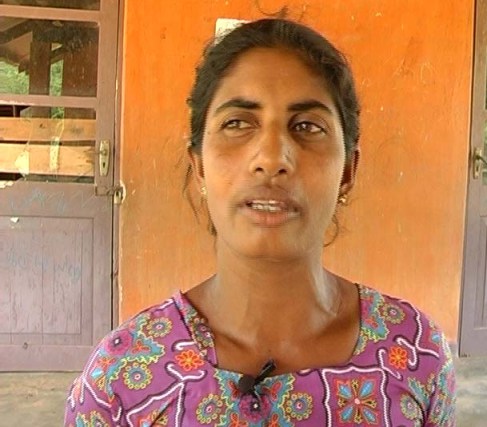
This is J A Malani. She’s an ordinary Sri Lankan woman living in Hambantota, on the island’s southern coast. Several hundred people in her town perished when the Indian Ocean Tsunami arrived on 26 December 2004 without any public warning. When the waves finally stopped their hammering, close to 40,000 people were dead or missing in the biggest disaster the island nation experienced.

Survivor Malani and her neighbours – lucky to be alive – are naturally apprehensive about when the next disaster might arrive, in what form and from where.

And this time around, too, they worry whether there would be anyone to warn them about it.

There just might be. Since the big tsunami three years ago, several Sri Lankan telecom operators, civil society organisations, IT companies and researchers have come together to test out a community-based hazard warning system — one that would prevent the repetition of the nasty surprise Malani’s community experienced not too long ago.

‘Evaluating Last Mile Hazard Information Dissemination Project’ (HazInfo project for short) was an action research project by LIRNEasia to find out how communication technology and training can be used to safeguard grassroots communities from disasters. It involved Sarvodaya, Sri Lanka’s largest development organisation, and several other partners, and was supported by International Development Research Center (IDRC) of Canada.

The project studied which information and communications technologies (ICTs) and community mobilisation methods could work effectively in disseminating information on hazards faced by coastal communities. The exercise was not confined to tsunamis alone; other rapid onset disasters such as cyclones and floods were also covered.

In its first phase, the project worked in 32 chosen coastal villages (all impacted by the tsunami) and mobilised local communities from muslim, Sinhala and Tamil backgrounds. Malini’s community was among those participating in this field testing of an approach that Sarvodaya hopes to roll out progressively to all 15,000 villages they work in.

That initial engagement by itself was reassuring to Malani. “This has helped us to get rid of fear and hesitation in our minds,” she said in a television interview recorded some weeks ago. “Now we know what we should do when a disaster strikes.”

That peace of mind is priceless to any human being, and that knowledge is liberating – particularly to one who has survived a major disaster that came from nowhere.

Malani is one of several beneficiaries featured in a 12-minute film TVE Asia Pacific recently produced. Several other participants from different coastal locations expressed similar views — and hopes that next time around, they will not be taken unawares.

The Long Last Mile can be viewed on YouTube in two parts:

The Long Last Mile, part 1 of 2:

The Long Last Mile, part 2 of 2:

LIRNEasia researchers analysed how each ICT tool or combination was integrated into communities to deliver timely warnings to those designated as first responders. The factors needed for efficient functioning of the hazard information hub were also studied. Read detailed findings and analysis here.

The HazInfo project grew out of a participatory concept paper that LIRNEasia developed in the aftermath of the 2004 tsunami. It noted that a national early warning system was a ‘pure public good’, and the responsibility of its supply would normally fall on the government. However, the paper acknowledged that, due to lack of capacity, “it is unlikely that the last mile of such a system will be provided by the local government or private firms operating in the marketplace”.

I have written a whole chapter on this project, titled Bridging the Long Last Mile, in Communicating Disasters: An Asia Pacific Resource Book (co-edited by Nalaka Gunawardene and Frederick Noronha). Read that chapter here:

bridging-the-long-last-mile-final-text-formated.pdf