Arthur C Clarke: My Vision for Sri Lanka in 2048

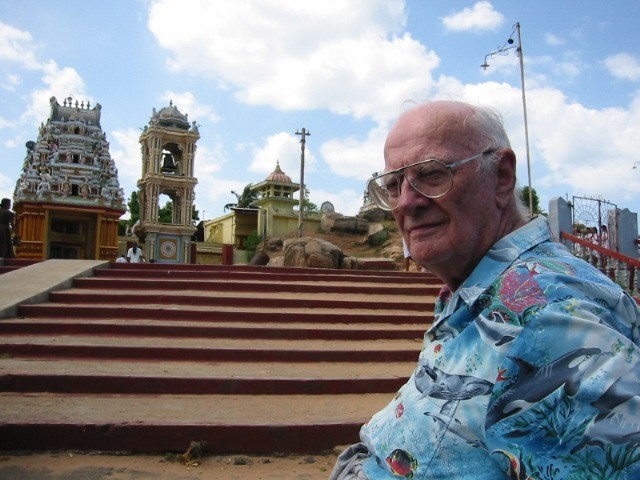
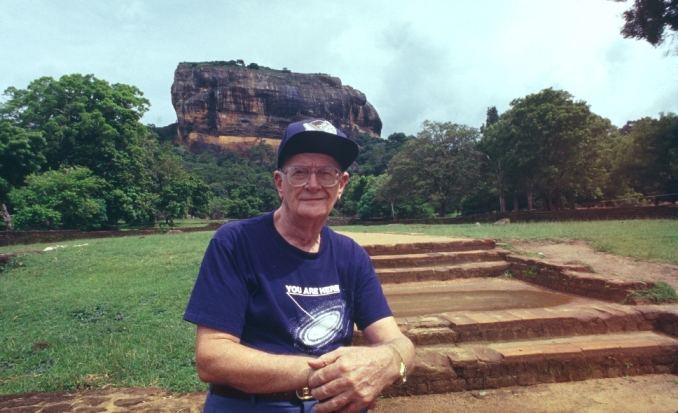
sir-arthur-clarke-with-sigiriya-in-background-photo-by-rohan-de-silva.jpg

Sir Arthur Clarke, who died last week, was buried at Colombo general cemetery at his request. That ended a 52-year-long association the author had with his adopted home.

His interest in diving and underwater exploration led him to Ceylon (now Sri Lanka), where he settled down in 1956. He pioneered diving and underwater tourism in Sri Lanka through his company Underwater Safaris, and played an active role as a public intellectual and as a patron of art, science and higher education. He served as Chancellor of Sri Lanka’s technological University of Moratuwa from 1979 to 2002.

Although he became the island nation’s first Resident Guest in 1975, Sir Arthur always remained a British citizen. The Sri Lankan government presented him the Lankabhimanya (‘Pride of Lanka’), the country’s highest civilian honour, in 2005. In December 2007, government officials, scientists, artistes and diplomats came together to felicitate Sir Arthur on his 90th birthday.

During the past few days, there was a good deal of coverage, editorialising and reminiscing in the Sri Lankan media about Sir Arthur, whom a former foreign minister once called a ‘one man cheering squad for Sri Lanka’. Most of this coverage looked back to recall the highlights and anecdotes of the sarong-clad, table tennis playing, myth-busting icon.

As Sir Arthur would have said, that was necessary – but not sufficient. His business was talking about the future and helping to shape it. So I dug up from my own archives a 1,100-word essay that I had written for The Sunday Observer in Sri Lanka a decade ago, for a series titled Sri Lanka in 2048. There, leading artistes, scientists and other public figures were asked to outline their personal vision for the year Sri Lanka would complete 100 years of political independence (the series marked the Golden Jubilee of this event).

Upon re-reading the essay, which was in Sir Arthur’s first person narrative, I found that it was still fully valid, and even more relevant a decade later than when it was first written. So I passed this on to Pramod de Silva, editor of The Daily News, the sister newspaper of the Observer, which ran it on 22 March 2008 – the day of Sir Arthur’s funeral. I found that quite appropriate – the physical remains were going on their final odyssey, but Sir Arthur’s vision would – hopefully – propel Sri Lanka to a better future for decades to come.

sir-arthur-clarke-at-swami-rock-trincomalee-sri-lanka-by-rohan-de-silva.jpg

Here’s how he opened the essay, My Vision for Sri Lanka in 2048:

“A guest must be careful about what he says of the host: contrary to popular perception, I am not a Sri Lankan citizen — only a resident guest. Yet, having lived here for 41 of my 80 years, I now regard this alone as home, and have visions and hopes for my adopted land.

“Half of all Sri Lankans alive today were not even born when, in December 1954, I had my first glimpse of the then Ceylon — when the P&O liner Himalaya carrying me to the Great Barrier Reef paused at the Colombo harbour for half a day. What I saw on a single afternoon tempted me to come back a year later to explore, and by the end of the 1950s, I had developed a life long love affair with the island.”

Taking stock of Sri Lanka’s already high human development indicators, Sir Arthur noted:
“It has been said that the biggest remaining challenge in terms of human health and welfare is not so much to add years to life, but to add life to years. For a country like Sri Lanka that has already achieved high levels of life expectancy and other impressive social indicators, this is indeed the next major challenge. The vision for the next fifty years should be to develop ways of improving the quality of life of all Sri Lankans. Difficult though it certainly is, such development will have meaning only if it is socially and environmentally sound.”

He then talked about two areas that were crucial for the socio-economic development of his adoptive land: energy and telecommunications. But he knew these physical improvements would not, by themselves, create a better society until and unless lasting peace could be achieved:
“The biggest challenge for all Sri Lankans in the coming century would be achieving better communications and understanding among the different ethnic, religious and cultural groups and sub-groups all of who call this their motherland. For material progress and economic growth would come to nothing if we allow the primitive forces of territoriality and aggression to rule our minds.

Read the full essay on the Daily News website

Related essay: Rebuilding after Tsunami: Sri Lanka’s challenges by Arthur C Clarke, January 2005

Photos by Rohan de Silva, Sir Arthur’s personal photographer

Governments, disasters and communication: Lead, follow or get out of the way!

The Association for Progressive Communications (APC) has just published a good review of the book I recently co-edited titled Communicating Disasters: An Asia Pacific Resource Book.

The review is written by two academics. Dr Malathi Subramanian is Former Principal, Daulat Ram College, University of Delhi, India, while Dr. Anupama Saxena is Head, Department of Political Science, Guru Ghasidas University, Bilaspur, Chhattisgarh, India.

As they remark: “The book has articles contributed by authors who do not engage in mere theoretical discussions. They draw on their rich and varied experiences working in either preparing disaster resilient communities or responding to humanitarian emergencies triggered by specific disasters in different parts of the globe.”

They add: “The eminently readable book provides first hand information about the real life situations of disaster, richly illustrated with case studies and use of professional images….The book is written in a manner that successfully sensitises the reader to the complexity of the issue of disaster management and its various nuances. After reading the book one is sure to echo the spirit of one of the contributors, Sanjana Hattotuwa: ‘We cannot prevent or predict all disasters. However, we can plan for, react to and learn from disasters when they do occur’.

In preparation of this review, Malathi and Anupama did an email interview with me where they posed half a dozen questions on some key issues we have addressed in the book. Here is the full interview, which brings out my personal views interspersed with those of some other contributors to our multi-author book.

Question: In developing countries the governments are considered to be the nodal agencies for disaster management. In this context do you think that there is a need to advocate the integration of the National disaster management policy with the national ICT Policy to exploit the potential of ICTs before, during and after a disaster?

Yes, that certainly is the ideal, desirable scenario. But I’m not sure how soon this can become a reality, given how many of our governments think of these sectors as separate compartments – or ‘silos’ – with little or no integration. In the real world, however, these are all mixed up: people who use ICTs are affected by various disasters and the first responders – including relief workers and journalists – use various ICT tools in their work. Increasingly, we are seeing disaster affected people themselves using ICTs, especially mobile phones, to communicate with family, friends, aid officials and others from the scenes of disaster. We have documented specific instances of all this in our book and pointed out that the typical hapless, uninformed affected person is being replaced by a digitally empowered one. So the integration of disaster management and ICTs has been happening on the ground for some time, whether or not policy-makers acknowledge it!

At policy and regulatory level, governments can play an enabling role by easing the various bottlenecks that currently hold back optimum use of ICTs in disaster preparedness, early warning or response. This is so lacking and badly needed in my own country Sri Lanka. One example: amateur radio enthusiasts played a key role in establishing emergency communication with some coastal areas badly hit by the 2004 tsunami. When everything was dead, short wave was alive. Yet, barely months later, the government blocked any new amateur radio equipment being brought into the country as someone felt it was a threat to national security!

But in my view, misguided policies are worse than no policies at all. That’s when I feel like quoting Rabindranath Tagore’s words which every southern government should heed: ‘If you can lead, lead. If you cannot, follow. If you can do neither, then get out of the way’.

tveap-image-archive.jpg

Question: Participatory Modes of communications form a very important part of a comprehensive strategy aiming at creating disaster resilient communities. What type of policies and frameworks the national governments should adopt to facilitate this?

Living with disasters – or developing resilience to disasters – is fast becoming a necessary strategy of day-to-day survival. Communication plays a role in this. In our book, we have an entire chapter on this written by Chin Saik Yoon, who has been researching and documenting participatory communication processes in development. He identifies communication as one of four necessary steps towards recovery from a disaster. Survivors need to maintain communication with family, friends, and counsellors in order to share their experiences. They need to tell their stories about the disaster, and listen to others as they tell theirs. This helps survivors to collectively release their stress.

To continue in his own words: “Participatory communication processes work best here. This is where survivors assume the role of both the ‘initiator’ as well as the ‘receiver’ of communication. No expert or government official should be there to decide what is to be discussed by the survivors. They need only facilitate the process. The participatory processes ensure that communication occurs at the pace that communities are comfortable with and address issues only when survivors are ready to deal with them.”

This makes eminent sense, but it is precisely this kind of thoughtful, sensitive approach that many governments are unable or unwilling to adopt. For too long, governments have been seen as the sole decider, provider and protector – and governments do have a responsibility in all these. But in today’s world, the role of government has to be reviewed and redefined. As Chin says, government officials may facilitate, but governments must get out of the historical habit and temptation of playing Big Mama (or worse, Big Brother!) by doing such communication themselves.

For our quest for disaster resilience to succeed, we need a transformation in governmental policies, attitudes and practices. In a world experiencing a growing number and intensity of multiple hazards, no government – however powerful or well intended – can reach out and protect every citizen. That illusion was shattered forever by hurricane Katrina. There is no need for such governmental omnipresence either! The smart option is to allow, encourage and empower individuals and communities to do part of it on their own. Governments, researchers, aid agencies and charities still have to be part of this – but first they have to break free from the ‘Let’s-Do-It-All-Ourselves’ mentality.

Question: It is evident from the many case studies in the book that participatory non-media modes of communications have been quite useful in dealing with disasters. Such efforts however, need constant involvement of a wider group of people on voluntary basis over a long period of time for creating resilience for disasters. How to develop this spirit and, more important, sustain it.

Yes, participatory communication efforts have to sustain the community engagement over weeks, months and sometimes years. As one of our contributing authors, Buddhi Weerasinghe, has written in the book: “The big challenge is to sustain disaster preparedness interventions over time. This is helped by the creation of informal leadership within the community through participatory action.”

Since no two communities are alike, it’s very hard to generalise on how to develop the necessary conditions and ‘spirit’, but some generic lessons can be drawn from documented examples. The right kind of community leadership helps, as does external help that is neither over-bearing nor fleeting. Assistance from aid agencies needs to be delivered at a pace the communities can absorb, integrate and use.

Disasters are often the latest (and highly disruptive) layer over existing multiple layers in a community. Even if a shared plight and grief temporarily unite a community, that alone cannot hold people together for too long, especially if there are deep divides in that community. So community cohesion and unity become very important factors in the success of participatory communication. There is no single formula that can work for everyone.

cartoon-noahs-doubters.gif

Question: The book describes many successful interventions based on non-media participatory mode of communications for disaster management. Which of these interventions do you think can be cited for the most optimal use of non media participatory mode of communications?

In our introduction to the book, Frederick Noronha and I wrote: “Media-based communication is vitally necessary, but not sufficient, in meeting the multiple information needs of disaster risk reduction and disaster management. Other forms of participatory, non-media communications are needed to create communities that are better prepared and more disaster resilient.”

These non-media communication methods range from basic inter-personal communication and small group discussions to participatory rural appraisal techniques. The methods are not new or unique; they are being customised to meet disaster preparedness and/or response needs.

It’s more than mere talk. Some methods involve experiential learning – or learning by doing. An example is participatory hazard mapping. First, community members are divided into a few groups and asked to map their neighbourhoods – they have to capture the roads, footpaths, rivers, hillocks, houses, schools, temples and other key landmarks. Then they mark the areas that have been affected historically with different disasters such as tsunami, floods or cyclones. This helps identify relatively safer areas as well as safety routes in case a new disaster demands quick evacuation. Admittedly this is communication plus social mobilisation, but that’s what it takes in the real world – communication is only part of the solution.

As Buddhi Weerasinghe has written in his chapter, “This exercise allows informal leaderships to emerge. Encouraging this leadership and recognizing their inputs can motivate them and enable sustainability of interventions. The process of hazard mapping also imparts a sense of ownership.”

Question: To what extent is it really practicable to achieve the ‘disaster resilience’ in communities?

Disasters are all about resilience – how we pick ourselves up after a tragedy and slowly return to normalcy. And also how we take repeated battering from a multitude of disasters and still carry on with living. There is no single recipe for success in building disaster resilient communities. Everyone needs to approach this with open and flexible minds, and see what works for whom under which conditions. Disaster resilience is not a slogan like halving poverty by 2015 or writing off majority world’s debt. It’s a long-drawn, incremental process and will always remain a work in progress because both community dynamics and the nature of hazards change over time.

In many cases, the community has information and insights that help achieve resilience, but it needs to be brought out – that’s where participatory communication helps. But let’s not romanticise matters too much – some communities need external guidance, and most can benefit from external facilitation in their quest for resilience.

In a chapter called ‘Bridging the Long Last Mile’, I have described the experience of a community-based disaster preparedness and early warning dissemination effort undertaken by Sarvodaya, LIRNEasia and other partners in Sri Lanka. The project studied which ICTs and community mobilisation methods could work effectively in disseminating information on hazards faced by selected coastal communities all of which were battered by the Indian Ocean tsunami of December 2004.

hazinfo-project-meeting-at-sarvodaya.jpg

Sri Lanka – Last Mile Hazard Info project planning meeting: Photo courtesy Sarvodaya

I would refer you to the chapter for details, but the key lessons may be summed up as follows:
• Trusted technology: Use ICTs that are reliable in performance, accessible at the local levels and trusted by the people.
• Complementary redundancy: Always have at least two different ICTs delivering information, to minimise transmission failures.
• Credible information: Tap only the most authentic sources of information at national and international level, reducing room for misinformation and rumour.
• Right mix: Achieve the appropriate combination of technology, training and institutional arrangements at the grassroots.
• Be prepared: Raise localised awareness and provide experiential training so community know what to do when crisis occurs.

book-cover-final.jpg

After the Tsunami: Going the Long Last Mile in Sri Lanka

hazlnfo-video-j-a-malani-hambantota.jpg

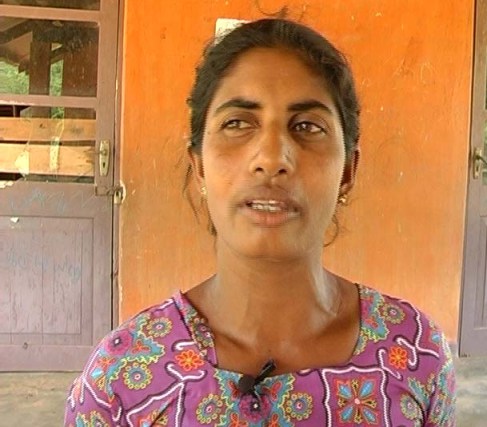
This is J A Malani. She’s an ordinary Sri Lankan woman living in Hambantota, on the island’s southern coast. Several hundred people in her town perished when the Indian Ocean Tsunami arrived on 26 December 2004 without any public warning. When the waves finally stopped their hammering, close to 40,000 people were dead or missing in the biggest disaster the island nation experienced.

Survivor Malani and her neighbours – lucky to be alive – are naturally apprehensive about when the next disaster might arrive, in what form and from where.

And this time around, too, they worry whether there would be anyone to warn them about it.

There just might be. Since the big tsunami three years ago, several Sri Lankan telecom operators, civil society organisations, IT companies and researchers have come together to test out a community-based hazard warning system — one that would prevent the repetition of the nasty surprise Malani’s community experienced not too long ago.

‘Evaluating Last Mile Hazard Information Dissemination Project’ (HazInfo project for short) was an action research project by LIRNEasia to find out how communication technology and training can be used to safeguard grassroots communities from disasters. It involved Sarvodaya, Sri Lanka’s largest development organisation, and several other partners, and was supported by International Development Research Center (IDRC) of Canada.

The project studied which information and communications technologies (ICTs) and community mobilisation methods could work effectively in disseminating information on hazards faced by coastal communities. The exercise was not confined to tsunamis alone; other rapid onset disasters such as cyclones and floods were also covered.

In its first phase, the project worked in 32 chosen coastal villages (all impacted by the tsunami) and mobilised local communities from muslim, Sinhala and Tamil backgrounds. Malini’s community was among those participating in this field testing of an approach that Sarvodaya hopes to roll out progressively to all 15,000 villages they work in.

That initial engagement by itself was reassuring to Malani. “This has helped us to get rid of fear and hesitation in our minds,” she said in a television interview recorded some weeks ago. “Now we know what we should do when a disaster strikes.”

That peace of mind is priceless to any human being, and that knowledge is liberating – particularly to one who has survived a major disaster that came from nowhere.

Malani is one of several beneficiaries featured in a 12-minute film TVE Asia Pacific recently produced. Several other participants from different coastal locations expressed similar views — and hopes that next time around, they will not be taken unawares.

The Long Last Mile can be viewed on YouTube in two parts:

The Long Last Mile, part 1 of 2:

The Long Last Mile, part 2 of 2:

LIRNEasia researchers analysed how each ICT tool or combination was integrated into communities to deliver timely warnings to those designated as first responders. The factors needed for efficient functioning of the hazard information hub were also studied. Read detailed findings and analysis here.

The HazInfo project grew out of a participatory concept paper that LIRNEasia developed in the aftermath of the 2004 tsunami. It noted that a national early warning system was a ‘pure public good’, and the responsibility of its supply would normally fall on the government. However, the paper acknowledged that, due to lack of capacity, “it is unlikely that the last mile of such a system will be provided by the local government or private firms operating in the marketplace”.

I have written a whole chapter on this project, titled Bridging the Long Last Mile, in Communicating Disasters: An Asia Pacific Resource Book (co-edited by Nalaka Gunawardene and Frederick Noronha). Read that chapter here:

bridging-the-long-last-mile-final-text-formated.pdf

From KL to Bali: Why were ICT and climate change debates worlds apart?

The timing of the Third Global Knowledge Conference or GK3 last week just couldn’t have been worse in terms of international media attention and coverage.

Some 1,700 people from all over the world – representing academia, civil society, governments and industry – gathered in the Malaysian capital of Kuala Lumpur from 9 to 13 December 2007 for this platform of events meant for everyone interested in using information and communications technologies (ICTs) for the greater good – to solve real world problems of poverty, under-development, illiteracy and various other disparities that afflict our world.

The organisers, a network called the Global Knowledge Partnership, called it ‘Event on the Future’. They had worked for almost two years on planning the event, and spent a huge amount of development funding to drum up global interest in the event.

As things turned out, GK3 was a complete non-event for the world’s media, whose attention was much more engaged by another event that was crucial for the future of all life on this planet – the UN Climate Change conference taking place in neighbouring Indonesia’s Bali island.

pic-iht-ad.jpg

That coincidence of events was very unfortunate, especially since GK3 also discussed and debated important issues that shape our common future. Yes, the substance at GK3 was immersed in — and sometimes buried under — massive volumes of hype and spin, but for the discerning participants there were occasional gem stones amidst the numerous gravel.

I have written up my impressions of GK3 as a series of missed opportunities. In my view, the biggest missed opportunity was GK3’s failure to position itself as part of the smart response to global climate change that scientists now confirm is happening and is largely human-induced.

After 20 years working in the media, I can understand why the news media ignored GK3. Yes, bad timing was one factor. But the bigger lapse was that the GK3 organisers and participants failed to find and articulate their common ground with the bigger global process that was unfolding in Nusa Dua, Bali island.

In the real world, Bali is not all that far from KL. But sadly, the two were worlds apart as parallel processes took place with little confluence.

It need not have been that way. There is much that ICTs can do in reducing carbon emissions that are warming up the planet.

The biggest ‘digital dividend’ from ICTs is how they can help reduce needless travel. Dependent as we still are on fossil fuels of oil and coal for most of our transport, even a few percentage points of travel that we can realistically cut down can yield major savings in emissions of carbon dioxide.

In a blog post written in August 2007, I cited Sir Arthur C Clarke’s slogan that sums this up very well: Don’t commute; communicate!

I quoted from an essay Sir Arthur had written for the UK’s Climate Group in 2005, included as part of a global exhibit on climate issues, where he noted: “….Meanwhile, other technologies enable us to adjust our work and lifestyles. For example, mobile phones and the Internet have already cut down a lot of unnecessary travel – and this is only the beginning. We should revive a slogan I coined in the 1960s: ‘Don’t commute – communicate!’”

My friend and academic colleague Dr Rohan Samarajiva, who heads the regional ICT research organisation LIRNEasia, has given this some further thought.

More and easier use of telecom should theoretically lead to less need to travel. But nothing is ever that simple, he says. “It is not realistic to think that improved telecom-based connectivity will immediately lead to a reduction in demand for transport and a reduction in greenhouse gases. But it is clearly a necessary action that will yield good results over time.”

For telecom to make a real contribution to reducing demand for transport, Rohan says several things need to happen:
• Most people need to have easy and convenient access to telecom, for sending as well as receiving messages and for retrieving as well as publishing information;
• All offices and business establishments must be reachable through telecom;
• They must change their business processes to reduce the need for people to physically come to their locations; and
• The ancillary infrastructures such as energy, payment and delivery systems must change accordingly.

These, then, are important goals that are worth pursuing not only for the achieving information societies but also for saving the planet from the current slow baking. That’s the message that GK3ers failed to grasp or convey to Bali.

Instead, we heard from the movers and shakers of the IT and ICT companies how they are working to achieve greater energy efficiency in the manufacture and use of their products. Their sincerity and commitment were not in question. But I didn’t hear anyone emphatically make the point that helping people to avoid needless transport use is the biggest climate benefit ICTs can deliver. (I was yearning to stand up and say ‘It’s avoided transport, stupid!’ in one plenary but we ran out of time.)

The industry mandarins were not alone. Even the International Telecommunications Union (ITU), which sets standards and keeps an eye on ICT trends and conditions, missed this point. In a statement delivered to the Bali climate conference, ITU talked about lots of small contributions that ICTs can make to find solutions to the climate crisis.

To quote from their 12 December 2007 press release:

“ITU pointed out that the proliferation of ICT products in homes and offices, and their deployment throughout the world, places an increasingly heavy burden on energy consumption. The late night glow in homes and offices emanating from computers, DVD players, TVs and battery chargers is all too familiar. And the move to “always-on” services, like broadband or mobile phones on standby, has greatly increased energy consumption compared with fixed-line telephones, which do not require an independent power source. Energy demands caused by high-tech lifestyles in some countries are now being replicated in others.”

It’s always good to improve energy efficiency, if only to keep the bills in check. But can ICT industry and ITU please stop apologising for the relatively minor contribution their sector makes to global warming — and instead become a much bigger part of the solution? In other words, stop rearranging chairs on the Titanic’s deck, and instead get in the engine room to help steer the planetary Titanic from heading straight into that iceberg looming large.

We don’t need further studies, expert groups or conferences to deliver this category of carbon-saving, climate-friendly benefits: just keep rolling out telecom coverage worldwide and also make the services affordable and dependable. The markets will do the rest.

earth-at-night-off-website.jpg

This point was also lost in Bali. Obsessed as they were with a mechanism to succeed the imperfect Kyoto Protocol, the delegates failed to fully appreciate tried and tested solutions that can begin to roll out now and here. Let the diplomats and lobbysts bicker for years to come, but don’t ignore what markets can do in the meantime.

Even some champions of climate change have yet to realise the ICT potential for their planet-saving crusade. Al Gore, being both ICT-savvy and green, is an exception. Sir Nicholas Stern is not.

In October 2006, the UK government published a 579-page report on the economics of climate change by Sir Nicholas Stern, a former chief economist at the World Bank. Despite the massive size, scope and authority of the report, the Stern Report had no reference to the role that the ICT sector could play in helping to reduce energy demand, mitigate CO2 emissions and help to save the planet.

Fortunately, as I wrote in August 2007, telecom operators are begining to taking note. Among them is the European Telecommunications Network Operators’ Association (ETNO), which issued a report — incidentally, in the same month as the Stern Report — titled Saving the climate @ the speed of light: ICT for CO2 reductions.

It was a joint publication with the World Wide Fund for Nature, WWF. Its introduction read: “A wider usage of ICT-based solutions can play an important role in reducing CO2 emissions. This joint WWF-ETNO road map proposes a concrete way forward for a better consideration and inclusion of ICT’s in EU and national strategies to combat climate change.

Read the full report here.

So it seems that part of the climate response answer is literally in the air – or the airwaves. The emergence of information societies — where more electrons (carrying information) are moved than atoms (people, goods) — can help the pursuit of climate-neutral or, even better, climate friendly lifestyles. To use a currently fashionable UN term, that’s a co-benefit!

For these co-benefits to be appreciated and seized, it’s essential that we look at the bigger picture and not just work in individual sectors such as ICT and sustainable development. The ITUs and UNEPs of this world have to meet and talk more often — and also listen to each other more seriously.

I chose to attend the ICT event of GK3 in KL in spite of receiving three separate (and sponsored) invitations to join various activities in Bali. After last week, I have mixed feelings about that choice, but there’s no doubt at all in my mind about the massive potential that ICTs hold for mitigating the worsening of climate change.

But the ICT sector has to put its money where its mouth is, and practise what it advocates. It’s not good enough to endlessly meet and talk about all things ‘e’. Just as the world has to kick its serious addiction to oil and coal, we in the development sector have to wean ourselves away from our obsession with paper. Lots and lots of it.

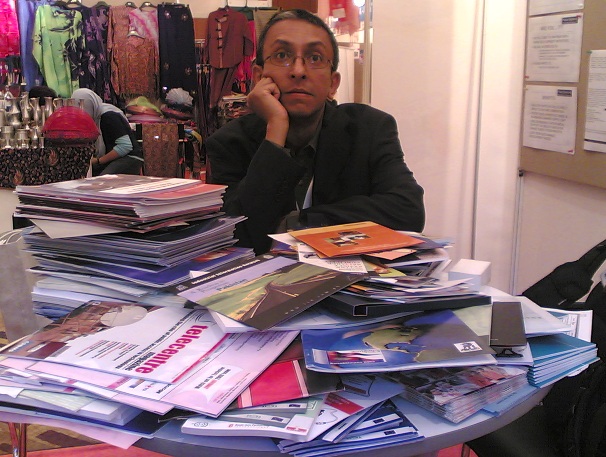
In the last hour of the final day, I walked around GK3’s exhibition area, with the ridiculous name MoO. I was stunned by the massive volumes of paper lying around everywhere. The week’s events were drawing to an end, and it was unlikely there would be too many more takers for all that paper. In that week, I saw very little digital media being used to peddle institutional messages or deliver their logos. It was 95% paper-based.

My colleague Manori captured on her mobile phone this image of an exasperated me surrounded by mountains of paper.

all-this-paper-at-the-end-of-an-ict-event.jpg

The MoO exhibitors were not alone in their profligacy and wastefulness – the GK3 secretariat easily wins the prize for producing the greatest volume of glossy, expensive paper-based promotional material for at least a year preceding the event.

Clearly both ICT and climate camps have some urgent rethinking to do. Together, we can find win-win, now-and-here solutions for slowing down processes of disruptive climate change already underway.

Or we can keep pushing bits of paper all around, all year round. The choice is ours – and the planet is at stake.

– Nalaka Gunawardene


Read my overall impressions of GK3: All geek but very little meek…and at what high cost?

Impressions of GK3: All geek but very little meek…and at what high cost?

I spent a good part of my last week (9 – 13 December 2007, both days inclusive) in the Malaysian capital of Kuala Lumpur participating in the Third Global Knowledge Conference or GK3.

GK3 was organised by a network called the Global Knowledge Partnership, as a platform for those interested in using information and communications technologies (ICTs) for the greater good – to solve real world problems of poverty, under-development, illiteracy and various other disparities that afflict our world.

Those within the GKP call it ICT for Development, abbreviated as ICT4D. I prefer the more catchy phrase ‘Geek2Meek’ (or using geeks’ tools/toys to serve the needs of the meek).

In the spirit of spawning endless acronyms and abbreviations that contribute to the Alphabet Soup, I will compress this as G2M.

GK3 was meant to showcase the best of G2M products, practices and processes in every area of human endeavour — education, health, natural resource management, poverty reduction, empowering youth and women, promoting enterprise, etc.
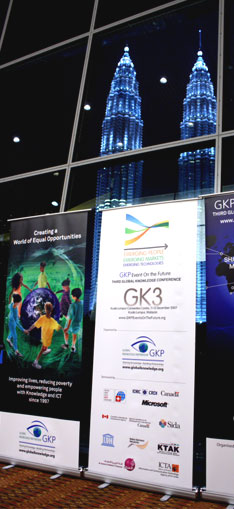
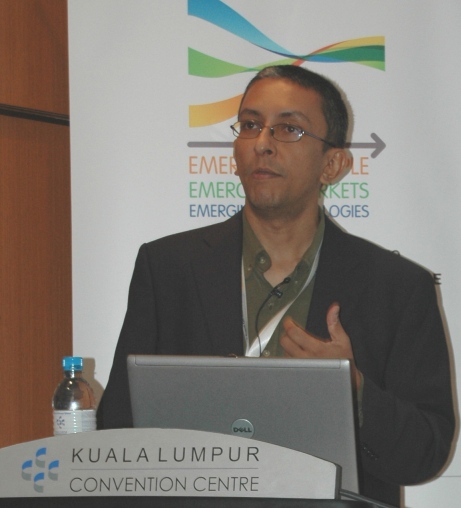
klcc-gk3-03.jpg nalaka-gunawardene-at-gk3.jpg

After spending a good deal of my time and energy sampling many of GK3’s offerings, my cumulative impression was: there was a lot of geek for sure, but very little of the meek.

And the nexus between geek (tools) and meek (needs) was hopelessly lost in the incredible volume of hype, PR and spin generated by the platform organisers. What a missed opportunity it was for everyone!

To be fair, GK3 was not a single conference, but a whole platform of events sharing the large physical space of the KL Convention Centre and spread through the week of 9 to 13 December 2007. During that time and using that space, various groups organised diverse events and activities — ranging from the usual talk sessions and workshops to training, exhibitions, quiz shows, a TV debate and a documentary film festival. There were also several social events that provided many hours networking among individuals and organisations.

Event platforms like GK3 mean very different things to different people. Some turn up mainly to show and tell (or share) what they are doing. Some attend simply to find out what’s going on. Others look for markets, partners or opportunities. With some planning and work, most participants get to take away something in the end.

All this certainly happened during GK3 to one extent or another. It brought together hundreds of people from all over the world who share an interest in G2M — according to official figures, a total of 1,766 registered participants from 135 countries, comprising 19% from public sector, 21% from private sector, 29% from civil society, 20% from international organisations, 5% from media and 6% from academia. Among them, 82% of participants were from developing countries. And half of all participants were from Asia, which was not surprising given their easier access to KL.

These participants — most of them eager, energetic and creative individuals — talked and mixed in a myriad combinations around the overall platform theme: how the threads of emerging people, markets and technologies will intertwine to deliver the future. There was discussion, debate, sharing and networking.

I myself did all of this. I attended part of the 3rd World Electronic Media Forum, joined the GKP’s 10th birthday celebration, sat through some plenary and parallel sessions and moderated two sessions myself. Some TVE Asia Pacific documentary films that I had scripted or directed were screened at the i4d film festival, a key side event. The week also saw the release of two Asian regional books that I was involved in creating (one I co-edited, and the other I wrote a chapter for).

But being the professional skeptic that I am, I don’t buy the GK3 secretariat’s post-event claim that “An overwhelming number of participants indicated that GK3 is the only event of its kind, is absolutely critical and worthwhile.” I have no doubt that a statistically higher number of people made nice and kind remarks about the week’s offerings, as many such people are wont to, especially if their participation was supported by travel scholarships. (I would be interested to know how many of the 1,700 people came on their own steam, as I did.)

In fact, style (and hype) over substance characterised the entire GK3 platform — the hype had actually started months before the event, with all registered participants being bombarded by endless promotional emails that I found simply intolerable. (And no, the organisers didn’t offer us the option of unsubscribing.) So much time, energy and donor funds were spent – nay, squandered – on dressing it up and inflating everything to the point of losing all credibility. If anyone was laughing all the way to their banks after GK3, it must be the assorted spin doctors!
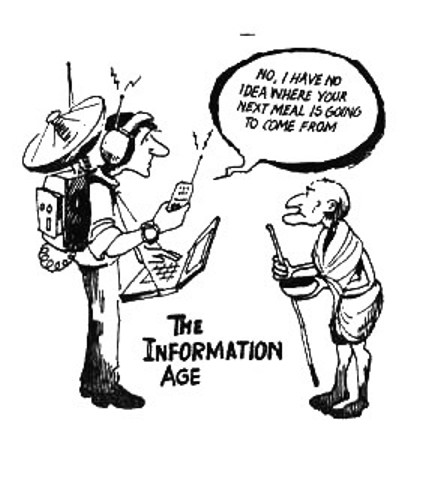
copy-of-all-inf-no-solutions.jpg
As I have written and spoken (for example in an op ed article in i4d magazine, June 2006), the gulf between the (expensive) hype and reality in ICT circles can be wide and shocking. What is worth investigating is the development effectiveness of this whole platform, and the value for money it delivered.

Take, for example, an email circular sent out by the GK3 organisers days after the platform ended. Under ‘key initial findings’, they list the following for emerging technologies, the area that interests me the most (verbatim reproduction here):

Four future-oriented outlook involving technologies were highlighted – media, cybersecurity, low cost devices, and green technologies.
* Increased convergence of different media allows single broadcasting (one to many) to be complemented by social broadcasting (many to many), and in turn increases interactivity in the exchange of information.
* Cybersecurity, cybercrimes and cyberwaste are becoming real dangers which deserve special attention.
* More new low cost devices are needed to facilitate affordable access to information, knowledge, communication and new forms of learning.
* Demand for innovative green technologies is welcomed and growing.

I don’t see how any of this can be labelled as ‘findings’ — these are not even articulate expressions of already known trends, conditions or challenges. Is this how the ‘Event of the Future’ going to be recorded for posterity? Surely, GK3 achieved more than this – probably below the radar of its spin doctors?

GK3 to me was more evidence of the disturbing and very unhealthy rise of spin in international development circles, where both development organisations and development donors are increasingly investing in propagandistic, narcissistic communications products and processes. While publicity in small doses does little harm, it is definitely toxic in the large volume doses that are being peddled whether in relation to MDGs or humanitarian assistance or, as with GK3, in relation to Geek2Meek. Full-page, full-colour paid advertisements in the International Herald Tribune don’t come cheap — but they come at the expense of the poor and marginalised.

I was also struck by how web 1.0 the GK3 organising effort was — all official statements, images and communication products (and even social events) were so carefully crafted, orchestrated, controlled. Whatever spontaneous action came not from the Big Brotherly organisers but from some free-spirited participants who seized the opportunity to express or experiment. The defining characteristics of web 2.0 – of being somewhat anarchic, highly participatory and interactive – were not the hallmarks of GK3. Again, a missed opportunity.

Then there was the ridiculously named Moooooooooooooo – sorry, it was actually MoO, an abbreviation for ‘Marketplace of Opportunities’, which GK3 was supposed to create or inspire for all those engaged in Geek2Meek work.

The MoO turned out to be just another exhibition where two or three dozen organisations put up their ware to show and tell (and a few did brag and sing, but that’s allowed at places like this). Strangely for an ICT gathering, there was so much paper floating around — posters, leaflets, booklets, books, postcards, you name it! And very few CDs, DVDs and electronic formats being distributed.

Oct 2007 Blog post: Say Moooooooooo – Mixing grassroots and iCT in KL

In the last hour of the final day, I walked around the MoO (I must admit I was half curious to see if the cows have come home!). I was stunned by the massive volumes of mixed up paper lying around everywhere. The week’s events were drawing to an end, and it was unlikely there would be too many more takers for all this paper. My colleague Manori captured on her mobile phone this image of an exasperated me surrounded by mountains of paper.
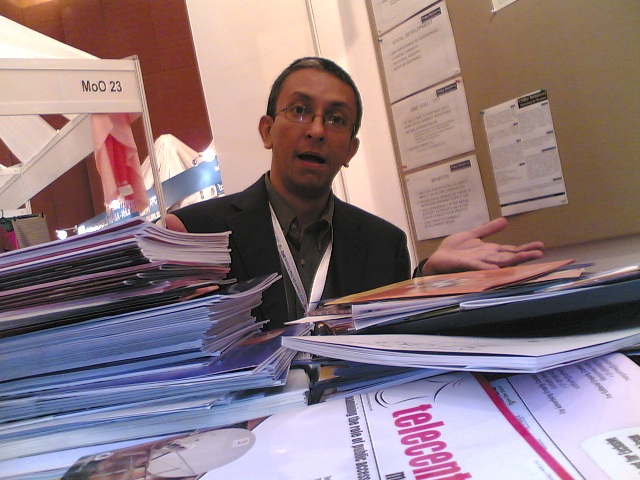
nalaka-gunawardene-sinking-in-a-sea-of-paper-at-gk3-dec-2007.jpg

The MoO exhibitors were not alone in their profligacy and wastefulness – the GK3 secretariat easily wins the prize for producing the greatest volume of glossy, expensive paper-based promotional material for at least a year preceding the event. These were often sent in multiple copies to heaven knows how many thousands of people all over the planet.

All this happened in a year (2007) when scientific confirmation of global climate change prompted governments, industry and civil society to realise that business as usual cannot continue, and more thrifty ways to consume energy and resources must be adopted. Ironically, GK3 was largely ignored by the world’s news media who focused much more attention on the UN Climate Change conference underway in neighbouring Indonesia’s Bali island.

I have commented separately on the missing link between KL and Bali. It is highly questionable what value-for-money benefit an ICT event like GK3 could derive from the abundance of paper-based materials produced to promote it. It’s revealing that the GKP’s oft-repeated claims of attracting 2,000 participants to GK3 were under-achieved despite excessive promotion.

Writing in October 2007, I said: “An informed little bird saysGK3 has milked development donors well and truly for this 3-day extravaganza. I hope someone will calculate the cost of development aid dollars per ‘Mooo’…”
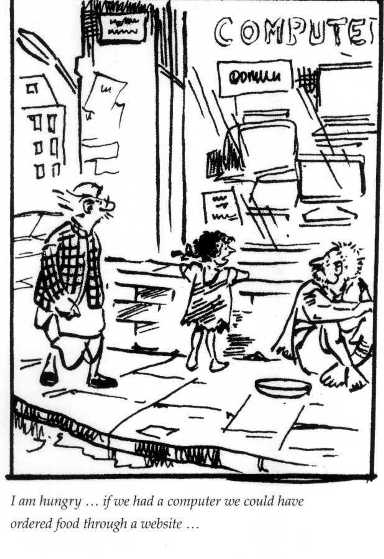
poor-hungry-boy-cartoon.jpg

Well, now is the time to ask those difficult questions. The donor agencies of several developed countries — and from Canada and Switzerland in particular — invested heavily in the GK3 extravaganza. These are public funds collected through taxes, given in trust to these agencies for rational and prudent spending. And it’s fair to say that most of this official development assistance (ODA) money is given with the noble aim of reducing poverty, suffering and socio-economic disparities in the majority world.

The GK3 organisers — that is, the GKP Secretariat — often talk in lofty terms about good governance, extolling the virtues of accountability and transparency. Here’s your chance to practise what you preach to the governments and corporations of the world: disclose publicly how much in total was collected for GK3 (from development donors, corporate sponsors, hefty registration fees), and how this money was spent. In sufficient detail, please!

We will then decide for ourselves whether GK3 provided value for money in the truest sense of that concept, and assess if GK3 was ‘absolutely critical and worthwhile’ as the organisers so eagerly claim.

It’s easy for like-minded people to become buddies and get cosy in international development networks. It’s also common to engage in self congratulatory talk and mutual back-slapping at and after gatherings like GK3. But too much manufactured (spun?) consensus and applause can blind our collective vision and lead us astray.

If we genuinely want to engage in Geek2Meek (or, ICT4D), we have to keep repeating the vital questions: what is the value addition that ICTs bring to the development process, and what is the value addition that mega-events like GK3 provide for turning geek tools to serve the meek? Answers must be honest, evidence-based and open to discussion (and dissension, if need be).

In not sharing the euphoria of GK3 organisers, I probably sound like that little boy who dared to point out that the mighty emperor had no clothes. If nobody talks these inconvenient truths and asks some uncomfortable questions, we would be going round and round in our cosy little grooves till the cows come home.

Did someone say Mooooooooooooo?

Read my November 2005 op ed essay written just after WSIS II: Waiting for pilots to land in Tunis

From KL to Bali: Why were ICT and climate change debates worlds apart?
Communicating Disasters in digitally empowered Asia: A tale of two books

I have just spent a hectic week in Kuala Lumpur, and am just coming up for fresh air. That explains why this blog was silent for a few days.

I was at the Third Global Knowledge Conference (GK3) held in the Malaysian capital from 11 to 13 December 2007. With several related events preceding the main conference, my week was completely full.

GK3 was a global platform for all those engaged in using ICTs (information and communication technologies) for meeting the real world’s needs and solving its problems — to reduce poverty, increase incomes, create safer communities, create sustainable societies and support youth enterprise, etc. (Read my impressions of GK3 in this blog post.)

The week’s assorted events saw two separate video films produced by TVE Asia Pacific being screened as integral components of two sessions. These were The Long Last Mile (on community-based warning of rapid onset disasters) and Teleuse@BOP (on telephone use patterns among low income groups in five emerging Asian economies).

That wasn’t surprising because we produce and distribute films that capture Asia’s quest for improving lives through sustainable development. But unusually for myself, I also had two books coming out during the week — one that I had edited, and another that carried a chapter I had written.

communicating-disasters-an-asia-pacific-resource-book-by-tveap-and-undp.jpg

The first was Communicating Disasters: An Asia Pacific Resource Book, which I co-edited with Indian journalist Frederick Noronha. It was the culmination of a year-long process that began with an Asian brainstorming meeting on Communicating Disasters that TVEAP convened in December 2006 in Bangkok. That meeting, attended by three dozen participants drawn from media and disaster management sectors, identified the need for a handbook that can strengthen cooperation of these two communities before, during and after disasters.

The book, comprising 19 chapters contributed by 21 authors, has a foreword written by Sir Arthur C Clarke, inventor of the communication satellite. Pulling together these contributions from the specialist authored scattered across the globe was no easy task for co-editor Fred and myself.

The book’s blurb reads as follows:

“Where there is no camera, there is no humanitarian intervention,” said Bernard Kouchner, co-founder of Medecins Sans Frontieres who later became the Foreign Minister of France. Disaster managers and relief agencies acknowledge the mass media’s key role at times of distress. Yet, the relationship between media practitioners and those managing disasters can often be stressful, difficult and fraught with misunderstandings. Communicating about disasters sometimes ends up as communication disasters.

How can these mishaps be minimised, so that the power of conventional and new media can be harnessed to create more disaster resilient communities? What value addition can the new information and communication technologies (ICTs) bring in? In this book, media and development professionals from across the Asia Pacific share their views based on decades of experience in covering or managing a variety of disasters – cyclones, droughts, earthquakes, floods, landslides and tsunamis.

This book is aimed at journalists, disaster managers and civil society groups who want to use information and communication to create safer societies and communities.

The other book that came out in KL was Digital Review of Asia Pacific, 2007-2008 edition. It was launched during a workshop on Emerging Knowledge Opportunities (The Progress of ICT in Asia-Pacific and Other Parts of the World) on 12 December 2007.

The completely updated edition of the Digital Review of Asia Pacific contains authoritative reports on how 31 economies are using ICT in business, government and civil society written by senior authors who live and work in the region.

I have written the Sri Lanka chapter for the book, continuing a tradition I started back in 2003 with the first edition of the book. I was only sorry that I missed the session during GK3 where the book was launched — because I was moderating another session exactly at the same time in another room. But I was glad to join at least part of the post-launch reception and to meet with some fellow authors who were attending GK3.

Both books are multi-author books, and both have been in the making for a year or longer. It was quite a challenge to get 20 other contributors to come up with their chapters for Communicating Disasters. They were genuinely interested and supportive, but everyone being so busy, it took time and effort to pull together all the strands.

I was not the only common author in these books. My colleague and one-time co-author Chanuka Wattegama (now with LIRNEasia) has written two distinctive chapters on ICTs and disaster communication for the two books.

Many years ago, my friend (now international expert on terrorism and widely published academic author) Rohan Gunaratna told me that writing a book was like waging a small war. I don’t normally use military metaphors, because I deplore all things military, but I can’t resist extending Rohan’s analogy to say that compiling a multi-author book is a bit like waging a mini-war with a coalition of the willing!

New media tsunami hits global humanitarian sector; rescue operations now on…

banner.jpg

Geneva, 25 October 2007 (MovingNews): The global humanitarian sector has been hit by a ‘new media’ tsunami, causing widespread damage and massive confusion in Geneva.

Giant waves — carrying blogs, wikis, YouTube and other new media products — have simultaneously swept over several aid capitals of the world, including London, New York and Tokyo.

United Nations and many other international relief organisations are among the worst affected. These aid agencies, usually among the first to arrive at the scene of major disasters or crises, found their information and communication capacities severely depleted.

“This is entirely a man-made calamity, and we just didn’t see it coming,” the UN spokesperson in Geneva said in a brief message released using the old-fashioned Morse code. “Our risk registers, log frame analyses and satellite technologies gave us no advance warning.”

Eye witness reports said some agencies were completely marooned on old media islands, saddled with very large numbers of completely unreadable documents going back to decades.

First casualties included assorted spin doctors carrying out propaganda for UN agencies. One perished while trying to sanitise the Wikipedia entry about his agency head.

Meanwhile, several dozen injured or badly bruised public information officers have been treated at a language clinic. Some will undergo trauma counselling.

“We have never been exposed to this level of open and two-way communication,” a survivor from UN OCHA said. “We were so used to always being in control, always telling others what to do and how to do it. I still don’t know what hit us!”

In a major show of solidarity, the world’s computer, telecommunications and media industries are rushing emergency teams to provide relief and recovery support.

“For decades, the UN, red cross and other aid agencies have responded to many and varied emergencies. In their hour of need, we have decided to come to their help,” a joint tele-com-media industry statement said.

Other survivors are being given first aid in simple, jargon-free public speaking. Those who respond well will be treated with basic courses in participatory communication methods.

The emergency coordinators have ordered that any spin doctors found alive be quarantined to prevent the spread of the fatal infection known as MDG.

As the recover process continues, ICT activists plan to conduct more advanced exercises — such as how to produce PowerPoint presentations with less than 20 words per slide.

“But we have to take things one step at a time,” a relief worker said. “These people have just had their entire frame of reference collapse all around them. They are in deep shock and disbelief. It will be a gradual process.”

It has now been established that a few alert officials had anticipated the new media tsunami well ahead of its dramatic arrival. But their warnings were ignored, as it now turns out, to everyone’s peril.

In Washington DC, the United States has just designated veteran broadcasters Walter Cronkite , Bill Moyers and Oprah Winfrey as their New Media Tsunami Relief Ambassadors. In the coming weeks, they will tour the decimated UN, red cross and other humanitarian aid agencies, taking stock of the global disaster and sharing their collective wisdom on telling the truth to the public simply and well.

You, dear reader, are now invited to continue building this unfolding scenario:

How soon and how well will the humanitarian sector raise its head from the new media tsunami?

Will they learn lessons from this disaster, or might they soon return to business as usual?

What would happen to the massive outpouring of goodwill, voluntary help and aid?

Message to aid workers: Go mobile — or get lost!

banner.jpg

“MY NAME is Mohammed Sokor, writing to you from Dagahaley refugee camp in Dadaab. Dear Sir, there is an alarming issue here. People are given too few kilograms of food. You must help.”

This short, urgent message of a single individual has already joined the global humanitarian lore. It was sent by SMS (a.k.a. mobile texting) from the sender’s own mobile phone to the mobiles of two United Nations officials, in London and Nairobi. Sokor found these numbers by surfing at an internet café at the north Kenyan camp.

The Economist used this example to illustrate how the information dynamics are changing in humanitarian crises around the world. In an article on 26 July 2007, titled ‘Flood, famine and mobile phones’, it noted:
The age-old scourge of famine in the Horn of Africa had found a 21st-century response; and a familiar flow of authority, from rich donor to grateful recipient, had been reversed. It was also a sign that technology need not create a ‘digital divide’: it can work wonders in some of the world’s remotest, most wretched places.”

Elsewhere in the article, it added: “Disaster relief is basically a giant logistical operation. Today’s emergency responders can no more dispense with mobile phones or electronically transmitted spreadsheets than a global courier company can. But unlike most couriers, aid donors operate amid chaos, with rapidly changing constraints (surges of people, outbreaks of disease, attacks by warlords). Mobile phones increase the flow of information, and the speed at which it can be processed, in a world where information used to be confused or absent. The chaos remains, but coping with it gets easier.

image-from-wikimedia.jpg
Image courtesy WikiMedia

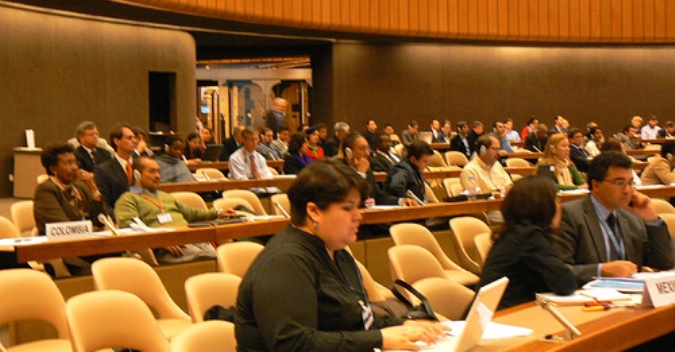
All available indicators suggest that the future of humanitarian assistance is going to be largely dependent on mobile communications. Despite this reality, old habits die hard. I sat through an entire presentation on ‘Innovation to Improve Humanitarian Action’ at the Global Symposium+5 on ‘Information for Humanitarian Action’ in Geneva this week — and not once did I hear mobile phones being mentioned. A group of 15 – 20 people had deliberated for 2 days to come up with their vision of ‘the potential of emerging technologies and approaches used in the field and globally to strengthen information sharing, coordination and decision-making’ in humanitarian work.

It might be that aid workers are all frustrated computer geeks…because all their talk was about collaborative and networking software, Geographic Information Systems (GIS), the use of really high resolution (read: oh-so-sexy) satellite imagery, and the latest analytical tools — all requiring high levels of skill and personal computers with loads of processing power.

But no mobile phones! This was too much to let pass, so I raised the question: did you guys even consider this near ubiquitous, mass scale technology and its applications in crisis and disaster situations? And how do you engage the digitally empowered, better informed disaster survivors and crisis-affected communities?

I also recalled the example of Aceh tsunami survivors keeping each other informed about the latest arrivals of relief supplies – all through their mobile phones (as cited by the head of MERCY Malaysia on the previous day).

It turned out that they did discuss mobiles — well, sort of. Amidst all the gee-whiz talk about high tech gadgets, I received a short answer: widespread as mobile phones now are, ‘these systems are not fully integrated or compatible with other information platforms’ — whatever that means! The group’s spokespersons also pointed out that since mobile services are all operated by commercial (telecom) service providers, using their networks involves lots of ‘negotiations’. (I would have thought it’s the same with those who operate earth-watching or communications satellites.)

The message I heard was: mobile phones are probably too down-market, low-tech and entirely too common for the great humanitarian aid worker to consider them as part of their expensive information management systems. For sure, everybody uses them to stay in touch in the field, but what use beyond that?

What uses, indeed. If today’s aid workers ignore the mobile phone revolution sweeping Africa, Asia Pacific and, to a lesser extent, Latin America, they risk marginalising their own selves. The choice seems to be: go fully mobile, or get lost.

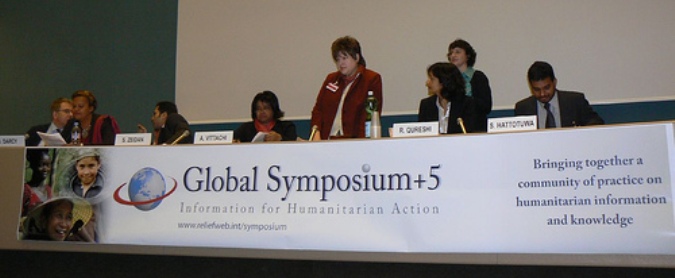
Fortunately, the panel discussion that followed — on ‘Envisioning the Future’ — partly redressed this imbalance. The panel, comprising telecom industry, citizen media and civil society representatives, responded to the question: what will our humanitarian future look like and what role will information play in supporting it?

panel-3-on-envisioning-the-future.jpg

Leading the ‘defence’ of mobiles was Rima Qureshi, head of Ericsson Response, part of the global mobile phone manufacturer’s social responsibility initiatives. She reminded us there were now 3.4 billion (3,400 million) mobile phones in the world — and it was growing at 6 new mobile connections every second. By the time she ended her 8-minute talk, she said, some 3,000 new mobiles would have been connected for the first time.

This represents a huge opportunity, she said, to put information into everyone’s hands whenever and wherever they need it. And mobiles are all about two-way communication.

The new generation of mobile phones now coming out are not locked into a single telecom network, and have built-in global positioning (GPS) capability. This means the phone’s location can be pinpointed precisely anywhere on the planet — which can be invaluable in searching for missing persons in the aftermath of a disaster.

Wearing her Ericsson prophet’s hat, Rima said: “Everything we can do on a personal computer will soon become possible on a mobile. Mass availability of mobile phones, able to connect to the global Internet, will represent a big moment for human communication.”

And not just Ericsson, but many other mobile phone makers and network operators are rolling out new products and services. The new mobiles are easier to use, more versatile and durable, and come with longer-lasting or renewable sources of power. Wind-up phone chargers have been on the market for some years, and some new mobile phones come with a hand-cranking charging device that makes them entirely independent of mains electricity. With all this, the instruments keep getting cheaper too.

And if aid workers ignore these and other aspects of mobile realities, they shouldn’t be in their business!

1743641460_63092b452a.jpg

Rima described another Ericsson initiative called Communication for All. It’s trying to harness the power of shared network, across commercial telecom operators and networks (but with some development funding from the World Bank) to deliver coverage to rural areas that aren’t as yet covered fully. The rolling out of coverage would have profound implications for disaster managers and aid workers.

As James Darcy, Director of humanitarian aid policy at the UK’s Overseas Development Institute, noted from the chair, the future of humanitarian communication is already here — but the sector needs to have more imagination in applying already available technologies for new and better uses.

My colleague Sanjana Hattotuwa, ICT researcher and activist from Sri Lanka, made the point that 3.4 billion mobiles raise new ethical considerations. For example, while it is now technologically possible to track the movement of every mobile phone – and therefore, in theory, each unit’s owner – this knowledge can be abused in the wrong hands. (I’ll write a separate blog post on Sanjana’s other remarks.)

Not everyone in the audience was convinced about the future being mobile. Soon enough, the predictable naysayer popped up: saying only 2.4 per cent of people in Sub-Saharan Africa as yet owned mobile phones, and Internet access was limited to only one per cent. Blah, blah, blah! (I was half expecting someone to blurt out the now completely obsolete – but sadly, not fully buried – development myth that there are more phones in New York city than in the whole of sub-Saharan Africa. That didn’t happen.)

Funny thing was, we were discussing all this at the Palais des Nations, the European headquarters of the UN, which is just literally across the street from the headquarters of the International Telecommunication Union (ITU), the authoritative monitor of telecom and ICT industry data and trends! It seemed that the gulf between some humanitarian workers and the telecom industry was much bigger than that.

Of course, being connected – to mobile, satellite and every other available information network – is only the first step. We can only hope humanitarian workers don’t end up in this situation, captured in one of my all-time favourite ICT cartoons (courtesy Down to Earth magazine):

copy-of-all-inf-no-solutions.jpg

Read about Sri Lanka’s pathfinding action research by LIRNEasia and others: Last Mile Hazard Information Dissemination Project

All Geneva photos courtesy UN-OCHA Flickr on Global Symposium+5