When citizens turn on journalists…

My latest op ed essay has just been published by Asia Media website of the University of California Los Angeles.

It’s titled: When citizens turn on journalists
Nalaka Gunawardene describes the disturbing trend of vigilantism against professional and citizen journalists

Once again I talk about the multiple pressures and risks faced by mainstream and citizen journalists alike when they try to cover matters of public interest in my native Sri Lanka. This is particularly so for photojournalists and videographers who simply must go out with tools of their profession.

Here are the few opening paras:

Friday, February 29, 2008

Colombo — For over two decades, Sri Lanka’s state-owned radio and television stations — located next to each other in residential Colombo — have been heavily guarded by police and army. This fortress-like arrangement is due to their being high on the list of targets for Tamil Tigers engaged in a bitter separatist war for a quarter century.

The joke is that the stations are just as likely to be attacked by outraged listeners or viewers. Considering the endless state propaganda they dish out day and night, that’s not as far-fetched as it sounds.

But shooting the messenger never solves any problem, as Sri Lanka’s deeply divided combatants — and their die hard supporters — need to be constantly reminded. Attacks on journalists and media organisations have increased several fold in the past two years, and the World Association of Newspapers ranked Sri Lanka as the third deadliest place for journalists (six killed in 2007) — behind only Iraq and Somalia.

As if this was not depressing enough, we have seen another disturbing trend emerge: authorities and citizens alike turning on reporters and photojournalists in public places, suspecting them to be agents of mayhem and terror.

Read the full essay on UCLA Asia Media

Fighting for our right to ‘shoot’: A struggle in New York…and Colombo!

Courtesy AP

Photojournalists usually bear witness to unfolding events, and then share it with the rest of us. It’s not everyday that they make the news themselves.

This photojournalist, Gemunu Amarasinghe working for Associated Press in Sri Lanka, just did. Earlier this week, he was detained, questioned and released by police — all for taking photographs near a well-known Colombo school.

According to news reports, Gemunu was apprehended by a group of parents who formed the school’s civil defence committee. They had handed him over to soldiers on duty near by, and he was briefly detained by the Narahenpita police. Sri Lanka’s Free Media Movement has already protested to the police chief on this – the latest in a series of worrying incidents.

This might seem a minor incident in the context of highly dangerous conditions in which Sri Lankan journalists operate today. It was only a few days earlier that the World Association of Newspapers ranked Sri Lanka as the third deadliest place for journalists (6 killed in 2007), behind only Iraq and Somalia.

In an op ed essay published today on the citizen journalism website Groundviews, I have discussed the far reaching implications of this latest trend – when misguided citizens turn on professional or citizen journalists simply taking photos in public places. That’s still not illegal in Sri Lanka, where many liberties have been curtailed in the name of anti-terrorism.

Read my full essay: Endangered – Our Right to ‘Shoot’ in Public

As I write: “Gemunu’s experience is highly significant for two reasons. Firstly, it is depressing that some members of the public have resorted to challenging and apprehending journalists lawfully practising their profession which responds to the public’s right to know. Battered and traumatised by a quarter century of conflict, Sri Lankan society has become paranoid. Everything seems to be ‘high S’: practically every city corner a high security place; every unknown person deemed highly suspicious; and everybody, highly strung.

Courtesy Daily Mirror - Sri Lanka Cartoon from Daily Mirror, Sri Lanka

“Secondly, far from being an isolated incident, this seems to be part of a disturbing new trend. Anyone with a still or video camera in a public place is suspected – and presumed guilty until proven otherwise. This endangers everyone’s basic right to click for personal or professional purposes.”

I mention some examples of this cameraphobia. In recent months, pedestrians who filmed public bomb attacks on their mobile phones have been confronted by the police. One citizen who passed on such footage to an independent TV channel was later vilified as a ‘traitor’. Overly suspicious (or jealous?) neighbours called the police about a friend who was running his video editing business from home in suburban Colombo.

None of these individuals had broken any known law. Yet each one had to protest their innocence.

It may not be illegal, but it sure has become difficult and hazardous to use a camera in public in Sri Lanka today. Forget political demonstrations or bomb attacks that attract media attention. Covering even the most innocuous, mundane aspects of daily life can be misconstrued as a ‘security threat’.

I stress the point that, unlike journalists working in the mainstream media, citizen journalists lack trade unions or pressure groups to safeguard their interests. The citizen journalist in Sri Lanka is very much a loner — and very vulnerable.

And it’s not just in war-torn Sri Lanka that the right to take photos or film video is under siege. I cite a recent example from what is supposed to be a more liberal democracy: in the US, where New York city officials last year proposed new regulations that could have forced tourists taking snapshots in Times Square and filmmakers capturing street scenes to obtain permits and $1 million in liability insurance. The plans were shelved only in the face of strong public protests, spearheaded by an Internet campaign that included an online petition signed by over 31,000 and a rap video that mocked the new rules. Photographers, film-makers and the New York Civil Liberties Union played a lead role in this campaign, which asked people to ‘picture New York without pictures of New York’.

Read my full essay: Endangered – Our Right to ‘Shoot’ in Public

Sep 2007 blog post: Kenji Nagai (1957 – 2007): Filming to the last moment

Dec 2007 blog post: Asian tsunami – A moving moment frozen in time

Suharto’s legacy: Mass grave Indonesia

“One death is a tragedy. A million deaths is just a statistic,” said Joseph Stalin — and he knew what he was talking about.

These words came to my mind as I followed the news coverage and commentary about the death on 27 January 2008 of Suharto, the former Indonesian military leader, and the second President of Indonesia, who was in office from 1967 to 1998.

Many western and globalised media reports touched on Suharto regime’s alleged mass-scale corruption, and the dizzy heights that crony capitalism reached under his watch.

But few talked about the genocide of unarmed, innocent civilians that took place in the years that brought him to power, 1965-67. Another blood bath took place in 1975 when Indonesian forces invaded and took over East Timor. Even those that touched on the subject used varying estimates of how many perished.

The Guardian (UK) obituary estimated the number killed in 1965-67 to be around 600,000. Others, such as BBC News, placed it at half a million, noting that “the bloodshed which accompanied his rise to power, after a mysterious coup attempt in 1965 which he blamed on Indonesia’s then-powerful Communist Party, was on a scale matched only in Cambodia in this region”.

In all probability, no one really knows the real number of Indonesians were slaughtered as the army – cheered by anti-communist west – cracked down on members and supporters of the Communist Party of Indonesia, at that time a legal political party. Genocidists don’t like to keep detailed records.

The New York Times, a long-standing cheer-leader of the ‘smiling general’, acknowledged that Suharto’s 32-year-long dictatorship was ‘one of the most brutal and corrupt of the 20th century’.

NYT added: “His rule was not without accomplishment; he led Indonesia to stability and nurtured economic growth. But these successes were ultimately overshadowed by pervasive and large-scale corruption; repressive, militarized rule; and a convulsion of mass bloodletting when he seized power in the late 1960s that took at least 500,000 lives.”

On the whole, however, the mainstream media has been far more preoccupied with the (admittedly important) issue of how much Suharto and family stole than how many people were killed extra-judicially during his regime.

In that respect, things haven’t changed all that much since Suharto was driven out of power by mass protests. American economist and media analyst Edward S Herman, who co-authored Manufacturing Consent with Noam Chomsky, wrote a commentary nearly 10 years ago titled Good and Bad Genocide: Double standards in coverage of Suharto and Pol Pot.

His opening para:
“Coverage of the fall of Suharto reveals with startling clarity the ideological biases and propaganda role of the mainstream media. Suharto was a ruthless dictator, a grand larcenist and a mass killer with as many victims as Cambodia’s Pol Pot. But he served U.S. economic and geopolitical interests, was helped into power by Washington, and his dictatorial rule was warmly supported for 32 years by the U.S. economic and political establishment. The U.S. was still training the most repressive elements of Indonesia’s security forces as Suharto’s rule was collapsing in 1998, and the Clinton administration had established especially close relations with the dictator (“our kind of guy,” according to a senior administration official quoted in the New York Times, 10/31/95).”

Suharto’s demise reminded me of a powerful short documentary I saw a few years ago. Titled Mass Grave Indonesia, it was directed by courageous young Indonesian journalist Lexy Junior Rambadeta (photos below).

Lexy Rambadeta

He works as a freelance TV journalist for international news agencies, and is a key member of the Jakarta-based media collective Off-Stream. It was started Off Stream in 2001 by journalists, filmmakers, photographers and multimedia artists “who have strong commitments and creativities on catering, promoting, covering, documenting and producing multiculturalism documentary video/film, photography and multimedia products”.

OffStream lists as its mission: To give a voice to “survivors of horror”; To tear down walls of “silence”; and To denounce “injustice” and “barbarism”.

One of their first productions was Mass Grave Indonesia, whose synopsis reads:
“Approximate between from 500 000 to 3 million of people in Indonesia have been killed by Soeharto’s regimes and buried somewhere in the wood distributed. A full and frank account of what happened in the reburial of 26 victims of horror in the 1965 mass killings. This documentary film weaves its story against the tide by presenting evidence of cruelties sponsored by the military in two regions of Central Java.”

I have just tracked down the 19-minute film on YouTube, presented in two parts:

Mass Grave – Indonesia: Part 1 of 2

Mass Grave – Indonesia: Part 2 of 2

This is no western film, filmed by visiting foreign journalists who might be accused of having one agenda or another. This is a film made by Indonesia’s own journalists who found their voice and freedom after the Suharto regime ended in 1998.

I have emailed Lexy this week asking how this film – and agitation by many human rights and democracy activists – have helped bring about belated justice to his own people. I await his reply, which will be published when received.

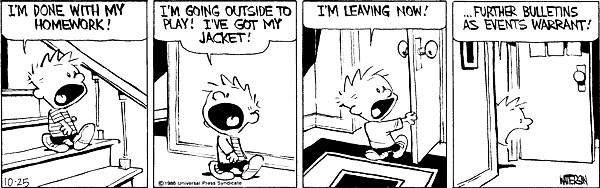
Creating news needlessly – or covering news needlessly?

covering-news-needlessly.gif

This came in a few days ago – as part of my daily diet of emailed Calvin and Hobbes comic strips sent free by Go Comics.

It reminded me of our South Asian governments and many 24/7 news channels who sound just like Calvin.

Governments – at least in popularity-conscious democracies – are constantly trying to create news, even when there is nothing new, true or interesting (the triple test for news). There’s a lot more rhetoric, plans and claims than actual accomplishments.

TV news channels, having to fill 24 hours of the day, cover news needlessly and in endless repetitions and detail. (By the way, covering news needlessly is an irreverent expansion of the abbreviation CNN!).

Actually, I shouldn’t compare either entity with the smart six-year-old Calvin. He is a great deal more interesting on an on-going basis than most of our governments and much of our news media.

I’m a long-standing fan of the comic – and followed it while Bill Watterson was still drawing them from 1985 to 1995. It was a sad day indeed when he decided on 31 December 1995 not to draw any more Calvin and Hobbes.

calvin-hobbes.png

AlertNet for Journalists: Rough guide to disasters and ‘alms bazaar’

Journalists are among the first responders to disasters and conflicts that break out without notice. They have to gather information from ‘ground zero’, process it and disseminate as rapidly and accurately as possible.

Easier said than done – especially when there’s more than the usual level of chaos, confusion and consternation. The multitude of humanitarian workers and their agencies who rush to such situations – to provide much-needed rescue, relief and recovery support – don’t always make life easier for journalists.

Yet they need each other. They just have to find better ways to work together. This is the central theme of our just-released book, Communicating Disasters: An Asia Pacific Resource Book – the entire book is now available online for free download.

reuters-alertnet-logo.jpg

One of the appendices to the book was contributed by Emma Batha of Reuters who talked about Reuters AlertNet for Journalists.

AlertNet for Journalists is “a set of free online tools designed to help journalists cover conflicts and disasters. The resources include crisis briefings, country statistics and aid agency contacts.”

It is part of Reuters AlertNet, a non-profit humanitarian news network based around a popular website, set up in 1997 by the Reuters Foundation. It aims to keep relief professionals and the wider public up-to-date on humanitarian emergencies around the globe.

Here’s a short video that AlertNet has just placed on YouTube – their first film to be thus offered:

It’s good to see more humanitarian and disaster related organisations engaging the YouTube. I wrote in October 2007 about UN-ISDR taking the plunge, placing some of its videos on a YouTube channel.

Read Emma Batha’s contribution to Communicating Disasters: Reuters AlertNet for Journalists

Asian Tsunami of December 2004: A moving moment frozen in time

An Indian woman mourns the death of a relative killed in the Asian Tsunami

An Indian woman mourns the death of a relative killed in the Asian tsunami. The picture was taken in Cuddalore, Tamil Nadu, on 28 December 2004 (REUTERS, Arko Datta)

From every disaster, conflict or tragedy emerges a single photograph that captures its essence in a way that becomes iconic. This image, showing the sheer haplessness of those who survived only just barely but lost everything they had, could well be that for the Asian tsunami of December 2004.

It was taken by Indian photojournalist Arko Datta, who won the 2004 World Press Photo Award for this image.

Indian journalist Max Martin (editor of indiadisasters.org) recently interviewed Arko Datta for a chapter in Communicating Disasters: An Asia Pacific Resource Book (co-edited by myself and Frederick Noronha, and just released). The chapter is titled ‘Stop All the Clocks! Beyond Text: Looking at the Pics’, which argues that disaster photography needs to break away from the constraints of time and space.

Excerpts from that interview:

On frames
I actually do not plan a frame. I am merely a messenger and do not try to bring in subjectivity or my priorities (in my photographs). I have to be very objective when I am covering any event. I leave the viewers to interpret the pictures according to their perspective. However, of course there are certain parameters I like to follow.

I do not like showing corpses or any (image of) morbidity unnecessarily. In natural disasters it is mostly unnecessary; however, in a war, one may need to show the victims as that may be the strongest way of making people aware of the fallout of wars.

In a natural disaster, the story is generally about the survivors — their struggle to cope with the loss of their near and dear ones, their struggle to get back to normalcy. It’s the story of their grit and determination to survive and live.

On emotions
The first viewer of my pictures is myself. When I am touched by a situation, I plan to capture it in my camera and show it to others too. So, definitely, as any other human being, I react to every situation too. However, while on work one has to control and restrain one’s emotions, as no productive work can emerge during an emotional state of mind.

Arko Datta
While covering an event, and covering several events over the years, these emotions keep getting suppressed and bottled up. One needs to know how to tackle this in the long run, or it can deeply effect one’s mind. And everyone has his or her own way of tackling it. I do so by talking to my family and very close friends about my experiences.

On interfacing with humanitarian workers
I feel, on the field, humanitarian workers have their own work to do and the press has its own. The humanitarian workers should not get concerned about the press, as definitely the victims will be their top priority. The press can surely manage on its own. In fact, the press should not come in the way of relief and rescue work.

Here’s his profile from World Press Photo:

Arko Datta started his professional photojournalistic career in an Indian dailies in Madras and Calcutta. He then worked at AFP, and joined Reuters in 2001. His awards include national photo competition prizes from the Indian government, a prize in the Canon International photo competition, a Publish Asia award in Malaysia, Best Photojournalist of the Year award from Asian Photography magazine in India, the Picture of the Year award in Bombay and awards in the General News and Daily Life categories of the Indian Express Photo Competition. His publications include “Lost Childhood”, a book on child labor sponsored by the International Labor Organization, and his pictures are featured in a coffee table book of the most memorable pictures of India in the last 100 years and in the Reuters picture book “On the Road”.

Download the full book chapter by Max Martin, titled: Stop All the Clocks! Beyond Text: Looking at the Pics

Read or download the full book’s contents at TVEAP website

When the Waves Came – the story behind the verse

I am a word-smith. Trained as a journalist and writer, I play with words (and occasionally make an honest living of it ) — but almost all of my published output over more than 20 years has been in prose. Not yet a creative writer (maybe someday!), I write mostly fact-based analysis or opinions.

One rare exception was when the Asian Tsunami struck three years ago in the last week of 2004. Extraordinary situations prompt extraordinary responses – and I went on to write the only verse I have so far published: When the waves came.

I was recovering from chicken pox when the mega-disaster that struck on 26 December 2004. The killer waves spared the Colombo city on the western part of coastal Sri Lanka where I live – and we were extremely lucky. But with close to 40,000 persons dead or missing (which was 1 in 500 of us), it was not a time to heave sighs of relief. We all knew people who were directly affected in one way or another: losing loved ones, suffering property damage, or seeing their jobs go up in the waves.

In the days following the disaster, the entire country was a giant funeral house. For a short while, at least, our utterly divided nation of Lanka was united — first in horror and then in grief.

creating-disaster-resilience-everywhere.jpg

I first heard about the disaster on local television – whose newscasters were struggling to make sense of what was happening. Tsunamis were not known in the Indian Ocean until then, and most people had not even heard of the term. Broadcast journalists had to improve with terms like ‘ferocious wave action’, ‘seas flooding land’ and ‘seas spilling over to coastal areas’, etc.

As the international news media started reporting the extent of devastation from all over South Asia and Southeast Asia, we realised that Sri Lanka was not alone – even though it had been battered very badly.

By Monday 27 December, the scale of the disaster was clearer, and the Sri Lankan death toll was already past 25,000 -– and counting. Search and rescue efforts were now underway, and relief agencies were continually updating their assessments of damage. The grim statistics kept rising by the hour.

The global family first watched in shock — and then started to react. Around the world, hundreds of caring people were dropping everything they had lined up for their Seasonal holidays and rushing to volunteer in Sri Lanka and other disaster hit countries. Inspired by the saturation media coverage, especially on television, caring women and men in far away corners of our planet were donating generously for disaster relief support. Children were breaking open their tills in which they’d carefully saved small change for months or years. Church congregations had special collections. Performing artistes were getting ready to have Tsunami aid concerts. Spurred and partly embarrassed by these citizen actions, governments belatedly started pledging massive volumes of aid. The worldwide response to Asia’s tragedy was deeply moving (the bickering and swindling came later).

My office (TVE Asia Pacific) was closed that week for Seasonal holidays, but I decided to go in and follow the disaster’s news coverage online (I didn’t have ADSL at home then.) Websites were often giving better coverage than TV channels, and the bloggers were rising to the challenge from many locations in impacted Asia.

I spent most of December 27 and 28 in my office. Weakened as I was by chicken pox, I didn’t rush out to help with relief efforts. I knew my limits. Instead, I was emailing regular updates to our friends and partners from many parts of the world who were concerned and anxious about our safety and well-being. Not being a blogger myself then, I was doing it on a one-to-one basis.

I slowly came to terms with a deep anguish that had built up since I first heard the dreadful news. I was badly shaken and numbed by the unfolding human tragedy and humanitarian crisis all around myself. No, I didn’t lose a loved one, or suffer personal property damage, but it was impossible not to be moved by the carnage and destruction all around. And at a scale that was unprecedented in my lifetime.

For hours on 28 December 2004, I watched the ‘doom and gloom’ television news coverage and monitored news updates online. At that stage, with little news yet emerging from Aceh, Indonesia, Sri Lanka had reported the highest death toll and the greatest damage. It was the biggest disaster in the island’s living memory.

When I finally gathered enough sense and wits, I wrote a verse ‘When the waves came’ – it was one way of coming to terms with the calamity. Its basic premise was that the killer waves had been a brutal ‘equaliser’ of all men and women. It no longer mattered on which side of law, morality, economics or social class they stood.

To drive home the point, I sprinkled the words of William Makepeace Thackeray throughout the verse:
“Good or bad, guilty or innocent —
they are all equal now.”

The verse was not meant for publication, and was only privately circulated for a few days. One friend who received it, Bircan Unver in New York, wanted to publish it on her Light Millennium website. After some persuasion, I agreed.

tsunami-survivor-children-return-to-the-sea-in-suduwella-southern-sri-lanka.jpg

I wrote this verse with tears running down both my cheeks. I kept on typing, without wiping my face, as words poured out from my grief-stricken mind. This was the least I could do, as my tribute to everyone who perished or suffered by nature’s incredible fury.

Writing this verse was cathartic for me. Three years after it happened, I can now disclose what followed my writing of this verse: I closed the laptop, sat down on the floor, and completely broke down.

I have no idea for how long I cried: it must have been 20 or 30 minutes. There was no one in the office that day so I didn’t have to subdue myself. Of course, my tears were nowhere near as abundant as those who lost their loved ones to the tsunami. But they were no less sincere.

Looking back, I suspect that during those hours of sorrowful solitude, Children of Tsunami was conceived.

But that’s another story.

Photos courtesy TVE Asia Pacific

Communicating Disasters: Lessons From Titanic to Asian Tsunami by Arthur C Clarke

What do the RMS Titanic, which sank on her maiden voyage in April 1912, and the Asian Tsunami of December 2004 have in common?

Both were maritime disasters and, when they happened, both shook the world as few others did before or since.

And now, Sir Arthur C Clarke has linked the two tragedies that happened 92 years apart: he says they both illustrate how communications failures can compound the impact of a disaster.

Writing a foreword to Communicating Disasters: An Asia Pacific Resource Book (co-edited by myself and Frederick Noronha, and just released), the inventor of the communications satellite revisits the two disasters that left deep impressions in his mind.

communicating-disasters-an-asia-pacific-resource-book-by-tveap-and-undp.jpg sir-arthur-clarke-by-shahidul-alam.jpg

Arthur C Clarke was born five years after the sinking of the ‘unsinkable’ RMS Titanic while on her maiden voyage. His home town Minehead, in Somerset, was not more than a couple of hundred kilometres from Southampton, from where the Titanic set off, he says, adding: “All my life, I have been intrigued by the Titanic disaster.”

He is particularly interested in what happened to the Titanic’s distress call after she hit the iceberg at 11.40 pm on the night of 14 April 1912. “A series of unfortunate factors compounded the disaster. The most ironic among them was that the wireless operator on the Californian, located closest to the Titanic, had shut down for the day just 30 minutes before the first distress call was sent out. Had the Californian been listening, it could have responded hours before the Carpathia, the eventual rescue vessel.”

The Titanic disaster prompted the shipping community to introduce a 24-hour radio watch on all ships at sea. It also consolidated the role of maritime radio in distress signalling and rescue operations.

But, as fate would have it, the absence of a timely warning once again characterised the second disaster to touch Sir Arthur’s life. Arriving 10 days after his 87th birthday, the Asian Tsunami of December 2004 left a massive trail of destruction in his adopted country Sri Lanka and several other countries bordering the Indian Ocean.

He reflects:
“Astonishingly, a full century after the invention of radio, the Tsunami arrived without any public warning. The disaster’s death toll could have been drastically reduced if its occurrence — already known to scientists — was disseminated quickly and effectively to millions of coastal dwellers living on its predictable path. Even a half hour’s notice would have allowed people to run away from the coast, and in many affected locations there was just enough time to get to safety. But alas, that didn’t happen — and tens of thousands perished.

“It was appalling that our sophisticated local and global communications systems completely failed us that fateful day. The communications satellites that I invented, and the global Internet that one of my stories inspired, could have spread the warning, with the hundreds of radio and television channels across coastal Asia amplifying it.

“It is now known that the failures were human, not technological. To ensure better results next time, we need to achieve an optimum mix of technology, management systems and community preparedness — not just for tsunamis, but for many other hazards that we live with. We have to remember that delivering credible early warnings to those who are most at risk is both an art and a science.”
copy-of-tsunamis-legacy-in-southern-sri-lanka.jpg

In his foreword, Sir Arthur sees the Asian Tsunami as a turning point for citizen journalism – ordinary people armed with digital tools bearing witness to unfolding events and then sharing it with others. He writes: “On 26 December 2004, many holiday-makers on affected beaches were armed with video cameras, and it was their ‘amateur’ images that later showed us the full force and fury of the unfolding disaster. Because it was distributed over a large area and occurred during peak holiday season, the Asian Tsunami was probably the most widely filmed disaster in history.”

This was not the first disaster that ‘citizen journalists’ covered, says Sir Arthur, but it marked a turning point in the growing phenomenon enabled by information and communications technologies (ICTs). “The post-Tsunami coverage showed that the professional and amateur divide had now blurred; there is a clear (and complementary) role that each can play.”

ICTs can do much in good times and bad, but as Sir Arthur recalls, the Tsunami also reminded us how disasters can make our information society vulnerable. “When electricity and telephone services — both fixed and mobile – went down in the worst affected areas, a century old technology came to the rescue: amateur radio enthusiasts restored the first communication links with the outside world, sometimes using the Morse Code to economise the power of car batteries.”

He quotes the President of the Radio Society of Sri Lanka as saying, “When all else is dead, short wave is alive.”

Sir Arthur’s perceptive foreword is a sobering counterpoint to the post-tsunami frenzy that we witnessed in the Indian Ocean rim countries. Yes, lacking a tsunami warning system – such as the one Pacific Ocean countries have – is a big gap that needed to be filled. But governments and development donors have rushed into setting up high tech, high cost early warning systems without due consideration for social, cultural and political realities of the intended beneficiary countries.

As we saw with some subsequent undersea quakes – such as the one off the resort town of Pangandaran, Java, on 17 July 2006, and the one off off Bengkulu, Sumatra, on 12 September 2007 – we have yet to achieve the right mix of technology, management systems and community preparedness in most coastal countries in Asia.

Governments, donors and UN agencies would do well do heed the wise words of Sir Arthur Clarke, who concludes his Foreword with these words:

“Communicating disasters — before, during and after they happen — is fraught with many challenges. Today’s ICT tools enable us to be smart and strategic in gathering and disseminating information. But there is no silver bullet that can fix everything. We must never forget how even high tech (and high cost) solutions can fail at critical moments. We can, however, contain these risks by addressing the cultural, sociological and human dimensions — aspects that this book explores in some depth and detail, from the perspective of both media professionals and disaster managers.

“The lessons of history are clear: if we are not careful, we can easily lull ourselves into the same kind of false confidence that doomed the Titanic.”

Read the full text of “Communicating Disasters: A Century of Lessons”, By Sir Arthur C Clarke
communicating-disasters-a-century-of-lessons-by-arthur-c-clarke.pdf

Or download foreword as contained in the printed book

GlobalVision at 20: Insiders turned outsiders keep kicking


GlobalVision, the path-breaking media company anchored in New York with a truly global outlook and a strong commitment to social justice, completed 20 years this week.

It was launched in November 1987 out of one room in Soho (New York) as a mission-driven company with little money but a big idea: to improve news coverage of the world through an “inside-out” approach that would offer voices not usually heard on the air in the US.

The founders were Danny Schechter, who became, in his words, a “network refugee” from ABC News 20/20 and Rory O’Connor, then with CBS News 48 Hours.

As the company introduction says:

“The whole world is watching… From Baghdad to Beijing, from Madrid to Manhattan, information is moving at the speed of light. Media and communications technology are transforming our lives — and those of our six billion neighbors. But in the emerging global village, whose stories get told — and who gets to tell them?

“At Globalvision, we believe in telling stories from the inside out. That means working with other cultures — not at them –and helping people to tell their own stories in their own way, to a world that’s getting smaller every day.”

In an industry saturated with media companies known more for their style than substance, Global Vision has not only blazed new trails, but used moving images in ways that moved people towards social change, political reform and – just as importantly – constantly question and challenge conventional wisdom and traditional authority.

They have also never hesitated to challenge the fellow journalists and corporate media on their servility, acquiescence and willing suspension of journalistic norms in the United States, especially under the current Bush administration.

They have won numerous awards and professional recognition for its pioneering international newsmagazine South Africa Now, which first broke through censorship to smuggle footage out of what was once the land of apartheid — and later chronicled Nelson Mandela’s transition from prisoner to President.

The company followed up with another award winning series, Rights & Wrongs: Human Rights Television with Charlayne Hundter-Gault, which aired for four years in sixty-two countries around the world.

Danny and Rory have also directed and produced more than thirty hard-hitting documentaries, many involving controversial issues and investigations — some for the PBS “Frontline” series” and others for television systems worldwide. Current films deal with subjects such as America’s child farm workers, bridging the global digital divide, flawed media coverage of the War in Iraq, and the ongoing debt crisis that threatens the global economic system.

I met Danny in person only once – in the Fall of 1995, when I spent a few weeks in New York on a fellowship to study the United Nations. Danny was one of the more colourful people we met (besides lots of men in suits from the UN, only a few of whom I can now recall by name). Danny introduced himself as a (TV) ‘network refugee’ — and gave a workshop on television journalism in defence of the public interest and human rights that had a lasting influence on myself.

Ever since, I have followed his books, incisive NewsDissector blog and Global Vision output with much interest.

So here’s wishing Danny, Rory and team at GlobalVision many more years of kicking ass!

MediaChannel.org: Global Vision marks 20th anniversary

Read Danny Schechter on: The Days of Our Dominion: Global Vision celebrations 20 years in the trenches

Rory O’Connor’s tribute to the late Anita Roddick, a long-standing supporter of Global Vision

“Hands up who is poor, speaks English – and looks good on TV!”

“Hands up who is poor, speaks English – and looks good on TV!”

With that title, I opened my panel remarks to the 8th Annual Symposium on Poverty Research in Sri Lanka on the morning of 30 November 2007.

Sri Lanka’s Centre for Poverty Analysis (CEPA) had invited me to speak during a session on ‘Taking it off the page: Alternative mediums of communication to influence change’. The theme of the overall symposium was ‘Communicating research and influencing change’.

Part of my talk was on challenges in using moving images to communicate development related research. The other part was on how most sections of the mainstream media covers stories of the poor — or those living at the bottom of the income pyramid.

I noted that as Asia’s billions strive for a better today and better tomorrow, there are millions of stories at the bottom of the pyramid. But most mainstream media manage to miss these stories due to their ignorance, or arrogance, or both.

But reporting from the bottom of the pyramid need not be all about doom, gloom and alarm. In fact, so much is happening there that a well informed story-teller won’t have much time to spend on negativity (while acknowledging a great deal of suffering that remains).

interviewing-tsunami-survivor-in-tamil-nadu-india.jpg

In my remarks, I emphasised that to discover these stories and tell them with empathy and accuracy, we as story-tellers need to recognise a few basic realities:
• The poor are not another species to be treated as if they were endangered! They are living and loving human beings as complex and nuanced as anyone in this room.
• Nor are the poor a ‘sub-human species’ with a simpler set of needs and aspirations. They have as many primary, secondary and tertiary needs – just like anyone else!
• When it comes to information, they have not only survival and practical information needs (which many development projects try to provide), but also what I call ‘information wants’ – cultural and social information – which many development projects completely ignore.
• The poor have opinions too — and are often more articulate and expressive when someone cares to listen and capture these.

So telling media stories from the Bottom of Pyramid needs the knowledge base, socio-cultural understanding and ethical framework in which to gather and process these stories. We at TVE Asia Pacific don’t claim to have got everything right, here are our basic rules of engagement:
• We treat the rich, middle class and poor alike – extending the same courtesy and respect (including obtaining personal clearances for interviews).
• We caption everyone on-screen by name and location, irrespective of their social and economic status.
• We film people – for interviews or generic footage – only with informed consent.
• Wherever possible, we take our the finished TV products back to where they were filmed and share with those who told us their stories. (We are not alone in this: I have written blog posts about Earthcare Films of India and the Brock Initiative of the UK who are also doing this.)

Our industry of broadcast TV is not always known for its class-less treatment of every human being with respect and dignity. In fact, the poor often become ‘Canon-fodder’ for camera crews looking for dramatic images of human suffering.

from-mediachannelorg.jpg from-mediachannelorg.jpg

The globalised media continue to use stereotyped images of the global South – captured mostly by northern photographers and camera crews. As my friend Shahidul Alam, founder of Drik Picture Library in Bangladesh, says: “Invariably, films about the plight of people in developing countries show how desperate and helpless they are…. Wide angle black and white shots, grainy, high contrast images characterise the typical third world helpless victim.”

This explained my title: “Hands up who is poor, speaks English and looks good on TV!” It’s a caricature of how some camera crews go looking for that convenient sound-bite with some doom-and-gloom visuals to match.

But it’s not just the northern media who sensationalise and oversimplify life at the bottom of the pyramid in the South. Many of our own media outlets, rooted in the cities and obsessed with middle class life styles, are also good (or bad) in this game!

And the media are not alone. When development agencies and ‘pro-poor’ activists presume – in their middle class arrogance – that the poor only need survival or sustenance related information, the latter is immediately reduced to sub-human status.

Nov 2005 op ed: Communication rights and communication wrongs


Nov 2006 op ed: Ethical news gathering: Al Jazeera’s biggest challenge

Aug 2007 blog post: Wanted: Ethical sourcing of international TV News