A J Gunawardana: Remembering a lost colleague…and discovering online gaps

A J Gunawardana with film director Lester James Peries
A J Gunawardana (left) with film director Lester James Peries

I have just written a 2,000-word essay recalling my times with a senior colleague and fellow media-watcher, the late Dr A J Gunawardana.

AJ, as he was affectionately known, was an outstanding university teacher, writer/journalist, cinema personality and art critic. When he died in September 1998 at the relatively young age of 65, we lost a rare intellectual who had his feet firmly on the ground, and constantly built bridges linking media, culture and society.

We shared more than our surname and involvement in the media. In fact, when I was beginning to be noticed for my journalistic writing in late 1980s and early 1990s, people kept asking me if I was AJ’s son, or at least a relation. I had to disappoint them.

My association with him was in the last decade of his life. His junior by a generation, I related to the genial professor as a fellow writer and occasional partner in mischief in the domains of media and popular culture. These are the times I have recalled in the tribute, just published on Groundviews citizen journalism website.

AJ started his career as a journalist with the then privately owned flagship of Sri Lankan journalism, Ceylon Daily News, where he was a noted arts and culture correspondent in the 1960s. He went on to obtain a doctorate in performing arts from New York University. Upon return, he pursued a career in academia as a professor of English at the Vidyodaya University (later University of Sri Jayawardenapura) and was closely associated with film and media education. He chaired a Presidential Committee of Inquiry on the Sri Lankan film industry, which issued its report in 1985.

In the arts world, he is perhaps best remembered for the screenplays he wrote for three films by Sri Lanka’s best known director Lester James Peries: Baddegama (1980), Kaliyugaya (1982) and Yuganthaya (1985). The latter two are included among the best of Sri Lankan cinema as compiled by the British Film Institute.

At the time of his death, AJ was working on a biography of the doyen of the Sri Lankan cinema, which was posthumously published in 2005 as LJP: Lester James Peries: Life and Work.

Read my full tribute:
Remembering A J Gunawardana: A creative public intellectual

In researching for this essay, I wanted to verify some biographical and filmographical specifics about AJ. The usually reliable Encyclopaedia of sri Lanka (2006) edition, compiled by Charles Gunawardena (note how we all spell our same surname differently!) had no entry on AJ, which is a bit disappointing considering the far more obscure personalities featured in this reference.

My next step was Googling for A J, using the various spellings for his and my shared surname. (Don’t ask me how and why different clans spell it differently – which must drive foreigners crazy – but it matters to us). Considering AJ published most of his journalistic writing before commercial Internet connectivity became widely available and newspapers started publishing their web editions, I wasn’t surprised by how little I could find online. I didn’t come across a single piece of AJ’s incisive writing online, although perhaps a specialised search might yet unearth a few from some depth of an archive.

This highlights an unmet need where many Asian newspapers and magazines are concerned: their archives only go back to a decade or a dozen years. Even when publishers are willing to unlock their archives and make it available, the sheer logistics involved must daunt them. This could change in time to come, with Google’s recently announced initiative to digitise newspaper archives. The search giant has begun scanning microfilm from some newspapers’ historic archives to make them searchable online, first through Google News and eventually on the papers’ own Web sites.

An aside: I remember making the same point to assembled ITU, UNESCO and other UN worthies at the WSIS Asia Preparatory Meeting in Tokyo in January 2003. In a world where search for information and records is moving increasingly to the web, I said, the old sources of Asia’s news, information and culture need to be progressively placed online. This is a huge undertaking even if we just consider only the newspaper archives. But if not done, these valuable sources may soon begin to be ignored as references.

I then turned to the Internet Movie Database, IMDB, for some specifics and was disappointed again. AJ’s main entry on IMDB listed only one of his three films, and there was no other information about him, at least in the areas allowed for free access. It was only later that I stumbled upon another IMDB entry for AJ, where the last two letters of his surname are lopped off, which keeps it out of most searches.

When the two entries are put together, one begins to get an idea of AJ’s cinematic accomplishments, but it still completely leaves out his work as a film critic.

These gaps are not unique to AJ. In fact, even though IMDb is said to be “one of the largest accumulation of data about films, television programs, direct-to-video products, and video games, reaching back to each medium’s respective beginning”, I imagine a large number of film industry creations and professionals from outside the mainstream English language cinema is currently missing or poorly indexed on it.

Clearly, there is work to be done – by film buffs from Asia, whose want their cinematic traditions and professionals featured adequately on IMDB. Although I occasionally edit entries on the Wikipedia, I haven’t figured out how to do it on IMDB.

In this era of user-generated content, we can’t just sit back and complain that the web is biased towards the English speaking west. It’s still the case, but web 2.0 allows us the opportunity and tools to go and do something about it.

Thailand’s people power gets a boost from satellite TV

Street protests in Bangkok - image from DayLife

Thailand, which had built up a reputation as a relatively stable country, has been under siege for much of this year. Confrontations between the coalition government, elected in December 2007, and the anti-government People’s Alliance for Democracy (PAD) have affected civil administration, law enforcement and economy, especially tourism.

On 10 September 2008, Thai prime minister Samak Sundaravej was forced to step down when a court found him guilty of accepting money from a TV station to host a popular cooking show. Bizarre as this reason was for his ouster, it has only added to the confusion that currently dominates Thai life.

Although I have been visiting Thailand regularly for the past 20 years, I don’t claim to understand the murky world of Thai politics. But until recently, Thais had somehow managed to keep their politics and business separate, allowing the latter to continue largely unaffected.


Pro-democracy struggles are not new to Thai people. But this time around, there is a new player involved: Asia Satellite Television (ASTV) a relatively new entrant into Thailand’s TV world which is dominated by commercial TV stations that offer a staple of light talk shows, soap operas and gossip programmes.

ASTV’s programmes, since May 2008, has consisted of speeches beamed from a stage set up at the site of a Bangkok protest rally, led by the PAD.

In early September 2008, around 200 PAD supporters banded together to guard the ASTV station and Manager newspaper offices on Phra Athit road amid rumours Prime Minister Samak Sundaravej was going to take the cable TV channel off the air.

In an interesting news analysis filed from Bangkok, Inter Press Service (IPS) noted on 5 September: “ASTV makes little effort to hide its political mission as the principle broadcaster of the PAD. After all, its founder, Sondhi Limthongkul, a fiery speaker, is one of the PAD’s leaders. His sustained attacks on the government and Thai democracy — that the prevailing elections system does not work, and the country needs a largely appointed parliament — have resonated with the thousands drawn to the PAD rallies after first hearing them on ASTV.”

Much of the PAD’s mass mobilisation has been possible due to ASTV’s reach, which is currently estimated at 20 million viewers. ‘’Our audience has doubled since 2006, when we had 10 million viewers, because we present the political side of the news that is not available on national TV,” the article quoted Chadaporn Lin, managing editor of the station’s English-language channel, as saying.

The Manager owns ASTV
Viewers who cannot access the station through a satellite dish or a provincial cable company turn to the website of ‘Manager,’ the newspaper produced by ASTV’s parent company. The site has seen the number of regular visitors rise and is now placed third among the top 10 Thai-language websites.

Read the full IPS article: THAILAND: Satellite TV Boosts Anti-Gov’t Protests By Marwaan Macan-Markar

To make sense of what’s going on, I turned to Pipope Panitchpakdi, a Thai friend who has worked in the broadcast media industry for many years:

Pipope Panitchpakdi, independent Thai journalist

He says: “It’s just too bad that the ideology behind the ASTV movement is identified by many as right-winged and nationalistic. For me, the movement itself is quite progressive in its post-modernistic use of everything that works to topple the existing government. In a way, it’s going back to the muckraking days of partisan journalism, which may be in need when mainstream media are no longer functioning during Thaksin/Samuk’s administration (with his equally keen media strategist team).”

Pipope adds: “Few mentioned that ASTV is self sponsoring through viewers’ subscriptions. That’s, to me, says a lot about the station. In my opinion what is unacceptable is when NBT (National Broadcasting Television) starts to give air time to government politician to bash the ASTV and to report heavily distorted news on the anti-government movement. They said it is the counter measure to what the ASTV is doing.”

He continues: “NBT, which is a free to air TV, funded by tax money and has a nation wide coverage, now becomes the state propaganda in the true sense of the word and by being such, there is no telling what kind of political fervor the NBT can stir.”

The argument of using NBT to project government view is a familiar one in other fragile or immature democracies across Asia. To understand it, we need to recall how rapidly broadcasting has changed in the past two decades.

In 1990, most Asian viewers had access to an average of 2.4 TV channels, all of them state owned. This has changed dramatically — first with the advent of satellite television over Asia in 1991, and then through the gradual (albeit partial) broadcast liberalisation during the 1990s. Asian audiences, at last freed from the unimaginative, propaganda-laden state channels, exercised their new-found choice and quickly migrated to privately owned, commercially operated channels. Soon, state owned TVs and radios found themselves with ever-shrinking audiences and declining revenue. For the past decade, most have survived only because governments infused them with massive amounts of tax payer money. Their public service remit is long forgotten.

In recent years, some governments have taken the view that since a growing number of private channels provide an outlet to political opposition and other dissenting views, the state channels are justified in peddling the ruling party (or ruling military junta) view – often exclusively. This convenient argument overlooks the fact that Pipope points out: state channels are funded mostly or wholly by tax payer money (as many lack the entrepreneurial skill to compete in a market environment). They have a moral and legal obligation to serve the public interest — and that does not coincide with the ruling party’s or junta’s self interest.

There are some who accuse ASTV of Thailand, and its equivalents such as courageous Geo TV of Pakistan (which stood up to the once mighty, now fallen general Musharaf), of being partisan. Perhaps they are, and in ASTV’s case it unashamedly and openly is. But in my view, they offer a much-needed counter balance to the disgusting excesses of state TV that prostitute the airwaves.

Supinya Klangnarong
Supinya Klangnarong

Supinya Klangnarong, deputy head of the Campaign for Popular Media Reform (CPMR), an independent local group lobbying for media rights, told IPS: “ASTV is offering knowledge and political information and new ideas that have never been seen on Thai TV. They have opened a new space for TV. There is 100 percent media freedom. You can say anything against the elected government and get away.’’

But she warned that while such a media agenda has tapped into an older audience that has felt left out by the dominant trends on the existing commercial stations, where youth is the focus, it is also creating a following that could become increasingly intolerant. “They are creating a culture of hate by the one-sided opinions being broadcast. They are promoting very conservative and very nationalistic ideas.’’

She added: “And if it attracts more people, ASTV may take over the role that has always been played by Thai newspapers of setting the political agenda for the country. That will be a win for those who say that Thailand has become too liberal, open and globalised… like my mother’s generation.’’

PAD protests hold Thai capital under siege - image from DayLife

Wanted: Development 2.0 to catch up with web 2.0!

i4d magazine August 2008 issue

Did anybody hear of the senior UN official who finally started blogging? He wrote perceptively and expressively – with some help from his speech writers – but a vital element was missing in his blog: no one could comment on his posts as he completely disabled that function.

Then there is the Red Cross chief who started her own Facebook account but remained completely ‘friendless’ for months – because she didn’t accept anyone seeking to join her social networking effort!

These are just two among many examples I have come across in recent months. They are all symptoms of a major challenge that development and humanitarian communities are grappling with: how to engage the latest wave of Information and Communication Technologies, or ICTs.

With these words, I open my latest essay, titled “Wanted: Development 2.0 to catch up with web 2.0” in the August 2008 issue of i4d magazine, published from New Delhi, India.

My thrust is something regular readers of this blog would be familiar with. In fact, in this essay I consolidate and expand on ideas that were initially discussed in various blog posts over the past many months.

The new wave of Internet, collectively known as Web 2.0, opens up new opportunities for us in the development and humanitarian communities to reach out and engage millions of people – especially the youth who make up the majority in most developing countries of Asia. But it also challenges us as never before.

This time around, it’s much more demanding than simply engaging the original web. It involves crossing what I call the ‘Other Digital Divide‘, one that separates (most members of) the development community from ‘Digital Natives‘- younger people who have grown up taking the digital media and tools completely for granted.

I have identified four key challenges involved in crossing the Other Digital Divide:
– Leave the comfort zone of paper
– Let go of control
– Invest less money but more time
– Recognise information needs and wants

I argue: “There are no authorities on this fast-changing subject: everyone is learning, some faster than others. Neither is there a road map to the new media world. From Rupert Murdoch and Steve Jobs downwards, every media mogul is working on this challenge. For those who get it right, there is potential to make corporate fortunes, and also to serve the public interest in innovative, effective ways.

I end the essay with a challenge to the development community: “To face challenges of web 2.0, we need to come up with development 2.0!”

Read the full essay on i4d magazine website

Olympics on TV: How the World is One

When Lopez Lomong led the US team into the opening ceremony of Beijing 2008 Olympics as its flag-bearer, he was completing a journey that started eight years earlier, on another continent. And under very different circumstances.

In September 2000, as a Sudanese refugee, he walked eight kilometers from a refugee camp in Kenya, and paid five Kenyan shillings, to watch the Sydney Olympics on a black and white television. There, he saw Michael Johnson win the gold medal in the 400 meters, and that gave him a dream.

Until then, he’d not even heard of the Olympics. From then onwards, he wanted to be an Olympic runner. In Beijing, he is competing as a 1,500-meter track runner. Just as important, he is a leading member of Team Darfur, an international coalition of athletes committed to raising awareness about and bringing an end to the genocide in Darfur, Sudan.

According to his website, at age 6 he was abducted from a Sudanese church by a militia faction that wanted to turn young boys into child soldiers. He eventually escaped the militia camp through a hole in a fence with three older boys who carried them on their backs as they walked for three days until they reached Kenya, where police arrested them and sent them to a refugee camp. He spent 10 years in the camp, living on one meal a day.

Read Lopez Lomong biography on his website

Read New York Times profile of Lopez Lomong, 2 July 2008

Through a combination of persistence, determination and luck, Lopez came to the United States through the help of Christian charities. There, he could pursue his dream – he became a naturalised citizen only about a year before the Beijing Olympics.

“I come here to inspire kids who are out there watching this Olympics, as I did watching the Sydney Olympics,” Lopez told the media in Beijing. “All the countries and all the nations are out there watching. I’m very honored to be here and I am very honored to lead the American team into the opening ceremony.”

Indeed, the summer Olympics have become one of the most widely watched events in the world. An estimated four billion people worldwide watched the Beijing Olympics opening ceremony on 8 August 2008. (Even if two complete spoilsports – Russia and Georgia – started a little war that very day, many news media outlets didn’t pay them much attention until the Beijing opening ceremony was over.)

And for the first time, that viewing was not confined to television alone: a small but growing number followed the event online, heralding the arrival of another distribution medium for this global event.

Olympic broadcasts go back to nearly half a century, when the 1960 Rome games became the first to be covered live on television. Olympic games have enjoyed a mutually beneficial relationship with television, with the medium popularizing the event to the point that the global audience is now counted in billions of viewers.

As I have commented in another blog post, this close relationship between the Olympics and television does have its downside. The medium’s showbiz driven demands for style over substance can and do sometimes distort reality and even threaten the integrity of the Olympics movement as a sporting event.

The International Olympics Committee (IOC) tries hard to strike a balance between revenue optimisation and safeguarding the Olympics ideals. This is why, for example, the IOC has often declined higher fee offers for broadcast on a pay-per-view basis or because a broadcaster could reach only a limited part of the population, as this is against Olympic Broadcast Policy.

As the IOC explains on its website: “This fundamental IOC Policy, set forth in the Olympic Charter, ensures the maximum presentation of the Olympic Games by broadcasters around the world to everyone who has access to television. Rights are only sold to broadcasters who can guarantee the broadest coverage throughout their respective countries.”

This is extremely important. It’s impossible to put a dollor or Euro figure to the inspirational value of television (and now online) coverage of the Olympics. For the couple of weeks that the summer Olympics are held, moving images from the host city captivate the world’s eyeballs in a way that few other events can.

Among the Beijing 2008’s billions of viewers might well be the next Lopez Lomong. We have no way of knowing that yet…but if not for the worldwide broadcasts and webcasts, the global event in Beijing will not be shared by most members of the Global Family.

Read more about Olympics and television

Blog post on 13 Aug 2008: Beijing 2008: So what’s a little fake for a cuter Olympics?

Blog post on 8 Aug 2008: Olympics 2008 Campaign: The Best of Us

Beijing 2008: So what’s a little fake for a cuter Olympics?

The world saw Lin Miaoke, right, sing at the Beijing Olympics opening ceremony - but actually heard the voice of Yang Peiyi, left.

So now it’s confirmed: the spectacular Beijing Olympics opening ceremony – watched live on television by over a billion people worldwide – had been a little more than what it seemed.

What we saw was not what we actually heard. It turns out that the little girl in a red dress, who sang “Ode to the Motherland” as China’s flag was paraded into Beijing’s National Stadium, wasn’t really singing. Clever stage management and sound mixing just made us believe she was.

Beijing games organisers have confirmed that Lin Miaoke, aged 9, whom we saw on TV, was lip-syncing to the sound of another girl, 7-year-old Yang Peiyi, who was only heard but not seen — all because she was deemed not “cute enough”. And they just forgot to tell us there were two…

To refresh memories, here’s that moment from 8 August 2008, as captured by China’s national broadcaster CCTV:

Since the story broke a couple of days later, it has been covered very widely in print, broadcast and online media. There has been particularly good coverage in the New York Times.

An extract from that story:

“The Chinese government has taken great pains to present the best possible image to the outside world during the Olympics, and perfection was the goal for the dazzling opening ceremonies. The filmmaker Zhang Yimou, who oversaw the production, has earned international praise for staging a performance that many considered one of the most spectacular in Olympic history.

“But to achieve the spectacular, not only did organizers fake the song, but they also have acknowledged that one early sequence of the stunning fireworks shown to television viewers actually included digitally enhanced computer graphics used for ‘theatrical effect.'”

And here’s how CNN covered the news of the fake incident on 12 August 2008:

The blogosphere is teeming with discussions on this — and not just in English. It sure raises a number of concerns.

The Olympic motto is made up of three Latin words: “Citius, Altius, Fortius”, which mean “Faster, Higher, Stronger”. At the rate things are moving — with media images taking precedence over accomplishment — we might soon find ‘cuter’ being annexed to it. (Somebody please find the right Latin word.)

But let’s face it: this is not the first time that the world’s greatest festival has been carefully stage-crafted for the benefit of broadcast television, nor will it be the last. The pressure on host nations is immense to show their best face to the world. Perhaps our Chinese friends took that literally, and opted to showcase the supposedly cuter Lin Miaoke to the billion plus audience. (Apparently, a party official deemed that the face of little Miss Yang Peiyi wasn’t good enough – both look perfectly adorable to me…)

Not for a moment do I condone the trickery that Beijing tried to get away with. At the same time, let this be seen as part of a growing, disturbing trend: the broadcast television ‘tail’ has been wagging the Olympics dog for quite some time.

Since the summer Olympics were first commercially broadcast in Rome in 1960, both television’s technology and industry have advanced leaps and bounds. Today, broadcast rights are a very significant source of income for the International Olympic Committee (IOC), and the host countries/cities.

As the IOC official website says: “Increases in broadcast revenue over the past two decades have provided the Olympic Movement and sport with an unprecedented financial base.” And according to the most recent data available, theat revenue accounts for a little over half of all the income that Olympic marketing generates.

That’s all well and good — much of competitive sport today relies so heavily on corporate sponsorships, and television rights are a key part of sports financing.

However, we must worry when so much time, effort, creativity and money is being invested in staging ever more spectacular opening (and to a lesser extent, closing) ceremonies. Yes, it’s a time for the world to celebrate the best and the brightest of the Global Family. And there’s absolutely no harm in having a gala party. But should that extend to rolling out all the tricks of showbiz and make belief? With such a massive global audience following the games not just on television but now also online, where do the IOC and hosts draw the line?

As the world becomes more and more media saturated, these pressures are only set to increase. This year, for the first time, the IOC also allowed online video platform YouTube (owned by Google) to carry about three hours a day of exclusive content — summaries and highlights — from Olympic Broadcasting Services on a dedicated channel.

Let’s not kid ourselves: the world of broadcast television distorts reality on a daily basis. This is an industry that prefers and promotes those whom it considers more cute, pretty, good-looking and sexy. It makes no secret of choosing style over substance. And not just in pure entertainment, but in ALL areas of coverage, including news and current affairs. I have been pointing out how this also affects the coverage of issues like poverty, disasters and development. Even in such serious, factual coverage, many television producers would go with faces that they think are tele-genic, cute or at least particularly pathetic-looking…

Television audiences, by and large, have come to terms with all these ‘adjustments and improvements’ to the murky, messy and unruly real world (yes, some pockets of resistance are fighting a brave vanguard battle, but their numbers are no match for the uncritical couch potatoes).

The challenge is when the real world of Olympic sports tries to mix with the make-belief world of broadcast television to reach out to all those billions of eyeballs. Whose values, standards and rules would then apply?

While the IOC jealously guards time-cherished Olympic principles, it has been slow to modernise and keep up with the times. It must find ways to balance the Olympics integrity with media’s obsession for manufactured reality and feel-good, look-great extravaganzas. And if IOC thinks manging broadcast rights is tricky, just wait till they have to deal with the more bewildering and multitudinous online and mobile media platforms…

What happened in Beijing once again rekindles a long simmering debate. It goes much deeper than an overzealous host nation trying to picture-perfect its proud moment. It takes us right to the heart of the Olympics, and tests if the founding ideals can survive the corporate media realities of the twenty first century.

Who’s Afraid of Citizen Journalists 2: Reflections from Asia Media Summit 2008

On World Press Freedom Day 3 May 2008, I wrote a blog post titled Who is Afraid of Citizen Journalists. The answer included the usual suspects: tyrannical governments, corrupt military and business interests, and pretty much everybody else who would like to suppress the free flow of information and public debate.

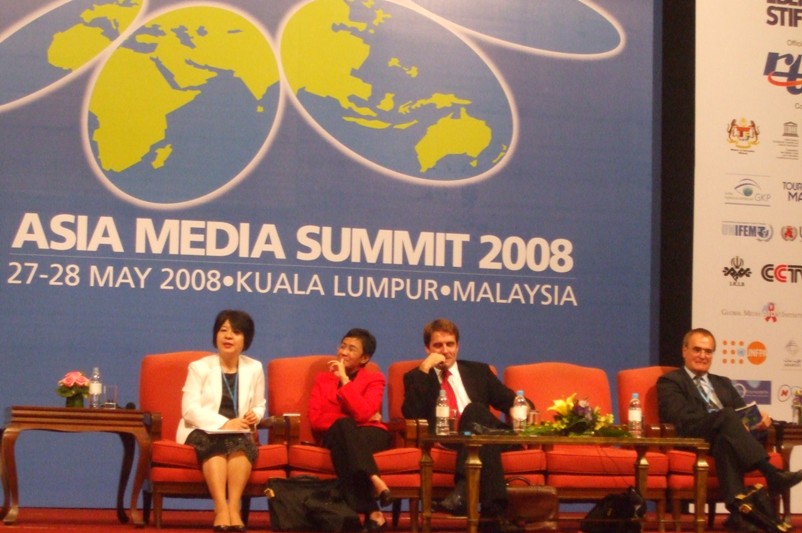
By end May, I realised that some people in the mainstream media (abbreviated MSM, and less charitably called old media or dinonaur media) are also afraid of citizen journalists. That was one insight I drew from attending Asia Media Summit 2008 in Kuala Lumpur, Malaysia (27-28 May 2008).

Asia Media Summit 2008

The two day event drew 530 broadcast CEOs, managing directors, media experts and senior representatives of development and academic institutions from more than 65 countries in Asia, Europe and the Middle East. Over eight plenary sessions and twice as many pre-summit events, they examined ‘new visions and new strategies broadcasters need to pursue to address the demands of new technologies, stiff competition, media liberalization and globalization’.

As I shared in my first impressions from the Summit, this annual event is still warming up to the new media. That’s understandable considering that most participants are those who work in MSM/OM/DM. Some, like myself, have been flirting or experimenting with new media in recent years, but even my own organisation, TVE Asia Pacific, still works largely with television broadcasters going out on terrestrial, cable or satellite platforms.

While the death of MSM/OM/DM has been greatly hyped, it’s a fact that they face more competition today than ever before. And instead of competing for eyeballs (and other sensory organs) with better content and higher levels of product customisation, some sections of MSM/OM/DM are trying to impose their own, obsolete mindset on the new media.

A session on ‘Regulations and New Media Models’ brought this into sharp focus. The session raised questions such as: Should we apply some principles from traditional media (meaning MSM) to the new media? Should we adopt some minimum rules to allow for sufficient legal space for new media businesses to find their niche in the market and evolve to fit the needs of consumers? What are the policy implications of User-Generated Content (UGC) with regard to copyright infringement, information accuracy and content quality?

The panel comprised three Europeans and one American, all working in MSM or academia (it wasn’t immediately clear if any of them blogged personally). For the most part, they said predictably nice and kind things about new media. It was interesting to see how these professionals or managers – who have had their careers entirely or mostly working in or studying about MSM – were trying to relate to a new and different sector like the new media.

But the panel’s cautious attitude about the new media went overboard on the matter of regulation. This is where matters are highly contentious and hotly debated: while most of us agree that there should be some basic regulation to ensure cyber security and to keep a check on content that is widely deemed as unacceptable – for example, hate speech – there is no consensus on what content should be regulated by whom under which guiding principles.

Ruling unanimously in Reno v. ACLU, the US Supreme Court declared the Internet to be a free speech zone in 1997, saying it deserved at least as much First Amendment protection as that afforded to books, newspapers and magazines. The government, the Court said, can no more restrict a person’s access to words or images on the Internet than it could be allowed to snatch a book out of a reader’s hands in the library, or cover over a statue of a nude in a museum.

It was during question time that the discussion took a cynical – even hostile – attitude on the new media. Some members of the audience engaged Dr Venkat Iyer, a legal academic from University of Ulster in the UK, in a narrowly focused discussion on how and where bloggers may be sued for the opinions expressed on their blogs. The issue of multiple jurisdictions came up, along with other aspects of cyber libel and how those affected by criticism made online by individual bloggers (as opposed to companies or organisations producing online content) may ‘seek justice’.

These discussions were more than academic, especially in view of worrying trends in host Malaysia and neighbouring Singapore where bloggers have been arrested or are being prosecuted in recent weeks.
Asia Media Forum: Restrictions follow critics to cyber space
IHT: Malaysian blogger jailed over article


From the floor, I remarked that I was disturbed by the tone and narrow vision of this discussion, which merely repeated new media bashing by those who failed to understand its dynamics. Acknowledging the need for restraint where decency and public safety were concerned, I argued that it is a big mistake to analyse the new media from the business models or regulatory frameworks that suit the old media.

There are mischief makers and anti-social elements using the new media just as there have always been such people using the old media. Their presence, which is statistically small, does not warrant a knee-jerk reaction to over-regulate or over-legislate all activity online, as some Summit participants were advocating. To do that would be akin to throwing the baby out with the bathwater.

I continued: “This is not a healthy attitude to adopt, especially when we look at the bigger picture. In many countries where freedom of expression and media freedom are threatened or suppressed by intolerant governments and/or other vested interests, new media platforms have become the only available opportunity for citizens to organise, protest and sustain struggles for safeguarding human rights, better governance and cleaner politics. In countries where the mainstream media outlets are either state owned or under pressure from government (or military), and where newspapers, radio and TV have already been intimidated into silence, citizen journalists are the last line of defence…”

I also noted with interest that on this panel was Mogens Schmidt, UNESCO’s Deputy Assistant Director-General for Communication and Information (in charge of freedom of expression), and said that this was not the kind of rolling back of freedoms of expression that UNESCO was publicly advocating. In a brief response immediately afterwards, Schmidt said that he fully agreed with my views, and that this was UNESCO’s position as well.

Another panel member, Dr Jacob van Kokswijk, secretary of the International Telecom User Group in the Netherlands, noted that the new media required a totally new thinking and approach where its content is concerned – the rules that have worked for the old media can’t be applied in the same manner. He added that only 3 to 4 per cent of Internet content could be considered as ‘bad’ (by whatever definition he was using), and that should not blind us to seizing the potential of new media.

Another panel member, Joaquin F Blaya, a Board member of Radio Free Asia (RFA), made a categorical statement saying he was opposed to any and all forms of censorship. He knows what that means – RFA says its mission is ‘to provide accurate and timely news and information to Asian countries whose governments prohibit access to a free press’.

By the end of the session, I was relieved to see a more balanced view on the new media emerging in our discussion, with more moderate voices taking to the floor. No, we didn’t resolve any of the tough issues of new media regulation during the 90 mins of that session, but we at least agreed that the old media mindset of command-and-control was not going to work in the new media world.

From its inception in 2003, the annual Asia Media Summit has been very slow to come to terms with this reality, but this year the event moved a bit closer to that ideal – partly because they invited leading new media activist Danny Schechter to be a speaker.

We just have to wait and see if this momentum can be sustained next year when the Summit is hosted by the Macau Special Administrative Region of China.

I’m going to keep an open mind about this — but won’t bet on it…

3 May 2008: Who’s afraid of citizen journalists? Thoughts on World Press Freedom Day

Asia Media Summit 2008: Still warming up to new media…

Asia Media Summit 2008

Last week, I tried being in two places at once: executive producing an ambitious new TV debate series in my city of anchor Colombo (Sri Lanka) and participating in Asia Media Summit 2008 (AMS 2008) taking place in the Malaysian capital of Kuala Lumpur, May 27-28.

The two cities are 2.5 hours and a few thousand kilometres apart, and I just about managed being productive on both fronts. But I don’t recommend the experience: I ended up with a massive sleep deficit that I’m still trying to shake off.

According to the summit organisers, some 530 CEOs, managing directors, media experts and senior representatives of development and academic institutions from 65 countries joined the two-day event and 16 pre- Summit workshops.

The Summit had its moments — a few ‘Aha!’ ones and quite a few others where I found myself nodding (bored out of my mind, and not in agreement with what was going on). Unlike last year, when I chaired part of a pre-Summit seminar and also served as a plenary speaker, I was merely participating this year — which gave me the chance to network, take things easy and ask more questions from the audience.

Of the five Summits held since 2004, I’ve attended four (I missed the first one). The scope, content and quality of this annual event have certainly improved in this time. But I find the Summit still very much a gathering of the movers and shakers in the mainstream media, primarily radio and TV (which dominate the Asian media landscape). Very few new media practitioners – individual bloggers like myself, as well as online audio/video publishers and operators of web portals – turn up at this event.

And the Summit discussions in the past have sometimes been decidedly cynical or dismissive of new media. When this happened in the opening plenary itself at Asia Media Summit 2007, I was so disappointed that I asked if I was actually attending the Asia ‘Mediasaurus’ Summit.

Things could only get better this year – and they did. For one thing, they had invited new media practitioners to speak of their chaotic new world (unlike last time, when we heard fossilised old media worthies pontificate fuzzily on the new media). Perhaps this was the organisers heeding our critique of last year. Or it had something to do with the rise and rise of bloggers in the host country Malaysia: the March 2008 general election there saw five active bloggers being elected to national Parliament from the opposition in the biggest political upheaval Malaysia had seen in half a century.

Asia Media Summit 2008

For this reason, we were looking forward to the Summit’s opening by Malaysian Prime Minister Abdullah Ahmad Badawi, but for the second year running, he decided to skip the event. Instead, he sent his deputy Mohd Najib Tun Abdul Razak in his place to read his speech.

As Malaysia’s pro-government New Straits Times newspaper reported the next day, he urged journalists not to be too taken in by the “bells and whistles of technology”, but to hold to established virtues of accuracy, intelligence, fairness and grit as these formed the competitive advantage of the traditional press in the “anarchic environment of the new age”.

He added: “The right to freedom of speech and expression cannot be used as a pretext or excuse to violate and abuse the reputation and dignity of a people, to slander and libel or to defame religions or religious symbols. If this were the case, there would be no laws of defamation or libel and laws against those who incite racial or ethnic violence.”

During question time, the well known American blogger and media analyst Danny Schechter had an interesting exchange with the chief guest. Danny referred to the case of Malaysian blogger Raja Petra bin Raja Kamarudin who was recently charged of sedition for having written a political blog post.

DPM Najib and Schechter had very different views on the limits of freedom of speech and how far the new media can and should be allowed to comment on current affairs, especially politics. On the wider issue of human rights, Najib took the populist line and made references to America’s detention camps in Guantanamo Bay and the CIA outsourcing torture. Danny shot back saying that only 20% of the American people now support their president and his policies (and Danny certainly wasn’t one of them). He argued that human rights should be universal. Read Danny’s take on it here, and the more official version in the New Straits Times.

With that slightly bumpy start, AMS 2008 went on to display the mainstream media’s still uneasy relationship with the new media. For sure, the Summit had sessions on user-generated content and new media business models. But for the most part, these sessions brought out the narrow perspective of mainstream media’s managers or its long-standing researchers. With notable exceptions like Danny Schechter, other speakers talked about a fast-changing, rapidly-evolving reality that they’d barely skimmed or experienced themselves.

I would belatedly write more blog posts on some of the discussions that took place in later sessions, which prompted me to intervene several times from the audience.

I just called to say….I love my mobile phone!

On this World Telecommunication and Information Society Day (May 17), I have a confession to make. I carry a murder weapon on my person every day and night, and I go to bed with it next to me within easy reach. I rely on it for my work, my leisure and my pleasure. And I won’t part with it under any circumstances.

Neither would more than 3.3 billion people worldwide — or half of humanity.

I’m talking about the humble and increasingly ubiquitous mobile phone, now the world’s most widely used and fastest spreading consumer technology item.

And if any paranoid law enforcement agency worries about its murder potential…relax, people – we are talking figuratively here!

How come it’s a murder weapon when it has no sharp edges and is too light weight to do much damage?

What the mobile has already stabbed, and is in the process of effectively finishing off, is the development sector’s over-hyped and under-delivered phenomenon called the ‘telecentre’.

For those outside the charmed development circles (which is most of humanity), the Wikipedia describes telecentre as “a public place where people can access computers, the Internet and other digital technologies that enable people to gather information, create, learn and communicate with others while they develop essential 21st century digital skills.”

So how is the mobile phone slowly killing the telecentres, into which governments, the United Nations agencies and other development organisations have pumped tens of millions of dollars of development aid money in the past decade?

Well, it’s rapidly making telecentres redundant by putting most or all of their services into literally pocket-sized units. If everyone could carry around a miniaturised, personalised gadget that has the added privacy value, why visit a community access point?

At least this is the persuasive point made by LIRNEasia researcher Helani Galpaya, who made a presentation in September 2007 at the Annenberg School for Communication in the US.

Courtesy Joy of Tech

She argued that, although telecentres, which have become the bright “stars” in many e-development programs in Asian countries, do have a role to play in providing ‘higher’-end citizen services to people at the bottom of the pyramid (BOP) in India, Sri Lanka, Pakistan, Philippines and Thailand, telephones are the cheaper, immediate and ubiquitous tool for Asian governments to inform, transact and interact with almost 400 million of their most needy citizens.

And in these emerging Asian economies, when we talk of telephones it’s predominantly mobiles. In my native Sri Lanka, for example, there were 10.7 million phone subscribers by end 2007 – of them, almost 8 million were mobile users. Mobiles outnumber fixed phones by 3 to 1, and the disparity continues to widen.

Mobile kills the telecentre star‘ was the title of Helani’s presentation – it’s a play on a 1979 song celebrating the golden era of radio, “Video killed the radio star.” For the trivia buffs, it was the first music video shown on MTV.

The song has been the subject of various parodies, and Helani’s isn’t the first or last. But in this instance, I would heartily cheer the rapid demise of the telecentre, which is both conceptually and operationally flawed in many developing countries where it has been tried out. (While at it, let me repeat something that baffles me: how is it that not a single development donor or UN agency foresaw the phenomenal rise of mobile phones in the majority world, and instead bet all their ICT money on computers and internet? And why can’t some of them still appreciate the potential of mobiles, keep harping on obsolete telecentres and other troubled initiatives like One Laptop Per Child?).

It’s also worth noting that hard core development activists were initially against mobile phones, arguing instead for more public payphones, especially in rural areas. Only very recently have they started acknowledging that, just maybe, mobile phone can create or improve jobs, generate incomes and move millions out of poverty. In the humanitarian sector, as I wrote in October 2007, aid workers are still uncertain how to make best use of mobiles in their relief work.

Why are mobile phones somehow not ‘sexy enough’ for these men and women in suits who typically look at our real world problems from 33,000 feet above the ground?

But hey, why bother with doomed concepts like telecentres, when we can instead discuss about the lively and vibrant mobiles? (When the telecentres finally die after being kept on life support by gullible aid donors for a few more years, I hope to write a suitable obituary.)

Meanwhile, who’s afraid of mobile phones except the failed prophets of development and unimaginative humanitarian workers? There’s a handful of crusty, old fashioned people, usually those who can’t figure out just how to use the new fangled devices that do a lot more than just talk. Then there are tyrannical governments who fear the power of instant communication being in the hands of their own people.

The rest of us have now adjusted to Life After the Mobile Arrived. We may love it, or love to hate it — but can we imagine life without it?

And since we’re a blog about moving images, here’s a short film that I wrote and TVE Asia Pacific produced for LIRNEasia in late 2007. It was filmed in the Philippines and Sri Lanka, and was based on
LIRNEasia’s path-breaking 2006 survey on telephone use at the bottom of the pyramid in emerging Asia. We
premiered at the 3rd Global Knowledge conference in Kuala Lumpur in December 2007.

The film’s synopsis reads:
With the next billion telecom users expected mainly from the emerging markets, we urgently need to understand telecom use, especially at the bottom of the pyramid. Who is using what devices for which purposes — and how much are they willing or able to pay? Capturing highlights of LIRNEasia’s 2006 survey in India, Pakistan, the Philippines, Sri Lanka and Thailand, this film shows that when it comes to phone use, the poor are not very different from anyone else.

Teleuse@BOP Part 1 of 2

Teleuse@BOP Part 2 of 2

And now, just when you think I’m a harmless mobile junkie, here’s my real confession:
I own more than one mobile phone (hey, doesn’t everybody?) and stashed away in my travel bag I have a collection of SIM cards with active mobile accounts in half a dozen Asian countries that I visit regularly.

One day soon, when there are enough people like myself moving across jealously guarded political borders, those ITU statistics on ICTs would become seriously skewed….

TVE Asia Pacific News: Film highlights telephone revolution in Asia’s emerging markets
Teleuse@BOP Film screened at GK3
LIRNEasia 2006 survey on telephone use at the bottom of the pyramid in emerging Asia

Who is afraid of Citizen Journalists? Thoughts on World Press Freedom Day

Today, May 3, is World Press Freedom Day. Proclaimed by the UN General Assembly in 1993, the day is celebrated each year on May 3 — the anniversary of the Declaration of Windhoek, a statement of free press principles put together by African newspaper journalists in 1991.

I’m holed up in a hotel in Singapore this whole weekend, attending the annual Board meeting of Panos South Asia, which works to promote greater public discussion and debate on development issues through the media. Our Board is drawn from Bangladesh, India, Nepal, Pakistan and Sri Lanka and includes leading journalists, publishers and social activists.

I’ve been busy preparing for and attending the intensive Board meeting that I’ve not had the time to do an original blog post on this important day. So like any resourceful journalist, I’m doing the second best thing – ‘recycling’ some material that I was recently associated with in producing.

First, here’s an extract from a chapter that I invited Sri Lankan ICT activist Sanjana Hattotuwa to write for Communicating Disasters: An Asia Pacific Resource Book that I edited last year. Sanjana traces the growing role played by digitally empowered citizens while disasters unfold as well as after disasters have struck. He then turns attention to the wider and more generic challenges faced by citizen journalists everywhere, especially in countries where democracy is under siege:

Who’s Afraid of Citizen Journalists?

But is it all good and positive? Put another way, merely because we now have access to a hundred times more content on a disaster than before does not mean that we get any closer to understanding it or responding to it.

Information overload is a real problem, as is the subjectivity of citizens, who only capture what they feel is important and often ignore aspects to a disaster beyond their own comfort zone and prejudices. There is still no widely accepted standard for citizen journalists, though organizations such as the Centre for Citizen Media are actively working towards such standards .

There are other challenges associated with citizen journalism, especially in a context of violent conflict. This author receives vicious hate mail, suffers public insults, is branded a ‘terrorist’ and even receives the occasional death threat – all because of the content he promotes on the citizen journalism websites he edits.

Not all citizens, even when they can do so and have access to digital devices, record disasters or human rights abuses – especially when their own security could be compromised for having done so. Governments can also clamp down hard on citizen journalism. The French Constitutional Council approved a law in early 2007 that criminalizes the filming or broadcasting of acts of violence by people other than professional journalists. The law could lead to the imprisonment of eyewitnesses who film acts of police violence, or operators of Web sites publishing the images. Sri Lanka unofficially banned a pro-Tamil nationalist website in 2007 and regularly cuts off mobile phone and Internet services in the North and East of the country.

Scared by the potential for embarrassment, political debacles and popular uprisings, countries such as Egypt, Iran, Cuba, North Korea and China vigorously censor and monitor content on blogs and exchanges through SMS, prompting Julien Pain, head of the Internet freedom desk at Reporters Without Borders (RSF) to note: “… all authoritarian regimes are now working to censor the Web, even countries in sub-Saharan Africa. The Ethiopian regime of Prime Minister Meles Zenawi has blocked openly critical Web sites and blogs since May 2006, and President Robert Mugabe of Zimbabwe is considering a law allowing security forces to intercept online messages without reference to the courts. One of the first moves by Thailand’s military rulers after their September (2006) coup was to censor news Web sites, even foreign ones, that criticized the takeover.”

Read Sanjana’s full chapter in Communicating Disasters book, placed online at TVEAP website

* * * * * *

When Citizens Turn on Journalists

The second extract is from my own recent essay under the above title, which was published by the Asia Media website managed by the University of California Los Angeles (UCLA). In this piece, written only a few weeks ago, I comment on a disturbing new threat to media freedom in my native Sri Lanka: misguided citizen vigilantes suspecting and attacking professional journalists engaging in their legitimate news and/or image gathering work in public places. When accredited journalists are affected by this paranoia, I point out how much more difficult it is for citizen journalists who lack the institutionalised media behind them.

Public interest blogging in Sri Lanka has been growing slowly but steadily since the Indian Ocean tsunami of December 2004, which marked a turning point for citizen journalism. According to researcher and new media activist Sanjana Hattotuwa, citizen journalists are increasingly playing a major role in meaningfully reporting deaths, the humanitarian fallout and hidden social costs of violent conflict that are often glossed over or sensationalised by the mainstream media.

Hattotuwa acknowledges, however, that the ready availability of information and communication technologies (ICTs) does not guarantee public-spirited citizen journalism.

“In Sri Lanka, the significant deterioration of democracy in 2006-2007 has resulted in a country where anxiety and fear overwhelm a sense of civic duty to bear witness to so much of what is wrong. No amount of mobile phones and PCs is going to magically erase this deep rooted fear of harm for speaking one’s mind out,” says Hattotuwa.

This makes the courage and persistence of the few citizen journalists even more remarkable. Unlike mainstream journalists, they lack official accreditation, trade unions and pressure groups to safeguard their interests. The state does not recognize bloggers as journalists; despite their growing influence online, most local news websites don’t enjoy any formal status either.

For now, the citizen journalist in Sri Lanka is very much a loner — and very vulnerable.

Read my full op ed essay on AsiaMedia website

Read my blog post for World Press Freedom Day 2007:
Press freedom in the digital age: Seeing beyond our noses and tummies

August 2007: The Road from Citizen Kane to Citizen Journalist

TVE Asia Pacific says Thank You to Sir Arthur C Clarke

In his 1992 book How the World Was One, Sir Arthur C Clarke described a dream: one day in the near future, CNN founder (and then owner) Ted Turner is offered the post of World President, but he politely turns it down – because he didn’t want to give up power!

Just three years later, the then Secretary General of the UN suggested that CNN should be the 16th member of the Security Council. Sir Arthur was fond of quoting this, and once famously told Turner: “You owe me 10 per cent of your income”.

These references – illustrating the power of globalised satellite television – are recalled in TVE Asia Pacific‘s official tribute to Sir Arthur C Clarke, who passed away on March 19 aged 90.

“With the death of Sir Arthur C Clarke, TVE Asia Pacific has lost a long-standing friend and supporter,” the tribute says.

It adds: “Since our establishment in 1996, Television for Education Asia Pacific – to use our full name – has been engaged in pursuing Sir Arthur’s vision of using the potential of moving images to inform and educate the public. Our founders chose to focus on covering development and social issues, with emphasis on the Asia Pacific region – home to half of humanity and where Sir Arthur spent the last half century of his life.”

Although he never held a formal position at TVEAP, Sir Arthur was an informal adviser and mentor to the regional media organisation whose work across Asia Pacific is only possible thanks to the comsat that invented and the web that he inspired.

By the time TVEAP was created in the mid 1990s, the satellite TV revolution was well underway in the Asia Pacific region, and the internet revolution was just taking off. In informal discussions, Sir Arthur advised us to always keep our eyes open on what’s coming up. In the ICT sector, he cautioned, being too closely wedded to one technology or system could lead to rapid obsolescence.

The tribute mentions Sir Arthur’s specific support for the Children of Tsunami media project, and the Communicating Disasters publication.

We also talk about Sir Arthur’s concerns about using information and communication technologies (ICTs) to benefit the poor and other disadvantaged groups – a process that he aptly described as ‘geek to meek’.

We end by recalling how TVEAP recorded and uploaded to YouTube Sir Arthur’s last public video address – his 90th birthday reflections in December 2007.

Read TVEAP’s tribute to Sir Arthur C Clarke, 1917-2008

sir-arthur-clarke-reflecting-on-90-orbits.jpg