Web 2.0 – The Machine is Us/ing Us!

Technology that drives the web is changing fast. Dozens of free or very low-cost interactive Web tools have emerged in recent years that enhance the ways we create and publish information and the ways we collaborate and share resources – text, images, audio and video.

This evolution of the Web is commonly known as Web 2.0. This term was first coined by the American media company O’Rieliy Media in 2003.

This blog you are reading is part of that web 2.0 evolution. So is YouTube!

Read more about web 2.0 on Wikipedia.

Here’s a cool video that I just came across on YouTube, which uses web 2.0 to show us a few things the new tools enable us to do:

My colleague Manori Wijesekera recently made a great presentation on how the development community can take advantage of web 2.0 tools in creating information products and in communicating their work to different audiences. She was speaking at TVE Asia Pacific’s regional workshop in Khao Lak, Thailand (2 – 6 July 2007), under the Saving the Planet project.

I’ll be summing up her key points in the next few days.

Arthur Clarke’s climate friendly advice: Don’t commute; communicate!

This week I’m working from home, as I nurse a cold that came from nowhere and knocked me down.

I have to take plenty of rest as my body battles the virus. So I alternate between bed and desk, keeping up with at least some of my work.

And that’s not as difficult as it once was, thanks to my home ADSL connection. (For sure, its day-time speeds make it more like ‘fraudband’ and not the broadband that it’s marketed as, but hey, at least I’m connected to the world.)

So this week I have practised a slogan that Sir Arthur C Clarke — inventor of the communications satellite and inspiration for the World Wide Web — suggested over some four decades ago: Don’t commute; communicate!

Well, that’s old hat — probably older than myself. But that assumes a new significance with the current concerns about climate change and how we may adapt our lifestyles to be more climate friendly, i.e. emit less carbon dioxide and other gases that trap the sun’s heat and warm up the planet.

sir-arthur-clarke-by-shahidul-alam.jpg

Trust Sir Arthur to make that link ahead of many others. In a short essay written for the UK’s Climate Group in 2005, included as part of a global exhibit on climate issues, he noted:

In 1973, when OPEC started to multiply oil prices, I rashly predicted: ‘The age of cheap power is over – the age of free power is still 50 years ahead.’

Three decades on, there are promising signs that we may soon get close to that ideal. There is a real possibility that the most important event of the early 21st century will be the advent of unlimited amounts of clean energy. Does it really matter whether hydrogen or nuclear fusion or another technology will finally liberate us from our current addiction to fossil fuels? Meanwhile, other technologies enable us to adjust our work and lifestyles. For example, mobile phones and the Internet have already cut down a lot of unnecessary travel – and this is only the beginning. We should revive a slogan I coined in the 1960s: ‘Don’t commute – communicate!’”

Self evident as this might seem, it’s not a point that is appreciated widely enough.

On 30 October 2006, the UK government published a 579-page report on the economics of climate change by Sir Nicholas Stern, a former chief economist at the World Bank. Despite the massive size, scope and authority of the report, the Stern Report had no reference to the role that the ICT sector could play in helping to reduce energy demand, mitigate CO2 emissions and help to save the planet.

Fortunately, others are taking note. Among them is the European Telecommunications Network Operators’ Association (ETNO), which issued a report — incidentally, in the same month as the Stern Report — titled Saving the climate @ the speed of light: ICT for CO2 reductions.

It was a joint publication with the World Wide Fund for Nature, WWF. Its introduction read: “A wider usage of ICT-based solutions can play an important role in reducing CO2 emissions. This joint WWF-ETNO road map proposes a concrete way forward for a better consideration and inclusion of ICT’s in EU and national strategies to combat climate change.

Read the full report here.

Image courtesy ETNO and WWF

And guess what, there is already a movement: ICT for carbon dioxide reduction, inevitably abbreviated as ICT4CO2R!

Read Sir Arthur Clarke’s full essay: Hydrocarbon Anonymous

Sir Arthur Clarke photo by Shahidul Alam, taken in January 2007

PS: I must admit that my carbon emission savings by working from home are pretty modest. I live about a kilometre from my office, so my personal commuting to and from work does not entail much of fossil fuel burning. On a good day, I can walk to work…

All Online Data Lost after Internet Crash…

This report has just come in, from my favourite news source, Onion News Network….enjoy!

I wonder what I would do if all my blog posts were suddenly lost….irrevocably? Agh — perish the thought!

And this reliable news report confirms something I’ve suspected all along — when it comes to e-commerce, Nigeria’s is the southern economy that is best developed: I receive evidence of that in my email practically everyday…

UNESCO playing spoil-sport in new Seven Wonders

UNESCO is playing spoil-sport again…this time about the new Seven Wonders of the world.

The crusty, officious UN agency — not my favourite, as regular readers know — is sadly trapped in its own ideological rhetoric of the 1980s. Somebody should kick them hard to enter the 21st century!

The new Seven Wonders of the World is an attempt to create a modern-day alternative to historical lists of the Seven Wonders of the World. Based on a worldwide online poll organised by the private, Swiss-based, non-profit New Open World Corporation (NOWC), the final list was announced on 7 July 2007 in Lisbon, Portugal.

The winners were selected from among dozens of initial nominations. The new Seven Wonders of the world are: The Great Wall of China; Petra of Jordan; Christ the Redeemer statue in Rio de Janeiro, Brazil; Machu Piccu ruins of Peru; Chichen Itza archaeological site in Mexico; The Colosseum of Rome, Italy; and the Taj Mahal of India.

Read more in the NOWC description or Wikipedia description

Image from n7w image courtesy n7w image from n7wimage from n7w

This campaign was launched in 2000 as a private initiative by the Swiss philanthropist, adventurer and film-maker Bernard Weber – his idea was to encourage citizens around the world to select seven new wonders of the world by popular vote.

And he turned to the Internet as a mass medium for people to express their preferences.

This is what seems to have irked UNESCO the most — allowing ordinary people to have their say about the common heritage of humankind.

After the new Seven Wonders were announced on 7 July 2007, two UNESCO spokespersons ridiculed the whole idea. Their contempt for the (rival?) process was palpable. This is not how any media spokespersons should behave. Read a widely reproduced media report: UNESCO slams new seven wonders

Earlier, in an official statement full of pomposity and self-importance, UNESCO had distanced itself from the initiative (even if the former UNESCO director general, Frederico Mayor of Spain, is heading the expert panel advising the new Seven Wonders selection process). Here’s an extract:
“There is no comparison between Mr Weber’s mediatised campaign and the scientific and educational work resulting from the inscription of sites on UNESCO’s World Heritage List. The list of the ‘7 New Wonders of the World’ will be the result of a private undertaking, reflecting only the opinions of those with access to the internet and not the entire world. This initiative cannot, in any significant and sustainable manner, contribute to the preservation of sites elected by this public.”

Note the word ‘mediatised’ — which I suppose means media-based and web-driven. This piques me the most. What is wrong in using the mass media, including the web, to generate new levels of interest and enthusiasm about cultural heritage, as the New Seven Wonders initiative has succeeded in doing.

Ironically, UNESCO has an entire division on Communication and Information, which says it promotes the use of media in socio-cultural development. They claim to work with both the conventional media (TV, radio, print) as well as the new media (web, mobile devices and other ICTs).

Is it that UNESCO is such a multi-headed, mixed-up creature that its World Heritage division can publicly condemn the use of media in the public interest while another division upholds it?

Or, could it be that when UNESCO talks about media in development and democracy, it expects the poor, suffering people in the Majority World to just stick to the issues of bread and butter, livestock and water? Does UNESCO expect the ordinary people and private citizens to stay away from the lofty issues of cultural heritage? Are those only discussed by diplomats and experts, many of them as crusty and officious as UNESCO itself?

And can somebody please explain to me how a process involving 100 million online votes is less valid than the ‘scientific and educational work’ of UNESCO in selecting World Heritage sites — involving no more than a few hundred persons at the most (all government officials and academics)?

image from n7w image from n7w image from n7w

The grand old lady of Paris should realise that she can’t have it both ways. If UNESCO sincerely advocates the free flow of information, media freedom and the promotion of ICTs in development, then it must be prepared for the resulting public engagement of issues in the media — ranging from the frivolous to lofty, and everything in between. It cannot and must not set the agenda, or expect certain issues to be left aside to boffins who claim to know more than the rest of us.

Whether UNESCO likes or not, the web has truly let the genie out of the bottle. Gone — hopefully forever, and not a moment too soon! — are the days when a handful of men in suits (it’s usually graying men, with very few women involved) could decide matters of global public interest behind closed doors.

By its aloofness, UNESCO made itself irrelevant in the seven wonders selection process. The smarter option would have been to stay engaged and use the massive popular interest to draw attention to the need to invest more time, effort and resources to conserve cultural heritage everywhere. A great opportunity was missed.

But thankfully, other arms of the UN were a bit more pragmatic. For example, the United Nations Office for Partnerships recognised the value of new Seven Wonders.

The stark choice for UNESCO is to rethink its intellectual arrogance, or risk being sidelined — and seen as the biggest hypocrite in the entire UN family.

At a minimum, UNESCO must heed the timeless advice of Rabindranath Tagore:
If you can lead, lead.
If you cannot, then follow.
If you cannot lead or follow, get out of the way!


Now, nominate your natural Seven Wonders of the world — new online poll now underway! Never mind what UNESCO has to say about it!

Who makes the best ‘Alphabet Soup’ of all?

Image courtesy Wikipedia

Take a close look. This is the original Alphabet Soup.

It’s is a kind of soup containing noodles shaped like the letters of the Latin alphabet. According to the ever-helpful Wikipedia, it comes as a prepared, canned vegetable soup with letter-shaped noodles. Read full Wikipedia entry

Metaphorically, alphabet soup means “an abundance of abbreviations or acronyms”. In this sense, the term goes back at least as far as President Franklin D. Roosevelt’s alphabet agencies of the New Deal (1933-38). In the United States, the Federal Government is described as an ‘alphabet soup’ on account of the multitude of agencies that it has spawned, including the NSA, CIA, FBI, USSS, BATF, DEA and INS.

But Uncle Sam’s expertise in making alphabet soups has been challenged by another entity – the United Nations. (Interestingly, Roosevelt was an architect of the UN, and coined the term with Winston Churchill). The UN’s propensity for enriching the alphabet soup has few parallels.

In the early 1990s, when I was earning a living as a UN consultant in Asia, I had to wade through the sea of acronyms and abbreviations as part of my daily bread. Funnily enough, some high-level peddlers of arconyms no longer even remembered what they stood for!

The UN has enriched the alphabet soup even more in the years since. MDG is a current favourite – it stands for Millennium Development Goals, a blue print for achieving basic socio-economic development by 2015.

It’s not just the UN, but the entire development community that is in love with coining abbreviations and then liberally bandying them about. Some are manageable. Others are unpronounceable tongue-twisters. PLWHA comes to mind – that stands for Persons Living with HIV/AIDS.

And then there are too many meanings or expansions for the same abbreviation, causing confusion to those who don’t know the context. ICT is a good example. We in media and development circles use it to mean Information and Communications Technologies. But the Wikipedia shows at least another two dozen meanings for the same three letter combination!

Journalism taught me to explain every technical term and abbreviation when introducing it. I still do, but on the whole I avoid abbreviations if we can help it.

But I have to watch out. A colleague reminded me recently that I’ve been happily coining inhouse acronyms myself. Examples:
GBR – The Greenbelt Reports (Asian TV series)
STP – Saving the Planet (Asian regional project and upcoming TV series)
D4C – Digits4Change (Asian TV series)

Does this make me a minor chef in expanding the Alphabet Soup?

Maybe it does! If I can’t beat ’em, I’ll join ’em….

Joey R B Lozano: The legacy continues…at Silverdocs

I met Joey R B Lozano only once, but he left a deep impression.

A small-made man with passionate zeal and tons of energy, he was every inch an activist-journalist-campaigner. We had invited him to a regional workshop of factual video producing and distributing partners from across Asia that we held in Singapore in November 2002.

We hadn’t worked with Joey earlier. He came recommended by our international partner Witness, which uses video-based advocacy and activism for promoting and safeguarding human rights worldwide.

Joey R B Lozano Joey R B Lozano Joey R B Lozano

Joey used his personal video camera to assert indigenous land rights, and to investigate corruption and environmental degradation in his native Philippines. Joey was an independent human rights activist and also one of the country’s leading investigative reporters.

He freelanced for the Philippine Daily Inquirer, covering Indigenous peoples’ rights and the environment, considered the two most dangerous beats in the Philippines. But years earlier, he had moved out of the capital Manila, and committed his life and career to stories and issues at the grassroots that many of his city-based colleagues had no time or patience in covering on an on-going basis.

Trained as a print journalist, Joey mastered new media and technologies whose potential he quickly realised. He moved into television and video media with ease, and later became an active blogger.

Joey’s TV investigations began in 1986, when he helped ABC’s 20/20 to uncover the “Tasaday hoax”, a highly successful fraud to pass off local tribespeople as a newly discovered Stone Age culture.

He soon embarked on his own investigations and started digging into illegal logging, gold mining and land-grabbing. In turn, his exposes quickly earned him repeated assassination and abduction attempts, in a country that is one of the more dangerous places to practice journalism.

When he came to Singapore, Joey had recently ‘starred’ in a major Canadian documentary titled Seeing is Believing: Human Rights, Handicams and The News, which looked at how committed, passionate individuals were using new communication technologies to change the world.

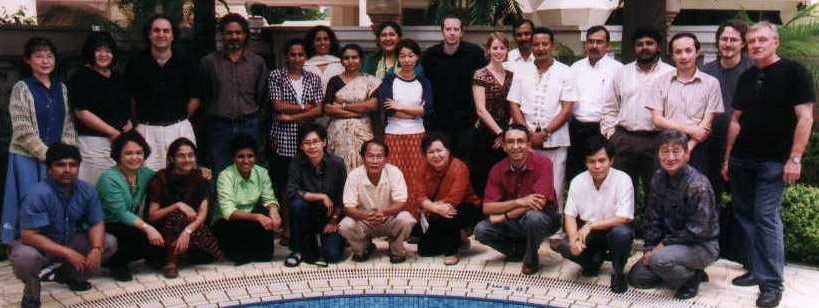
participants-at-tveap-partner-workshop-singapore-nov-2002.jpg

Photo of Singapore TVEAP workshop participants: Joey Lozano is 6th from left on the frontmost row

Follow Seeing is Believing storyboard on the film’s website

We screened the film, made by Katerina Cizek and Peter Wintonick, and heard first hand from Joey on what his struggles entailed. The film followed Joey as he delivers a new “Witness” donated video camera to Nakamata, a coalition of Indigenous groups in Central Bukidnon. Together, Nakamata and Joey begin documenting a dangerous land claims struggle, and it doesn’t take long for tragedy to unfold in front of the camera.

Watching the film and then listening to Joey — and his Witness colleague Sam Gregory — describe the on-going struggle, was one highlight of our week-long workshop. Some of us saw in Joey the activist-campaigner that we wanted to be, but were too scared or too polite to really become.

Not everyone shared that view. The cynicism — sometimes bordering on disdain — of a fellow Filipino from Metro Manila was palpable. No wonder Joey moved away from the city.

We at TVE Asia Pacific were extremely keen to distribute Seeing is Believing, for it held such a powerful and relevant message for our region, but it was not to be. Our enquiries showed that like most documentaries, it was tied up in too many copyrights restrictions and commercial distribution deals.

Following the Singapore workshop, I did keep a watchful eye on what Joey Lozano was up to. The film’s website provided occasional updates, and sometimes blog posts from Joey himself.

Our paths never crossed again. Almost three years after our single encounter came the news that Joey had passed away. It wasn’t the assorted goons who hated his guts that finally got him. His own body turned against him.

His tribute on the film’s website started as follows:

Joey Lozano defied the odds. For three decades, he survived dangerous missions to defend human rights using his video camera, in the Philippines, a country that ranks high, year after year, for most journalists killed. Joey went into hiding numerous times, and he dodged two assassination attempts. Once, bullets whizzed past his ear as he made his escape on motorbike.
But Joey couldn’t beat the odds of cancer. He died in his sleep on September 16, 2005 – at home and surrounded by his family.

Joey R B Lozano - image courtesy Seeing is Believing

The spirit and legacy of Joey R B Lozano live on. He inspired a large number of journalists and activists to stand up for what is right and just — and to be smart about it in using modern information and communication technologies, or ICTs.

Joey and other Witness activists were pioneers in different parts of the world who turned handicams away from weddings and birthday parties to capture less cheerful sights and sounds the world must see — and then act on. They were at it years before mobile phone cameras, YouTube and user-generated content in the mainstream media.

And now, Witness has established an award at the Silverdocs film festival. The WITNESS Award in Memory of Joey R.B. Lozano will be awarded to the qualifying SILVERDOCS filmmaker of a feature-length film who has produced a well-crafted and compelling documentary about a human rights violation or social justice issue. The winning filmmaker will also have a thoughtful, creative, and feasible outreach plan to use their film as a tool to raise awareness of the human rights or social justice issue explored in the film with a goal to bring about change.

The inaugural award was announced on June 17 — and has been won by “The Devil Came on Horseback” by Annie Sundberg and Ricki Stern.

Joey was a Witness partner and board member. He co-produced many films and collaborated on others that helped raise awareness about threats to indigenous people’s rights in the Philippines from corporations, and the complicity of the government in the abuses. Witness was founded in 1991 by musician peter Gabriel and the Lawyer’s Committee for Human Rights to put new technologies into the hands of local activists around the world.

Joey R B Lozano with his handycam

Read International Wildlife May 1999: Why Joey Lozano Is A Marked Man – investigative reporter works for the environment

Read about and watch Rule of the Gun in Sugarland

Community Broadcasting: A way forward in Asia

In an earlier post, I wrote about what I presented to the workshop on community broadcasting and ICTs during Asia Media Summit 2007 in Kuala Lumpur, Malaysia, last week.

The workshop on ‘Connecting Communities through Community Broadcasting and ICTs’ gave us a chance to clarify key issues and concerns, and to agree on a common understanding for future action.

On behalf of our workshop, dynamic young Manisha Aryal, broadcast activist from Nepal who currently works for InterNews in Pakistan, presented our recommendations to the Summit plenary.

manisha-aryal-at-asia-media-summit-2007.jpg

Here, for the record, are the recommendations. I don’t hold my breath on this, but it’s good to synthesize a long and hard day’s work — over nine hours of talking! — into a few short paras.

Connecting Communities Though Community Radios and ICT

Recognizing the importance of community media in economic, political and social development, in promoting good governance practices, and in empowering marginalized groups and communities in participating fully in society in urban, rural as well as remote areas; and

Understanding the importance of encouraging community media initiatives that are owned and managed by communities and with material produced predominantly by, for and about communities,

We, the participants at the workshop on Connecting Communities through Community Radios and ICTs at Asia Media Summit 2007:
• Advocate for the recognition of community radio and other community media as a distinct tier of legislation and regulation, alongside public service and commercial broadcasting, thus, contributing to the promotion of “air diversity”
• Advocate for the recognition of community media practitioners as valuable, professionally competent resources who can be involved in both peer training and training of other media professionals
• Organize awareness building and sensitization programs on community radio and other ICTs’ potential in development for legislators and community broadcasters
• Invite community media practitioners and include the topic of community broadcasting prominently in regional and global meetings (for example: a plenary session on community media at AMS 2008, World Electronic Media Forum later this year, etc.)
• Organize training and mentoring sessions for Community Broadcasting practitioners with special recognition of the role of younger generations on how community radio can capitalize on the development in the ICT sector, on new ways of addressing financial and organizational sustainability, etc.
• Include Community Media practitioners in the documentation and sharing of local and indigenous knowledge, as well as other discussions on global themes (for example the discussions on GM, MDGs, etc.)
• Look for ways to ground community media initiatives to initiatives in other sectors (health, agriculture, education, etc.)
• Facilitate partnerships between efforts to promote community broadcasting and efforts to promote newer ICTs among communities such as Community Multimedia Centers, etc.
• Recognize community broadcasting stations as an effective entry point to take ICTs to the grassroots both in rural as well as urban settings.
• Document and disseminate best-practices and learnings in community broadcasting

Photo courtesy Manori Wijesekera, TVEAP

Communities are not what they used to be…so let’s get real!

I like busting myths when I see them. That’s probably the result of my training as a journalist to be evidence-based, open-minded and always ask probing questions.

This makes me popular in some circles and very unwelcome in others!

I took a few shots at persistent development myths while speaking last week to a group of Asian broadcasters gathered in Kuala Lumpur, Malaysia, for a workshop on ‘Connecting Communities through Community Broadcasting and ICTs’ in the run-up to Asia Media Summit 2007.

I was speaking during a session on ‘ICTs – Bringing Added Value to Community Radio’. ICT stands for information and communication technologies.

The first myth I exposed was what I call the development community’s ‘rural romance’ — almost exclusive obsession with the rural poor to the exclusion of similar, or even more compelling, needs of the urban poor. I have already devoted an entire blog post to this topic, so won’t repeat it here.

The next myth I tackled was the popular notion of ‘communities’.

I told my audience of researchers, activists and broadcasters: Communities are not just rural and unspoilt as some of you might imagine.

Here’s the relevant excerpt from my remarks:

What does ‘community’ meant to many card-carrying members of the development community? For starters:
• To begin with, people must be remote and rural, and in a geographically confined location.
• They are invariably poor, under-developed and living on the edges of survival.
• If they also have unique cultural artefacts or performances, that would offer convenient photographic or videographic opportunities to the development workers travelling from the city bearing gifts.

You get the idea. Now I ask you to get real.

Yes, such idyllic, hapless and romanticised communities probably exist in some endangered form in a few locations. But in most parts of the Real World (at least in Asia), communities -– both urban and rural -– are undergoing rapid transformation:
• People are on the move in search of jobs and opportunities.
• Technologies are on the move — especially mobile phones that no development agency put their money on!
• People are discerning and demanding, not blissfully ignorant or willing to settle for any offering from the outside!

These may seriously shatter some of your visions of an idyllic and ideal community, but these are essentially positive changes.

And communities no longer need to be defined merely by geographic proximity.

Newer ICTs now allow individuals scattered over larger areas to be connected via the airwaves or the web. This enables the creation and sustaining of:
• communities of practice;
• communities of shared interest/need;
• single issue agitation such as rallying around for constitutional reform, or repeal of an unfriendly law; and
• clamouring for political or democratic reforms.

So please move away from your narrow understanding of communities. Members of any of the above kinds of communities can benefit from community broadcasting.

I added that broadcasting itself isn’t what it used to be. The days of centrally manufactured content being imposed upon a hapless audience are now over.

Interactivity and user-generated content are IN.

Pompous, know-all anchors and presenters are OUT.

My plea to all my colleagues was: Things have moved on in the media world. So must we!

Read full text of my remarks to the workshop (cleaned up after delivery)
ams-2007-connecting-people-via-icts-ng-remarks.pdf

Read my op ed on Media: Step-child of WSIS? published by OneWorld in Nov 2003

The ‘Rural Romance’ lives on in the ICT Age: Urban poor need not apply

Poor rice farmers running up laptops in paddy fields.

Fishermen navigating their ramshackle vessels using satellite-guided global positioning systems (GPS).

A wide-eyed girl child seated in front of a computer screen, looking completely awe-struck.

A saffron-robed Buddhist monk gleefully chatting away on a mobile phone.

Do these images sound a bit familiar to you? That’s because you keep seeing them on magazine covers, posters and various other items produced and distributed to show how modern-day communication gadgets are making a difference in the majority world.

The majority world is where a majority of people live in poverty or hover close to it.

Some influential members of the development community – which includes aid giving nations, UN agencies, researchers and assorted charities working on humanitarian and development issues – now try to fix poverty with gadgets. Or, to use the proper term, unleash information and communication technologies (ICTs) to help combat poverty.

Photo courtesy SciAm Image courtesy Panos Image courtesy Panos

ICT is a basket term that includes the well established services like radio, television and fixed phones as well as newer technologies such as computers, Internet and mobile phones.

Can ICTs help developing countries overcome the current income, social and other disparities? In an editorial written for the Global Knowledge Partnership (GKP) three years ago, I answered this question as a conditional ‘yes’ — with the caution that ICTs are not a panacea that can fix deep-rooted ills.

Read my full essay in GKP Partners Newsletter (My essay is the last one, so keep scrolling down, down, down.)

I said:
ICTs cannot turn bad development into good development; they can only make good development, better. However, when used strategically and as part of a wider development process, ICTs can offer substantial value addition.

But that presumes there is a rigorous assessment of the needs and rational investment of the limited resources. What happens when experts and activists act on their perceptions and prejudices, and not on evidence?

The development community’s obsession with everything rural is one key factor creating such distortions. Sharad Shankardass, Spokesperson for the United Nations Human Settlements Programme (UN-HABITAT), once described this as the development community’s ‘rural romance’.

In 2003 – 2004, Sharad joined us at TVE Asia Pacific in running two regional workshops for training Asian TV journalists in covering sustainability related issues. As the UN agency that chronicles humanity’s urbanization, his agency has all the facts and figures to draw evidence-based conclusions.

The amiable and articulate Sharad summed it up well: more than half the world’s population – including significant numbers of its poor – now live in cities or semi-urban areas. Yet, most members of the development community continue to think of poverty and under-development as an exclusively rural phenomenon.

In other words, they are hooked on a romanticised notion of the rural poor and cannot see (or choose to ignore) a more multi-faceted reality.

Image courtesy UN HABITAT Image courtesy TVE Asia Pacific

Here’s the blurb for State of the World’s Cities 2006/2007 report, published by UN-HABITAT:
“It is generally assumed that urban populations are healthier, more literate and more prosperous than rural populations. However, UN-HABITAT’s State of the World’s Cities Report 2006/7 has broken new ground by showing that the urban poor suffer from an urban penalty: Slum dwellers in developing countries are as badly off if not worse off than their rural relatives.”

Read State of the World’s Cities 2006/2007 online, as pdf chapters

This kind of evidence is being ignored by researchers, activists and UN officials who have fallen (or sleep-walked) into a ‘rural romance trap’. To them, the unmet needs of millions of urban poor are not a concern, or at least not a priority.

In their strange logic, it’s not just a low income level and deprivation of basic human amenities that qualify someone for support under various poverty reduction efforts. That person must also live in an idyllic village, away from major signs of civilization, and preferably in a mud hut surrounded by starving children and emaciated cattle.

That’s picture perfect poverty for you. Urban poor, living in the shadow of highrise buildings and skytrains, rather spoil this pristine image!

Last week while visiting Kuala Lumpur, Malaysia, for Asia Media Summit 2007, I had two separate encounters related to this rural romance.

First was a pre-summit workshop on Connecting Communities through Community Broadcasting and ICTs that brought together some 25 – 30 participants, mostly activists and researchers. In my remarks to the workshop (where I spoke and chaired a session), I urged everyone not to romanticize either communities or broadcasting.

“Communities in need are no longer rural and idyllic as some of you might imagine,” I cautioned. “And broadcasting isn’t what it used to be either. Things have moved on. So must we.”

During question time, a communications advisor from UNESCO New Delhi took me to task for saying this. “We are working with 45 years of solid experience behind us,” she reminded me and everyone else. “You can’t just dismiss this body of work.”

She seemed affected by my questioning the strong or exclusive focus that community radio promoters have on rural areas and rural poor in particular.

I didn’t want to split hairs on this when bigger issues were at stake. I just said that what had worked in the first century of radio will not work in that same form in the medium’s second century that we have now entered. New thinking based on a century’s experience was needed.

Why are organizations like UNESCO so resistant to change and new thinking? Why do they go around spreading development myths that actually do more harm than good?

Read my 2004 essay that exposes the UNESCO-sponsored myth of ‘community radio’ in my native Sri Lanka

And they are not alone. Other UN agencies and development practitioners still plan and deliver development aid and support based on a reality that prevailed in the 1980s or earlier.

My Malaysian friend Chong Sheau Ching, whom I met last week after two years, told me a recent experience that corroborates it.

Chong Sheau Ching, photo courtesy IDRC e-homemakers

Sheau Ching is a remarkable woman. She combines many roles – social entrepreneur, columnist and single mom among them. She is a leading voice in Southeast Asia for using modern ICTs to help women – especially single moms — to find work that they can do from home yet earn decent incomes.

She is founder and head of e-homemakers, a non-profit organisation that networks over 13,000 Malaysian women who are home workers, home-based entrepreneurs and home-makers. These women live and work in cities or towns, and now take advantage of Malaysia’s well-developed telecommunications infrastructure.

Sheau Ching was an invited speaker at Asia Telecentre Forum held in the Malaysian capital on 6 – 8 February 2007. In her presentation, she had spoken about the ICT needs and uses of urban women, including the poor women living in cities. She had questioned why the tele-centre movement was focusing almost entirely on rural areas.

Guess what? The organisers didn’t like such outspokenness at all – she had been reprimanded in public during the rest of the session as well as ‘scolded’ in private after it ended. So much for plurality of views!

Sheau Ching is full of such stories, even if some of them make us feel outraged at the stupidity of people or institutions involved.

Here’s another one, recounting an experience at the World Summit on the Information Society in Tunis, Tunisia in November 2005:

At WSIS Tunis, I gave a short presentation to a small group of bankers from developing countries on using low cost ICT4D innovations for urban poor women to generate income. One politely said to me as he handed out dinner invitations, “We are interested in big projects for youth and the rural people.” I was the only woman in the group, the only one from the civil society, and needless to say, the only one who was not invited to the fancy dinner in a five-star hotel in North Tunis.
Read her full essay, Unsexy and voiceless!!

Next time when UN agencies and other bleeding-heart do-gooders turn on their rhetoric about busting poverty, ask a simple question: Are they fighting poverty no matter where it exists, or is it only poverty in rural, idyllic settings where they like to visit and take photographs?

Like those images I mentioned at the beginning.

Read IDRC profile on Chong Sheau Ching

Promote AirDiversity, Asian broadcasters urged

Protect and promote AirDiversity!

Just like bio-diversity and cultural diversity, we need to value and support diversity on the airwaves. Not just government or corporate voices, but the fullest range of citizen and community voices must also be included in that diversity.

That was my call to a group of Asian broadcasters gathered in Kuala Lumpur, Malaysia, for a workshop on ‘Connecting Communities through Community Broadcasting and ICTs’ in the run-up to Asia Media Summit that opens on May 29.

I was speaking during the second session on ‘ICTs – Bringing Added Value to Community Radio’. ICT stands for information and communication technologies. As I reminded my fellow participants, radio broadcasting itself is very much an ICT – it is a more established form of ICT along with the telephone and television. Newer ICTs include computers, Internet, mobile phones and other hand-held data processing devices such as i-pods and PDAs.

For more details, see these blog posts:

The ‘rural romance’ lives on in the ICT age: Urban poor need not apply

Communities are not what they used to be…so let’s get real!

By the way, I think I have just made up that term – AirDiversity. I asked Google, which can’t track down any previous use…

Read post-delivery text of my remarks to the workshop:
ams-2007-connecting-people-via-icts-ng-remarks.pdf