Sri Lanka 2048: Business As Unusual

Sri Lanka 2048 - Nalaka Gunawardene moderating

When our Sri Lanka 2048 TV debate series started a few weeks ago, I had no idea that I’d be hosting some programmes. But through an interesting turn of events, I’ve ended up doing just that.

The series, which TVE Asia Pacific is co-producing with IUCN and MTV Channel (Pvt) Limited — Sri Lanka’s ratings leading TV broadcaster — has been going out once every week from 22 May 2008. As I wrote at the time the series started, most programmes (8 out of 10) were hosted by Sirasa TV’s versatile and dynamic presenter Kingsly Rathnayaka.

Our plan was to do two shows in English, exploring the topics living with climate change and the nexus between business and the environment. We were still searching for a presenter for these two even as we produced and aired the Sinhala programmes.

In the end, the channel management as well as our production team all suggested for me to take it on. I’ve been hosting quiz shows on TV since 1990, and have been a regular ‘TV pundit’ on a broad range of development, science and technology issues for at least a decade. I’ve also been doing a fair amount of moderating sessions and panels at international conferences. Hosting Sri Lanka 2048 challenged me to combine all these skills — and to be informed, interested and curious about our topics under discussion.

I enjoyed being the ‘skeptical inquirer’, a role I’ve had fun playing for long years as a development journalist. Our viewers can judge how well I fared. My aim was to keep the panel and audience focused, engaged and moving ahead. My style is slower and more reflective than Kingsly’s fast-paced, chatty one. Direct comparisons would be unfair and unrealistic since we are very different personalities.

But I’m enormously grateful to the younger, more experienced Kingsly for his advice and guidance in preparing for my new role. The TV camera is ruthless in capturing and sometimes magnifying even minor idiosyncrasies in presenters. It has as much to do with style as with substance. Hope I made the grade…

Sri Lanka 2048 series branding

Here’s the promotional blurb for this weekend’s show, titled Business As Unusual (yes, I borrowed the apt title from our sorely missed inspiration Anita Roddick). It was broadcast on Channel One MTV, the English language channel of Sri Lanka’s Maharaja broadcasting group.

Sri Lanka 2048 looks at Business As Unusual: How can companies do well while doing good?

The private sector is acknowledged as the engine of our economic growth. But how long can this ‘engine’ keep running without addressing its many impacts on society and the natural environment? With public concerns rising everywhere for a cleaner and safer environment, how best can businesses respond to the environmental challenges — and find new opportunities to grow and innovate?

These and related questions will be raised in this week’s Sri Lanka 2048, the series of TV debates exploring Sri Lanka’s prospects for a sustainable future in the Twenty First Century. The one-hour debate, this time in English, will be shown on Channel One MTV from 8 to 9 pm on Saturday, 19 July 2008.

Titled Business As Unusual, this week’s debate brings together concerned Sri Lankans from academic, corporate, civil society and government backgrounds to discuss what choices, decisions and tradeoffs need to be made for businesses to become environmentally responsible — and still remain profitable. Increasingly, there are examples of smart companies achieving this balance.

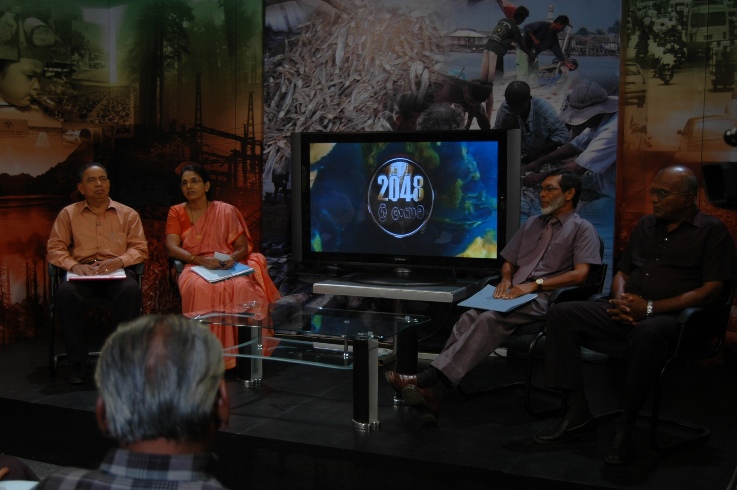
This week’s panel comprises (seated left to right in the photo below): Professor Sarath W Kotagama, Professor of Environment Science, University of Colombo; Renton de Alwis, Chairman, Sri Lanka Tourism Development Authority; Dilhan C Fernando, Marketing Director, MJF Group; and Jeevani Siriwardena, Director – Product Management, Sri Lanka Export Development Board.

Sri Lanka 2048 panel on business and environment broadcast on 19 July 2008

The wide ranging discussion — looking at both domestic and international markets, and covering a range of industries — notes that many companies already address not just financial but also social and environmental bottomlines. Adopting cleaner production practices have helped increase profits through being thrifty with resources and careful with waste.

The debate also looks at the findings of a survey that IUCN and the Ceylon Chamber of Commerce carried out last year of 45 companies on their corporate social responsibility (CSR) policies and practices. It revealed that a significant number of companies are actively applying CSR principles, with slightly over half (53%) already having environmental components in their CSR (known as CSER). The survey also found that local companies were stronger on CSR/CSER than the local operations of multinational companies.

As some panelists and audience members argue, embracing sound environmental practices goes well beyond CSR. With rising consumer awareness and greater scrutiny of how companies source materials and energy, ‘going green’ has become an integral part of responsible corporate citizens.

Sri Lanka 2048 debates are co-produced by TVE Asia Pacific, an educational media foundation, and IUCN, the International Union for Conservation of Nature, in partnership with MTV Channel (Private) Limited. This editorially independent TV series is supported under the Raising Environmental Consciousness in Society (RECS) project, sponsored by the Government of the Netherlands.

Sri Lanka 2048 - Nalaka briefing audience just before recording starts...

Wherever you are, Anita, I hope you were watching our show tonight — and hopefully nodding… When you insisted that businesses must care for community and the environment, you were so ahead of the pack. We’re still struggling to catch up.

Nalaka with panelist Jeevani Siriwardena
On the set of Sri Lanka 2048: Nalaka with panelist Jeevani Siriwardena

Photos by Amal Samaraweera, TVE Asia Pacific

Celebrating Nelson Mandela…and South Africa’s television revolution

Nelson Mandela

Nelson Mandela‘s long walk to freedom is an epic story of our times, one that continues to inspire millions everywhere who are deprived of that freedom by state tyranny or economic hardships.

As Mandela turns 90 years today, we join people all over the world to celebrate his life and reiterate his message.

Send your greetings to Nelson Mandela on his birthday!

And as Mandela himself reminded us in London during the June 2008 mega musical concert to celebrate his 90th birthday: “Even as we celebrate, let us remind ourselves that our work is far from complete. Where there is poverty and sickness, including AIDS, where human beings are being oppressed , there is more work to be done. Our work is for freedom for all.

American film-maker, social activist and blogger Danny Schechter — who filmed Mandela’s struggle to end apartheid and restore democracy in South Africa — has just remarked: He (Mandela) is one of those leaders who not only helped free his own country and people but became an icon and symbol for freedom in the world. At a time when darkness seems to be descending again, with the economy on the edge amidst protracted wars and pervasive abuses of powers, he is the one person that people the world over look to as a symbol of that saying that ‘another world is possible.’ He is not perfect – who is? He has taken great risks, and made his share of mistakes, but the love and adoration he inspires speaks to how special he is – even as he sees himself as part of a collective, a movement…

The Mandela story has been told many times by many film-makers, writers and journalists. Few other leaders have engaged the media’s attention and popular imagination — both in and out of office — as Mandela has, and with reason.

This is how the BBC in the UK reported the release of Nelson Mandela, by then the world’s most celebrated prisoner, on 11 February 1990.

I find it interesting to go back and watch TV coverage of important events as they unfolded. They say journalists write the first draft of history — that’s done on the run, without the benefit of hindsight or chance to reflect for too long.

In that sense, this BBC television reportage did reasonably well to capture the historic moment of Mandela’s release — the reporter and presenter couldn’t have known what lay ahead for South Africa.

In the report, available on YouTube, there’s a reference to South African television giving live coverage for Mandela’s release. That would have been perfectly logical from a ‘breaking news’ point of view — but there is something very significant and symbolic about that.

During the 1950s and 1960s, South Africa was the only wealthy country in the world that did not have a national television broadcasting service. In fact, despite being the most economically advanced country on the continent, South Africa was among the last in Africa to introduce television broadcasting. The main reason: television was viewed as potentially undermining the apartheid government’s ideology. The white minority regime saw it as a threat to its control of the broadcasting media, even though the state-controlled South African Broadcasting Corporation (SABC) had a virtual monopoly on radio broadcasting.

The minister of broadcasting, Albert Hertzog, simply refused to permit television. He said that TV would come to South Africa “over my dead body”. He denounced it as “a miniature bioscope [cinema] over which parents would have no control.” He also argued that “South Africa would have to import films showing race mixing; and advertising would make (non-white) Africans dissatisfied with their lot.”

Many white South Africans, including Afrikaners, didn’t share Hertzog’s views, and regarded the hostility towards what he called “the little black box” as absurd. When Neil Armstrong became the first man to walk on the moon in 1969, South Africa was one of the few countries unable to watch the event live, prompting one newspaper to remark that “The moon film has proved to be the last straw… The situation is becoming a source of embarrassment for the country.”

But Hertzog was adamant. A few months later, in an interview with The Cape Times on 1 Dec 1969, he admitted: “If, at the present time, you introduce television, you will pay for it with the end of the white man…”

That was an extremely perceptive remark. From the white minority regime’s point of view, the minister was right: if the pen is mightier than the sword, the camera can be mightier than both.

No wonder that most governments, whether liberal or otherwise, try to control – or manipulate – what appears on television, especially domestic transmissions that a majority of their people regularly watch. The power of the idiot box is not to be underestimated, even if it’s often dominated by….well, idiots.

As events turned out, the national and international media – especially television – did play a major role in the transformation of South Africa during the last two decades of the twentieth century.

And we now know: Albert Hertzog’s worst fears came true.

But the world’s worst fears of South Africa descending into utter chaos did not — thanks, largely, to the compassionate vision and leadership of Nelson Mandela.

Watch Nelson Mendela’s inauguration speech, when he was sworn in as the 11th President of South Africa on 27 April 1994:

Historical footnote from Wikipedia:
In 1971, the SABC was finally allowed to introduce a television service. Initially, the proposal was for two television channels, one in English and Afrikaans, aimed at white audiences, and another, known as TV Bantu, aimed at black viewers, but when television was finally introduced, there was only one channel. Experimental broadcasts in the main cities began on 5 May 1975, before nationwide service commenced on 5 January 1976.

The Mandela legacy continues, on air and off air, and more films are still being made about his remarkable life and times. The latest is a new documentary being released this month to mark his 90th birthday. SABC television will premiere it in 18 July during prime time – how times have changed!

Here’s part of the press release from the South African production company that made it:

Viva Madiba: A Hero For All Seasons, a feature length film produced by Anant Singh and Videovision Entertainment as a 90th Birthday Tribute to former president, Nelson Mandela, will have its World Premiere when it is broadcast on Friday, 18 July 2008 on SABC 2 at 21h00.

Viva Madiba: A Hero For All Seasons is a celebration of Nelson Mandela’s epic life and his status as an international icon. In this, the year of his 90th birthday, he remains a man at the centre of attention, not only in South Africa, but around the world as a moral leader, an elder statesman and an exceptional human being.

Viva Madiba: A Hero For All Seasons takes one on a journey behind the headlines and away from the public eye and looks at Madiba as a loyal friend, a dependable comrade, a trusted confidant, a respected mentor, and a man who has touched and transformed countless lives.

For the first time his complete story is being told – a life of struggle, humanity, destiny and greatness is recalled and celebrated by those who knew him best and who worked with him in the quest to break the chains of oppression, taking us beyond the political and into the personal. The programme features exclusive interviews with politicians, close friends and comrades of Madiba, among whom are Archbishop Desmond Tutu, Oliver Tambo, George Bizos, Ahmed Kathrada, Pik Botha, Dorothy Masuka, Nthato Motlana, Cyril Ramaphosa, Helen Suzman, Zolani Mkiva, Jessie Duarte, Francois Pienaar, Sydney Kentridge, Mac Maharaj, Christo Brand and Gill Marcus.

Read and watch Danny Schechter talk about his role supporting the making of Viva Madiba


The price of light: Insights from The Willow Tree

The Willow Tree

“There are two tragedies in life. One is not to get your heart’s desire. The other is to get it.”

These words, by George Bernard Shaw (in “Man and Superman”, 1903), came to my mind as we watched Iranian director Majid Majidi’s 2005 film The Willow Tree (96 mins, in Farsi with English subtitles) as TVE Asia Pacific’s monthly feature film screening this week.

The Willow Tree chronicles the revelations and shocks experienced by Youssef (Parvis Parastui), a blind professor of literature whose eyesight is miraculously restored 38 years after he lost it in a childhood firecracker accident. For nearly four decades, he lived in the care of his comfort zone, first in biological and then married family. But when he regained the ability to see, it opens up a whole new world — one which he is not fully prepared to face.

Some critics see The Willow Tree as closely linked to Majidi’s 1999 film, The Color of Paradise, the story of the lonely but strangely happy Mohammad, a blind 8-year-old boy whose widowed father reluctantly abandons him to the care of a rural carpenter. (Not having seen the latter film yet, I can’t comment.)

As Stephen Holden wrote in a New York Times review: “If the two films are viewed as a matched pair, as I think they should be, Youssef could be Mohammad’s urban grown-up counterpart. Both films are explicitly religious, intensely poetic meditations, filled with recurrent symbols and suffused with a spirit of divine apprehension. Both are sad beyond measure, and both risk seeming mawkishly sentimental.”

The Willow Tree is a soulful, emotionally moving film where Majidi once again proves his dexterity with multi-layered symbolicism and clever use of soundtrack, especially music, to convey much that is unsaid in dialogue.

At one level, the film reinforces the cautionary tale to be careful of what you wish for. At another, it makes us question the whole notion of what it means to be able to see the world with our eyes — something many of us take for granted, but is the defining attribute in Professor Youssef’s life.

It’s easy for us who work in moving images to forget that there is a wholly different world for those who cannot see, or whose vision is impaired as in, say, astigmatism or colour blindness. We sometimes tend to picture perfect our creations – with extra touches of visual effects, some of which are so subtle that they could easily be lost in the fleeting playback. We argue over the shades of gray, the seamlessness of a fade-in and fade-out, or the precise colour corrections, as if those choices were matters of life and death. We who play with light like to get things exactly right.

Well, it’s fine to strive for excellence, but it’s sobering to note that there are some who will never see and appreciate our hard-laboured visual subtleties. A few among them may listen to the soundtrack of our audio-visual creations. But on the whole, cinema, television and video are media catering to those who can both see and hear. Watching films like The Willow Tree, therefore, gives a sense of perspective to us that is not typically part of our daily work milieu.

In the end, we are what our sensory perceptions make us. Yes, it’s a blessing to have all or most of our five senses (and some among us seem to have an as yet undefined sixth sense). But before we rejoice, it’s good to reflect that there may be other beings in the vast universe (or in other dimensions) with far greater powers of sensory perception in realms we have no way of knowing.

This is what American poet Harry Kemp (1883—1960) hinted at in his most famous poem, ‘Blind’:

THE SPRING blew trumpets of color;
Her Green sang in my brain—
I heard a blind man groping
“Tap—tap” with his cane;

I pitied him in his blindness;
But can I boast, “I see”?
Perhaps there walks a spirit
Close by, who pities me,—

A spirit who hears me tapping
The five-sensed cane of mind
Amid such unguessed glories—
That I am worse than blind.

The Willow Tree

UNEP’s search for God: Here’s the way forward to save the planet!

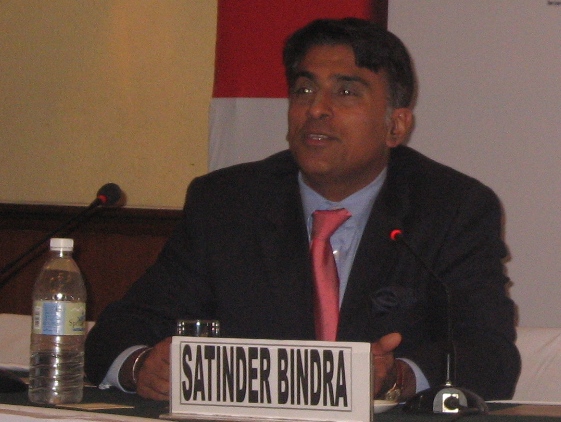
Satinder Bindra
Satinder Bindra: Voice of the Planet?

“Content is king — but distribution is God!”

With these words, UNEP’s newly appointed Director of Communications and Public Information, Satinder Bindra (photo, above), engaged my attention at a meeting in Paris earlier this week.

I almost jumped up in total agreement — this is just what we’ve been saying for years, especially to those who support information, education and communication activities in UN agencies.

Unlike many career UN officials, Satinder knows what he’s talking about. He comes to UNEP with over two decades of wide and varied experience in journalism and broadcasting – the last 10 years spent as a Senior International Correspondent/South Asia Bureau Chief for CNN based in New Delhi, India.

In the hard headed and hard nosed world of international news and current affairs television, distribution and outreach can make or break any content provider. This is something that the two leading news channels BBC World and CNN International know very well — and the more recent entrant Al Jazeera English is still finding out.

Satinder’s remark, in this instance, was more to do with how to get information and analysis on sustainable development out to as many people as possible in all corners of the planet. This is part of UNEP’s core mission since its founding in 1972 — and as chief of communication and public information, Satinder now takes on this formidable challenge.

In Paris, he was listening, taking notes and talking to everyone in the small group who’d come together for the annual partner meeting of the Com Plus Alliance of Communicators for Sustainable Development.

Com+ is a “partnership of international organizations and communications professionals from diverse sectors committed to using communications to advance a vision of sustainable development that integrates its three pillars: economic, social and environmental”. TVE Asia Pacific was admitted to the partnership a few months ago.

As I’m sure Satinder realises, at stake in his new assignment is a lot more than audience ratings, market share or revenue stream of a single broadcaster. Those are important too, but not in the same league as ensuring life on Earth – in all its diversity and complexity – continues and thrives.

Satinder struck me as a practical and pragmatic journalist who wants to get the job done efficiently. We can only hope the rest of UNEP will keep up with him — or at least they don’t get too much in his way!

As he finds his way around the globally spread, multidisciplinary and sometimes heavily bureaucratic UN organisation, Satinder will come across some incongruities, cynicism and institutional inertia all of which have held UNEP back from being the dynamic global leader in our pursuit of elusive sustainable development.

At the big picture level, communication at UNEP has often been defined narrowly as institutional promotion – delivering UNEP logo to the news media of the world, or boosting the image of its executive director and other senior officials. We don’t grudge anyone enjoying their 15 minutes of fame, but a technical agency like UNEP has so much more to offer — in terms of rigorous science, multiple perspectives, wide ranging consultation and bringing diverse players to a common platform.

The Nobel Peace Prize winning Inter-governmental Panel on Climate Change (IPCC), co-supported by UNEP and World Meteorological Organisation, is a good recent example of how solid science, communicated through the media, can inspire governments, industry and rest of society to find solutions to a major global challenge.

The 20-year success of the Montreal Protocol to save the ozone layer is another example. Again, UNEP was a key player in this accomplishment, and is still engaged in the race to phase out the use of a basket of chemicals that damage the protecting ozone layer in the upper atmosphere.

There’s a lot more good science and tons of good stories lurking inside UNEP — if only its experts know how to get these out, and if only its bean-counters won’t stand in the way.

Ironically, elsewhere in the same UNEP Paris building that we were having the Com Plus meeting, the adorable cartoon character Ozzy Ozone (below) was being holed up by excessive rules and regulations. He is one of the best known public communication products to come out of the organisation. Yet, as I wrote earlier this year, he is bottled up and kept captive by an unimaginative UN system.

Then there is the whole scandalous situation where UNEP-funded environmental films are released with needlessly excessive copyright restrictions. As I have been saying, this is the big mismatch in environment and development film-making: many films are made using donor (i.e. public or tax payer) funds, but due to the ignorance or indifference of funders, the copyrights are retained by private individuals or companies involved in the production.

In UNEP’s case, for years it has been commissioning (and sometimes funding) a London-based production company, with a charitable arm, to produce environmental films. That’s certainly a choice for UNEP if the agency feels it continues to get value for its money. But tragically, the producers jealously guard all the copyrights, releasing these only under rigid conditions to a select few.

Whatever outreach figures they might claim, these cannot match what the same films would achieve if the copyrights were not so restrictive. Freed from crushing rights, such environmental films – made with UNEP funding or blessings or both – could benefit thousands of groups engaged in awareness, advocacy, activism, education and training.

For sure, we’ve heard the arguments in favour of tight copyright regimes. Film-makers have every right to be acknowledged for their creative efforts, but public funded products must not be locked up by greedy lawyers and accountants — or even by selfish film-making charities. And millions of users around the world should be able to access such products without having to get through the eye of the copyright needle first.
July 2007 blog post: Lawyers who locked up the butterfly tree

Can Satinder Bindra overcome these hurdles that have for so long inhibited UNEP from reaching its potential? We just have to wait and see.

When he talks about distribution being God, we have to readily agree. But he will soon find some elements within UNEP – or in crony partnerships with UNEP – that stand between him and this God.

To be fair, there’s only so much that an inter-governmental agency like UNEP – beholden to its member governments – can really accomplish. That’s why it needs partners from corporate, civil society, activist and academic spheres. Some of us can easily say and do things that UNEP would, in all sincerity, like to — but cannot.

Satinder sounds like he can forge broad alliances that go beyond monopolist partnerships. Here’s wishing him every success….for everyone’s sake!

Photo courtesy UNEP Climate Neutral Network

Lakshani: A child of the sea travels beyond the seas…

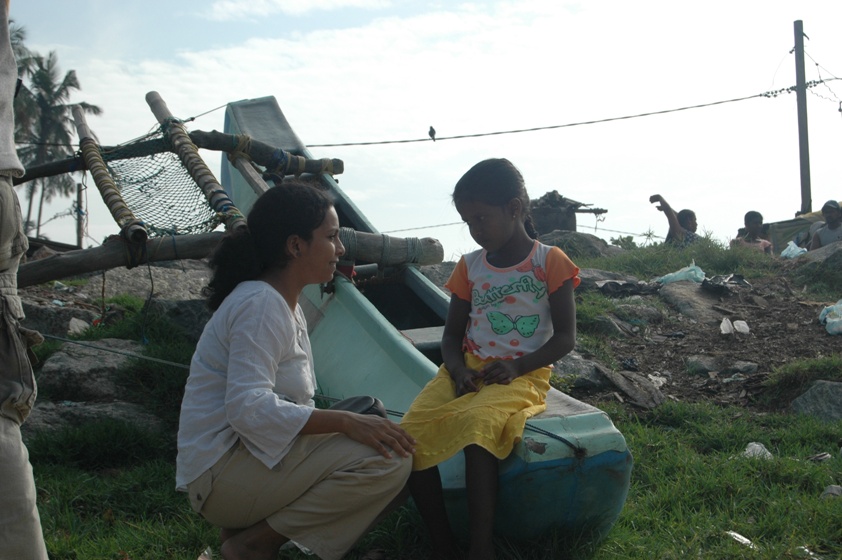
Lakshani photo by TVEAP

Our teacher said our country is small and is surrounded by the sea….she showed it on the globe.”

With these words, young Lakshani Fernando (photo, above) begins telling us the compact story of her short life.

Lakshani, 9, has lived by the sea (Indian Ocean) from the time she was born. When she was just six, the Asian Tsunami of December 2004 destroyed their beachfront house in Koralawella, Moratuwa, on Sri Lanka’s western coast. More than three years later, when my colleague Buddhini Ekanayake met Lakshani in March 2008, the family was still struggling to raise their heads from that massive blow.

A day in Lakshani’s life is the story of a short, 3-minute film that Buddhini produced for TVE Asia Pacific a few weeks ago. It’s part of an Asian and African television co-production project that is about, for and by children.

In the film, Lakshani shares the highlights of a typical day. That includes going for a walk on the polluted beach with her fisherman father, spending a few hours at the nearby school and playing with neighbourhood children. While at it, she tells us her wishes for a cleaner beach and a better neighbourhood.

Buddhini called Lakshani a ‘Child of the Sea’. Even the cruel waves of the tsunami didn’t scare Lakshani away for too long.

I love to play with waves…” Lakshani says towards the end of the film. Then she looks far out at the horizon, and talks again. “There are ships far out at sea. That’s all there is…

She might not yet imagine lands beyond ships and waves, but last week, her story travelled across the seas. Over 500 broadcast media managers, journalists and researchers from around the world, who’d gathered in Kuala Lumpur, Malaysia, for Asia Media Summit 2008, had a glimpse of Lakshani when the first 90 seconds of the film was screened during plenary.

Elizabeth Smith, secretary general of the Commonwealth Broadcasting Association (CBA), chose an extract from Lakshani’s story to introduce the media initiative. Sitting in the audience, I immediately texted the news to Buddhini.

Watch “I am A Child of the Sea”:

This film forms part of a series that has 20 TV producers from 13 countries engaging in a co-production of a short programmes series (mini documentaries) about and for children. The series is the outcome of a regional project organised by the Asia Pacific Institute for Broadcasting Development (AIBD) in collaboration with the French Ministry of Foreign affairs, the Commonwealth Broadcasting Association (CBA), Thomson Foundation, Prix Jeunesse, Children and Broadcasting Foundation for Africa and RTM-IPTAR of Malaysia.

The project tries to capture cultural diversity through the eyes of children. When its concept first reached us, it was defined very narrowly in terms of ethnicity and/or religion. TVE Asia Pacific being a strictly secular organisation, we couldn’t fit into such a tight range. Besides, we realised that many modern day children have a self identity that goes above and beyond the race and religion that blind chance of birth assigned to them.

So we took an editorial decision: instead of doing a story that highlights factors that utterly and bitterly divide humanity (such as race and religion, both of which fuel the long-drawn war in Sri Lanka), we would look for a unifying factor. The tsunami’s killer waves, when they rolled in, didn’t care for our petty human divisions. For a few days and weeks following the tragedy, Sri Lanka was united in shock and grief in a manner I have never seen in my 42 years of living here. (Then we went back to killing each other again.)

The result of our search was Lakshani and her story captured in ‘I am a Child of the Sea’.

Buddhini chose to feature Lakshani after interviewing 10 children from different localities and a diversity of cultural backgrounds. (Never once did she ask for the child’s religion, which unlike ethnicity is not always apparent from the name.) There was some significance in featuring a child who identifies herself closely with the Sea in a country where tens of thousands of tsunami-affected people have still not come to terms with the sea. Even after the tsunami destroyed their home, Lakshani’s family moved to a ‘temporary’ shelter within sight of the sea. Thus, her story had a close association with the sea which formed part of her lifestyle, environment and culture.

Buddhini developed the script after several leisurely chats with Lakshani, based partly on the child’s own writing about herself. Filming the story took place in early March 2008, with the full consent of her parents, extended family and neighbours. Read more about the making of this film on TVEAP website and on Buddhini’s own blog.

TVEAP crew filming Lakshani's story

Lakshani’s story is symbolic at another level. It reveals how, despite receiving a massive outpouring of donations from all over the world, some tsunami-affected families are still struggling to put together their shattered lives. The litany of woes, missed opportunities and sometimes outright plundering of donations came out strongly in the first hand accounts of affected people (in India, Indonesia, Sri Lanka and Thailand) who spoke to us during the Children of Tsunami media project. Read our reflections on the project in Communicating Disasters book published in 2007.

Lakshani’s family is not typical of Sri Lanka’s tsunami affected persons. Unlike most such families, the Fernandos live on the western coast, relatively close to Colombo. Although wave action destroyed or damaged beachfront homes in these areas, most attention was focused on areas in the south, east and north of the island that were hit much harder. So those affected and living on the west coast have often been overlooked or dismissed lightly. In this sense, Lakshani’s family has some parallels with what I called ‘step-children of tsunami’.

There is a bit more cheerful post-script to this story. During several visits to Lakshani and family for researching, filming and editing this film, Buddhini (who has a daughter aged four herself) bonded with the girl. It became more than a mere film-making venture, and has led to a lasting relationship. Meanwhile, young voice artiste Shanya Fernando, who rendered Lakshani’s Sinhala voice into English for an international audience, has also felt an attachment to the ‘star’ of our film.

While the film was made with the informed consent of Lakshani’s family who received no material benefits for their participation, both Buddhini and Shanya have since presented some basic educational gifts to Lakshani — who is certainly in need of such help. And who am I to stand in the way of such gestures of human kindness?

Producer BUddhini with Lakshani

Photos by Amal Samaraweera, TVE Asia Pacific

Sri Lanka 2048: Talking today for a better tomorrow!

Sri Lanka 2048 - TV Debate series on sustainable futures for Sri Lanka

I’m just coming up for fresh air after two hectic weeks – this blog was silent during that time as I was deep immersed in doing something new and interesting.

With my team at TVE Asia Pacific, I’m involved in producing a new TV series started airing on May 22 on Sri Lanka’s ratings-leading, privately-owned, most popular channel, Sirasa TV.

Named Sri Lanka 2048, it is an innovative series of one-hour television debates that explore prospects for a sustainable future for Sri Lanka in the Twenty First Century.

Each debate will involves -– as panel and studio audience -– over two dozen Sri Lankans from academic, civil society, corporate and government backgrounds. They are recorded ‘as live’ and broadcast every Thursday at 10.45 pm, which, in Sri Lankan TV viewing patterns, is the favoured time for serious current affairs and political programmes.

The debates are being co-produced by TVE Asia Pacific, the educational media foundation that I head, in partnership with IUCN, the International Union for Conservation of Nature, and MTV Channel (Private) Limited, which runs a bevy of radio and TV channels including Sirasa TV and Channel One MTV.

The editorially independent series will accommodate a broad spectrum of expertise and opinion.
The debates are based on topics such as managing our waste, reducing air pollution, protecting biodiversity on land and in the seas, and buffering communities from disasters. Two debates in English will look at the nexus between business and the environment, and coping with climate change.

Read detailed news story on TVEAP website
Read series line up and broadcast schedule

Sri Lanka 2048 image montage by The Nation newspaper

The series is based on the overall premise that Sri Lanka has abundant land and ocean resources that can be used to build such a future -– but it faces many challenges in taking the right action at the right time. We believe that public discussion and debate on issues, choices and alternatives is an essential part of this process. Read more on why this series.

Why 2048? For one thing, it’s the year Sri Lanka will mark 100 years of political independence. Being 40 years in the future, the year lies slightly more than a generation ahead, allowing ample time and opportunity to resolve deep-rooted problems of balancing development with conservation.

Sri Lanka 2048 follows an informal, talk show format that allows ample interaction between the panel and empowered audience. Although they take place within a clearly defined scope that enables some focus, all debates are unscripted.

Our amiable moderator Kingsly Rathnayaka (centre in the photo montage above), one of the most versatile presenters on Sri Lankan television today, keeps the panel and audience engaged. By design, we ask more questions than we are able to answer in a television hour (48 mins). But then, we don’t expect to resolve these burning issues in that time – all we can hope to do is to stretch the limits of public discussion.

Logistics and studio size limit the number of our audience to a two dozen. We’ve tried hard to ensure a good mix among them, drawn from all walks of life. To bring in additional voices and perspectives, we insert into each debate 2 or 3 short video reports produced in advance. These highlight solutions to environment or development problems that have been tried out by individuals, communities, NGOs, government agencies or private companies. Played at key points during debates, these help steer discussion in a particular direction.

Sri Lanka 2048 by TVE Asia Pacific
We are already receiving favourable media reviews and coverage. Here are some that appeared in English language newspapers (more have come up in Sinhala newspapers, the language in which most of this series is produced and broadcast):
The Morning Leader, 28 May 2008: Timely action to sustain Sri Lanka’s development

The Sunday Times, 18 May 2008: TV Debate series to create a sustainable future
The Nation, 1 June 2008: Pick the best at Sri Lanka 2048

Sri Lanka 2048 is the culmination of months of research, development and pre-production work carried out by TVE Asia Pacific’s production team in collaboration with IUCN Sri Lanka. Our preparatory work involved consultations with dozens of experts, activists, officials, entrepreneurs – and their various organisations or companies. We synthesize and package their information, opinions and experiences with the dynamic and creative production team at MTV Channel (Pvt) Limited.

The inspiration for this series came from my mentor Sir Arthur C Clarke, with whom I wrote an essay 10 years ago that outlined his personal vision for his adopted country in 2048. The celebrated futurist that he was, Sir Arthur often said that there is a range of possible futures, and our actions – and inaction – determine what kind of future actually happens. Desirable futures don’t just happen; they need to be worked on.

Sri Lanka 2048 is an attempt to discuss how Sri Lankans can pursue economic prosperity without trading off their good health, natural wealth and public order. This is not a series preaching narrowly focused green messages to a middle class audience. We want to rise above and beyond the shrill of green activists, and engage in informed, wide ranging discussions on the tight-rope balancing act that emerging economies like Sri Lanka have to perform between short term economic growth and long term health of people and ecosystems.

Contrary to popular perception, ‘sustainable development’ is not some utopian or technical ideal of environmental activists. It’s about creating a liveable society here and today – where everyone has an acceptable quality of life, ample opportunities to learn and earn, and the freedom to pursue their own dreams.

Doing good television takes a good deal of time, effort and money. This TV series is supported under the Raising Environmental Consciousness in Society (RECS) project of IUCN Sri Lanka, which is funded by the Government of the Netherlands. But neither is responsible for editorial content or analysis, which rests on my shoulders as the executive producer of the series.

And I, in turn, stand on the shoulders of dedicated, hard working production teams drawn from TVE Asia Pacific and MTV Channel (Pvt) Limited. Doing good television is all team work.
Sri Lanka 2048 - Fisheries panel at Sirasa Studio - Photo by TVEAP

All photos courtesy TVE Asia Pacific

H R Premaratne: The Lankan artist who built a space station for 2001

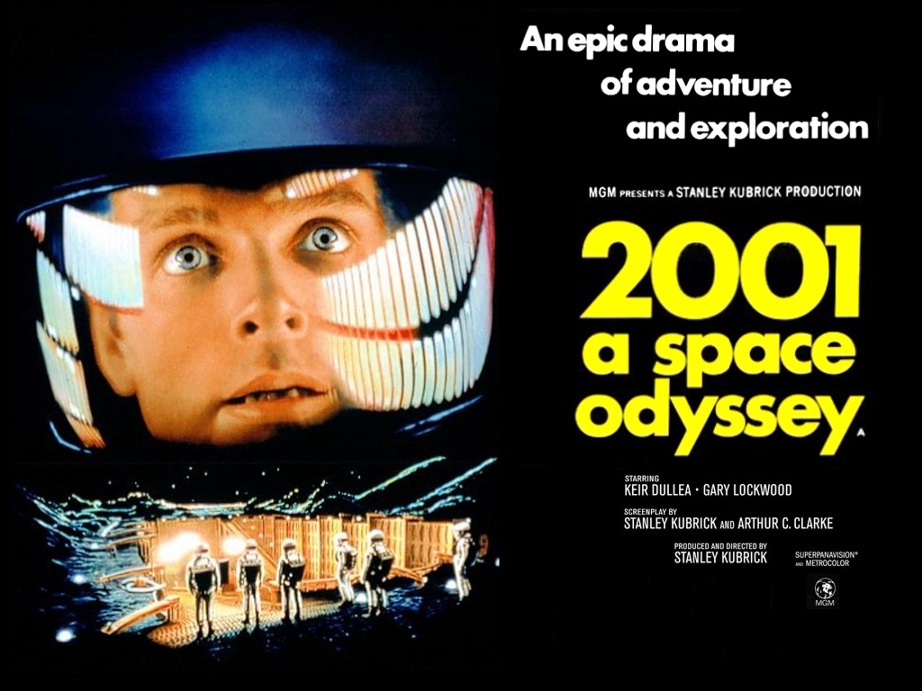
2001 A Space Odyssey movie poster from 1968

The Sunday Observer, Sri Lanka, reproduces this story on 11 May 2008

This month marks the 40th anniversary of the release of classic science fiction movie 2001: A Space Odyssey. The Academy of Motion Picture Arts and Sciences held a commemorative screening last week in Hollywood’s MGM theatre.

In May 1964 director Stanley Kubrick and science fiction author Arthur C Clarke embarked on a creative collaboration: a novel and a screenplay inspired by Clarke’s 1950 short story “The Sentinel.” In December 1965, many ideas, drafts, and titles later, filming commenced on 2001: A Space Odyssey. The futuristic epic, placed in the first year of the new millennium, premiered in the US in April 1968 — and went on to become one of the finest science fiction movies made.

Official MGM trailer for 2001: A Space Odyssey

As the Academy noted on its website: “With its epoch-spanning storyline and its nearly dialogue-free script, 2001: A Space Odyssey combined the production value of Hollywood film-making with the artistic sensibility of European cinema. Its cerebral approach to the genre helped usher in a new, more literate age of science fiction cinema, and its extraordinary imagery – the widescreen 70mm cinematography of Geoffrey Unsworth, the visually dazzling and scrupulously researched production design, and especially the Oscar®-winning special effects – instantly became the benchmark by which all space films would be judged.”

The film’s best known connection to Sri Lanka is that its co-creator Arthur C Clarke had by then settled down there. During the 1964-68 period that he was associated with the production, Clarke would make periodic returns to his Colombo home — first from New York, where he brainstormed with Kubrick for weeks, and then from England, where the movie went into production. Filming of 2001 began in December 1965 in Shepperton Studios, Shepperton, England. Soon, filming was moved to MGM-British Studios in Borehamwood.

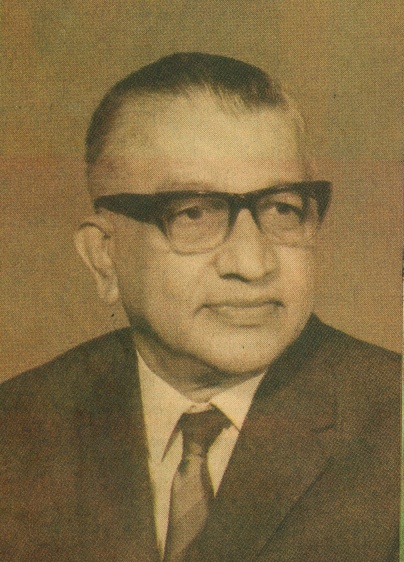
The anniversary coverage has triggered my memories of another, much less known Sri Lankan connection with the film. The accomplished Sri Lankan engineer, painter and sculptor H R (Hapugoda Rankothge) Premaratne worked on the movie’s special effects, all of which was hand-made. (Not a single computer was involved in creating the movie, which still awes movie-goers many of who take computer generated imagery, or CGI, completely for granted today.)

H R Premaratne

I got to know Premaratne (in photo above, affectionately known as Prema) in the late 1980s when he was special assistant to Arthur Clarke, in whose Colombo office I started working as a research assistant in 1987. I have just unearthed, from the depths of my own archives, an illustrated profile I wrote on Prema which appeared in The Island newspaper (Sri Lanka) on 26 January 1991. In a 2,000-word biographical sketch of the man that veteran journalist and biographer D B Dhanapala once called ‘a modern day Viswakarma’, I chronicle how Prema came to be associated with the movie’s production.

Prema had just retired in 1965 as Director of the Department of Public Works – in other words, the Ceylon government’s chief builder. By happy coincidence, 2001 was just entering its production stages around this time, so Clarke put Prema in touch with the Borehamwood Studios where elaborate sets for space scenes were being constructed. There, Prema worked with British and American set designers and special effects specialists.

For his efforts, he was listed as a member of the full production crew – even though he would go uncredited in the movie itself (as did dozens of others). When the Internet Movie Database was created decades later, he would also earn himself an entry there as Hapugoda Premaratne.

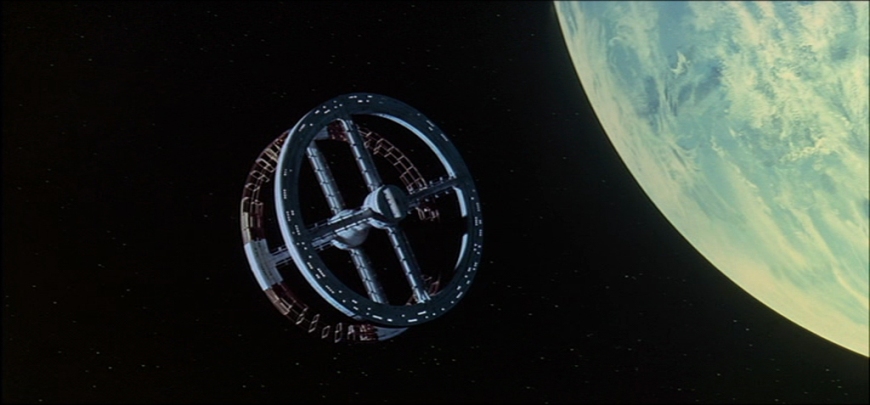
Space station in the movie 2001, envisaged in the mid 1960s

Harry Lange, chief designer of Hawke Films Limited who was in charge of production designs, later wrote to Prema: “Not one model could have been brought to the exceptionally high standard required in this production without the skills and imagination of people like yourself.”

Harry Lange recalls the making of 2001

“Prema was a very skilled architect, his best known work being the magnificent Independence Hall,” Clarke recalled years later in his tribute to Prema upon the latter’s death in the early 1990s. “During his stay in England in the mid 1960s, I put him in touch with Stanley Kubrick, who was then making 2001: A Space Odyssey. Prema’s expertise in art and engineering was very valuable in the production of the movie’s special effects, and he assisted in the building of the spectacular space station.”

Excerpt from 2001: Arrival at the space station in Earth orbit

Prema capped his long and illustrious public service as Sri Lanka’s ambassador to Burma, concurrently accredited to Thailand, Laos and Singapore (1974-78). From 1983, he worked as Clarke’s special assistant, while pursuing his own painting, sculpture and design work from his home at Wijerama Mawatha, Colombo — a short walk from Clarke’s own residence at Barnes Place.

I remember visiting Prema at home on several occasions. After his wife passed away and son moved overseas, he lived alone in a large, old house that was teeming with works of art – it was like a private art gallery or museum. All over the garden, there were scaled replicas of famous rock sculptures from places like Anuradhapura and Polonnaruwa. He pioneered a method of creating fibre glass replicas of archaeologically valuable statues and artefacts. These were used to showcase the best of Sri Lanka in major exhibitions in London, Washington DC and other capitals of the world in the 1980s.

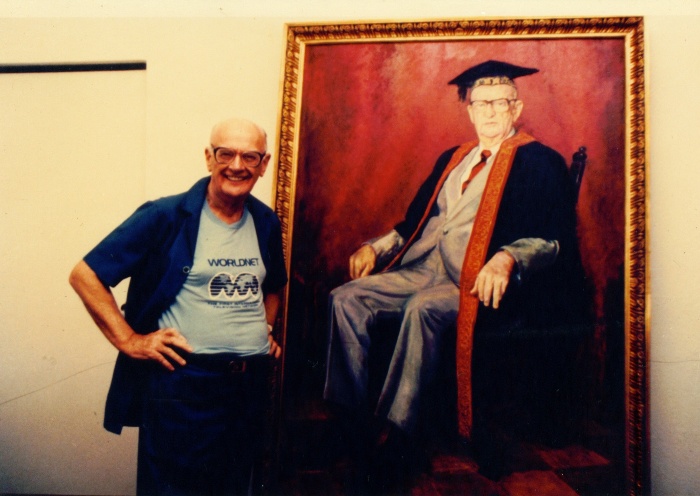
In the late 1980s, Prema also painted a life-size portrait Arthur C Clarke as Chancellor of the University of Moratuwa, which is still on display at the Arthur Clarke Centre there (photo, below).

It’s a bit cliched to say this, but they don’t seem to make renaissance men like H R Premaratne anymore. He straddled the arts and sciences with equal dexterity and with impressive results in both spheres. He not only built bridges in newly independent Ceylon, but was himself a bridge between the Two Cultures of the sciences and humanities.

Just like his friend Arthur C Clarke was…

Sir Arthur Clarke with his Chancellor portrait by H R Premaratne, circa 1990

More information on making 2001: A Space Odyssey is found in the documentary, 2001: The Making of a Myth.

The making of 2001: A Space Odyssey, by Richard Boyle (The Sunday Times, Sri Lanka, November 1998)

The other side of Reality TV: When Cicadas kill innocent people…

I have nothing against reality television. It’s a TV programming format that, according to Wikipedia, presents purportedly unscripted dramatic or humorous situations, documents actual events, and features ordinary people instead of professional actors.

In fact, I’ve been telling my friends who are factual film-makers that we can learn a thing or two from the recent successes of some reality TV shows.

But everything has its sane limits — and evidently these were exceeded in the recent controversy involving a British TV production company that stands accused of starting a ‘flu epidemic that left four people from a tribe of isolated Peruvian Indians dead and others seriously ill.

Matt Currington (in photo above, on the right), a London-based documentary maker, has been blamed for triggering a “mini-epidemic” in the village of 250 people which led to the deaths of three children and one adult of the Matsigenka people, who live in the isolated Amazonian Cumerjali area of south-eastern Peru.

The 38-year-old was employed by Cicada Films as researcher when he travelled to the area with a guide last year to scout for locations for the World’s Lost Tribes series, which airs on the Discovery Channel.

Here are some extracts from the story that appeared in The Guardian newspaper in the UK on 27 March 2008, written by its environment correspondent John Vidal:

The regional Indian rights organisation Fenama, government officials and a US anthropologist working in the region said in statements seen by the Guardian that a two-person crew working for London-based Cicada Films had visited groups of isolated Indian communities despite being warned not to. Fenama said the film team travelled far upriver and provoked an epidemic. It accused them of threatening the lives of Indians and called for Cicada Films to be barred from entering the area again.

It is understood the company was scouting for a location to set a TV show for Mark Anstice and Olly Steeds, in which the two British presenters would live with a remote tribe, in exchange for gifts. The company has already filmed episodes in New Guinea.

According to the Peruvian government’s protected areas department, Cicada was given a permit to visit only the community of Yomybato. It expressly prohibited visits to uncontacted or recently contacted Indians. “The Cicada team entered [remote headwaters] which are part of the strictly protected zone,” it said.


Read the full story: British reality TV crew accused as flu kills four in isolated Peruvian tribe

In case you think this is some left-wing or liberal conspiracy, read also The Times London story: TV researcher brought fatal flu to Amazon tribe.

The American anthropologist, Glenn Shepard, who met the film team on location, said he had urged them not to make the trip to the Cumerjali settlements, “where people were vulnerable to western illnesses”. “Reality tv seeks ever more dangerous, remote and exotic locales and communities,” he said.

Stephen Corey of the international tribal rights organization, Survival International, agreed. “There has been a whole rash of bizarre and extreme programmes on tribal rights. The key issue here is sensitivity which is not often a priority for television companies,” he said.

Survival International news: British TV company accused of bringing ‘epidemic’ to isolated Indians

British TV company deny allegations about Peru visit

Image from Survival International Image from Survival International

According to Survival International, Cicada Films previously caused controversy with a documentary about an expedition to visit Indians in Ecuador, which allegedly provoked an attack from uncontacted Waorani Indians.

But Cicada is certainly not alone when it comes to exploiting marginalised people in the global South in the course of film-making. And reality TV is not the only format of TV film making that often oversteps the ethical boundaries in search of a ‘good story’.

As I have been saying for sometime now, documentary film-makers and TV news gathering crews are equally guilty of many excesses, lapses and gross abuses all perpetrated in the name of media freedom.
Aug 2007 blog: Wanted – Ethical sourcing of international TV News

Nor is this sinister trend entirely new. I opened a September 2007 blog post with this bizarre request: “Can you help us to film a child’s leg being broken?” This was made by a visiting Canadian TV crew in the 1970s to my friend Darryl D’Monte, one of the most senior journalists in India and former editor of the Times of India.

This was in connection with a brutal practice that was believed to exist in India, so that forcefully maimed children could be employed as beggars. When Darryl was outraged, the film crew had shrugged off saying: “It’s going to happen anyway”.

December 2007: “Hands up who’s poor, speaks English – and looks good on TV!”

Film-makers and TV journalists roam the planet exercising their license to protect and promote the people’s right to know, and in the public interest. But this privileged position is grossly abused when they allow the end to justify their highly questionable means.

Commenting on TV’s latest crime against voiceless people, India’s Down to Earth magazine (30 April 2008 issue) says:

“These forays of reality tv perpetuate an imagery conceived by a 19th century alliance of anthropologers and photographers, that of tribals in their “innocent” state. It’s another matter these images were taken after the tribal groups were ravaged by colonialism.

“Today in the era of digital images when computer games mimic real wars, it might be hard for even the most naive eye to believe what it sees. But tv casts an enormous sway over audience perception and digitization has, in fact, aided it. We know of the images, not the circumstances in which they were taken. We believe them though they might be contrived. That’s why reality tv is dangerous.”

Read Down to Earth leader: Television has new stars

Don’t say a word: Men, women and Bruno Bozzetto

I just wrote a blog post titled Children of Heaven: Appreciating the sound of silence. Reviewing the 1997 movie by Majid Majidi, I remarked about his strategic use of silences in his soundtrack – we must never underestimate its power in the right place.

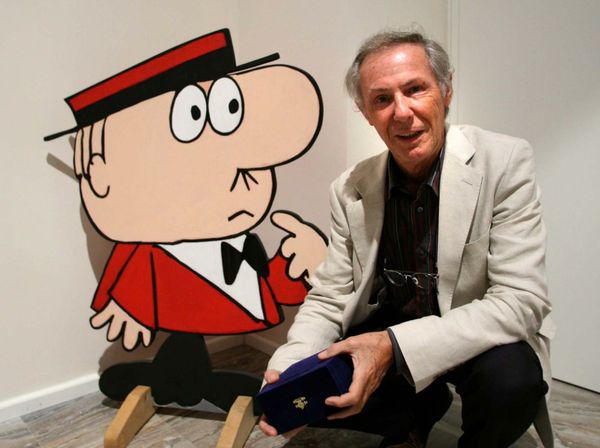
Other creators of moving images do their magic with a good sound track – but sometimes without using a word of dialog. Here’s a clever example I’ve found on YouTube – it is by Italy’s leading animator, Bruno Bozzetto (photos below, courtesy Bruno Bozzetto website).

Bruno Bozzetto

Titled Femminile & Maschile (Feminine and Masculine), this 2-D animation was made in 2004. I can’t find a synopsis online, but one website introduced it simply as follows: Some situations that show the difference of behaviour between men and women in the everyday life.

Anyone with a sense of humour can appreciate this piece – and I hope that includes die-hard feminists…

Here’s the intro from Wikipedia:
Bruno Bozzetto (born March 3, 1938 in Milan, Italy) is an Italian cartoon animator, creator of many short pieces, mainly of a political or satirical nature. He created his first animated short “Tapum! the weapons’ story” in 1958 at the age of 20. His most famous character, a hapless little man named “Signor Rossi” (Mr. Rossi), has been featured in many animated shorts as well as starring in three feature films: “Mr. Rossi Looks for Happiness” (1976), “Mr. Rossi’s Dreams” (1977), and “Mr. Rossi’s Vacation” (1977). Read the rest of his profile on Wikipedia

Earlier this week, to mark Earth Day on 22 April 2008, I took part in a half hour, live interview with Sri Lanka’s highest rated, most popular channel, Sirasa TV. I wanted to relate the global to not just the local but also to the individual and family level. To discuss how our lifestyle choices and consumer decisions affect that planet, I used a series of brilliant cartoon animations that Bruno Bozzetto had done some years ago for WWF.

Again, without having his characters utter a single word, Bozzetto gives out profound messages through images and musical sound track. This is why I keep saying that when it comes to the sheer economy of words, we writers just can’t beat cartoonists.

Sorry, I can’t locate these anywhere online (YouTube lists dozens of his other creations, but not this series — which I can’t even find on his own website.) It’s time for someone to revive this series, for their message is even more relevant for today’s climate-challenged world…

Bruno Bozzetto entry on Internet Movie Database
Visit the official website of Bruno Bozzetto
Watch other Bruno Bozzetto short animations online

Children of Heaven: Appreciating the sound of silence

Courtesy Wikipedia

What’s it with children and shoes? Those who have none dream of owning their first pair. Those who have one, or some, still dream about a better, or perfect, pair. Shoes are worth dreaming about, crying (even fighting?) over, and running races for.

Like Ali did, in Majid Majidi’s superbly crafted 1997 movie Children of Heaven. For 90 minutes this afternoon, my team and I ran the race with little boy Ali, sharing his dreams, sorrows and eventual (albeit bitter-sweet) triumph.

I had seen this film before, but this time around, the experience felt even better than I remembered it. I already knew the story, but I was spell-bound by the film’s culmination – the children’s race where Ali wanted to come third, but ended up winning. I followed the last few minutes with tears in my eyes and the heart beating faster.

This is what good story telling is all about.

Read Children of Heaven synopsis on Wikipedia

Of course, Majid Majidi didn’t work this miracle alone. The superb cinematography of Parviz Malekzaade was well packaged by its editor Hassan Hassandoost. His work is uncluttered and elegant: the story flows in a simple, linear manner with no flashbacks or flash-forwards; no special effects to jazz things up; and the scenes are so seamlessly meshed together with hardly a second being wasted.

And the soundtrack played a vital part in shaping the whole experience. It’s not just the music. As my colleague Buddhini remarked, it also made clever, strategic use of silence.

We might call it the sound of silence – and never underestimate its power in the right place.

All this reminded me of what our Australian film-maker colleague Bruce Moir often said when we worked with him: “We’ve got to remember that film appeals to people’s hearts more than their minds. The way to people’s heads is through their hearts, from the chest upwards — and not the other way round.”

A year ago, I invited him as my special guest to a talk I gave at the University of Western Sydney in Australia – in his home city. There, he once again made the point: “Our fundamental job is to tell a story – one that holds an audience’s interest and moves their heart, regardless of language, cultural context or subject….I have always believed that film achieves its optimal impact by aiming to ‘get at the audience’s head via their heart’…”

April 2007 blog post: Moving images moving heart first, mind next

As I then wrote, I hope this was an ‘Aha!’ moment to some in our largely academic and activist audience. Many who commission films or even a few who make films tend to overlook this. Especially when they set out trying to ‘communicate messages’.

Bruce never tires of saying: “Film is a lousy medium to communicate information. It works best at the emotional level.”

Children of Heaven is living proof of this. It has no lofty agenda to deliver information or communicate messages of any kind. Yet, by telling a universal story set in modern day Iran, it brings up a whole lot of development related issues that can trigger hours of discussion: not just the rich/poor or rural/urban disparities, but other concerns like how a country like Iran is portrayed in the western news media.

As a colleague remarked after today’s film, she had no idea of this aspect of life in Iran — the version we constantly hear is of an oil-rich, nuke-happy, terror-sponsoring theocracy that, to the incumbent US president at least, is part of the ‘axis of evil‘. And the Al Jazeera International channel, packed with BBC discards or defectors, has done little to change this popular perception.

We watched the movie as part of our monthly screening of a feature film. We are lining up critically acclaimed films from different cinematic traditions of the world. And then we discuss its artistic, technical and editorial aspects.

As for me, I totally agree with the famous movie critic Roger Ebert, who wrote in the Chicago Sun-Times at the time of the movie’s first US release: “Children of Heaven is very nearly a perfect movie for children, and of course that means adults will like it, too. It lacks the cynicism and smart-mouth attitudes of so much American entertainment for kids and glows with a kind of good-hearted purity. To see this movie is to be reminded of a time when the children in movies were children and not miniature stand-up comics.”

As he summed it up: “Children of Heaven is about a home without unhappiness. About a brother and sister who love one another, instead of fighting. About situations any child can identify with. In this film from Iran, I found a sweetness and innocence that shames the land of Mutant Turtles, Power Rangers and violent video games. Why do we teach our kids to see through things, before they even learn to see them?”

Note: The film, originally made in Persian, was named Bacheha-Ye aseman . It was nominated for an Academy (Oscar) Award for the best foreign film in 1998, but lost out to a worthy competitor, Roberto Benigni’s Life is Beautiful.