Moving images moving research…beyond academic circles!

Although I’ve dabbled in some media research at times, I don’t think of myself as a researcher. So when Sri Lanka’s Centre for Poverty Analysis (CEPA) invited me to speak at their 8th Annual Symposium on Poverty Research in Sri Lanka, I spoke on what I know a little bit about — communicating research using the audio-visual media.

My panel remarks, delivered on the morning of 30 November 2007, were on ‘alternative mediums of communication to influence change’. I opened with the provocative title “Hands up who is poor, speaks English – and looks good on TV!” (see separate blog post on media related aspects of my talk).

These days, so much of research in physical, biological and social sciences is justified in the name of poverty reduction. Yes, studying and understanding development problems is the essential first step of solving them. But without properly communicating this research, the results won’t help the poor — or anyone else.

We at TVE Asia Pacific are committed to covering Asia’s development issues using TV, video and web. Our small challenge is to capture the many and varied facets of how Asians are working for a better today and better tomorrow. Reducing and eventually eliminating poverty is a significant part of that process.

As Asia’s billions strive for better lives, there are millions of stories at the bottom of the income pyramid. But most mainstream media manage to miss these stories due to their ignorance, or arrogance, or both.

For us, one key source of information and analysis is researchers – people who study trends and conditions, and keep reflecting on how and why. Their knowledge and insights are invaluable for us to tell stories from and about the bottom of the pyramid.
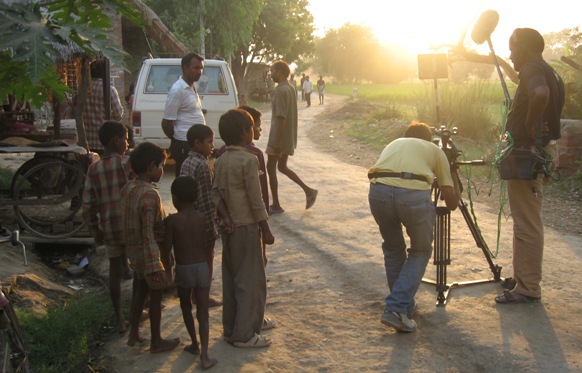
filming-living-labs-in-uttar-pradesh-india.jpg

As I told the researchers in my audience: “Part of our challenge is to know what you are studying — and then figure out the public interest and human interest angles of your work. As communicating research to those outside the scientific or research communities is more an art than a science.”

I cited three recent examples where we had produced engaging TV/video content to communicate research directly relevant or related to the poor.

Digits4Change
was our attempt to understand and document how information and communication technologies (ICTs) are changing the way Asians live, work and play. We covered technologies such as Internet, computers, mobile phones and satellite communications applied in education, healthcare and rural business development. The knowledge base for this 2006 series came from IDRC’s Pan Asia programme which supports action research that addresses specific problems.

Also in 2006, we produced The Greenbelt Reports to take a close look at the environmental lessons of the Indian Ocean tsunami. We visited a dozen locations in India, Indonesia, Sri Lanka and Thailand to find out how community and conservation interests can be balanced in relation to coral reefs, mangroves and sand dunes. In telling these stories, we worked with researchers from global agencies like IUCN the World Conservation Union and UNEP as well as national organisations like the M S Swaminathan Research Foundation in India.

The Greenbelt Reports

Living Labs is our most recent series, released in March 2007. Filmed in 9 countries in Africa, Asia, Europe and Latin America, it looked at how researchers are addressing different aspects of a major challenge in agriculture: how to grow more food with less water. We worked with a global action research project called the CGIAR Challenge Programme on Water and Food, which gave us exclusive access to their on-going field work and emerging findings in nine major river basins of the developing world.
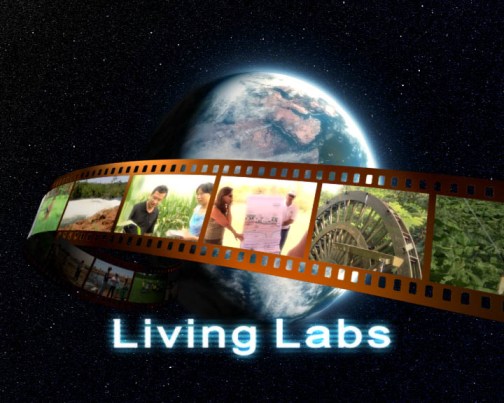
living-labs-by-tveap.jpg

In telling these and other stories, we work within a certain framework we have defined for ourselves. Among its salient points:
• We don’t set out trying to communicate messages; we just want to tell good stories and development communication is a by-product.
• We look for under-reported/ignored development issues, or a less covered angle in a widely reported story.
• We don’t just talk to technical experts but to many other individuals involved or affected – women, men and children from all walks of life.
• We seek and accommodate different points of view, not allowing single-issue activists or one source to dominate/monopolise a story.
• Our finished products are informed by science but never immersed in science – we always keep in mind that our audience is non-specialsits.

All our stories cover real people dealing with real world issues and challenges. And since Asia has more people living in poverty than anywhere else in the world, most of the time our stories concern what’s happening at the bottom of the pyramid – or what can directly impact people living there.

And without exception, all these TV series and individuals films are available free of any license fees for broadcast, civil society and educational use. They are also available for online viewing at TVE Asia Pacific’s channel on YouTube.

Communicating research through moving images is not easy. Packing years of hard work into a few mins of engaging visuals and narration involves ruthless condensation which sometimes leaves some researcher egos bruised. When covering the work of large research organisations, we’ve also had deal with internal politics and hierarchies: for example, what to do when a junior researcher is more authentic and articulate than her supervisor?

Producing Living Labs based on filming in 9 countries on 3 continents in just 5 months during 2006 was a challenge in both logistics and political negotiations. As editor-in-chief, I had to balance the public accessibility of our end product with researchers’ keenness to pack their stories with facts and figures.
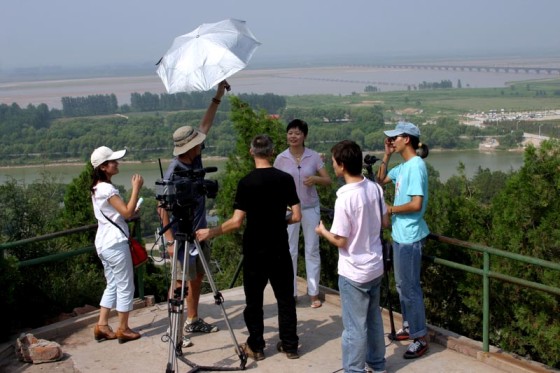
living-labs-being-filmed-in-yellow-river-basin-china.jpg

We didn’t please everyone. One senior researcher told us that his multi-faceted, multi-year nad multi-million dollar was like an elephant — and we’d only glimpsed just one part of that big creature!

That’s just the point: we can never cover the whole elephant in a media product intended for non-specialists. So we choose which part of the elephant is most interesting and present it in a way that will make viewers realise — and hopefully, appreciate — that there’s a lot more that’s worth finding out.

Moving image products often act only as ‘teasers’ — communicating highlights of research, and directing those interested to online or offline sources that offer more information.

Because they act as a/v versions of executive summaries, these ‘teasers’ by themselves are a powerful way of reaching out those who are unlikely to look up the details: that includes many policy makers, government officials and business people.

Winston Churchill used to ask his staff to give him everything ‘on one page’. These days, he might have asked for everything to be summed up in a five minute video — as we often do.

A million video cameras to change the world!

Something remarkable is happening with online public video sharing platforms: progressive non-profit groups worldwide are seizing their power to do good.

YouTube started off more like the people’s version of funniest home videos. But it’s no longer confined to that category. Activist and social groups are increasingly uploading their videos. As broadband Internet rolls out around the world, more people are actually able to watch these videos online.

In response, YouTube, owned by search giant Google, is creating a special section for nonprofits to air their videos and link them to its Google Checkout online payment system to receive funds directly.

“Nonprofits understand that online video isn’t just a way to broadcast public service announcements on a shrunken TV set,” Reuters quoted Steve Grove, head of news and politics at YouTube, as saying. “It’s a way to get people to do more than just absorb your message but to engage with their user generated content as well.”

Pure Digital, maker of the Flip video camera, has said it plans to give away a million video cameras to non-profit organizations around the world to capture images and moments in places traditional media outlets might not be able to reach.

“Video has power and media has power but the challenge is that the media is limited to telling stories that are controlled by a very small number of people,” Jonathan Kaplan, chief executive of Pure Digital, told Reuters. “This program along with YouTube and other sites will expand the media universe for learning what’s really going on in the world,” he said.

Visit FlipVideo website on support for non-profit groups

Reuters quotes the recent example of the impact of clips of the Myanmar army’s confrontations with local protesters which were posted on YouTube and other Web sites. Some of the clips made their way to mainstream news media, which were blocked out of entering or covering events in Burma.

See an example of a YouTube video on what’s happening in Burma:

Our friends at Witness, an activist group founded by the musician Peter Gabriel in 1992, has long specialised in raising awareness of such previously unseen events through video. Sam Gregory, programme director at Witness, says online distribution has made it easier to put videos in front of the right people such as decision makers and others with a personal connection to the cause.

“It’s not necessarily about the size of the audience it’s about placing targeted video and turning ‘watching’ into action,” said Gregory.

Read the Reuters story on 19 Oct 2007: Nonprofits turn to YouTube to raise awareness, funds

My blog post on 1 Oct 2007: Shoot on sight: Rights Alert on Burma

My blog post on 30 Sep 2007: Kenji Nagai: Filming to the last moment

TVE Asia Pacific News story March 2007: TVEAP films now on YouTube

What’s happening with online video has a parallel in how activist groups seized the potential of the hand-held video camera. The handicam was invented in 1985 by Sony. Intended originally for entertainment and domestic documentation purposes only (ranging from family vacations and weddings), it did not take long to find new uses for this revolutionary technology.

The Handicam Revolution in media began when a video camera captured police beating Rodney King on a Los Angeles highway. The shocking amateur footage was broadcast on TV around the world. The acquittal of the police officers after their first trial sparked outrage, and riots erupted in a 20 block section of Los Angeles, leaving 54 people dead and over 2,000 injured.

Ever since Rodney King, broadcasters have been using amateur video to provide images of events that their own camera people have not captured. And human rights activists have started relying on the power of video images to capture the attention of the broadcasters to expose acts of human rights abuse and violation.

Taking it personally: Anita Roddick’s Arabian Nights

“I am overwhelmed by the potential of the web to link like-minded people and move them to mass-action,” the late Anita Roddick once wrote. “We are excited to experiment in other media too — perhaps subversive billboards, or a television program, or other print projects. As someone once said, we are only limited by our imaginations.”

In my personal tribute to Anita, written shortly after her untimely death on 10 September 2007, I touched on her extraordinary skills as an activist-communicator. It was in connection with a global television series that I last met Anita in person.

In the summer of 2003, I was invited to join a small group of people at Anita’s country home, Highfield House, in Arundel, Somerset, England. It was a one-day brainstorming on the future of Hands On, a global TV series that she’d been hosting for three years.

Hands On stood out as a beacon of hope amidst so much doom and gloom on television -– it featured environmentally-friendly technologies, business ideas and processes that have been tried out by someone, somewhere on the planet.

It covered a broad range of topics, from renewable energies, waste management and information technology to food processing and transport. The aim was to showcase good news and best practices so they could inspire others — entrepreneurs, communities or even governments — to try these out.

The series was first broadcast on BBC World and was redistributed to dozens of TV channels worldwide through my own organisation, TVE Asia Pacific, and others. It was backed by the reputed development agency Intermediate Technology (now called Practical Action).

Watch a typical Anita introduction of Hands On and a sample story in capsule form:

Anita brought her usual passion and dynamism to our discussion, energising the development and communications professionals enjoying her hospitality. Covering good news was already going against the media’s grain, but it was harder to keep at it year after year, especially when the media landscape was changing rapidly. It was a challenge to stay engaged and relevant to viewers across Africa, Asia Pacific, Latin America and Europe.

During the meeting, Anita asked me to sum up the World Summit on the Information Society (WSIS) which was coming up in a few months. Putting aside all the ‘developmentspeak’ of UN agencies, I described it as an attempt to put new information and communication technologies (ICTs) to work for the poor and disadvantaged of our world. Or get the geek tools to work for the meek. (I still think my phrase ‘Geek2Meek’ sounds better than the official ICT4D, where D stands for development.)

We agreed that civil society had to seize the opportunities offered by these new media tools. (A few months later, Anita presented two Hands On editions called ‘Communicating for Change’ on BBC World that profiled some initiatives doing just this.)

Always fond of analogies, I likened Hands On to Arabian Nights, which, according to legend, a young woman had spun from her rich imagination for 1,001 nights to save her life from an evil king. In Hands On, I suggested, we are telling stories to save not one life, but all life on Earth.

Read my July 2007 post: Telling stories to save ourselves…and the planet

Anita quite liked my analogy. She was always a good story teller, and had so many good stories to tell (A favourite opening line from her biography, Body and Soul: “There I was, with my panty down to my knees.” You’ll never guess why until you read that story…)

She challenged everyone at that meeting to make Hands On more interesting to younger viewers in different cultures. We recognised that offering one media product to a global audience was a tough sell: most people prefer a home-made, local story.

But then, she’d built the entire Body Shop chain with a largely common product offering, even if raw materials were sourced from different parts of the globe. She never imposed the Body Shop experience on our meeting, but it was sometimes instructive to look at how a globally available product could still be localised.

hands-on-in-asia.jpg hands-on-in-asia.jpg

This is just what we did in the months and years following the Arundel brainstorming. We rolled out the ‘Localising Hands On in Asia’ project, which saw several dozen Hands On stories being versioned into local languages and distributed through broadcast and narrowcast means in Cambodia, India, Laos and Nepal. The two-year project, generously supported by Toyota, was hugely successful in delivering the Hands On stories to millions of people who would never have been exposed to it in original English.

We were thrilled when our localising work inspired similar local TV shows in three countries (Cambodia, Nepal and Laos). Yet it was the narrowcast outreach that was more rewarding.

Read about one narrowcast experience in my April 2007 blog post: Anita Roddick, Angkor Wat and the development pill

Coming soon: Who killed Hands On, one of the most successful multimedia initiatives in recent years to communicate development?

Making fun of HIV: Welcome to the Scenarios from Africa

General Assembly of Diseases: In the city of Contaminobo, assorted germs in an emergency session. Tuberculosis, Polio, Hepatitis and others are all angry and afraid because their favourite target – humans – are fighting back. Enter ‘His Royal Heinous, Overlord AIDS’. Hope at last! When he attacks the immune system of humans, other germs can still have a chance…The humans are so careless, that it’s easy for AIDS to quickly spread from one to many. But wait a minute – somebody has been listening into all their talk. Which means the secret of defending humans from HIV and his cronies is out.

Iron Will: Moussah is a young man with a healthy, or bubbling, interest in girls. His male friends advise him to be play it safe — carefree sex can easily expose him to HIV, for which there is no cure. They talk about condoms, and another strategy that is an alternative to using the rubber latex. But Moussah doesn’t quite understand the expression ‘iron will’. He interprets it differently, and gets custom made iron underpants made — much to the amusement of his friends, who remind him the most important sex organ is…the brain!

Just Once: A man returns from the field and feels like making love to his wife. She is living with HIV and insists that he uses a condom — but they’ve run out of stocks. So he cycles far and wide in search of condoms – where is a rubber when you need one? Finally he succeeds and rushes home, only to find that his wife did have one last, unused condom with her. So why didn’t you tell me, he asks in exasperation. Her answer is revealing….

Intrigued? There’s a lot more where they came from.

These three stories are part of Scenarios from Africa — a highly successful and popular pan-African initiative to use moving images to get young people talking and acting on HIV/AIDS. The decade-long project has been carried out with and for young people, with community mobilisation, education and media elements.

Integral to this communication effort are television drama vignettes about different scenarios involving HIV in everyday life.

Some are very funny while others are very moving. They cover many dimensions of the HIV epidemic, from preventing the virus spreading to taking care of persons living with HIV. Underlying themes include safe sex, removing social stigma from the epidemic and dispelling misconceptions about how HIV spreads or does not spread.

The project was started in 1997 and is coordinated by the non-profit Global Dialogues Trust. It gave African children and young adults an exciting opportunity to educate themselves and others about HIV/AIDS by inviting them to participate with internationally acclaimed directors in the production of these short films.

The films are based on ideas thought up by young people in a series of contests. So far, over 105,000 young people from 37 African countries have taken part in these contests. Over 1,000 local and international partner organisations have been involved in organising the contests and selecting the winning ideas.

The films range in duration from just under 2 minutes to almost 15 minutes. They were produced by top fiction film-makers and animation specialists in Africa.

All stories use African actors, locations and situations – and employ different story telling tactics.

Scenarios from Africa is a multi-media communication project that has been widely acclaimed by practitioners, activists and scholars worldwide. The films are supported by a user’s guide and online discussion points that help teachers, trainers and activists to make the best use of these stories in their work.

The films are all distributed on a non-commercial basis across Africa and beyond, for broadcast and narrowcast use. The Scenarios films have been broadcast on locally-based television stations in almost every country in sub-Saharan Africa. The films are also collected on compilation DVDs and video cassettes for use by organisations and schools. Some 60,000 copies of the films (DVDs and video cassettes) of the films have been distributed to date.

The films are now available in a wide and growing range of African and European languages, and are reaching tens of millions of people.

Says Daniel Enger of the Global Dialogues Trust: “Although the films were originally produced for the sub-Saharan African cultural context, we have been pleased to learn over the years that the films have proven useful as awareness-raising tools in many countries of the Asia Pacific area. Indeed, most of the HIV-related topics raised in the Scenarios from Africa collections have universal relevance, making the films useful discussion starters across the globe.”

TVE Asia Pacific has recently taken on the task of distributing all Scenarios films across the Asia Pacific region. As with all other films in its catalogue, TVEAP will distribute Scenarios on a non-exclusive, non-commercial basis to broadcast, civil society and educational. We have been promoting the Scenarios films since we screened them to packed houses during the 2004 AIDS Film Festival in Bangkok

Meanwhile, the 5th Scenarios contest will be held from 1 December 2007 to 15 March 2008. Please contact for more information.

Watch Scenarios films on the official website (RealPlayer required)

Scenarios from Africa now available from TVE Asia Pacific

All images used in this post are courtesy Global Dialogues Trust.

Read my other blog posts on HIV:
HIV: Stigma a bigger killer than the virus?
Three Amigos: Funny condoms with a serious mission
Beware of Vatican condoms!
50? In South African terms, you’re probably dead!
Ratomate’s best cup of tea
A girl named Nan-nan

‘Toxic Trail’ continues its trail across Asia

mongkon-tianponkrang.jpg mongkon-tianponkrang-of-tef.jpg
Meet Mongkon (Mong) Tianponkrang.

He is a Programme Coordinator with the Thai Education Foundation (TEF), a non-profit organisation working to improve education in Thailand at all levels, especially using non-formal methods.

I met Mong earlier this month during our regional workshop on communication capacity building under TVE Asia Pacific‘s Saving the Planet project.

TEF’s School and Community Farmland Biodiversity Conservation project is one of six stories that was chosen from among dozens of public nominations to be featured in the Asian regional TV series we are working on, titled Saving the Planet.

Saving the Planet will feature remarkable initiatives from South and Southeast Asia by educational, civil society and community groups engaged in Education for Sustainable Development (ESD).

Mong was a live wire during our 5-day workshop in Khao Lak, Thailand. We encouraged everyone to share experiences in communicating with their respective audiences, using whatever communication methods and means (media or non-media).

At one point, Mong started describing how he and his team have been using a video film called Toxic Trail that takes a critical look at the use of pesticides in crop cultivation in Thailand and neighbouring countries.

He described how they’d found the film’s Thai version very useful in their work with farmers, housewives and other community members.

This was a fine coincidence: he didn’t know until then that we at TVE Asia Pacific had been involved in versioning Toxic Trails, originally produced in English, into half a dozen Asian languages including Thai. That was back in 2002.

Toxic Trail is a two part documentary that was produced in early 2001, directed by a long-time friend and colleague Janet Boston (who today heads the Thomson Foundation, which has a 40-year track record in training journalists in the developing world). It was first broadcast on BBC World in April 2001.


Image courtesy Community IPM website

It followed Russell Dilts, an expert working with the United Nations Food and Agriculture Organisation (FAO) as he investigated the pesticide industry in South East Asia. The trail begins in Thailand, moving to Cambodia and ending in Indonesia. The main focus, however, is on Cambodia, where Dilts uncovers major problems in the misuse of pesticides.

Dilts makes stark and horrifying findings: the mass use of pesticides is progressively destroying delicate local ecosystems, as well as causing many health problems to farmers and their families involved. Eventually, everybody is affected by consuming agricultural produce with high levels of pesticide residues.

Read TVEAP website feature on Toxic Trail (Aug 2002).

Read key issues raised by Toxic Trail films

Image courtesy Toxic Trail website

Interesting things happened following the release of Toxic Trail in 2001. First, the FAO came under intense pressure from pesticide companies for having supported an investigative film that probed the reality of product stewardship that these companies claimed existed.

Stated simply, Product Stewardship is when companies take the responsibility for their products. It includes the monitoring of the distribution of products with regard to choice of outlet and method of sale. Toxic Trail questioned how this concept was being practised in developing countries such as Thailand and Cambodia.

Clearly, the companies didn’t like what was disclosed with tangible, visual evidence. In the weeks that followed the film’s release, and its high profile broadcast on BBC World, at least three heads rolled at FAO’s Integrated Pest Management (IPM) programme for Asia.

But by then the genie was out of the bottle. The BBC broadcast may have been watched by a handful of officials, diplomats and businessmen who walk the corridors of power. But a much larger Asian audience was reached by our versioning the films into Bahasa Indonesia, Hindi, Khmer, Mandarin, Sinhala and Thai — which, between them, are spoken by close to two billion people. These versions have been broadcast and narrowcast through numerous outlets ever since.

And as Mong reminded us earlier this month, the films are still in good use, several years after their production and versioning.

One clear lesson: it’s not just enough to produce a good TV film. How much it is seen and used depends on the amount of promotion, local adaptation and subsidised or free distribution that goes with it.

In the case of Toxic Trail, there was a network of promoters for IPM and sustainable agriculture who picked it up and ran with it — and continue to spread the word.

Meanwhile, we should be releasing more such ‘genies’ out of their bottles…

Visit Community IPM website

Look up more online resources on integrated pest management

Photos of Mongkon Tianponkrang by Indika Wanniarachchi of TVEAP
Other images courtesy Toxic Trail website

Money is not an issue: ‘No budget’ films have their own festival

After over a decade working in television and film, most of that time commissioning new content from independent producers or creating content ourselves, I have yet to come across a film-maker who had enough budget.

We’re are all used to getting by with less than ideal budgets.

Some more than others, though: there are low budget films, and then there are ‘no budget’ films.

A few idealists among us still believe money is not an issue in cultural expression.

They now have their own festival, unashamedly for just that kind of films: No Budget VideoFilmfestival, Heilbronn / Weimar & Tour 2007
No budget video film festival

Their self-intro reads:

In 2007 the „Geld spielt keine Rolle“ (“money is not an issue””it’s only money”) VideoFilmfestival will start a series of events during an independent art-, film- and musicfestival in Heilbronn. From the 8th to 10th of June 2007 it will be in Heilbronn, and thereafter will be ample opportunity to screen the films in Weimar (at the Lichthaus Kino in summer 2007), Magdeburg, London and other cities. The previous festival was carried by the faculty of media of the Bauhaus- University Weimar and took place in Weimar in May 2006.

Filmmakers characterized by creativity and idealism get the opportunity to present their films to a wide audience.
For the audience this promises good films which possibly fall through the cracks of commerce.

Remember: deadline for entries is 1 May 2007.

The festival is being organised by a group of German film enthusiasists calling themselves the film sharing community.

Under the topic GELD SPIELT KEINE ROLLE (Money is no issue) the film sharing community wants to provide a platform for productions of moderate means achieving remarkable outputs and meaningful films on a shoestring.

May their tribe increase!

Mark Pesce: In the company of a hypermind

Oops – I didn’t immediately realise that I was sharing a panel with a digerati – a highly accomplished pioneer and visionary of the digital world. And did he get us to think outside the idiot box!

His name is Mark Pesce. He is one of the early pioneers in Virtual Reality.
The co-inventor of VRML, he is the author of five books and numerous papers on the future of technology. Now based on Sydney, Australia, he is a writer, researcher and teacher.

Mark Pesce, courtesy Wikipedia

During the OUR Media 6 panel discussing how to safeguard community interests in the era of digital broadcasting, he was emphatic that broadcasting as we know it is doomed.

“The mass mind is not going to last. The sooner broadcasters recognise this, the better,” he said.

The broadcast model of one-way, point-to-multipoint, passive distribution of content is endangered by the digital revolution. The age of hyperdistribution has already dawned, and that is going to wipe out conventional distribution models sooner than later.

Hyperdistribution is audience-driven distribution of films and television programmes. The economics of production and distribution of media have changed radically – can film-makers adapt to the new rules? This is the question that Mark posed in talk given at the Sydney International Film Festival in Jube 2006 – listen to audio recording of his talk.

The near future of content distribution is in Internet-enabled, user-driven and often mobile devices. Already, two billion people – almost a third of humanity – walks around with mobile phones. These will provide new pathways to peddle new types of content to more audiences than ever before.

The film-making and TV-producing communities need to wake up to these new realities, Mark said.

His blog, Hyperpeople, is full of fascinating insights and extrapolations. Here’s one short extract:
Television producers are about to learn the same lessons that film studios and the recording industry learned before them: what the audience wants, it gets. Take your clips off of YouTube, and watch as someone else – quite illegally – creates another hyperdistribution system for them. Attack that system, and watch as it fades into invisibility. Those attacks will force it to evolve into ever-more-undetectable forms. That’s the lesson of music-sharing site Napster, and the lesson of torrent-sharing site Supernova. When you attack the hyperdistribution system, you always make the problem worse.

In May 2005, he wrote in an article titled Piracy is good? How Battlestar Galactica killed broadcast TV:
Television broadcasters owe their existence to the absence of substantially effective competition. When you’re dealing with real-world materials that are in naturally short supply – whether diamonds, oil, or broadcasting spectrum — a cartel can maintain and enforce its oligopoly. But when you’re working with media, which exist today as digital ephemera, bits that can be copied and reproduced endlessly at nearly zero cost, broadcast oligopolies are susceptible to a form of “digital arbitrage,” which can hollow-out their empires in an afternoon. Hyperdistribution techniques are more efficient than broadcast networks for television program distribution.

Read my other post on the OUR Media Forum on the community use of digital spectrum

Mark Pesce website

Mark Pesce blog, Hyperpeople