Wildlife and Natural History Film making: Are Darwinian Rules at play?

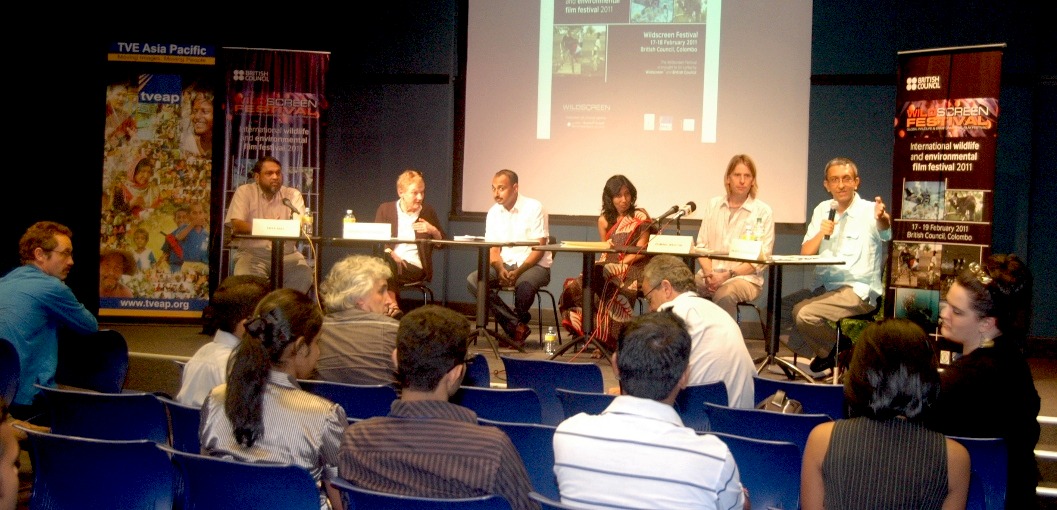
Wildscreen 2011 Colombo Panel: From L to R - Taya Diaz, Amanda Theunissen, Delon Weerasinghe, Anoma Rajakaruna, Dominic Weston and Nalaka Gunawardene

Is there an elite or ‘charmed’ circle of wildlife and natural history film makers in the world? If so, how does a new film maker break into this circle?

This is the question I posed to a group of visiting British film makers and their Sri Lankan counterparts during a panel discussion I moderated at the British Council Colombo on February 17 evening.

The panel, organised around the topic ‘Differences and mutual challenges in Asian, American and European productions/film making’, was part of the Wildscreen traveling film festival held hosted in Colombo, Sri Lanka, from 17 to 19 February 2011.

Amanda Theunissen, who has worked with the BBC Natural History Unit and National Geographic Television, gave a straight answer: yes, there is such a charmed circle.

And although she didn’t say it in so many words, it was clear from our overall discussions that the circle is jealously guarded, and it’s not easy for any newcomer to break into it. And the entry barrier becomes harder if the film maker is from the global South.

I opened the panel recalling the opening sentence of Our Common Future, the 1987 Report by the World Commission on Environment and Development: “The Earth is one but the world is not”. I said: “A similar disparity exists in wildlife and natural history film making. We are all covering the same planet Earth in all its splendour and diversity. But on this planet there are many different worlds of film making.”

I asked my five panelists — Amanda Theunissen and Dominic Weston from the UK, and Delon Weerasinghe, Anoma Rajakaruna, and Taya Diaz from Sri Lanka — to address three key challenges faced by all wildlife and natural history film makers everywhere: the art of effective story telling; fund raising to make films; and ensuring wide distribution of the films made.

The panel discussion was lively, wide-ranging and engaged the audience which comprised mostly aspiring film makers or film students. I didn’t want our discussion to scare any of them away from a career in environment and wildlife film making. But at the same time, we wanted to acknowledge the practical realities — and disparities — that exist within and across countries in this respect.

I’ve now written up a summary of the panel discussion for TVE Asia Pacific news. Its heading comes from a provocative question I asked during the panel: does wildlife film making operate on almost Darwinian rules?

Read the full story: Wildlife and Natural History Film making: Survival of the Fittest?
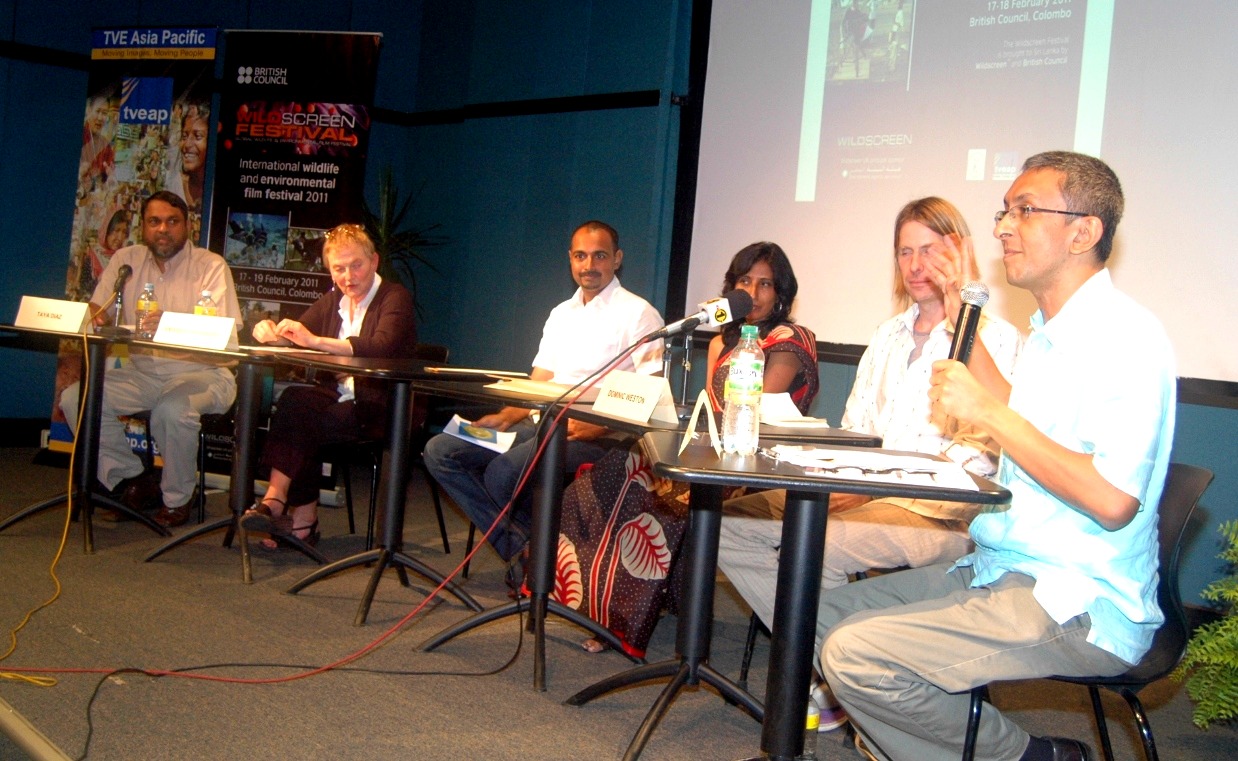
Wildscreen Colombo Panel: From L to R - Taya Diaz, Amanda Theunissen, Delon Weerasinghe, Anoma Rajakaruna, Dominic Weston, Nalaka Gunawardene

Wiz Quiz 5: Beware, the Fury of a Young Lady!

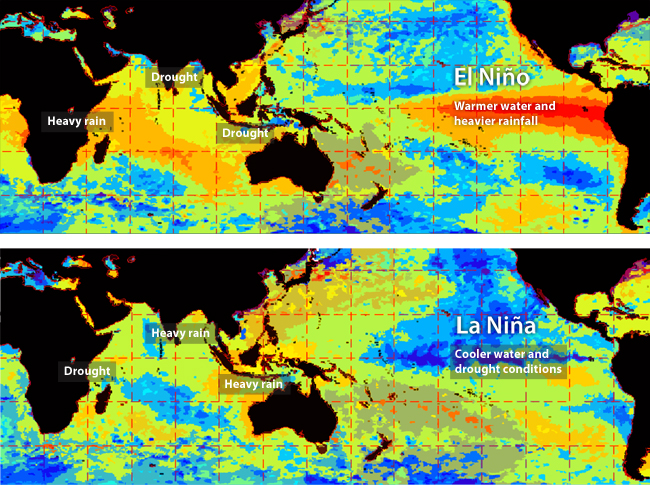
The current spell of heavy rainfall and resulting floods is being blamed on a phenomenon called La Niña. It involves both the ocean and atmosphere.

La Niña occurs when surface temperatures get cooler than normal (by 3 to 5 degrees Centigrade) in the western Pacific Ocean. During a La Niña, the cold water that pools near the coast of South America surges westwards across the mighty Pacific, the largest ocean in the world. This flow causes a greater build up of warmer water along the eastern coast of Australia and in the South East Asia region. The contrast in sea surface temperatures across the Pacific, as well as the contrast in air pressure, produces more rainfall.

La Niña is the Spanish term for “the girl child”. In that literal sense, the current weather extremes might be called the fury of a very formidable young lady! And it’s not the first time she has unleashed such havoc on us. This week in my quiz column, I started off with some questions on freaky weather, and then moved on to other topics.

Other ladies figure in the quiz: from Nobel Prize winning Marie Curie to Harry Potter creator J K Rowling. And we ask about the lady school teacher who died in the Challenger space shuttle disaster in February 1986.

Read Wiz Quiz 5: Fury of a Young Lady

Wiz Quiz 3: Wetlands are not Wastelands! Marking World Wetlands Day

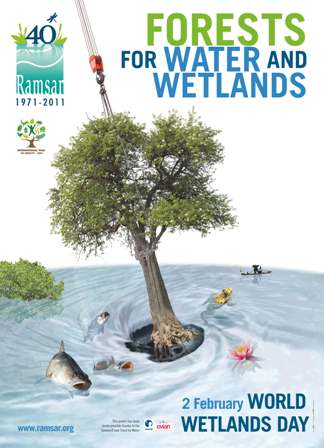
World Wetlands Day 2011 poster
World Wetlands Day is observed every year on 2 February. It marks the date of adopting a global treaty on wetlands 40 years ago, on 2 February 1971, in the Iranian city of Ramsar on the shores of the Caspian Sea.

Each year since 1997, government agencies, conservation organisations and citizen groups around the world have used this anniversary to undertake actions aimed at raising public awareness of wetland values and benefits in general — and of the Ramsar Convention in particular.

In this International Year of Forests 2011, the theme for World Wetlands Day is: Forests for water and wetlands. It also marks the 40th anniversary of the Ramsar Convention.

Bordering between dry land and total water, wetlands are one of Nature’s most productive regions, and home to a high number of plant and animal species. Covering about 6 per cent of the Earth’s surface, wetland types include swamps, marshes, lakes, salt marshes, mudflats, mangroves, coral reefs, fens, peat bogs, and other bodies of water – whether natural or artificial, permanent or temporary. Water within these areas may be static or flowing; fresh, brackish or saline; and can include inland rivers and coastal or marine water to a depth of six metres at low tide. There are even underground wetlands.

How fluid is your wetlands knowledge?
My weekly quiz in Daily News this week is devoted to the theme of wetlands — exploring their diversity, ecosystem services and threats to their survival.

Wiz Quiz 3: Wetlands are not Wastelands!

How do you measure progress? Say it in 3 min video!

How do you measure progress? Count simply the economic growth numbers? Or something more? Are people in richer countries necessarily happier? If not, what’s the key to real progress that makes people better economically, environmentally and socially?

The Organisation for Economic Co-operation and Development (OECD) wants to hear from young people about these issues through a video competition. To celebrate the OECD’s 50th Anniversary, young people worldwide are invited to create a short video describing their vision of Progress. In 3 mins, or 180 secs. The competition is open to young people (18-25 years) in every country worldwide.

Upload your video on YouTube and register online before MIDNIGHT (Paris time) on 1 March 2011. Details here. Promo video below:

Coping with a warming planet and WikiLeakable world: Common challenges

Time is ticking away...but crises also mean opportunities

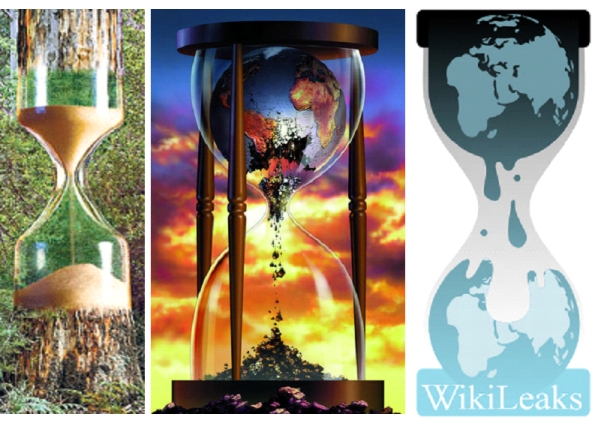
I like to think and speak in metaphors, especially visual metaphors. Sometimes I coin or design new ones. This illustration is the latest example.

Individual elements in this came from very different sources (thanks to them all). I just mixed them together to make two points during a talk I just gave at the Colombo University.

We live in a crisis-ridden world where we have to cope with multiple emergencies unfolding at the same time, impacting us on different fronts. This illustration captures three of them: crisis in biodiversity, man-made climate change, and the new reality of living in a rapidly WikiLeakable world — what I called the Global Glass House.

We don’t get to choose the timing, severity or duration of any challenge. But we do have some choice over how we respond: we can despair and grumble (blaming the Gods or karma if we believe in those); we can become really alarmist (a la Chicken Little); or we can be measured and smart in how we deal with the seemingly overwhelming situations.

Speaking at the Leaders in Environmental Advocacy Forum (LEAF) on Preserving the Past, Securing the Future on 22 January 2011 at the University of Colombo, I advocated this last option. I also pulled together a number of ideas mentioned on this blog over the past four years.

LEAF was a two-day summit held in Colombo, Sri Lanka, hosted by members of the Elon University’s Periclean Scholar Class of 2011, in partnership with the University of Colombo, the United States Embassy in Colombo, the National Science Foundation of Sri Lanka and Rainforest Rescue International.

My illustrated talk was titled “Telling Stories to Save Ourselves: Communicating on a Warming Planet” — I revisited an idea originally featured on this blog in mid 2007 (about Arabian Nights and their modern day relevance) and coupled that with a more recent proposal of mine: consider education and communication the third track of plank in humanity’s response to climate change (alongside climate mitigation and adaptation).

In fact, some challenges of living on a warming planet are comparable to coping with a WikiLeakable world: both demand quick adaptation to a new reality. In both cases, governments and society have to change mindset and practices on the go — business as usual is no longer an option. Denialism, or demonising the messenger, won’t take us forward. We need more measured, sometimes even pragmatic responses.

In that process, all-or-nothing is not a viable approach. Waiting for full knowledge and understanding is not feasible either. As I once described it, responding to the planet’s climate and other ecological crisis with partial scientific understanding is akin to many pages of our planet’s ‘operations manual’ being still completely blank — and yet we have to manage the planet to the best of our knowledge, intuition and common sense.

Many of the same principles apply to living in the modern networked info society, where no secrets can be kept that way for too long. The sooner we come to terms with this new reality and adapt, the better.

I’m delighted to see others are addressing these parallels. In my talk, I mentioned a recent essay titled Could climate science become open source? by Brendan Barrett and Sulayman K. Sowe, published earlier this month on the UN University’s Our World 2.0 website.

In their perceptive piece, the authors ask whether climate science would benefit by being more firmly grounded in the principles of openness, perhaps along the lines of the free and open source software communities and open content movements. “The concept of openness behind free and open source software describes a mode of creative knowledge production and sharing in which individuals and communities freely generate and adapt or remix resources (content or software) without licensing restrictions.”

They add: “Proposing a move to a new model of climate science in no way suggests that climate change is not a real and present threat or that we cannot rely on the integrity of our contemporary climate science institutions and scientists. Rather, the argument here is that learning from the way free and open source software projects and communities work may be an important way forward in engendering more effective global, national and local responses to climate change.”

I have always worn multiple ‘hats’, and dabbled in multiple pursuits rather than follow narrow paths of enquiry. I see myself continuing to oscillate between the ‘geeks’ and greens, and where possible, bridging their worlds. It’s really encouraging to see some others straddling the two spheres.

Statistics made simple: Global Village of 100 = World of 7 billion

The Earth is one, but the world is not...

As I wrote the other day, during 2011, human numbers will add up to 7 billion. That is 7,000,000,000 living and breathing people.

But how many of us can grasp such a large number? I can size up a gathering of a few hundred people, or at the most, a couple of thousand. After that, I lose count…and I’m not alone.

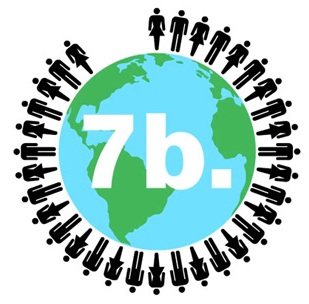
That’s why the idea of a Global Village of 100 is so very useful. It’s based on a simple yet profound premise: if we could reduce the world’s population to a village of precisely 100 people, with all existing human ratios remaining the same, what would it look like?

The idea was the brainchild of Donella Meadows, a pioneering American environmental scientist, teacher and writer. She is best known as lead author of the influential book The Limits to Growth (1972).

It was first published in May 1990 with the title “State of the Village Report”, and Meadows originally envisaged a village of one thousand people. This approach to showing the global disparities was so refreshing and accessible that it soon spread among educators, journalists and activists — in today’s Internet terms, we would call that ‘going viral’.

David Copeland, a surveyor and environmental activist, revised the report to reflect a village of 100 and single-handedly distributed 50,000 copies of a Value Earth poster at the 1992 Earth Summit in Rio de Janiero.
What happened after that is recounted in this brief history by Carolyn Jones, adapted by Bob Abramms.

The analogy has been revised every few years to reflect the changing demographics and global development trends. The practice is now sustained by the Miniature Earth Project, whose latest animated video version for 2010 runs as this:

There is also the 100 People Foundation (www.100people.org) which is “committed to simplifying and humanizing complex global statistics by looking at the world as a community of 100 people”. They provide media and educational tools to teachers around the world to help them teach a global view, and inspire their students to learn more about their global neighbors. Here’s their own video:

100 People: A World Portrait Trailer


Here’s another variation on the theme, set to John Lenon’s ‘Imagine’:

If the world were a village of 100 people…
This cartoon animation uses the same approach, but with emphasis on linguistic and cultural diversity.

2011: The Year We Hit 7 Billion…Are we ready?

Coming soon to a planet near you: 7 Billion...and counting

Sometime during 2011, human numbers will add up to 7 billion.

That is 7,000,000,000 living and breathing people — all of who will need to be fed, clothed, sheltered and cared for in many other ways.

During this year, National Geographic magazine will publish a 7-part series examining specific challenges and solutions to the issues we face. The magazine introduces the series with its January cover story “7 Billion,” offering a broad overview of demographic trends that got us to today and will impact us all tomorrow. The first in-depth story will appear in the March issue, focusing on humans’ impact on the planet’s geology. Other stories will follow throughout 2011.

This clever video accompanies the coverage:

Correction added by NatGeo editors: in 2050, 70% of the population will be living in “urban areas,” not “megacities” as stated in an earlier version of this video.

A world party of 7 Billion?
In another short video on National Geographic website, Nigel Holmes imagines how much space we would need to host a world party for 7 billion people in 2011.

I don’t like the word population: it sounds cold, clinical and detached. Zoologists can talk about ant populations or elephant populations, but when demographers (and others, including journalists) refer to our the counting of species as human population, I somehow feel it’s too impersonal. Aren’t we more than mere numbers?

So in my own writing and TV scripts, I use the phrase human numbers.

Can you visualise 7 billion?
Semantics apart, our rising numbers are indeed a cause for concern. We didn’t quite see the ‘population bomb’ go off the way we were warned about – thank the secular Force – but we still face formidable challenges.

In 1987 — the year I entered journalism — human numbers passed five billion. A dozen years later, in 1999, the six billion was reached. By then, I too had added my contribution of one co-produced human being. Soon in 2011, we will be seven billion.

Our planet’s natural systems are over-stretched not only by our sheer numbers, but also by our technologies and consumption. The many signs of planetary stress include accelerated loss of species, fast spreading deserts, and declining air and water quality. To cap it all, scientists now confirm that human activity is changing our climate.

On the New York Times Dot Earth blog, science writer Andrew C. Revkin regularly examines efforts to balance human affairs with the planet’s limits.

Eco campaign tells car-happy Chinese: Walk more, drive less!

Global Green Awards for Creativity in Sustainability 2010

China’s emergence as a major automobile market has led to high levels of air pollution in the cities. It has also caused an increase in the country’s carbon dioxide emissions that warm the planet.

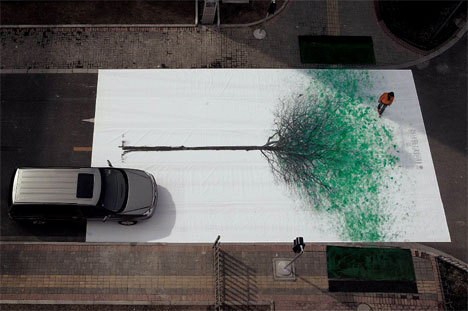
Now, an innovative outdoor campaign, called green pedestrian crossing, is urging Chinese people to walk more and drive less.

This campaign targeted young Chinese people who chose to drive over walking. The campaign involved the creation of an outdoor poster advertisement on pedestrian crossings across 7 thoroughfares in Shanghai.

Green pedestrian crossingThe China Environmental Protection Foundation, in association with DDB China Group (a marketing communications company), has won the Grand Prix at the 2010 Global Green Awards for Creativity in Sustainability.

The Green Awards, presented from the UK, culminated on December 2 with a glittering, ‘green carpet’ event at the Natural History Museum in London. The awards ceremony announced winners for all 16 categories and the 2010 Grand Prix. I was one of the international judges for this year’s awards.

The Green Awards Grand Prix is given to the overall winner which is judged the best amongst all the entries. It is meant to recognise a campaign which, in the opinion of the expert judging panel, best exemplified an outstanding environmental message, and had the greatest capacity to raise public awareness.

Judges were impressed by the creativity shown by the campaign and the simple and effective use of local knowledge. Moreover, the results of the campaign supported the judges’ decision. The campaign reached an estimated 3.9 million people and increased general public awareness about environmental awareness by 86%.

Watch video about the campaign:


Read full list of 2010 winners

Saving Biodiversity…from Evolution’s Most Dangerous Creature!

The United Nations designated 2010 as the International Year of Biodiversity (IYB). It is a celebration of biological diversity and its value for life on Earth, taking place around the world throughout the year 2010.

The 10th meeting of the Conference of the Parties (COP 10) of the Convention on Biological Diversity is being held in Nagoya, Aichi Prefecture, Japan, from 18 to 29 October 2010.

To mark these twin events, we feature some short videos on biodiversity found online.

Official video of the International Year of Biodiversity 2010

This video, produced by our friends at dev.tv in Geneva for the CBD Secretariat, is superbly crafted and engagingly presented. It visualises the core message of IYB 2010:
Biodiversity is life
Biodiversity is our life

Biodiversity Countdown 2010 video
In the puzzle of life each element is essential. Man has the power to do good, do bad, destroy or protect. What will you do?

Nature Our Precious Web: A photo montage

The exhibition is the result of a collaboration between Geo Magazine, GTZ, Countdown 2010, the Secretariat of the Convention on Biological Diversity and the United Nations Development Programme.

And finally, here’s an example of how not to produce a video on biodiversity. This 2006 film, made for the CBD Secretariat, has a good sound track and some excellent still photos. But it’s evidently been put together by a committee of UN agency officials and/or researchers who wanted to pack everything into 5 mins. The result – a wasted opportunity.

Nature, Inc. TV series: Exploring the planet’s largest ‘enterprise’!

Nature is priceless -- or is i? The answer might save us all!
Nature is priceless — or is it?

If we put a cash price on the economic services that, say, watersheds or insects or coastal mangroves provide, would we value Nature more? Would we be prepared to change our ways of measuring wealth and economic growth? And if we did, would that slow down the extinctions and collapse of ecosystems?

These are some of the issues that are explored in Nature, Inc., a path-breaking TV documentary series that puts a price-tag on environmental services such as forests, wildlife and coral reefs.

First broadcast in 2008 and 2009 on BBC World News, Nature Inc. broke new ground for environmental programming by seeking out a new breed of investor – those who believe they can make money out of saving the planet.

Watch Nature, Inc. series trailer:

Nature Inc. offers new insights into valuing the benefits of natural systems and biodiversity. It takes its lead from economists who have worked out that ecosystem services are worth more than the total of all the world’s national economies.

The first and second series are now available from TVE Asia Pacific (TVEAP). Each series comprises six half-hour episodes, compacting stories filmed in different parts of the world. Broadcast, civil society and educational users across the Asia Pacific may order copies at the cost of duplication and dispatch, and without having to pay a license fee.

The series was produced by One Planet Pictures of the UK, in association with dev.tv of Switzerland.

“There is new green thinking out there and some of it is grappling with pricing renewable assets. As such we felt it was a legitimate new area to take as an organising theme for the new series,” says Robert Lamb, series producer of Nature, Inc. “Perhaps the global recession has made viewers more aware of the ‘eco’ in economics”.

Robert Lamb
The series is based on new research and analysis being done on the subject. Among these new studies is the Economics of Ecosystems and Biodiversity (TEEB), a major international initiative to draw attention to the global economic benefits of biodiversity, to highlight the growing costs of biodiversity loss and ecosystem degradation, and to draw together expertise from the fields of science, economics and policy to enable practical actions moving forward.

But adding a price tag to Nature is not something that pleases all scientists or activists. Robert says the producers received “an overwhelmingly positive reaction” to the first series, but there was also a small minority who wrote in to say they hated the premise of the whole series.

He adds: “That’s good, we want to foster discussion in Nature Inc. which is why we are encouraging viewers to contribute ideas for the next series.”

Read Robert Lamb’s reflections on the Making of Nature, Inc. TV series

Here’s a sample episode from the series, titled Coral Cashpoint. In this, Nature Inc investigates a claim that our coral reefs are worth $30 billion a year. In this fourth episode, we go diving on the Great Barrier Reef, the Maldives and to the bottom of the North Sea to find out how coral reefs supply 500 million of us with food and work. But we are destroying the reefs so quickly, they could vanish entirely in less than a hundred years.

Nature, Inc: Coral Cashpoint – Part 1 of 2

Nature, Inc: Coral Cashpoint – Part 2 of 2