In the environment and development circles, all the roads these days seem to lead to Copenhagen.
That’s because the Danish capital will be hosting the 15th conference of parties (COP15) of the UN Framework Convention on Climate Change, or UN-FCCC from 7 to 18 December 2009.
All sorts of campaigns are underway to raise awareness and build up consensus — a tough call when nations of the world are bickering endlessly as the planet warms up.
Now, CNN and YouTube have created Raise Your Voice campaign: it allows your voice to be amplified to the world leaders at COP15 – the most important climate change conference in a decade.
Here’s the blurb: As nations seek an agreement to protect the world we want your views from across the spectrum.
What needs to be done?
How do the issues affect you?
Do you agree there needs to be action?
There is a breathtaking short video now on YouTube supporting this call:
Click here to send a video with your views, opinions and questions. The best contributions will be aired during the COP15 CNN/YouTube TV debate on December 15.
Tata Young, 28, is a Thai-American singer, model and actress who is one of the best known performers in Thailand, with a growing following across Southeast Asia. Last week, she was among the performers at the “What on Earth!” concert in Bangkok, part of the EU Green Days event to coincide with the latest round of negotiations of the UN Framework Convention on Climate Change, UN-FCCC.
Tata is the latest Asian entertainment celebrity to join the climate bandwagon. Inside the UN Convention Centre in Bangkok, the climate negotiations were making slow progress. Environmental activists and campaigners were trying every trick in their books to speed things up — but governments bickered over selfish interests even as the planet heated up.
Tata’s newest album, Ready for Love, has its cover printed on recycled paper and sports a sticker that says “Protect the Ozone Layer”. Her interest in campaigning for ozone was sparked when she donated her time filming an ozone related public service announcement for UNEP last year.
The PSA is one of four that UNEP’s ozone team in Asia produced in 2008 as part of their public awareness campaign. They all draw attention to an important date that is drawing close: by or before 1 January 2010, all consumption and production of chlorofluorocarbons, or CFCs, one of the main destroyers of the ozone layer would be phased out in all countries of the world. That is a significant achievement under the Montreal Protocol that nations of the world adopted in 1987 to save the endangered ozone layer.
The PSAs started screening in movie theatres in the Philippines earlier this year, to be followed by Thailand and other countries in the region.
Watch Tata Young’s ozone PSA for UNEP:
In June this year, talking to journalist Nirmal Ghosh, Tata Young said: “It’s important that people are aware of the little things you can do to protect our world, are aware (of ozone) and know what’s going on, especially because unlike garbage and other types of pollution, you can’t see the ozone layer.”
Tata is now singing and speaking for the ozone layer on her own steam. Unlike some other UN agencies, UNEP does not have a formal goodwill ambassador programme. But she has de facto become one.
Full credit to her for this choice. After all, the Ozone Layer – located between 10 and 50 kilometres above the Earth, and invisible to the naked eye – is not something tangible like cuddly animals or endangered plants. Moving ordinary people to care for something they can’t see or touch is that much harder, even if all life on Earth depends critically on it (the Ozone Layer absorbs most of the Sun’s harmful ultra-violet days).
Tata used to hit the headlines in Thailand for some songs which were considered a little too ‘hot’ for the conservative guardians of culture. But looking at the less-than-glacial pace kept by climate change talks in Bangkok, perhaps activists should roll out Tata Young to turn on the heat…
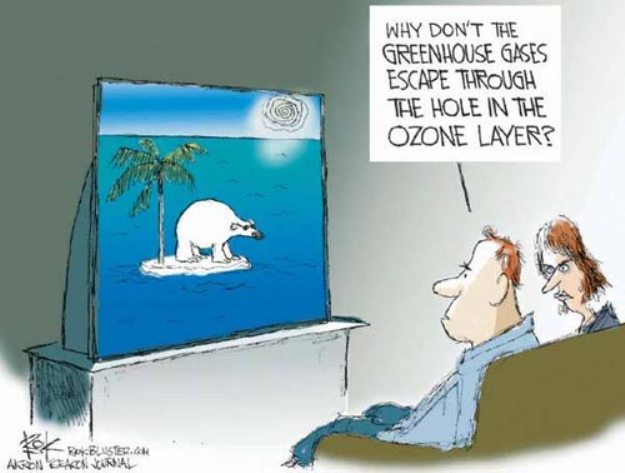
Don’t laugh. The perception of the TV viewer in this cartoon (which first appeared a couple of years ago in the Akron Beacon Journal in Ohio, United States) is more common that you’d think. In recent years, as climate change rose up in the media’s news agenda and the public’s list of concerns, I have met a number of people – from across educational and cultural spectra – who harbour similar confusion about the two issues.
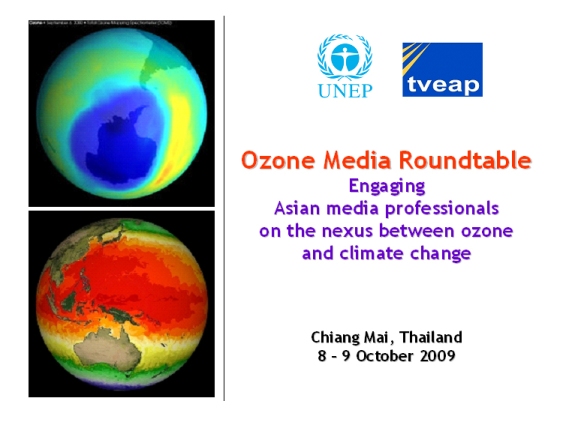
I showed this cartoon, and referred to the wide-spread confusion, in my opening remarks to the Ozone Media Roundtable, an event to engage Asian media professionals on the nexus between ozone depletion and climate change. The meeting, held in Chiang Mai, Thailand, on 8 – 9 October 2009, was organised jointly by the United Nations Environment Programme (UNEP) and TVE Asia Pacific for invited senior journalists and broadcasters from the Asia Pacific region.
Ozone layer depletion and climate change are linked in a number of ways, but ozone depletion is not a direct or major cause of climate change.
In fact, the relationship between ozone and climate is both complex and nuanced, which has prompted some experts to call it a ‘Tango in the Atmosphere’. Ozone affects climate, and climate affects ozone. The authoritative UNEP GRID Arendal website says: “Ozone depletion and climate change are two distinct problems but as they both modify global cycles, they cannot be totally separated. There are still many uncertainties concerning the relations between the two processes.”
In recent years, research has outlined that global efforts to protect the ozone layer has also delivered climate benefits as many of the chemicals that damage the ozone layer – such as chloroflurocarbons or CFCs – also cause global warming.
In 2007 a scientific paper calculated the climate mitigation benefits of the ozone treaty as totalling an equivalent of 135 billion tonnes of C02 since 1990 or a delay in global warming of seven to 12 years. That same year countries meeting in Canada, under the Montreal Protocol, agreed to an accelerated freeze and phase-out of Hydrochloroflurocarbons (HCFCs)—chemicals designed to replace the old, more ozone-damaging CFCs – in the main for the climate benefits.
If an alien spaceship were to randomly descend to the one third of our planet that is not covered by ocean, chances are high that it would land on a rice field.
So I was told a few years ago, when spending time with some rice researchers. Rice is the most widely cultivated food crop in the world. It is also the most important staple food for a large part of the world’s human population, especially in East Asia, South Asia, Southeast Asia, Latin America and the West Indies. From risotto to sushi to paella, food-savvy consumers are using rice as the main ingredient in recipes from around the world. Rice lends substance and texture to many dishes.
Despite all this, rice is under some pressures both economically and culturally. For one thing, it has been taken for granted by many of those who regularly have a ‘rice day’ and think nothing further about it.
How effective do you think this award will be?
When we set out on this joint effort, we posed two big questions: What feeds 3 billion people? And what is slowly but surely disappearing without anyone noticing it? The answer to both questions is Rice! We wanted this film award to draw attention to the central role that rice plays in Asian and Pacific cultures and economies. The measure of our success will be a long term one, and will depend on how many take part in this competition and how far and wide we will be able to distribute their creative efforts.
Why do you think Asia is in need for a wake up call on the subject of rice?
Rice one of our most revered treasures in the Asia Pacific, and many of us take it for granted. It is central to the Asian way of life — its cultural heritage and diversity, spirituality and traditions. This precious rice heritage is under threat from corporate or industrialized agriculture, neo-liberal globalization, private control of the rice seeds, and genetic engineering of the rice genome. Rice lands are also being torn away from small rice farming communities in the name of “development” projects such as special economic zones, cash cropping, and agro-fuel plantations.
Pesticide Action Network Asia Pacific (PAN-AP) has for the last two decades championed the food sovereignty of the grassroots, namely, farmers, agricultural workers, indigenous people and consumers. In 2003, PAN-AP launched the SAVE OUR RICE CAMPAIGN. It is founded on Five Pillars of Rice Wisdom: Rice Culture, Community Wisdom, Biodiversity based Ecological Agriculture, Safe Food and Food Sovereignty. Last year, PAN-AP joined TVE Asia Pacific and Public Media Agency to organise this film competition as part of the on-going campaign. We all share the ideals of promoting rice in Asia and the Pacific.
APRFA co-organisersWhat would you be looking out for in the short films?
The Asia Pacific Rice Film Award will be presented to creators of short innovative television, video or cinematic films that effectively educate the public on the role of rice in Asian cultures, economies and communities/societies. The films should use the ‘Five Pillars of Rice Wisdom’ as guiding principles. They should enhance appreciation of the rice heritage of Asia; raise public awareness of the issues on and threats to rice; highlight the role of small farmers, women in rice; strengthen the people’s resolve and action to save rice; and encourage a stronger role for youth in rice.
Any tips for the participants?
We are looking for short films that are innovative, imaginative and ultimately effective in raising public awareness. Rice may be a pervasive topic in Asia, but the threats to rice are not yet widely appreciated. How do we take this message to the three billion rice growers and eaters of Asia using moving images? How do we engage the YouTube generation – predominantly youthful populations of Asia – with films that open eyes and provoke minds to think further? What would work best — factual reportage, drama, humour, performing arts or other formats? These questions are worth pondering. As organisers, we are open to all formats. We want to be surprised!
After all this, what would be the next step/project?
As I said, this is an on-going campaign, so the winning and commended entries will become new tools and resources for that campaign. Making films and ranking them is only the first half of our shared challenge. We then have to get these films distributed far and wide, using broadcast, narrowcast, webcast and mobile platforms. Three billion people means six billion eye balls that need to be reached! That should keep all of us busy for a while…
A tale of two iconic images...
I am in Chiang Mai, northern Thailand, conducting the Ozone Media Roundtable, a high level event to engage Asian media professionals on the nexus between ozone depletion and climate change. The meeting, held on 8 – 9 October 2009, is organised jointly by the United Nations Environment Programme (UNEP) and TVE Asia Pacific for invited senior journalists and broadcasters from the Asia Pacific region.
TVE Asia Pacific and UNEP convened the roundtable meeting in Chiang Mai to explore the ozone/climate nexus from a communications perspective. We brought together a small group of senior journalists and broadcasters who have been covering ozone and/or climate issues. We also invited a few ozone and climate technical experts to discuss the close links between ozone layer protection and climate change mitigation.
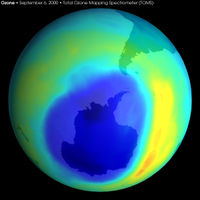
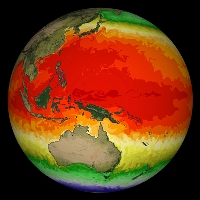
I work with moving images, but I also know the power of still images — especially when they are highly symbolic. Looking for a good visual link between ozone depletion and climate change, I came up with two images of our planet, seen in different ways that represent the two global environmental challenges.
Largest ever Ozone hole, Sept 2000The first image is better known, and is a colour enhanced satellite image of the Ozone Hole that was discovered in 1985 by British scientists Joesph Farman, Brian Gardiner and Jonathan Shanklin of the British Antarctic Survey. The ozone “hole” is really a reduction in concentrations of ozone high above the earth in the stratosphere. It is defined geographically as the area wherein the total ozone amount is less than 220 Dobson Units.
This discover was largely responsible for galvanising international attention and response to the threat of ozone depletion. After a series of inter-governmental meetings and negotiations, the Montreal Protocol on Substances that Deplete the Ozone Layer was finally agreed upon on 16 September 1987 at the headquarters of the International Civil Aviation Organization in Montreal.
Temperature projection for Year 2100The second image is not as widely known, but represents an even greater environmental calamity that is currently unfolding: global warming and rapid changes in climate it has triggered. The image is a colour enhanced image of the Earth’s temperatures in 2100 AD (less than a century from now), as projected by the Earth Simulator — one of the world’s most powerful supercomputers — which Japanese scientists use to project the climatic disasters in next 100 years.
The system was developed in 1997 for running global climate models to evaluate the effects of global warming and problems in solid earth geophysics. It has been able to run holistic simulations of global climate in both the atmosphere and the oceans — down to a resolution of 10 km.
Between these two images, we are looking at two of the biggest environmental challenges of our times. How the climate crisis can learn valuable lessons from the ozone crisis is what we discussed at the Ozone Media Roundtable.
How much can you pack in to one minute, or 60 seconds? That’s a lot of air time, as broadcasters and advertisers know very well.
‘One Minute to Midnight‘ has been a favourite metaphor of dooms-dayers – and is the title of a 2008 book. It was widely used in relation to the world drawing closer to nuclear war during the second half of the 20th century.
Now, as global climate change surpasses fears of global nuclear war, we are given just one minute to save the world.
One Minute to Save the World is an international short film competition to raise awareness of climate change. Entries are currently being sought from professionals and amateurs, with 31 October 2009 as the deadline. There is also a category for under 18s and for entries shot on mobile phones.
The idea is to enable anyone, anywhere, to deliver a short but powerful message to the world on climate change. The winning films will be sent around the world in November as an online campaign to raise awareness of the Copenhagen Climate Conference in December 2009.
Good planets are hard to find...British TV presenter and adventurer Bruce Parry, a founder of the competition, says: “Together we will be looking for films that convey a powerful message about how climate change affects you and those around you. Were you a flood victim? Have you seen a change in the plants and wildlife in your garden? How has your world been affected and how can we address it?
He adds: “So, we hope you’ll all get thinking and shooting – whether you’re a seasoned pro or just someone who cares. Your planet needs you and your talents. One minute might not seem like a long time but it’s actually longer than many advertisers spend hundreds of thousands of pounds on. It’s also an easy length of time to hold people’s attention. And that is one of the things we urgently need to do if we’re going to turn things around for our planet before it’s too late.”
The winning entries will be judged by an international panel that includes Parry himself, award-winning director and climate change activist Shekhar Kapur; Franny Armstrong, director of Age of Stupid and The Guardian‘s environment editor John Vidal.
The website will become an online film festival which requires no travel or celebrity status to attend – all you need is access to a computer. “And as everyone knows, the power of the net can make the most unexpected video attract the attention of millions globally,” says Bruce Parry.
Whatever we might think about the artistic and technical merits of his climate film An Inconvenient Truth, it has settled with a resounding ‘yes’ one question: can a single film make a difference in tipping public opinion about a matter of global importance?
But the climate crisis that confronts us is so formidable that we need many more Al Gores to come up with as many moving images creations as they can.
Their call out for all climate films says: “This December thousands of delegates, decision makers, stakeholders and activists will converge on Copenhagen. To be part of this EngageMedia is putting together a compilation of Asia-Pacific climate films to be screened and distributed at the event and around the world. Submit your film to EngageMedia and be part of the action. Global action is urgent and essential – the time for debate is over.”
TVE Asia Pacific, already a partner on EngageMedia platform, is submitting all its recently produced climate change films.
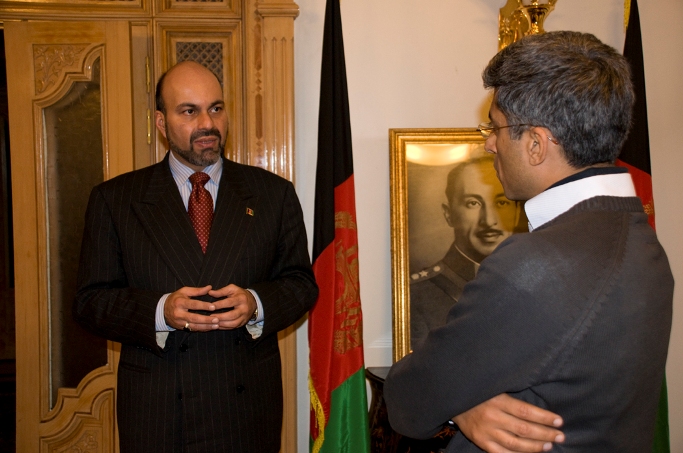
Prince Mostapha Zaher (left) with Rohit Gandhi in Kabul
I haven’t yet met Prince Mostapha Zaher in person, but feel almost as if I have. That’s because he features prominently in a short documentary film we released earlier this year on the environmental problems in Kabul, the capital of Afghanistan — where he is now the environmental chief, and where his grandfather was Afghanistan’s last king, Mohammed Zahir Shah (1914-2007).
In January 2009, I was watching a rough edit of the film (Breathing Life into Kabul) in Delhi, where Indian film-maker Rohit Gandhi was putting it together. In the interview, Mostapha Zaher came across as authoritative and resolute.
And does he have formidable challenges to deal with! Since the Taliban regime fell in 2001, people have been returning to Afghanistan after years in neighbouring countries. This massive influx is exerting pressure on the resources and infrastructure of the capital Kabul. Among the effects are high levels of air and water pollution, massive shortages of electricity and mounting problems waste.
Addressing these and other environmental issues is made that much more difficult because Afghanistan is one of the poorest countries in Asia, where large parts of the country are still engulfed in a prolonged conflict with extremists and the Taliban.
Says TIME: “Since then he has worked to rewrite the nation’s environmental laws, enshrining in the constitution an act that declares it the responsibility of every Afghan citizen to “protect the environment, conserve the environment and to hand it over to the next generation in the most pristine condition possible.” In a country ravaged by 25 years of war, it was an extraordinary feat.”
Apart from the typhoons that blow in from the Pacific Ocean, the Philippines also sits on the Pacific Rim of Fire where periodic earthquakes occur, and active volcanoes are found.
Disasters not only kill or injure people and cause property damage; they also disrupt livelihoods and cultural practices. That’s what happened when the volcanic Mount Pinatubo erupted in 1991, its lava and ashes destroyed many surrounding villages – including the traditional homeland of the Ayta, indigenous people descending from the first inhabitants of the Philippines. They had fled to the hills from the lowlands during the protracted Spanish conquest of the Philippines which first commenced in 1565.
Today, resettled elsewhere on Luzon island, the Ayta are trying to preserve their traditional culture and community integrity through education and theatre. These efforts are supported by the Ayta organisation PBAZ, part of the Education for Life Foundation. Going back to the abandoned village is one way of keeping memories alive.
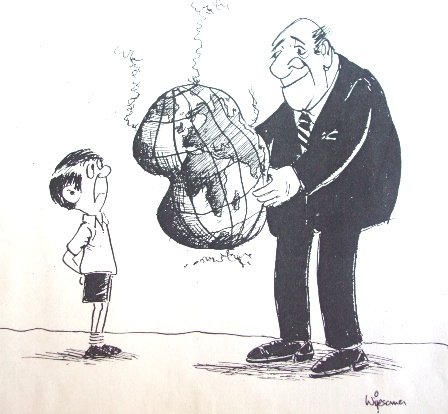
Passing the buck? Cartoon by W R WijesomaThis was one of the most memorable cartoons drawn by W.R. Wijesoma, Sri Lanka’s pre-eminent political cartoonist (and my one-time colleague). If I remember right, it first appeared sometime in the late 1980s in ‘Mihikatha’, Sri Lanka’s first all-environmental newspaper.
Alas, both Mihikatha and Wijesoma are no more among us. But the message in this cartoon is more timely than ever before.
“Is this what we are going to hand over to our future generations? Please……no!” was the emphatic message from Yugratna Srivastava, a 13-year-old Indian girl who addressed over 100 world leaders gathered at the United Nations headquarters on 22 September 2009 for the historic Summit on Climate Change.
Passing the ball – or buck – is something that governments are good at. Most governments are so narrowly focused on the now and here, and sometimes rightfully so, that they have neither the time nor interest for medium to long term scenarios. As I wrote earlier this week, “it’s going to take many more meetings, bickering and hard bargaining before the leaders begin to think in terms of the next generation.”
This is where citizen action comes in. Governments are not going to save this planet from environmental catastrophes; if at all, it would be the ordinary people. This is the premise of TVE Asia Pacific’s latest Asian TV series, Saving the Planet.
Where does the buck stop?
Governments, experts and big corporations alone cannot solve all these problems. Real change requires changing how each and every human being lives and works. Education becomes the biggest key to achieving environmentally sustainable development at local and global levels.
Filmed in six countries in South and Southeast Asia, Saving the Planet profiles groups working quietly and relentlessly to spread knowledge, understanding and attitudes that inspire action that will help humans to live in harmony with the planet. They often work without external funding and beyond the media spotlight. They have persisted with clarity of vision, sincerity of purpose and sheer determination. Their stories inspire many others to pursue grassroots action for a cleaner and safer planet.
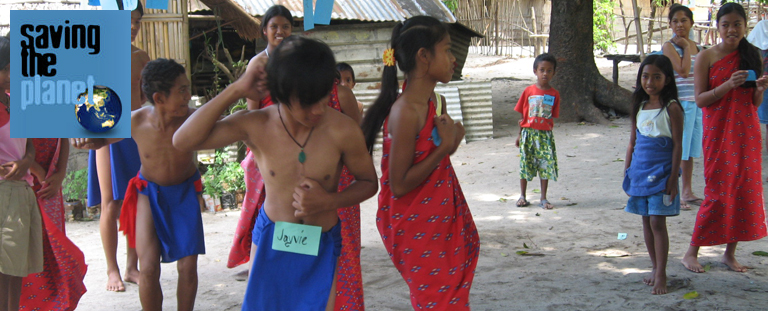
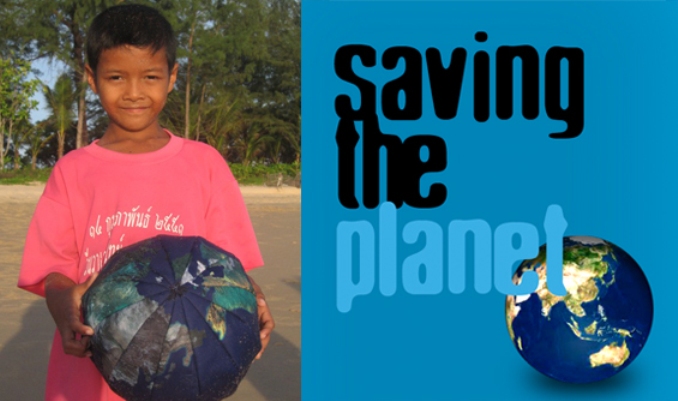
We tried out a creative idea for the series opening sequence (20 seconds), an extended version of which became the series trailer (see below). It was planned and filmed in all the six countries where the stories came from — Cambodia, India, Laos, Nepal, the Philippines and Thailand. In each country, our roving director-producers filmed different individuals – young and old, men and women, in all their Asian diversity – passing around an inflated ball made to look like planet Earth.
I know my colleagues had fun filming these sequences, and back in our studio, it was also great fun to mix and match these various shots to create the apparently seamless passing around of our planet in peril. (Who said planet saving cannot be fun?)
Watch Saving the Planet trailer (1 minute):
Now it can be revealed: our original inspiration came from an unexpected source: the world’s largest media corporation, Google! In one brainstorming, our then production coordinator Buddhini Ekanayake remembered an open challenge that Google had made online just before introducing their email service, GMail. Google asked people to “imagine how an email message travels around the world” using a video camera.
In all, Google received over 1,100 clips from fans in more than 65 countries around the world — each one of them a different creative idea, playing with the iconic Gmail M-velope.
“The clips you submitted were amazing and it was hard to choose selections for the final video,” Google said when releasing the outcome of this collaborative video project.







 Open Minds!