Is UK’s Channel 4 the latest ‘Fossil Fool’?

Even as climate change gathers momentum as a worldwide concern, more media organisations are ending up with egg on their face about their coverage of the issue.

Last month, I quoted British environmentalist George Monbiot about the BBC’s appalling track record on this: see ‘The BBC as a Fossil Fool’, 7 April 2007.

And now, UK’s Channel Four can make its own claims to be a Fossil Fool.

The Independent on 8 May 2007 reported that the makers of a Channel 4 documentary which claimed that global warming is a swindle have been accused of fabricating data by one of the scientists who participated in the film.

The Great Global Warming Swindle was broadcast on 8 March and has been criticised by leading scientists for errors, distortions and misrepresentations.

Image courtesy Channel 4

The article reads:

The film has also been referred to the UK regulatory watchdog OFCOM which is considering a complaint from 37 senior scientists that the programme breached the broadcasting code on the misrepresentation of views and facts.

Now even a climate sceptic whose dissenting views were used by the film-makers to bolster their claims about the “lies” and “swindles” of global warming has accused the documentary of promulgating falsehoods.

Eigil Friis-Christensen, director of the Danish National Space Centre, has issued a statement accusing the film-makers of fabricating data based on his work looking at the links between solar activity and global temperatures.

The scientists who have written to Ofcom include Sir John Houghton, the former chief executive of the Met Office, Lord May of Oxford, a former government chief scientist and past-president of the Royal Society, and Professor Chris Rapley, director of the British Antarctic Survey in Cambridge. In a letter to Mr Durkin they call for changes to the programme before the DVD version is released, even though DVDs are not covered by the Ofcom Broadcasting Code.

“So serious and fundamental are the misrepresentations that the distribution of the DVD without their removal amounts to nothing more than an exercise in misleading the public,” they say.

Image courtesy the film's website

Commenting on the documentary on 13 March 2007, George Monbiot wrote in The Guardian:

The problem with The Great Global Warming Swindle…is that to make its case it relies not on future visionaries, but on people whose findings have already been proved wrong. The implications could not be graver. Just as the government launches its climate change bill and Gordon Brown and David Cameron start jostling to establish their green credentials, thousands have been misled into believing there is no problem to address.

The film’s main contention is that the current increase in global temperatures is caused not by rising greenhouse gases, but by changes in the activity of the sun. It is built around the discovery in 1991 by the Danish atmospheric physicist Dr Eigil Friis-Christensen that recent temperature variations on Earth are in “strikingly good agreement” with the length of the cycle of sunspots. Unfortunately, he found nothing of the kind.

Read full commentary by George Monbiot in The Guardian 13 March 2007

Read the full article by Steve Connor in The Independent online on 8 May 2007

The Great Global Warming Swindle website

Profile of film’s director, Martin Durkin

Nepal’s Aankhijhyal is 500 — and counting!

Aankhijhyal is a Nepali word. It means window.

Aankhijhyal is today also a ‘brand name’ in Nepal. It’s Nepal’s most popular TV magazine programme on environment and social development, which recently produced its 500th edition.

Aankhijhyal logo NEFEJ logo

The half-hour programme has been produced regularly since May 1994. Now in its 13th year, it is one of developing Asia’s longest running television shows.

The landmark 500th edition was broadcast on 27 February 2007. In this special programme, its producers, the Nepal Forum of Environmental Journalists (NEFEJ), looked back at the interesting and challenging times they have chronicled and investigated.

And last night in Kathmandu, the Nepali capital, I sat down with a team of friends from NEFEJ to belatedly celebrate the occasion.

A dozen journalists, producers and film-makers joined us. We chatted away well into the night. There was no longer any worries about curfews and army check-points.

“We don’t often get together like this as one big group,” said Rabindra Pandey, head of Audio-Visual at NEFEJ. “Most of the time, we are too busy to socialise. We are chasing deadlines, or stories, or sponsors!”

There is much to cheer, both at micro and macro levels.

Sustaining a half-hour show on television is no mean feat in any part of the world, especially in a low income country like Nepal. Broadcasters here don’t put any money in programmes like Aankhijhyal . In fact, NEFEJ not only produces the show entirely at its own cost, but also pays for airtime on Nepal Television to get it out to the public! That’s the broadcast reality that many of our western colleagues are often unable to understand.

And the general feeling right now in Nepal is upbeat. After Nepal’s own People Power revolution of April 2006, people are hopeful that their ‘second chance in democracy’ can actually work better. While the streets of Nepal are as dusty and chaotic as ever, I can see far more tourists and far fewer soldiers on the roads now than on previous visits in recent years.

NEFEJ is a non-profit collective of journalists committed to communicating sustainable development issues. Foundecd 20 years ago, it has a much better record of democracy than Nepal itself: every year, office-bearers are democractically elected by its over 100 members. There is regular ‘change of guard’ at the top.

NEFEJ is also one of the oldest and strongest parters for us at TVE Asia Pacific.

Aankhijhyal is the organisation’s ‘crown jewel’. It’s the centrepiece of NEFEJ’s Audio Visual Department, and has been widely acclaimed for its investigative approach to sustainable development and social justice issues.

From land reform and agrochemical misuse to the conservation of heritage sites, and from the trafficking of women and children to HIV, Aankhijhyal has been covering a broad range of issues, concerns and controversies in the public interest. While remaining apolitical, the programme has also reflected the human, social and environmental costs of Nepal’s violent insurgency and pro-democracy struggle in recent years.

Filming Aankhijhyal - image courtesy NEFEJ

“Since its inception in 1993, we have come a long way and Aankhijhyal has managed to create awareness among the Nepalis on the issues related to environment and development,” says Rabindra. “Aankhijhyal still remains one of the most popular video magazines on Nepal Television.”

Aankhijhyal’s passing 500 editions is all the more significant because it has been sustained without a break by this non-profit cooperative of journalists. Whether or not external funding was available, NEFEJ has continued producing the programme – often using its own savings from other, better-funded projects.

And it was clear to me last night that they have no intention of resting on their laurels.

“There’s so much happening in Nepal today. We are living in a period of rapid change. We feel one half-hour show a week is not enough to capture the unfolding stories,” said NEFEJ’s current President, Sahaj Man Shrestha, himself a former CEO of a private TV channel in Nepal.

Image courtesy NEFEJ

Read TVE Asia Pacific news item: Nepal’s premier TV magazine Aankhijhyal is 500 (27 Feb 2007)

NEFEJ Aankhijhyal online archives

More about NEFEJ Audio-Visual Department

Read Indian magazine Down to Earth on Aankhijhyal

All images courtesy NEFEJ

Can you make a one minute film for a better planet?

One minute – or 60 seconds – is a lot of time on the air. Our friends in radio and TV broadcasting know this well.

And with shrinking attention spans, many news items on TV are now being packaged for a minute, or not much longer.

Now, Friends of the Earth (together with FilmMinute) are challenging us all to come up with very short films that are one minute long — and still pack a message that benefits our planet.

Image courtesy FoE UK

Their challenge: make a film of exactly 60 seconds which explores how we look after our planet and use it like there is a tomorrow.

Here are the key rules of the game:

60 seconds – no more, no less.
Ideally broadcast quality.
Consider audience – Internet, TV, phones, etc.
Contributors must be the sole author(s).
You can submit more than one film.
No unlicenced use of copyrighted material.
No rude, unlawful or discriminatory material.
No promotion of products or services.
Some prizes are only open to UK residents.
All green one-minute films can be entered, regardless of previous screenings and awards.

Deadline is 20 August 2007. That should give us plenty of minutes to come up with some really compelling one minute films.

Image courtesy FoE

Helpful links:

Making your greenfilm


How to submit your film (via YouTube!)

Competition rules and regulations in detail

Awards and prizes
FilmMinute – the international one minute film festival: make every second count

Bill Moyers: How the American media followed Pied Pipers of Pentagon

Bill Moyers has done it again.

The heavyweight of public interest broadcasting in America has turned the spotlight right at his own industry, asking how so many members of his profession could be so easily tamed and led astray by the Pied Pipers of Pentagon.

In Buying the War, a 90-minute documentary that aired on the Public Broadcasting System (PBS) on 25 April 2007, Moyers explores the role of the press in the lead-up to the invasion of Iraq.

Buying the War includes interviews with Dan Rather, formerly of CBS; Tim Russert of MEET THE PRESS; Bob Simon of 60 MINUTES; Walter Isaacson, former president of CNN; and John Walcott, Jonathan Landay and Warren Strobel of Knight Ridder newspapers, which was acquired by The McClatchy Company in 2006.

Image courtesy PBS Bill Moyers

How did the mainstream press get it so wrong? How did the evidence disputing the existence of weapons of mass destruction and the link between Saddam Hussein to 9-11 continue to go largely unreported?

“What the conservative media did was easy to fathom; they had been cheerleaders for the White House from the beginning and were simply continuing to rally the public behind the President — no questions asked. How mainstream journalists suspended skepticism and scrutiny remains an issue of significance that the media has not satisfactorily explored,” says Moyers.

“How the administration marketed the war to the American people has been well covered, but critical questions remain: How and why did the press buy it, and what does it say about the role of journalists in helping the public sort out fact from propaganda?”

The programme opened with the following words of Moyers:

Four years ago this spring the Bush administration took leave of reality and plunged our country into a war so poorly planned it soon turned into a disaster. The story of how high officials misled the country has been told. But they couldn’t have done it on their own; they needed a compliant press, to pass on their propaganda as news and cheer them on.

Since then thousands of people have died, and many are dying to this day. Yet the story of how the media bought what the White House was selling has not been told in depth on television. As the war rages into its fifth year, we look back at those months leading up to the invasion, when our press largely surrendered its independence and skepticism to join with our government in marching to war.

The show has already drawn rave reviews. David Sirota says at WorkingforChange:

I went to journalism school because I thought journalism was about sifting through the B.S. in order to challenge power and hold the Establishment accountable. Bill Moyers and the folks I’ve gotten to know at McClatchy Newspapers who Moyers highlights show that that long tradition still exists. But the fact that they are such rare exceptions to the rule also show that the incentive system in journalism today is to reward not the people who challenge power, but the people who worship it. And though Tim Russert and Peter Beinart and Bill Kristol and Tom Friedman can kick back in Washington with their six figure salaries and tell themselves that they are really Important People, what we have seen is that they are part of a new journalistic culture that is threatening to destroy what once was a truly noble profession and undermine our democracy.”

Read the full transcript of Buying the War online

Watch Buying the War online at PBS website

Read the full review at David Sirota’s blog: When journalism became transcription and reporting disappeared

A hummingbird calls out to the world

Earth Day was observed worldwide on Sunday, April 22.

Among the many activities that took place that day was the premiere of a new documentary film, Call of the Hummingbird, at Toronto’s Hot Docs film festival.

Its promotional material says the film picks up from where An Inconvenient Truth (Al Gore’s Oscar-award winning film on climate change) left off: the film raises questions about what we need to change even about the way we make change.

The film, made by Alice Klein, a magazine editor and documentary filmmaker in Toronto, tracks the 13 days when some 1,000 teachers, eco-activists, farmers, Mayans, Rastafarians, holistic health-workers, non-governmental organisation executives and student leaders from all over Latin America and a few from Europe and North America camped out together in central Brazil in 2005.

call-of-the-hummingbird-promo-image.jpg

Their purpose was to live on the land and co-create a temporary peace eco-village in harmony with nature and each other. It wasn’t easy or harmonious. There were problems with garbage, sanitation and, not surprisingly given the diversity of their backgrounds, simply getting along with each other.

According to the film’s website:

It turns out that this is no easy task. Welcome to Survivor for social change addicts.

This verite journey documented in autumn 2005, in the wake of Hurricane Katrina, by a small crew of three Canadians, two Americans and one Mexican, was propelled by a sense of urgency that almost anyone reading the news feels these days.

In a story datelined 21 April 2007 filed from Toronto, Inter Press Service quoted Alice Klein as saying:
“This world is ending; we need to lay the foundations for a new world. We have a great opportunity to make a better world.”

The report added:
“There is very little training or study in our formal education systems about conflict resolution and how to get along with each other,” says Klein, noting that, instead, we are constantly exposed to violent and conflict-ridden programming in our media.

Watch clips from Call of the Hummingbird

Read Earth Day press release for Call of the Hummingbird

Remembering Saneeya Hussain

20 April 2007: It’s exactly two years ago that Saneeya Hussain left us.

Saneeya was a journalist who took a special interest in environment and human rights issues. All her working life, she campaigned tirelessly for a cleaner, safer and more equitable society for everyone — not just in her native Pakistan, but everywhere.

Ironically, it was the urban nightmare that we have collectively created that finally snatched her away at the prime of her career. She was 51.

saneeya-hussain.jpg

I first met Saneeya when we both worked for the same global organisation – IUCN, The World Conservation Union. She headed IUCN Pakistan’s Communication Division while I started a similar division for IUCN in Sri Lanka in the early 1990s. In fact, the trails she and her team had blazed in Pakistan was a model and inspiration for us.

In 1998, Saneeya moved to Cape Town in South Africa to work with the World Commission on Dams, an independent group of experts that had a tough mandate: consult widely to resolve the controversial issues associated with large dams. When the Commission held its South Asia consultations in Colombo, Sri Lanka, Saneeya approached us at TVE Asia Pacific to handle all the media relations.

It was while working in Cape Town that Saneeya met Luis Ferraz, a Brazilian geographer, whom she married later.

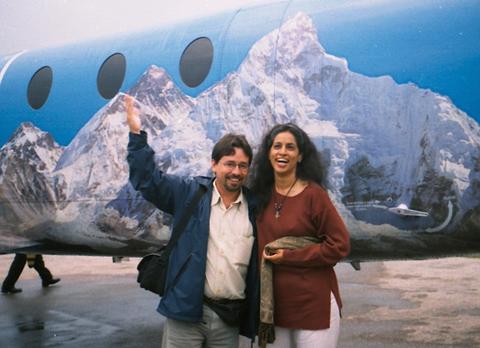
saneeya-and-luis-taking-an-everest-flight.jpg

In 2002, Saneeya became the Executive Director of Panos South Asia, a regional media organisation with its headquarters in Kathmandu, Nepal. As a Board member of Panos, I worked closely with Saneeya in a number of projects and activities.

Although everyone at Panos and in Kathmandu liked her, Saneeya’s stay there was cut short by what her successor at Panos, A S Panneerselvan, called her Siamese twin: asthma.

It was asthma that forced Saneeya to leave Nepal – and the Panos director’s job – as she just couldn’t cope with Kathmandu’s polluted air. As a fellow asthmatic, I fully empathised with her. She moved to Sao Paulo, where she set up what was to be her final home.

What happened in April 2005 has been written and discussed widely by Saneeya’s far-flung network of friends in the past two years. I can only reproduce the last few paras of a tribute I wrote in May 2005, which was privately circulated at the time:

When Saneeya suffered an acute attack of asthma in Sao Paulo on April 7, her husband Luis rushed her to hospital in his car. It was rush hour at 6.30 in the evening, and it took him 20 minutes to drive to the hospital only 2 kilometres away. Saneeya — who had walked to the car — stopped breathing five minutes into the journey. Luis drove as fast as the traffic would allow him, but as it turned out, not nearly fast enough.

Her brain suffered too much damage due to oxygen deprivation, and she never recovered.

As Luis was to remark later, it was not asthma but the traffic that killed Saneeya.

Similar tragic scenarios unfold on South Asia’s mean streets every day. Heart and stroke patients fail to reach help in time. Ambulences and fire engines, with their sirens blaring, only manage to proceed at a snail’s pace. It’s not uncommon for expectant mothers in labour to give birth on their way to hospitals. Then there is the slow, insidious poisoning that goes on 24/7.

So let us be forewarned. If the air pollution doesn’t get us, the traffic jams will. And if we survive both, our road accidents will wait for us. It’s only a matter of time.

Not one but several serial killers are out there.

And we unleashed them all.

beena-sarwar-left-and-saneeya-hussain-photo-courtesy-b-sarwar.jpg

Our mutual friend Beena Sarwar (in the photo above, with Saneeya) has made a 14-minute documentary called Celebrating Saneeya. It was screened at the 5th Karachi International Film Festival in December 2005.

See also my essay ‘Grappling with Asia’s Tsunami of the Air’ (December 2006).

All photos from Saneeya Yahoo Group that links her friends around the world.

Money is not an issue: ‘No budget’ films have their own festival

After over a decade working in television and film, most of that time commissioning new content from independent producers or creating content ourselves, I have yet to come across a film-maker who had enough budget.

We’re are all used to getting by with less than ideal budgets.

Some more than others, though: there are low budget films, and then there are ‘no budget’ films.

A few idealists among us still believe money is not an issue in cultural expression.

They now have their own festival, unashamedly for just that kind of films: No Budget VideoFilmfestival, Heilbronn / Weimar & Tour 2007
No budget video film festival

Their self-intro reads:

In 2007 the „Geld spielt keine Rolle“ (“money is not an issue””it’s only money”) VideoFilmfestival will start a series of events during an independent art-, film- and musicfestival in Heilbronn. From the 8th to 10th of June 2007 it will be in Heilbronn, and thereafter will be ample opportunity to screen the films in Weimar (at the Lichthaus Kino in summer 2007), Magdeburg, London and other cities. The previous festival was carried by the faculty of media of the Bauhaus- University Weimar and took place in Weimar in May 2006.

Filmmakers characterized by creativity and idealism get the opportunity to present their films to a wide audience.
For the audience this promises good films which possibly fall through the cracks of commerce.

Remember: deadline for entries is 1 May 2007.

The festival is being organised by a group of German film enthusiasists calling themselves the film sharing community.

Under the topic GELD SPIELT KEINE ROLLE (Money is no issue) the film sharing community wants to provide a platform for productions of moderate means achieving remarkable outputs and meaningful films on a shoestring.

May their tribe increase!

John Pilger: Being a journalist is a privilege

Towards the end of our week’s stay in Sydney for OUR Media 6 Conference, the organisers gifted us copies of The Australian Photojournalist, which is the journal of the Australian Photojournalists’ Association.

The June 2006 issue I received is a handsome volume and makes fascinating reading. On the inside front cover, I came across these words by John Pilger, the courageous and outspoken Australian journalist and film-maker hailing from Sydney.

John Pilger

“The best journalism is about looking behind facades and pretensions. It is never accepting the status quo; it is always questioning and remaining sceptical of the pronouncements and actions of those in authority, especially authority that is not accountable.

“The best journalism is following the dictum, wry but true: Never believe anything until it is officially denied. It is seeing the world from ground up, where ordinary people are, not from the top down, where the powerful reside. In many respects, the best journalists are the agents of ordinary people, not of those who preside over them.

“By looking at the world this way, from the standpoint of humanity not its would-be controllers, journalists will find themselves closer to the truth about all manner of things than they will ever be, following the manuals of establishment thinking.

“And by journalists, I mean photographers, too. The finest photographers produce images that ought to achieve mor than a gut reaction but help us make sense of events, great and small.

“Speaking personally, being a journalist is a privilege.”

Indeed. And few people bear that title with greater responsibility and passion than John Pilger.

I had the privilege of listening to John Pilger early on in my career, during one of the first international media conferences I attended in Sweden in the late 1980s. Of the three dozen speakers who spoke there, the only ones who have withstood the gradual erosion of memory are Pilger and Norwegian academic Johan Galtung.

Years later, I read Pilger’s book The New Rulers of the World — which was also the title of 2002 documentary film he wrote, produced and presented on the consequences of globalisation, taking Indonesia as the primary example of the serious problems with the new globalization.

And thank heavens, he shows no signs of slowing down — or mellowing.

The War on Democracy is John Pilger’s first major film for the cinema. Set in Latin America and the US, it explores the historic and current relationship of Washington with countries such as Venezuela, Bolivia and Chile. Two years in the making, The War on Democracy is due to be released in cinemas in the UK on 15 June 2007.

He has produced more than 55 TV documentaries. Links to two of his more recent ones available online:

Breaking the Silence: Truth and Justice in the War on Terror (2004) on Google Video (51 mins)

Stealing a Nation (2004) on Google Video

Noam Chomsky on John Pilger

Images courtesy www.johnpilger.com

Copyright, copyleft and film-makers in the digital age

In my post on 1 April, Have you made your million dollars yet?, I wrote:

Many development film-makers like to decry our society’s obsession with money, consumerism and greed. Some would make films that passionately promote sharing ideas and resources at community level, and advocate common property resources over private ownership.

But when it comes to rights of their own film/s, these very film-makers would become extremely possessive: they want to restrict it in every conceivable way.

This came up during a session at the OUR Media 6 conference in Sydney yesterday.

Andrew Lowenthal, from EngageMedia in Australia, talked on ‘Online video for social action’ and presented what his non-profit organisation is doing.

As their website says:
EngageMedia is a website and a network for distributing social justice and environmental video from South East Asia, Australia and the Pacific. It is a space for critical documentary, fiction, artistic and experimental works that challenge the one-way communication model of the mainstream media.

Andrew said they currently host around 120 videos online, all offered for free public access at the moment. They are keen to add more titles to this collection, to build an online, engaged community of film makers and film viewers.

But as we discussed, many film makers aren’t yet ready or willing to give their films to be placed online.

“Some of them freak out at the very mention of being placed online. They ask how their copyright can be safeguarded, and how they can make money,” Andrew noted.

Fred Noronha, who has campaigned for a long time for Indian documentary makers to open up and share their films, agreed. “Many film-makers are apprehensive. They aren’t broadcasting, or webcasting their productions. They just show it at a few film festivals. Many films don’t go out to the wider public.”

At TVE Asia Pacific, we come across this all the time. As a non-commercial, non-exclusive distributor, we ask film-makers to share distribution rights while copyright stays firmly with them. Even then, many are not convinced.

Of course, each creative professional is entitled to the full returns of their investment of time, effort and creativity. But let’s not forget: many films, especially those on development issues (which covers health, education, environment, ICT, science in development and human rights, among others), are made with development funding or philanthropic grants. Which means the production costs are largely or entirely paid for.

Yet when such films are made, their creators would rather hang on to them than let them go. Copyright is one concern they cite. ‘Returns on investment’ is another. (Hmmm…if a film has been paid for by public/donor funds, returns to whom?)

Creative Commons offers a good way forward, and we had a presentation from CC Australia on this during the session. More about that later.

Go to:
Engage Media
Creative Commons

Moving images moving heart first, mind next

“Film is a lousy medium to communicate information. It works best at the emotional level.”

Bruce Moir, one of Australia’s seniormost film professionals made this remark soon after I had presented TVE Asia Pacific’s Children of Tsunami experience to OUR Media 6 conference in Sydney last afternoon.

After more than 35 years in documentary and feature film production for both cinematic and broadcast industries, in different parts of the English speaking world, Bruce knows a thing or two about moving people with moving images.

I was delighted and privileged to have Bruce join my presentation. He’d come at my invitation to the conference happening in his city.

“We’ve got to remember that film appeals to people’s hearts more than their minds,” Bruce explained. “The way to people’s heads is through their hearts, from the chest upwards — and not the other way round.”

I hope this was an ‘Aha!’ moment to at least some in our audience. I’ve personally heard Bruce say this before, but it bears repetition – because many film professionals tend to overlook this. Especially those who are trying to ‘communicate messages’.

Even a few weeks ago, I quoted him in a review as saying: “Our fundamental job is to tell a story – one that holds an audience’s interest and moves their heart, regardless of language, cultural context or subject….I have always believed that film achieves its optimal impact by aiming to ‘get at the audience’s head via their heart’ rather than the other way around.”

Bruce Moir

Without Bruce’s involvement, Children of Tsunami would have turned out to be very different. He was our Supervising Producer for the entire effort, advising and guiding our national film production teams tracking the progress of Tsunami survivor families in India, Indonesia, Sri Lanka and Thailand for one year afer the Asian Tsunami.

As Bruce recalled, the four teams came with different backgrounds, skill levels and film-making traditions of their own – ranging from television news and current affairs to development film-making, the type usually commissioned by UN agencies. Bringing them to be ‘on the same page’ was no easy task.

Film-makers are not particularly known for their patience or people-skills. Many I know have a ‘just-get-on-with-it-never-mind-the-niceties’ attitude. Bruce is one of the most patient persons I know: he would spend days and weeks relating to our production teams – usually by email or phone – gently nudging them in certain directions.

For sure, there’s no one right way to make a film. But there are some tried and tested principles in good story telling, which is what Bruce excels in. And which he willingly shares with others.

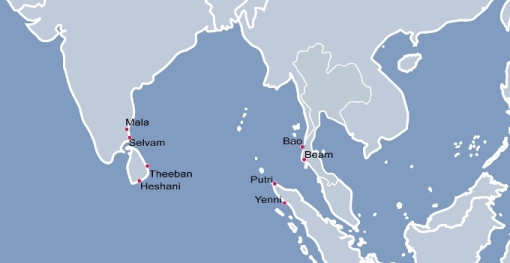
The year-long, 4-country and 8-location Children of Tsunami project was the biggest logistical operation TVE Asia Pacific has mounted in its 11 years of existence. (We’re in no great hurry to top that one!). Our production teams – operating from Bangkok, Colombo, Ubud (Indonesia) and Chennai – related to our regional production team based in two cities: Colombo, where TVEAP office is currently anchored, and Sydney, where Bruce lives.

We only came together face to face just once, in Bangkok, early on in the process. That meeting agreed on styles and formats, and also helped build the human relationships.

The rest of the time it was all through communications technologies. As you can imagine, lots of tapes moved around, as did many Gigabytes of video over the web. (DHL should have become a sponsor – they had lots of business from us!)

children-of-tsunami-locations.jpg

As I explained in my talk, Children of Tsunami was not just a film project. We published a monthly video report online on each of the eight families we were tracking, plus maintained a dedicated website with growing volumes of text, images and links. The monthly videos were edited and post-produced in the countries of filming, by our production teams themselves. It was distributed film-making, even if everyone worked to a common format.

With all that frenzy now behind us, the products of Children of Tsunami continue to be distributed, showcased and discussed at film festivals and conferences like OUR Media.

As I said yesterday to my predominantly academic audience: we’ve got a story telling and journalistic practice, and we now need a theory for it.

Related links:

Children of Tsunami: Documenting Asia’s longest year

Children of Tsunami revisited two years later