Return to Paradise: Maldives on the frontline of climate change

Related blog post: 6 Jan 2008: Little voices from the waves: Maldives too young to die
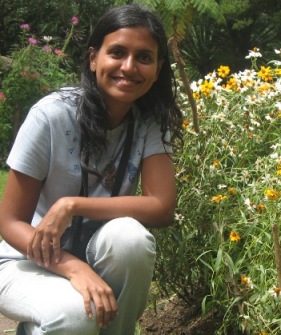
Mariyam Niuma - photo by TVEAP

All of us at TVE Asia Pacific are missing Mariyam Niuma.

This bubbly, happy-go-lucky intern returns to her native Maldives this week after working with us for over a year as a programme assistant. She plans to spend more time with her family, and explore work opportunities in the Indian Ocean archipelago nation of 370,000 people.

Niuma, in her early 20s, applied for a staff position in late 2006. Among other things, she came with skill and dexterity in graphic design, web research and English proficiency — always useful for a regional communication organisation like ourselves.

“I want to learn as much as I can how a non-profit organisation works,” she told as at the recruitment interview. She had plans of taking the knowledge and skills back to her home atoll, hoping to make life better for her people.
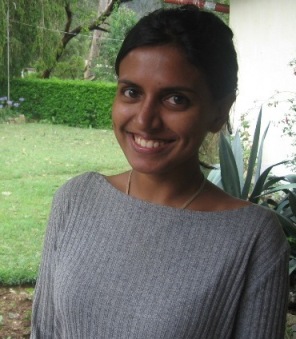
I hope she found what she was looking for. We found in her an energetic young person with good attitude – one who could be challenged to work on tough (and sometimes tedious) tasks on a regular basis.

“The last year has been a very challenging and fulfilling year for me, and being at TVEAP helped a lot,” she wrote in an email on her last day at work. “I will miss you all and being a part of you and will always remember the good times and everything I have learnt here both professionally and personally.”

Some months into her internship, Niuma gave us a presentation on her home country, home atoll and life at home. To many outsiders, Maldives evokes images of palm-fringed sandy beaches, shallow seas of an exquisitely azure blue, high end resorts, crystal clear blue waters for diving…and plenty of sunshine all the year round. (Image shows Kurumba resort, Maldives.)

Well, all that’s true as widely advertised. But Maldives is a whole lot more – a history going back to at least 1,500 BC, distinctive island culture, and a nation that is struggling to reconcile tradition with modernity. Divehi, the Maldivian language, contributed the word “atoll” (a ring-shaped coral reef) to the English language.

The former British protectorate, which became independent in 1965 and a republic in 1968, has a pro-democracy movement sustained over the past few years. If such political turbulences create a sense of uncertainty in the minds of Maldivians about their future, it’s only one source of concern.

They also have to worry about whether their nation would have a collective future. That’s because of climate change that scientists now confirm are underway, aggravated by human action.

Most of the 1,200 islands in the Maldives are no more than 1m (3 feet) above sea level. Even a modest rise in sea levels could inundate these lands. Within 100 years the Maldives could become uninhabitable.

Time is indeed running out for Niuma and her country — as this poster produced by The Body Shop reminds us.
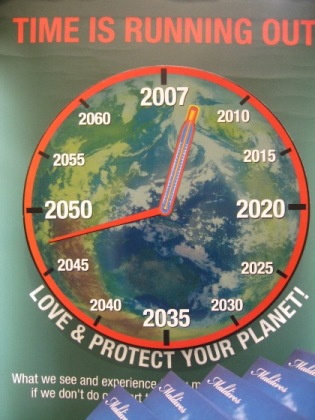
Time is running out...and not just for the Maldives

In 1987 and 1991 storm surges flooded a large number of islands, including one-third of the capital where one-quarter of the country’s population lives. Unusually high waves forced the international airport to be closed, causing great damage to tourism and constraining emergency relief operations. On 26 December 2004, the Asian tsunami battered the Maldives, forcing the evacuation of 13 of its 200 inhabited islands. These incidents indicate how vulnerable the islands are to wave action.

Maldives was among the first countries in the world to raise climate change as a serious issue at the United Nations. President Maumoon Abdul Gayoom raised the alarm back in 1987, when most people had not even realised the problem and scientific evidence was just beginning to come in.

The Maldives did more than raise the issue. The country played a lead role in rallying around other small island states worldwide that would be among the first to be impacted when sea levels rise due to thermal expansion and melting of polar ice.

In November 1989, the Maldives hosted the first ever small states conference on sea level rise, which was one of the first international scientific events that I covered as an eager young science journalist.

The conference issued the Malé Declaration on Global Warming and Sea Level Rise, which urged for inter-governmental action on the issue. The small island states played a key role in negotiations that led to the UN Framework Convention on Climate Change adopted in 1992. This is the precursor to Kyoto, Bali and other processes that are now very much in the news.

Just a few weeks ago, in mid November 2007, the Maldives once again hosted representatives from small island states to discuss climate change. Eighteen years after the original meeting, the subject is no longer a fringe concern; it’s now on everybody’s agenda.
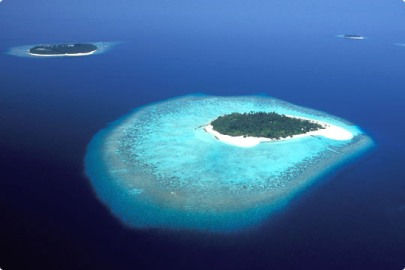
Maldives from the air: tiny specs in the ocean
The meeting urged the the human dimension of global climate change to be included in the agenda of UN Climate Change Summit in Bali (December 2007), and sought the international community’s commitment “to protect people, planet and prosperity by taking urgent action to stabilize the global climate change”.

This time, the Male’ Declaration on the Human Dimension of Global Climate Change called for the UN High Commissioner for Human Rights to assess the human rights implications of climate change and “to conduct a study into the effects of climate change on the full enjoyment of human rights”. It requested the UN Human Rights Council to convene in March 2009 a debate on human rights and climate change.

I wasn’t at the November 2007 Male meeting, but was glad that the meeting stressed the need for adding a human face to the complex, nuanced challenge of climate change. This resonates very much with my own experience.

Read my April 2007 blog post: Wanted – human face of climate change

Mariyam Niuma takes me a bit closer to the realities of what climate change means to communities living on the frontline. Unlike Niuma, who is web savvy and connected with the wider world, many are blissfully unaware of the problem.

Our challenge is to bring their voices, stories and aspirations to the global news agenda and the myriad discussions now underway searching for solutions.

I hope someday we can work with Niuma again — perhaps amplifying her story in moving images.

Nov 2007 blog post: True people power needed to fight climate change

Related blog post: 6 Jan 2008: Little voices from the waves: Maldives too young to die

Photos of Mariyam Niuma courtesy Manori Wijesekera of TVEAP
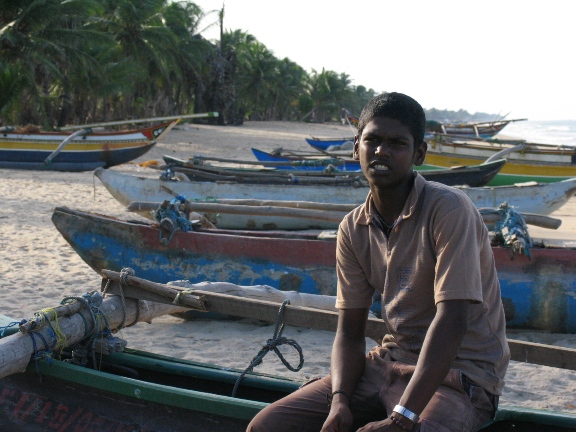
Sri Lanka: What killer waves united, killer humans divided again…

Today is the third anniversary of the Indian Ocean tsunami, which left a trail of destruction in many countries in South and Southeast Asia.

Today we remember those who perished and salute those who survived and endured enormous hardships.

We thank everyone everywhere who donated to help, and curse those who plundered or squandered the outcome of that generosity.

As I wrote in my only published verse, When the Waves Came, written on 28 December 2004 – when the disaster’s full impact was dawning on the world:

When the waves came
Roaring and moving mightily,
Unleashing the power of
A million bombs exploding at once,
They didn’t care
And just didn’t discern
Who or what was in their way.

My basic premise was that the killer waves had been a brutal ‘equaliser’ of all men and women. It no longer mattered on which side of law, morality, economics or social class they stood. This was particularly apt for Sri Lanka, a land divided for a quarter of a century by an armed separatist struggle that has hardened fundamentalist positions at both Sinhalese and Tamil ends of our ethnic spectrum. Towards the end of the verse, I noted:

As we in the aftermath tiptoe
Through endless depressing scenes
Of death and utter devastation
Can we tell the difference
Between Sinhala and Tamil,
Or Muslim and Burgher,
Or soldier and rebel
Or policeman and prisoner
Or rich and poor?

For a few days after the tsunami, there was a flicker of hope that the lashing from the seas might finally convince everyone of the complete futility of war. Political cartoonists in Sri Lankan newspapers were among the first to make this point. One cartoon, appearing two days after the disaster, showed a government soldier and Tiger rebel swimming together in the currents, struggling to save their lives. (Indeed, there were some reports of them helping each other in the hour of need.)

The cartoonists and other media commentators asked a common question: what happened to the land, and the dividing border that both sides had fought so hard and long for?

Alas, what Nature proposed we humans (Sri Lankans) disposed. While the tsunami helped usher in a negotiated settlement to the long-drawn armed struggle in Aceh, Indonesia, it only created a temporary lull in the Sri Lankan conflict. As soon as both sides recovered from Nature’s blow, they were back at each others’ throats again. (This contrast has been studied by various groups – see, for example, the summary of a Worldwatch Institute study Beyond Disasters: Creating Opportunities for Peace).

Looking back three years later, all I can say is that the land killer waves temporarily and forcibly united, killer human beings have managed to divide again for petty political, communal and personal gains.

theeban-survived-the-tsunami-but-not-sri-lankas-conflict.jpg

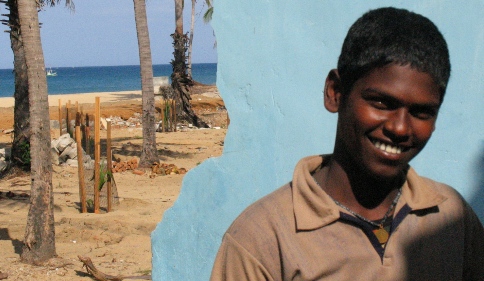
This boy, Thillainayagam Theeban, epitomizes that bigger tragedy. He survived the tsunami — but not the escalation of Sri Lanka’s ethnically driven civil war, which consumed his life in March 2007.

Theeban was one of eight surviving children – from India, Indonesia, Sri Lanka and Thailand – whose remaining families we tracked and filmed for a year in Children of Tsunami media project, a citizens’ media response to the Indian Ocean Tsunami.

Theeban was murdered by unidentified gunmen who stormed into his ‘temporary’ tsunami shelter on 3 March 2007. The death was linked to political violence that has engulfed Sri Lanka since 2006.

theeban.jpg

When the shocking news reached us three days later, our Sri Lankan camera team at Video Image and we at TVE Asia Pacific just couldn’t believe it. We were all in tears, and some of us were also angry. Theeban, who survived the killer waves 26 months earlier (but lost his mom and kid brother in the disaster) suffered many indignities in displacement. And now, he is gone.

We still don’t know who killed Theeban. He was abducted by an armed group sometime in 2006, from whom he escaped in early 2007. It is believed that Theeban was killed as a punishment for running away — and as a warning to all others.

He was 16 years at the time of his death. It is unlikely that his killers would ever face justice.

As I wrote in my personal tribute to Theeban in March 2007, published by UCLA’s Asia Media and MediaHelpingMedia, UK: “The disaster’s Sri Lankan death toll (close to 40,000 dead or missing) shocked the world when it happened within a few hours or days. Yet, at least twice as many people -– most of them unarmed and uninvolved civilians — have been killed in over a quarter century of fighting. That doesn’t always grab headlines.

“Thillainayagam Theeban has become another statistic in a ‘low-intensity conflict’ (as some researchers call it). And while this war lasts, it will continue to consume thousands of other young lives — a grim roll call of Sri Lanka’s Lost Generation.”

The third anniversary of the tsunami is a reminder – if any were needed – that man’s inhumanity to man is often worse than Nature’s fury.

March 2007 blog post: Remembering Theeban

April 2007 blog post: More memories of Theeban

Children of Tsunami: Documenting Asia’s Longest Year

Thillainayagam Theeban (1990 – 2007)

After the Tsunami: Going the Long Last Mile in Sri Lanka

hazlnfo-video-j-a-malani-hambantota.jpg

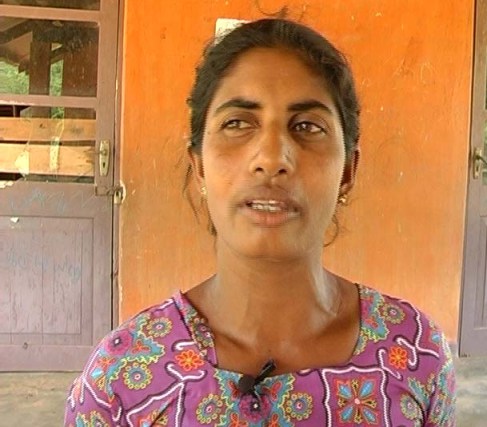
This is J A Malani. She’s an ordinary Sri Lankan woman living in Hambantota, on the island’s southern coast. Several hundred people in her town perished when the Indian Ocean Tsunami arrived on 26 December 2004 without any public warning. When the waves finally stopped their hammering, close to 40,000 people were dead or missing in the biggest disaster the island nation experienced.

Survivor Malani and her neighbours – lucky to be alive – are naturally apprehensive about when the next disaster might arrive, in what form and from where.

And this time around, too, they worry whether there would be anyone to warn them about it.

There just might be. Since the big tsunami three years ago, several Sri Lankan telecom operators, civil society organisations, IT companies and researchers have come together to test out a community-based hazard warning system — one that would prevent the repetition of the nasty surprise Malani’s community experienced not too long ago.

‘Evaluating Last Mile Hazard Information Dissemination Project’ (HazInfo project for short) was an action research project by LIRNEasia to find out how communication technology and training can be used to safeguard grassroots communities from disasters. It involved Sarvodaya, Sri Lanka’s largest development organisation, and several other partners, and was supported by International Development Research Center (IDRC) of Canada.

The project studied which information and communications technologies (ICTs) and community mobilisation methods could work effectively in disseminating information on hazards faced by coastal communities. The exercise was not confined to tsunamis alone; other rapid onset disasters such as cyclones and floods were also covered.

In its first phase, the project worked in 32 chosen coastal villages (all impacted by the tsunami) and mobilised local communities from muslim, Sinhala and Tamil backgrounds. Malini’s community was among those participating in this field testing of an approach that Sarvodaya hopes to roll out progressively to all 15,000 villages they work in.

That initial engagement by itself was reassuring to Malani. “This has helped us to get rid of fear and hesitation in our minds,” she said in a television interview recorded some weeks ago. “Now we know what we should do when a disaster strikes.”

That peace of mind is priceless to any human being, and that knowledge is liberating – particularly to one who has survived a major disaster that came from nowhere.

Malani is one of several beneficiaries featured in a 12-minute film TVE Asia Pacific recently produced. Several other participants from different coastal locations expressed similar views — and hopes that next time around, they will not be taken unawares.

The Long Last Mile can be viewed on YouTube in two parts:

The Long Last Mile, part 1 of 2:

The Long Last Mile, part 2 of 2:

LIRNEasia researchers analysed how each ICT tool or combination was integrated into communities to deliver timely warnings to those designated as first responders. The factors needed for efficient functioning of the hazard information hub were also studied. Read detailed findings and analysis here.

The HazInfo project grew out of a participatory concept paper that LIRNEasia developed in the aftermath of the 2004 tsunami. It noted that a national early warning system was a ‘pure public good’, and the responsibility of its supply would normally fall on the government. However, the paper acknowledged that, due to lack of capacity, “it is unlikely that the last mile of such a system will be provided by the local government or private firms operating in the marketplace”.

I have written a whole chapter on this project, titled Bridging the Long Last Mile, in Communicating Disasters: An Asia Pacific Resource Book (co-edited by Nalaka Gunawardene and Frederick Noronha). Read that chapter here:

bridging-the-long-last-mile-final-text-formated.pdf

Tsunami Stories: How a film saved lives in Kosgoda, southern Sri Lanka

With the third anniversary of the Asian Tsunami drawing close, we are reliving memories of the mega-disaster that hit many parts of coastal Asia on 26 December 2004.

On 10 October 2007, I wrote the story of Tilly Smith, the 11-year-old English school girl whose geography knowledge helped save hundreds of lives on the Maikhao Beach in Thailand that day.

Here’s another story, which was related by Thyagee de Zoysa, a young Sri Lankan woman who until recently was working as Project Officer of CEE Sri Lanka, a non-profit educational charity that I am associated with.

In January 2007, Thyagee spoke at the European launch of TVE Asia Pacific’s latest environmental television series, The Greenbelt Reports</em>, held in Athens, Greece. There she made a passionate appeal for education and awareness to be put into action.

She drew from her personal experience, having survived the Indian Ocean Tsunami in her native village of Kosgoda in southern Sri Lanka. These are her exact words:

“I, myself, am particularly willing to participate in this project, as I was at my home on the 26th of December 2004, with my parents, until we heard a young man crying ‘Run to the temple, run to the hill, the sea is coming’. We ran — and it saved our lives.

“The young man told me later that he knew that the sea was going to come with full power because of a film that he had seen. A film, which was about a meteorite impact with earth and how a tsunami happens after that. He knew that, if there comes a day when the sea goes back towards the horizon, it then comes back again to take your life.

“It does not matter in what way you create awareness on the environment, be it books, films or the Internet. What matters is that you do it and make somebody understand the possible actions to take up. Believe me, I am grateful to this young man for saving my life and that of my family…”

Neither Thyagee nor the young life-saver could recall the name of the film, but it doesn’t matter. The film left a bit of knowledge in the young man’s mind which surfaced instantly just when it was needed. That helped save lives.

Alas, there were very few Sri Lankans – young or old – who had any idea about tsunamis prior to that fateful Boxing Day 2004.

Writing a foreword to Communicating Disasters: An Asia Pacific Resource Book (co-edited by Nalaka Gunawardene and Frederick Noronha), Sir Arthur C Clarke refers to another rare exception: a retired sailor living in the coastal village of Galbokka recognised the tell-tale signs of the on-coming tsunami and rushed the entire community to safety.

The challenge we still face is to build everybody’s awareness on multiple hazards and what to do when hazards turn into disasters.

Communicating Disasters in digitally empowered Asia: A tale of two books

I have just spent a hectic week in Kuala Lumpur, and am just coming up for fresh air. That explains why this blog was silent for a few days.

I was at the Third Global Knowledge Conference (GK3) held in the Malaysian capital from 11 to 13 December 2007. With several related events preceding the main conference, my week was completely full.

GK3 was a global platform for all those engaged in using ICTs (information and communication technologies) for meeting the real world’s needs and solving its problems — to reduce poverty, increase incomes, create safer communities, create sustainable societies and support youth enterprise, etc. (Read my impressions of GK3 in this blog post.)

The week’s assorted events saw two separate video films produced by TVE Asia Pacific being screened as integral components of two sessions. These were The Long Last Mile (on community-based warning of rapid onset disasters) and Teleuse@BOP (on telephone use patterns among low income groups in five emerging Asian economies).

That wasn’t surprising because we produce and distribute films that capture Asia’s quest for improving lives through sustainable development. But unusually for myself, I also had two books coming out during the week — one that I had edited, and another that carried a chapter I had written.

communicating-disasters-an-asia-pacific-resource-book-by-tveap-and-undp.jpg

The first was Communicating Disasters: An Asia Pacific Resource Book, which I co-edited with Indian journalist Frederick Noronha. It was the culmination of a year-long process that began with an Asian brainstorming meeting on Communicating Disasters that TVEAP convened in December 2006 in Bangkok. That meeting, attended by three dozen participants drawn from media and disaster management sectors, identified the need for a handbook that can strengthen cooperation of these two communities before, during and after disasters.

The book, comprising 19 chapters contributed by 21 authors, has a foreword written by Sir Arthur C Clarke, inventor of the communication satellite. Pulling together these contributions from the specialist authored scattered across the globe was no easy task for co-editor Fred and myself.

The book’s blurb reads as follows:

“Where there is no camera, there is no humanitarian intervention,” said Bernard Kouchner, co-founder of Medecins Sans Frontieres who later became the Foreign Minister of France. Disaster managers and relief agencies acknowledge the mass media’s key role at times of distress. Yet, the relationship between media practitioners and those managing disasters can often be stressful, difficult and fraught with misunderstandings. Communicating about disasters sometimes ends up as communication disasters.

How can these mishaps be minimised, so that the power of conventional and new media can be harnessed to create more disaster resilient communities? What value addition can the new information and communication technologies (ICTs) bring in? In this book, media and development professionals from across the Asia Pacific share their views based on decades of experience in covering or managing a variety of disasters – cyclones, droughts, earthquakes, floods, landslides and tsunamis.

This book is aimed at journalists, disaster managers and civil society groups who want to use information and communication to create safer societies and communities.

The other book that came out in KL was Digital Review of Asia Pacific, 2007-2008 edition. It was launched during a workshop on Emerging Knowledge Opportunities (The Progress of ICT in Asia-Pacific and Other Parts of the World) on 12 December 2007.

The completely updated edition of the Digital Review of Asia Pacific contains authoritative reports on how 31 economies are using ICT in business, government and civil society written by senior authors who live and work in the region.

I have written the Sri Lanka chapter for the book, continuing a tradition I started back in 2003 with the first edition of the book. I was only sorry that I missed the session during GK3 where the book was launched — because I was moderating another session exactly at the same time in another room. But I was glad to join at least part of the post-launch reception and to meet with some fellow authors who were attending GK3.

Both books are multi-author books, and both have been in the making for a year or longer. It was quite a challenge to get 20 other contributors to come up with their chapters for Communicating Disasters. They were genuinely interested and supportive, but everyone being so busy, it took time and effort to pull together all the strands.

I was not the only common author in these books. My colleague and one-time co-author Chanuka Wattegama (now with LIRNEasia) has written two distinctive chapters on ICTs and disaster communication for the two books.

Many years ago, my friend (now international expert on terrorism and widely published academic author) Rohan Gunaratna told me that writing a book was like waging a small war. I don’t normally use military metaphors, because I deplore all things military, but I can’t resist extending Rohan’s analogy to say that compiling a multi-author book is a bit like waging a mini-war with a coalition of the willing!

GlobalVision at 20: Insiders turned outsiders keep kicking


GlobalVision, the path-breaking media company anchored in New York with a truly global outlook and a strong commitment to social justice, completed 20 years this week.

It was launched in November 1987 out of one room in Soho (New York) as a mission-driven company with little money but a big idea: to improve news coverage of the world through an “inside-out” approach that would offer voices not usually heard on the air in the US.

The founders were Danny Schechter, who became, in his words, a “network refugee” from ABC News 20/20 and Rory O’Connor, then with CBS News 48 Hours.

As the company introduction says:

“The whole world is watching… From Baghdad to Beijing, from Madrid to Manhattan, information is moving at the speed of light. Media and communications technology are transforming our lives — and those of our six billion neighbors. But in the emerging global village, whose stories get told — and who gets to tell them?

“At Globalvision, we believe in telling stories from the inside out. That means working with other cultures — not at them –and helping people to tell their own stories in their own way, to a world that’s getting smaller every day.”

In an industry saturated with media companies known more for their style than substance, Global Vision has not only blazed new trails, but used moving images in ways that moved people towards social change, political reform and – just as importantly – constantly question and challenge conventional wisdom and traditional authority.

They have also never hesitated to challenge the fellow journalists and corporate media on their servility, acquiescence and willing suspension of journalistic norms in the United States, especially under the current Bush administration.

They have won numerous awards and professional recognition for its pioneering international newsmagazine South Africa Now, which first broke through censorship to smuggle footage out of what was once the land of apartheid — and later chronicled Nelson Mandela’s transition from prisoner to President.

The company followed up with another award winning series, Rights & Wrongs: Human Rights Television with Charlayne Hundter-Gault, which aired for four years in sixty-two countries around the world.

Danny and Rory have also directed and produced more than thirty hard-hitting documentaries, many involving controversial issues and investigations — some for the PBS “Frontline” series” and others for television systems worldwide. Current films deal with subjects such as America’s child farm workers, bridging the global digital divide, flawed media coverage of the War in Iraq, and the ongoing debt crisis that threatens the global economic system.

I met Danny in person only once – in the Fall of 1995, when I spent a few weeks in New York on a fellowship to study the United Nations. Danny was one of the more colourful people we met (besides lots of men in suits from the UN, only a few of whom I can now recall by name). Danny introduced himself as a (TV) ‘network refugee’ — and gave a workshop on television journalism in defence of the public interest and human rights that had a lasting influence on myself.

Ever since, I have followed his books, incisive NewsDissector blog and Global Vision output with much interest.

So here’s wishing Danny, Rory and team at GlobalVision many more years of kicking ass!

MediaChannel.org: Global Vision marks 20th anniversary

Read Danny Schechter on: The Days of Our Dominion: Global Vision celebrations 20 years in the trenches

Rory O’Connor’s tribute to the late Anita Roddick, a long-standing supporter of Global Vision

“Hands up who is poor, speaks English – and looks good on TV!”

“Hands up who is poor, speaks English – and looks good on TV!”

With that title, I opened my panel remarks to the 8th Annual Symposium on Poverty Research in Sri Lanka on the morning of 30 November 2007.

Sri Lanka’s Centre for Poverty Analysis (CEPA) had invited me to speak during a session on ‘Taking it off the page: Alternative mediums of communication to influence change’. The theme of the overall symposium was ‘Communicating research and influencing change’.

Part of my talk was on challenges in using moving images to communicate development related research. The other part was on how most sections of the mainstream media covers stories of the poor — or those living at the bottom of the income pyramid.

I noted that as Asia’s billions strive for a better today and better tomorrow, there are millions of stories at the bottom of the pyramid. But most mainstream media manage to miss these stories due to their ignorance, or arrogance, or both.

But reporting from the bottom of the pyramid need not be all about doom, gloom and alarm. In fact, so much is happening there that a well informed story-teller won’t have much time to spend on negativity (while acknowledging a great deal of suffering that remains).

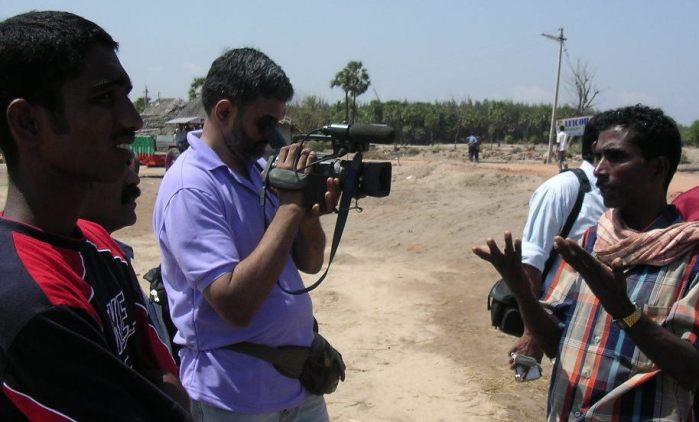
interviewing-tsunami-survivor-in-tamil-nadu-india.jpg

In my remarks, I emphasised that to discover these stories and tell them with empathy and accuracy, we as story-tellers need to recognise a few basic realities:
• The poor are not another species to be treated as if they were endangered! They are living and loving human beings as complex and nuanced as anyone in this room.
• Nor are the poor a ‘sub-human species’ with a simpler set of needs and aspirations. They have as many primary, secondary and tertiary needs – just like anyone else!
• When it comes to information, they have not only survival and practical information needs (which many development projects try to provide), but also what I call ‘information wants’ – cultural and social information – which many development projects completely ignore.
• The poor have opinions too — and are often more articulate and expressive when someone cares to listen and capture these.

So telling media stories from the Bottom of Pyramid needs the knowledge base, socio-cultural understanding and ethical framework in which to gather and process these stories. We at TVE Asia Pacific don’t claim to have got everything right, here are our basic rules of engagement:
• We treat the rich, middle class and poor alike – extending the same courtesy and respect (including obtaining personal clearances for interviews).
• We caption everyone on-screen by name and location, irrespective of their social and economic status.
• We film people – for interviews or generic footage – only with informed consent.
• Wherever possible, we take our the finished TV products back to where they were filmed and share with those who told us their stories. (We are not alone in this: I have written blog posts about Earthcare Films of India and the Brock Initiative of the UK who are also doing this.)

Our industry of broadcast TV is not always known for its class-less treatment of every human being with respect and dignity. In fact, the poor often become ‘Canon-fodder’ for camera crews looking for dramatic images of human suffering.

from-mediachannelorg.jpg from-mediachannelorg.jpg

The globalised media continue to use stereotyped images of the global South – captured mostly by northern photographers and camera crews. As my friend Shahidul Alam, founder of Drik Picture Library in Bangladesh, says: “Invariably, films about the plight of people in developing countries show how desperate and helpless they are…. Wide angle black and white shots, grainy, high contrast images characterise the typical third world helpless victim.”

This explained my title: “Hands up who is poor, speaks English and looks good on TV!” It’s a caricature of how some camera crews go looking for that convenient sound-bite with some doom-and-gloom visuals to match.

But it’s not just the northern media who sensationalise and oversimplify life at the bottom of the pyramid in the South. Many of our own media outlets, rooted in the cities and obsessed with middle class life styles, are also good (or bad) in this game!

And the media are not alone. When development agencies and ‘pro-poor’ activists presume – in their middle class arrogance – that the poor only need survival or sustenance related information, the latter is immediately reduced to sub-human status.

Nov 2005 op ed: Communication rights and communication wrongs


Nov 2006 op ed: Ethical news gathering: Al Jazeera’s biggest challenge

Aug 2007 blog post: Wanted: Ethical sourcing of international TV News

Moving images moving research…beyond academic circles!

Although I’ve dabbled in some media research at times, I don’t think of myself as a researcher. So when Sri Lanka’s Centre for Poverty Analysis (CEPA) invited me to speak at their 8th Annual Symposium on Poverty Research in Sri Lanka, I spoke on what I know a little bit about — communicating research using the audio-visual media.

My panel remarks, delivered on the morning of 30 November 2007, were on ‘alternative mediums of communication to influence change’. I opened with the provocative title “Hands up who is poor, speaks English – and looks good on TV!” (see separate blog post on media related aspects of my talk).

These days, so much of research in physical, biological and social sciences is justified in the name of poverty reduction. Yes, studying and understanding development problems is the essential first step of solving them. But without properly communicating this research, the results won’t help the poor — or anyone else.

We at TVE Asia Pacific are committed to covering Asia’s development issues using TV, video and web. Our small challenge is to capture the many and varied facets of how Asians are working for a better today and better tomorrow. Reducing and eventually eliminating poverty is a significant part of that process.

As Asia’s billions strive for better lives, there are millions of stories at the bottom of the income pyramid. But most mainstream media manage to miss these stories due to their ignorance, or arrogance, or both.

For us, one key source of information and analysis is researchers – people who study trends and conditions, and keep reflecting on how and why. Their knowledge and insights are invaluable for us to tell stories from and about the bottom of the pyramid.

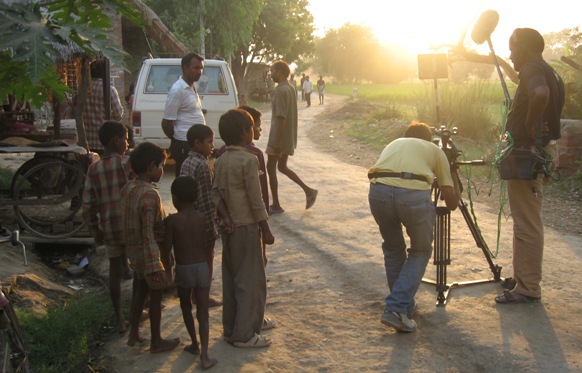
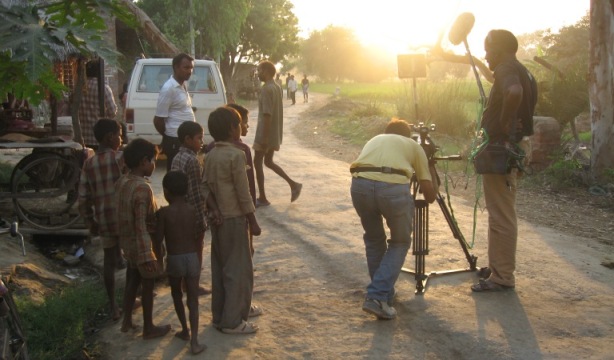
filming-living-labs-in-uttar-pradesh-india.jpg

As I told the researchers in my audience: “Part of our challenge is to know what you are studying — and then figure out the public interest and human interest angles of your work. As communicating research to those outside the scientific or research communities is more an art than a science.”

I cited three recent examples where we had produced engaging TV/video content to communicate research directly relevant or related to the poor.

Digits4Change
was our attempt to understand and document how information and communication technologies (ICTs) are changing the way Asians live, work and play. We covered technologies such as Internet, computers, mobile phones and satellite communications applied in education, healthcare and rural business development. The knowledge base for this 2006 series came from IDRC’s Pan Asia programme which supports action research that addresses specific problems.

Also in 2006, we produced The Greenbelt Reports to take a close look at the environmental lessons of the Indian Ocean tsunami. We visited a dozen locations in India, Indonesia, Sri Lanka and Thailand to find out how community and conservation interests can be balanced in relation to coral reefs, mangroves and sand dunes. In telling these stories, we worked with researchers from global agencies like IUCN the World Conservation Union and UNEP as well as national organisations like the M S Swaminathan Research Foundation in India.

The Greenbelt Reports

Living Labs is our most recent series, released in March 2007. Filmed in 9 countries in Africa, Asia, Europe and Latin America, it looked at how researchers are addressing different aspects of a major challenge in agriculture: how to grow more food with less water. We worked with a global action research project called the CGIAR Challenge Programme on Water and Food, which gave us exclusive access to their on-going field work and emerging findings in nine major river basins of the developing world.

living-labs-by-tveap.jpg

In telling these and other stories, we work within a certain framework we have defined for ourselves. Among its salient points:
• We don’t set out trying to communicate messages; we just want to tell good stories and development communication is a by-product.
• We look for under-reported/ignored development issues, or a less covered angle in a widely reported story.
• We don’t just talk to technical experts but to many other individuals involved or affected – women, men and children from all walks of life.
• We seek and accommodate different points of view, not allowing single-issue activists or one source to dominate/monopolise a story.
• Our finished products are informed by science but never immersed in science – we always keep in mind that our audience is non-specialsits.

All our stories cover real people dealing with real world issues and challenges. And since Asia has more people living in poverty than anywhere else in the world, most of the time our stories concern what’s happening at the bottom of the pyramid – or what can directly impact people living there.

And without exception, all these TV series and individuals films are available free of any license fees for broadcast, civil society and educational use. They are also available for online viewing at TVE Asia Pacific’s channel on YouTube.

Communicating research through moving images is not easy. Packing years of hard work into a few mins of engaging visuals and narration involves ruthless condensation which sometimes leaves some researcher egos bruised. When covering the work of large research organisations, we’ve also had deal with internal politics and hierarchies: for example, what to do when a junior researcher is more authentic and articulate than her supervisor?

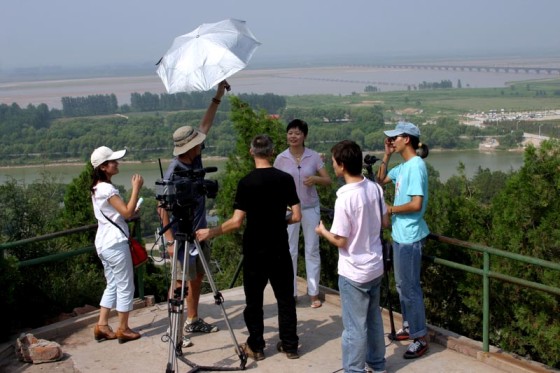
Producing Living Labs based on filming in 9 countries on 3 continents in just 5 months during 2006 was a challenge in both logistics and political negotiations. As editor-in-chief, I had to balance the public accessibility of our end product with researchers’ keenness to pack their stories with facts and figures.

living-labs-being-filmed-in-yellow-river-basin-china.jpg

We didn’t please everyone. One senior researcher told us that his multi-faceted, multi-year nad multi-million dollar was like an elephant — and we’d only glimpsed just one part of that big creature!

That’s just the point: we can never cover the whole elephant in a media product intended for non-specialists. So we choose which part of the elephant is most interesting and present it in a way that will make viewers realise — and hopefully, appreciate — that there’s a lot more that’s worth finding out.

Moving image products often act only as ‘teasers’ — communicating highlights of research, and directing those interested to online or offline sources that offer more information.

Because they act as a/v versions of executive summaries, these ‘teasers’ by themselves are a powerful way of reaching out those who are unlikely to look up the details: that includes many policy makers, government officials and business people.

Winston Churchill used to ask his staff to give him everything ‘on one page’. These days, he might have asked for everything to be summed up in a five minute video — as we often do.

Al Jazeera English is one: Getting better at imitating its rival BBC World!

al-jazeera.jpg

Al Jazeera English (AJE), the world’s newest global news and current affairs channel, completed one year on the air on 15 November 2007.

This in itself is a commendable accomplishment, and we extend heart-felt first birthday greetings to the channel that entered the highly competitive arena of global newscasting offering to ‘balance the information flow from South to North, providing accurate, impartial and objective news for a global audience from a grass roots level, giving voice to different perspectives from under-reported regions around the world.

AJE wanted to revolutionise English language TV in the same way Al Jazeera turned Arabic TV world upside down, ending the monopoly of the airwaves by state broadcasters.

First, the good news. AJE has done well on some fronts, adding to the diversity in international news and current affairs television, and enriching the often endangered media pluralism in a world that is, ironically, having more broadcast channels than ever before in history. It has brought to us stories ignored by other news outlets, while offering us somewhat different takes on widely covered stories.

In a self-congratulatory note and video clip posted this week on YouTube, the channel says: “A year ago Al Jazeera English was launched, marking the start of a new era in international journalism. In the last 12 months we have brought a fresh perspective to world events and shed light on many of the world’s little reported stories.”

Here are some of the highlights compiled by AJE.

In another post on its own website, AJE offers a selection of exclusive video stories from its correspondents to show how it ‘continues to set the news agenda’.

We also salute AJE for withstanding the unofficial yet widespread ‘block out’ of its distribution by North American cable operators, depriving most viewers in the US and Canada the opportunity of watching it on their TV screens. In a nifty move, the channel started placing some of its more consequential content on YouTube, making it available to anyone, anywhere with a sufficiently high speed Internet connection.

Image courtesy Al Jazeera

And now, on to the not-so-good news…

If AJE in its first year somewhat stood apart from the other two global newscasters – BBC World and CNN International – that was occasional and superficial, and not quite consistent or substantial. In fact, the only thing that AJE has consistently done is to under-deliver on its own lofty promise of doing things differently.

As I wrote in a blog post in August 2007: “I’m looking long and hard for the difference that they (AJE) so emphatically promised. Instead, I find them a paler version of BBC World, at times trying oh-so-hard to be just like the BBC!”

Of course, AJE – or any other broadcaster, for that matter – is fully entitled to set a trend or follow a model already set by another channel, even that of a rival. But to so blatantly imitate the BBC while all the time claiming to be different is simply not credible.

And credibility is the most important virtue for a news and current affairs media operation. Earn and sustain it and the world will be on their side. Lose it, and they will be the laughing stock on the air.

I’m not suggesting that has happened yet. But as I cautioned in an op ed written days after AJE started broadcasting in November 2006, “unless it’s very careful and thoughtful, AJE runs the risk of falling into the same cultural and commercial traps that its two rivals are completely mired in.”

Here’s a simple test. If viewers were to watch AJE, BBC World and CNN International without logos and any other tell-tale branding, how many would be able to tell the channels apart?

To me, CNN is in a league of its own for a variety of positive and negative reasons. Their offering is technically and professionally superior, even if I have objections to some of their editorial choices and analysis.

However, it’s harder to discern differences between the often befuddled BBC World and its enthusiastic imitator, Al Jazeera English. Perhaps it’s no coincidence that the latter has a significant number of former BBC reporters and presenters, many of who have been poached. While that again is a choice for AJE’s management, they must realise that we the viewers in the global South do not want a global channel rooted in our part of the world to dress up in the BBC’s increasingly discredited clothes.

And then there is the whole question of ethical sourcing of content — an important consideration which most global, regional and national TV channels continue to ignore. Many roaming news journalists’ key operating guideline seems to be: get the story ahead of rivals, no matter what — or who gets hurt in that process.

That business as usual must end. As I have argued in this blog and elsewhere: “If products of child labour and blood diamonds are no longer internationally acceptable, neither should the world tolerate moving images whose origins are ethically suspect.”

Aug 2007 blog post: Wanted: Ethical sourcing of international TV news

Nov 2005 op ed on SciDev.Net: Communication rights and communication wrongs, by Nalaka Gunawardene

In August 2007, I critiqued some Sri Lanka related stories appearing on AJE’s People & Power strand, pointing out some ethically questionable practices in how their reporter got the story, possibly placing some of her sources and interviewees at personal risk. To her credit, the reporter Juliana Ruhfus engaged me in this blog, explaining her side. Read the full exchange here.

But there are other key areas where AJE needs to very carefully guard its image and credibility. In the past year, the world’s assorted development and humanitarian agencies have realised that it’s ‘cool’ to be seen on Al Jazeera than on BBC and CNN. Some of their propagandists (sorry, public information officers) had beaten a path to AJE offices in London, Doha and Kuala Lumpur, seeking to cut various deals to get coverage.

Yes, the development and humanitarian communities certainly have worthwhile messages and issues to communicate, many of which need urgent, wide dissemination. Tragically, what most agencies seek is self-promotion and ego-massaging, not issue based discussion. It is precisely this alarming trend of paying media outlets to carry agency propaganda that I have labelled ‘cheque-book development’.

Aug 2007: ‘Cheque-book Development’ – paying public media to deliver development agency logos

It’s no secret that BBC World has shamelessly allowed its airwaves to be sold for cash by assorted ‘touts’ claiming to have privileged access to the once-respected broadcaster. In the past year, some of these touts have extended their tentacles to AJE. We don’t yet know if these are entirely pro bono acts of goodwill by AJE, or if money has exchanged hands somewhere along the line.

If the latter has happened, we ardently hope that someone within AJE would blow the whistle in their own collective self interest. Or perhaps AJE wants to be too much like BBC World in every respect — including the corruption part?

Meanwhile, the real challenge to Al Jazeera remains exactly what I said one year ago: to usher in real change, it needs to transform not just how television news is presented and analysed, but also how it is gathered.

Despite having a code of ethics for its conduct, the well-meaning, south-cheering channel has yet to rise to that part of the challenge. Let’s hope that in its second year, Al Jazeera English would spend less time imitating its rivals, and more time in living up to its own promise.

Personal note: Some readers have asked why I continue to hold AJE to higher standards in a world where media ethics are being observed in the breach all the time. It’s simply because I still see AJE as the best hope for the majority world to tell its own stories in its own myriad voices and accents. I desperately want AJE to succeed on all fronts, not just in audience ratings, signal coverage and market penetration. For that, it must fast find its identity and stop defining itself by its rivals.

Beyond coffee and bananas: We need fair trade in international media!

Fair trade is gaining momentum worldwide. More products are coming within the scope of fair trade in more countries.

That’s certainly good news in a world full of exploitation, inequality and unfairness at various levels.

But are we, in the mass media whose business it is to gather and deliver news and information, yet part of this good news ourselves? In other words, isn’t it high time there was fair trade in international media products too?

This is the simple question I raised this week at the V Greenaccord International Media Forum on the Protection of Nature, held from 7 to 11 Novmeber 2007 at the historic Villa Mondragone in Frascati, some 20km southeast of Rome.

During the 3.5 day international gathering of journalists and scientists concerned about the environment, we had several speakers referring to fair trade in Europe and at a global level. As more consumers become aware of environmental and social justice considerations, they are doing something about it in their buying of goods that are fairly traded, we heard.

The Wikipedia describes fair trade as ‘an organised social movement and market-based model of international trade which promotes the payment of a fair price as well as social and environmental standards in areas related to the production of a wide variety of goods.’

The movement focuses in particular on exports from developing countries to developed countries, most notably handicrafts, coffee, cocoa, tea, bananas, honey, cotton, wine and fresh fruit.

Fair trade is all about creating opportunities for small scale producers in the developing countries to get organised and supply directly to consumers in different parts of the world. When they sell direct, with few or no intermediaries, they can earn three or four times more, and that money will enhance their incomes, living standards and societies.

Read more about fair trade at Oxfam website, Make Trade Fair

Fair trade is certainly a cherished ideal, but it’s mired in complex economic and political realities. The globalised march of capital, profit-maximising corporations and developed country farm subsidies are among many factors that make fair trade difficult to achieve.

Fair trade activists are well aware of these realities. Their success is built on connecting producers with individual consumers. The proliferation of new media – especially the Internet – has made it easier to sustain such communications.

But the fair trade movement is still largely rooted in goods, not services. In my view, this is necessary but not sufficient in a modern world economy where nearly two thirds of global GDP comes from the services sector. (The Wikipedia’s breakdown for global GDP is agriculture 4%; industry 32%; services 64%).

I can’t immediately find how much the print, broadcast and online media contribute to that 64%, but it must be significant in the media saturated world today. And certainly the flow of media products — text, audio, photographs, moving images, online content and derivatives of these — has become more globalised in the past two decades.

So why not begin to agitate for fair trade in media products when they cross borders? Why aren’t we practising fair trade in our own media industry even as we cover fair trade as a story in our editorial content?

I didn’t get a very clear answer from fair trade activists that I posed this question to this week. While agreeing with me that the same fair trade principles can be applied to the media sector, they acknowledged that each sector has its own dynamics and must develop realistic ways to accomplish fair trade.

So it’s up to us who produce, distribute and manage assorted media products to begin this transformation from within.

Let’s not kid ourselves about what we are taking on. As I wrote in a blog post in September 2007:

“In the media-rich, information societies that we are now evolving into, media and cultural products are an important part of our consumption — and therefore, more of these have to be produced. In the globalised world, more television and film content is being sourced from the majority world — or is being outsourced to some developing countries where the artistic and technical skills have reached global standards.

“But in a majority of these media production deals, the developing country film and TV professionals don’t enjoy any fair terms of trade or engagement. Their creativity and toil are being exploited by those who control the global flow of entertainment, news and information products.

“This is why the top talent in the global South become assistants, helpers and ‘fixers’ to producers or directors parachuting in to our countries to cover our own stories for the Global Village. Equitable payments and due credits are hardly ever given.”

In the same commentary, I added:
“Unfair trade in film and TV is also how the unsung, unknown creative geniuses contribute significantly to the development of new cartoon animation movies or TV series, as well as hip video games that enthrall the global market. Lacking the clout and skill to negotiate better terms, freelancers and small companies across the global South remain the little elves who toil through the night to produce miracles. They work for tiny margins and even tinier credit lines. Some don’t get acknowledged at all.”

Read my blog post: Wanted: Fair trade in film and television!

tveap-camera-crew-in-lucknow-india.jpg

Raising this amidst 60 journalists and producers from Africa, Asia, Europe, Latin America and the Caribbean attending the annual Greenaccord meeting, I pointed out that many of us were keen to contribute to media outlets beyond the countries where we are based. It gives us a chance to tell our stories to a bigger audience, and to have our voices heard about a range of issues and topics important to our communities.

And yes, the additional income that such work brings in is quite useful too, thank you.

Heads were nodding when I pointed out how hard it is for a talented, hard working journalist based in the majority world to break into the tightly controlled international media outlets. Even when they make an occasional breakthrough, they are often exploited by being paid lower professional fees for the same output and quality of work.

Or worse, majority world journalists are slighted and insulted for being where they are and who they are, rather than be judged on the merit of their work. As I wrote in a commentary published by SciDev.Net in November 2005: “Media gatekeepers in the North often dismiss the better-informed and equally competent Southern professionals — saying, insultingly, that ‘they don’t have the eye’! And for years, I have resisted the widespread practice of Northern broadcasters and filmmakers using the South’s top talent merely as ‘fixers’ and assistants.”

greenaccord-v-forum-in-progress-nov-2007.jpg

All this makes it imperative for us in the globalised media — in the developed North and developing South — to begin agitating for fair trade in media products and services. As in other products, we are not looking for charity or tokenism or a lowering of standards. We must strive for fairness and equality while working on building the capacity of southern journalists to generate world class media products.

And as my friend Darryl D’Monte — whom we missed dearly at this year’s Greenaccord forum — has been saying for years, publishing each other’s stories is one great step forward.

Mahatma Gandhi put it this way: we must be the change we wish to achieve.

Note: My own organisation, TVE Asia Pacific, practises what I preach here, and always engages local camera crews when we film TV stories across Asia. We will be taking up Fair Trade in Film and Television (FTinFT) as a campaign from 2008.

Read other related blog posts:

Images from the Majority World: Global South telling its own stories

Wanted: Fair trade in film and television!

Image of camera crews courtesy Pamudi Withanaarachchi of TVEAP.

Meeting photos courtesy Adrian Gilardoni’s Flickr account